What are the funding trends in clinical decision support?
Whether you're building or investing in the clinical decision support market, our report covers everything you need to know: the players, the money, and what's coming next.
Summary
Clinical decision support funding is holding steady in 2026, but fewer startups are raising money. The market has attracted $961.9 million across 28 rounds through September 24, up just 1.2% from the comparable 2025 period, while transaction volume has fallen 26.3%. The headline funding total looks healthy. The broader fundraising market doesn't.
The divergence becomes sharper when large transactions are excluded. Funding from rounds of $50 million or less fell 22.9%, from $333.3 million to $256.9 million. Yet the median financing increased from $7.89 million to $10 million, suggesting capital is concentrating in fewer, generally larger transactions.
Three rounds account for 67.6% of all 2026 funding. OpenEvidence raised $250 million twice, while Aidoc secured $150 million. Together, these transactions contributed $650 million, leaving just $311.9 million for the other 25 deals.
Diagnostic Decision Support has suffered the sharpest decline among the major categories. Deal volume dropped from 23 to 12 and funding fell from $475.1 million to $271.8 million. Diagnostics nevertheless remains the largest category by transaction count, accounting for 42.9% of all rounds.
Evidence and Guideline Support has overtaken diagnostics in dollars raised, reaching $522 million. But $500 million came from OpenEvidence alone. The apparent rotation toward clinical evidence platforms is primarily the financing story of one company, rather than a broad wave of new businesses securing capital.
Risk Prediction and Alerts is moving differently. Its deal count doubled from three to six, even as funding declined from $74.1 million to $61.4 million. Precision Medicine shows the reverse pattern, attracting more capital across fewer transactions.
Early-stage funding has proved more resilient in volume than in dollars. Seed and Series A rounds increased from 13 to 16, but combined funding fell from $188.3 million to $120.3 million. Meanwhile, no identified Series B rounds were recorded in 2026, compared with six in 2025 and eight in 2024.
The other end of the funding market looks very different. Series C and later-stage rounds, together with Growth Equity, absorbed $789.6 million, approximately 82% of the year's capital. Investors are still willing to finance major healthcare AI expansions, even as the intermediate funding pipeline appears unusually thin.
North America captured 84.1% of global clinical decision support funding, up from 62.5% in 2025. Europe experienced a much broader slowdown, with transactions falling from 22 to 12. The geographical shift reflects both enormous US financings and a genuine decline in European deal activity.
The market is attracting fewer disclosed lead investors and corporate participants, broadly in line with the reduction in transactions. Full-year 2026 funding could still approach or surpass 2025's $1.29 billion, but that would not automatically mean a stronger startup ecosystem. The real test is whether financing recovers beyond the handful of established clinical AI platforms.

Written by the New Market Pitch teamWe track new markets so founders and investors can move faster. About us

In our report covering the clinical decision support market, you will always find fresh funding data, taken straight from our own verified funding database.
All funding deals in the clinical decision support market over the last years
Below is the table listing all the deals. You can find our methodology at the end of this page.
If you want a deeper understanding of the market and its current dynamics, get our report covering the clinical decision support market.
| Company | Category | Date | Stage | Deal size | What they do | Region | Lead investors | Country | Rank |
|---|---|---|---|---|---|---|---|---|---|
| OpenEvidence | Evidence & Guideline Support | September 2026 | Growth Equity | $250M | Operates an AI clinical evidence platform that answers physicians' patient-specific questions using medical literature and treatment guidelines. | North America | Andreessen Horowitz; Byers Capital | United States | |
| PGxAI | Medication Decision Support | September 2026 | Seed | $3M | Develops AI pharmacogenomic decision-support software that recommends individualized medications and dosages using genetic, clinical and interaction data. | North America | Not disclosed | United States | |
| Implicity | Risk Prediction & Alerts | September 2026 | Growth Equity | $40M | Provides AI-powered cardiac remote-monitoring software that analyzes implanted-device data, prioritizes clinical alerts and identifies patients requiring intervention. | Europe | IRIS | France | |
| Elucid | Diagnostic Decision Support | September 2026 | Series D+ | $55M | Provides AI-powered coronary CT analysis that characterizes arterial plaque to inform cardiovascular diagnosis and individualized treatment decisions. | North America | Not disclosed | United States | |
| Eyedentity | Diagnostic Decision Support | August 2026 | Seed | $1.6M | Develops AI software that analyzes retinal photographs to identify suspected eye cancer and support clinical referral decisions. | Europe | Norrsken Launcher | Sweden | |
| RevealDx | Diagnostic Decision Support | August 2026 | Series A | $3.4M | Develops AI software that assesses the malignancy risk of lung nodules on CT scans to support radiologists' diagnostic and follow-up decisions. | North America | 4DMedical | United States | |
| Neuronostics | Diagnostic Decision Support | June 2026 | Unknown | ≈$4M | Develops BioEP, digital EEG-biomarker software that helps clinicians diagnose epilepsy when conventional EEG findings are inconclusive. | Europe | Empirical Ventures; The FSE Group | United Kingdom | |
| NEX Health Intelligence | Risk Prediction & Alerts | May 2026 | Seed | ≈$1.2M | Develops AI software that predicts hospital-acquired infection risks and identifies emerging transmission patterns to guide clinical infection-prevention decisions. | Europe | Brighteye Ventures | United Kingdom | |
| Aidoc | Diagnostic Decision Support | April 2026 | Series D+ | $150M | Develops clinical AI software that detects abnormalities in medical images, prioritizes findings, and alerts care teams to support diagnosis and timely intervention. | North America | Growth Equity at Goldman Sachs Alternatives | United States | |
| Almanac Health | Evidence & Guideline Support | April 2026 | Seed | $10M | Provides an evidence-grounded clinical AI assistant that synthesizes medical research and guidelines to support clinicians' decisions at the point of care. | North America | F-Prime | United States | |
| Future Fertility Inc. | Diagnostic Decision Support | April 2026 | Series A | $4.1M | Provides AI software that evaluates human egg quality to support individualized IVF counseling and treatment planning. | North America | M Ventures; Whitecap Venture Partners | Canada | |
| Predictheon Medical, S.L. | Risk Prediction & Alerts | April 2026 | Seed | ≈$2.1M | Develops predictive software that analyzes patient data to warn anesthesiologists of impending complications during surgical procedures. | Europe | Grow Venture Partners | Spain | |
| Acurion | Precision Medicine Decision Support | April 2026 | Seed | $4.3M | Develops OncoGaze, AI software that predicts actionable cancer biomarkers from pathology images to inform personalized oncology treatment decisions. | North America | TK & Partners | United States | |
| Ambient Clinical Analytics | Risk Prediction & Alerts | March 2026 | Unknown | $5M | Provides real-time clinical analytics and decision-support software that helps hospital teams identify deterioration and manage acute-care risks. | North America | Not disclosed | United States | |
| Avo | Care Pathway Support | March 2026 | Series A | $10M | Provides an EHR-integrated clinical AI platform that combines patient information and medical guidelines to recommend diagnoses and care plans. | North America | Noro-Moseley Partners | United States | |
| Mediwhale | Risk Prediction & Alerts | March 2026 | Series C | $13.1M | Develops retinal-image AI software that predicts patients’ cardiovascular and cardiometabolic disease risks to support clinical decisions. | Asia-Pacific | Premier Partners | South Korea | |
| Lucida Medical | Diagnostic Decision Support | March 2026 | Growth Equity | $11.6M | Develops AI software that analyzes prostate MRI scans to help clinicians detect cancer and make diagnostic decisions. | Europe | IW Capital | United Kingdom | |
| Waiv | Precision Medicine Decision Support | March 2026 | Series A | $33M | Develops AI-powered oncology precision tests that analyze pathology and multimodal clinical data to guide biomarker-based treatment selection. | Europe | OTB Ventures; Alpha Intelligence Capital | France | |
| Spotlight Pathology | Diagnostic Decision Support | March 2026 | Seed | $1.9M | Develops AI pathology software that assists specialists in diagnosing blood cancers from digital tissue images. | Europe | UK Innovation and Science Seed Fund; Liverpool City Region Seed Fund | United Kingdom | |
| Brainomix | Diagnostic Decision Support | February 2026 | Series C | $6.5M | Develops AI imaging software that interprets brain and lung scans to support clinical diagnosis and treatment decisions. | Europe | Parkwalk Advisors; Hostplus | United Kingdom | |
| PH Predicting Health GmbH | Risk Prediction & Alerts | February 2026 | Seed | Not Disclosed | Develops AI software that analyzes hospital records to predict individual patients’ risks of delirium, falls and malnutrition. | Europe | Not disclosed | Austria | |
| Prenosis | Diagnostic Decision Support | January 2026 | Series A | $20M | Develops AI-based clinical diagnostic software that analyzes patient biological and clinical data to support sepsis and critical-care decisions. | North America | PACE Healthcare Capital | United States | |
| OpenEvidence | Evidence & Guideline Support | January 2026 | Series D+ | $250M | Provides an AI medical evidence-search platform that synthesizes clinical research to support physicians’ diagnostic and treatment decisions. | North America | Thrive Capital; DST Global | United States | |
| Eolas Medical | Evidence & Guideline Support | January 2026 | Series A | $12M | Provides an AI-powered clinical knowledge platform that gives healthcare professionals access to institutional guidelines and evidence at the point of care. | Europe | Acton Capital | United Kingdom | |
| neuropacs Corp. | Diagnostic Decision Support | January 2026 | Seed | >$1M | Develops AI-assisted neurological diagnostic software that analyzes MRI data to differentiate Parkinson’s disease and related conditions. | North America | Not disclosed | United States | |
| Omniscient Neurotechnology | Treatment Recommendation | January 2026 | Series D+ | $13.4M | Develops AI brain-mapping software that supports personalized neurosurgical planning and neurological treatment decisions. | Asia-Pacific | National Reconstruction Fund Corporation; OIF Ventures | Australia | |
| VieCure | Precision Medicine Decision Support | January 2026 | Unknown | $43M | Provides an oncology clinical decision-support platform that combines patient data and medical evidence to guide personalized cancer treatment. | North America | Mitch Rales; Northpond Ventures | United States | |
| BrightHeart | Diagnostic Decision Support | January 2026 | Series A | $12.8M | Develops AI software that supports prenatal ultrasound interpretation and detection of congenital abnormalities. | Europe | Odyssée Venture; GO Capital | France | |
| Pragmatech AI Solutions | Medication Decision Support | December 2025 | Unknown | ≈$560K | Develops iAST, clinical decision-support software providing patient-specific antibiotic prescribing recommendations. | Europe | First Drop | Spain | |
| a2z Radiology AI | Diagnostic Decision Support | December 2025 | Seed | $4.5M | Develops AI software that identifies urgent findings in abdominal and pelvic CT scans and assists radiologists with interpretation. | North America | Khosla Ventures; SeaX Ventures | United States | |
| Revela | Diagnostic Decision Support | December 2025 | Seed | ≈$550K | Develops AI software that analyzes ultrasound images to identify signs of endometriosis for clinician review. | Europe | Not disclosed | United Kingdom | |
| MultivisionDx | Precision Medicine Decision Support | December 2025 | Seed | ≈$1.2M | Uses AI and spatial pathology analysis to identify cancer characteristics and support personalized treatment selection. | Europe | Antler | Finland | |
| AITRICS | Risk Prediction & Alerts | December 2025 | Series C | ≈$23.9M | Develops hospital AI software that predicts patient deterioration and provides clinical risk alerts. | Asia-Pacific | Premier Partners; Hanriver Partners; Mirae Asset Venture Investment; ShinYoung Securities–BSK Investment | South Korea | |
| Healthplus.ai | Risk Prediction & Alerts | November 2025 | Seed | ≈$2.7M | Predicts individual patients' postoperative infection risks and recommends preventive measures to surgical teams. | Europe | Elevating Capital; LUMO Labs | Netherlands | |
| Innocens | Risk Prediction & Alerts | November 2025 | Seed | ≈$1.7M | Analyzes neonatal intensive-care monitoring data to warn clinicians of early signs of sepsis in premature infants. | Europe | Not disclosed | Belgium | |
| Voio, Inc. | Diagnostic Decision Support | November 2025 | Seed | $8.6M | Develops AI models that interpret radiology images, identify clinical findings and assist radiologists in drafting diagnostic reports. | North America | Laude Ventures | United States | |
| AI-Stroke | Diagnostic Decision Support | November 2025 | Seed | $4.6M | Uses smartphone video analysis to identify suspected strokes and support urgent clinical triage before CT imaging. | Europe | Heka | France | |
| Clairity, Inc. | Risk Prediction & Alerts | November 2025 | Series B | $43M | Uses AI to estimate a patient's five-year breast-cancer risk from screening mammograms to guide personalized prevention. | North America | ACE Global Equity; Santé Ventures | United States | |
| Traick AI | Diagnostic Decision Support | November 2025 | Seed | $1.5M | Develops AI ultrasound analysis that assigns malignancy-risk scores to thyroid and breast nodules for clinician diagnosis. | Europe | Not disclosed | United Kingdom | |
| Lumonus | Treatment Recommendation | November 2025 | Series B | ≈$16.2M | Provides AI software that supports individualized radiation-oncology prescriptions, dosimetry and cancer treatment planning. | Asia-Pacific | Aviron Investment Management | Australia | |
| HoloMD | Treatment Recommendation | November 2025 | Seed | $1.6M | Provides AI-assisted psychiatric monitoring that alerts clinicians to patient deterioration and supports individualized treatment adjustments. | North America | Not disclosed | United States | |
| Mecha Health | Diagnostic Decision Support | November 2025 | Seed | $4.1M | Builds radiology foundation models that interpret medical images and generate structured findings for clinicians. | North America | Valia Ventures | United States | |
| Primaa | Diagnostic Decision Support | October 2025 | Series A | $2.8M | Develops AI pathology software that detects and quantifies cancer biomarkers to support diagnostic interpretation. | Europe | Not disclosed | France | |
| Virtest Technologies | Treatment Recommendation | October 2025 | Seed | ≈$930K | Develops patient-specific cardiac digital-twin software to support surgical planning, device selection and complication assessment. | Europe | Grow Venture Partners | Spain | |
| OpenEvidence | Evidence & Guideline Support | October 2025 | Series C | $200M | Provides physicians with AI-powered medical evidence search and research synthesis to support patient-specific clinical decisions. | North America | GV | United States | |
| Kneu Health | Risk Prediction & Alerts | October 2025 | Seed | $5.6M | Analyzes smartphone-based motor, speech and cognitive measurements to detect neurological deterioration and inform personalized care. | Europe | Oxford Science Enterprises; Cedars-Sinai | United Kingdom | |
| Aisthesis Medical | Risk Prediction & Alerts | October 2025 | Seed | ≈$1.2M | Develops explainable AI software that predicts hospital patients' sepsis risk and provides clinicians with early-warning insights. | Europe | Twin Path Ventures | United Kingdom | |
| StratifAI | Precision Medicine Decision Support | September 2025 | Unknown | $14.7M | Develops multimodal AI biomarkers from pathology and molecular data to estimate cancer prognosis and inform individualized treatment selection. | Europe | Picus Capital; Alven | Germany | |
| Aiosyn | Diagnostic Decision Support | September 2025 | Unknown | $2.8M | Develops AI pathology software that evaluates tissue images and biomarkers to assist pathologists with cancer diagnosis. | Europe | Not disclosed | Netherlands | |
| Joint Ai | Diagnostic Decision Support | September 2025 | Unknown | $315K | Develops an AI clinical decision aid combining X-rays and patient-reported outcomes to assess hip and knee arthritis and guide orthopedic triage. | North America | Richard King Mellon Foundation | United States | |
| Seluna | Diagnostic Decision Support | August 2025 | Seed | $850K | Develops AI software that interprets pediatric sleep studies to help clinicians diagnose sleep apnea and prioritize treatment. | Europe | Gabriel Investment Syndicate | United Kingdom | |
| Better Medicine | Diagnostic Decision Support | August 2025 | Seed | $1.2M | Develops AI radiology software that detects and characterizes suspicious kidney lesions on CT scans to support cancer diagnosis. | Europe | Soulmates Ventures | Estonia | |
| Ultromics | Diagnostic Decision Support | July 2025 | Series C | $55M | Develops AI software that analyzes echocardiograms to help clinicians identify heart failure and cardiac amyloidosis. | Europe | L&G; Allegis Capital; Lightrock | United Kingdom | |
| C8 Health | Evidence & Guideline Support | July 2025 | Series A | $12M | Delivers AI-powered, context-aware access to clinical protocols and evidence-based guidance within hospital workflows. | North America | Team8 | United States | |
| BloodFlow | Diagnostic Decision Support | July 2025 | Seed | $1.4M | Provides AI software integrated with clinical systems to interpret blood-test results and deliver actionable diagnostic insights to physicians. | Europe | 3xP Global | Portugal | |
| Aidoc | Diagnostic Decision Support | July 2025 | Series D+ | $110M | Develops clinical AI software that analyzes medical imaging, detects urgent findings, and alerts clinicians to support diagnosis and treatment decisions. | North America | General Catalyst; Square Peg | United States | |
| OpenEvidence | Evidence & Guideline Support | July 2025 | Series B | $210M | Provides an AI-powered medical evidence assistant that answers clinicians' questions and synthesizes research to support patient-care decisions. | North America | GV; Kleiner Perkins | United States | |
| EnsoData | Diagnostic Decision Support | June 2025 | Series B | $20M | Develops EnsoSleep, AI software that analyzes sleep studies to support clinical diagnosis of sleep disorders. | North America | Questa Capital | United States | |
| Arine | Medication Decision Support | June 2025 | Series C | $30M | Develops AI-driven medication intelligence software that identifies and recommends patient-specific medication interventions. | North America | Town Hall Ventures | United States | |
| PointCaré | Treatment Recommendation | June 2025 | Seed | $1.7M | Develops OnTarget, AI software that interprets operating-room and intensive-care data to recommend patient-specific clinical interventions. | Europe | Not disclosed | Belgium | |
| PreciseDx | Precision Medicine Decision Support | June 2025 | Series B | $11M | Develops AI pathology software that predicts individual breast-cancer recurrence risk to inform treatment planning. | North America | Eventide Asset Management; Merck Global Health Innovation Fund; Philips Ventures | United States | |
| Brainreader A/S | Diagnostic Decision Support | May 2025 | Unknown | $7.3M | Develops Neuroreader, AI software that analyzes brain MRI scans to quantify structural changes supporting neurological diagnosis. | Europe | Dahlgren Capital | Denmark | |
| SeqOne Genomics | Precision Medicine Decision Support | May 2025 | Growth Equity | $22.7M | Develops AI-powered genomic analysis and variant-interpretation software supporting oncology and rare-disease clinical decisions. | Europe | Supernova Invest | France | |
| Mentaily | Diagnostic Decision Support | May 2025 | Seed | $3M | Develops conversational AI that conducts psychiatric assessments and produces diagnostic insights for mental-health clinicians. | Middle East | Not disclosed | Israel | |
| Medmain Inc. | Diagnostic Decision Support | May 2025 | Unknown | $3.3M | Develops PidPort, an AI-powered digital pathology platform supporting cancer diagnosis from patient tissue images. | Asia-Pacific | One Capital | Japan | |
| Spotlight Pathology | Diagnostic Decision Support | April 2025 | Unknown | $567K | Develops AI tools to help pathologists identify blood cancers from lymph-node and bone-marrow biopsy images. | Europe | EHE Ventures | United Kingdom | |
| Skin Analytics | Diagnostic Decision Support | April 2025 | Series B | $19.9M | Develops DERM, autonomous AI software that evaluates skin lesions and identifies potential skin cancers. | Europe | Intrepid Growth Partners | United Kingdom | |
| CGC Genomics | Precision Medicine Decision Support | April 2025 | Seed | $1.9M | Develops Qnomx, generative AI software that interprets cancer genomic profiles to inform oncology diagnosis and treatment decisions. | Europe | Not disclosed | Switzerland | |
| Okeiro | Risk Prediction & Alerts | April 2025 | Series A | $11.1M | Develops AI-powered prognostic software that predicts transplant complications and supports patient-specific clinical management. | Europe | Alven; Forepont Capital Partners; Red River West | France | |
| Diagnoly | Diagnostic Decision Support | April 2025 | Seed | $6.1M | Develops Fetoly, AI software that analyzes fetal ultrasound examinations to help clinicians detect prenatal abnormalities. | Europe | Mutuelles Impact; Newfund | France | |
| GenomeUp | Precision Medicine Decision Support | April 2025 | Unknown | $4.9M | Develops AI software for genetic variant interpretation and patient-specific diagnostic decision support in rare diseases. | Europe | The Techshop | Italy | |
| Navina | Risk Prediction & Alerts | March 2025 | Series C | $55M | Develops an AI clinical copilot that synthesizes patient records to surface clinical risks, care gaps and actionable insights for physicians. | North America | Growth Equity at Goldman Sachs Alternatives | United States | |
| Brainomix | Diagnostic Decision Support | March 2025 | Series C | $18M | Develops AI imaging software that supports patient-specific stroke treatment decisions and assessment of lung fibrosis. | Europe | Parkwalk Advisors; Boehringer Ingelheim Venture Fund | United Kingdom | |
| Deontics Limited | Treatment Recommendation | March 2025 | Unknown | $1.6M | Develops clinical decision-support software that converts medical guidelines into personalized treatment recommendations using patient data. | Europe | Not disclosed | United Kingdom | |
| EvidenceCare | Evidence & Guideline Support | March 2025 | Series B | $10M | Provides EHR-integrated clinical decision-support software that delivers patient-specific evidence and care recommendations to physicians. | North America | Orlando Health Ventures; Rockmont Partners | United States | |
| Ataraxis AI | Precision Medicine Decision Support | March 2025 | Series A | $20.4M | Develops AI cancer-prognosis software that predicts patient outcomes and helps oncologists select appropriate treatments. | North America | AIX Ventures | United States | |
| OpenEvidence | Evidence & Guideline Support | February 2025 | Series A | $75M | Provides an AI medical-evidence assistant that helps physicians apply scientific literature to point-of-care clinical decisions. | North America | Sequoia Capital | United States | |
| Cercare Medical | Diagnostic Decision Support | February 2025 | Unknown | $7.8M | Develops CT and MRI perfusion-analysis software that helps clinicians assess stroke, brain tumors and other neurological conditions. | Europe | West Hill Capital | Denmark | |
| hema.to GmbH | Diagnostic Decision Support | February 2025 | Unknown | $3.8M | Develops AI-powered flow-cytometry analysis software to support blood-cancer diagnosis and clinical treatment decisions. | Europe | LUMO Labs | Germany | |
| Harrison.ai | Diagnostic Decision Support | February 2025 | Series C | $112M | Develops AI diagnostic-support software that analyzes radiology and pathology images to help clinicians identify disease. | Asia-Pacific | Aware Super; ECP; Horizons Ventures | Australia | |
| Floy | Diagnostic Decision Support | February 2025 | Seed | $3.7M | Develops AI software that helps radiologists identify subtle abnormalities in medical images. | Europe | Acurio Ventures; HV Capital | Germany | |
| C the Signs | Risk Prediction & Alerts | January 2025 | Unknown | $8M | Develops AI software that analyzes patient risk factors and medical records to flag suspected cancers and recommend diagnostic investigations. | Europe | Khosla Ventures | United Kingdom | |
| Quibim | Diagnostic Decision Support | January 2025 | Series A | $50M | Develops AI imaging biomarkers that help clinicians detect disease, characterize lesions and assess patient-specific outcomes. | Europe | Asabys Partners; Buenavista Equity Partners | Spain | |
| Videa | Diagnostic Decision Support | January 2025 | Series B | $40M | Provides dental AI software that analyzes radiographs to identify clinical findings and support dentists' diagnostic decisions. | North America | Threshold Ventures | United States | |
| Sycai Medical | Diagnostic Decision Support | January 2025 | Unknown | $3.1M | Develops AI software that identifies and characterizes abdominal cancer lesions in medical images to support earlier diagnosis. | Europe | LUMO Labs; Ship2B Ventures | Spain | |
| BrainSightAI | Diagnostic Decision Support | January 2025 | Unknown | $5M | Develops AI-based brain-connectivity mapping software that helps clinicians diagnose neurological disorders and plan interventions. | Asia-Pacific | IAN Alpha Fund | India | |
| Nucs AI | Precision Medicine Decision Support | December 2024 | Seed | $3.5M | Develops AI tools for prostate cancer imaging analysis and personalized treatment assessment. | North America | Not disclosed | United States | |
| dEEGtal Insights SA | Diagnostic Decision Support | December 2024 | Seed | $1.1M | Develops AI software that analyzes EEG recordings to assist neurologists in diagnosing epilepsy. | Europe | Not disclosed | Switzerland | |
| Saventic Health | Diagnostic Decision Support | December 2024 | Unknown | $2.1M | Uses AI to identify patients potentially affected by rare diseases and recommend further diagnostic investigation. | Europe | Not disclosed | Poland | |
| Cleerly | Diagnostic Decision Support | December 2024 | Series C | $106M | Provides AI analysis of coronary CT angiography to characterize plaque and support coronary artery disease diagnosis. | North America | Insight Partners | United States | |
| Raidium | Diagnostic Decision Support | November 2024 | Seed | $16.9M | Develops AI-native medical imaging software for clinical image interpretation, segmentation and quantitative diagnosis. | Europe | Newfund; Kurma Partners | France | |
| FertilAI | Treatment Recommendation | November 2024 | Seed | $4.5M | Provides AI-assisted fertility treatment planning and personalized IVF clinical recommendations. | Middle East | Longevity Venture Partners; Redseed | Israel | |
| Augere Medical AS | Diagnostic Decision Support | November 2024 | Unknown | $2.1M | Develops real-time AI assistance for identifying and characterizing colorectal polyps during colonoscopy. | Europe | Not disclosed | Norway | |
| Primaa | Diagnostic Decision Support | November 2024 | Unknown | $5.3M | Develops AI pathology software that detects cancer biomarkers and assists pathologists with diagnostic interpretation. | Europe | Not disclosed | France | |
| mediaire | Diagnostic Decision Support | November 2024 | Series A | $12.7M | Provides AI-based MRI analysis software that quantifies neurological abnormalities for radiologists. | Europe | LBO France | Germany | |
| Soombit.ai | Diagnostic Decision Support | November 2024 | Seed | $3.6M | Develops AI software to help clinicians interpret chest X-rays and identify potential abnormalities. | Asia-Pacific | Altos Ventures | South Korea | |
| Ataraxis AI | Precision Medicine Decision Support | October 2024 | Seed | $4M | Develops AI pathology tests that predict cancer recurrence and support personalized oncology treatment decisions. | North America | Giant Ventures; Obvious Ventures | United States | |
| Vara | Diagnostic Decision Support | October 2024 | Series B | $8.9M | Provides AI-assisted mammography interpretation to help clinicians detect breast cancer. | Europe | Smart Family Office; FJH; IBB Ventures | Germany | |
| Ikerian (formerly RetinAI) | Diagnostic Decision Support | October 2024 | Series B | $8M | Develops AI software for interpreting retinal images and extracting diagnostic biomarkers for ophthalmic care. | Europe | Sanoptis | Switzerland | |
| LEVY Health | Diagnostic Decision Support | October 2024 | Seed | $4.5M | Develops clinical decision-support software to identify reproductive and hormonal disorders and guide fertility-related diagnostic testing. | North America | XYZ Venture Capital | United States | |
| Mindpeak | Diagnostic Decision Support | September 2024 | Series A | $15.3M | Develops AI digital-pathology software that analyzes tissue images to assist cancer diagnosis and biomarker assessment. | Europe | ZEISS Ventures; InnoVentureFund | Germany | |
| VieCure | Precision Medicine Decision Support | September 2024 | Unknown | $45M | Provides AI-powered precision-oncology decision support that helps clinicians select and manage personalized cancer treatments. | North America | Northpond Ventures | United States | |
| Mediwhale | Risk Prediction & Alerts | September 2024 | Series A | $12M | Develops AI software that analyzes retinal scans to predict cardiovascular and metabolic disease risks for clinical assessment. | Asia-Pacific | Korea Development Bank | South Korea | |
| Qure.ai | Diagnostic Decision Support | September 2024 | Series D+ | $65M | Develops AI software that interprets medical images to identify, prioritize and monitor conditions including tuberculosis, lung cancer and stroke. | Asia-Pacific | Lightspeed; 360 ONE Asset | India | |
| StratifAI | Precision Medicine Decision Support | September 2024 | Seed | ≈$1.7M | Develops AI software for cancer prognosis and risk stratification to support personalized oncology treatment decisions. | Europe | Neulogy Ventures; MultiplexDX | Germany | |
| PreciseDx | Precision Medicine Decision Support | August 2024 | Series B | $20.7M | Develops AI pathology software that assesses breast-cancer recurrence risk to inform treatment decisions. | North America | Eventide Asset Management | United States | |
| DreaMed Diabetes | Medication Decision Support | August 2024 | Unknown | $3M | Provides AI-based clinical decision support that generates personalized insulin-treatment recommendations for diabetes care. | Middle East | eHealth Ventures | Israel | |
| RetiSpec | Diagnostic Decision Support | July 2024 | Series A | $10M | Develops AI software that analyzes retinal images to assess Alzheimer's-related biomarkers and assist clinical evaluation. | North America | iGan Partners | Canada | |
| Pearl | Diagnostic Decision Support | July 2024 | Series B | $58M | Provides AI software that interprets dental radiographs to identify potential pathology and support dentists' diagnoses. | North America | Left Lane Capital | United States | |
| RevealDx | Diagnostic Decision Support | July 2024 | Unknown | $4.3M | Develops AI software that analyzes lung CT scans to assess pulmonary-nodule malignancy risk and assist diagnostic decisions. | North America | Not disclosed | United States | |
| Spotlight Medical | Precision Medicine Decision Support | July 2024 | Seed | ≈$6.8M | Develops AI-powered cancer prognosis tests that help physicians select appropriate patient-specific treatments. | Europe | Kurma Partners; Heal Capital | France | |
| Regard | Diagnostic Decision Support | July 2024 | Series B | $61M | Develops AI software that analyzes patient records to identify relevant diagnoses and surface clinical insights for physicians. | North America | Oak HC/FT | United States | |
| Octagos Health | Risk Prediction & Alerts | July 2024 | Series B | >$43M | Provides AI software that analyzes cardiac-device monitoring data and alerts clinicians to potentially significant cardiac events. | North America | Morgan Stanley Expansion Capital | United States | |
| Canary Speech, Inc. | Diagnostic Decision Support | June 2024 | Series A | $13M | Develops AI vocal-biomarker software to support clinical screening for mental health and cognitive disorders. | North America | Cortes Capital, LLC | United States | |
| Psyomics Ltd. | Care Pathway Support | June 2024 | Unknown | $5.1M | Develops Censeo, an AI-informed mental health assessment system that helps clinicians evaluate patients and direct them to appropriate care pathways. | Europe | Parkwalk Advisors | United Kingdom | |
| Valar Labs | Precision Medicine Decision Support | May 2024 | Series A | $22M | Develops computational histology AI tests that predict cancer treatment response to help oncologists select patient-specific therapies. | North America | DCVC; Andreessen Horowitz | United States | |
| Atropos Health | Evidence & Guideline Support | May 2024 | Series B | $33M | Provides software that generates personalized real-world clinical evidence to inform patient-care decisions when published guidance is insufficient. | North America | Valtruis | United States | |
| Videra Health | Diagnostic Decision Support | May 2024 | Seed | $5.6M | Develops AI-powered video assessments that help clinicians screen for mental health conditions and monitor symptom changes. | North America | Peterson Ventures | United States | |
| HoneyNaps Co., Ltd. | Diagnostic Decision Support | May 2024 | Series B | $11.6M | Develops AI software that analyzes polysomnography and other sleep biosignals to support clinical diagnosis of sleep disorders. | Asia-Pacific | Not disclosed | South Korea | |
| inHEART | Treatment Recommendation | May 2024 | Unknown | $11M | Develops AI-driven patient-specific cardiac digital twins to guide catheter-ablation planning and other clinical decisions. | Europe | Vesalius Biocapital IV; Elaia Partners | France | |
| AISAP Ltd. | Diagnostic Decision Support | May 2024 | Seed | $13M | Develops AI software that interprets point-of-care cardiac ultrasound scans and provides diagnostic findings and urgency scores to clinicians. | Middle East | Harel Insurance Investments & Financial Services Ltd.; Shoni Top Ventures, L.P. | Israel | |
| AI Medical Technology AIM AB | Diagnostic Decision Support | April 2024 | Unknown | $1.1M | Develops Dermalyser, an AI diagnostic decision-support application that evaluates skin lesions for malignant melanoma. | Europe | Not disclosed | Sweden | |
| Prescriby | Medication Decision Support | April 2024 | Seed | $2.1M | Provides clinician-directed medication tapering plans and monitoring software to support decisions about reducing addictive prescriptions. | Europe | Crowberry Capital | Iceland | |
| Endimension Technology Private Limited | Diagnostic Decision Support | April 2024 | Seed | $720K | Develops AI software that helps radiologists identify abnormalities in medical images and generate diagnostic findings. | Asia-Pacific | Inflection Point Ventures | India | |
| Clarified Precision Medicine | Precision Medicine Decision Support | April 2024 | Seed | $1.2M | Provides molecular tumor-board decision support that interprets genomic test results and identifies personalized oncology treatment options. | North America | Avestria Ventures | United States | |
| Neuronostics | Diagnostic Decision Support | April 2024 | Seed | $2.7M | Develops BioEP, software that analyzes EEG recordings to help clinicians diagnose epilepsy. | Europe | Ascension Life Fund | United Kingdom | |
| Ambient Clinical Analytics | Risk Prediction & Alerts | April 2024 | Series B | $1.7M | Develops real-time clinical decision-support software that analyzes patient data to detect sepsis and other acute-care deterioration risks. | North America | Not disclosed | United States | |
| AITRICS | Risk Prediction & Alerts | March 2024 | Series B | $20.4M | Develops AI software that analyzes hospitalized patients' clinical data to predict sepsis, cardiac arrest and other deterioration risks. | Asia-Pacific | Not disclosed | South Korea | |
| UpHill | Care Pathway Support | March 2024 | Series A | $7.6M | Provides clinical pathway and decision-support software that guides patient-specific care processes using standardized medical evidence. | Europe | Explorer Investments; Redstone; Brighteye Ventures; Maze | Portugal | |
| Limbic | Diagnostic Decision Support | March 2024 | Series A | $14M | Provides clinical AI that assesses mental-health symptoms, predicts potential diagnoses and helps triage patients to appropriate care. | Europe | Khosla Ventures | United Kingdom | |
| AZmed | Diagnostic Decision Support | February 2024 | Series A | $16.2M | Develops AI software that detects fractures and other radiographic abnormalities to assist clinicians with diagnostic interpretation. | Europe | Not disclosed | France | |
| ArteraAI | Precision Medicine Decision Support | February 2024 | Unknown | $20M | Develops multimodal AI tests that predict cancer prognosis and individual patients' likely benefit from specific treatments. | North America | Prosperity7 Ventures | United States | |
| Mesh Bio | Risk Prediction & Alerts | January 2024 | Series A | $3.5M | Develops predictive clinical intelligence and digital-twin software to assess chronic-disease progression and inform patient management. | Asia-Pacific | East Ventures | Singapore | |
| Swift Medical | Diagnostic Decision Support | January 2024 | Unknown | $8M | Provides AI-based wound imaging, measurement and clinical assessment software to support wound-care treatment decisions. | North America | BDC Capital Women in Technology Venture Fund; Virgo Investment Group | Canada | |
| Eyecuracy | Diagnostic Decision Support | January 2024 | Seed | $1.3M | Develops AI-powered eye-tracking software to support diagnosis and monitoring of neurological and neuro-ophthalmological disorders. | Middle East | Random Forest VC | Israel |

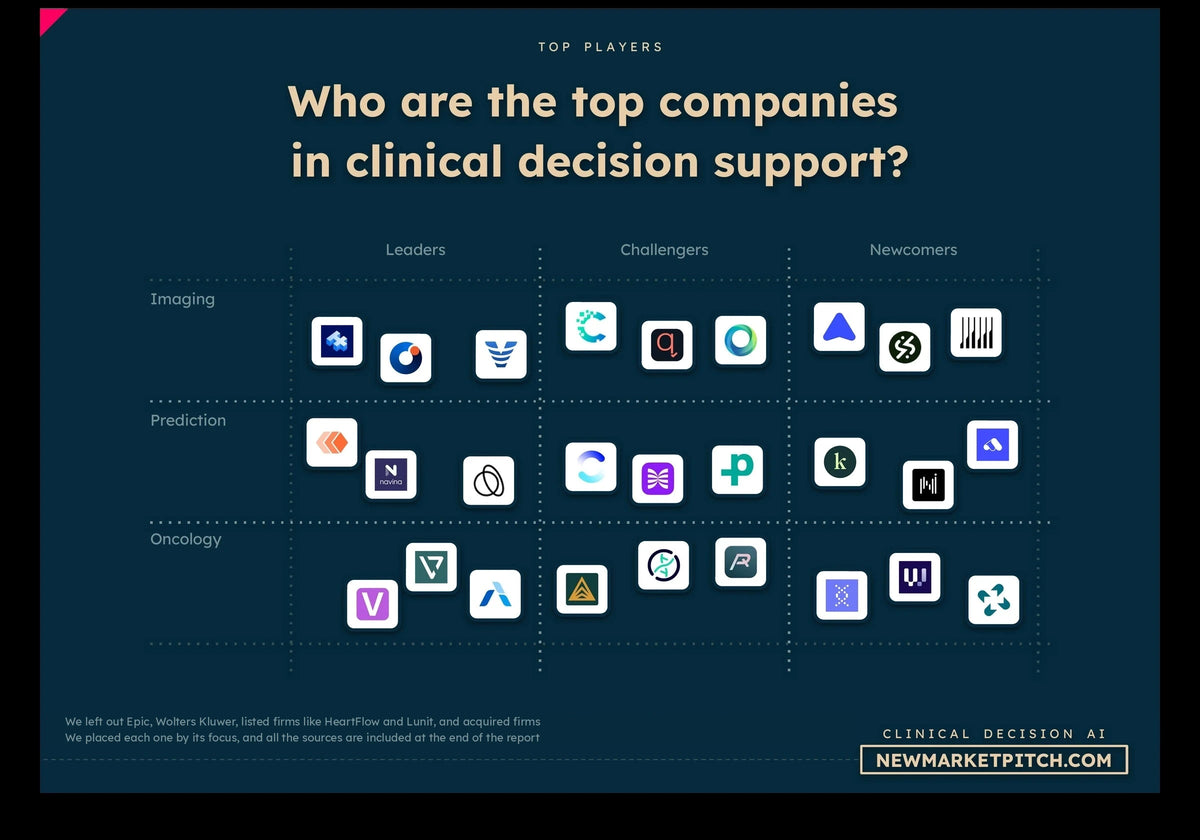
In our research about clinical decision support tools, we turn what is vague and complex into simple, useful visuals. Market maps like this one show you at a glance where every startup stands.
Is clinical decision support funding actually growing in 2026?
Clinical decision support funding is holding up in dollar terms, but the number of startups raising money has dropped sharply. We've counted $961.9 million across 28 rounds so far in 2026, up just 1.2% from $950.3 million across 38 rounds during the same period in 2025.
The number of funded companies fell from 37 to 27, a 27% decline. Compared with 2024, the contrast is even more striking: funding has more than doubled from $423.2 million, while the number of transactions has fallen from 31 to 28.
The weaker side of the market becomes visible when we remove the biggest rounds. Funding excluding transactions above $50 million fell 22.9% year over year, from $333.3 million to $256.9 million. Removing rounds above $100 million produces a 39.8% decline.
Meanwhile, the median round increased from $7.89 million to $10 million. Investors are writing somewhat larger checks, but considerably fewer companies are getting funded.
| Funding indicator | 2024 YTD | 2025 YTD | 2026 YTD |
|---|---|---|---|
| Funding rounds | 31 | 38 | 28 |
| Funded companies | 31 | 37 | 27 |
| Total funding | $423.2M | $950.3M | $961.9M |
| Funding excluding rounds above $50M | $304.2M | $333.3M | $256.9M |
| Funding excluding rounds above $100M | $423.2M | $518.3M | $311.9M |
| Median round | $8.0M | $7.89M | $10.0M |
| Average disclosed round | $13.65M | $25.01M | $35.63M |
| Top-three funding share | 38.3% | 45.5% | 67.6% |
The average disclosed round excludes transactions with undisclosed amounts. In 2026, 27 rounds had usable reported funding amounts, while 28 transactions were counted overall.
Are OpenEvidence and Aidoc carrying the clinical decision support market?
Yes. OpenEvidence and Aidoc are responsible for most of the clinical decision support funding recorded in 2026. Together, just three transactions brought in $650 million, representing 67.6% of the market's total.
OpenEvidence raised $250 million in January at a reported $12 billion valuation, followed by another $250 million financing in September at a reported $15 billion valuation. The second round was reported as having closed before our September 24 cutoff, although the company's subsequent confirmation came later.
Aidoc contributed another $150 million with its April Series E, led by Goldman Sachs Alternatives. The company said the financing would help expand its clinical foundation model and enterprise AI platform across healthcare systems.
These three rounds explain why total funding remains close to $1 billion even as deal activity declines. The top three deals captured 45.5% of funding in 2025 and 38.3% in 2024, so concentration has increased substantially across the three comparable periods.
OpenEvidence alone accounts for roughly 52% of current funding. That is an extraordinary share for a single company in a market containing 27 funded businesses.

Your time is limited. In our market report about clinical decision support tools, we put numbers on each part of the market, so you can see where it makes sense to focus.
Why are investors putting so much money into OpenEvidence?
OpenEvidence is attracting unusually large investments because it has built a clinical AI product used regularly by physicians, giving investors a clearer adoption story than many early-stage healthcare software companies can offer.
The platform helps doctors find medical evidence, interpret research and answer clinical questions using information from peer-reviewed journals and medical guidelines. Its value proposition is broad: the product can support clinicians across many specialties rather than addressing only one disease or diagnostic procedure.
By September, OpenEvidence had reportedly reached widespread adoption among American physicians. The company also benefited from integrations into healthcare workflows, including electronic health record environments, which can make clinical software easier to use during everyday medical practice.
Investors have rewarded that growth with repeated financing rounds. OpenEvidence went from a reported $3.5 billion valuation in July 2025 to $12 billion in January 2026 and $15 billion in September.
The important uncertainty is how much of its adoption can translate into durable revenue and profitability. Physician usage is an impressive starting point, but it doesn't settle the question of long-term monetization, particularly at a $15 billion valuation.
Why is money moving from diagnostic AI toward clinical evidence platforms?
Evidence and Guideline Support has overtaken Diagnostic Decision Support in funding, largely thanks to OpenEvidence's two enormous rounds. The evidence category raised $522 million in 2026, compared with $307 million in 2025, even though its deal count stayed at four.
Diagnostic Decision Support moved in the opposite direction. Funding fell from $475.1 million to $271.8 million, while transactions dropped from 23 to 12.
There is a plausible product-level explanation for the different investor interest. Evidence platforms can become tools that physicians consult repeatedly across a wide range of clinical decisions. Diagnostic AI companies often start by addressing a more specific medical task, such as interpreting an imaging examination or identifying a particular condition.
Diagnostic software can deliver measurable clinical benefits and build strong relationships with hospitals, but some products also face demanding validation, integration and regulatory requirements.
The FDA's updated January 2026 clinical decision support guidance illustrates how differently software functions can be treated. Depending on what a product does, certain decision-support functions may fall outside medical-device regulation, while software analyzing medical images or producing particular clinical outputs may remain subject to FDA oversight.
Still, the funding comparison needs perspective. Of the $522 million raised by Evidence and Guideline Support, $500 million came from OpenEvidence. There is much stronger evidence of one company's fundraising success than of a broad migration of investment toward evidence-platform startups.
| Category | 2025 deals | 2026 deals | 2025 funding | 2026 funding |
|---|---|---|---|---|
| Diagnostic Decision Support | 23 | 12 | $475.1M | $271.8M |
| Evidence & Guideline Support | 4 | 4 | $307.0M | $522.0M |
| Precision Medicine | 5 | 3 | $60.9M | $80.3M |
| Risk Prediction & Alerts | 3 | 6 | $74.1M | $61.4M |
| Treatment Recommendation | 2 | 1 | $3.2M | $13.4M |
| Care Pathway Support | 0 | 1 | $0 | $10.0M |
| Medication Decision Support | 1 | 1 | $30.0M | $3.0M |
| Total | 38 | 28 | $950.3M | $961.9M |

In our document detailing everything you need to know about clinical decision support, we always try to gather several sources and make estimates that make sense, so you can work with solid numbers.
Is diagnostic AI losing investors?
Diagnostic Decision Support is clearly having a tougher fundraising year, with deal count nearly halving from 23 to 12. Its share of clinical decision support transactions has fallen from 60.5% to 42.9%.
But diagnostics is still the busiest part of the market by number of rounds. It has three times as many transactions as Evidence and Guideline Support, despite attracting much less money.
Diagnostic funding is down approximately 43% year over year, accompanied by a 47.8% decline in transactions. This is a broader contraction than the disappearance of one or two exceptionally large financings.
The commercial environment also deserves attention. Medical imaging AI companies must often demonstrate clinical performance, work within hospital technology systems and navigate regulatory requirements. The American College of Radiology's January 2026 discussion of FDA guidance reinforced that image-analysis functions producing diagnostic recommendations generally remain under FDA oversight.
Harrison.ai offers an example of how much capital established diagnostic platforms can require. Its February 2025 $112 million Series C supported US expansion alongside its radiology and pathology products. That round also helps explain why the previous year's funding picture was stronger.
We can't establish from completed financings alone whether diagnostic startups are encountering more investor rejection, struggling with deployment economics or simply raising less frequently. What we can see is a substantial reduction in both capital and transactions.
Is risk prediction becoming the next big clinical AI category?
Risk Prediction and Alerts is attracting more funding rounds, making it one of the few clinical decision support categories with a clear increase in startup activity. We counted six deals in 2026, compared with three in 2025 and four in 2024.
The catch is that total funding fell from $74.1 million to $61.4 million. Investors are financing more transactions, but those rounds are generally smaller.
Risk prediction now represents 21.4% of market deals, up from 7.9% last year. Its share of funding, however, slipped to 6.4%.
These products can cover a broad range of medical needs, including predicting patient deterioration, identifying complications or helping clinicians prioritize interventions. Their commercial appeal comes from fitting predictive information into clinical decisions that hospitals already make.
Precision Medicine Decision Support shows almost the reverse funding pattern. It attracted $80.3 million from three rounds in 2026, compared with $60.9 million from five rounds last year. Its median round reached $33 million.
Risk prediction is seeing more businesses complete financings, while precision medicine is attracting larger investments among fewer recipients. With such small samples, neither change is enough to declare a new dominant category.

Our report covering the clinical decision support market gets updated several times a month, so you always get the latest view of where things stand.
Are early-stage clinical decision support startups having a harder time raising money?
Early-stage clinical decision support startups are still getting funded, and Seed and Series A deal counts have held up better than overall market activity. We recorded 16 early-stage rounds in 2026, compared with 13 in 2025 and 16 in 2024.
Seed activity was especially stable, with nine transactions this year against eight last year and nine two years earlier. Series A transactions increased from five to seven.
What weakened was the amount of money being raised. Combined Seed and Series A funding fell from $188.3 million to $120.3 million, despite the higher number of rounds.
Series A explains much of that decline. Funding at the stage dropped from $168.5 million to $95.3 million. More companies completed Series A financings, but the total amount invested at that stage was much lower.
There's also a data-quality issue. Early-stage deals represent 57.1% of all 2026 transactions, compared with 34.2% in 2025. But the proportion of deals with a known stage improved considerably between the two periods.
Among deals with identified stages, the early-stage share is 64% today, versus 50% last year and 66.7% in 2024. The longer comparison looks more like a return toward the earlier funding mix than an unprecedented surge in young startups raising money.
Has Series B funding disappeared from clinical decision support?
Series B funding has disappeared from our identified 2026 clinical decision support transactions. We found no Series B rounds through September 24, compared with six in 2025 and eight in 2024.
That's a striking gap, especially since Series B brought in $310.9 million during the comparable 2025 period and $249.4 million in 2024.
At the other end of the market, Series D+ rounds increased from one to four, while Growth Equity transactions increased from one to three. Together, those two stages accounted for approximately $770 million in current funding.
The apparent missing middle is worth watching. Startups can still raise Seed and Series A capital, while established companies can secure exceptionally large later rounds. But intermediate-stage financings have become conspicuously scarce.
There are limits to that conclusion. Three 2026 financings have unknown stages, and our figures cover completed deals rather than companies attempting to raise money.
Even allowing for those limitations, moving from six and eight Series B rounds in the previous comparable periods to zero identified rounds is one of the year's more unusual developments.
| Stage | 2024 deals | 2025 deals | 2026 deals | 2026 funding |
|---|---|---|---|---|
| Seed | 9 | 8 | 9 | $25.0M |
| Series A | 7 | 5 | 7 | $95.3M |
| Series B | 8 | 6 | 0 | $0 |
| Series C | 0 | 5 | 2 | $19.6M |
| Series D+ | 0 | 1 | 4 | $468.4M |
| Growth Equity | 0 | 1 | 3 | $301.6M |
| Unknown | 7 | 12 | 3 | $52.0M |
| Total | 31 | 38 | 28 | $961.9M |

In our research about clinical decision support tools, we look at what the winners do differently, so you can learn from the best instead of guessing.
Are clinical AI investors only backing established companies now?
Established clinical AI companies are receiving most of the money, even though younger businesses still account for most funding rounds. Series C and later-stage financings, together with Growth Equity, attracted $789.6 million in 2026, around 82% of the market's capital.
Only nine identified transactions at those stages generated that amount, compared with 13 deals raising $713.6 million last year.
Aidoc shows what investors are willing to finance at this level. Its April $150 million Series E was intended to expand its CARE clinical foundation model and enterprise AI platform. The company named Goldman Sachs Alternatives as the lead investor, alongside participation from General Catalyst, SoftBank Vision Fund 2 and NVentures.
The round illustrates the capital available to companies building software for use across healthcare systems, particularly when they have existing customers, established products and a clear expansion plan.
Company age also offers some context. The median funded business was approximately seven years old in 2026, compared with six years in the two earlier periods. Seed recipients were also older, with a median age of five years against three in 2025.
However, first-financing activity has remained relatively stable. We identified six first financings this year, five last year and six in 2024.
New companies continue to enter the funding market. The bigger change is how much capital previously funded businesses can attract.
Follow-on rounds captured $920.9 million in 2026, approximately 95.7% of the total. Their count fell from 33 to 22, even as the amount invested remained close to last year's $932.8 million.
Is North America pulling ahead of Europe in clinical decision support funding?
North America is pulling further ahead in clinical decision support funding, helped by giant US rounds and a sharp decline in European transactions. North American businesses raised $808.8 million across 14 deals in 2026, compared with $593.7 million across 12 deals in 2025.
Europe went from 22 deals to 12, with funding falling from $233.3 million to $126.6 million.
North America's share of global transactions increased from 31.6% to 50%, while its share of funding rose from 62.5% to 84.1%.
The largest US financings account for much of the capital gap, but the transaction counts show that the geographical change goes further than those companies alone. North America recorded slightly more deals, whereas Europe's activity fell 45.5%.
Asia-Pacific also experienced a major funding decline, from $120.3 million to $26.5 million. Here, the comparison is heavily influenced by Harrison.ai's February 2025 $112 million financing, which supported its expansion into the United States and further product development.
Europe's decline deserves the most attention because it involves fewer transactions as well as less money. The figures identify where funded companies are located; they don't establish that European venture funds have redirected their capital toward American startups.

In our market report about clinical decision support tools, we don't want to repeat what boring consulting reports say. Instead, we show you the real and latest market signals that matter.
Are venture capital firms losing interest in clinical decision support?
Fewer venture investors are appearing as disclosed leads in clinical decision support deals, although the decline closely follows the reduction in fundraising activity. We identified 33 unique lead investors or co-leads in 2026, compared with 47 in 2025.
Lead disclosure coverage remained similar at 82.1%, against 84.2% last year, so the comparison is reasonably consistent.
One interesting detail is that no disclosed lead appeared in multiple 2026 deals. LUMO Labs was the only repeated lead in the 2025 comparison, appearing in two financings.
That makes it difficult to argue that a tiny group of VC firms is taking over funding leadership. There are simply fewer completed transactions and fewer identified investors leading them.
Strategic investors have also become less common in the recorded rounds. We found named strategic participation in five 2026 transactions, compared with 11 in 2025 and seven in 2024.
The current group includes NVIDIA and NVentures, M Ventures, UCI Health Ventures, Labcorp Venture Fund, Carle Health and 4DMedical. These participants span AI infrastructure, pharmaceutical technology, diagnostics and healthcare delivery.
Corporate participation remains diverse, but its frequency has dropped from 28.9% of deals in 2025 to 17.9% this year, despite prominent names appearing in major financings.
Why are healthcare AI platforms still raising such large rounds?
Healthcare AI platforms can still raise hundreds of millions of dollars when investors see a credible path toward widespread clinical use. Physician adoption and enterprise healthcare deployments offer stronger evidence of commercial progress than a promising model demonstrated in isolation.
Clinical AI platforms are also expanding beyond individual diagnostic tasks. A company that can serve several medical specialties or hospital departments has more opportunities to deepen its relationship with existing customers.
That expansion is demanding, though. Software needs to fit into electronic health records, clinical processes and hospital technology infrastructure. Product validation, implementation and continued development can require substantial financing long after a company has launched its first commercial product.
Healthcare technology policy also provides useful context. The US government's HTI-1 rule introduced transparency requirements for predictive decision support within certified health IT, while subsequent interoperability standards have addressed ways to integrate clinical decision support tasks into electronic health record workflows.
These developments are making clinical AI part of the established healthcare technology environment, although they don't establish a direct connection between regulation and larger financing rounds.
The stronger explanation comes from the companies' own activities: physician usage, hospital distribution, product development and the cost of expansion. Investors appear prepared to support businesses that have already made measurable progress on those fronts.

Learning from others' mistakes is the cheapest lesson there is. In our document detailing everything you need to know about clinical decision support, we look at what broke startups before you, so you don't repeat it.
Could 2026 become the biggest year ever for clinical decision support funding?
Clinical decision support funding could still finish 2026 strongly, although current figures don't justify calling it a record year. Through September 24, the market had raised $961.9 million, equivalent to 74.5% of the $1.29 billion recorded throughout 2025.
The current total has already exceeded full-year 2024 funding of $743.7 million by approximately 29%.
But the number of rounds tells a less impressive story. We have counted 28 deals so far this year, compared with 58 throughout 2025 and 49 throughout 2024.
A single additional $200 million or $300 million transaction could change the annual funding total substantially. That's realistic given the size of recent financings, but it wouldn't necessarily change the experience of the average clinical decision support founder.
The more interesting question for the remainder of the year is whether fundraising picks up among businesses outside the handful of largest platforms, particularly at Series B and other intermediate stages.
What is actually changing in clinical decision support funding?
Clinical decision support funding is becoming much more concentrated around established AI platforms, while fewer startups are securing investment across the broader market.
Total funding is slightly higher than last year, but deal count and funded-company count have declined considerably. Once financings above $50 million are removed, the market is contracting.
Diagnostic Decision Support has experienced the largest decline in category-level transaction volume. Evidence and Guideline Support has attracted more capital through a handful of large rounds, while Risk Prediction and Alerts is one of the few categories completing more financings.
Early-stage founders are still raising money, although in smaller aggregate amounts. The lack of identified Series B financings is harder to dismiss, especially alongside the growth in late-stage capital concentration.
North America is capturing a larger share of investment, while Europe has recorded substantially fewer deals. Fewer lead investors and strategic participants also appear in completed transactions.
The market still produces companies capable of raising hundreds of millions of dollars. What's missing is comparable momentum across the wider startup population. Until that improves, a billion-dollar funding year says more about the success of a few established platforms than the health of clinical decision support fundraising overall.

If you build or invest in the clinical decision support market, you need to know which business models pay off now and which ones are fading. That's why our report covering it has a whole section on it.
Our methodology
This analysis examines private-company financing activity specifically within the clinical decision support market. We compare three aligned year-to-date periods: January 1 to September 24, 2026; January 1 to September 24, 2025; and January 1 to September 24, 2024. Full-year 2024 and 2025 figures are used separately when discussing annual funding performance.
Our analysis is based on 135 matching financing records, including 97 transactions across the three main comparison periods. We preserve separate financing rounds raised by the same company while checking for duplicate records referring to a single transaction. The market definition excludes businesses classified only within broader healthcare AI or digital health categories.
We calculated total investment, financing counts, unique funded companies, median and average round sizes, funding stages, category composition, geographical distribution, company maturity, first-time and follow-on financing activity, disclosed investor participation and capital concentration. We also recalculated funding after removing individual transactions above $50 million and $100 million to distinguish broad market activity from the influence of exceptional rounds.
Funding totals use disclosed or otherwise usable amounts recorded in the database. The 2026 neuropacs financing is recorded as a lower-bound amount above $1 million, while PH Predicting Health GmbH has an undisclosed amount. The 2024 Octagos Health financing also contains a lower-bound figure. These transactions remain in the relevant counts, with reported funding totals interpreted accordingly. The average disclosed round is calculated from transactions with usable financing amounts.
Funding stages, first-financing classifications, lead investors and strategic investor participation are assessed using the available transaction records. Unknown stages remain separate rather than being estimated from financing size. Company age is calculated from available founding dates. Comparisons of lead-investor activity account for differences in disclosure coverage, and geographical comparisons reflect the location of funded companies rather than the domicile of participating investors.
We supplemented the transaction analysis with company announcements, regulatory documents, healthcare technology policy materials and established financial and industry reporting. Particular attention was given to large transactions because they materially affect aggregate funding, category performance and regional comparisons. We distinguished reported financing dates from subsequent public confirmation dates when determining which transactions belonged within the September 24 cutoff.
Key company and financing sources include Aidoc's April 2026 Series E announcement, Aidoc's clinical foundation model financing announcement, Becker's Hospital Review on OpenEvidence's September financing, Sacra's OpenEvidence financing history, and Harrison.ai's February 2025 Series C announcement.
For the regulatory and healthcare technology context, we used the FDA's January 2026 Clinical Decision Support Software guidance, the FDA's clinical decision support FAQs, the American College of Radiology's review of the updated FDA guidance, the ONC HTI-1 Final Rule, and the ONC's HTI-4 interoperability materials.
External reporting supports our examination of company adoption, financing purposes, clinical AI products and healthcare technology regulation. The financing database remains the basis for all aggregate market statistics. Category-level changes are assessed alongside transaction counts to avoid treating an increase driven by one large company as evidence of widespread growth. Conclusions about investor selectivity and company maturity are based on observed completed financings, rather than unsuccessful fundraising attempts or unverified investor decisions.

In our research about clinical decision support tools, we like to show you the big picture. We know your time is precious, so we make every page quick to read and packed with as much learning as possible per minute.
Written by the New Market Pitch teamWe track new markets so founders and investors can move faster. About us