What are the top clinical decision support startups by total funding raised?
Whether you're building or investing in the clinical decision support market, our report covers everything you need to know: the players, the money, and what's coming next.
Summary
OpenEvidence, Aidoc and Cleerly are the top clinical decision support startups by total funding raised, with $985 million, $524 million and $387 million respectively. DentalMonitoring ($307 million), Caresyntax ($303 million) and AMBOSS ($298 million) complete the top six, illustrating how much capital is flowing into AI-powered medical information, diagnostics and clinical workflow software.
The ten largest companies have raised $3.851 billion combined. OpenEvidence accounts for roughly a quarter of that amount, but its lead also reflects a growing investor appetite for physician-facing AI platforms that could become part of everyday medical practice.
Medical imaging remains one of the strongest investment categories. Aidoc, Cleerly, Viz.ai, Harrison.ai, Infervision and Shukun Technology have all attracted substantial financing, although their technologies address different diagnostic problems. The opportunity is particularly attractive where AI can help hospitals identify urgent findings earlier and reduce pressure on clinical teams.
Cardiovascular AI has developed into another major funding category. AliveCor has raised $284 million, followed by Anumana ($185 million), Elucid ($185 million), Eko Health ($164 million) and CathWorks ($151 million). These companies cover everything from personal ECG monitoring to coronary imaging and procedure-related decision support.
Pathology is attracting serious investment too. PathAI leads with $258 million, while Proscia and Scopio Labs have each raised $129 million. Ibex Medical Analytics, Deciphex and Aignostics are also building businesses around AI-assisted tissue analysis, cancer detection and digital pathology.
Europe has produced several particularly well-funded companies. France's DentalMonitoring leads the European group, followed by Germany's AMBOSS and Ada Health. The United Kingdom also has a growing collection of specialist businesses, including Ultromics, Perspectum and Brainomix. Asia is developing a strong position in imaging and diagnostics, particularly in China.
Investors are not limited to traditional venture capital firms. Insight Partners, Andreessen Horowitz and General Catalyst appear alongside strategic investors such as GE Healthcare, Boston Scientific, Medtronic and Siemens Healthineers. These relationships can bring commercial expertise and access to established medical technology ecosystems.
Large financing rounds are continuing across the industry. OpenEvidence raised $250 million in September 2026, Aidoc secured $150 million in April, and DentalMonitoring attracted $100 million in February. Smaller companies are also raising meaningful Series A and growth rounds, showing that investment has not dried up outside the market leaders.
Physician adoption is progressing, but there is a considerable gap between interest in AI and the use of software that directly influences clinical decisions. While 54% of surveyed US physicians reported using AI in clinical practice, only 28% of surveyed health systems had implemented or planned to implement AI clinical decision support. Accuracy, clinical responsibility and integration remain major obstacles.
Regulation and commercial execution will determine which companies emerge as long-term winners. Diagnostic products may need medical device clearance and extensive clinical validation, while physician information platforms face the challenge of maintaining trust and accuracy. Funding creates room to compete, but hospital adoption, repeat usage and measurable clinical value will ultimately matter more.
Our view is that clinical decision support has become a substantial investment category, with opportunities extending well beyond general-purpose medical AI. OpenEvidence, Aidoc and Cleerly currently occupy particularly strong positions, but specialist companies in cardiovascular care, pathology, cancer detection and surgical analytics could become important players in their respective markets.

Written by the New Market Pitch teamWe track new markets so founders and investors can move faster. About us

In our report covering the clinical decision support market, you will always find fresh funding data, taken straight from our own verified funding database.
Top startups in the clinical decision support market ranked by total funding raised
Here is an updated table that ranks the top startups in the clinical decision support market based on the total amount of funding they have raised to date.
The table also includes the total number of funding rounds, the date and size of the latest round, the financing type (e.g. Series A, equity financing), key investors, the startup’s current status (active, IPO, acquired, or shut down), and a confidence score based on the data collected (we excluded startups with very low data confidence, to make sure everything is reliable).
If you need to dig deeper and get more detailed data, please check our report covering the clinical decision support market.
| # | Startup | What They Do | Total Raised ($) | Total Rounds | Last Round Date | Last Round Amount ($) | Last Round Type | Key Investors | Current Stage | Confidence | Country |
|---|---|---|---|---|---|---|---|---|---|---|---|
| 1 | OpenEvidence | Evidence-based AI assistant for clinicians | $985M | 5 | September 2026 | $250M | Series E / Growth | Andreessen Horowitz, Byers Capital | Active | Strong | United States |
| 2 | Aidoc | AI medical imaging triage | $524M+ | 9 | April 2026 | $150M | Series E | Goldman Sachs, General Catalyst, NVentures | Active | Strong | Israel |
| 3 | Cleerly | AI coronary CT analysis | $387M | 4 | December 2024 | $106M | Series C Extension | Insight Partners, Battery Ventures | Active | Strong | United States |
| 4 | DentalMonitoring | AI orthodontic treatment monitoring | $307M | 5 | February 2026 | $100M | Growth Equity | Lazard Elaia Capital, ISALT | Active | Strong | France |
| 5 | Caresyntax | Surgical analytics and decision support | $303M | 7 | August 2024 | $80M | Series C | Symbiotic Capital, MTIP, Optum Ventures | Active | Strong | United States |
| 6 | AMBOSS | Medical knowledge and clinical decision support | $298M | 5 | March 2025 | $259M | Late VC | KIRKBI, M&G Investments, Lightrock | Active | Partial | Germany |
| 7 | AliveCor | AI-enabled personal ECG monitoring | $284M | 7 | August 2022 | $150M | Series F | GE Healthcare, Khosla Ventures, Qualcomm Ventures | Active | Partial | United States |
| 8 | PathAI | AI-powered digital pathology diagnostics | $258M | 6 | May 2021 | $165M | Series C | D1 Capital Partners, Kaiser Permanente, General Atlantic | Active | Strong | United States |
| 9 | Viz.ai | AI disease detection and care coordination | $254M | 8 | April 2022 | $100M | Series D | Tiger Global, Insight Partners, Scale Venture Partners | Active | Strong | United States |
| 10 | Shukun Technology | AI medical imaging and diagnostics | ~$251M1 | 7 | February 2022 | Undisclosed | Strategic | Marathon Venture Partners, HongShan, Huagai Capital | Active | Partial | China |
| 11 | Harrison.ai | AI-powered medical imaging diagnostic support | $229M | 3 | February 2025 | $112M | Series C | Aware Super, ECP, Horizons Ventures | Active | Strong | Australia |
| 12 | Glooko | Connected diabetes management and clinical analytics | $224M | 10 | September 2025 | $6M | Series F Extension | Georgian | Active | Partial | United States |
| 13 | Infervision | AI-assisted medical imaging and diagnosis | $213M | 5 | July 2021 | $94.9M | Series D2 | Goldman Sachs Asset Management, Qiming Venture Partners, Z-Park Fund | Active | Partial | China |
| 14 | Ada Health | AI symptom assessment and care navigation | $193M | 4 | February 2022 | $30M | Series B Extension | Farallon Capital, Red River West, Bertelsmann Investments | Active | Partial | Germany |
| 15 | Anumana | AI-enabled ECG disease detection | $185M | 4 | April 2025 | $95M | Series C | Boston Scientific, Matrix Partners, Mayo Clinic Ventures | Active | Full | United States |
| 16 | Elucid | AI cardiovascular imaging analysis | $185M | 7 | September 2026 | $55M | Series D | IAG Capital Partners, Elevage Medical Technologies | Active | Strong | United States |
| 17 | Overjet | AI dental diagnostics and analytics | $174M | 6 | December 2025 | $34.8M | Series C-1 | General Catalyst, March Capital | Active | Strong | United States |
| 18 | Eko Health | AI heart-lung detection devices | $164M | 7 | June 2024 | $41M | Series D | ARTIS Ventures, Highland Capital Partners, Questa Capital | Active | Strong | United States |
| 19 | CathWorks | AI-guided coronary physiology assessment | $151M2 | 4 | July 2022 | $75M | Strategic Equity Investment | Medtronic | Acquired | Strong | United States |
| 20 | Digital Diagnostics | Autonomous AI disease screening | $142M | 7 | August 2022 | $75M | Series B | KKR, 8VC, Optum Ventures | Active | Partial | United States |
| 21 | CorVista Health | Non-invasive AI cardiac diagnostics | $142M | 10 | October 2025 | $0.55M | Undisclosed Equity | Bioworld Ventures | Active | Partial | United States |
| 22 | Scopio Labs | AI-powered digital blood cell analysis | $129M | 7 | July 2025 | $10M | Series D Extension | Viola Growth | Active | Partial | Israel |
| 23 | Proscia | AI-powered digital pathology software | $129M | 7 | March 2025 | $50M | Growth / Series D | Insight Partners, Triangle Peak Partners, Avenue Capital | Active | Strong | United States |
| 24 | AI Medical Service | Endoscopy AI diagnostic support | $124M | 4 | April 2022 | $70M | Series C | SoftBank Vision Fund 2, Globis Capital Partners, WiL | Active | Strong | Japan |
| 25 | Deepwise | AI medical imaging diagnostics | $121M | 4 | January 2025 | $69M | Undisclosed Stage | Legend Capital | Active | Partial | China |
| 26 | Qure.ai | AI-powered medical imaging diagnostics | $121M | 4 | September 2024 | $65M | Series D | Lightspeed Venture Partners, Kae Capital, Novo Holdings | Active | Partial | India |
| 27 | Ultromics | AI cardiac ultrasound diagnostics | $115M | 7 | December 2025 | Undisclosed | Series C Extension | American Heart Association | Active | Strong | United Kingdom |
| 28 | VieCure | AI-driven precision oncology decision support | $113M | 3 | January 2026 | $43M | Growth Equity | Mitch Rales, Northpond Ventures, Durable Capital Partners | Active | Full | United States |
| 29 | Keya Medical | AI-based cardiovascular imaging diagnostics | $110M+ | 4 | January 2021 | $46M | Series D | CICC Capital, Shanghai AI Investment Fund, IN Capital | Active | Partial | China |
| 30 | Imagen Technologies | AI-assisted medical imaging and diagnostics | $110M3 | 5 | November 2024 | $32M | Later-stage Venture | Undisclosed | Active | Partial | United States |
| 31 | ArteraAI | AI predictive cancer treatment tests | $110M | 4 | August 2025 | Undisclosed | Seed Equity | Coatue Management, Johnson & Johnson Innovation, Walden Catalyst | Active | Partial | United States |
| 32 | Huimei Technology | AI clinical decisions and quality management | $109M | 6 | August 2025 | ~$28M | Later-stage Equity | Shanghai Science and Technology Innovation Fund, Eastern Bell Capital, Qiming Venture Partners | Active | Partial | China |
| 33 | Ibex Medical Analytics | AI-assisted cancer pathology diagnosis | $107M | 4 | September 2023 | $55M | Series C | 83North, Sienna Venture Capital, Octopus Ventures | Active | Strong | Israel |
| 34 | Navina | AI clinical intelligence for primary care | $99M | 4 | March 2025 | $55M | Series C | Goldman Sachs Alternatives, Vertex Ventures Israel, Grove Ventures | Active | Strong | United States |
| 35 | RapidAI | AI stroke and neurovascular decision support | $94M | 3 | July 2023 | $75M | Series C | Vista Equity Partners | Active | Strong | United States |
| 36 | Corti | Clinical AI assistant for clinicians | $92M | 5 | September 2023 | $60M | Series B | Atomico, Prosus Ventures, Eurazeo | Active | Strong | Denmark |
| 37 | Perspectum | AI-powered quantitative medical imaging | $91M | 4 | March 2023 | $19M | Series C Extension | Oppenheimer | Active | Partial | United Kingdom |
| 38 | Regard | AI clinical documentation and insights | $81M | 3 | July 2024 | $61M | Series B | Oak HC/FT, Cedars-Sinai Health Ventures, Calibrate Ventures | Active | Strong | United States |
| 39 | Diagnostic Robotics | AI patient triage and care management | $79M | 4 | July 2022 | $45M | Series B | StageOne Ventures, Mayo Clinic, Bradley Bloom | Active | Partial | United States |
| 40 | VoxelCloud | AI medical imaging diagnostic analysis | $79M | 4 | December 2018 | $50M | Series B | Hongtai Capital, Hanfor Capital Management, HSG | Active | Strong | United States |
| 41 | Volta Medical | AI-assisted cardiac ablation decision support | $74M+ | 3 | January 2023 | $38M | Series B | Vensana Capital, Lightstone Ventures, Gilde Healthcare | Active | Partial | France |
| 42 | Clairity | AI image-based cancer risk prediction | $73M | 2 | November 2025 | $43M | Series B | ACE Global Equity, Santé Ventures, Breast Cancer Research Foundation | Active | Strong | United States |
| 43 | Podimetrics | Predictive diabetic foot complication monitoring | $72M | 5 | March 2022 | $45M | Series C | D1 Capital Partners, Polaris Partners, Medtech Convergence Fund | Active | Partial | United States |
| 44 | Implicity | AI remote cardiac monitoring platform | $68M | 4 | September 2026 | $40M | Growth Equity | IRIS, Five Arrows | Active | Strong | France |
| 45 | Quibim | AI imaging biomarkers for precision medicine | $66M | 5 | January 2025 | $50M | Series A | Asabys Partners, Buenavista Equity Partners, UI Investissement | Active | Partial | Spain |
| 46 | Brainomix | AI stroke and lung imaging | $62M | 7 | February 2026 | $7M | Series C Extension | Parkwalk Advisors, Hostplus, Modi Ventures | Active | Partial | United Kingdom |
| 47 | AITRICS | AI patient deterioration prediction | $61M | 5 | December 2025 | $24M | Series C | Mirae Asset Venture Investment, Premier Partners, SV Investment | Active | Partial | South Korea |
| 48 | Deciphex | AI digital pathology diagnostics | $57M | 5 | January 2025 | $32M | Series C | Molten Ventures, ACT Venture Capital, Seroba Life Sciences | Active | Strong | Ireland |
| 49 | Hutom | AI surgical planning and navigation | $57M | 4 | March 2024 | ~$35M | Series C | Undisclosed | Active | Partial | South Korea |
| 50 | Aignostics | AI-powered computational pathology insights | $55M | 3 | October 2024 | $34M | Series B | ATHOS, Mayo Clinic, HTGF | Active | Full | Germany |
| 51 | Clinomic | AI intensive-care decision support | $51M | 3 | April 2025 | ~$25M | Series B | DeepTech & Climate Fonds | Active | Strong | Germany |
| 52 | SeqOne | AI clinical genomic interpretation software | $49M | 3 | May 2025 | $23M | Series B | Supernova Invest, Elaia, Omnes Capital | Active | Partial | France |
| 53 | ClosedLoop.ai | Predictive healthcare analytics software | $48M | 5 | August 2022 | $0M | Angel | Undisclosed | Active | Strong | United States |
| 54 | Atropos Health | Personalized real-world evidence for clinicians | $47M | 4 | May 2024 | $33M | Series B | Valtruis, Cencora Ventures, McKesson Ventures | Active | Partial | United States |
| 55 | ScreenPoint Medical | AI breast cancer imaging analysis | $47M | 3 | April 2026 | $14M | Series C Extension | Insight Partners, Siemens Healthineers | Active | Strong | Netherlands |
| 56 | Optain | AI retinal screening for systemic disease | $45M | 3 | October 2026 | $7M | Series A Extension | Aegis Ventures | Active | Partial | Australia |
| 57 | Infermedica | AI symptom assessment and triage | $44M | 3 | January 2022 | $30M | Series B | One Peak, Karma Ventures, Heal Capital | Active | Strong | Poland |
| 58 | EvidenceCare | EHR-integrated clinical decision support | $41M | 6 | March 2025 | $10M | Equity Financing | Ballad Ventures, Jumpstart Capital, Rockmont Partners | Active | Partial | United States |
| 59 | Gleamer | AI radiology interpretation and detection | $40M | 4 | June 2025 | Undisclosed | Series C / Internal | XAnge, Elaia | Acquired | Partial | France |
| 60 | Synapse Medicine | AI medication safety decision support | $40M | 3 | February 2023 | $28M | Series B | Korelya Capital, XAnge, MACSF | Active | Strong | France |
| 61 | Healthleap | AI screening for undiagnosed inpatient conditions | $38M | 2 | October 2026 | $30M | Series A | Hummingbird Ventures | Active | Strong | United States |
| 62 | CathVision | AI cardiac electrophysiology analytics | $36M | 7 | July 2023 | $9M | Series B Extension | Undisclosed | Active | Partial | Denmark |
| 63 | Cydar Medical | AI-guided surgical imaging | $36M | 6 | June 2025 | ~$12M | Late VC | Undisclosed | Active | Strong | United Kingdom |
| 64 | Incepto Medical | AI diagnostic imaging software platform | $36M | 3 | September 2026 | $16M | Growth Equity | LBO France, Wille Finance, AXA Venture Partners | Active | Strong | France |
| 65 | Eyenuk | AI diabetic retinopathy screening | $33.9M+ | 6 | June 2026 | $6M | Series A-II | Undisclosed | Active | Partial | United States |
| 66 | See All AI | AI-generated surgical 3D imaging | $33M | 1 | May 2025 | $33M | Venture | Undisclosed | Active | Low | United States |
| 67 | VIDA Diagnostics | AI-powered pulmonary imaging and analysis | $33M | 7 | September 2023 | $11M | Undisclosed Equity | Undisclosed | Active | Partial | United States |
| 68 | Vera Health | Evidence-based AI clinical research assistant | $32M4 | 2 | October 2026 | $29M | Series A | Threshold Ventures, Mantis VC, SV Angel | Active | Partial | United States |
| 69 | deepc | Radiology AI orchestration platform | $30M | 3 | July 2024 | $13M | Series A Extension | Sofinnova Partners, Bertelsmann Investments, KHP Ventures | Active | Partial | Germany |
| 70 | Hypervision Surgical | AI hyperspectral imaging for surgery | $30M | 2 | April 2026 | ~$22M | Series A | Heal Capital, Angelini Ventures, IP Group | Active | Strong | United Kingdom |
| 71 | Optellum | AI lung cancer risk prediction | $30M | 6 | January 2026 | Undisclosed | Series B | Woori Venture Partners, Healthliant Ventures, Mercia Ventures | Active | Partial | United Kingdom |
| 72 | Koios Medical | AI ultrasound-based cancer detection | $29M | 5 | September 2026 | $3M | Preferred Equity | Wefunder investors | Active | Partial | United States |
| 73 | Skin Analytics | Autonomous AI skin cancer detection | $29M | 7 | April 2025 | ~$20M | Series B | Intrepid Growth Partners | Active | Partial | United Kingdom |
| 74 | MDI Health | AI personalized medication optimization | $27M | 3 | February 2023 | $20M | Series A | Intel Capital, Hanaco Ventures, Welltech Ventures | Active | Strong | Israel |
| 75 | Tricog Health | AI ECG interpretation and cardiac monitoring | $24M | 6 | November 2025 | Undisclosed | Strategic | Omron Healthcare | Active | Partial | India |
| 76 | Prenosis | AI sepsis prediction and diagnostics | $22M | 3 | January 2026 | $20M | Series A | PACE Healthcare Capital, UC Investments, Labcorp Venture Fund | Active | Low | United States |
| 77 | AZmed | AI medical imaging workflow software | $21M | 4 | February 2024 | $16M | Series A | Teampact Ventures, Maison Worms, Techstars | Active | Partial | France |
| 78 | Avenda Health | AI-guided prostate cancer treatment | $21M | 4 | June 2023 | $1M | Late VC | Undisclosed | Active | Strong | United States |
| 79 | CancerIQ | Precision cancer risk assessment software | $19M | 5 | August 2024 | Undisclosed | Growth Equity | Decathlon Capital Partners | Active | Partial | United States |
| 80 | Eon | Incidental finding patient tracking | $19M | 4 | April 2026 | $2M | Series A-1 | Undisclosed | Active | Partial | United States |
| 81 | Bayesian Health | AI hospital risk detection platform | $15M | 1 | July 2021 | $15M | Series A | Andreessen Horowitz, Health2047 Capital Partners, Lifeforce Capital | Active | Partial | United States |
| 82 | Etiometry | ICU analytics and clinical intelligence | $15M | 3 | June 2021 | $9M | Series A-3 | SKK 9i Ventures, Shamrock Holdings | Active | Strong | United States |
| 83 | Visiopharm | AI-powered precision digital pathology analysis | $15M5 | 4 | September 2020 | Undisclosed | Venture Equity | BankInvest, ATP, NorthCap | Acquired | Partial | Denmark |
| 84 | InsightRX | Precision medication dosing decision support | $13M | 2 | September 2019 | $10M | Series A | HealthX Ventures, Rock Health, Leawood Venture Capital | Active | Partial | United States |
| 85 | Eolas Medical | Clinical knowledge platform | $12M | 2 | June 2026 | $12M | Series A | Acton Capital, Whiterock Capital, Portfolio Ventures | Active | Strong | United Kingdom |
| 86 | AvoMD | No-code clinical application builder | $5M | 3 | March 2026 | Undisclosed | Series A | Undisclosed | Active | Partial | United States |
- Estimated total; individual equity rounds do not fully add up.
- Includes a strategic equity commitment of up to $75M.
- Excludes a further $32M deal not yet confirmed as equity.
- Includes about $3.5M of earlier funding implied by the company's total.
- Minimum: three other equity rounds have undisclosed amounts.

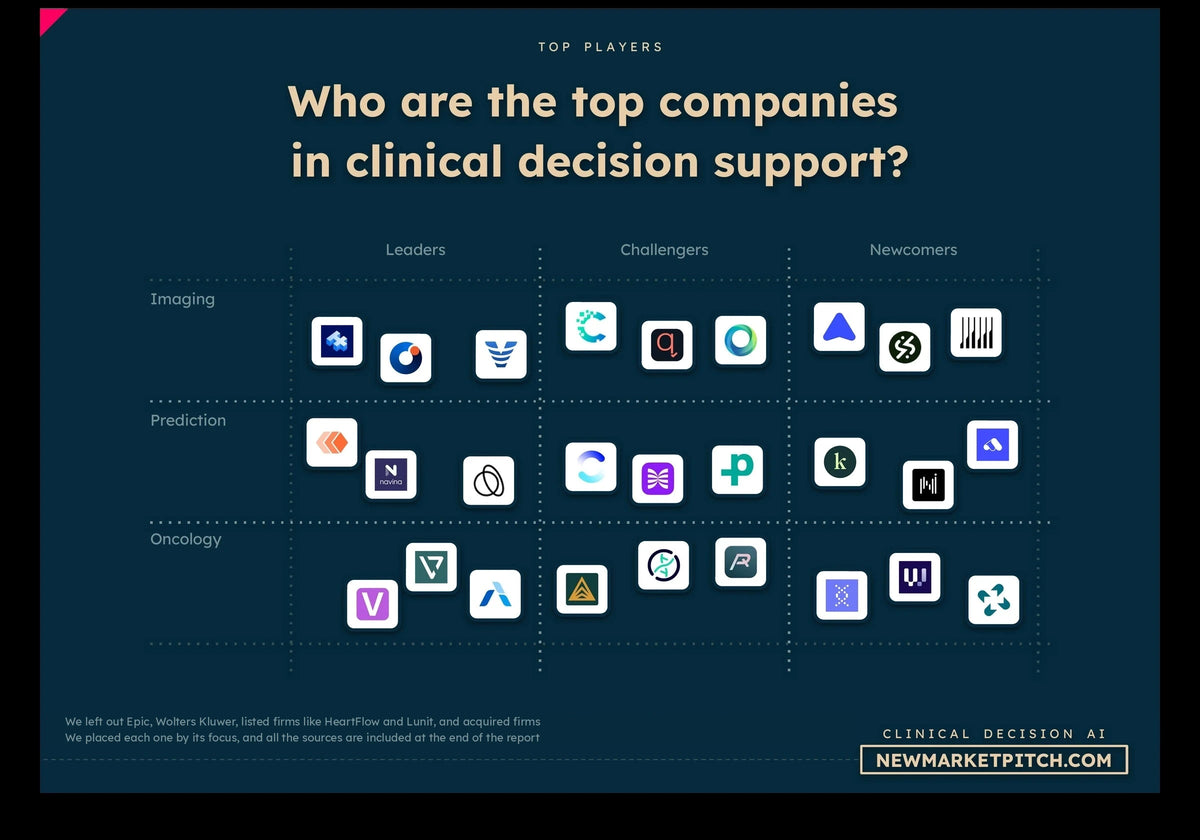
In our research about clinical decision support tools, we turn what is vague and complex into simple, useful visuals. Market maps like this one show you at a glance where every startup stands.
Which clinical decision support startups have raised the most money?
OpenEvidence, Aidoc and Cleerly lead clinical decision support fundraising, with $985 million, $524 million and $387 million raised respectively. The gap between these three companies and the rest of the market is substantial: OpenEvidence has raised almost twice as much as Aidoc and about two and a half times as much as Cleerly.
The top ten companies have raised a combined $3.851 billion. OpenEvidence alone accounts for approximately 25.6% of that amount, while the five largest companies represent approximately 65.1%. Funding is heavily concentrated, even though the companies are developing products for very different parts of healthcare.
There are some interesting differences in how these businesses have raised their money. Aidoc has completed nine rounds, compared with four for Cleerly. DentalMonitoring has raised $307 million across five rounds, while Caresyntax has accumulated $303 million across seven. AMBOSS has raised $298 million, including a substantial €240 million financing transaction in March 2025.
The top ten also include companies working in very different areas, from medical knowledge and imaging diagnostics to surgical analytics and diabetes management.
| Rank | Startup | Total raised |
|---|---|---|
| 1 | OpenEvidence | $985M |
| 2 | Aidoc | $524M |
| 3 | Cleerly | $387M |
| 4 | DentalMonitoring | $307M |
| 5 | Caresyntax | $303M |
| 6 | AMBOSS | $298M |
| 7 | AliveCor | $284M |
| 8 | PathAI | $258M |
| 9 | Viz.ai | $254M |
| 10 | Shukun Technology | ~$251M |
Why is OpenEvidence attracting so much money from investors?
OpenEvidence has raised $985 million because it is building an AI-powered medical information platform with the potential to become a regular tool in physicians' daily work. Its five funding rounds include a $250 million Series E / Growth financing in September 2026, with Andreessen Horowitz and Byers Capital among its key investors.
The company's appeal is easy to understand. Doctors regularly need to check clinical guidelines, interpret medical research and compare treatment options. OpenEvidence brings these activities into an AI-powered interface designed specifically for healthcare professionals.
Its fundraising is particularly impressive compared with other physician knowledge platforms. AMBOSS has raised $298 million, Ada Health $193 million and Corti $92 million. OpenEvidence has therefore accumulated more than three times AMBOSS's funding and over five times Ada Health's.
The competition is getting more interesting, too. AMBOSS has been expanding its AI capabilities, including its AI Mode for clinical care, while general-purpose AI companies are also moving into healthcare. OpenEvidence will need to maintain physicians' trust as these alternatives improve.
Its funding position gives it considerable resources, but the bigger question is whether it can become part of routine clinical practice while maintaining the accuracy and reliability doctors expect. In medicine, a convincing answer is not enough if the underlying information cannot be trusted.

Your time is limited. In our market report about clinical decision support tools, we put numbers on each part of the market, so you can see where it makes sense to focus.
Is Aidoc better funded than other medical imaging AI startups?
Aidoc has raised $524 million, putting it comfortably ahead of the other medical imaging AI specialists in our ranking. Its nine funding rounds include a $150 million Series E in April 2026, led by Goldman Sachs Alternatives, with General Catalyst, SoftBank Vision Fund 2 and NVentures also participating.
The difference becomes clear when we compare Aidoc with its closest imaging competitors. Cleerly has raised $387 million, Harrison.ai $229 million, Infervision $213 million and Qure.ai $121 million.
Their products target different problems. Aidoc helps hospitals identify and prioritize potentially urgent findings in medical images. Cleerly specializes in coronary CT analysis, Harrison.ai develops AI-powered diagnostic support, and Qure.ai focuses on imaging applications such as detecting tuberculosis, lung cancer and stroke.
Aidoc's financing history is particularly interesting because it has attracted several large investors over multiple rounds. Its $150 million Series E followed another $150 million growth financing in July 2025, demonstrating that substantial capital continued to flow into the company across consecutive financing events.
The company is one of the strongest-funded businesses in medical imaging AI. Whether it delivers better diagnostic performance than its competitors is a separate question, and funding alone cannot answer it.
Which clinical decision support startups have raised more than $200 million?
Thirteen companies in our ranking have raised more than $200 million, ranging from OpenEvidence at $985 million to Infervision at $213 million. Together, they give a good indication of where investors have committed the largest amounts of capital.
The companies cover several distinct areas. OpenEvidence and AMBOSS focus on clinical information and physician support. Aidoc, Cleerly, PathAI, Viz.ai, Shukun Technology, Harrison.ai and Infervision concentrate on medical imaging or diagnostic applications.
DentalMonitoring develops AI-based orthodontic monitoring, Caresyntax works on surgical analytics, AliveCor specializes in personal ECG monitoring, and Glooko focuses on connected diabetes management.
The next funding tier is also worth watching. Anumana and Elucid have each raised $185 million, Overjet $174 million, Eko Health $164 million and CathWorks $151 million.
Investors are backing both broad clinical platforms and highly specialized medical technologies. The latter can attract substantial funding even when they address a much narrower group of healthcare professionals. A specialized diagnostic product can still represent a sizeable business if it solves an expensive clinical problem.

In our document detailing everything you need to know about clinical decision support, we always try to gather several sources and make estimates that make sense, so you can work with solid numbers.
Which clinical decision support companies have raised the largest funding rounds?
AMBOSS and OpenEvidence have the two largest latest financing transactions in our ranking, at $259 million and $250 million respectively. Aidoc follows with $150 million, while AliveCor also recorded a $150 million latest round.
AMBOSS's March 2025 financing was announced as a €240 million transaction involving KIRKBI, M&G Investments and Lightrock. OpenEvidence's September 2026 financing involved Andreessen Horowitz and Byers Capital.
Several other transactions stand out. Infervision raised approximately $95 million in its July 2021 Series D2, Harrison.ai secured $112 million in February 2025, and Cleerly raised $106 million in December 2024.
DentalMonitoring's $100 million growth equity financing in February 2026 is another important example. Its lead investor, Lazard Elaia Capital, announced that the company had achieved operational profitability in 2025, making the financing particularly interesting.
| Startup | Latest round | Amount | Date |
|---|---|---|---|
| AMBOSS | Late VC | $259M | March 2025 |
| OpenEvidence | Series E / Growth | $250M | September 2026 |
| Aidoc | Series E | $150M | April 2026 |
| AliveCor | Series F | $150M | August 2022 |
| Harrison.ai | Series C | $112M | February 2025 |
| Cleerly | Series C Extension | $106M | December 2024 |
| DentalMonitoring | Growth Equity | $100M | February 2026 |
| Anumana | Series C | $95M | April 2025 |
| Infervision | Series D2 | $94.9M | July 2021 |
| Caresyntax | Series C | $80M | August 2024 |
Which types of clinical decision support startups attract the most investment?
Medical imaging, clinical information platforms and cardiovascular diagnostics account for many of the largest funding totals in the market. Looking across the companies, there are several well-funded areas rather than one application attracting practically all the capital.
Medical imaging has some of the strongest individual fundraising histories. Aidoc has raised $524 million, Cleerly $387 million, PathAI $258 million, Viz.ai $254 million and Harrison.ai $229 million. Further down, Infervision has raised $213 million and Qure.ai $121 million.
Cardiovascular technology is another major category. AliveCor has raised $284 million, Anumana $185 million, Elucid $185 million, Eko Health $164 million and CathWorks $151 million.
Clinical knowledge platforms are particularly interesting because they can potentially reach a much broader physician audience. OpenEvidence has raised $985 million, AMBOSS $298 million and Ada Health $193 million.
Other specializations include pathology, surgical analytics, dental diagnostics, medication optimization and patient deterioration prediction. PathAI, Caresyntax, DentalMonitoring, MDI Health and AITRICS illustrate just how different the underlying products can be.
The investment opportunity is spread across several healthcare problems, from helping doctors interpret medical evidence to identifying disease earlier and improving treatment decisions. Imaging currently produces some of the largest fundraising stories, but the broader clinical software opportunity is considerably wider.

Our report covering the clinical decision support market gets updated several times a month, so you always get the latest view of where things stand.
Who are the biggest investors in clinical decision support startups?
Insight Partners, Andreessen Horowitz, Goldman Sachs, General Catalyst and several healthcare-focused investors appear among the important names in clinical decision support financing. Their investments cover different types of companies, suggesting that the market attracts both general technology investors and specialists with healthcare experience.
Insight Partners has backed Cleerly, Proscia and ScreenPoint Medical. These companies work in cardiovascular imaging, digital pathology and breast cancer imaging analysis.
Goldman Sachs has participated in Aidoc and Navina, while Andreessen Horowitz appears among the investors in OpenEvidence and Bayesian Health.
Healthcare and medical technology companies are also active. GE Healthcare has invested in AliveCor, Boston Scientific in Anumana, and Medtronic in CathWorks. Siemens Healthineers is among the investors in ScreenPoint Medical, while Omron Healthcare has backed Tricog Health.
The involvement of established organizations is particularly interesting. They understand hospital purchasing, clinical workflows and medical technology distribution, which can be difficult for young software companies to navigate independently.
There is also a distinction between financial and strategic investment. A venture capital firm may primarily seek financial returns, while a medical technology company may see an investment as a way to gain access to complementary technology or future acquisition opportunities. That strategic interest can become valuable when a startup is trying to move from a promising product to large-scale hospital deployment.
Which clinical decision support startups are attracting the most investment in Europe?
DentalMonitoring and AMBOSS are two of Europe's largest clinical decision support fundraising success stories, with $307 million and $298 million raised respectively. Germany and France have particularly strong representation, although the United Kingdom, Denmark, Ireland, the Netherlands and Poland also have funded companies in the market.
Germany's largest companies include AMBOSS, Ada Health ($193 million), Aignostics ($55 million), Clinomic ($51 million) and deepc ($30 million). Their products range from medical knowledge and symptom assessment to computational pathology and intensive-care decision support.
France has DentalMonitoring at $307 million, followed by Volta Medical at $74 million or more, Implicity at $68 million and Incepto Medical at $36 million. DentalMonitoring's February 2026 financing is especially interesting because the company reported achieving operational profitability in the preceding year.
The United Kingdom has developed a strong specialist group. Ultromics has raised $115 million, Perspectum $91 million, Brainomix $62 million, Hypervision Surgical $30 million, Optellum $30 million and Skin Analytics $29 million. Ireland's Deciphex has raised $57 million, while Denmark's Corti has raised $92 million.
These companies are working on very different clinical problems, but European fundraising is clearly not limited to general medical software. Diagnostic imaging, pathology, cardiovascular AI and specialist clinical applications have all attracted meaningful investment.

In our research about clinical decision support tools, we look at what the winners do differently, so you can learn from the best instead of guessing.
Which clinical decision support startups are attracting the most investment in Asia?
China has several of the most heavily funded clinical decision support startups in Asia, led by Shukun Technology at approximately $251 million and Infervision at $213 million. Both companies focus on AI-powered medical imaging and diagnostics.
Other Chinese companies include Keya Medical, with at least $110 million raised, Huimei Technology at $109 million and Deepwise at $121 million. Their products cover cardiovascular imaging, clinical decision support and AI-assisted medical imaging diagnostics.
Japan is represented by AI Medical Service, which has raised $124 million across four rounds. The company develops AI-based endoscopy diagnostic support, focusing on a specialized area of medical imaging.
India has Qure.ai at $121 million and Tricog Health at $24 million. Qure.ai develops imaging AI for applications including tuberculosis, lung cancer and stroke, while Tricog Health focuses on ECG interpretation and cardiac monitoring.
South Korea has AITRICS, with $61 million raised, and Hutom, with $57 million. AITRICS develops technology to predict patient deterioration, while Hutom focuses on surgical planning and navigation.
The distribution is interesting because Asian clinical AI investment covers several different parts of healthcare. China has particularly strong representation in imaging, while Japan, India and South Korea have developed companies in endoscopy, cardiovascular monitoring, patient deterioration prediction and surgical applications.
Are US clinical decision support startups raising more money than companies in Europe and Asia?
US-based companies dominate many of the highest positions in our ranking, although several European and Asian startups have attracted comparable amounts of capital. OpenEvidence, Cleerly, Caresyntax, AliveCor, PathAI and Viz.ai occupy six of the first ten positions.
The US also has a strong presence further down the ranking. Anumana has raised $185 million, Elucid $185 million, Overjet $174 million, Eko Health $164 million, and CorVista Health and Digital Diagnostics $142 million each.
However, international competitors are substantial. Israel's Aidoc has raised $524 million, France's DentalMonitoring $307 million, Germany's AMBOSS $298 million and Australia's Harrison.ai $229 million.
China also has five companies above $100 million: Shukun Technology, Infervision, Keya Medical, Deepwise and Huimei Technology.
The geographical distribution shows that the United States has produced many of the largest individual fundraising stories, but clinical decision support is developing into an international market. European and Asian companies have demonstrated that they can attract substantial capital in specialized applications without necessarily building broad physician-facing platforms.

In our market report about clinical decision support tools, we don't want to repeat what boring consulting reports say. Instead, we show you the real and latest market signals that matter.
Which cardiovascular AI startups have raised the most money?
AliveCor leads cardiovascular-related fundraising in our ranking with $284 million, followed by Anumana at $185 million, Elucid at $185 million, Eko Health at $164 million and CathWorks at $151 million.
The companies work on different parts of cardiovascular care. AliveCor develops personal ECG monitoring technology, Anumana uses AI to detect disease through ECG analysis, and Elucid focuses on cardiovascular imaging.
Eko Health combines digital stethoscopes with AI-powered heart and lung detection, while CathWorks develops technology that helps physicians assess coronary physiology during procedures.
There is another group of specialist companies below the largest five. CorVista Health has raised $142 million, Volta Medical at least $74 million, Implicity $68 million, CathVision $36 million and Tricog Health $24 million.
The range of products is particularly interesting. Some companies focus on detecting abnormalities during an initial examination, others monitor patients remotely, and others support decisions during specialist cardiovascular procedures.
This gives cardiovascular AI several routes to commercialization. Companies can sell monitoring devices, diagnostic software, hospital platforms or technology integrated into medical procedures. They are not necessarily competing for the same hospital budgets, even when they operate in the same broad category.
Which pathology AI startups have raised the most funding?
PathAI leads the pathology AI group in our ranking with $258 million raised, followed by Proscia and Scopio Labs at $129 million each. Ibex Medical Analytics has raised $107 million, Deciphex $57 million and Aignostics $55 million.
PathAI's fundraising history includes a $165 million Series C in May 2021, co-led by D1 Capital Partners and Kaiser Permanente. This was a particularly large financing transaction for digital pathology, helping the company expand its technology and commercial activities.
The other companies have different areas of specialization. Proscia develops digital pathology software, Ibex Medical Analytics focuses on AI-assisted cancer pathology diagnosis, and Scopio Labs applies AI to digital blood cell analysis.
Aignostics works on computational pathology, combining digital tissue imaging with AI-based analysis. Deciphex also focuses on digital pathology diagnostics, while its business includes applications in pathology services.
These companies are benefiting from the broader shift toward digital pathology, where tissue samples can be scanned and analyzed using software. AI can help pathologists identify patterns and process large quantities of information, although clinical validation and integration into laboratory workflows remain essential.

Learning from others' mistakes is the cheapest lesson there is. In our document detailing everything you need to know about clinical decision support, we look at what broke startups before you, so you don't repeat it.
Which clinical decision support startups are working on cancer detection?
PathAI, ArteraAI and Ibex Medical Analytics are among the most heavily funded cancer-related clinical decision support companies in our ranking, with $258 million, $110 million and $107 million raised respectively.
Their technologies cover different stages of cancer care. PathAI and Ibex Medical Analytics focus on pathology, helping analyze tissue samples and identify potential signs of disease. ArteraAI develops predictive tests intended to support cancer treatment decisions.
Other companies are addressing specific cancers and diagnostic methods. Clairity has raised $73 million for image-based cancer risk prediction, while Optellum has raised $30 million for AI lung cancer risk prediction.
Skin Analytics has raised $29 million for autonomous AI skin cancer detection, and Avenda Health has raised $21 million for AI-guided prostate cancer treatment.
The differences are important because cancer decision support covers much more than identifying a suspicious scan. Some products help assess risk before diagnosis, others support pathology interpretation, and others help clinicians select treatment options.
The range of applications gives specialist companies opportunities to build products around individual cancers and clinical workflows rather than competing directly with every general-purpose medical AI platform.
Are doctors actually using AI clinical decision support tools today?
Doctors are increasingly using AI in their work, but adoption of clinical decision support remains less advanced than the broader use of AI for documentation, research and administrative tasks.
Doximity's 2026 State of AI in Medicine report surveyed 3,151 US physicians across 15 specialties. It found that 54% were already using AI in their clinical practice, compared with 47% in its earlier survey period. The proportion rose to 63% in the later survey cohort.
The same report found that 94% of surveyed physicians were either using AI or interested in doing so. That is a strong indication of physician interest, although it should not be interpreted as 94% actively using clinical decision support software.
Hospital adoption presents a more cautious picture. Eliciting Insights surveyed 120 health systems in February 2026 and found that 75% had implemented at least one AI solution. However, only 28% had implemented or planned to implement AI clinical decision support.
By comparison, 68% had implemented or planned to implement clinical note-taking and ambient listening solutions.
The difference is striking. Hospitals are adopting AI for tasks such as documentation relatively quickly, while software that directly influences clinical recommendations faces a higher bar. Accuracy, responsibility for decisions, regulatory requirements and physician trust all play a role.

If you build or invest in the clinical decision support market, you need to know which business models pay off now and which ones are fading. That's why our report covering it has a whole section on it.
Can clinical decision support startups become essential hospital software?
Yes, and the strongest opportunity is probably with products that become part of everyday clinical workflows rather than occasional standalone tools.
Caresyntax develops surgical analytics and decision support, EvidenceCare provides EHR-integrated clinical decision support, Clinomic focuses on intensive-care decision support, and Navina develops clinical intelligence for primary care.
These businesses are addressing specific operational problems inside healthcare organizations. Their products can potentially become part of the systems doctors use to review patients, interpret information and decide what to do next.
Medical imaging companies have a similar opportunity. Aidoc, Viz.ai and Qure.ai develop products that support the identification and prioritization of medical findings. Their usefulness depends partly on how well their software integrates with existing imaging systems and hospital communication processes.
The challenge is that healthcare technology environments are fragmented. Hospitals use different electronic health records, imaging systems and clinical protocols. A product that works well in one hospital may require substantial additional integration before it can be deployed elsewhere.
This creates an advantage for companies that can demonstrate reliable integration and repeatable implementation. A clinically useful product that takes months of customization at every hospital will have a harder time expanding than one that fits naturally into existing workflows.
Which clinical decision support startups have raised money most recently?
OpenEvidence, Elucid, Implicity, Aidoc and DentalMonitoring are among the companies with particularly significant recent financing transactions in our ranking.
OpenEvidence raised $250 million in September 2026, while Elucid secured $55 million through a Series D during the same month. Implicity also raised $40 million in growth equity in September 2026.
Aidoc's $150 million Series E in April 2026 and DentalMonitoring's $100 million growth equity financing in February 2026 are two other major transactions.
There has also been activity among smaller companies. Healthleap raised $30 million in October 2026, Vera Health raised $29 million in the same month, and Optain secured $7 million through a Series A Extension.
Other recent rounds include Eolas Medical's $12 million Series A in June 2026, Brainomix's $7 million Series C Extension in February 2026 and Hypervision Surgical's approximately $22 million Series A in April 2026.
The variety of these transactions is worth watching. Funding is still reaching companies working on physician-facing AI, medical imaging, cardiovascular diagnostics, surgical applications and inpatient screening.
The latest financing activity also shows why round size and cumulative funding should be kept separate. A relatively young company can raise a large Series A without approaching the historical fundraising totals of more established competitors.

In our research about clinical decision support tools, we like to show you the big picture. We know your time is precious, so we make every page quick to read and packed with as much learning as possible per minute.
Are clinical decision support startups still raising large Series A and Series B rounds?
Yes. Clinical decision support companies are still attracting substantial early- and mid-stage financing, especially when they develop specialist medical technologies with clear clinical applications.
Quibim has raised $66 million in total, including a $50 million Series A in January 2025. VieCure has raised $113 million across three rounds, while its January 2026 growth equity financing brought in $43 million.
Hypervision Surgical has raised $30 million, including approximately $22 million in its April 2026 Series A. Healthleap has raised $38 million, with a $30 million Series A in October 2026.
Other examples include MDI Health, which has raised $27 million, and Skin Analytics, with $29 million. Both operate in specialist clinical applications rather than broad physician information platforms.
These rounds can be substantial because medical AI startups often need to fund product development, clinical validation, regulatory work and hospital integration before they can generate significant commercial revenue.
However, a large Series A does not automatically mean that a company has established a scalable business. We still need to see whether the product can secure repeat customers and expand across healthcare organizations.
What are the biggest regulatory challenges for clinical decision support startups?
The biggest regulatory challenge for clinical decision support startups is determining when their software is treated as a medical device and what evidence they need to demonstrate before it can be marketed.
The FDA published its final Clinical Decision Support Software guidance in January 2026, clarifying how it interprets the statutory criteria for certain software functions that are excluded from the medical device definition.
The distinction is particularly important for AI companies. Software that presents medical information or recommendations that a healthcare professional can independently review may qualify for different treatment from software that directly analyzes medical images or generates diagnostic outputs.
Companies such as OpenEvidence and AMBOSS therefore face a different regulatory context from businesses developing AI-powered diagnostic imaging products such as Aidoc, Cleerly and PathAI.
The FDA's guidance also makes clear that software functions meeting the definition of a medical device remain subject to the relevant medical device policies. Calling a product clinical decision support software does not automatically exempt it from regulation.
This can create a substantial development burden for specialist diagnostic companies. They must establish clinical performance, document intended use and meet applicable regulatory requirements before expanding into certain markets.
For investors, regulatory progress is an important part of assessing clinical AI businesses, particularly those whose recommendations can directly influence diagnosis or treatment.

When you build or invest in the clinical decision support market, you need clarity, not confusion. In our market report about clinical decision support tools, we always try to put numbers on and quantify whatever is usually vague and confusing.
Which clinical decision support startups have already been acquired?
CathWorks, Gleamer and Visiopharm are three acquired companies in our ranking, and their histories show how specialist clinical technologies can become part of larger healthcare businesses.
CathWorks has raised $151 million across four rounds. Medtronic completed its acquisition in April 2026, following a strategic partnership that began in 2022. The acquisition was valued at $585 million, with additional potential earn-out payments.
Gleamer has raised $40 million across four rounds and is now part of DeepHealth, following RadNet's acquisition in March 2026. The French company develops AI-powered radiology software, including tools for fracture detection and medical imaging interpretation.
Visiopharm has raised at least $15 million and was acquired by Grundium in May 2026. The transaction brought together Grundium's digital slide scanning technology and Visiopharm's AI-powered precision pathology software.
These acquisitions show how clinical decision support technology can fit into the portfolios of larger healthcare businesses. Medtronic can integrate CathWorks into its cardiovascular offering, while DeepHealth and Grundium can combine specialist imaging software with broader diagnostic infrastructure.
The companies remain part of our historical fundraising ranking because their financing as startups is still relevant, even though they no longer operate as independent businesses.
What are the biggest risks for clinical decision support startups?
Clinical accuracy, physician trust, hospital adoption and regulatory requirements are the biggest challenges facing clinical decision support startups. A company can develop an impressive AI product and still struggle to turn it into a widely used clinical tool.
Accuracy is particularly important. An incorrect recommendation can influence a diagnosis, delay treatment or lead to unnecessary investigations. Healthcare providers need evidence that the software works reliably in the specific clinical setting where it will be used.
Doximity's 2026 physician survey found that 71% of surveyed doctors identified the accuracy and reliability of AI-generated outputs as a concern. This is a significant obstacle for companies trying to establish trust in clinical applications.
Hospital adoption is another difficulty. The Eliciting Insights survey found that only 28% of surveyed health systems had implemented or planned to implement AI clinical decision support, compared with 68% for ambient clinical note-taking and listening.
Regulation adds further complexity, particularly for companies developing diagnostic software and medical devices. They may need clinical evidence and regulatory clearance before expanding into certain applications.
Finally, startups face competition from established EHR providers, medical technology companies and general-purpose AI platforms. Companies such as OpenEvidence, Aidoc and PathAI must demonstrate why healthcare providers should adopt their products rather than rely entirely on existing systems or competing solutions.

A good product starts with a real problem. In our document detailing everything you need to know about clinical decision support, we show you the ones customers still live with.
Which clinical decision support startups are best positioned for long-term growth?
OpenEvidence, Aidoc, AMBOSS, Cleerly and PathAI have some of the strongest starting positions because they have attracted substantial financing and operate in important clinical applications. However, their long-term prospects will depend on adoption, clinical evidence and the ability to generate sustainable revenue.
OpenEvidence has a broad physician-facing proposition, while AMBOSS combines medical knowledge with clinical decision support. Their potential reach is considerable because physicians regularly need reliable information across a wide range of medical specialties.
Aidoc and Cleerly have more specialized propositions in medical imaging and cardiovascular diagnostics. PathAI and Proscia operate in digital pathology, while DentalMonitoring has developed a specialist orthodontic monitoring business.
Some smaller companies also deserve attention. Anumana and Eko Health address cardiovascular diagnostics, AITRICS focuses on predicting patient deterioration, and Ultromics develops AI cardiac ultrasound diagnostics.
The commercial differences between these businesses are considerable. A physician information platform may scale through software subscriptions and broad adoption, while a diagnostic imaging company may need regulatory clearance, hospital integration and specialized clinical partnerships.
We would therefore pay particular attention to evidence of repeat usage, hospital deployments, clinical validation and revenue growth. The largest funding total gives a company financial resources, but it does not guarantee that it will become the strongest long-term competitor.
Which clinical decision support startups should investors watch?
Investors should follow companies that combine a clear clinical application with a realistic route to adoption in hospitals, medical practices and diagnostic centers.
At the larger end, OpenEvidence, Aidoc, Cleerly, DentalMonitoring and AMBOSS are particularly important because of their fundraising scale and their positions in physician support, imaging diagnostics and specialist monitoring.
PathAI, Viz.ai, Harrison.ai and Anumana are also worth following. They address established healthcare problems where improvements in diagnostic speed, accuracy or workflow efficiency can have meaningful value.
There are interesting opportunities further down the ranking. Healthleap develops AI screening for undiagnosed inpatient conditions, Optain focuses on retinal screening for systemic disease, and Hypervision Surgical applies hyperspectral imaging to surgery.
The acquired companies CathWorks, Gleamer and Visiopharm are also useful examples of how clinical technology can attract strategic buyers.
For investors, the most useful distinction is between capital raised and commercial progress. A company with $100 million in funding and strong hospital adoption may be more attractive than a much better-funded competitor that has yet to establish a repeatable sales model.

In our report covering the clinical decision support market, we try to remove everything that could confuse you, especially if you're investing or building in this market.
Which clinical decision support startups have raised the most funding overall?
OpenEvidence leads clinical decision support fundraising with $985 million, followed by Aidoc at $524 million and Cleerly at $387 million. Our ranking shows that investment is concentrated among a small number of heavily financed companies, although the wider market includes dozens of businesses addressing different clinical problems.
The top ten have raised $3.851 billion combined, and the five largest account for approximately 65.1% of that total. OpenEvidence's position is particularly striking, but Aidoc, Cleerly, DentalMonitoring, Caresyntax and AMBOSS also demonstrate that substantial capital is available across several different applications.
Medical imaging and diagnostics have produced some of the largest funding totals, with cardiovascular AI and digital pathology also attracting considerable investment. Physician-facing knowledge platforms have become another important category, led by OpenEvidence and AMBOSS.
The geographical picture is similarly diverse. US startups occupy many of the highest positions, but Aidoc, DentalMonitoring, AMBOSS, Harrison.ai and Shukun Technology demonstrate the strength of international competition.
Our overall judgment is that clinical decision support has become a serious investment category, with several companies now attracting hundreds of millions of dollars. The next stage will be decided by which businesses can turn that funding into products that doctors trust, hospitals adopt and healthcare organizations are willing to pay for over the long term.
Our methodology
This analysis ranks startups in the clinical decision support market by cumulative funding raised. We focus on companies developing technologies that support medical decisions, including medical imaging, diagnostic AI, clinical knowledge platforms, digital pathology, cardiovascular monitoring, surgical analytics and treatment recommendations.
We include companies that subsequently went public or were acquired, since their earlier startup financing remains relevant to their funding histories. Large established healthcare groups and divisions of larger companies are excluded. Cumulative funding figures focus on equity financing, with debt, grants and other non-equity funding excluded.
We examine individual financing rounds, including their amounts, dates, financing types and participating investors. Where a transaction combines equity and debt, we distinguish the equity component rather than treating the entire headline financing as equity. We also account for subsequent financing activity when assessing each company's total.
Our research prioritizes company announcements, investor disclosures, regulatory publications, official press releases and reputable financial and healthcare industry reporting. Key sources include Becker's Hospital Review on OpenEvidence's September 2026 financing, Aidoc's Series E announcement, Cleerly's financing announcement, Lazard Elaia Capital on DentalMonitoring's investment, and AMBOSS's €240 million financing announcement.
Additional financing sources include Caresyntax's funding announcement, PathAI's Series C announcement, Viz.ai's Series D announcement, Harrison.ai's Series C announcement, AliveCor's Series F announcement and Qure.ai's Series D announcement.
For company developments and market adoption, we also consulted Medtronic's CathWorks acquisition announcement, DeepHealth's announcement on Gleamer, Visiopharm's acquisition announcement, the FDA's Clinical Decision Support Software guidance, Eliciting Insights' February 2026 health system AI adoption survey and Doximity's 2026 State of AI in Medicine report.
Written by the New Market Pitch teamWe track new markets so founders and investors can move faster. About us