What’s the latest funding news in the construction robotics market? (October 2026)
Whether you're building or investing in the construction robotics market, our report covers everything you need to know: the players, the money, and what's coming next.
Construction robotics funding reached approximately $919 million across 12 reported startup financing announcements between November 2025 and October 2026, including one cumulative funding disclosure.
Investors backed everything from autonomous excavators and robotic bricklayers to 3D building printers, solar installation systems and robots that finish interior walls.
The largest confirmed round was Bedrock Robotics' $270 million Series B, while Origin and ICON announced the two most recent funding events in October 2026.
And if you want to better understand this new industry, you can download our pitch covering the construction robotics market.
Insights
- Four companies, Bedrock Robotics, ICON, Gravis Robotics and TerraFirma, accounted for $770 million, or about 84% of the reported funding. Investors clearly favored construction robotics platforms capable of transforming large-scale building and infrastructure operations.
- Autonomous earthmoving was particularly attractive. Bedrock Robotics, Gravis Robotics and TerraFirma secured $570 million combined, showing how excavators, bulldozers and loaders have become a major investment focus within construction automation.
- Eleven of the 12 identified announcements occurred in 2026. This concentration suggests strong recent investor activity, although a selected funding shortlist cannot establish the growth rate of the entire global construction robotics market.
- October 2026 brought two very different announcements. ICON secured $200 million to expand robotic building production, while Origin disclosed $20 million in cumulative funding to scale robots for interior finishing and drywall work.
- Not all construction robots operate on traditional building sites. Planted raised $31.8 million for robotic solar infrastructure installation, illustrating how construction automation increasingly supports energy projects and data-center-related power demand.
- Commercial maturity varies considerably. ICON and Monumental already have substantial real-world construction experience, while All3, Sitegeist and Buildroid's originally announced robotics platform represent earlier stages of technical validation and deployment.
- Large funding announcements do not always reveal company valuations. Bedrock Robotics disclosed a $1.75 billion valuation, while Gravis Robotics was reported to exceed $1 billion; most other startups did not publish precise valuations.
- European startups represented five of the 12 companies, spanning Swiss earthmoving and reinforcement robots, Dutch bricklaying systems, British building assembly and German concrete renovation. The opportunities extend well beyond the United States.
- Funding totals need careful interpretation. Excluding Origin's $20 million cumulative disclosure, the remaining reported financing amounts equal approximately $899 million, including approximate currency conversions for MESH and Sitegeist.
- Pure-player classification also matters. August Robotics operates across construction and exhibition markets, while Buildroid's current website emphasizes metal fabrication rather than its originally announced blocklaying robots, making their construction-robotics concentration less certain.

Written by the New Market Pitch teamWe track new markets so founders and investors can move faster. About us

In our report covering the construction robotics market, you will always find fresh funding data, taken straight from our own verified funding database.
Summary table of the latest funding deals in the construction robotics market as of October 2026
We define the construction robotics market as robots and autonomous machines that perform construction-site or building-production tasks.
We include robotic excavation, layout, installation, bricklaying and construction-specific fabrication systems.
We exclude general construction software, conventional machinery and robots used only for unrelated manufacturing.
| Name | When | Amount in $ | Round Type | Category |
|---|---|---|---|---|
| Origin | October 15, 2026 | $20M total funding* | Undisclosed | Interior Finishing Robotics |
| ICON | October 13, 2026 | $200M | Series D | Robotic 3D Construction Printing |
| Planted | September 15, 2026 | $31.8M | Series B | Robotic Solar Infrastructure Installation |
| Gravis Robotics | August 17, 2026 | $200M | Series A | Autonomous Earthmoving & Excavation |
| Monumental | July 15, 2026 | $32M | Series B | Robotic Bricklaying & Masonry |
| TerraFirma | July 14, 2026 | $100M | Series A | Remote & Autonomous Construction Machinery |
| August Robotics | May 21, 2026 | $30M | Series B | Robotic Drilling & Construction Layout |
| All3 | April 29, 2026 | $25M | Seed | Robotic Building Assembly |
| MESH | March 26, 2026 | Approx. $3.8M | Seed | Robotic Rebar & Reinforcement Fabrication |
| Sitegeist | February 16, 2026 | Approx. $4.75M | Pre-seed | Concrete Renovation Robotics |
| Bedrock Robotics | February 4, 2026 | $270M | Series B | Autonomous Heavy Construction Equipment |
| Buildroid AI | November 24, 2025 | $2M | Pre-seed | Robotic Blocklaying & Construction Automation |
* Origin announced $20 million in cumulative funding rather than a separately verified latest-round amount. TerraFirma's $100 million Series A excludes earlier financing included in its $115 million cumulative announcement. Bedrock Robotics' reported October Series C fundraising was not treated as completed financing.
All the latest funding deals in the construction robotics market as of October 2026
Origin announced $20 million in total funding in October 2026 to expand its construction robotics platform.
When was it?
Origin announced its funding and emergence from stealth on October 15, 2026.
Who are they?
Origin develops OG-1, a mobile robot that applies drywall compound, sands surfaces and primes walls on construction sites.
Geographical focus?
Origin has India-linked founders and targets construction contractors in the United States and Europe, with additional pilots planned in Saudi Arabia.
Why do we include them in the construction robotics market?
Origin directly automates interior construction tasks for finishing contractors, making its mobile robotic system a strong fit for the construction robotics market.
What is the company stage?
Origin is in early commercialization, with working robots, contractor pilots and plans to expand its deployed fleet.
How much did they raise?
Origin disclosed $20 million in total funding, although the amount attributable to its latest individual financing was not separately verified.
What round is it?
Origin announced its funding during its stealth exit, with Accel and Zacua Ventures as co-leads, but did not clearly disclose a standalone round classification.
Why did they raise?
Origin plans to manufacture approximately 150 robots by the end of 2027, expand customer deployments and automate more interior construction trades.
ICON raised $200 million in October 2026 to scale robotic 3D printing for buildings.
When was it?
ICON announced its new financing on October 13, 2026.
Who are they?
ICON develops large robotic 3D printers that construct concrete walls and building structures directly from digital architectural designs.
Geographical focus?
ICON primarily operates in the United States, with international construction initiatives including projects in Mexico.
Why do we include them in the construction robotics market?
ICON belongs to the robotic construction fabrication category because its machines physically produce building structures rather than simply assisting with design.
What is the company stage?
ICON is in commercial growth, having completed more than 270 3D-printed buildings and begun rolling out its Titan construction printing system.
How much did they raise?
ICON secured $200 million in new financing, co-led by Baillie Gifford and funds managed by BlackRock.
What round is it?
ICON completed a Series D financing round.
Why did they raise?
ICON plans to manufacture more robotic construction systems, open an Austin research facility, improve its Titan and Olympus technologies and expand into additional American markets.

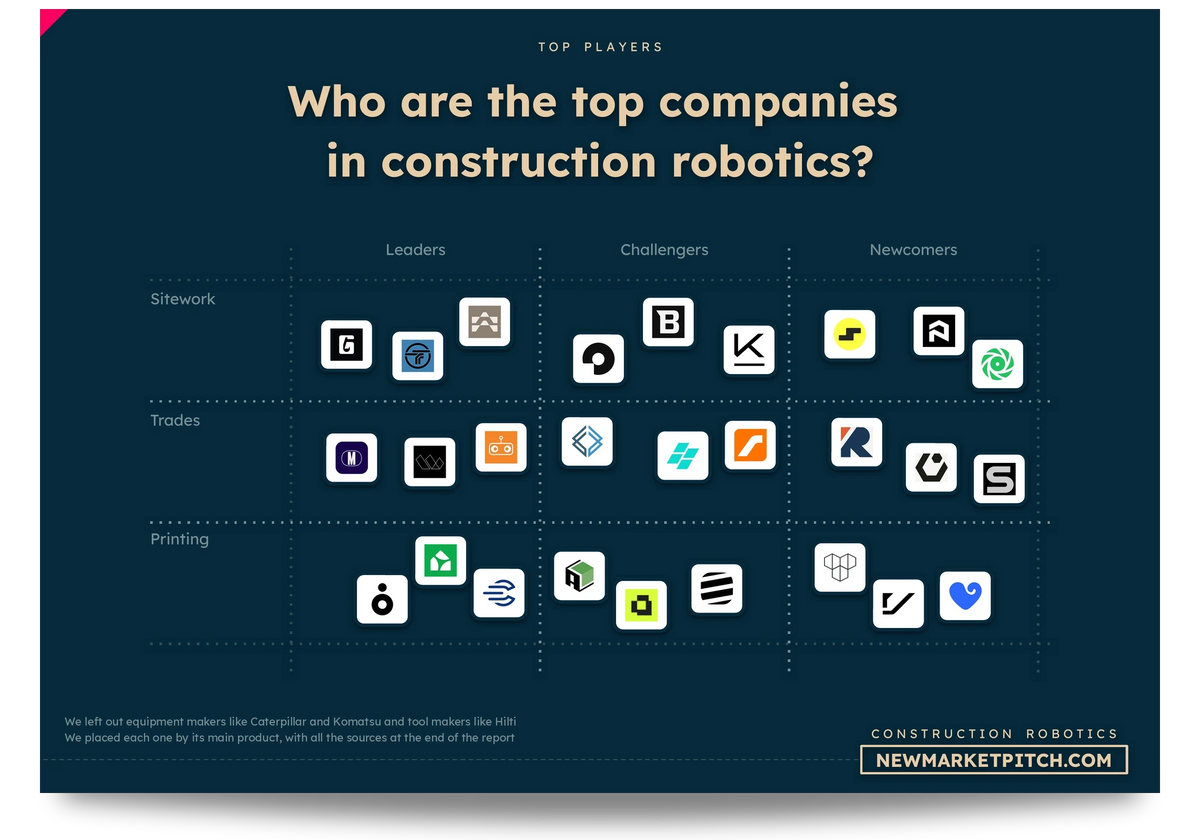
In our research about construction robots, we turn what is vague and complex into simple, useful visuals. Market maps like this one show you at a glance where every startup stands.
Planted raised $31.8 million in September 2026 to expand robotic solar construction.
When was it?
Planted announced its financing on September 15, 2026.
Who are they?
Planted develops autonomous installation robots and terrain-aware solar designs to build utility-scale solar infrastructure with less earthmoving.
Geographical focus?
Planted focuses on the United States, particularly utility-scale solar developments and projects serving growing electricity demand from data centers.
Why do we include them in the construction robotics market?
Planted qualifies through robotic infrastructure installation because its machines physically assemble solar structures at construction sites.
What is the company stage?
Planted is commercially scaling its robotic installation operations following field deployments and growing demand from solar developers.
How much did they raise?
Planted raised $31.8 million, co-led by Piva Capital and RA Capital Management's Planetary Health strategy.
What round is it?
Planted completed a Series B financing round.
Why did they raise?
Planted intends to expand its robotic installation fleet, introduce the next-generation Sage robot and serve more utility-scale solar projects.
Gravis Robotics raised $200 million in August 2026 to expand autonomous earthmoving technology.
When was it?
Gravis Robotics announced the investment on August 17, 2026.
Who are they?
Gravis Robotics develops retrofit hardware and AI software that allow excavators and heavy equipment to dig, load and move materials autonomously or under remote supervision.
Geographical focus?
Gravis Robotics is headquartered in Switzerland and is expanding deployments across Europe, the United Kingdom and the United States.
Why do we include them in the construction robotics market?
Gravis Robotics directly automates excavation and earthmoving activities, which are central physical tasks in construction and infrastructure development.
What is the company stage?
Gravis Robotics is in commercial expansion, with its autonomy systems already demonstrated and deployed in working construction and quarry environments.
How much did they raise?
Gravis Robotics secured $200 million from SoftBank to accelerate construction machine automation.
What round is it?
Gravis Robotics completed a Series A round, with investor-associated reporting placing its valuation above $1 billion.
Why did they raise?
Gravis Robotics plans to increase field deployments, develop its autonomy technology and expand internationally across major construction markets.

Your time is limited. In our market report about construction robots, we put numbers on each part of the market, so you can see where it makes sense to focus.
Monumental raised $32 million in July 2026 to deploy more autonomous bricklaying robots.
When was it?
Monumental announced its new funding on July 15, 2026.
Who are they?
Monumental designs and operates coordinated mobile robots that transport bricks, handle mortar and build masonry walls on live construction sites.
Geographical focus?
Monumental is based in the Netherlands and operates across European construction markets, particularly the Netherlands and United Kingdom, while expanding into the United States.
Why do we include them in the construction robotics market?
Monumental belongs to the robotic bricklaying and masonry category because its robots directly build walls for residential construction projects.
What is the company stage?
Monumental is commercially deployed, with a large operational robot fleet and experience contributing to the construction of approximately 100 homes.
How much did they raise?
Monumental secured approximately $32 million, equivalent to around €27 million, led by Khosla Ventures.
What round is it?
Monumental completed a Series B financing round.
Why did they raise?
Monumental plans to increase its robot fleet, strengthen engineering, serve more European construction sites and develop additional robotic construction capabilities.
TerraFirma raised $100 million in July 2026 to expand remotely operated and autonomous construction machinery.
When was it?
TerraFirma announced its financing on July 14, 2026.
Who are they?
TerraFirma develops technology that lets construction crews remotely control excavators, bulldozers and loaders while automating selected earthmoving workflows.
Geographical focus?
TerraFirma focuses on the United States, beginning with construction and infrastructure projects in Texas, while maintaining longer-term ambitions for extraterrestrial construction.
Why do we include them in the construction robotics market?
TerraFirma qualifies through semi-autonomous construction equipment and robotic earthmoving because its technology directly controls machinery performing construction tasks.
What is the company stage?
TerraFirma is in early commercial growth, using its technology on real construction projects while developing more capable autonomous machinery.
How much did they raise?
TerraFirma raised $100 million in its Series A, bringing reported cumulative funding to approximately $115 million.
What round is it?
TerraFirma completed a Series A round led by Kleiner Perkins, with participation from Bain Capital Ventures and other investors.
Why did they raise?
TerraFirma intends to hire engineering and construction teams, expand equipment deployments and improve its remote-operation and autonomous construction systems.

In our document detailing everything you need to know about construction robotics, we always try to gather several sources and make estimates that make sense, so you can work with solid numbers.
August Robotics raised $30 million in May 2026 to scale autonomous construction drilling robots.
When was it?
August Robotics announced its investment on May 21, 2026.
Who are they?
August Robotics develops autonomous mobile robots for precision drilling, floor marking and repetitive industrial layout tasks, including data-center construction.
Geographical focus?
August Robotics operates internationally, serving customers across Australia, the United States, Europe and Asia.
Why do we include them in the construction robotics market?
August Robotics qualifies through construction drilling and layout automation, although its exhibition robotics business makes its construction-specific market concentration less certain.
What is the company stage?
August Robotics is commercially scaling, with deployed robots and partnerships supporting precision drilling and industrial construction workflows.
How much did they raise?
August Robotics secured $30 million from investors led by Big Pi Ventures, alongside Blackbird, Skip Capital and other backers.
What round is it?
August Robotics completed a Series B financing round.
Why did they raise?
August Robotics plans to increase robot production, develop its AI software and accelerate international deployments, particularly in data-center construction.
All3 raised $25 million in April 2026 to develop autonomous building assembly robots.
When was it?
All3 announced its funding on April 29, 2026.
Who are they?
All3 develops Mantis, a legged construction robot designed to assemble buildings using specialized components produced through an integrated fabrication system.
Geographical focus?
All3 operates from the United Kingdom and targets European residential construction markets, including Germany.
Why do we include them in the construction robotics market?
All3 qualifies through autonomous building assembly and construction-specific fabrication because physical robotic execution is central to its proposed building process.
What is the company stage?
All3 is in advanced product development and early commercialization preparation, with its first major construction deployments being planned.
How much did they raise?
All3 raised $25 million in financing led by RTP Global, with participation from SuperSeed and other investors.
What round is it?
All3 completed a Seed financing round.
Why did they raise?
All3 plans to move its robotic building system into real-world deployment, improve component production and expand residential construction operations.

Our report covering the construction robotics market gets updated several times a month, so you always get the latest view of where things stand.
MESH raised approximately $3.8 million in March 2026 to automate construction reinforcement fabrication.
When was it?
MESH announced its financing on March 26, 2026.
Who are they?
MESH develops robotic fabrication systems that shape, position and assemble reinforcing steel for customized concrete structures.
Geographical focus?
MESH is headquartered in Switzerland and targets construction-component manufacturers and industrial partners across international markets.
Why do we include them in the construction robotics market?
MESH belongs to construction-specific robotic fabrication because its systems automate the physical production of reinforcement assemblies used in concrete buildings.
What is the company stage?
MESH is in early commercial scaling, turning robotic fabrication technology developed from academic research into industrial production systems.
How much did they raise?
MESH raised CHF 2.9 million, equivalent to approximately $3.8 million, with investors including Sika, ABB Robotics Ventures and Shimizu Corporation.
What round is it?
MESH completed a Seed financing round.
Why did they raise?
MESH plans to hire engineering and commercial employees, establish industrial partnerships and expand automated reinforcement manufacturing internationally.
Sitegeist raised approximately $4.75 million in February 2026 to automate concrete renovation tasks.
When was it?
Sitegeist announced its financing on February 16, 2026.
Who are they?
Sitegeist develops modular construction robots that remove damaged concrete, prepare surfaces and automate drilling and rehabilitation work.
Geographical focus?
Sitegeist is based in Germany and focuses on construction and infrastructure maintenance customers across European markets.
Why do we include them in the construction robotics market?
Sitegeist qualifies through robotic concrete rehabilitation because its machines physically perform difficult construction and renovation tasks for contractors.
What is the company stage?
Sitegeist is in early commercialization, with robotic systems designed for field testing and deployment by concrete renovation contractors.
How much did they raise?
Sitegeist raised €4 million, approximately $4.75 million, in financing co-led by b2venture and OpenOcean.
What round is it?
Sitegeist completed a Pre-seed financing round.
Why did they raise?
Sitegeist plans to hire engineers, manufacture additional robots and expand deployments for infrastructure repair and renovation work.

In our research about construction robots, we look at what the winners do differently, so you can learn from the best instead of guessing.
Bedrock Robotics raised $270 million in February 2026 to accelerate autonomous heavy construction machinery.
When was it?
Bedrock Robotics announced its completed financing on February 4, 2026.
Who are they?
Bedrock Robotics develops retrofit sensors, hardware and autonomy software that enable excavators, bulldozers and loaders to operate autonomously on construction sites.
Geographical focus?
Bedrock Robotics focuses on the United States, particularly large infrastructure projects, excavation sites and industrial construction operations.
Why do we include them in the construction robotics market?
Bedrock Robotics directly automates excavation and earthmoving, making autonomous heavy construction equipment its central product category.
What is the company stage?
Bedrock Robotics is in advanced commercial validation, with supervised autonomous excavation demonstrated at large construction sites and deployments expanding.
How much did they raise?
Bedrock Robotics raised $270 million at a disclosed $1.75 billion valuation, with the investment co-led by CapitalG and Valor Atreides AI Fund.
What round is it?
Bedrock Robotics completed a Series B round, while a reported $600 million Series C fundraising effort in October 2026 remained unconfirmed as completed.
Why did they raise?
Bedrock Robotics intends to scale autonomous equipment deployments, reduce the need for on-site operators and develop coordinated fleets of construction machines.
Buildroid AI announced $2 million in pre-seed funding in November 2025 for robotic blocklaying.
When was it?
Buildroid AI announced its financing and United States market launch on November 24, 2025.
Who are they?
Buildroid AI initially presented a simulation-first robotics platform for automated blocklaying, although its current website primarily promotes custom steel-parts fabrication.
Geographical focus?
Buildroid AI initially targeted construction customers in the United Arab Emirates and United States, following pilot activity in the UAE.
Why do we include them in the construction robotics market?
Buildroid AI qualified through its announced robotic blocklaying and masonry automation platform, although its current business positioning makes the ongoing construction-robotics focus uncertain.
What is the company stage?
Buildroid AI was at the prototype and pilot-validation stage for blocklaying robots when the investment was announced, before its website began emphasizing metal fabrication services.
How much did they raise?
Buildroid AI announced $2 million in funding led by Tim Draper.
What round is it?
Buildroid AI completed a Pre-seed financing round.
Why did they raise?
Buildroid AI originally planned to expand construction robotics pilots, improve autonomous blocklaying systems and validate commercial deployment in the UAE and United States.
Written by the New Market Pitch teamWe track new markets so founders and investors can move faster. About us