Construction robotics funding tracker (48 deals)
Whether you're building or investing in the construction robotics market, our report covers everything you need to know: the players, the money, and what's coming next.
Summary
Our construction robotics funding tracker (48 deals) shows a market attracting serious investment, with $1.224 billion raised by 41 companies between January 2024 and September 2026. But funding is extremely concentrated, and most construction robotics startups are raising nowhere near the amounts suggested by the industry's biggest announcements.
Just two companies, Bedrock Robotics and Gravis Robotics, account for $560.25 million, or 45.8% of recorded capital. The five largest recipients captured 66% of funding, and the top ten absorbed approximately 82%, leaving only about $221 million for the other 31 companies.
The typical disclosed financing was $10.8 million, compared with a $28.46 million average. Only six transactions exceeded $50 million, yet those six deals represented 64.1% of all measured funding. Without them, the market's recorded capital falls to roughly $440 million.
Autonomous earthmoving dominates the funding landscape, attracting $675.05 million across just eight deals. That's 55.2% of all recorded investment, largely reflecting investor appetite for technologies that could automate existing excavators and heavy-equipment fleets rather than individual construction tasks.
Robotic drilling and installation is actually the more active category by transaction count, with 11 deals involving nine companies. Infravision, Xpanner and Planted Solar illustrate how construction automation is expanding into power infrastructure, equipment retrofitting and solar-farm installation, even though the average checks are considerably smaller than in heavy-equipment autonomy.
Follow-on financing accounts for 77.1% of transactions but approximately 94% of recorded capital. First-time external financings had a median size of just $3.65 million, compared with $16.6 million for follow-ons. Investors are committing much more money to companies that have already begun developing and validating their technology.
The conventional late-stage funding ladder remains thin. We recorded 18 Seed rounds, 14 Series A rounds, nine Series B rounds and only one Series C. The shortage of later-stage transactions suggests that relatively few businesses have yet reached the financing scale typically associated with broad commercial expansion.
North America accounts for 67.4% of recorded funding, with $824.56 million across 23 deals. Europe follows at $333.29 million, although Gravis Robotics alone represents about two-thirds of that amount. Asia-Pacific has nearly as many deals as Europe, but five undisclosed amounts make its capital total particularly incomplete.
Industrial and strategic investors participated in 18 of the 48 financings, including investors connected to major equipment manufacturers, construction-materials companies and technology suppliers. Their involvement may help robotics startups reach customers and industrial partners, although the data does not establish that strategic backing produces better commercial outcomes.
The central challenge is turning technically successful robots into profitable, repeatable construction operations. Investors are already willing to finance ambitious automation platforms at enormous valuations and round sizes, but most companies still need to prove reliability, deployment economics and customer adoption before they can reach that scale. The $1.224 billion total is based on recorded amounts, with five undisclosed financings excluded.

Written by the New Market Pitch teamWe track new markets so founders and investors can move faster. About us

In our report covering the construction robotics market, you will always find fresh funding data, taken straight from our own verified funding database.
Our funding tracker covering the construction robotics market
Below is the table listing all the deals. You may find our methodology at the end of this page.
And, if you want to gain a deeper understanding of the market and its current dynamics, get our report covering the construction robotics market.
| Company | Category | Date | Stage | Deal size | What they do | Region | Lead investors | Country | Rank |
|---|---|---|---|---|---|---|---|---|---|
| Planted (Planted Solar) | Robotic Drilling & Installation | September 2026 | Series B | $31.8M | Develops and deploys autonomous field robots that install mounting structures and solar panels at utility-scale solar construction sites. | North America | Piva Capital; RA Capital Management (Planetary Health) | United States | |
| Reframe Systems | Construction Fabrication Robots | August 2026 | Unknown | $40M | Operates robotics-enabled microfactories that fabricate building components for residential construction. | North America | Energy Impact Partners | United States | |
| Gravis Robotics | Autonomous Earthmoving | August 2026 | Series A | $200M | Develops autonomous control systems and retrofit kits that enable excavators and other earthmoving machines to operate autonomously on construction sites. | Europe | SoftBank Group | Switzerland | |
| Fangshi Robotics (Beijing Fangshi Robotics Co., Ltd.; 北京方石机器人有限公司) | Painting & Finishing Robots | August 2026 | Series A | Not Disclosed | Develops construction-site robots for wall coating, surface treatment, concrete-floor finishing and tile installation. | Asia-Pacific | Jinan Quehua Sci-Tech Venture Capital | China | |
| Gritt | Robotic Drilling & Installation | July 2026 | Series A | $26M | Develops AI-controlled construction robots that attach to jobsite equipment to automate solar-panel installation and other material-handling tasks. | North America | Obvious Ventures | United States | |
| Hyperion Robotics | Construction 3D Printing | July 2026 | Unknown | $7.4M | Uses robotic concrete 3D printing and automated microfactories to manufacture construction foundations and infrastructure components. | Europe | Course Corrected; European Innovation Council Fund (EIC Fund) | Finland | |
| Kind Designs | Construction 3D Printing | July 2026 | Seed | $10M | Uses robotic large-format concrete 3D printing to manufacture living seawalls, marine infrastructure panels and reef structures. | North America | Not disclosed | United States | |
| Monumental | Bricklaying & Masonry Robots | July 2026 | Series B | $32M | Develops and operates autonomous mobile bricklaying robots that construct masonry walls on building sites. | Europe | Khosla Ventures | Netherlands | |
| TerraFirma | Autonomous Earthmoving | July 2026 | Series A | $100M | Develops and operates semi-autonomous excavators, dozers and other heavy equipment for construction earthworks and site preparation. | North America | Kleiner Perkins | United States | |
| Xpanner | Robotic Drilling & Installation | May 2026 | Series B | $18M | Develops retrofit robotic automation systems for construction equipment performing pile installation, material handling and earthworks. | North America | Korea Investment Partners | United States | |
| Fangshi Robotics (Beijing Fangshi Robotics Co., Ltd.; 北京方石机器人有限公司) | Painting & Finishing Robots | May 2026 | Series A | ≈$14M | Develops construction robots for concrete-floor leveling and trowelling, wall finishing, spraying and tile installation. | Asia-Pacific | Not disclosed | China | |
| Flo Mobility Private Limited | Autonomous Earthmoving | May 2026 | Seed | $2.5M | Develops autonomous mobile robots that transport heavy construction materials across active building sites and between floors. | Asia-Pacific | Mela Ventures; Arali Ventures | India | |
| All3 | Robotic Drilling & Installation | April 2026 | Seed | $25M | Develops autonomous robots for on-site building assembly integrated with robotic factories manufacturing construction components. | Europe | RTP Global | United Kingdom | |
| Crewline AI | Autonomous Earthmoving | April 2026 | Seed | $7.1M | Develops retrofit autonomous-driving systems for construction equipment, initially automating soil-compaction rollers. | North America | Initialized Capital; Nebular | United States | |
| Strata Robotics | Autonomous Earthmoving | April 2026 | Seed | $5.2M | Develops autonomous heavy-duty robots for material handling and transportation on construction sites. | North America | Founders Fund | United States | |
| MESH AG | Rebar & Concrete Robots | March 2026 | Seed | $3.8M | Develops robotic fabrication systems that automatically position, assemble, and join reinforcing steel for concrete construction and prefabrication. | Europe | Not disclosed | Switzerland | |
| Sitegeist GmbH | Rebar & Concrete Robots | February 2026 | Seed | ≈$4.8M | Develops autonomous modular robots that remove deteriorated concrete and perform abrasive blasting during construction and infrastructure renovation. | Europe | b2venture; OpenOcean | Germany | |
| Bedrock Robotics | Autonomous Earthmoving | February 2026 | Series B | $270M | Develops retrofit autonomy systems that enable excavators and other heavy construction machines to operate autonomously and as coordinated fleets. | North America | CapitalG; Valor Atreides AI Fund | United States | |
| Orcas Robot (湖州奥卡机器人有限公司) | Painting & Finishing Robots | January 2026 | Seed | ≈$1.4M | Develops autonomous robotic systems for concrete floor grinding, polishing, and surface preparation on construction projects. | Asia-Pacific | Not disclosed | China | |
| Polyuse Inc. (株式会社Polyuse) | Construction 3D Printing | December 2025 | Series B | $17.3M | Develops and deploys construction-specific robotic concrete 3D printers for civil infrastructure and building components. | Asia-Pacific | World Innovation Lab (WiL); Globis Capital Partners (GCP) | Japan | |
| Gravis Robotics | Autonomous Earthmoving | November 2025 | Seed | $23M | Develops retrofit AI, sensing and control systems that turn conventional excavators and earthmoving machinery into autonomous construction robots. | Europe | IQ Capital; Zacua Ventures | Switzerland | |
| Buildroid AI | Bricklaying & Masonry Robots | November 2025 | Seed | $2M | Develops robotic block-laying systems coordinated through construction-specific digital-twin simulations to automate masonry work. | North America | Tim Draper | United States | |
| Partner Robotics (湃特纳机器人) | Painting & Finishing Robots | November 2025 | Series A | Not Disclosed | Develops autonomous floor-tile paving and construction-layout marking robots for building sites. | Asia-Pacific | China Growth Capital | China | |
| Infravision, Inc. | Robotic Drilling & Installation | November 2025 | Series B | $91M | Develops drone-based robotic systems and automated ground equipment for installing electrical transmission lines during infrastructure construction. | North America | GIC | United States | |
| Verustruct | Construction 3D Printing | September 2025 | Seed | $2.4M | Develops gantry-less robotic construction systems using automated 3D-printing and slipforming methods to produce housing structures. | North America | Necessary Ventures; Anorak Ventures | United States | |
| LightYX | Robotic Layout & Surveying | September 2025 | Series A | $11M | Develops intelligent laser-projection and scanning systems that transfer construction plans onto site surfaces. | Middle East | NOVA by Saint-Gobain | Israel | |
| Mechasys | Robotic Layout & Surveying | August 2025 | Series A | $16.6M | Manufactures robotic laser projectors that display building plans at full scale on construction surfaces for site layout. | North America | Idealist Capital | Canada | |
| Raise Robotics | Robotic Drilling & Installation | July 2025 | Seed | $7.8M | Develops mobile construction robots for façade layout, drilling, bracket fastening, and installation tasks. | North America | MaC Venture Capital | United States | |
| Bedrock Robotics | Autonomous Earthmoving | July 2025 | Series A | $67.3M | Develops retrofit autonomous-driving systems for excavators and other heavy construction equipment. | North America | 8VC | United States | |
| Civ Robotics | Robotic Layout & Surveying | July 2025 | Series A | $7.5M | Develops autonomous ground robots that mark survey and layout coordinates directly on construction sites. | North America | AlleyCorp | United States | |
| AIM Intelligent Machines | Autonomous Earthmoving | June 2025 | Unknown | $50M | Retrofits bulldozers, excavators and construction/mining earthmoving equipment with AI-based autonomous fleet operation technology. | North America | Not disclosed | United States | |
| Automated Architecture (AUAR) | Construction Fabrication Robots | June 2025 | Unknown | ≈$6.9M | Develops deployable robotic micro-factories that fabricate timber-frame wall, floor, and roof panels for homebuilding. | Europe | Planet A | United Kingdom | |
| Cosmic Robotics | Robotic Drilling & Installation | April 2025 | Seed | $4M | Develops autonomous mobile robots that lift and install photovoltaic modules at utility-scale solar construction sites. | North America | Giant Ventures | United States | |
| Charge Robotics | Robotic Drilling & Installation | March 2025 | Series B | $22M | Builds mobile robotic factories that autonomously assemble and install solar-panel structures at utility-scale solar construction sites. | North America | Not disclosed | United States | |
| Apis Cor Inc. | Construction 3D Printing | March 2025 | Unknown | $920.6K | Develops mobile robotic concrete 3D printers for automated construction of building structures. | North America | Not disclosed | United States | |
| Guangdong Tianlin High-Tech Co., Ltd. (广东天凛高新科技有限公司) | Rebar & Concrete Robots | February 2025 | Seed | Not Disclosed | Develops robotic mobile production lines that automatically position, fabricate and cast building walls on construction sites. | Asia-Pacific | Qifu Capital | China | |
| ICON Technology, Inc. (ICON) | Construction 3D Printing | February 2025 | Series C | $56M | Develops large-scale robotic 3D-printing systems and materials for constructing buildings directly on site. | North America | Norwest Venture Partners; Tiger Global | United States | |
| Ken Robotech Co., Ltd. (建ロボテック株式会社) | Rebar & Concrete Robots | February 2025 | Series B | ≈$1.2M | Develops and deploys autonomous rebar-tying robots and construction-site material-handling robots under the TOMOROBO brand. | Asia-Pacific | Not disclosed | Japan | |
| Aridditive | Construction 3D Printing | November 2024 | Seed | ≈$537K | Develops automated concrete 3D-printing technology for manufacturing prefabricated construction components. | Europe | BeAble Capital | Spain | |
| Nanjing Zhuling Technology (南京筑领科技有限责任公司) | Painting & Finishing Robots | October 2024 | Seed | Not Disclosed | Develops autonomous construction robots for laying floor tiles and preparing mortar beds. | Asia-Pacific | Shunwei Capital | China | |
| Optimotive Technologies Inc. (Optimotive) | Robotic Layout & Surveying | September 2024 | Seed | $2M | Develops autonomous mobile robots for construction-site surveying, 3D data capture and repetitive jobsite operations. | North America | Version One Ventures | Canada | |
| Charge Robotics | Robotic Drilling & Installation | August 2024 | Series A | $17M | Builds autonomous robotic systems that assemble and install solar-panel structures at utility-scale solar construction sites. | North America | Not disclosed | United States | |
| Q-Bot Limited | Robotic Drilling & Installation | July 2024 | Unknown | $1.6M | Develops and deploys remotely operated robots that install spray-foam insulation underneath building floors. | Europe | EMV Capital | United Kingdom | |
| Fulltime Robotics (丰坦机器人; Hangzhou Fengtan Robot Co., Ltd.) | Painting & Finishing Robots | July 2024 | Series A | Not Disclosed | Develops construction robots that automate wall putty application, sanding, surface preparation and paint spraying. | Asia-Pacific | Century Golden Source | China | |
| Xpanner | Robotic Drilling & Installation | June 2024 | Series B | ≈$10.8M | Develops robotic retrofit controllers that automate excavation, grading, compaction and solar pile-driving equipment on construction sites. | North America | Korea Investment Partners | United States | |
| OKIBO | Painting & Finishing Robots | March 2024 | Unknown | $7.9M | Develops autonomous construction-site robots for painting, plastering, and drywall finishing. | Middle East | BitStone Capital; Shadow Ventures | Israel | |
| Automated Architecture (AUAR) | Construction Fabrication Robots | March 2024 | Seed | $3.3M | Develops robotic microfactories that cut and assemble timber components for modular residential buildings. | Europe | Miles Ahead | United Kingdom | |
| Monumental | Bricklaying & Masonry Robots | February 2024 | Series A | $25M | Develops autonomous mobile robots that transport materials and lay bricks and mortar on construction sites. | Europe | Plural; Hummingbird Ventures | Netherlands | |
| Agorus | Construction Fabrication Robots | January 2024 | Series A | $20M | Uses proprietary robotics and automated manufacturing systems to fabricate prefabricated wall, floor, and roof panels for residential construction. | North America | Toyota Ventures | United States |

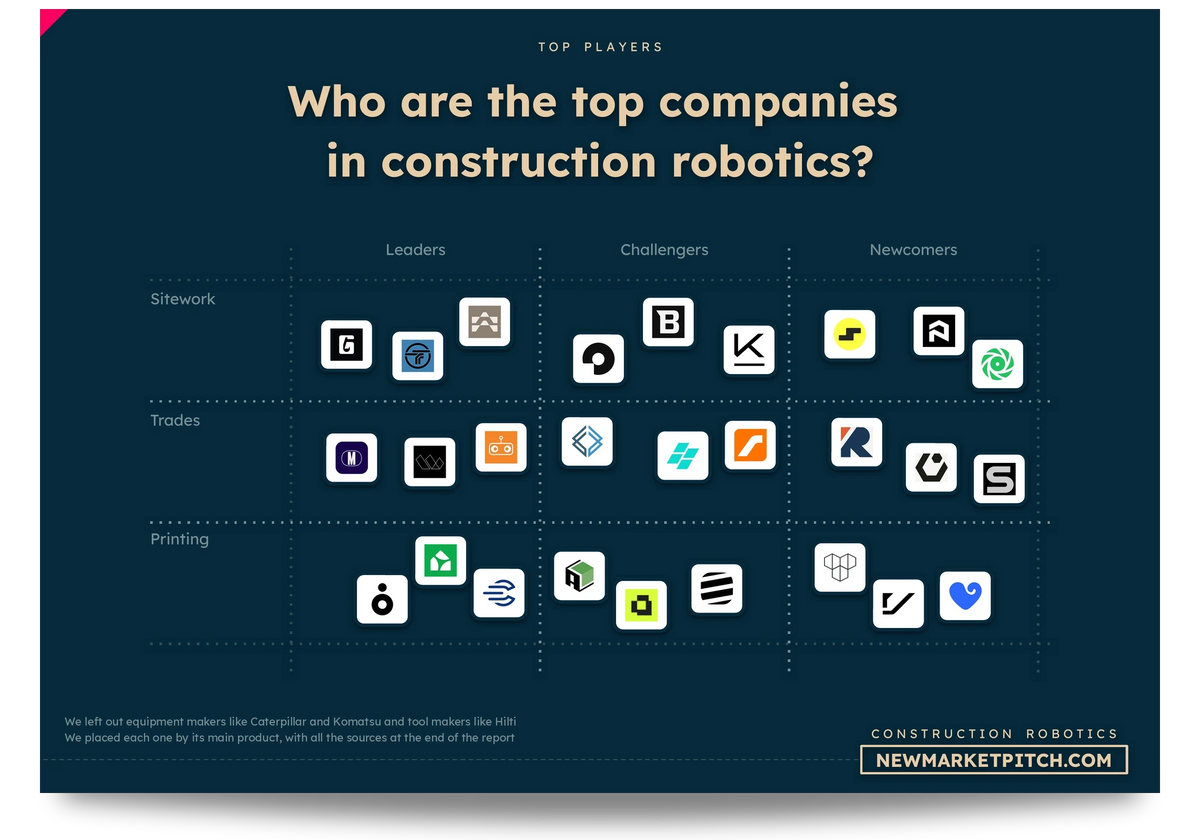
In our research about construction robots, we turn what is vague and complex into simple, useful visuals. Market maps like this one show you at a glance where every startup stands.
Is construction robotics actually attracting serious investment?
Construction robotics has attracted serious money, with $1.224 billion in recorded financing across 48 deals, but most of that money has gone to a surprisingly small group of companies.
We identified 41 companies that raised funding between January 1, 2024 and September 15, 2026. They work on everything from autonomous excavators and robotic bricklaying to 3D-printed homes, automated solar installation and construction-site surveying.
The difference in funding between these businesses is enormous. Bedrock Robotics raised $337.25 million across two rounds, while Gravis Robotics secured $223 million. Together, they attracted $560.25 million, close to half the capital we recorded across the entire market.
That leaves roughly $664 million for the other 39 companies. Construction robotics is getting substantial venture backing, but access to large amounts of capital is highly uneven.
How many construction robotics startups are actually getting funded?
We counted 41 construction robotics companies receiving funding across 48 transactions, giving us a relatively small but diverse group of funded businesses.
Thirty-four companies appeared only once during the observation period, while seven raised money twice. Nobody recorded three or more qualifying rounds.
The technologies also vary considerably. Bedrock and Gravis are developing autonomous heavy-equipment systems, Monumental builds bricklaying robots, ICON works on robotic 3D printing, and Infravision uses aerial robotics to build electricity infrastructure.
These businesses face very different customers, development costs and routes to commercial adoption. A startup automating wall painting has little in common financially with one trying to make entire fleets of excavators operate autonomously.

Your time is limited. In our market report about construction robots, we put numbers on each part of the market, so you can see where it makes sense to focus.
Are a few construction robotics companies getting almost all the money?
Yes. Construction robotics funding is heavily concentrated, with just five companies receiving 66% of the capital raised during the period we studied.
Bedrock Robotics leads with $337.25 million, followed by Gravis Robotics at $223 million. TerraFirma comes next with $100 million, while Infravision and Monumental complete the top five.
The ten largest recipients collectively account for around 82% of measured funding. That leaves about $221 million for the other 31 companies.
| Company | Deals | Capital raised |
|---|---|---|
| Bedrock Robotics | 2 | $337.25M |
| Gravis Robotics | 2 | $223.00M |
| TerraFirma | 1 | $100.00M |
| Infravision | 1 | $91.00M |
| Monumental | 2 | $57.00M |
| ICON | 1 | $56.00M |
| Reframe Systems | 1 | $40.00M |
| Charge Robotics | 2 | $39.00M |
| Planted Solar | 1 | $31.80M |
| Xpanner | 2 | $28.80M |
What can a typical construction robotics startup expect to raise?
The typical disclosed construction robotics financing was $10.8 million, far below the $28.46 million average.
That gap tells us quite a lot about what an ordinary startup can expect. Most disclosed rounds fall below $20 million, with 13 financings under $5 million and another 15 between $5 million and $20 million.
The largest transactions pull the average upward. Bedrock's $270 million Series B and Gravis's $200 million Series A alone represent $470 million. Remove all six deals above $50 million, and measured funding drops to approximately $440 million.
There is also an important difference between individual rounds and a company's cumulative financing. The median capital recorded per company was $7.75 million during the period.
For a founder building a specialized construction robot, raising between a few million dollars and the low tens of millions is considerably more common than securing a $100 million round. Of course, these figures describe completed financings, not the odds of getting funded in the first place.

In our document detailing everything you need to know about construction robotics, we always try to gather several sources and make estimates that make sense, so you can work with solid numbers.
How common are $50 million or $100 million rounds in construction robotics?
Very uncommon. Only six of the 48 recorded construction robotics rounds exceeded $50 million, and just two were strictly above $100 million. A third reached exactly $100 million.
Those six larger transactions absorbed 64.1% of all measurable funding. Meanwhile, 28 financings were smaller than $20 million.
A single enormous round can outweigh several years of smaller seed financings in specialized robotics. That's worth remembering when a few major announcements make the entire market appear to be booming.
| Financing size | Deals | Measured capital | Share of measured capital |
|---|---|---|---|
| Under $5M | 13 | $30.44M | 2.5% |
| $5M to under $20M | 15 | $164.40M | 13.4% |
| $20M to under $50M | 9 | $244.80M | 20.0% |
| $50M to under $100M | 3 | $214.25M | 17.5% |
| $100M+ | 3 | $570.00M | 46.6% |
| Undisclosed | 5 | Unknown | Unknown |
Which type of construction robot is getting the most investment?
Autonomous earthmoving is currently the clear winner in construction robotics funding, accounting for $675.05 million across eight financings.
That's 55.2% of the market's disclosed capital from just 16.7% of its deals. The category includes autonomous excavators and other heavy-equipment systems designed to automate major construction operations.
Robotic drilling and installation comes second with almost $255 million, followed by construction 3D printing at approximately $95 million.
The numbers also reveal very different levels of investor interest. Painting and finishing robots recorded six financings but only $9.25 million in known amounts. Four deals in that category have undisclosed values, however, making its capital total particularly incomplete.
| Construction robotics category | Deals | Companies | Recorded capital |
|---|---|---|---|
| Autonomous Earthmoving | 8 | 6 | $675.05M |
| Robotic Drilling & Installation | 11 | 9 | $254.95M |
| Construction 3D Printing | 7 | 7 | $94.60M |
| Construction Fabrication Robots | 4 | 3 | $70.20M |
| Bricklaying & Masonry Robots | 3 | 2 | $59.00M |
| Robotic Layout & Surveying | 4 | 4 | $37.10M |
| Rebar & Concrete Robots | 5 | 5 | $23.74M+ |
| Painting & Finishing Robots | 6 | 6 | $9.25M+ |

Our report covering the construction robotics market gets updated several times a month, so you always get the latest view of where things stand.
Why are autonomous excavators attracting so much money?
Investors are putting unusually large amounts into autonomous earthmoving because the technology could be deployed across existing construction-equipment fleets, giving successful companies a much bigger market than a robot designed for one specific task.
Bedrock Robotics and Gravis Robotics illustrate that opportunity.
In February 2026, Bedrock announced a $270 million Series B financing backed by investors including CapitalG, Valor Atreides AI Fund and NVentures. Its plans focused on autonomous equipment deployments, contractor partnerships and eventually coordinating fleets of heavy machinery.
Gravis took a related approach. The company announced a $200 million Series A led by SoftBank in August 2026. According to ETH Zurich, its technology can be installed on excavators from manufacturers including Caterpillar, Volvo, Hitachi, John Deere and JCB.
The attraction is relatively straightforward. Contractors already own expensive machinery, and replacing that equipment with entirely new robotic vehicles would create a major barrier to adoption. Retrofitting existing machines offers a different route.
Developing reliable autonomy still requires considerable spending on sensors, software, machine integration, testing and field operations. Construction sites change constantly, so a system that works on one machine in one environment must prove it can handle different equipment, materials and conditions.
Investors are financing that costly transition from working technology to commercial deployment. Whether these companies eventually deliver attractive economics across large fleets is still an open question.
Is construction robotics mostly about autonomous excavators?
No. Robotic drilling and installation actually attracts more financing deals than autonomous earthmoving, even though the latter receives much larger checks.
We recorded 11 installation-related deals involving nine companies, compared with eight earthmoving deals involving six companies.
Infravision is a good example of how broad installation robotics can be. The company raised a $91 million Series B in November 2025, led by Singapore's GIC, to expand the use of its drone-based power-line construction system. Its technology combines aerial robotics, intelligent ground equipment and specialized hardware to install high-voltage transmission lines.
Xpanner represents another approach, using automation systems that can be fitted to existing construction equipment. Its $18 million Series B bridge round in May 2026, led by Korea Investment Partners, was intended partly to expand its subscription-based automation offering.
Planted Solar works in a different installation market, using robotics and software to speed up the construction of solar farms.
These businesses show how construction robotics is spreading into projects with very specific workflows. The largest checks still favor heavy-equipment autonomy, but funding activity extends well beyond excavators.

In our research about construction robots, we look at what the winners do differently, so you can learn from the best instead of guessing.
Are robotic bricklayers and 3D-printed houses getting real funding?
Yes. Robotic bricklaying and construction 3D printing have attracted more than $150 million combined in recorded financing, although much of that funding belongs to two companies.
ICON represents the largest individual financing in 3D printing, with a $56 million Series C. It accounts for roughly 59% of all measured capital in that category.
Bricklaying is even more concentrated. Monumental received $57 million across two financings, compared with $2 million for Buildroid.
Monumental's July 2026 announcement offers useful commercial context. The company reported operating more than 100 robots laying bricks on European construction sites and raised a $32 million Series B led by Khosla Ventures to expand production and move into the United States.
That's evidence of real deployments. What we still don't know is how profitable those installations are.
Construction 3D printing has attracted funding across seven different companies, while the bricklaying sample contains only two. Both technologies have moved beyond the earliest experimental stage in selected companies, but funding is still concentrated among a few businesses.
How old are construction robotics startups when they raise money?
Construction robotics companies raise funding at a median age of four years, and some of the biggest rounds go to businesses that are still remarkably young.
Bedrock Robotics received its $270 million Series B roughly two years after founding, while Gravis raised $200 million at approximately four years old.
Their financing histories suggest that investors are prepared to commit substantial capital early when they believe a robotics platform could serve a large construction market.
Still, the market includes older specialists such as Q-Bot and Ken Robotech, which have followed longer development and commercialization paths. Building a robot that performs one construction task reliably can take years of hardware development, product testing and work with contractors.
We found an average company age of 4.38 years at financing, close to the median. That makes the broader funded population relatively young, even though its financing requirements vary substantially.

In our market report about construction robots, we don't want to repeat what boring consulting reports say. Instead, we show you the real and latest market signals that matter.
Are construction robotics startups raising their first rounds, or coming back for more?
Construction robotics investors are overwhelmingly backing companies that have raised before, with follow-on rounds representing 77.1% of deals and approximately 94% of recorded capital.
Out of 48 financings, only 11 were identified as companies' first external funding rounds. Those first financings had a median size of $3.65 million, compared with $16.6 million for follow-ons.
This distinction tells us more than the Seed versus Series A labels alone.
Many construction robotics companies need several years to develop machinery, run field tests, improve reliability and persuade contractors to adopt their technology. Companies returning to investors may already have hardware, pilot customers and experience working on real construction sites.
Large follow-ons also reflect the cost of expanding production and deployments. Monumental's financing, for example, supports the manufacturing and rollout of additional bricklaying robots, while Gravis is using its Series A to expand the deployment of autonomous equipment internationally.
Investors are writing much bigger checks once a company has moved beyond its initial development phase. That doesn't necessarily mean the underlying business is profitable yet.
Why do so few construction robotics startups reach Series C?
Construction robotics currently has a very thin late-stage funding ladder, with only one Series C financing and no recorded Series D or growth-equity rounds during the period.
We classified 18 rounds as Seed, 14 as Series A, nine as Series B and just one as Series C.
The sharpest drop comes after Series B. Nine financings carry that label, but only ICON's $56 million round appears at Series C.
Some companies may have raised later-stage funding before the observation window or used different financing structures. The dataset also represents a fixed period, so this is not a measure of how many startups will eventually progress from Series B to Series C.
Even allowing for those limitations, the sample contains very few conventional late-stage financings. Construction robotics has produced several companies capable of raising substantial capital, but the broader population has yet to demonstrate the same financing progression.
| Stage | Deals | Companies | Recorded capital | Median round |
|---|---|---|---|---|
| Seed | 18 | 18 | $104.78M | $3.90M |
| Series A | 14 | 13 | $504.35M | $20.00M |
| Series B | 9 | 8 | $494.09M | $22.00M |
| Series C | 1 | 1 | $56.00M | $56.00M |
| Series D+ | 0 | 0 | $0 | - |
| Growth Equity | 0 | 0 | $0 | - |
| Unknown | 6 | 6 | $64.68M | $7.15M |

Learning from others' mistakes is the cheapest lesson there is. In our document detailing everything you need to know about construction robotics, we look at what broke startups before you, so you don't repeat it.
Where are construction robotics startups raising the most money?
North America leads construction robotics financing by a wide margin, accounting for $824.56 million and nearly half of all recorded deals.
We counted 23 financings involving 21 North American companies, compared with 12 European rounds and 11 in Asia-Pacific.
The United States benefits from large domestic construction and infrastructure markets, venture-backed robotics companies and established industrial customers. Bedrock, TerraFirma and ICON are among the major recipients contributing to its lead.
Europe comes second in measured capital at $333.29 million, but Switzerland-based Gravis accounts for about two-thirds of that figure.
Asia-Pacific has almost as many deals as Europe, yet its disclosed financing total is much smaller. Five of its 11 transactions lack numeric amounts, so the regional comparison is less reliable than it first appears.
| Region | Deals | Companies | Recorded capital | Capital share |
|---|---|---|---|---|
| North America | 23 | 21 | $824.56M | 67.4% |
| Europe | 12 | 9 | $333.29M | 27.2% |
| Asia-Pacific | 11 | 10 | $47.19M+ | 3.9% |
| Middle East | 2 | 2 | $18.85M | 1.5% |
Which investors keep funding construction robotics startups?
Construction robotics has surprisingly few repeat lead investors, with Korea Investment Partners the only institution appearing more than once as a disclosed lead or co-lead in our dataset.
Forty financings identify at least one lead investor, producing 51 distinct lead or co-lead names.
Korea Investment Partners appears in both of Xpanner's qualifying rounds, totaling $28.8 million in combined financing. That amount represents the size of the rounds, rather than the firm's individual contribution.
The major transactions involve quite different backers.
CapitalG and Valor Atreides AI Fund co-led Bedrock's $270 million Series B. SoftBank funded Gravis's $200 million Series A, GIC led Infravision's $91 million Series B, and Khosla Ventures led Monumental's $32 million Series B.
These investors come from different backgrounds, including large technology investment groups, sovereign investment capital and venture firms with interests in robotics, industrial technology or artificial intelligence.
We don't yet see a handful of specialist venture firms repeatedly leading construction robotics rounds across many companies. Different investors are backing different parts of the industry.

If you build or invest in the construction robotics market, you need to know which business models pay off now and which ones are fading. That's why our report covering it has a whole section on it.
Are big industrial companies investing in construction robotics?
Yes. Corporate and strategic investors participated in 18 of the 48 construction robotics financings we examined, representing 37.5% of all deals.
Industrial involvement includes investors connected to ABB, Bobcat, NVIDIA, Saint-Gobain, Sika and Holcim, alongside construction and infrastructure businesses.
These companies have practical reasons to pay attention. A successful construction robot may need access to equipment manufacturers, compatible building materials, established distribution channels or large contractors willing to test it.
The disclosed funding data also shows a difference in round sizes. Financings involving strategic investors had a median value of $14.15 million, compared with $10 million for rounds without identified corporate participation.
We cannot attribute that difference directly to the investors. Corporate backers may simply prefer companies that have already developed working machinery and begun commercial deployments.
Still, their involvement shows that construction robotics is relevant to established industrial businesses, not just technology-focused venture investors.
Is construction robotics funding growing steadily?
Construction robotics financing has arrived in bursts, with a few exceptional rounds creating much bigger monthly funding totals than the underlying deal activity would suggest.
Across the 32 completed calendar months in our analysis, the median was only one financing per month.
February 2026 recorded the highest dollar volume at $274.75 million, almost entirely because of Bedrock's Series B. August 2026 also stood out with $240 million, including Gravis's $200 million raise.
July 2026 had the highest number of deals, at five, despite not being the biggest month by capital.
Monthly funding peaked at roughly 25 times its median, while deal counts peaked at five times their median. It's a fairly erratic pattern.
We therefore have stronger evidence of funding clustering around individual company events than of a consistently accelerating market. The data doesn't establish a recurring seasonal fundraising pattern either.

In our research about construction robots, we like to show you the big picture. We know your time is precious, so we make every page quick to read and packed with as much learning as possible per minute.
Is the construction labor shortage really driving investment in robots?
Labor shortages are a credible reason for the interest in construction robotics, but investors also appear to be paying for faster projects, better equipment use and greater control over construction costs.
The US Bureau of Labor Statistics recorded approximately 326,000 construction job openings in July 2026. That provides some context for the industry's staffing problems, although a vacancy figure alone cannot tell us how much robotics demand will follow.
Bedrock's stated plans focus on increasing the work existing equipment fleets can perform. Gravis wants to let contractors retrofit machinery and ultimately supervise more autonomous operations. Monumental is building robots capable of repeatedly laying bricks on commercial projects.
These are different ways of addressing the same practical problem: construction work depends heavily on skilled labor, specialized machinery and processes that are difficult to standardize.
Reframe Systems offers another approach. Its $40 million financing supports expansion of robot-assisted homebuilding through regional microfactories. The company has described plans for a second Massachusetts facility capable of producing up to 500 multifamily units or 250 single-family homes annually.
The investment case becomes particularly attractive when automation can increase output without requiring contractors to rebuild their entire business around unfamiliar equipment.
But robotics still has to prove itself commercially. Contractors will ultimately judge these systems by productivity, reliability, safety and total operating cost rather than by how impressive the technology looks.
What is still holding construction robotics startups back?
The biggest unresolved problem in construction robotics funding is how many companies can turn early technical progress into repeatable, large-scale commercial deployment.
The financing figures already show a substantial gap between businesses receiving modest rounds and those securing enough money to scale hardware manufacturing, customer support and field operations.
Working on real construction sites is more demanding than demonstrating a robot in a controlled environment. Equipment must operate around workers, vehicles, changing ground conditions and other unpredictable hazards.
OSHA's industrial robotics safety guidance highlights the importance of risk assessments, operator training, machine safeguarding and managing unexpected movement. These considerations become particularly important when robotics companies move from supervised testing to routine deployment.
There are also commercial questions. A contractor needs to know whether a robot reduces total project costs, how often it breaks down, who maintains it, and how quickly workers can learn to use it.
That helps explain why capital requirements differ so much between categories. A relatively focused installation robot may reach commercial customers with a smaller financing round, while an autonomous heavy-equipment platform needs extensive testing across machine types and construction environments.
For now, the funding record shows considerably more early-stage participation than repeat, large-scale financing. Whether more companies can bridge that gap will do much to determine the industry's next phase.

When you build or invest in the construction robotics market, you need clarity, not confusion. In our market report about construction robots, we always try to put numbers on and quantify whatever is usually vague and confusing.
What should we actually take away from the funding data?
Construction robotics has become a meaningful venture-backed industry, but money is distributed very unevenly. The 41 funded companies cover a wide range of technologies, while a small group of autonomy and industrial automation businesses receives most of the financing.
Autonomous heavy equipment attracts the largest checks. Bedrock and Gravis have convinced major investors to finance systems that could make existing construction fleets substantially more productive. The scale of those rounds shows how much capital investors are prepared to commit to that opportunity.
The typical construction robotics company still raises far less. Most observed financings with disclosed amounts are below $20 million, and the median is closer to $11 million. That's the more useful benchmark for understanding the funding environment outside the market's biggest names.
Robotic installation has strong participation, while masonry, 3D printing, fabrication and finishing remain more unevenly financed. Some have credible commercial deployments, but a handful of companies account for much of the disclosed capital within their categories.
Later-stage funding is the weakest part of the picture. Seed and Series A activity is widespread, yet very few companies appear at Series C or beyond within the observation window. That's a concern for hardware businesses that need capital to expand production and support customers.
Industrial investors are already involved, and their participation may become increasingly useful as construction robots require stronger links with equipment manufacturers, contractors and materials suppliers.
The central question now is whether construction robotics can produce a larger group of companies with repeatable commercial success. The biggest rounds show that investors believe the opportunity could be enormous. The smaller rounds show how much of the industry is still working toward proving it.
Our methodology
This analysis examines fundraising in the construction robotics market between January 1, 2024 and September 15, 2026, inclusive. Our primary source is the construction robotics deals we tracked. We identified 49 matching funding records and removed one duplicate, leaving 48 qualifying transactions involving 41 companies. The analysis treats the observation window as one continuous period rather than comparing individual calendar years.
We classified financings by company, robotics application, financing stage, geography, disclosed investors and round size. The market definition includes autonomous earthmoving, robotic drilling and installation, construction fabrication, masonry, construction 3D printing, surveying, concrete and rebar automation, and finishing robots. Some infrastructure, solar installation and adjacent industrial automation businesses are included because their technologies directly support construction activities.
Funding amounts reflect reported US dollar values and approximate conversions of foreign-currency financings. Five transactions had no usable numeric amount and were excluded from capital totals, although they remain included in deal counts. We distinguished individual financing rounds from cumulative announcements, extensions and repeated disclosures. For example, Raise Robotics' SEC filing and its later $7.75 million seed announcement were treated as disclosures relating to the same financing. Stage labels were retained when available, and approximate company ages were calculated from recorded founding years.
Our quantitative findings come from the defined funding cohort. We used company announcements, investor disclosures, institutional publications and regulatory documents to examine major transactions and their commercial context. Key financing sources include Bedrock Robotics' Series B announcement, Gravis Robotics' Series A announcement, ETH Zurich's coverage of Gravis, Infravision's financing announcement, GIC's confirmation, Monumental's Series B announcement, Planted Solar's financing announcement, Xpanner's Series B bridge announcement, Reframe Systems' funding announcement, and ICON's company newsroom.
For broader industry context, we referenced the US Bureau of Labor Statistics' July 2026 job openings data and OSHA's industrial robotics safety guidance. These sources help explain the labor, operational and safety challenges relevant to construction automation.
The resulting $1.224 billion represents recorded financing within our defined dataset, with undisclosed amounts excluded. It is not an estimate of every dollar raised by construction robotics companies worldwide. Funding concentration, stage distribution and investor participation are calculated from the recorded transactions, while explanations of investor motivations, adoption economics and future commercial potential are interpretations of the available evidence.

A good product starts with a real problem. In our document detailing everything you need to know about construction robotics, we show you the ones customers still live with.
Written by the New Market Pitch teamWe track new markets so founders and investors can move faster. About us