Construction robotics: what’s funding like now?
Whether you're building or investing in the construction robotics market, our report covers everything you need to know: the players, the money, and what's coming next.
Summary
Construction robotics funding is much stronger than a year ago. Over the 12 months ending September 15, 2026, investment reached $934.69 million across 25 deals, up 363.5% in capital and 78.6% in transactions from the previous year. More startups are raising money, and the improvement extends well beyond a handful of enormous rounds.
The strongest evidence is what happens after removing outliers. Excluding every round above $50 million from both periods, funding still increased 249.1%, from $78.40 million to $273.69 million. The market's recovery is considerably broader than the headline total suggests.
Construction robotics has developed a much stronger middle tier of financing. Rounds between $20 million and $50 million increased from one to six, while the median disclosed financing more than doubled to $17.30 million. Investors are writing larger checks to companies outside the industry's biggest names.
Autonomous earthmoving is the clear investment winner. Seven financings attracted approximately $607.8 million, representing 65% of market capital. Bedrock Robotics, Gravis Robotics and TerraFirma alone raised roughly $570 million, reflecting investor interest in automating existing heavy construction equipment and the work performed with it.
Other applications are following different trajectories. Robotic drilling and installation funding increased from $33.8 million to $191.8 million, while construction 3D printing declined from $57.5 million to $37.1 million. Autonomous equipment and infrastructure-related robotics are attracting substantially more capital than they did a year earlier.
New companies are still entering the funded population. First recorded financings doubled from three to six, and the number of distinct funded companies increased from 14 to 23. Established businesses nevertheless received 95.6% of measured capital, illustrating how strongly the largest checks favor companies with previous financing histories.
The financing structure is changing quickly. Seed rounds increased from five to eleven, while six Series B rounds attracted $460.1 million, compared with just $23.2 million previously. Some companies are securing extraordinarily large growth financings only a few years after being founded.
Europe has become a more important funding center. European construction robotics companies raised approximately $296 million across seven deals, compared with $7.4 million across two deals previously. Gravis accounts for much of the increase, but the broader deal growth also includes companies such as Monumental.
Commercial deployment is becoming central to the largest fundraising stories. Gravis is expanding autonomous retrofits for existing machinery, Bedrock is developing operatorless construction fleets, and Monumental operates bricklaying robots as a construction service. Investors are financing the equipment, operations and expansion required to bring these systems onto real jobsites.
The remaining question is whether these heavily financed businesses can deliver sustainable economics. Funding activity demonstrates stronger investor demand and more substantial deployment ambitions, but company announcements provide less consistent evidence about profitability, customer retention and long-term equipment utilization.

Written by the New Market Pitch teamWe track new markets so founders and investors can move faster. About us

In our report covering the construction robotics market, you will always find fresh funding data, taken straight from our own verified funding database.
All funding deals in the construction robotics market over the last 24 months
Below is the table listing all the deals. You can find our methodology at the end of this page.
If you want a deeper understanding of the market and its current dynamics, get our report covering the construction robotics market.
| Company | Category | Date | Stage | Deal size | What they do | Region | Lead investors | Country | Rank |
|---|---|---|---|---|---|---|---|---|---|
| Planted (Planted Solar) | Robotic Drilling & Installation | September 2026 | Series B | $31.8M | Develops and deploys autonomous field robots that install mounting structures and solar panels at utility-scale solar construction sites. | North America | Piva Capital; RA Capital Management (Planetary Health) | United States | |
| Reframe Systems | Construction Fabrication Robots | August 2026 | Unknown | $40M | Operates robotics-enabled microfactories that fabricate building components for residential construction. | North America | Energy Impact Partners | United States | |
| Gravis Robotics | Autonomous Earthmoving | August 2026 | Series A | $200M | Develops autonomous control systems and retrofit kits that enable excavators and other earthmoving machines to operate autonomously on construction sites. | Europe | SoftBank Group | Switzerland | |
| Fangshi Robotics (Beijing Fangshi Robotics Co., Ltd.; 北京方石机器人有限公司) | Painting & Finishing Robots | August 2026 | Series A | Not Disclosed | Develops construction-site robots for wall coating, surface treatment, concrete-floor finishing and tile installation. | Asia-Pacific | Jinan Quehua Sci-Tech Venture Capital | China | |
| Gritt | Robotic Drilling & Installation | July 2026 | Series A | $26M | Develops AI-controlled construction robots that attach to jobsite equipment to automate solar-panel installation and other material-handling tasks. | North America | Obvious Ventures | United States | |
| Hyperion Robotics | Construction 3D Printing | July 2026 | Unknown | $7.4M | Uses robotic concrete 3D printing and automated microfactories to manufacture construction foundations and infrastructure components. | Europe | Course Corrected; European Innovation Council Fund (EIC Fund) | Finland | |
| Kind Designs | Construction 3D Printing | July 2026 | Seed | $10M | Uses robotic large-format concrete 3D printing to manufacture living seawalls, marine infrastructure panels and reef structures. | North America | Not disclosed | United States | |
| Monumental | Bricklaying & Masonry Robots | July 2026 | Series B | $32M | Develops and operates autonomous mobile bricklaying robots that construct masonry walls on building sites. | Europe | Khosla Ventures | Netherlands | |
| TerraFirma | Autonomous Earthmoving | July 2026 | Series A | $100M | Develops and operates semi-autonomous excavators, dozers and other heavy equipment for construction earthworks and site preparation. | North America | Kleiner Perkins | United States | |
| Xpanner | Robotic Drilling & Installation | May 2026 | Series B | $18M | Develops retrofit robotic automation systems for construction equipment performing pile installation, material handling and earthworks. | North America | Korea Investment Partners | United States | |
| Fangshi Robotics (Beijing Fangshi Robotics Co., Ltd.; 北京方石机器人有限公司) | Painting & Finishing Robots | May 2026 | Series A | ≈$14M | Develops construction robots for concrete-floor leveling and trowelling, wall finishing, spraying and tile installation. | Asia-Pacific | Not disclosed | China | |
| Flo Mobility Private Limited | Autonomous Earthmoving | May 2026 | Seed | $2.5M | Develops autonomous mobile robots that transport heavy construction materials across active building sites and between floors. | Asia-Pacific | Mela Ventures; Arali Ventures | India | |
| All3 | Robotic Drilling & Installation | April 2026 | Seed | $25M | Develops autonomous robots for on-site building assembly integrated with robotic factories manufacturing construction components. | Europe | RTP Global | United Kingdom | |
| Crewline AI | Autonomous Earthmoving | April 2026 | Seed | $7.1M | Develops retrofit autonomous-driving systems for construction equipment, initially automating soil-compaction rollers. | North America | Initialized Capital; Nebular | United States | |
| Strata Robotics | Autonomous Earthmoving | April 2026 | Seed | $5.2M | Develops autonomous heavy-duty robots for material handling and transportation on construction sites. | North America | Founders Fund | United States | |
| MESH AG | Rebar & Concrete Robots | March 2026 | Seed | $3.8M | Develops robotic fabrication systems that automatically position, assemble, and join reinforcing steel for concrete construction and prefabrication. | Europe | Not disclosed | Switzerland | |
| Sitegeist GmbH | Rebar & Concrete Robots | February 2026 | Seed | ≈$4.8M | Develops autonomous modular robots that remove deteriorated concrete and perform abrasive blasting during construction and infrastructure renovation. | Europe | b2venture; OpenOcean | Germany | |
| Bedrock Robotics | Autonomous Earthmoving | February 2026 | Series B | $270M | Develops retrofit autonomy systems that enable excavators and other heavy construction machines to operate autonomously and as coordinated fleets. | North America | CapitalG; Valor Atreides AI Fund | United States | |
| Orcas Robot (湖州奥卡机器人有限公司) | Painting & Finishing Robots | January 2026 | Seed | ≈$1.4M | Develops autonomous robotic systems for concrete floor grinding, polishing, and surface preparation on construction projects. | Asia-Pacific | Not disclosed | China | |
| Polyuse Inc. (株式会社Polyuse) | Construction 3D Printing | December 2025 | Series B | $17.3M | Develops and deploys construction-specific robotic concrete 3D printers for civil infrastructure and building components. | Asia-Pacific | World Innovation Lab (WiL); Globis Capital Partners (GCP) | Japan | |
| Gravis Robotics | Autonomous Earthmoving | November 2025 | Seed | $23M | Develops retrofit AI, sensing and control systems that turn conventional excavators and earthmoving machinery into autonomous construction robots. | Europe | IQ Capital; Zacua Ventures | Switzerland | |
| Buildroid AI | Bricklaying & Masonry Robots | November 2025 | Seed | $2M | Develops robotic block-laying systems coordinated through construction-specific digital-twin simulations to automate masonry work. | North America | Tim Draper | United States | |
| Partner Robotics (湃特纳机器人) | Painting & Finishing Robots | November 2025 | Series A | Not Disclosed | Develops autonomous floor-tile paving and construction-layout marking robots for building sites. | Asia-Pacific | China Growth Capital | China | |
| Infravision, Inc. | Robotic Drilling & Installation | November 2025 | Series B | $91M | Develops drone-based robotic systems and automated ground equipment for installing electrical transmission lines during infrastructure construction. | North America | GIC | United States | |
| Verustruct | Construction 3D Printing | September 2025 | Seed | $2.4M | Develops gantry-less robotic construction systems using automated 3D-printing and slipforming methods to produce housing structures. | North America | Necessary Ventures; Anorak Ventures | United States | |
| LightYX | Robotic Layout & Surveying | September 2025 | Series A | $11M | Develops intelligent laser-projection and scanning systems that transfer construction plans onto site surfaces. | Middle East | NOVA by Saint-Gobain | Israel | |
| Mechasys | Robotic Layout & Surveying | August 2025 | Series A | $16.6M | Manufactures robotic laser projectors that display building plans at full scale on construction surfaces for site layout. | North America | Idealist Capital | Canada | |
| Raise Robotics | Robotic Drilling & Installation | July 2025 | Seed | $7.8M | Develops mobile construction robots for façade layout, drilling, bracket fastening, and installation tasks. | North America | MaC Venture Capital | United States | |
| Bedrock Robotics | Autonomous Earthmoving | July 2025 | Series A | $67.3M | Develops retrofit autonomous-driving systems for excavators and other heavy construction equipment. | North America | 8VC | United States | |
| Civ Robotics | Robotic Layout & Surveying | July 2025 | Series A | $7.5M | Develops autonomous ground robots that mark survey and layout coordinates directly on construction sites. | North America | AlleyCorp | United States | |
| AIM Intelligent Machines | Autonomous Earthmoving | June 2025 | Unknown | $50M | Retrofits bulldozers, excavators and construction/mining earthmoving equipment with AI-based autonomous fleet operation technology. | North America | Not disclosed | United States | |
| Automated Architecture (AUAR) | Construction Fabrication Robots | June 2025 | Unknown | ≈$6.9M | Develops deployable robotic micro-factories that fabricate timber-frame wall, floor, and roof panels for homebuilding. | Europe | Planet A | United Kingdom | |
| Cosmic Robotics | Robotic Drilling & Installation | April 2025 | Seed | $4M | Develops autonomous mobile robots that lift and install photovoltaic modules at utility-scale solar construction sites. | North America | Giant Ventures | United States | |
| Charge Robotics | Robotic Drilling & Installation | March 2025 | Series B | $22M | Builds mobile robotic factories that autonomously assemble and install solar-panel structures at utility-scale solar construction sites. | North America | Not disclosed | United States | |
| Apis Cor Inc. | Construction 3D Printing | March 2025 | Unknown | $920.6K | Develops mobile robotic concrete 3D printers for automated construction of building structures. | North America | Not disclosed | United States | |
| Guangdong Tianlin High-Tech Co., Ltd. (广东天凛高新科技有限公司) | Rebar & Concrete Robots | February 2025 | Seed | Not Disclosed | Develops robotic mobile production lines that automatically position, fabricate and cast building walls on construction sites. | Asia-Pacific | Qifu Capital | China | |
| ICON Technology, Inc. (ICON) | Construction 3D Printing | February 2025 | Series C | $56M | Develops large-scale robotic 3D-printing systems and materials for constructing buildings directly on site. | North America | Norwest Venture Partners; Tiger Global | United States | |
| Ken Robotech Co., Ltd. (建ロボテック株式会社) | Rebar & Concrete Robots | February 2025 | Series B | ≈$1.2M | Develops and deploys autonomous rebar-tying robots and construction-site material-handling robots under the TOMOROBO brand. | Asia-Pacific | Not disclosed | Japan | |
| Aridditive | Construction 3D Printing | November 2024 | Seed | ≈$537K | Develops automated concrete 3D-printing technology for manufacturing prefabricated construction components. | Europe | BeAble Capital | Spain | |
| Nanjing Zhuling Technology (南京筑领科技有限责任公司) | Painting & Finishing Robots | October 2024 | Seed | Not Disclosed | Develops autonomous construction robots for laying floor tiles and preparing mortar beds. | Asia-Pacific | Shunwei Capital | China |

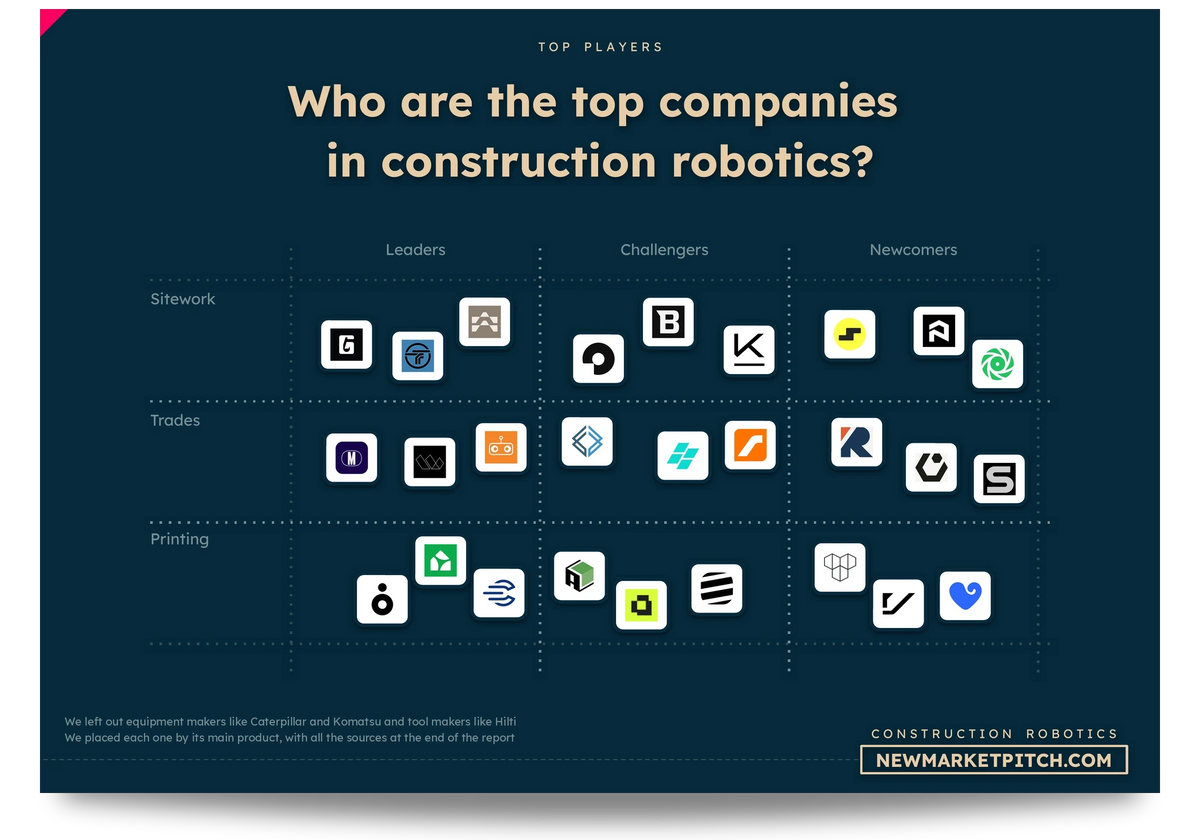
In our research about construction robots, we turn what is vague and complex into simple, useful visuals. Market maps like this one show you at a glance where every startup stands.
Is construction robotics funding actually healthier than a year ago?
Construction robotics funding is in much better shape, with more startups getting financed, much larger rounds, and stronger investment activity even after removing the biggest deals.
During the 12 months ending September 15, 2026, we recorded 25 financings involving 23 companies, compared with 14 deals across 14 companies in the preceding 12 months. Deal activity increased 78.6%, while the number of funded companies grew 64.3%. Total capital rose from $201.65 million to $934.69 million, an increase of 363.5%.
The median disclosed round more than doubled, moving from $7.63 million to $17.30 million. Companies raising between $20 million and $50 million went from one to six, while first recorded financings doubled from three to six.
Funding also became more consistent. Only two months passed without a recorded financing, compared with four in the previous period. The median monthly deal count increased from one to two.
There are differences between categories, though. Autonomous earthmoving captured most of the new capital, while construction 3D printing received less money than the year before. Overall, more construction robotics companies can raise money, and those that do are generally raising more.
| Funding indicator | Previous 12M | Current 12M | Change |
|---|---|---|---|
| Total funding | $201.65M | $934.69M | +363.5% |
| Financing deals | 14 | 25 | +78.6% |
| Funded companies | 14 | 23 | +64.3% |
| Median disclosed round | $7.63M | $17.30M | +126.7% |
| Average disclosed round | $16.80M | $40.64M | +141.8% |
| Funding excluding rounds over $50M | $78.40M | $273.69M | +249.1% |
| First recorded financings | 3 | 6 | +100% |
| Months without financing | 4 | 2 | −50% |
Would construction robotics funding still be growing without the biggest deals?
Yes, and by a considerable margin. The recent increase extends beyond the industry's three largest transactions.
Bedrock Robotics raised approximately $270 million in its February 2026 Series B, Gravis Robotics secured $200 million from SoftBank in August 2026, and TerraFirma announced a $100 million Series A in July 2026. Together, these transactions account for approximately $570 million, or 61% of the latest year's capital.
Removing all three would leave roughly $364.7 million in funding, about 81% more than the previous year's entire $201.65 million. That comparison does not adjust the previous period, however.
The cleaner test removes every round strictly above $50 million from both periods. Funding then rises from $78.40 million to $273.69 million, an increase of 249.1%. Removing rounds strictly above $100 million leaves $464.69 million in current funding, compared with $201.65 million previously.
Concentration has also declined slightly. The three largest rounds represented approximately 72% of the previous year's capital, compared with 61% recently. The biggest companies are attracting enormous investments, but substantially more money is also reaching everyone else.

Your time is limited. In our market report about construction robots, we put numbers on each part of the market, so you can see where it makes sense to focus.
Are more construction robotics startups getting funded now?
Yes. We identified 23 distinct funded companies during the latest 12 months, against 14 previously. Deal volume increased slightly faster than company count because two businesses completed multiple financings within the year.
Autonomous earthmoving went from one financing to seven, robotic drilling and installation increased from three to five, and painting and finishing robotics recorded three transactions instead of one.
Funding also spread geographically. European companies secured seven deals compared with two previously, while Asia-Pacific activity doubled from three to six.
Ten of the latest twelve months contained at least one financing, up from eight in the preceding year. Average monthly transactions increased from 1.17 to 2.08.
Full investor lists are unavailable for several transactions, so we cannot determine whether the number of unique participating investors increased at the same rate. The expansion in funded companies, however, is clear.
Are construction robotics startups raising bigger rounds now?
Construction robotics startups are securing substantially larger rounds, particularly in the $20 million to $50 million range.
The median disclosed financing increased 126.7%, but the change in deal distribution is more revealing.
Previously, nine of fourteen deals were below $20 million. In the latest year, there were thirteen such transactions out of twenty-five. Smaller financings increased in absolute number but became less dominant as larger funding tiers expanded.
Six rounds fell between $20 million and $50 million, compared with only one previously. That middle tier now represents 24% of all financing events.
At the top, three rounds reached at least $100 million. None had crossed that threshold in the earlier period. TerraFirma's $100 million financing is included in this category but remains in calculations excluding only rounds strictly greater than $100 million.
There is still plenty happening at the smaller end: six financings were below $5 million, with another seven between $5 million and $20 million.
| Deal size | Previous deals | Current deals | Previous deal share | Current deal share |
|---|---|---|---|---|
| Under $5M | 4 | 6 | 28.6% | 24.0% |
| $5M–under $20M | 5 | 7 | 35.7% | 28.0% |
| $20M–under $50M | 1 | 6 | 7.1% | 24.0% |
| $50M–under $100M | 2 | 1 | 14.3% | 4.0% |
| $100M or more | 0 | 3 | 0% | 12.0% |
| Undisclosed amount | 2 | 2 | 14.3% | 8.0% |
| Largest round | $67.25M | $270M | - | - |

In our document detailing everything you need to know about construction robotics, we always try to gather several sources and make estimates that make sense, so you can work with solid numbers.
Are investors still backing new construction robotics startups?
New construction robotics startups are finding more funding opportunities, although companies with previous financing histories still receive almost all the money.
We recorded six first financings, twice the previous year's three. Their median disclosed size increased from $2.27 million to $3.60 million, while measured capital going into those rounds rose from $4.54 million to $40.79 million.
The first-financing share increased slightly from 21.4% to 24% of all deals. Investors are still willing to back new entrants rather than concentrating exclusively on companies they already know.
Existing companies nevertheless command much larger amounts. Follow-on rounds attracted $893.90 million across nineteen transactions, compared with $197.11 million across eleven previously. Their median disclosed financing increased from $9.38 million to $23 million.
Previously financed companies consequently collected about 95.6% of all measured capital.
One distinction is important: first financings refer to the earliest transaction identified in our research. Because historical disclosure is incomplete for some private companies, these should not automatically be interpreted as first-ever equity investments.
Why are Bedrock Robotics and Gravis Robotics raising so much money?
Bedrock Robotics and Gravis Robotics are attracting exceptional investment because they are trying to automate the heavy machinery used across major construction projects. Both are pursuing opportunities that extend far beyond one specialized construction task.
Bedrock announced approximately $270 million in Series B funding in February 2026, co-led by CapitalG and Valor Atreides AI Fund. Its earlier financing history included an $80 million combined Seed and Series A announcement in July 2025, during the preceding comparison period, of which our database records $67.25 million against the Series A.
Bedrock is developing autonomous equipment systems designed to coordinate construction fleets. Its February announcement emphasized working with contractors and progressing toward fully operatorless excavator deployments.
Gravis followed a similar trajectory. After announcing $23 million in November 2025, the ETH Zurich spinout secured a $200 million Series A from SoftBank in August 2026.
Its Gravis Rack is a retrofit system designed to make existing excavators and other heavy equipment autonomous. Rather than requiring contractors to replace their machinery, Gravis aims to work across manufacturers including Caterpillar, John Deere, Hitachi and Volvo.
The company reported deployments across four continents and a UK government-backed project with Flannery Plant Hire to introduce autonomous capabilities into rental equipment fleets.
These are young businesses targeting enormous pools of construction equipment spending. Their fundraising success also raises the bar for competitors, who will increasingly be measured against companies with substantial capital, industrial relationships and real-world deployment experience.

Our report covering the construction robotics market gets updated several times a month, so you always get the latest view of where things stand.
Why is autonomous earthmoving getting so much construction robotics funding?
Autonomous earthmoving has become the largest construction robotics investment category, attracting almost two-thirds of recorded market capital.
We identified seven earthmoving financings worth approximately $607.8 million during the latest period, compared with a single $67.3 million transaction previously. The category now accounts for about 65% of measured capital, up from 33.4%.
Bedrock and Gravis are the two largest contributors, but TerraFirma adds a different business model. Its $100 million Series A, announced in July 2026 and led by Kleiner Perkins, supports a vertically integrated construction business using remote-operated and semi-autonomous heavy equipment.
TerraFirma plans to combine robotics, equipment operations and construction services. That gives it a route to revenue from performing construction work directly, rather than relying exclusively on machine or software sales.
The broader attraction is the potential to improve how contractors operate excavators, loaders, dozers and other expensive machinery. Better utilization, less downtime and the ability to supervise more equipment with fewer operators could produce substantial savings.
Gravis claims its technology can improve jobsite productivity by up to 30%. That remains a company-reported performance claim, not an independently established industry average.
Investors are betting that autonomy can become a valuable technology layer across existing equipment fleets. Whether the economics work consistently across different construction environments remains to be proven.
Is construction 3D printing falling behind autonomous equipment?
Construction 3D printing is losing ground in the funding race, although the number of printing companies receiving financing has increased slightly.
The category recorded four deals worth $37.1 million during the latest year, compared with three deals and $57.5 million previously. Capital declined approximately 35.5%. The earlier total was heavily influenced by ICON's $56 million financing, so one transaction explains much of the apparent deterioration.
Other applications have been attracting considerably more capital. Robotic drilling and installation expanded from $33.8 million to $191.8 million across five deals, helped by Infravision's $91 million Series B led by GIC. Its aerial robotics support power-line construction and grid infrastructure.
Bricklaying and masonry robotics also returned to the funded sample, with two deals totaling $34 million. Monumental announced a $32 million Series B led by Khosla Ventures and reported that its robotic fleet had already built walls for more than 100 homes. The Dutch company operates as a subcontractor paid for completed construction work rather than selling robots outright.
Meanwhile, robotic layout and surveying recorded no new financings, compared with three deals worth $35.1 million previously.
The divergence is striking. Construction 3D printing continues to attract money, but autonomous equipment, robotic installation and operational service models are capturing much stronger investment interest.
| Category | Previous capital | Current capital | Previous deals | Current deals |
|---|---|---|---|---|
| Autonomous Earthmoving | $67.3M | $607.8M | 1 | 7 |
| Robotic Drilling & Installation | $33.8M | $191.8M | 3 | 5 |
| Construction Fabrication Robots | $6.9M | $40.0M | 1 | 1 |
| Construction 3D Printing | $57.5M | $37.1M | 3 | 4 |
| Bricklaying & Masonry Robots | $0 | $34.0M | 0 | 2 |
| Rebar & Concrete Robots | $1.2M | $22.6M | 2 | 3 |
| Painting & Finishing Robots | Undisclosed | $1.4M | 1 | 3 |
| Robotic Layout & Surveying | $35.1M | $0 | 3 | 0 |

In our research about construction robots, we look at what the winners do differently, so you can learn from the best instead of guessing.
Is construction robotics moving beyond seed funding?
Construction robotics is developing a much stronger growth-stage funding market, even as seed activity continues to expand.
Seed transactions increased from five to eleven, with capital rising from $12.3 million to $87.2 million. The median seed round grew more modestly, from $4 million to $4.75 million.
Series A capital increased from $102.4 million to $340 million across six deals. Gravis's unusually large $200 million Series A explains much of the growth and demonstrates how little a stage label sometimes tells us about an industrial robotics company's capital requirements.
Series B financing changed even more dramatically. Six rounds attracted $460.1 million, compared with two rounds totaling $23.2 million in the preceding period. Bedrock was the largest contributor.
Early-stage rounds, defined here as Seed and Series A, now account for 68% of transactions. Their share of measured capital nevertheless declined from 56.8% to 45.7% as growth-stage financings became larger.
The funded companies are getting younger, too. Based on reported founding and financing years, their median age declined from approximately six years to four years. Bedrock was founded in 2024, Gravis in 2022 and TerraFirma in 2024.
Investors are committing substantial amounts to companies with relatively short operating histories when their plans involve expensive machinery, industrial deployments and large potential markets.
Is Europe catching up with the US in construction robotics funding?
Europe has become a much more important construction robotics funding destination, although North America still receives most of the capital.
European companies secured seven financings worth approximately $296 million during the latest period, compared with two deals totaling $7.4 million previously. Europe's share of recorded capital increased from 3.7% to 31.7%.
Gravis's $200 million Swiss financing accounts for a large part of that change. But the increase from two to seven transactions shows that the expansion extends beyond one company.
Monumental provides another example. Its July 2026 financing supports expanding autonomous bricklaying operations beyond the Netherlands and UK into the US.
North America remained the largest funding market, with twelve deals worth $603.5 million. Its capital share nevertheless declined from 90.3% to 64.6%, despite receiving more money in absolute terms.
Asia-Pacific activity also doubled from three deals to six. Several Chinese financings lacked disclosed values, limiting regional capital comparisons. Xpanner's headquarters classification also remains uncertain because public records differ between US and South Korean descriptions.
Europe's growth is evident in both deal counts and capital. Asia-Pacific's improvement is clearer in the number of financings than in disclosed funding amounts.

In our market report about construction robots, we don't want to repeat what boring consulting reports say. Instead, we show you the real and latest market signals that matter.
Are corporate investors becoming more important in construction robotics?
Corporate investors remain involved in major construction robotics rounds, but their recorded participation has become less common relative to overall deal activity.
We found seven deals with named strategic participants in each comparison period. Because total transactions increased from fourteen to twenty-five, their recorded participation rate declined from 50% to 28%.
Major examples remain easy to find. Bedrock's February 2026 financing included NVentures, NVIDIA's venture capital arm, alongside Tishman Speyer and institutional backers such as CapitalG.
Gravis secured $200 million from SoftBank, which has explicitly identified physical AI as an important investment area. Its earlier $23 million financing also included investors connected to industrial and construction businesses, including Holcim.
Infravision's $91 million round, led by GIC, included Hitachi Ventures, Activate Capital and existing investor Energy Impact Partners.
Corporate investment does not necessarily establish customer adoption. A company's venture arm can invest without its parent business becoming a paying customer.
Full co-investor lists are also missing for some transactions. The defensible finding is that construction robotics attracted substantially more deals without a corresponding increase in the recorded number involving strategic investors.
Are construction robotics companies raising money again faster?
Some leading construction robotics startups have returned to investors remarkably quickly, although the available records do not establish a market-wide acceleration.
Bedrock raised its recorded $67.25 million Series A in July 2025, during the previous comparison period, and announced an approximately $270 million Series B in February 2026. The later financing was roughly four times larger, following an interval of about seven months.
Gravis moved from $23 million in November 2025 to $200 million in August 2026. That is an 8.7-fold increase over approximately nine months, with both financings falling within the latest 12-month period.
These are unusually large funding jumps for young industrial robotics companies. They show how aggressively investors can finance businesses pursuing autonomous heavy equipment.
But we do not have reliable previous-round dates and amounts for every follow-on financing. Bedrock and Gravis are exceptional cases, not evidence that the typical construction robotics company now raises money faster.

Learning from others' mistakes is the cheapest lesson there is. In our document detailing everything you need to know about construction robotics, we look at what broke startups before you, so you don't repeat it.
Do construction robotics startups need real customers to raise big rounds?
Commercial deployment features prominently among the biggest recent financing recipients. Several have already moved beyond laboratory demonstrations and into construction operations.
Gravis reported deployments across four continents by the time SoftBank announced its $200 million investment. Its partnership with Flannery Plant Hire also demonstrates how autonomous technology could reach contractors through existing rental equipment fleets.
Bedrock is working directly with contractors on autonomous machinery and fleet coordination. Its February 2026 financing was tied to accelerating progress toward fully operatorless excavator deployments.
Monumental offers a different example. The company reported a fleet of more than 100 bricklaying robots working across construction projects in Europe, with customers paying for completed walls rather than purchasing the equipment.
These examples help investors evaluate machinery operating in the field, customer relationships and the practical ability to expand deployments.
Still, the available records do not establish a universal commercial threshold for raising a large round. Customer revenue, gross margins, equipment utilization and contract values are not consistently disclosed across the funded companies.
Are construction robotics startups raising to build products or scale their businesses?
The largest recent construction robotics financings increasingly emphasize putting machines into operation and expanding deployment capacity.
Bedrock's funding supports coordinated autonomous fleets and planned operatorless excavator deployments. Gravis intends to expand internationally and install its retrofit technology across additional equipment fleets.
TerraFirma is using its financing to expand engineering, manufacturing, construction and operations teams. Its business connects semi-autonomous equipment directly with construction project delivery.
Monumental's $32 million Series B supports manufacturing more robots, increasing deployment capacity and entering the US market. Infravision's financing similarly supports broader use of aerial robotics in electricity infrastructure construction.
Engineering remains a major expense for all these businesses. The available use-of-funds disclosures do not support a precise market-wide split between R&D and commercialization spending.
Among the largest rounds, however, the financing plans increasingly involve more equipment in the field, broader geographic operations and greater capacity to serve construction customers.

If you build or invest in the construction robotics market, you need to know which business models pay off now and which ones are fading. That's why our report covering it has a whole section on it.
Is construction robotics becoming a mature investment market?
Construction robotics is becoming a more developed investment market, with larger growth rounds, a wider startup population and more attention on actual construction operations.
The financing structure has changed substantially. Seed activity is growing, the $20 million to $50 million tier has expanded, and Series B capital has increased sharply. Investors are willing to commit especially large amounts to young businesses preparing for industrial deployment.
The business models are also diversifying. Bedrock develops autonomous fleet technology, Gravis retrofits existing heavy equipment, TerraFirma combines robotic machinery with construction operations, and Monumental provides bricklaying as a service.
Each approach carries different equipment costs, operating risks and routes to revenue. Their fundraising success indicates that investors see several viable commercial possibilities for construction robotics.
The industry still has plenty to prove. Company announcements provide evidence of deployments and partnerships, but broad public information on profitability, customer retention and long-term equipment performance remains limited.
The funding environment is undoubtedly stronger than it was a year ago. The harder test now is whether these expensive robotic systems can consistently improve construction economics and generate durable returns.
Our methodology
This analysis examines construction robotics funding across two consecutive, non-overlapping twelve-month periods: September 16, 2025 to September 15, 2026 (current period), and September 16, 2024 to September 15, 2025 (previous period). The data cutoff is September 15, 2026. Every year-over-year comparison uses these same windows.
We used a market-specific construction robotics financing dataset, reviewed the underlying transactions and cross-checked selected major rounds against company announcements, investor communications and institutional reporting. We retained consistent market boundaries across both periods, including companies working across construction robotics, industrial automation and technology-enabled construction services where their recorded core activities qualified.
For each period, we calculated disclosed funding capital, deal count, distinct funded companies, median and average disclosed round size, financing-stage distribution, first recorded financings, follow-on activity, geographic allocation, application categories and recorded strategic-investor participation. Undisclosed transactions count toward financing activity but do not contribute estimated capital. Foreign-currency amounts were converted approximately where applicable.
We examined whether funding growth was concentrated in unusually large transactions by comparing the largest rounds and recalculating funding after excluding transactions strictly greater than $50 million and $100 million. The same thresholds were applied to both periods. Round-size categories distinguish amounts of at least $100 million from those strictly above $100 million.
Transaction-level checks addressed duplicate reports, financing extensions and announcements combining multiple funding instruments. Raise Robotics' March and July 2025 records were consolidated into one financing; Partner Robotics' approximately $14 million cumulative funding figure was excluded from measured round capital; and Polyuse's equity financing was kept separate from its bank financing. Bedrock's July 2025 financing was assigned to the previous comparison period, while its February 2026 Series B belongs to the current period. Both Gravis financings, announced in November 2025 and August 2026, fall within the current period.
First recorded financings refer to the earliest transaction identified in our research rather than necessarily a company's first-ever investment. Financing stages follow the recorded classifications, not assumptions based on round size. Company ages are approximate and calculated from reported founding years. Geographic comparisons use recorded headquarters classifications, with unresolved cases treated cautiously.
We also examined how funding plans relate to commercial deployment, equipment expansion and company maturity. Company-reported robot deployments, customer projects and productivity estimates were treated as reported achievements or claims rather than independently established sector-wide outcomes. Investor participation and financing velocity were evaluated using the transactions for which sufficiently detailed information was available.
The analysis combines individual financing announcements with comparisons across the full dataset. We collected recent funding and commercial developments, checked transaction-level information, aggregated findings across consistent dimensions, and assessed which changes were substantial enough to support conclusions about market growth, capital concentration and investment maturity.
Key sources include Bedrock Robotics' Series B announcement and deployment plans, Bedrock's initial company announcement, Gravis Robotics' $200 million Series A announcement, Gravis's November 2025 financing and partnerships, ETH Zurich's report on Gravis's investment and autonomous excavators, TerraFirma's financing announcement distributed through Business Wire, GIC's announcement of Infravision's $91 million Series B, Infravision's technology and infrastructure information, Monumental's $32 million Series B and commercial deployment announcement, and Monumental's company announcement archive. Aggregate funding figures and period comparisons are calculated from our construction robotics financing dataset rather than taken directly from these publications.

In our research about construction robots, we like to show you the big picture. We know your time is precious, so we make every page quick to read and packed with as much learning as possible per minute.
Written by the New Market Pitch teamWe track new markets so founders and investors can move faster. About us