What are the top construction robotics startups by total funding raised?
Whether you're building or investing in the construction robotics market, our report covers everything you need to know: the players, the money, and what's coming next.
Summary
Bedrock Robotics, ICON and Gravis Robotics are the three largest construction robotics startups by total funding raised, with $950 million, $693 million and $223 million respectively. The top ten companies have raised $2.453 billion combined, showing how much capital is flowing into autonomous machinery, robotic building systems and construction automation.
Funding is heavily concentrated at the top. Bedrock, ICON, Gravis Robotics and TerraFirma have raised $1.981 billion together, representing approximately 80.8% of the top ten's cumulative funding. The gap between these four companies and the rest of the market is substantial.
Autonomous heavy equipment is attracting some of the biggest investments. Bedrock Robotics, Gravis Robotics, TerraFirma and Built Robotics are developing technologies that can automate excavators, bulldozers and other machinery, with Bedrock's retrofit approach allowing contractors to use existing equipment rather than replace entire fleets.
ICON represents a different investment thesis. Its $693 million in funding supports an integrated robotic construction platform combining 3D printing equipment, materials and software. The company has reported more than 270 printed buildings and is now selling its Titan systems to external builders.
Specialized construction robots are also attracting serious financing. Monumental has developed a subcontracting model around robotic bricklaying, Dusty Robotics automates construction layout, and Planted Solar and Charge Robotics are tackling the labor-intensive installation of solar farms.
Factory-based construction is another important category. Reframe Systems, Promise Robotics, BotBuilt and Intelligent City are moving more building activities into automated manufacturing environments, particularly for housing, framing and prefabricated structures.
Energy infrastructure is creating an additional market for construction automation. Planted Solar's latest financing supports the expansion of its robotic installation fleet, while companies such as EarthGrid are targeting the construction of underground infrastructure. The expansion of data centers and electricity networks provides potential demand well beyond residential construction.
The United States dominates the highest-funded part of the market, particularly in autonomous machinery and 3D printing. Europe has developed notable specialists such as Monumental and KEWAZO, while Asian companies including WEIBUILD, Legend Robot and Partner Robotics are pursuing automated construction and finishing applications.
There is already meaningful deployment activity. Bedrock has announced autonomous excavators operating on live infrastructure projects, ICON has reported hundreds of completed printed structures, and Monumental has described a fleet of more than 100 robots working across European construction sites.
However, deployment figures and fundraising totals do not tell the whole story. Construction robots must operate in constantly changing environments, integrate with existing crews and equipment, and deliver savings that justify their purchase and maintenance costs. A March 2026 academic study of 75 real-world deployments found that environmental challenges, system integration and hardware limitations were the most frequently reported obstacles.
The strongest commercial opportunities appear to be in activities that are repetitive, expensive and difficult to staff. Autonomous excavation, bricklaying, solar installation and automated housing production all fit that description. The next winners will be determined by repeat customers, machine utilization and project economics, rather than by the size of their latest financing round.

Written by the New Market Pitch teamWe track new markets so founders and investors can move faster. About us

In our report covering the construction robotics market, you will always find fresh funding data, taken straight from our own verified funding database.
Top startups in the construction robotics market ranked by total funding raised
Here is an updated table that ranks the top startups in the construction robotics market based on the total amount of funding they have raised to date.
The table also includes the total number of funding rounds, the date and size of the latest round, the financing type (e.g. Series A, equity financing), key investors, the startup's current status (active, IPO, acquired, or shut down), and a confidence score based on the data collected. Funding figures and round details are subject to the qualifications listed in the notes below.
If you need to dig deeper and get more detailed data, please check our report covering the construction robotics market.
| # | Startup | What They Do | Total Raised ($) | Total Rounds | Last Round Date | Last Round Amount ($) | Last Round Type | Key Investors | Current Stage | Confidence | Country |
|---|---|---|---|---|---|---|---|---|---|---|---|
| 1 | Bedrock Robotics | Autonomous heavy-equipment construction | $950M+ | 4 | October 2026 | $600M | Series C | CapitalG, Emergence Capital, Bessemer Venture Partners | Active | Full | United States |
| 2 | ICON | Robotic 3D printing of buildings | $693M1 | 6 | October 2026 | $200M | Series D | Baillie Gifford, BlackRock, Norwest | Active | Partial | United States |
| 3 | Gravis Robotics | Autonomous heavy construction equipment | $223M | 2 | August 2026 | $200M | Series A | SoftBank | Active | Full | Switzerland |
| 4 | TerraFirma | Autonomous construction heavy equipment | $115M | 2 | July 2026 | $100M | Series A | Kleiner Perkins, Bain Capital Ventures, Glade Brook Capital Partners | Active | Strong | United States |
| 5 | Built Robotics | Autonomous construction equipment | $112M | 3 | April 2022 | $64M | Series C | Tiger Global, NEA, Fifth Wall Ventures | Active | Full | United States |
| 6 | Dusty Robotics | Automated construction layout printing | $89M | 5 | May 2026 | $20M | Series B2 | Undisclosed | Active | Strong | United States |
| 7 | EarthGrid | Plasma-powered robotic underground tunneling | $83M2 | 2 | August 2026 | $53M | Series A | Elevation Ventures | Active | Partial | United States |
| 8 | Reframe Systems | Robotic microfactories for housing | $65.7M | 3 | August 2026 | $40M | Growth Equity | Energy Impact Partners, Counterpart Ventures, E12 Ventures | Active | Strong | United States |
| 9 | Planted Solar | Robotic solar farm construction | $65.4M | 3 | September 2026 | $32M | Series B | Piva Capital, RA Capital Management, Breakthrough Energy Ventures | Active | Strong | United States |
| 10 | Monumental | Autonomous robotic bricklaying systems | $57M | 2 | July 2026 | $32M | Series B | Khosla Ventures, Plural, Hummingbird Ventures | Active | Strong | Netherlands |
| 11 | AIM Intelligent Machines | AI-powered autonomous heavy machinery | $50M | 2 | June 2025 | $50M | Series A | Khosla Ventures, General Catalyst, DCVC | Active | Strong | United States |
| 12 | August Robotics | Autonomous construction and industrial robots | $43M | 3 | May 2026 | $30M | Series B | Big Pi Ventures, Blackbird Ventures, GS Futures | Active | Full | Hong Kong |
| 13 | Charge Robotics | Robotic solar farm construction | $39M | 4 | July 2026 | $22M | Series B | Undisclosed | Active | Partial | United States |
| 14 | Xpanner | Retrofitting construction equipment with automation | ~$38M | 4 | May 2026 | ~$18M | Series B Bridge | Korea Investment Partners, KB Investment | Active | Strong | United States |
| 15 | KEWAZO | Robotic scaffolding and material transport | ~$34M | 4 | March 2026 | $16M | Series A Extension | Schooner Capital, True Ventures, Chevron Technology Ventures | Active | Partial | Germany |
| 16 | WEIBUILD | Automated plastering and rebar robots | ~$32M3 | 4-6 | August 2024 | ~$17M | Series A Extension | C&D Emerging Investment, Ruyi Capital, Linear Capital | Active | Partial | China |
| 17 | Gritt | Physical AI for infrastructure construction | $32M | 2 | July 2026 | $26M | Series A | Obvious Ventures, Union Square Ventures, Active Impact Investments | Active | Strong | United States |
| 18 | Legend Robot | Automated construction finishing robots | ~$28M | 3 | May 2023 | ~$10M | Series A+ | XVC Ventures | Active | Strong | China |
| 19 | All3 | Autonomous robotic construction platform | $25M | 1 | April 2026 | $25M | Seed | RTP Global, SuperSeed, Begin Capital | Active | Full | United Kingdom |
| 20 | Promise Robotics | Robotic prefabricated housing production | $25M | 2 | October 2023 | $15M | Series A | Horizons Ventures, Radical Ventures, PSP Investments | Active | Partial | Canada |
| 21 | SQ4D | Robotic concrete 3D printing | $25M | 1 | June 2025 | $25M | Undisclosed | Undisclosed | Active | Low | United States |
| 22 | Cuby Technologies | Automated modular home manufacturing | $23M | 2 | August 2024 | $17M | Series B | Type One Ventures | Active | Strong | United States |
| 23 | Kind Designs | 3D-printed coastal protection seawalls | $20M | 4 | July 2026 | $10M | Pre-Series A | New York Angels, Tamiami Angel Funds, Mark Cuban | Active | Partial | United States |
| 24 | Origin | Autonomous interior construction finishing | $20M4 | Undetermined | October 2026 | Undisclosed | Undisclosed | Accel, Zacua Ventures, Unilazer Ventures | Active | Partial | United States |
| 25 | Branch Technology | Robotic large-scale 3D printing | $18M | 5 | October 2023 | Undisclosed | Strategic Equity | Tokyu Construction | Active | Partial | United States |
| 26 | Mechasys | Robotic construction blueprint projection | ~$18M | 4 | August 2025 | ~$17M | Series A | Idealist Capital, Fondaction | Active | Partial | Canada |
| 27 | Intelligent City | Robotically manufactured mass-timber buildings | $17M | 2 | July 2022 | $17M | Series A | BDC Capital, Greensoil PropTech Ventures, UIT Growth Equity | Active | Partial | Canada |
| 28 | Apis Cor | Robotic concrete 3D printing | $17M | 13 | March 2025 | $1M | Regulation CF | At One Ventures, Retail Investors | Active | Partial | United States |
| 29 | Q-Bot | Robotic underfloor insulation installation | ~$15M5 | 8+ | September 2026 | Undisclosed | Equity Allotment | EMV Capital | Active | Partial | United Kingdom |
| 30 | Toggle Robotics | Robotic rebar fabrication and assembly | $15M | 4 | February 2023 | $3M | Series A Extension | Global Brain, New York Ventures | Active | Strong | United States |
| 31 | Partner Robotics | Robotic tiling and layout | ~$14M | 2 | November 2025 | Undisclosed | Series A | China Growth Capital, Cowin Capital, Redpoint China Ventures | Active | Partial | China |
| 32 | Suzhou Fangshi Technology | Modular construction site robots | ~$14M | 5 | August 2026 | Undisclosed | Series A Follow-on | Undisclosed | Active | Partial | China |
| 33 | PaintJet | Automated industrial surface painting | $14M | 2 | December 2023 | $10M | Series A | Outsiders Fund, Dynamo Ventures, MetaProp | Active | Full | United States |
| 34 | Civ Robotics | Autonomous construction surveying robots | $13M | 3 | June 2025 | $8M | Series A | AlleyCorp, ff Venture Capital, Newfund Capital | Active | Strong | United States |
| 35 | BotBuilt | Robotic automated home framing | $13M | 4 | December 2023 | $12M | Seed | Shadow Ventures, Y Combinator, Owens Corning | Active | Strong | United States |
| 36 | Rugged Robotics | Robotic construction layout marking | $12M | 2 | March 2022 | $9M | Series A | BOLD Capital Partners, Brick & Mortar Ventures, Suffolk Technologies | Active | Strong | United States |
| 37 | Hyperion Robotics | Robotic low-carbon concrete manufacturing | ~$10M | 2 | July 2026 | $7M | Growth | Course Corrected, EIC Fund, RE Ventures | Active | Partial | Finland |
| 38 | Automated Architecture (AUAR) | Automated sustainable housing construction | ~$10M | 3 | June 2025 | ~$7M | Early VC | Planet A Ventures, Shadow Ventures, Concrete Ventures | Active | Strong | United Kingdom |
| 39 | Raise Robotics | Robotic facade installation assistance | $10M | 2 | July 2025 | $8M | Seed | MaC Venture Capital, Undivided Ventures, Cybernetix Ventures | Active | Partial | United States |
| 40 | Okibo | Autonomous wall painting robots | $8M | 2 | March 2024 | $8M | Growth Equity | Shadow Ventures, BitStone Capital, Pi Labs | Active | Partial | Israel |
| 41 | Aeditive | Robotic precast concrete manufacturing | ~$7M | 2 | June 2021 | ~$7M | Seed | BitStone Capital, Atlantic Labs, Glatthaar Holding | Shutdown | Strong | Germany |
| 42 | Sitegeist | Robotic concrete infrastructure renovation | ~$5M | 1 | February 2026 | ~$5M | Pre-Seed | b2venture, OpenOcean, UnternehmerTUM | Active | Full | Germany |
| 43 | Phoenix Boring | Robotic underground utility boring | $5M | 1 | February 2026 | $5M | Private Equity Offering | Undisclosed | Active | Partial | United States |
| 44 | Cosmic Robotics | Autonomous infrastructure construction robots | $4M | 3 | September 2026 | $0M | Seed | Y Combinator | Active | Partial | United States |
| 45 | Advanced Construction Robotics | Autonomous rebar placement robots | $4M | 2 | July 2021 | Undisclosed | VC Round | Grouse Ridge Capital | Active | Partial | United States |
| 46 | Luminous Robotics | Robotic solar infrastructure construction | $4M | 1 | July 2025 | $4M | Series A | LmNT VC | Active | Partial | United States |
| 47 | Flo Mobility | Autonomous construction material hauling | $3M | 3 | May 2026 | $3M | Pre-Series A | Mela Ventures, Arali Ventures | Active | Partial | India |
| 48 | KOBOTS | Robotic drywall cutting systems | ~$3M | 2 | December 2021 | ~$1M | Equity Crowdfunding | Seedrs Investors | Active | Strong | Denmark |
| 49 | Spacer Robotics | Autonomous rebar tying robots | ~$2M | 2 | July 2026 | Undisclosed | Seed | u.ventures, LongHash Ventures, Geek Ventures | Active | Partial | United States |
| 50 | XTreeE | Robotic concrete 3D printing | ~$2M | 4 | March 2021 | Undisclosed | Corporate Minority | LafargeHolcim France | Active | Partial | France |
| 51 | Buildroid AI | Humanoid robots for construction | $2M | 1 | November 2025 | $2M | Seed | Tim Draper | Active | Partial | Mexico |
| 52 | COBOD | Industrial construction 3D printers | ~$2M | 6 | October 2022 | Undisclosed | Strategic Equity | Holcim | Active | Partial | Denmark |
| 53 | Alquist 3D | 3D-printed homes and infrastructure | $1M | 1 | January 2022 | $1M | Seed | Undisclosed | Active | Partial | United States |
| 54 | Les Companions | Autonomous construction painting robots | ~$1M | 1 | Undisclosed | ~$1M | Crowdfunding | Private Investors, FFB-GESTES | Active | Partial | France |
| 55 | Finish Robotics | Mobile robots for construction finishing | $1M | 4 | November 2023 | $0M | Seed | Undisclosed | Active | Strong | United States |
- Some securities filings do not match ICON's announced rounds.
- Minimum: earlier investments are not fully known.
- Published total; past rounds cannot be added up independently.
- Total announced without a separate amount for the latest round.
- Estimate: overlapping equity deals and convertible instruments are unresolved.

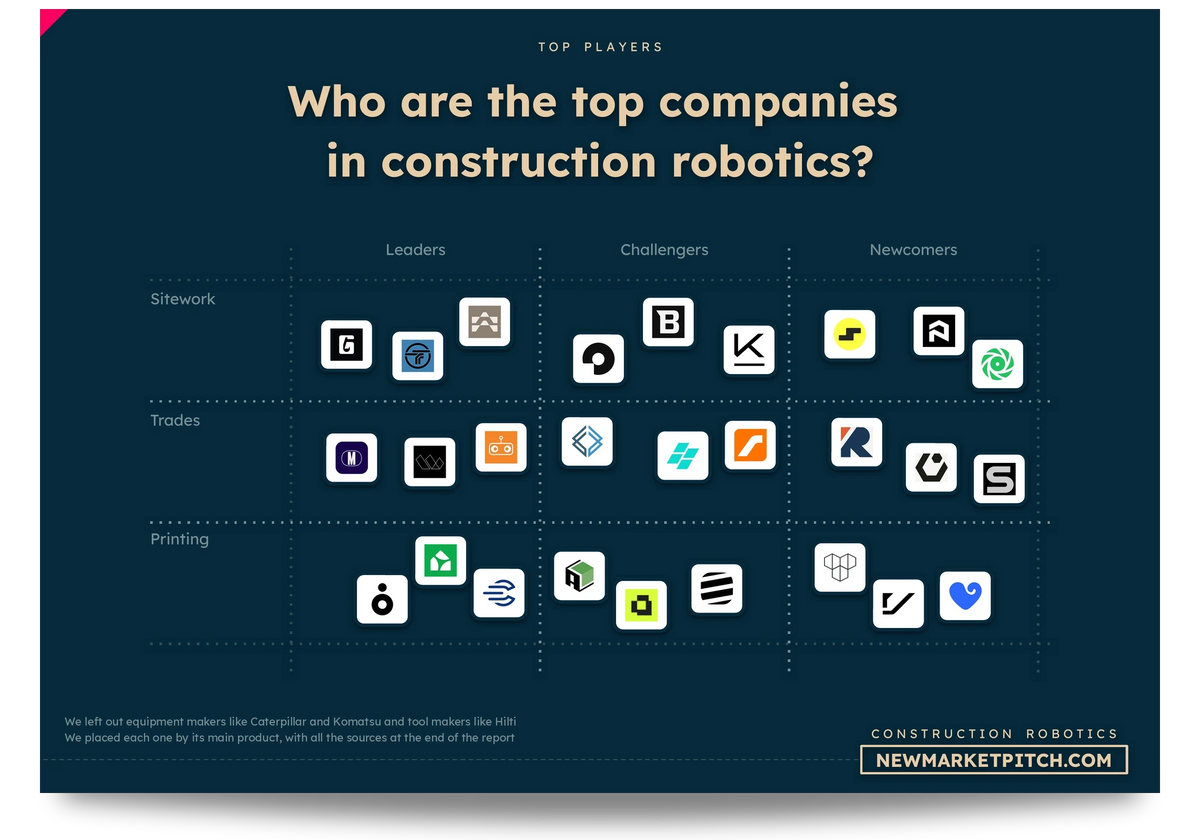
In our research about construction robots, we turn what is vague and complex into simple, useful visuals. Market maps like this one show you at a glance where every startup stands.
Why are investors putting so much money into construction robotics?
Investors are putting hundreds of millions of dollars into construction robotics because the industry offers an unusually large opportunity to automate expensive, repetitive work that still depends heavily on human labor. We are seeing a shift towards autonomous machinery, robotic building systems and automated infrastructure construction, with several startups now attracting financing on a scale previously associated with much more mature technology businesses.
The recent rounds are particularly striking. Bedrock Robotics raised $600 million in October 2026, Gravis Robotics secured $200 million in August, and TerraFirma raised $100 million in July. ICON also announced a $200 million Series D in October. These four transactions show how much money investors are willing to commit to companies attempting to automate construction at scale.
There are several reasons behind this interest. Contractors struggle to recruit experienced machine operators, construction projects regularly face delays, and productivity improvements have historically been difficult to achieve on traditional building sites. At the same time, demand for infrastructure, housing, data centers and energy projects is creating additional pressure to build faster.
The opportunity extends well beyond autonomous excavators. Monumental is automating bricklaying, Dusty Robotics is automating construction layout, and Planted Solar is developing robotic systems for solar farm installation. Investors are financing several different ways of making construction more productive.
Which construction robotics startups have raised the most funding?
Bedrock Robotics leads the construction robotics funding ranking with $950 million raised, followed by ICON with $693 million, Gravis Robotics with $223 million and TerraFirma with $115 million.
The concentration is remarkable. The four largest startups account for $1.981 billion, representing approximately 80.8% of the $2.453 billion raised by the top ten companies.
Bedrock Robotics has attracted particularly substantial financing for its autonomous heavy-equipment technology. ICON has raised capital to develop robotic 3D-printed buildings, while Gravis Robotics and TerraFirma are targeting autonomous construction machinery.
The next six companies have raised between $57 million and $112 million each. They include Built Robotics, Dusty Robotics, EarthGrid, Reframe Systems, Planted Solar and Monumental.
There is a considerable funding gap between the largest platforms and the rest of the market. The top four have raised more than four times as much as the next six combined.
| Rank | Startup | Total funding raised |
|---|---|---|
| 1 | Bedrock Robotics | $950M+ |
| 2 | ICON | $693M |
| 3 | Gravis Robotics | $223M |
| 4 | TerraFirma | $115M |
| 5 | Built Robotics | $112M |
| 6 | Dusty Robotics | $89M |
| 7 | EarthGrid | $83M |
| 8 | Reframe Systems | $65.7M |
| 9 | Planted Solar | $65.4M |
| 10 | Monumental | $57M |

Your time is limited. In our market report about construction robots, we put numbers on each part of the market, so you can see where it makes sense to focus.
Why has Bedrock Robotics attracted so much funding?
Bedrock Robotics has raised $950 million because it is targeting one of the most economically important activities in construction: operating heavy machinery without relying entirely on human operators.
The company develops autonomous technology for excavators and other construction equipment. Its approach is particularly interesting because it can retrofit existing machines rather than requiring contractors to purchase entirely new fleets.
In February 2026, Bedrock announced a $270 million Series B co-led by CapitalG and Valor Atreides AI Fund. The company subsequently raised a $600 million Series C in October, co-led by CapitalG and Emergence Capital.
Its commercial progress has also become more tangible. In August 2026, Bedrock announced that autonomous excavators were operating on live infrastructure projects with Sundt Construction, Champion Site Prep and Zachry Construction.
One deployment involved a 1.2 million cubic yard civil sitework project with Zachry, while another involved a multi-million cubic yard earthwork project in Texas.
This gives Bedrock an interesting position: it has attracted enormous financing while moving its technology onto actual construction sites. The next challenge is demonstrating that autonomous excavation can be deployed consistently across more contractors, machinery types and working environments.
Why has ICON raised almost $700 million?
ICON has raised $693 million by developing an integrated robotic construction platform focused on 3D-printed buildings and infrastructure.
The Austin-based company combines large-scale printing equipment, proprietary materials, software and construction expertise to automate parts of the building process.
ICON announced a $200 million Series D in October 2026, co-led by Baillie Gifford and funds managed by BlackRock. Other participating investors included Norwest, Tiger Global and several existing backers.
The company has also made progress towards selling its technology to external builders. In March 2026, ICON launched its Titan commercial program, allowing construction companies to acquire integrated robotic printing systems.
ICON reported having surpassed 270 3D-printed buildings in its October announcement, an increase from the more than 245 homes and structures it had reported earlier in the year.
The commercial question is whether ICON can turn its construction technology into a repeatable business model across different builders and building types. Printing walls is only one part of delivering a finished property, and the company still needs to integrate its technology with foundations, roofing, plumbing, electrical systems and other conventional construction activities.

In our document detailing everything you need to know about construction robotics, we always try to gather several sources and make estimates that make sense, so you can work with solid numbers.
Which construction robotics startups have raised the largest funding rounds?
Bedrock Robotics has the largest latest financing round in the ranking, with a $600 million Series C in October 2026. Gravis Robotics and ICON follow with $200 million rounds each.
These financings are unusually large for a young industrial technology market. TerraFirma's $100 million Series A is another example of investors committing substantial amounts before a company has reached a conventional late-stage financing profile.
Further down the ranking, Built Robotics raised $64 million in its Series C in April 2022, while EarthGrid secured $53 million in its Series A in August 2026.
Reframe Systems raised $40 million in growth equity in August, and Planted Solar and Monumental each announced rounds of approximately $32 million in September and July respectively.
The difference between individual rounds and cumulative funding is worth keeping in mind. Built Robotics has raised $112 million across three rounds, but its latest financing was announced several years ago. EarthGrid, meanwhile, has accumulated $83 million, including a much more recent $53 million Series A.
| Startup | Latest round | Amount | Date |
|---|---|---|---|
| Bedrock Robotics | Series C | $600M | October 2026 |
| ICON | Series D | $200M | October 2026 |
| Gravis Robotics | Series A | $200M | August 2026 |
| TerraFirma | Series A | $100M | July 2026 |
| Built Robotics | Series C | $64M | April 2022 |
| EarthGrid | Series A | $53M | August 2026 |
| Reframe Systems | Growth Equity | $40M | August 2026 |
| Planted Solar | Series B | $32M | September 2026 |
| Monumental | Series B | $32M | July 2026 |
| AIM Intelligent Machines | Series A | $50M | June 2025 |
Which construction robotics startups are attracting the biggest investors?
CapitalG, Emergence Capital, Baillie Gifford, BlackRock, SoftBank and Kleiner Perkins are among the major investors backing construction robotics startups.
Bedrock Robotics has attracted CapitalG, Emergence Capital and Bessemer Venture Partners. Its latest $600 million financing also involved investors including Temasek and NVIDIA.
ICON has secured backing from Baillie Gifford, BlackRock and Norwest, while Gravis Robotics attracted a $200 million Series A investment from SoftBank.
TerraFirma's investors include Kleiner Perkins, Bain Capital Ventures and Glade Brook Capital Partners.
There is also substantial interest from investors focused on specific industrial applications. Khosla Ventures has backed Monumental and AIM Intelligent Machines. Energy Impact Partners has invested in Reframe Systems, while Piva Capital and RA Capital Management are among the investors in Planted Solar.
The variety of investors is worth watching. Construction robotics is attracting traditional venture capital firms, technology investors, industrial specialists and funds focused on energy and infrastructure.
| Startup | Key investors |
|---|---|
| Bedrock Robotics | CapitalG, Emergence Capital, Bessemer Venture Partners |
| ICON | Baillie Gifford, BlackRock, Norwest |
| Gravis Robotics | SoftBank |
| TerraFirma | Kleiner Perkins, Bain Capital Ventures, Glade Brook Capital Partners |
| Built Robotics | Tiger Global, NEA, Fifth Wall Ventures |
| Monumental | Khosla Ventures, Plural, Hummingbird Ventures |
| AIM Intelligent Machines | Khosla Ventures, General Catalyst, DCVC |
| Reframe Systems | Energy Impact Partners, Counterpart Ventures, E12 Ventures |
| Gritt | Obvious Ventures, Union Square Ventures, Active Impact Investments |
| Promise Robotics | Horizons Ventures, Radical Ventures, PSP Investments |

Our report covering the construction robotics market gets updated several times a month, so you always get the latest view of where things stand.
Which construction robotics startups are focused on autonomous heavy equipment?
Bedrock Robotics, Gravis Robotics, TerraFirma and Built Robotics are among the largest funded startups developing autonomous construction equipment.
Their technologies focus on automating machinery such as excavators, bulldozers, loaders and other heavy equipment used in infrastructure and building projects.
Bedrock Robotics has raised $950 million, Gravis Robotics $223 million, TerraFirma $115 million and Built Robotics $112 million. Other companies pursuing related applications include AIM Intelligent Machines, which has raised $50 million, and Gritt, with $32 million.
The economics are attractive because heavy machinery represents a significant investment for contractors. Increasing the number of hours machines can operate productively could improve the economics of large projects.
Bedrock's retrofit approach is especially interesting because it allows contractors to automate existing machinery. Gravis Robotics is also developing autonomous systems for existing construction equipment, while TerraFirma is pursuing a broader range of autonomous heavy machinery.
Gritt has a slightly different approach. Its robotic arms and AI systems can be attached to existing jobsite equipment to automate material handling and other labor-intensive tasks.
The challenge is getting these machines to operate safely and reliably in unpredictable environments. Construction sites change constantly, and autonomous systems must handle obstacles, workers, changing terrain and coordination with other equipment.
Which construction robotics startups are building 3D-printed houses?
ICON is the largest funded construction 3D-printing startup in the ranking, with $693 million raised. Other companies pursuing robotic concrete printing include SQ4D, Branch Technology, Apis Cor, XTreeE, COBOD and Alquist 3D.
These companies are attempting to automate the production of concrete structures and building components, potentially reducing manual work and allowing more complex designs.
Their funding histories are very different. SQ4D has raised $25 million, Branch Technology $18 million, Apis Cor $17 million and XTreeE approximately $2 million. COBOD has also raised approximately $2 million, while Alquist 3D has raised $1 million.
Kind Designs is another interesting company, although its focus is different. It uses 3D printing to produce coastal protection seawalls rather than conventional residential buildings.
ICON's Titan program is an important development for this category. Launched in March 2026, it allows external builders to acquire robotic construction systems rather than relying exclusively on ICON to deliver completed projects.
The commercial opportunity is substantial, but 3D printing still has to compete with conventional construction methods on total project costs, building codes, structural performance and delivery times.
A printed wall alone does not make a finished house. The technology must fit into the wider building process, including insulation, plumbing, electrical systems, roofing and finishing.

In our research about construction robots, we look at what the winners do differently, so you can learn from the best instead of guessing.
Can robotic bricklaying startups compete with traditional construction companies?
Monumental is one of the most interesting construction robotics startups attempting to make robotic bricklaying commercially viable.
The Dutch company has raised $57 million, including a $32 million Series B led by Khosla Ventures in July 2026.
In its funding announcement, Monumental reported operating a fleet of more than 100 robots across European construction sites. It also described having built walls for more than 100 homes, alongside projects including a school, a community center and a hotel.
Its business model is particularly interesting. Monumental operates as a specialist subcontractor and charges for completed walls rather than simply selling robotic machines to construction companies.
This removes much of the initial complexity for customers. Builders do not need to purchase the equipment, train their own robotic operators or manage the entire maintenance process.
The model could make adoption easier, especially for contractors who want to automate a specific construction activity without changing their entire operating structure.
The remaining challenge is expanding beyond bricklaying. Monumental will need to demonstrate that its robots can handle a wider range of building tasks while maintaining consistent quality and attractive project economics.
Which startups are automating prefabricated and modular housing?
Reframe Systems, Promise Robotics, Cuby Technologies, Intelligent City, BotBuilt and Automated Architecture (AUAR) are developing technologies to automate housing production and prefabrication.
Reframe Systems has raised $65.7 million, including $40 million in growth equity in August 2026. Promise Robotics has raised $25 million, while Cuby Technologies has accumulated $23 million.
Intelligent City has raised $17 million, BotBuilt $13 million and AUAR approximately $10 million.
Their approaches differ, but they share an ambition to move more construction activity into controlled manufacturing environments. Factories offer more predictable conditions for robotics than outdoor building sites, where weather, terrain and material handling can complicate automation.
Reframe Systems is developing robotic microfactories for housing, while Promise Robotics focuses on automated prefabricated housing production. BotBuilt specializes in robotic home framing, and Intelligent City uses robotic manufacturing for mass-timber buildings.
The biggest challenge is making factory production economically viable across different building projects. Transport, foundations, permits and on-site assembly still have to be coordinated, and manufacturers need enough recurring orders to keep their facilities busy.

In our market report about construction robots, we don't want to repeat what boring consulting reports say. Instead, we show you the real and latest market signals that matter.
Which construction robotics startups are automating solar farm construction?
Planted Solar and Charge Robotics are two of the most important startups in the ranking focused on robotic solar farm construction.
Planted Solar has raised $65.4 million across three rounds, including a $32 million Series B in September 2026. Charge Robotics has raised $39 million across four rounds, including a $22 million Series B in July 2026.
The opportunity comes from the enormous amount of repetitive installation work involved in building large solar farms. Projects require extensive positioning, handling and installation of equipment across large areas, often under tight construction schedules.
Planted Solar combines software, digital site planning and robotic installation systems to automate parts of the process. In its September 2026 announcement, the company said its latest $31.8 million financing would help expand its robotic fleet and launch its next-generation Sage robot.
The company also highlighted a solar project redesign that used 40% less land to produce the same amount of power.
Charge Robotics is pursuing automation in solar construction through its own robotic installation systems.
Both businesses benefit from the growing demand for energy infrastructure, particularly as electricity requirements rise alongside data center construction. Their long-term opportunity will depend on how much of the installation process they can automate and whether contractors can achieve meaningful cost savings.
Which European construction robotics startups have raised the most money?
Switzerland's Gravis Robotics is the largest European construction robotics startup in the ranking, with $223 million raised. It is followed by Monumental with $57 million and KEWAZO with approximately $34 million.
The European ecosystem includes companies pursuing several different construction applications.
Germany's KEWAZO develops robotic scaffolding and material transportation systems, while Finland's Hyperion Robotics focuses on robotic low-carbon concrete manufacturing.
The Netherlands has Monumental, which automates bricklaying, while the United Kingdom is home to All3, Q-Bot and Automated Architecture (AUAR).
Germany also has Sitegeist, which raised approximately $5 million in February 2026 to develop robotic concrete infrastructure renovation technology.
Denmark is represented by COBOD and KOBOTS, while France has XTreeE and Les Companions.
The range of applications is worth noting. European startups are developing technologies for new construction, renovation, infrastructure maintenance and industrialized housing production.
Monumental has some of the clearest deployment evidence in the region, with its reported fleet of more than 100 robots and construction activity across European sites.
The next hurdle for these businesses is expanding across national markets with different building regulations, construction practices and customer requirements.

Learning from others' mistakes is the cheapest lesson there is. In our document detailing everything you need to know about construction robotics, we look at what broke startups before you, so you don't repeat it.
Which Asian construction robotics startups are attracting the most funding?
WEIBUILD, Legend Robot, Partner Robotics and Suzhou Fangshi Technology are among the largest Asian construction robotics startups in the ranking.
WEIBUILD has raised approximately $32 million, while Legend Robot has accumulated approximately $28 million. Partner Robotics and Suzhou Fangshi Technology have each raised approximately $14 million.
These companies are working on technologies such as automated plastering, rebar installation, construction finishing, robotic tiling and modular construction site operations.
India is represented by Flo Mobility, which has raised $3 million to develop construction automation.
August Robotics, headquartered in Hong Kong, has raised $43 million across three rounds and develops autonomous construction and industrial robots.
The regional opportunity is substantial because many Asian construction markets have large workforces and significant demand for housing and infrastructure. Automating repetitive finishing, material handling and installation tasks can therefore be commercially attractive.
The main challenge is adapting these technologies to different construction methods and demonstrating that the robots can work reliably outside controlled environments.
Is the United States dominating construction robotics funding?
The United States has a particularly strong presence among the largest funded construction robotics startups, especially in autonomous heavy equipment, 3D printing and infrastructure automation.
Bedrock Robotics, ICON and TerraFirma are the most prominent examples by cumulative funding in the ranking. The country also has Built Robotics, Dusty Robotics, EarthGrid, Reframe Systems, Planted Solar, AIM Intelligent Machines and Gritt.
This breadth is important because American startups are tackling several different construction activities rather than concentrating exclusively on one type of robot.
The United States also offers a large market for infrastructure construction, housing, commercial buildings and energy projects. These activities create potential customers for companies automating everything from excavation to finishing.
However, Europe and Asia have developed meaningful competitors in specialized applications. Monumental has demonstrated substantial bricklaying activity in Europe, while Chinese startups are pursuing automated construction equipment and finishing systems.
The United States currently has the strongest representation among the highest-funded companies, but the longer-term competitive picture will depend on commercial deployments and international expansion.

If you build or invest in the construction robotics market, you need to know which business models pay off now and which ones are fading. That's why our report covering it has a whole section on it.
Are construction robotics startups already using robots on real projects?
Yes. Bedrock Robotics, ICON and Monumental have all reported meaningful activity on actual construction projects, although the scale and type of deployment differ.
Bedrock Robotics announced in August 2026 that its autonomous excavators were operating on live infrastructure projects with Sundt Construction, Champion Site Prep and Zachry Construction.
ICON reported surpassing 270 3D-printed buildings in October 2026, covering residential and other building applications.
Monumental reported operating more than 100 robots and having built walls for more than 100 homes, alongside several other types of construction projects.
These examples show that construction robotics has moved beyond individual laboratory demonstrations. Companies are beginning to deploy their technologies as part of actual construction workflows.
However, we should distinguish between deployments, completed projects and recurring commercial revenue. A company can have dozens of robots operating without necessarily having a profitable business.
The next important evidence will be the number of repeat customers, the amount of work completed per machine, maintenance costs and the ability to deploy systems across different sites without continuous engineering support.
Can construction robotics really solve labor shortages?
Construction robotics can reduce the amount of manual work required for repetitive tasks, but the most realistic outcome is that smaller teams will be able to complete more work.
Bedrock Robotics is addressing the shortage of experienced heavy-equipment operators, while Monumental is automating bricklaying. Dusty Robotics focuses on layout marking, PaintJet on industrial painting and KEWAZO on scaffolding and material transportation.
These are activities that can consume substantial amounts of labor across construction projects.
Automating even one part of a project can improve productivity if the machine performs consistently and does not create additional work elsewhere.
Construction will still require engineers, supervisors, electricians, plumbers, installers and workers responsible for activities that are difficult to automate.
The best opportunities are likely to come from robots that make existing crews more productive. A contractor who can complete more work with the same number of employees has a clear economic reason to adopt the technology.

In our research about construction robots, we like to show you the big picture. We know your time is precious, so we make every page quick to read and packed with as much learning as possible per minute.
How do construction robotics startups actually make money?
Construction robotics startups generate revenue through equipment sales, robotics-as-a-service, subcontracting, software and integrated manufacturing solutions.
ICON's Titan program allows external builders to acquire robotic construction systems, creating an equipment and technology sales opportunity.
Monumental has chosen a different route. It operates robots as a specialist subcontractor and charges for completed walls, allowing builders to benefit from automation without purchasing the machines themselves.
Companies such as Bedrock Robotics and Built Robotics focus on automating existing construction equipment. Their commercial opportunity includes providing hardware, software and autonomous capabilities to contractors.
Reframe Systems and Promise Robotics are pursuing manufacturing-oriented models in which automated production facilities are central to the offering.
These business models have different economics. Selling a machine can generate substantial upfront revenue, while service-based models can create recurring customer relationships but require the startup to finance and maintain its own robotic fleet.
The key is whether customers save enough time and labor to justify the total cost of using the technology.
What are the biggest risks facing construction robotics startups?
The biggest risks for construction robotics startups are unreliable operation in changing environments, difficult integration with existing workflows and the cost of maintaining machines across multiple sites.
A particularly useful study published in Developments in the Built Environment in March 2026 examined 75 real-world construction robot deployments between 2016 and 2025.
Environmental challenges appeared in 45 cases, system integration problems in 44 and hardware limitations in 39. Scalability and cost constraints appeared in 15 cases, while human-robot interaction issues appeared in 14.
The findings highlight a recurring problem: construction sites are much harder to automate than controlled manufacturing environments.
For Bedrock Robotics, autonomous excavators must operate safely around workers, other machines and changing terrain. ICON must ensure its printed structures meet building requirements and integrate with conventional construction activities.
Monumental must maintain consistent bricklaying quality across different sites, while companies such as Dusty Robotics and KEWAZO must make their systems fit naturally into existing contractor workflows.
There is also a financial risk. Hardware development, manufacturing, field support and maintenance can consume substantial amounts of capital before a startup reaches meaningful scale.
The companies that succeed will need to show that their robots can perform reliably over repeated projects, with economics that make sense for both the startup and its customers.

When you build or invest in the construction robotics market, you need clarity, not confusion. In our market report about construction robots, we always try to put numbers on and quantify whatever is usually vague and confusing.
Which construction robotics startups have the strongest commercial potential?
Bedrock Robotics, ICON and Monumental stand out because they combine substantial fundraising with concrete examples of commercial deployment.
Bedrock has announced autonomous excavation on live infrastructure projects. ICON has reported more than 270 3D-printed buildings, and Monumental has described a fleet of more than 100 robots operating across European construction sites.
These companies are pursuing different markets, but they share an important advantage: their technologies have been tested in actual construction environments.
Gravis Robotics and TerraFirma are also worth watching because autonomous heavy equipment could address a large and expensive part of the construction process.
Dusty Robotics, Planted Solar and Reframe Systems offer different opportunities through specialized automation, solar installation and robotic housing production.
We would pay particular attention to recurring customer demand, deployment frequency and the amount of work completed by each machine. Those measures will tell us much more about the quality of a construction robotics business than fundraising totals alone.
Is construction robotics becoming a major venture capital market?
Yes. Construction robotics has become a significant venture capital category, with several startups now attracting financing in the hundreds of millions of dollars.
Bedrock Robotics, ICON, Gravis Robotics and TerraFirma together account for $1.981 billion in cumulative funding. Their combined fundraising illustrates the scale of investor interest in autonomous machinery and robotic building systems.
The wider ecosystem is also attracting capital across specialized applications, including bricklaying, prefabricated housing, solar farm installation, surveying, painting and infrastructure maintenance.
However, the market remains highly concentrated. The top ten startups account for $2.453 billion, while many companies further down the list have raised less than $20 million.
The next stage will be particularly important. Investors have already committed substantial capital to develop construction robots. Now, companies must show that they can deploy them at scale, win repeat customers and generate attractive economics.
The category has clearly attracted serious investment. Whether that investment produces a large group of sustainable construction technology businesses remains the central question.

A good product starts with a real problem. In our document detailing everything you need to know about construction robotics, we show you the ones customers still live with.
Which are the top 55 construction robotics startups by total funding raised?
The construction robotics market includes companies developing autonomous machinery, robotic building systems, concrete printing, infrastructure automation and specialized construction equipment.
Bedrock Robotics leads the ranking with $950 million raised, followed by ICON with $693 million and Gravis Robotics with $223 million.
The distribution becomes considerably more fragmented further down the list. Several startups have attracted between $10 million and $100 million, while others have raised only a few million dollars.
Aeditive is included with approximately $7 million in historical funding despite having shut down. Its financing remains part of the historical investment activity in construction robotics.
| Rank | Startup | Total raised | Latest round | Current stage |
|---|---|---|---|---|
| 1 | Bedrock Robotics | $950M+ | Series C | Active |
| 2 | ICON | $693M | Series D | Active |
| 3 | Gravis Robotics | $223M | Series A | Active |
| 4 | TerraFirma | $115M | Series A | Active |
| 5 | Built Robotics | $112M | Series C | Active |
| 6 | Dusty Robotics | $89M | Series B2 | Active |
| 7 | EarthGrid | $83M | Series A | Active |
| 8 | Reframe Systems | $65.7M | Growth Equity | Active |
| 9 | Planted Solar | $65.4M | Series B | Active |
| 10 | Monumental | $57M | Series B | Active |
| 11 | AIM Intelligent Machines | $50M | Series A | Active |
| 12 | August Robotics | $43M | Series B | Active |
| 13 | Charge Robotics | $39M | Series B | Active |
| 14 | Xpanner | ~$38M | Series B Bridge | Active |
| 15 | KEWAZO | ~$34M | Series A Extension | Active |
| 16 | WEIBUILD | ~$32M | Series A Extension | Active |
| 17 | Gritt | $32M | Series A | Active |
| 18 | Legend Robot | ~$28M | Series A+ | Active |
| 19 | All3 | $25M | Seed | Active |
| 20 | Promise Robotics | $25M | Series A | Active |
| 21 | SQ4D | $25M | Undisclosed | Active |
| 22 | Cuby Technologies | $23M | Series B | Active |
| 23 | Kind Designs | $20M | Pre-Series A | Active |
| 24 | Origin | $20M | Undisclosed | Active |
| 25 | Branch Technology | $18M | Strategic Equity | Active |
| 26 | Mechasys | ~$18M | Series A | Active |
| 27 | Intelligent City | $17M | Series A | Active |
| 28 | Apis Cor | $17M | Regulation CF | Active |
| 29 | Q-Bot | ~$15M | Equity Allotment | Active |
| 30 | Toggle Robotics | $15M | Series A Extension | Active |
| 31 | Partner Robotics | ~$14M | Series A | Active |
| 32 | Suzhou Fangshi Technology | ~$14M | Series A Follow-on | Active |
| 33 | PaintJet | $14M | Series A | Active |
| 34 | Civ Robotics | $13M | Series A | Active |
| 35 | BotBuilt | $13M | Seed | Active |
| 36 | Rugged Robotics | $12M | Series A | Active |
| 37 | Hyperion Robotics | ~$10M | Growth | Active |
| 38 | Automated Architecture (AUAR) | ~$10M | Early VC | Active |
| 39 | Raise Robotics | $10M | Seed | Active |
| 40 | Okibo | $8M | Growth Equity | Active |
| 41 | Aeditive | ~$7M | Seed | Shutdown |
| 42 | Sitegeist | ~$5M | Pre-Seed | Active |
| 43 | Phoenix Boring | $5M | Private Equity Offering | Active |
| 44 | Cosmic Robotics | $4M | Seed | Active |
| 45 | Advanced Construction Robotics | $4M | VC Round | Active |
| 46 | Luminous Robotics | $4M | Series A | Active |
| 47 | Flo Mobility | $3M | Pre-Series A | Active |
| 48 | KOBOTS | ~$3M | Equity Crowdfunding | Active |
| 49 | Spacer Robotics | ~$2M | Seed | Active |
| 50 | XTreeE | ~$2M | Corporate Minority | Active |
| 51 | Buildroid AI | $2M | Seed | Active |
| 52 | COBOD | ~$2M | Strategic Equity | Active |
| 53 | Alquist 3D | $1M | Seed | Active |
| 54 | Les Companions | ~$1M | Crowdfunding | Active |
| 55 | Finish Robotics | $1M | Seed | Active |
Is construction robotics worth watching as an investment market?
Construction robotics is worth watching because it is tackling a large industry with substantial opportunities to automate repetitive and expensive work.
The strongest investment activity currently revolves around autonomous heavy equipment, robotic building production and specialized construction automation. Bedrock Robotics and ICON illustrate the enormous capital available to ambitious platforms, while Monumental, Dusty Robotics and Planted Solar demonstrate how more focused applications can also attract meaningful financing.
The real test is now commercial execution. Investors have funded the development of increasingly sophisticated construction robots, but companies still need to prove that their systems can operate reliably across different projects and generate enough savings to justify adoption.
We expect the gap between companies with impressive technology and those with repeatable commercial businesses to become increasingly visible. The winners will be the startups that make construction work faster, cheaper and easier to deliver, while building businesses that can support their own hardware and operational costs.
Our methodology
We ranked construction robotics startups by cumulative funding raised, focusing on companies whose core business involves robotic construction equipment, automated building systems, infrastructure construction or specialized construction robotics. The analysis covers autonomous heavy machinery, 3D printing, bricklaying, prefabrication, solar installation and other construction applications.
We examined individual financing rounds, including their dates, amounts, types and participating investors, to establish the cumulative funding figures. The ranking focuses on equity financing, excluding debt, grants and other non-equity funding wherever these could be distinguished reliably. Companies that subsequently shut down remain included when their historical fundraising is relevant.
We prioritized company and investor announcements, regulatory filings, reputable financial publications, construction industry reporting and established venture databases. Where financing announcements included several components, particular attention was given to the amounts attributed to the actual investment rounds.
We also examined commercial deployment evidence, including operating robot fleets, completed construction projects, partnerships with contractors and the launch of commercial equipment programs. For the assessment of operational risks, we considered peer-reviewed research examining real-world construction robot deployments and the challenges of implementing automation on active building sites.
Key sources used for this analysis include: Bedrock Robotics' October 2026 $600 million Series C announcement, Bedrock Robotics' announcement of autonomous excavator deployments, ICON's October 2026 Series D announcement, Gravis Robotics' Series A announcement, Kleiner Perkins' coverage of TerraFirma's financing, Monumental's Series B announcement, Planted Solar's September 2026 financing announcement, Construction Dive's reporting on construction technology investments, and the March 2026 study A multi-dimensional failure factor affecting the on-site adoption of construction robots, published in Developments in the Built Environment.

In our report covering the construction robotics market, we try to remove everything that could confuse you, especially if you're investing or building in this market.
Written by the New Market Pitch teamWe track new markets so founders and investors can move faster. About us