What are the top counter-UAS startups by total funding raised?
Whether you're building or investing in the counter-UAS market, our report covers everything you need to know: the players, the money, and what's coming next.
Summary
Anduril has raised $11.3B, making it the best-funded counter-UAS startup by a wide margin. CHAOS Industries comes next with $1.0B, followed by Cambridge Aerospace with at least $600M. The leaders build very different things: an entire defense platform, advanced radar, and low-cost interceptors.
Anduril's funding is 11x that of CHAOS Industries. It has raised money for many defense products, so that gap does not mean it spends 11x as much on stopping drones.
Specialists are raising big sums too. Epirus makes high-power microwave weapons, while SensoFusion sells drone detection and radio-frequency countermeasures and has gone public.
The gap below the leaders is steep. Just 9 of the startups we track have raised nine-figure totals. The other 49, or 84%, have raised less.
Across the 58 companies, the typical one has raised at least $10M, the median. A company building one sensor or interceptor can therefore sit far below the best-funded names and still have a product worth buying.
The United States has 21 companies in this group, or 36%. Britain and Finland have prominent fundraisers too, and German, French, and Estonian startups are building different parts of the counter-drone system.
A big lifetime total does not always mean a fresh deal. Some established radar and detection companies last raised years ago, while younger interceptor makers are financing new production lines now.
The last recorded equity round took place in 2026 for 32 companies and in 2025 for 14. Those dates show that the leaders include both long-running businesses and newer manufacturers.
Exits complicate comparisons. Of these companies, 3 have been acquired and 4 have reached an IPO. Their historic equity totals stop at those milestones even when their products keep selling afterward.
For money raised since founding, Anduril wins easily. But there is no single winning counter-drone product: sensors, software, electronic attack, lasers, and interceptors solve different problems for different buyers.

Written by the New Market Pitch teamWe track new markets so founders and investors can move faster. About us

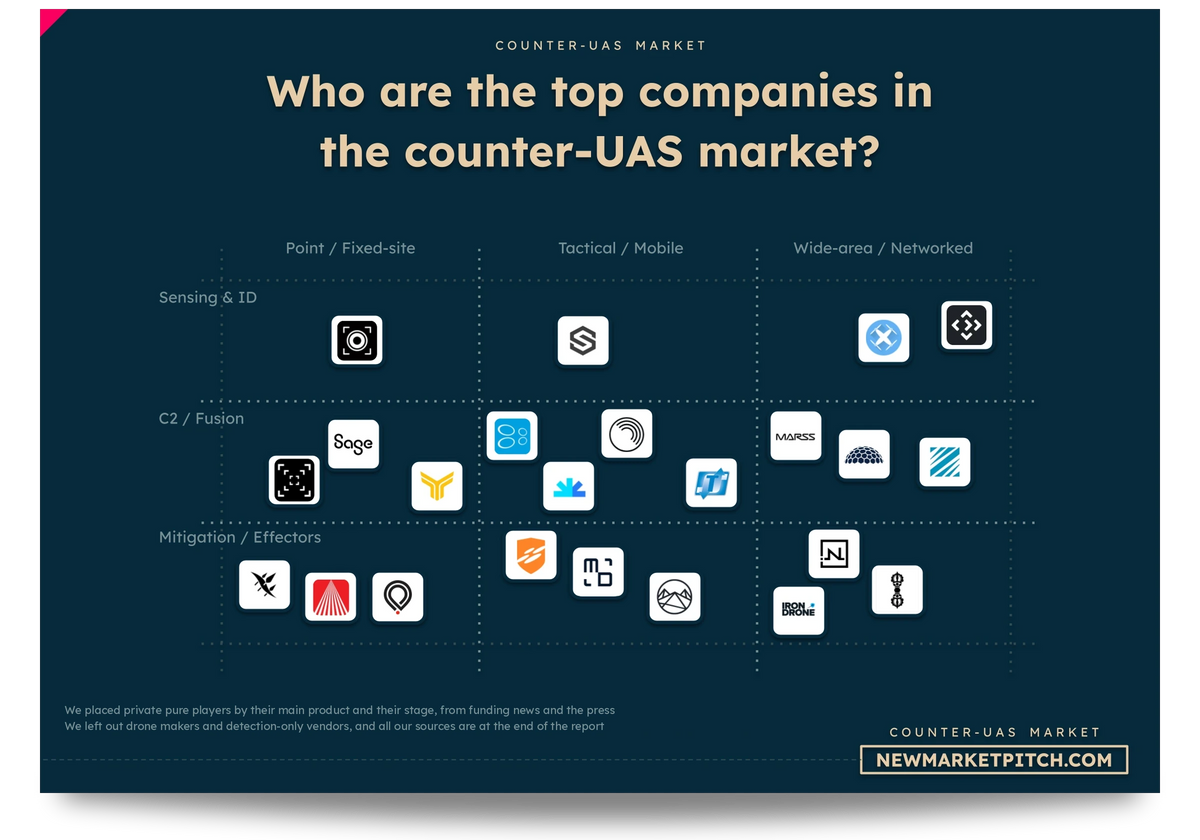
In our report covering the counter-UAS market, we turn what is vague and complex into simple, useful visuals. Market maps like this one show you at a glance where every startup stands.
Top startups in the counter-uas market ranked by total funding raised
Here is the current ranking of the counter-UAS startups that raised the most, with the total each one has raised and our confidence level.
If you want to go deeper into the counter-UAS startup landscape, check our report covering the counter-UAS market.
| # | Startup | Total raised | Last round | Status | Confidence |
|---|---|---|---|---|---|
| $1B and above | |||||
| 1 | AndurilAutonomous defence systems and weapons | $11.3B | May 2026$5.0B · Series D+ | Active | Full |
| 2 | CHAOS IndustriesDistributed radar and threat detection | $1.0B | Nov 2025$510M · Series D | Active | Full |
| $500M to $1B | |||||
| 3 | Cambridge AerospaceLow-cost drone and missile interceptors | $600M+ | Aug 2026$300M · Series C | Active | Full |
| 4 | EpirusHigh-power microwave drone neutralization systems | $537M | Mar 2025$250M · Series D+ | Active | Full |
| $100M to $500M | |||||
| 5 | SensoFusionDrone detection tracking and radio jamming systems | $385M+1 | Oct 2026$335M · IPO | IPO | Full |
| 6 | Allen Control SystemsAutonomous kinetic counter-drone weapon stations | $242M | Jun 2026$200M · Series B | Active | Full |
| 7 | EchodyneElectronically scanning tactical surveillance radars | $199M | Jun 2022$135M · Series C | Active | Full |
| 8 | Hidden LevelPassive drone detection and tracking | ~$120M | Feb 2025$65M · Series C | Active | Full |
| 9 | Fortem TechnologiesRadar-guided autonomous drone interception systems | $118M | Sep 2026$50M · Series B | Active | Full |
| Below $100M | |||||
| 10 | DedroneDrone detection and military C-UAS command control | $71M | Dec 2021$31M · Series C | Acquired | Full |
| 11 | D-Fend SolutionsCounter-drone radio frequency cyber systems | $67M | Dec 2024$31M · Series C | Acquired | Full |
| 12 | Alta AresAI-powered battlefield air defense | $59M | Jun 2026$57M · Series A | Active | Full |
| 13 | Aurelius SystemsAutonomous laser-based drone defense systems | $52M | Aug 2026$40M · Series A | Active | Full |
| 14 | TYTAN TechnologiesAI-powered autonomous drone interceptors | $50M | Feb 2026$33M · Series A | Active | Full |
| 15 | SkySafeDrone detection and airspace intelligence | $45M | Dec 2021$30M · Series B | Active | Full |
| 16 | Beijing Lizheng TechnologyRF-based drone detection and defeat | $43M+ | Dec 2025$43M+ · Series C+ | Active | Full |
| 17 | MatrixSpaceRadar systems for detecting and tracking drones | $40M | Oct 2025$20M · Series B | Active | Full |
| 18 | Frankenburg TechnologiesMass-produced low-cost interceptor missiles | $37M | Feb 2026$33M · Series A | Active | Full |
| 19 | SkapionMobile autonomous counter-swarm defense | $36M | Jul 2026$36M · Seed | Active | Full |
| 20 | WhiteFox Defense TechnologiesDrone detection and threat mitigation | $31M | Jun 2021$5.3M · Series A | Active | Full |
| 21 | PowerusAutonomous counter-drone defense systems | $30M | Jun 2026$30M · Growth equity | IPO | Full |
| 22 | Arcanus Aerial SystemsIntegrates allied counter-drone and aerial-interception technologies into deployable airspace-defence systems. | $28M+ | Nov 2026$27M+ · Series A | Active | Low |
| 23 | Robin RadarDrone detection and tracking radars | $27M+ | Jan 2025~$27M · Growth equity | Acquired | Full |
| 24 | North Vector DynamicsDevelops the CM-70 precision-guided missile interceptor to defeat hostile unmanned aircraft. | $26M+ | Oct 2026$20M+ · Series A | Active | Full |
| 25 | INLEAP PhotonicsLaser-based drone neutralization systems | $22M | Sep 2026$22M · Seed | Active | Full |
| 26 | Esh-Tech SystemsPulsed-laser drone neutralization systems | $18M | Jun 2026$18M · Seed | Active | Full |
| 27 | Axon VisionAI counter-drone vision systems | $13M1 | Aug 2025$11M · IPO | IPO | Full |
| 28 | Askari DefenseHand-launched autonomous drone interceptors | $12M | May 2026$11M · Seed | Active | Full |
| 29 | Alpine EagleAirborne autonomous counter-drone defense systems | $11M+ | Mar 2025~$11M · Seed | Active | Full |
| 30 | Ground AAI-guided laser drone defense | $10M | Jun 2026$10M · Pre-Seed | Active | Full |
| 31 | EGIDEAffordable interceptors and defense software | $9.3M | Mar 2026~$9.3M · Seed | Active | Full |
| 32 | ParaZero TechnologiesDefendAir autonomous anti-drone net interceptor | $7.8M1 | Jul 2023$7.8M · IPO | IPO | Full |
| 33 | MaraAutonomous kinetic drone interception | $7M | Aug 2026$7M · Seed | Active | Full |
| 34 | ZeroMarkAI-assisted counter-drone targeting systems | $7M+ | May 2024$7M · Seed | Active | Full |
| 35 | AirbilityDevelops autonomous airborne interceptors and coordinated defeat systems for hostile drones. | $6.4M+ | Sep 2026$4.7M · Series A | Active | Partial |
| 36 | Perseus DefenseAffordable guided anti-drone missiles | $6M+ | Sep 2025$6M · Seed | Active | Full |
| 37 | IndrajaalAutonomous wide-area counter-drone defense | $5.5M | Sep 2025~$5.5M · Growth equity | Active | Full |
| 38 | StendrMultisensor hardware for detecting hostile drones | $5.4M | Apr 2026$5.4M · Pre-Seed | Active | Full |
| 39 | Nordic Air DefenceSoftware-defined low-cost drone interceptors | $4.8M | Jul 2025$3M · Seed | Active | Full |
| 40 | Surtr Defense SystemsUnified counter-drone command software | $4.8M+ | Jul 2026$4.8M · Seed | Active | Full |
| 41 | Big Bang Boom SolutionsIndigenous military counter-drone defense systems | $4.8M | Aug 2024$2.6M · Growth equity | Active | Partial |
| 42 | WalarisAI-powered drone detection and tracking | $4.6M | May 2025$4.6M · Series A | Active | Full |
| 43 | Thermopylae AerospaceAutonomous interceptor drones for counter-UAS | $4.1M | Nov 2025$1.6M · Seed | Active | Full |
| 44 | Origin RoboticsAutonomous precision drones for military missions | $2.6M+ | Oct 2024$2.6M · Pre-Seed | Active | Full |
| 45 | Molfar Defence TechnologiesCounter-drone intelligence and detection systems | $1.7M | Jun 2026$1.7M · Seed | Active | Full |
| 46 | ArmoryAI-powered integrated counter-drone systems | $1.5M | Jun 2025$1.5M · Seed | Active | Full |
| 47 | Yunsun ZhifeiDevelops autonomous interceptor drones, guidance technology and integrated systems to neutralize hostile UAVs and drone swarms. | $1.4M+ | Aug 2026$1.4M+ · Seed | Active | Full |
| 48 | OpenWorks EngineeringOptical drone tracking and targeting | $1.3M | May 2019$1.3M · Seed | Active | Full |
| 49 | SkylanceLow-cost kinetic drone interceptors | $1.2M | Sep 2026$1.2M+ · Seed | Active | Full |
| 50 | Valkyrie DynamicsDevelops miniature radar seekers to detect and track hostile drones for all-weather protective interceptors. | $1.2M | Nov 2026~$1.2M · Seed | Active | Low |
| 51 | ShotlingRapid-fire anti-drone shotgun systems | $826K | Feb 2026$826K · Seed | Active | Full |
| 52 | Drone DefenceDrone detection and airspace security | $640K | Jun 2020$640K · Seed | Active | Full |
| 53 | Valkyr Defense SystemsAutonomous close-range drone interception | $400K+ | Jun 2026$400K+ · Seed | Active | Full |
| 54 | MaXon SystemsAutonomous Shahed drone interceptors | $300K+ | Feb 2026Undisclosed · Seed | Active | Full |
| Undisclosed | |||||
| 55 | Advanced Protection SystemsIntegrated radar and anti-drone systems | Undisclosed | Aug 2023Undisclosed · Growth equity | Active | Low |
| 56 | Auron SolutionsAI-based electronic drone warfare systems | Undisclosed | Aug 2026Undisclosed · Seed | Active | Low |
| 57 | CDDSAutonomous kinetic drone interception | Undisclosed | Jul 2026Undisclosed · Seed | Active | Low |
| 58 | Claymore IndustriesShotgun-based kinetic anti-drone systems | Undisclosed | 2026Undisclosed · Pre-Seed | Active | Low |
No startups match this search.
- Includes the primary proceeds of its IPO.

Our research about counter-drone systems gets updated several times a month, so you always get the latest view of where things stand.
Why does Anduril have such a huge lead in counter-UAS funding?
Anduril has raised far more than other counter-UAS startups because it builds a much wider range of defense systems, not just products for stopping drones.
We count $11.3B raised across 9 equity rounds. Anduril sells Sentry sensors, Lattice command software, Anvil interceptors, and Roadrunner aircraft for drone defense. It also builds other autonomous military systems. That wider business gives investors more than one product line to fund, and it helps Anduril sell detection and interception as parts of one package.
The company has a clear route to government customers. In March 2025, Anduril announced a ten-year U.S. Marine Corps counter-UAS program valued at $642M. Its systems also connect with broader U.S. Army command-and-control programs. The Marine Corps figure is a potential contract value, not equity funding or money already collected from the government.
Anduril's lead tells us that investors are backing a large defense manufacturer with a serious counter-drone business inside it. That is a different proposition from financing a company that makes one kind of radar, jammer, or interceptor. Its funding lead is real; treating every dollar as counter-UAS spending would be wrong.
Did one giant round make Anduril the counter-drone funding leader?
No single giant round gave Anduril its counter-UAS funding lead; several huge financings came before its biggest deal.
Anduril's $5.0B Series D+ closed in May 2026. That was the biggest single equity round among the counter-UAS market companies we track. Anduril had already raised a $1.5B Series D+ in August 2024 and a $2.5B Series D+ in June 2025. It has completed more funding rounds than any other company in this market, so its lead comes from repeated large checks rather than one lucky deal.
Anduril called the most recent financing a Series D+; we group Series D and later rounds as Series D+. The company tied the money to factories, research, and the ability to make and deploy defense equipment in large quantities. That is consistent with a business producing aircraft, sensors, and weapons alongside its software.
There is still a useful distinction between raising that cash and delivering products at scale. The money can pay for plants and inventory before orders arrive, but it cannot replace military tests or customer acceptance. Anduril has won investors' backing repeatedly. Its next challenge is turning that backing into more equipment in the field.

In our market report about counter-drone systems, we look at what the winners do differently, so you can learn from the best instead of guessing.
Is CHAOS Industries catching Anduril in counter-drone fundraising?
CHAOS Industries is a serious counter-UAS fundraising challenger, but it is still nowhere near Anduril's lifetime total.
We count $1.0B raised across 4 equity rounds by CHAOS Industries. CHAOS Industries' $510M Series D+ in November 2025 was led by Valor Equity Partners, with participation from 8VC and Accel. The company said it would put the money into development and manufacturing. That is a major commitment to a business best known for sensing threats rather than selling a broad collection of military products.
CHAOS builds its VANQUISH PRIME radar for persistent detection and tracking, and its VESPID interceptor adds a response to the threats those sensors find. Its pitch makes sense: a military or airport cannot stop a drone it has not spotted. A specialist sensor supplier can win work even when another contractor handles the rest of the defense system.
The companies are playing different games. CHAOS concentrates on finding threats early; Anduril offers a broader military platform with several ways to detect and defeat them. CHAOS has proved that investors will put substantial money into radar. It has not shown that a focused radar business will match the funding of a diversified defense manufacturer.
How did Cambridge Aerospace raise so much for drone interceptors?
Cambridge Aerospace has become one of the best-funded counter-UAS startups by convincing investors that armies need affordable interceptors they can buy in large numbers.
We count at least $600M in lifetime equity raised by the British company. Cambridge Aerospace's $300M Series C in August 2026 was led by DFJ Growth, with Lux, Accel, and Lakestar among the investors. Cooley, which represented the lead investor, said the funding would expand manufacturing and help the company meet existing and future contracts.
Cambridge Aerospace is developing Skyhammer for a clear problem: armies cannot afford to fire an expensive conventional air-defense missile at every cheap hostile drone. Its approach is closer to an industrial manufacturing challenge than a pure software business. Buyers need interceptors that work, cost less, and can be delivered repeatedly. That requires money for plants, testing, suppliers, and production staff before the company reaches its full potential.
The financing puts Cambridge Aerospace well ahead of most newer European interceptor makers. It does not establish how many weapons the company can deliver on schedule. For investors, and eventually defense ministries, that production record will matter more than another impressive fundraising announcement.
Why are investors putting so much money into Epirus and its anti-drone microwaves?
Epirus has attracted major counter-UAS investment because its Leonidas system offers a way to stop groups of drones without firing a missile at every target.
We count $537M in cumulative equity funding for Epirus. Epirus's $250M Series D+ in March 2025 backed production of Leonidas, a high-power microwave system designed to disrupt drone electronics. The company has described U.S. Department of Defense tests and military deliveries. That gives investors something specific to finance: hardware that has to work outside a laboratory and be manufactured consistently.
Compare that with Fortem Technologies, which uses autonomous DroneHunter aircraft to intercept drones, or Anduril, which brings sensors, software, and multiple weapons into one system. Microwaves can be useful against several nearby targets, but they also create difficult engineering problems involving power, range, integration, and safe operation. A strong test result is a good start. Sustained deployment is harder.
Epirus shows why no single counter-drone technology has attracted all the money. Some investors back radar, others back interceptors, and others back weapons that use energy rather than ammunition. Military customers may end up buying several of them for the same site.

In our document detailing everything you need to know about counter-UAS, you will always find fresh funding data, taken straight from our own verified funding database.
Can a counter-drone startup really raise money through an IPO?
SensoFusion has proved that a dedicated counter-UAS startup can raise fresh money through an IPO.
We count at least $385M in lifetime equity raised by SensoFusion, including $335M in primary IPO proceeds in October 2026. Nasdaq Helsinki confirmed the Finnish company's listing. SensoFusion develops radio-frequency sensing, drone identification, and countermeasures, so its business is narrower than Anduril's wider defense product range.
The company's IPO materials said it planned to spend the new money on research, production, and growth. The offering also involved shares sold by existing owners. Those sales are different from new shares issued by the company: only the latter provide fresh capital for its operations. That distinction matters whenever an IPO headline combines money going to a business with money going to its shareholders.
SensoFusion's listing gives other European counter-drone specialists a concrete example of a route to public markets. It does not guarantee that they can follow it. Investors still have to believe the product can sell, the company can deliver, and the public market will pay the price being asked.
Are investors really backing anti-drone gun turrets with big checks?
Investors are putting large sums into autonomous counter-drone gun turrets, and Allen Control Systems is a leading example.
Our lifetime equity count for Allen Control Systems is $242M. Allen Control Systems' $200M Series B in June 2026 was led by Smash Capital, according to Axios and the company's announcement. The money was intended to increase production and deployment of Bullfrog. Rather than invent a new missile, the system tries to make existing guns more effective at tracking and engaging small airborne targets.
Allen Control Systems also announced selection for the U.S. Marine Corps Ground Based Air Defense program. That creates a path to military use, although selection alone does not tell us how many turrets have been delivered or how often customers will order more. The company must still manufacture reliable equipment that works in difficult field conditions.
This investment is a useful counterpoint to the attention paid to lasers and microwaves. An autonomous gun turret can use familiar ammunition and established military logistics. Investors are betting that better sensing and aiming can make that old weapon practical against a new threat. Whether Bullfrog wins lasting orders will settle the business question.

Learning from others' mistakes is the cheapest lesson there is. In our report covering the counter-UAS market, we look at what broke startups before you, so you don't repeat it.
Did Echodyne stop raising money for its counter-drone radars?
Echodyne remains a major funded counter-UAS radar company even though its last recorded equity round is much older than those of the newest startups.
We count $199M in lifetime equity raised by Echodyne. The last round in our history is Echodyne's $135M Series C in June 2022, co-led by Bill Gates and Baillie Gifford, with Northrop Grumman among the participants. Echodyne makes electronically scanned radars for defense, security, and autonomous systems; detecting drones is a major part of that work. In November 2026, Shield agreed to buy Echodyne, a deal that was not yet completed.
The company has continued to discuss military deployments, border-security applications, and products such as EchoShield. So the age of its last disclosed round tells us very little about whether buyers still want its radars. Echodyne also takes a different technical route from Hidden Level's passive detection and CHAOS Industries' distributed radar. These products can compete for some contracts and work together in others.
Echodyne is a reminder that raising new money and selling useful equipment are separate things. An established company may have enough capital or revenue to keep operating without a new funding announcement. Its earlier raise is part of the lifetime comparison, but recent business activity has to be judged separately.
Is Fortem Technologies turning counter-drone contracts into bigger funding?
Fortem Technologies has raised more counter-UAS equity as its autonomous drone interceptors win government contracts.
We count $118M in total equity raised by Fortem Technologies, which places it ninth, just behind Hidden Level's ~$120M. Fortem Technologies' $50M Series B, closed in September 2026 after a first tranche announced in April, was led by Lockheed Martin. Fortem said the money would expand manufacturing in Utah and deployments of its SkyDome system, which combines TrueView radar, command software, and DroneHunter interceptor aircraft.
Fortem reported a Department of Homeland Security order tied to World Cup security, a U.S. Army installation-defense contract, and selection for a wider federal buying program. The program's maximum contract value is the most that agencies could eventually order under it; that is not funding Fortem received or revenue it has already earned. What makes these awards interesting is the possibility of repeat purchases, not the headline ceiling.
Fortem now faces a practical test. Can it build and maintain enough interceptors to protect more sites, not just demonstrate that DroneHunter works? The company's fundraising helps pay for that expansion. Actual deliveries and follow-on orders will tell us how far it can go.

In our research about counter-drone systems, we always try to gather several sources and make estimates that make sense, so you can work with solid numbers.
Can a drone-detection startup raise serious money without building weapons?
Hidden Level has raised serious counter-UAS funding for detecting and tracking drones without building weapons.
We count ~$120M raised by Hidden Level, including Hidden Level's $65M Series C in February 2025. The company said DFJ Growth led the financing and pointed to national-security demand. Hidden Level uses passive sensors to detect drones without relying on a conventional active radar beam. Its customers buy information that can help them identify threats and decide what to do next.
That is valuable in places where shooting, jamming, or electronically taking over a drone may be restricted. Airports, stadiums, and government facilities still need reliable alerts even if only certain authorities can act on them. Hidden Level therefore competes for some budgets with radar makers like Echodyne and MatrixSpace, while also offering another layer for integrated air-defense systems.
A detection company has a different job from an interceptor manufacturer. It must prove its sensors can locate real threats without overwhelming staff with false alarms. Hidden Level's funding shows that investors take this part of drone defense seriously. It does not make a passive sensor the right choice for every site.
Why isn't Dedrone closer to the top of counter-UAS fundraising?
Dedrone has built a well-known drone-detection business, but its acquisition ended the period when it raised equity as an independent counter-UAS startup.
We count $71M across 5 equity rounds for Dedrone. Dedrone's last recorded financing was a $31M Series C in December 2021. Axon completed its acquisition in October 2024 and brought Dedrone's airspace-monitoring products into its wider public-safety business. Customers can still buy the technology, but that does not create new equity funding for the former standalone startup.
Dedrone helps organizations spot and manage unauthorized drones. Its software can connect those alerts with other public-safety tools, which helps explain why a company like Axon wanted it. An acquired technology supplier may reach more customers through its new parent than it could have reached alone. That success will not appear as a bigger total of pre-acquisition venture funding.
This is why Dedrone belongs in a list of the most important counter-drone businesses even if its historic equity total is smaller than those of newer private companies. Funding rankings measure checks raised by companies, not every product sold after an acquisition.
Why did Motorola buy D-Fend Solutions before it raised $100M?
Motorola Solutions bought D-Fend Solutions after the counter-UAS market specialist had raised far less than the best-funded startups in the industry.
We count $67M raised by D-Fend Solutions, including D-Fend Solutions' $31M Series C in December 2024. Motorola Solutions completed the acquisition in August 2026. D-Fend's technology can identify certain drone threats and take control of their radio links, allowing an authorized operator to guide a drone to a safer landing rather than destroy it. That gives customers a different option from a gun or missile.
Motorola said D-Fend's systems had been used in airports, stadiums, military facilities, and border settings in more than 30 countries. A buyer with existing public-safety customers can add this capability to products and relationships it already has. It does not need the acquired company to have raised billions of dollars first.
D-Fend's sale makes a useful comparison with Fortem's manufacturing push and SensoFusion's IPO. All three sell counter-drone technology, but they have taken different routes to a bigger customer base. An acquisition may be a successful outcome for a startup with a smaller lifetime funding total. The size of its venture rounds alone would not reveal that outcome.

If you build or invest in the counter-UAS market, you need to know which business models pay off now and which ones are fading. That's why our report covering it has a whole section on it.
Can Europe's best-funded counter-drone startups stand up to Anduril?
Europe has several well-funded counter-UAS specialists, but none yet matches Anduril's lifetime fundraising scale.
Cambridge Aerospace is building cheaper drone interceptors, while SensoFusion sells radio-frequency detection and defeat systems. Alta Ares develops AI-based battlefield air defense, TYTAN Technologies works on autonomous interceptors, and Frankenburg Technologies plans to produce low-cost missiles in greater numbers. Their products tackle different parts of the problem, and buyers may use several at once.
There are signs of progress beyond funding. Airbus announced a cooperation agreement with Alta Ares in June 2026, and Frankenburg has described work to support local missile production. Partnerships can help a young company get its technology into larger defense systems. They do not automatically mean a factory is running at full capacity or that a customer has placed a large repeat order.
Europe's opening is to make parts of air defense that armed forces need and can buy repeatedly. A reliable interceptor or sensor can win orders without copying Anduril's entire business. The startups below show the range of European products now attracting capital.
The table below shows selected European counter-UAS startups by lifetime equity raised.
| Company | Country | Total raised |
|---|---|---|
| Cambridge Aerospace | United Kingdom | $600M+ |
| SensoFusion | Finland | $385M+ |
| Alta Ares | France | $59M |
| TYTAN Technologies | Germany | $50M |
| Frankenburg Technologies | Estonia | $37M |
| Robin Radar | Netherlands | $27M+ |
| INLEAP Photonics | Germany | $22M |
A plus sign marks a minimum, not an exact total.
Are investors putting serious money into lasers that stop drones?
Counter-UAS laser startups are raising serious money, even if their totals remain well below those of leading radar and microwave makers.
Aurelius Systems has raised $52M, including Aurelius Systems' $40M Series A in August 2026. Its Archimedes laser system is designed to defeat drones, and the company has discussed integration work with American Rheinmetall. INLEAP Photonics has raised $22M, Esh-Tech Systems has raised $18M, and Ground A has raised $10M. These are different teams trying to make laser-based defenses work in practice.
The appeal is easy to understand. A laser may be able to deal with repeated threats without needing a fresh missile for every shot. But a real system has to track a moving target, deliver enough energy through changing conditions, and operate safely near other equipment and people. Those problems are harder than they look in a demonstration video.
The laser group is still far behind Epirus in lifetime funding. That is not a verdict on which technology will work better. Lasers and high-power microwaves engage drones in different ways, and the right choice depends on the setting. For now, the funding shows that investors are keeping several options alive.

In our document detailing everything you need to know about counter-UAS, we don't want to repeat what boring consulting reports say. Instead, we show you the real and latest market signals that matter.
Can cheap drone-interceptor startups raise money like the biggest defense companies?
Affordable drone-interceptor startups are getting serious backing, but most are still far smaller fundraisers than the big counter-UAS defense platforms.
Fortem Technologies uses autonomous DroneHunter aircraft, while TYTAN Technologies and Frankenburg Technologies are working toward cheaper, repeatable interceptor production. Askari Defense, Alpine Eagle, EGIDE, and Mara are developing other compact approaches. TYTAN discussed expansion plans in Germany and allied markets in February 2026, while Frankenburg has described plans to build missile production at multiple European sites.
The smaller companies have a clear opportunity. An army facing many inexpensive drones needs weapons it can replenish without running out of money or stock. But designing a promising interceptor and producing thousands of consistent units are different jobs. Every factory needs suppliers, testing, staff, maintenance, and buyers willing to place repeat orders. Canadian developers add another route: Arcanus Aerial Systems has raised at least $28M for integration and production, while North Vector Dynamics has raised at least $26M to develop its CM-70 guided interceptor.
Some specialists may never need a giant platform-sized raise. They could supply a larger contractor instead. Others will need fresh rounds if orders force them to expand manufacturing quickly. The funding figures below show how much distance remains between established interception businesses and smaller entrants.
The table below shows selected interceptor startups and their lifetime equity raised.
| Company | Country | Total raised |
|---|---|---|
| Fortem Technologies | United States | $118M |
| TYTAN Technologies | Germany | $50M |
| Frankenburg Technologies | Estonia | $37M |
| Askari Defense | United States | $12M |
| Alpine Eagle | Germany | $11M+ |
| EGIDE | France | $9.3M |
| Mara | United States | $7M |
A plus sign marks a minimum, not an exact total.
Can civilian counter-drone startups get funding without selling weapons?
Civilian-focused counter-UAS startups can raise money by detecting drones even when their customers cannot legally disable them.
SkySafe has raised $45M, and companies such as Dedrone and Robin Radar have built businesses around detection and airspace awareness. Airports, stadiums, and industrial sites may need to know where a drone is flying and whether it poses a threat before anyone considers stopping it. Sensors and software can provide that information without carrying a weapon.
Legal authority matters. In the United States, counter-drone powers have expanded for certain trained and certified state and local law-enforcement agencies, but private organizations do not automatically gain the right to jam, seize, or shoot down an aircraft. That leaves a market for products that alert staff and help authorized agencies make decisions. Detection is still useful when an active response is off limits.
Robin Radar has reported deployments of its IRIS systems in World Cup security operations, and Dedrone's technology is now part of Axon's public-safety offering. The important commercial test is whether customers trust the alerts and use them in everyday operations. A counter-drone startup does not have to build an interceptor to reach paying customers.

In our report covering the counter-UAS market, we like to show you the big picture. We know your time is precious, so we make every page quick to read and packed with as much learning as possible per minute.
Why isn't DroneShield among these best-funded counter-UAS startups?
DroneShield makes widely known counter-UAS equipment, but it is too long-established as a public company to count as a startup in this comparison.
DroneShield trades on the Australian Securities Exchange, and ASX records show that its shares began trading in June 2016. We include companies that went public within the last five years, but a long-listed business belongs in a different comparison. Its later share sales are also not part of the lifetime equity totals for the startups in this article.
That exclusion says nothing negative about DroneShield's products. The company sells drone-detection and electronic-warfare systems, and many readers will recognize it before some of the young companies with larger fundraising totals. Public-market access, sales history, and product adoption are separate questions from how much a qualifying startup has raised since it was founded.
The same logic keeps Lockheed Martin and other longstanding defense contractors out of the startup list. They may build, buy, or invest in counter-drone products, but their corporate histories are not comparable with recent venture-backed companies. Dedrone, by contrast, stays included because it was a qualifying startup before Axon acquired it.
Do counter-UAS startups really need to raise $100M to compete?
Counter-UAS startups do not need $100M to compete, although the largest manufacturers may need much more.
Only 9 of the 58 companies we track have reached nine-figure equity totals. The other 49 remain below that mark, and the median company has raised at least $10M. This gap is big enough to make the best-funded names poor examples of a normal counter-drone startup budget.
Compare Epirus, which has to develop and manufacture powerful microwave systems, with smaller teams building a single guided interceptor or detection product. Both may need rigorous testing and strong customer relationships. They do not necessarily need the same factories, equipment, or staff. A startup making software can also face another kind of spending problem from one that builds radar hardware or missiles.
Having more cash helps a company hire engineers, carry inventory, and support customers across more sites. It does not ensure that military users will choose its product. Buyers care about whether a system works against the threats they face and whether they can keep it running. The funding threshold separates large fundraisers from smaller ones, not winning technologies from failed ones.
Does the best-funded counter-drone startup also have the best product?
The best-funded counter-UAS startup is not automatically the best choice for an airport, military base, or battlefield.
Anduril offers several detection and defeat tools in one system. CHAOS Industries has put major resources into radar, Epirus builds microwave weapons, Fortem Technologies uses autonomous interceptors, and SensoFusion sells radio-frequency detection and countermeasures. These products answer different questions. Can a sensor find a small drone early enough? Can an interceptor reach it safely? What happens if many drones arrive together? One lifetime fundraising total cannot answer all of them.
There is better evidence to look at. Fortem has announced government security work and Army contracts, Epirus has reported military tests and system deliveries, and Robin Radar has described deployments of its IRIS sensors. Even those facts require care. A successful test, a contract award, and a system used every day are three different kinds of proof.
Funding tells us who has obtained the money to develop, test, and manufacture. It does not replace customer trials, deployment results, or the total cost of using the equipment. The best-funded company may sell an excellent system, but another supplier could still be the better fit for a particular threat.

When you build or invest in the counter-UAS market, you need clarity, not confusion. In our research about counter-drone systems, we always try to put numbers on and quantify whatever is usually vague and confusing.
Are counter-UAS startups still raising money, or living on old rounds?
Counter-UAS startups are still raising equity today, while some established radar and detection companies continue to operate on older funding.
The last recorded equity round falls in 2026 for 32 companies and in 2025 for 14. Echodyne last raised in June 2022, SkySafe in December 2021, and Dedrone has since been acquired. An older financing date does not show that a business stopped selling equipment. It simply marks where that company's independent equity history currently ends.
Newer founders are getting access to serious capital. CHAOS Industries, founded in 2022, and Cambridge Aerospace, founded in 2024, have moved past many older specialists in lifetime funding. Allen Control Systems, also founded in 2022, raised money to build more Bullfrog systems. At the other end of the market, recent rounds have supported laser prototypes, guided interceptors, and other early products. The money is going to companies at very different stages.
Those last-round dates cannot tell us whether total market funding is rising each quarter. But they do tell us something about this particular list: it includes older suppliers, acquired businesses, and new manufacturers trying to turn investor cash into real equipment. A high lifetime total and a recent fundraising announcement answer different questions.
So, which counter-UAS startups have raised the most money today?
Anduril leads counter-UAS startup fundraising by a huge margin, with CHAOS Industries and Cambridge Aerospace heading the group behind it.
The top names do not sell the same product. Anduril runs a broad defense business that includes counter-drone sensors, software, and interceptors. CHAOS Industries focuses on radar, Cambridge Aerospace makes lower-cost interceptors, and Epirus builds high-power microwave defenses. SensoFusion has also reached public markets. Farther down the funding list, Allen Control Systems, Echodyne, Hidden Level, Fortem Technologies, and Dedrone represent several other ways to find or stop hostile drones.
For the question of lifetime equity raised, the winner is clear. For the question of which company a buyer should choose, it depends on the threat and the site. A military base facing swarms may need a different system from an airport that can only detect and report unauthorized flights. The funding leaders can invest more heavily in production and development, but customers still decide whether the equipment solves their problem.
The table below shows what we found.
| Question | Answer |
|---|---|
| Is the funding lead a close race? | No, Anduril remains far ahead of its closest rival. Anduril's $11.3B lifetime total makes the funding gap unusually large. That advantage also finances broader defense programs, not only counter-UAS. |
| Did Anduril need repeated giant rounds? | Yes, several large financings established its position over time. Anduril's $5.0B round in May 2026 extended an existing advantage. A single deal did not create the leadership from nothing. |
| Can radar alone attract major backing? | Yes, CHAOS Industries has become a major radar specialist. The $510M Series D+ of CHAOS Industries supported product development and manufacturing. Investors therefore see value beyond companies selling complete weapons systems. |
| Is Europe producing a major interceptor challenger? | Yes, Cambridge Aerospace has won unusually large manufacturing support. Cambridge Aerospace's $300M Series C financed more capacity and development. Turning that capital into deliveries remains the important next test. |
| Do microwave systems require serious investment? | Yes, Epirus has substantial backing for its Leonidas technology. Epirus' $250M Series D+ supported production of high-power microwave defenses. Swarm protection remains different from intercepting each drone individually. |
| Can a specialized company use public markets? | Yes, SensoFusion has completed an IPO in Finland. SensoFusion's $335M IPO round supplied primary capital to the business. A listing offers financing options unavailable to private rivals. |
| Are autonomous gun turrets receiving large checks? | They are, with Allen Control Systems among the funded contenders. Allen Control Systems' $200M Series B targeted expansion of Bullfrog production. Established ammunition and autonomous aiming create a different defense approach. |
| Are older radar startups still relevant today? | Yes, Echodyne remains a significant funded radar company. Echodyne's $135M Series C dates to June 2022. An older financing date does not prove weak customer demand. |
| Can smaller firms win operational contracts? | Yes, Fortem Technologies has demonstrated government customer interest. Fortem's $118M equity total grew after notable counter-drone deployments. Contract ceilings and capital raised must still be kept separate. |
| Do acquisitions make funding totals misleading? | They can, because acquired startups stop raising independently. Dedrone raised $71M before joining Axon's product ecosystem. Its historic total cannot measure all subsequent commercial reach. |
| Must serious startups raise nine-figure funding? | No, most counter-UAS startups remain below that funding level. Only 9 of 58 companies have raised nine-figure totals. Product usefulness depends on deployment and economics, not that threshold. |
Our methodology
Our data runs through November 14, 2026. We then reviewed this article and updated its answers on November 17, 2026, the date shown under the title. We define counter-UAS as businesses dedicated to detecting, tracking, identifying, managing, or defeating unauthorized or hostile drones. This includes dedicated sensors, command software, jamming, directed energy, and purpose-built interceptors; companies close to the category boundary are included rather than discarded when the counter-UAS market activity is material. Every company in the ranking qualifies as a startup under our definition: an independent, growth-oriented technology business founded in 2000 or later that is private or entered public markets within the last five years. Acquired and shut-down companies remain shown with their status, and listed companies remain eligible during that five-year window. Their fundraising total stops at the acquisition or IPO, with IPO primary proceeds included.
A total counts equity raised from founding through the data date, including the earliest private rounds and primary capital issued at IPO. We exclude loans, venture debt, grants, unconverted convertibles and SAFEs, post-IPO offerings, secondary share sales, and repeated reports of the same financing. A SAFE converted into equity is counted within the round that absorbed it, not counted again separately. A plus sign means a minimum because at least one equity round has no disclosed amount. We compare lifetime totals here, not just deals announced in the last twelve months or since January 2024.
Rounds confirmed by a company announcement, a press article or a regulatory filing are counted in full. Where no article exists, a round is counted only when at least two recognised databases agree on its date (within one month) and amount (within 5%), and it is marked as low confidence; a round found in a single database stays in the company's history but is left out of totals. For companies that have raised more than $100M, every round counted is backed by an article.
We do not take a commercial database's published cumulative total as our final figure. Such figures may mix equity with debt, grants, unfulfilled commitments, or estimates. Instead, we rebuild the total from individual rounds, prioritizing company statements, investor disclosures, filings, and reporting. When only two recognized databases agree on a round, we count it at low confidence rather than presenting it as fully corroborated. Our confidence labels, Full, Strong, Partial, and Low, show how much of each total rests on independently confirmed rounds. Where a company or the press uses a different cumulative figure, we retain the sum of eligible equity rounds and flag major differences in notes accompanying the ranking.
A familiar company's absence is not a finding that its technology or sales are unimportant. A long-listed manufacturer such as DroneShield or an established defense contractor falls outside this startup comparison; an acquired specialist such as Dedrone stays in, but its independent total ends at acquisition. Conversely, Anduril remains eligible because it operates material counter-UAS products even though it sells other defense systems. We make these choices consistently to avoid disguising different types of companies as direct fundraising peers.
These figures are capital raised, not valuations, revenue, contract awards, or cash still held. Funding can support products outside counter-UAS at a diversified company, while a smaller specialist can secure government orders without needing a fresh equity round. We use the ranking to identify who obtained the most eligible capital, and company announcements and procurement evidence to interpret why that capital matters.
Key sources include Anduril counter-UAS product range and integration, Marine Corps program announced by Anduril, Anduril's financing announcement and industrial expansion rationale, CHAOS Industries' funding and manufacturing plans, Cambridge Aerospace investor and manufacturing context, Epirus Leonidas military development and deployment milestones, SensoFusion public offering, primary capital and listing, Allen Control Systems' Bullfrog financing and program announcements, Echodyne's historic financing and radar commercialization, Shield's November 2026 agreement to acquire Echodyne, Fortem funding, manufacturing and government demand, Hidden Level's passive detection and Series C context, Dedrone acquisition and integration into Axon, D-Fend acquisition and radio-frequency technology, Alta Ares and Airbus counter-drone cooperation, Aurelius laser defense and financing plans, TYTAN interceptor production expansion, Frankenburg production investment and interceptor economics, Arcanus Canadian production and equity financing, North Vector Dynamics' CM-70 and capital plans, Robin Radar operational deployments, Statutory limits on US public-sector counter-UAS authority, DroneShield listed status and company focus, and ASX evidence of DroneShield's 2016 listing.
Written by the New Market Pitch teamWe track new markets so founders and investors can move faster. About us