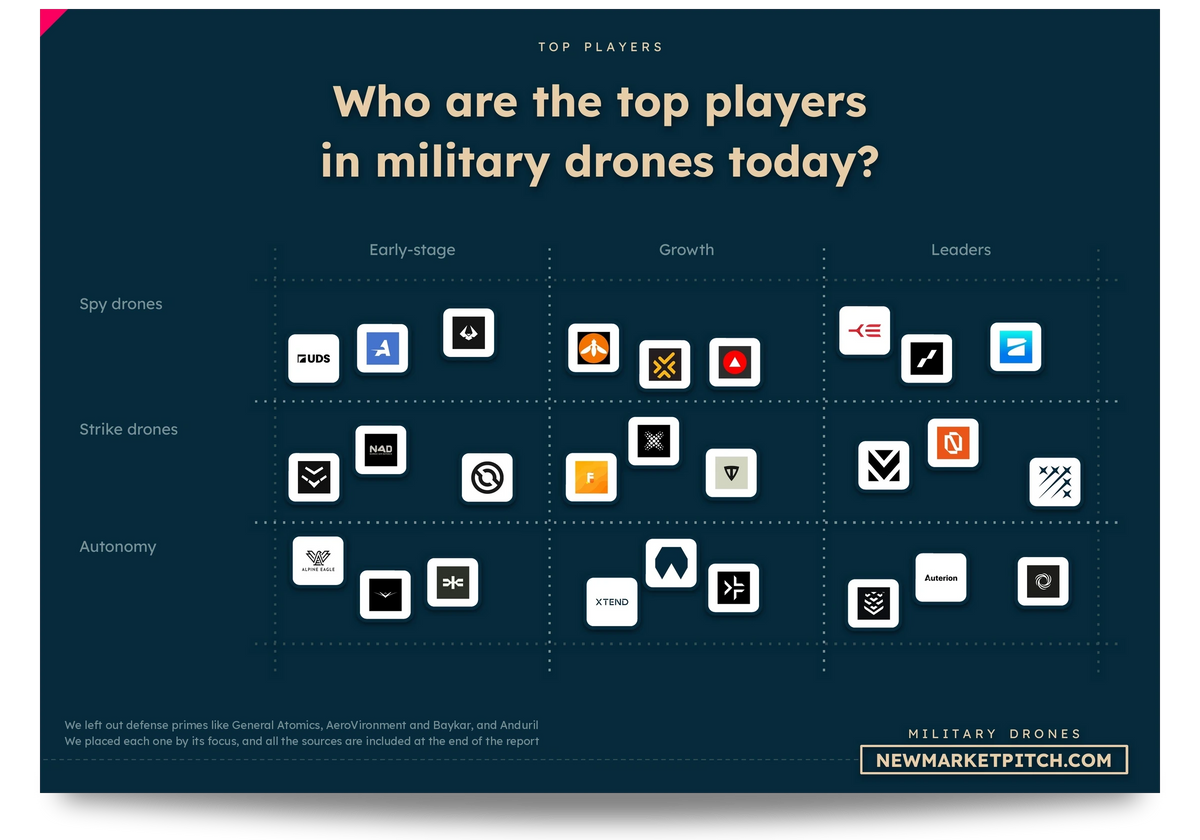
What are the top military drone startups by total funding raised?
Everything we know about the military drones market, in one place. Get our report whether you build or invest.
Summary
Anduril leads military drone startup fundraising with $11.3B raised. Shield AI follows with $3.8B, with Germany's Helsing also near the top. No other company has yet matched Anduril's ability to raise equity on that scale.
Anduril got there over years, not through a single lucky round. Its $5.0B late-stage round in May 2026 was enormous, but the company had already financed several rounds of aircraft development, software and factory expansion.
Shield AI took a different path. It builds military aircraft and autonomy software that can fly other manufacturers' drones. Its many funding rounds show how much investors are willing to spend on both.
Europe has its own serious contenders. Helsing is developing strike drones, Quantum Systems builds reconnaissance aircraft, and STARK Defence is working on autonomous weapons. Their businesses overlap, but they are not interchangeable.
Newer names have moved into the picture surprisingly fast. UFORCE and Cambridge Aerospace have secured major funding despite being young companies. Both are betting that armed forces need new systems faster than traditional suppliers can deliver them.
Those exceptional rounds can give the wrong impression of the wider market. Only 6 of the 85 military drone startups we track have crossed the billion-dollar line. Another 66 are below nine figures.
That split partly reflects what companies build. A firm opening drone factories needs different resources from one selling flight software or small aircraft that intercept incoming threats.
The geography is also changing. American companies still dominate the top of the list, but Germany now has several major competitors. Ukraine's drone makers play an outsized battlefield role without showing comparable private funding totals.
We also separate money invested in a company from money promised through contracts or loans. An army order can be valuable without adding anything to a startup's equity funding total.
So Anduril's lead is real, but the race behind it is wide open. Some startups spent years raising money; others arrived near the top after one exceptional round. The funding totals show who can afford to build, not which drone will win every military contract.

Written by the New Market Pitch teamWe track new markets so founders and investors can move faster. About us

In our report covering the military drone market, you will always find fresh funding data, taken straight from our own verified funding database.
Top startups in the military drones market ranked by total funding raised
Here is the current ranking of the military drones startups that raised the most, with the total each one has raised and our confidence level.
If you want to go deeper into the military drones startup landscape, check our report covering the military drones market.
| # | Startup | Total raised | Last round | Status | Confidence |
|---|---|---|---|---|---|
| $1B and above | |||||
| 1 | AndurilAutonomous defence systems and weapons | $11.3B | May 2026$5.0B · Series D+ | Active | Full |
| 2 | Shield AIAI autonomy software and military drones | $3.8B | Nov 2026$1.0B · Series H | Active | Strong |
| 3 | HelsingAI-powered autonomous defense systems | $3.3B+ | Jul 2026$1.8B · Series E | Active | Full |
| 4 | Quantum SystemsAI-powered military unmanned aerial systems | $1.7B | Jul 2026$1.2B · Series D | Active | Partial |
| 5 | SkydioAutonomous drones for defense and inspection | $1.1B+ | Nov 2026$255M · Series G | Active | Full |
| 6 | Mach IndustriesMilitary attack drones and aerial interceptors | $1.1B+ | Sep 2026$600M · Series C extension | Active | Full |
| $500M to $1B | |||||
| 7 | TEKEVERAI-powered military surveillance drones | $759M | Sep 2026~$580M · Series D | Active | Full |
| 8 | UFORCECombat-tested autonomous military drone systems | $750M | Nov 2026$700M · Series A | Active | Full |
| 9 | STARK DefenceAutonomous military drones and weapons | $627M+ | Jun 2026$550M · Series C | Active | Partial |
| 10 | Cambridge AerospaceLow-cost drone and missile interceptors | $600M+ | Aug 2026$300M · Series C | Active | Full |
| $100M to $500M | |||||
| 11 | Neros TechnologiesFPV strike and interceptor drones | $371M | Aug 2026$250M · Series C | Active | Full |
| 12 | Harmattan AIAutonomous military drones and air defence | $230M | Jan 2026$200M · Series B | Active | Strong |
| 13 | PDWAmerican-made military unmanned aircraft systems | $222M+ | Sep 2026$52M · Late VC | Active | Full |
| 14 | XTENDAI-assisted military reconnaissance and tactical drones | $200M | Sep 2026$68M · Growth equity | IPO | Full |
| 15 | Firestorm LabsExpeditionary drone manufacturing and UAS | $150M+ | Apr 2026$82M · Series B | Active | Full |
| 16 | Fortem TechnologiesRadar-guided autonomous drone interception systems | $118M | Sep 2026$50M · Series B | Active | Strong |
| 17 | AuterionAutonomy software for military drone fleets | $115M+ | Nov 2025Undisclosed · Growth equity | Active | Full |
| 18 | Raphe mPhibrMilitary UAVs and autonomous systems | $100M | Jun 2025$100M · Series B | Active | Partial |
| 19 | Heven AeroTechHydrogen-powered long-endurance military drones | $100M+ | Dec 2025$100M · Series B | Active | Partial |
| Below $100M | |||||
| 20 | VectorMilitary drones and warfare services | $74M | Sep 2025$61M1 · Series A | Active | Full |
| 21 | Alta AresAI-powered battlefield air defense | $59M | Jun 2026$57M · Series A | Active | Strong |
| 22 | Swarm AeroLarge autonomous military aircraft | $59M | Mar 2026$35M · Series A | Active | Strong |
| 23 | NewSpace Research & TechnologiesSwarm drones and long-endurance UAVs | $57M | Mar 2024$33M · Bridge equity | Active | Partial |
| 24 | ideaForgeMilitary and industrial surveillance drones | $56M+2 | Jul 2023$29M · IPO | IPO | Full |
| 25 | DarkhiveAutonomous tactical reconnaissance drones | $55M | May 2026$30M · Series B | Active | Full |
| 26 | TYTAN TechnologiesAI-powered autonomous drone interceptors | $50M | Feb 2026$33M · Series A | Active | Strong |
| 27 | AITANEdge-AI autonomous defense robotic systems | $41M | Sep 2026$41M · Series A | Active | Full |
| 28 | Skydweller AeroSolar-powered long-endurance autonomous aircraft | $40M+ | Sep 2021$8M · Series A extension | Active | Full |
| 29 | SwarmerAutonomous drone swarm control software | $35M2 | Mar 2026$17M · IPO | IPO | Full |
| 30 | Beyond VisionManufactures AI-enabled military drones and ISR unmanned platforms. | $32M+ | Oct 2026$32M+ · Series A | Active | Low |
| 31 | Hoverfly TechnologiesTethered drones for persistent aerial surveillance | $31M | Oct 2025$20M · Series B | Active | Full |
| 32 | SE3Develops onboard spatial AI and natural-language mission software that controls military drones even when GPS is denied. | $30M | Nov 2026$30M · Series A | Active | Full |
| 33 | DestinusAutonomous aerospace and hypersonic systems | $29M+ | Feb 2022$29M · Seed | Active | Full |
| 34 | Buntar AerospaceReconnaissance drones and battlefield software | $28M+ | Oct 2026$16M · Undisclosed stage | Active | Partial |
| 35 | Arcanus Aerial SystemsIntegrates and manufactures allied military UAV systems for reconnaissance and combat-support missions in Canada. | $28M+ | Nov 2026$27M+ · Series A | Active | Low |
| 36 | Easy AerialAutonomous tethered surveillance drone systems | $26M | Aug 2026$20M · Series B | Active | Full |
| 37 | Grid AeroAutonomous cargo aircraft for military missions | $26M | Jan 2026$20M · Series A | Active | Full |
| 38 | OrqaFPV drones and defence electronics | $22M | Mar 2026$14M · Series A | Active | Strong |
| 39 | DelairMilitary and industrial UAV systems | $18M+ | Sep 2018Undisclosed · Series B | Active | Full |
| 40 | SpearUAVEncapsulated military tactical AI loitering munitions; UVision subsidiary | $17M+ | Mar 2025Undisclosed · Other | Acquired | Full |
| 41 | SkywaysAutonomous military cargo delivery drones | $16M+ | Dec 2021$15M · Series A | Active | Low |
| 42 | VermeerGPS-independent drone navigation technology | $15M | Oct 2025$10M · Series A | Active | Partial |
| 43 | Six RoboticsSwarm autonomy software for unmanned systems | $14M | Jun 2026~$14M · Seed | Active | Strong |
| 44 | Tycho AIAI navigation for unmanned vehicles | $12M | Oct 2025$10M · Series A | Active | Full |
| 45 | Askari DefenseHand-launched autonomous drone interceptors | $12M | May 2026$11M · Seed | Active | Strong |
| 46 | Twentyfour IndustriesMass-produced modular military drones | $12M | Jan 2026$12M · Undisclosed stage | Active | Strong |
| 47 | AD SystemsStealth military reconnaissance drone manufacturing | $12M | Sep 2026~$9.4M · Series A | Active | Partial |
| 48 | Alpine EagleAirborne autonomous counter-drone defense systems | $11M+ | Mar 2025~$11M · Seed | Active | Partial |
| 49 | Farsight VisionDrone-derived 3D intelligence and mapping | $9.2M | Feb 2026~$8.6M · Seed | Active | Strong |
| 50 | Vantage RoboticsTactical reconnaissance and surveillance drones | $8.9M | Apr 2018$8.9M · Series A | Active | Full |
| 51 | ElistairTethered drones for persistent surveillance | $7.7M+ | Mar 2021$5.5M · Series B | Active | Full |
| 52 | Occam IndustriesAutonomous control software for military drones | $7.5M | Sep 2026$4.2M · Growth equity | Active | Strong |
| 53 | Orbotix IndustriesAI-powered autonomous defense drone systems | $7.2M+ | Oct 2025$7.2M · Pre-Seed | Active | Full |
| 54 | MaraAutonomous kinetic drone interception | $7M | Aug 2026$7M · Pre-Seed | Active | Strong |
| 55 | Certo AerospaceBuilds the CAPSTONE heavy-lift autonomous VTOL aircraft for military logistics and support missions. | $6.6M | Oct 2026~$6.6M | Active | Full |
| 56 | AirbilityHigh-speed eVTOL counter-drone aircraft | $6.4M+ | Sep 2026$4.7M · Series A | Active | Partial |
| 57 | LenduraiGPS-denied autonomous UAV navigation | $6.4M | Jun 2025$6.4M · Seed | Active | Strong |
| 58 | TrypillianUkrainian military drones and systems | $5M | May 2025$5M · Angel / strategic | Active | Strong |
| 59 | FlyFocusMilitary UAV design and manufacturing | $5M+ | Feb 2026$5M · Seed | Active | Partial |
| 60 | Nordic Air DefenceSoftware-defined low-cost drone interceptors | $4.8M | Jul 2025$3M · Seed | Active | Full |
| 61 | TheseusAutonomous defense drones and navigation systems | $4.3M | Apr 2025$4.3M · Seed | Active | Full |
| 62 | Evolve DynamicsAll-weather ISR unmanned aircraft systems | $4.1M | Mar 2025$768K · Growth equity | Active | Partial |
| 63 | Thermopylae AerospaceAutonomous interceptor drones for counter-UAS | $4.1M | Nov 2025$1.6M · Seed | Active | Full |
| 64 | Swarm Defense TechnologiesLow-cost coordinated military drone swarms | $3.5M+ | Sep 2026$2M · Form D / Undisclosed stage | Active | Full |
| 65 | Unmanned Defense SystemsAutonomous military drones and robotic systems | $3.5M | May 2024~$3.5M · Seed | Active | Full |
| 66 | AirlogixUnmanned aerial systems for defense | $3.3M | Feb 2026$3.3M · Seed | Active | Full |
| 67 | EOS TechnologieRodeur/Veloce ISR and loitering unmanned aerial weapons | $2.8M | Sep 2022$2.8M · Seed | Active | Full |
| 68 | Quantum AeroAI-guided autonomous defense drones | $2.7M | Mar 2025$2.7M · Seed | Active | Full |
| 69 | M-FlyLaser guidance and UAV gimbals | $2.7M | Sep 2026Undisclosed · Follow-on equity | Active | Full |
| 70 | Origin RoboticsAutonomous precision drones for military missions | $2.6M+ | Oct 2024$2.6M · Pre-Seed | Active | Full |
| 71 | MonopulseElectronic-warfare-resistant reconnaissance drones | $2.3M+ | Oct 2026$2.3M+ · Early VC | Active | Low |
| 72 | PDKINEMATICSPrecision-guidance kits for UAV munitions | $2.2M | Jun 2026$2.2M · Seed | Active | Partial |
| 73 | DOD SolutionOnboard autonomy for unmanned systems | $2.1M | Sep 2026$2.1M · Pre-Seed | Active | Strong |
| 74 | UnmanndAutonomous UAVs for defense operations | $2M | Sep 2025$2M · Pre-Seed / seed | Active | Strong |
| 75 | FuvexLong-range drones for infrastructure inspections | $2M | Oct 2025$2M · Series A | Active | Full |
| 76 | Agilis AirAutonomous drones for defense missions | $1.4M | Sep 2026$1.4M · Seed | Active | Full |
| 77 | Silent ArrowAutonomous military cargo delivery drones | $1.3M | Sep 2023$1.2M · Growth equity | Active | Full |
| 78 | NORDA DynamicsAutonomous drone navigation for defense | $1.2M | Sep 2025$1M · Seed | Active | Full |
| 79 | Granta AutonomyAutonomous drones for defense reconnaissance | $1.1M | Jul 2024$1.1M · Seed | Active | Full |
| 80 | ZULU Defence SystemsAutonomous military drone systems | $750K | Apr 2024$750K · Seed | Active | Full |
| 81 | HoverItLong-range drones for defense missions | $500K | Jan 2026$500K · Seed | Active | Full |
| 82 | Apollyon DynamicsMilitary drones for defense operations | $480K | May 2026~$480K · Seed | Active | Full |
| 83 | MaXon SystemsAutonomous interceptor drones for air defense | $300K+ | Feb 2026Undisclosed · Seed | Active | Full |
| 84 | SkyfrontPerimeter long-endurance UAS; civilian versus military share uncertain | $20K | Jun 2015$20K · Seed | Active | Full |
| Undisclosed | |||||
| 85 | AcodyneAutonomous military-use VTOL cargo aircraft | Undisclosed | Jun 2026Undisclosed · Pre-Seed | Active | Low |
No startups match this search.
- Includes earlier funding without amounts per round.
- Includes the primary proceeds of its IPO.

In our research about military drones, we turn what is vague and complex into simple, useful visuals. Market maps like this one show you at a glance where every startup stands.
Can any military drone startup catch Anduril's fundraising lead?
Anduril is still far ahead of every other military drone startup, with $11.3B raised since founding.
Its lead over Shield AI, the next company, is 3.0x. That is money investors have actually put into the company, rather than a valuation or a contract paid over time.
Anduril can pay for several expensive projects at once: developing autonomous aircraft, building software, testing weapons and expanding domestic production. In January 2025, Anduril announced Arsenal-1, its large manufacturing site in Ohio, explicitly linking factory scale to the ability to deliver autonomous systems for the United States and its allies. It has more than one aircraft program to support its growth.
Shield AI focuses heavily on autonomy and aircraft such as V-BAT, while Helsing is building software-defined strike systems and Quantum Systems is expanding reconnaissance-drone production. All three are serious competitors in specific products. None has matched Anduril's cumulative equity financing. Anduril's funding advantage gives it more room to build, but military buyers will still judge each aircraft on performance and price.
Did one huge round put Anduril ahead of every military drone rival?
No. Anduril built its military drone funding lead over several big rounds, and its $5.0B late-stage round in May 2026 pushed it much further ahead.
We count 9 equity rounds for Anduril, and the biggest check came after years of fundraising.
Anduril also raised the largest disclosed round among these startups in 2024 and again in 2025. Its lead had already been growing before this year's giant check. Reuters reported in May 2026 that Anduril had doubled its revenue during the previous year and was expanding its workforce, giving investors an operating story alongside its manufacturing plans. The revenue and manufacturing story helps explain why investors kept writing bigger checks.
The contrast is UFORCE, which entered the upper funding tier with a much shorter financing history, and Shield AI, which has drawn on more separate rounds than Anduril. With that much capital raised over time, Anduril can work on several expensive programs in parallel. A company built around one recent round has less of a track record to judge.

In our market report about military drones, we always try to gather several sources and make estimates that make sense, so you can work with solid numbers.
Is Shield AI catching Anduril in military drone funding?
Shield AI is Anduril's nearest rival in military drone fundraising, but the funding gap is still huge.
Shield AI has raised $3.8B across 14 rounds, the highest round count among the 85 companies we track. It has spent years convincing investors to return, but Anduril remains far ahead in cumulative funding.
The new Echodyne deal makes Shield AI's headline funding harder to read. The company split the financing into Series D+ equity, structured equity and debt. We count the $1.0B Series D+ in November 2026 as Shield AI's qualifying equity round, rather than adding the entire announced package. Adding the debt would make the comparison with Anduril misleading.
The commercial thesis also differs. Shield's Hivemind autonomy software flew multiple U.S. Air Force collaborative combat aircraft as a coordinated team in demonstrations announced in November 2026, while its V-BAT aircraft continued securing military orders. Hivemind could reach customers who do not buy Shield AI aircraft, but demonstrations do not add to its equity total. Shield AI could still grow much larger. For now, it has raised far less equity than Anduril.
Has Helsing become Europe's best-funded military drone startup?
Yes. Helsing leads European military drone startups by total equity raised, with at least $3.3B.
Helsing started in military AI before moving into autonomous strike aircraft.
Helsing's $1.8B Series D+ in July 2026 was the latest large step in that shift. The company had already announced the HX-2 strike drone and, in February 2025, plans to manufacture additional HX-2 systems for Ukraine after earlier deliveries of HF-1 aircraft. Its Resilience Factory gave those aircraft a place to be built at scale. Helsing now sells strike-drone hardware alongside its software.
Its closest European peers are in Germany too. Germany's Quantum Systems has entered the billion-dollar funding tier for military aircraft and autonomy, and STARK Defence has raised at least $627M for loitering munitions. Their products differ, but investors have put serious money behind several German military drone businesses. Helsing leads Europe by money raised. That alone tells us nothing conclusive about who delivers the most aircraft.

Our document detailing everything you need to know about military drone gets updated several times a month, so you always get the latest view of where things stand.
Why are investors giving Quantum Systems so much money for military drones?
Quantum Systems has raised $1.7B to expand military reconnaissance aircraft and the software that controls them.
Quantum Systems' $1.2B Series D+ in July 2026 was the latest major check for the German company.
There was a practical reason to expand production. In February 2025 it described growing its manufacturing capacity in Ukraine for VECTOR reconnaissance systems, following the opening of a local plant. It later explained that its new financing would support software-defined autonomous systems across air, land and sea. Quantum Systems also wants to sell systems for land and sea, but military aircraft remain a substantial part of its business.
Quantum Systems and Helsing therefore test different models of scaling. Quantum Systems builds reconnaissance aircraft near customers; Helsing applies autonomy software to strike drones. Skydio also concentrates on reconnaissance, but serves different procurement programs and has a smaller cumulative total. Quantum Systems shows that investors will back reconnaissance drones on a huge scale. A drone does not have to carry an explosive to attract major funding.
Can Mach Industries catch older military drone manufacturers?
Mach Industries has already raised at least $1.1B for military drones, though it has not matched older manufacturers' record of deployments.
Founded in 2023, Mach caught up in funding with manufacturers that had been developing aircraft for much longer.
Mach Industries announced a $600M Series C continuation in September 2026. The company said it would invest in long-range strike systems, drone interception, propulsion and manufacturing capacity. It followed a $300M Series C in June 2026, so a very large announcement can be the second part of one financing rather than a wholly new product milestone.
Its approach differs from Anduril's long financing history and from narrower specialists such as Neros Technologies, which has raised $371M, and Performance Drone Works (PDW), which has raised at least $222M. Mach is pursuing a broader industrial stack, whereas PDW has fielded modular tactical aircraft and Neros focuses on relatively affordable strike and interceptor drones. Mach can now fund a serious manufacturing push. Investors still need to see whether its planned weapons reach large-scale deployment.
Is Skydio falling behind newer military drone startups?
No. Skydio is among the best-funded military drone startups, with at least $1.1B raised and an established U.S. Army customer.
Its latest round, a $255M Series D+ from Axon in November 2026, lifted it just above Mach Industries in lifetime funding. Skydio did not build its reputation around disposable attack drones.
The U.S. Army reported in December 2025 that it had directed procurement of Skydio X10D systems under its Short Range Reconnaissance program. Its initial fielding had begun earlier that year. That means Skydio has moved beyond pitching a future aircraft: the Army is already buying it through an established program. Skydio's hardware and software were already being tested and issued within Army processes.
At the same time, it would be wrong to equate Skydio's cumulative venture capital with recent investor enthusiasm for every drone category. STARK Defence has accelerated in attack systems, TEKEVER focuses on larger reconnaissance aircraft, and Neros Technologies is building strike and interceptor products. They sell into different military budgets and missions. Skydio raised that money while building aircraft the Army could buy. It does not need to dominate strike drones to remain a major military supplier.

In our report covering the military drone market, we look at what the winners do differently, so you can learn from the best instead of guessing.
Can military surveillance drones attract as much funding as attack drones?
Not quite as much, but military surveillance drones still attract major funding: TEKEVER has raised $759M and Quantum Systems $1.7B.
The Portuguese company has spent years developing military surveillance aircraft, a very different business from Helsing's loitering weapons and Mach Industries' attack drones.
A military contract gives TEKEVER's funding story more weight. In 2026, the UK government announced that TEKEVER's AR5 had been selected to replace the Army's Watchkeeper surveillance aircraft, under a program worth up to £400 million. The UK government described the aircraft's endurance and sensor capacity as central reasons for the decision and said manufacturing would support its domestic industrial base. The contract's ceiling is not money invested in TEKEVER, so we do not add it to equity funding.
Quantum Systems offers a second example of high-funded military reconnaissance, and Skydio a third at a smaller-aircraft scale. These aircraft have different ranges and missions, but all three sell useful battlefield information rather than focusing on explosives. Investors clearly see value in drones that watch and report, too.
Can a brand-new military drone startup raise hundreds of millions?
Yes. UFORCE, founded in 2025, has already raised $750M for autonomous military systems.
The UK-based company has completed 2 rounds, including its $700M Series A in November 2026.
The UK National Wealth Fund confirmed UFORCE's new investment in November 2026. UFORCE, founded in Ukraine and headquartered in London, makes autonomous systems for air, land and sea. Valor Equity Partners and the National Wealth Fund led the investment, and the company plans to expand production for Ukrainian and allied forces. Investors were backing manufacturing for a battlefield problem they could already see, rather than funding an untested idea in search of customers.
Compare that with Shield AI's 14 rounds and Anduril's 9. Both spent years building their financing histories. Cambridge Aerospace, founded in 2024, likewise entered the upper funding tier through a compressed series of financings. UFORCE reached the funding elite extraordinarily quickly. It still has to show that production and deliveries can match the size of that check.

In our research about military drones, we don't want to repeat what boring consulting reports say. Instead, we show you the real and latest market signals that matter.
Are billion-dollar funding totals becoming normal for military drone startups?
No. Only 6 of the 85 military drone startups we track have raised more than $1B.
That top group represents just 7% of the 85 companies we cover. It consists of Anduril, Shield AI, Helsing, Quantum Systems, Skydio and Mach Industries. Skydio and Mach Industries both show at least $1.1B, and Skydio ranks fifth because its exact total is slightly higher.
There is still plenty of money below that small group. TEKEVER, UFORCE, STARK Defence and Cambridge Aerospace have each accumulated substantial capital without entering that six-company group. Beyond them, 9 startups sit in the nine-figure bracket below $500M, while 66 companies have not reached nine figures. The billion-dollar headlines are real, but most military drone companies are far smaller.
Funding alone is a rough guide to what a drone company can do. A company building aircraft factories may need far more cash than a provider of onboard control software, even if the latter is installed on many drones. Equally, a specialized interceptor startup may win an urgent customer without ever approaching Anduril's total. That funding threshold identifies companies with very large cash resources. It does not tell us which smaller drone makers can win customers.
Do American military drone startups still dominate fundraising?
American startups still lead military drone fundraising, even as European manufacturers raise increasingly large rounds.
The United States has 30 of the 85 military drone startups we track, or 35%, and the two largest individual funding totals belong to American startups.
American companies are raising money for quite different products. Anduril is building a large manufacturing operation; Shield AI sells autonomy software as well as aircraft; Skydio supplies reconnaissance drones; and Neros Technologies is expanding first-person-view strike and interceptor systems. Neros announced its $250M Series C in August 2026 for new aircraft programs, demonstrating that capital also flows to manufacturers outside the very top of the list.
German startups are also close to the top. UK-based UFORCE and Cambridge Aerospace show that Britain can attract unusually large rounds, while Portugal's TEKEVER has a major surveillance-drone business. The United States leads by company count and holds the funding top spot. But a military buyer can still find competing designs from several countries.
The table below shows the countries with the most military drone startups.
| Country | Companies | Share |
|---|---|---|
| United States | 30 | 35% |
| India | 8 | 9% |
| Ukraine | 8 | 9% |
| Germany | 7 | 8% |
| France | 5 | 6% |
| United Kingdom | 5 | 6% |
| Lithuania | 4 | 5% |

Learning from others' mistakes is the cheapest lesson there is. In our market report about military drones, we look at what broke startups before you, so you don't repeat it.
Are German military drone startups catching American rivals?
Germany has several of the best-funded military drone startups, although American companies still hold the top positions.
Germany has 7 of the military drone startups we track, and several have raised far larger amounts than the typical company in the market.
Helsing builds strike aircraft and AI; Quantum Systems makes military reconnaissance systems; STARK Defence develops autonomous weapons. The range of products makes Germany stand out. The country's position goes well beyond Helsing. The June 2026 financing of STARK Defence also followed German military interest in loitering munitions, according to Handelsblatt, linking private funding to concrete procurement demand.
France's Harmattan AI offers a useful contrast: it raised $230M, including a $200M Series B in January 2026 led by Dassault Aviation, to scale autonomous military platforms. Britain has UFORCE and Cambridge Aerospace, and Portugal has TEKEVER. European investors are backing different products in different countries. Germany now has the deepest group of European contenders near the top, while the United States still has the overall leader.
Could Britain's military drone startups catch the leaders?
British military drone startups are now serious fundraising contenders, especially UFORCE and Cambridge Aerospace.
The standout is Cambridge Aerospace, which has raised at least $600M, including its $300M Series C in August 2026, while developing low-cost interception systems.
Axios reported that Cambridge Aerospace had secured UK government contracts and was developing systems intended to intercept drones and other airborne threats at a lower cost than traditional defenses. Armies face cheap attacking drones and cannot afford to answer every one with an expensive missile. That opens a market for cheaper airborne interceptors. Buyers will still demand proof they work under battlefield conditions.
British startup capital also supports different missions. UFORCE spans autonomous combat systems developed through the experience of Ukraine's war, and Evolve Dynamics builds reconnaissance aircraft with a much smaller funding record. British startups are solving distinct problems. UFORCE and Cambridge Aerospace can now compete for big investment checks alongside German and American suppliers.

If you build or invest in the military drone market, you need to know which business models pay off now and which ones are fading. That's why our report covering it has a whole section on it.
Why aren't Ukrainian military drone makers at the top of fundraising?
Ukrainian military drone makers are vital on the battlefield, but their disclosed private equity totals are still far below the biggest U.S. and German startups.
Ukraine has 8 of the 85 military drone startups we track, but their funding records are much smaller than those of Anduril, Shield AI or Helsing.
Swarmer, a drone-swarm autonomy software company, has raised $35M. Buntar Aerospace, which develops reconnaissance aircraft and battlefield software, has raised at least $28M; Airlogix has raised $3.3M. Those figures tell us how much private equity has gone into these businesses. They say little about how many drones Ukrainian factories have shipped or how fast their designs improve.
That distinction is supported by Ukraine's own procurement system. In June 2026, its Ministry of Defence said 95% of drones purchased by the Defence Procurement Agency for the armed forces were Ukrainian-made. The ministry has also described a market where units choose among domestic producers through a digital purchasing platform. A company can fill large military orders in Ukraine without raising a giant venture round. Ukraine's factories matter on the battlefield even when their private funding totals look small.
Why haven't Indian military drone startups raised billions yet?
Indian military drone startups have not reached the global billion-dollar funding group, despite strong demand for locally made systems.
Raphe mPhibr leads the Indian names by equity raised. NewSpace Research & Technologies has raised $57M, and ideaForge has raised at least $56M.
Raphe mPhibr's $100M Series B in June 2025 was reported by TechCrunch as an all-equity investment led by General Catalyst. The company described plans to expand domestic research and military aircraft production as India's demand for locally made drones increased. NewSpace Research & Technologies focuses on swarms and long-endurance systems, while ideaForge is associated with military and industrial surveillance.
These businesses sell different kinds of aircraft, rather than smaller versions of Anduril's products. India wants more defense equipment made at home. That creates customers, but a government order is not a venture funding round. India has companies that could grow much larger. None has yet raised equity on the scale of the biggest American or German names.
Are drone interceptors raising as much money as attack drones?
Interceptor-drone makers now raise large rounds, but few have funding totals close to the leading military attack-drone companies.
Cambridge Aerospace has built a large funding base, and U.S. specialist Fortem Technologies has raised $118M. Most newer interceptor specialists have raised considerably less.
Interceptor drones physically bring down hostile aircraft. Radar and jammers alone are different products. That is why Cambridge Aerospace's Skyhammer and Fortem's DroneHunter belong in the military drone market, while a standalone radar supplier does not. Ukraine's Ministry of Defence added interceptor drones to its DOT-Chain Defence purchasing platform in November 2025, providing a clear signal that these products were becoming a distinct military procurement category.
There is a big gap between the best-funded companies and newer specialists. TYTAN Technologies has raised $50M, Alta Ares $59M and Origin Robotics at least $2.6M. Those firms may target the same urgent drone threat through different aircraft sizes and operational concepts. These companies cannot yet spend like the largest attack-drone makers. But interceptors are already attracting more than experimental seed funding.

In our report covering the military drone market, we like to show you the big picture. We know your time is precious, so we make every page quick to read and packed with as much learning as possible per minute.
Can military drone software startups raise as much as manufacturers?
Military drone software startups attract serious funding, but specialist software companies have raised much less than the biggest aircraft manufacturers.
Auterion has raised at least $115M, Swarmer $35M and Occam Industries $7.5M. Shield AI is a much larger software-and-aircraft business, so it is not a clean comparison with those narrower providers.
Auterion shows how much the control software can change a drone's usefulness. In January 2026, it announced a live-fire test in which a single operator controlled multiple autonomous strike drones. A software company can improve an entire fleet without owning the factory that builds each drone.
Smaller funding totals do not necessarily mean weaker products. Manufacturers buy machinery, components and inventory, while a mission-software company pays primarily for engineers, testing, integration and field support. We compare how much money the businesses have raised, not how clever their technology is. For software companies, the real test is whether aircraft makers keep using their systems. They need not match a factory's funding total to matter.
Do you need $100M to build a serious military drone company?
No. Most military drone startups have raised less than nine figures, and some already sell useful systems without such large checks.
Only 19 of the companies we track have crossed the nine-figure line, while the median lifetime funding total is at least $14M.
It depends heavily on the product. Anduril is putting capital into large manufacturing facilities. Firestorm Labs, which has raised at least $150M, designs transportable manufacturing systems intended to produce drones closer to customers. TechCrunch reported in April 2026 that Firestorm's xCell concept grew from demand for production capacity nearer military operations, a very different expense from developing a flight-control algorithm.
Performance Drone Works (PDW) offers another route: it builds modular aircraft, wins military programs and expands production in stages. The company announced a U.S. Air Force C100 contract in October 2025, showing how sales can arrive alongside, rather than only after, substantial investment. On the other side are specialized navigation providers and small interceptor developers. Those smaller checks do not make the companies less serious. Cargo drones make the point too: Grid Aero has raised $26M and Skyways at least $16M, while Swarm Aero has raised $59M for large autonomous military aircraft. Aircraft carrying supplies need different testing and production capacity from small strike drones. Different missions call for different amounts of capital.

When you build or invest in the military drone market, you need clarity, not confusion. In our research about military drones, we always try to put numbers on and quantify whatever is usually vague and confusing.
Do military drone startups need years of funding rounds to reach the top?
No. UFORCE shows that one huge round can put a military drone startup near the top, while Anduril and Shield AI took years to get there.
Shield AI has 14 rounds, while 28 military drone startups have only 1 recorded equity round.
The biggest names show both approaches. Anduril and Shield AI accumulated capital across long histories, allowing investors to observe product development and contract execution between raises. UFORCE, by contrast, entered the upper group after a very large Series A, and Harmattan AI advanced quickly with institutional and industrial backing. A faster raise is not automatically better. Military manufacturers need cash at different moments as they test aircraft, win orders and open factories.
Among the startups we track, 50 last raised in 2026, compared with 20 whose most recent round was in 2025. Those figures show which companies have raised recently. They do not show how much the whole market raised each year. For this comparison, what counts is each company's lifetime equity raised.
The table below shows how the latest disclosed round differs from lifetime funding for selected leading startups.
| Startup | Last amount | Stage | Date | Total raised |
|---|---|---|---|---|
| Anduril | $5.0B | Series D+ | May 2026 | $11.3B |
| Shield AI | $1.0B | Series D+ | November 2026 | $3.8B |
| Helsing | $1.8B | Series D+ | July 2026 | $3.3B+ |
| Quantum Systems | $1.2B | Series D+ | July 2026 | $1.7B |
| Skydio | $255M | Series D+ | November 2026 | $1.1B+ |
| Mach Industries | $600M | Series C | September 2026 | $1.1B+ |
| TEKEVER | ~$580M | Series D+ | September 2026 | $759M |
| UFORCE | $700M | Series A | November 2026 | $750M |
A plus sign indicates a minimum disclosed lifetime total, not a precise final amount. Series D+ groups every round from Series D+ onward. Skydio ranks ahead of Mach Industries on its slightly higher exact total.
So, which military drone startups have raised the most?
Anduril is the number-one military drone startup by total equity raised, followed by Shield AI and Helsing.
What stands out behind Anduril is how differently the other leading startups raised their money. Anduril built a long sequence of exceptionally large rounds; Shield AI combined a deep funding history with a broad autonomy business; Helsing moved from defense AI into military strike aircraft.
The other leaders followed their own paths. Quantum Systems grew through military reconnaissance, Mach Industries attracted industrial-scale capital for attack and interception systems, and Skydio built a substantial funding base around autonomous reconnaissance. TEKEVER, UFORCE, STARK Defence and Cambridge Aerospace show that European suppliers and younger companies are now real contenders. None of these totals predicts which aircraft will work best in combat. They show which teams have persuaded investors to provide the most equity.
Most smaller specialists are still far behind on fundraising. Investors are paying for factories, software, aircraft and future sales. We do not include debt or government contract values in those equity totals. Recent listings by XTEND, Swarmer and ideaForge have not changed the top of this equity-funding comparison.
The table below shows what we found.
| Question | Answer |
|---|---|
| Is Anduril's fundraising lead still out of reach? | Anduril is still the biggest-funded military drone startup by far. Its lead over Shield AI stands at 3.0x. That gives it room to build several expensive programs simultaneously. |
| Has Shield AI finally caught the market leader? | Shield AI is still chasing Anduril in lifetime equity funding. Its November 2026 Series D+ brought in $1.0B. Its autonomy software could reach aircraft beyond its own fleet. |
| Can a European military drone company compete? | Helsing has moved into the global military drone funding elite. It has raised at least $3.3B since its founding. Building strike aircraft gives its AI business a concrete product. |
| Are investors willing to fund surveillance drones? | Reconnaissance drones can attract major equity investment from private investors. Quantum Systems has raised $1.7B since it was founded. Its factories in Ukraine put production closer to customers. |
| Have younger attack-drone makers already broken through? | Mach Industries has raised money at an extraordinary early pace. Its lifetime equity total is at least $1.1B. Actual weapons deliveries still need to catch up with its ambition. |
| Does winning military orders guarantee the top spot? | Skydio shows contracts and funding rankings are different things. The company has raised at least $1.1B in equity. Its Army relationship makes the business more than a prototype. |
| Can surveillance specialists secure large government customers? | TEKEVER is winning attention far beyond its funding announcements. It has raised $759M since it was founded. A British military aircraft selection strengthens its commercial case. |
| Can one enormous round transform a young startup? | UFORCE reached the military drone funding leaders unusually quickly. Its $700M Series A came in November 2026. The real test now is production and delivery at scale. |
| Have most military drone startups raised billions? | Billion-dollar funding totals remain rare among military drone startups. Only 6 companies have raised more than $1B. Most specialist firms work with much smaller equity budgets. |
| Is the military drone race only American? | American companies still lead this comparison by cumulative equity. Germany has 7 military drone startups in the race. Britain and Portugal are producing strong competitors as well. |
| Do drone makers need enormous funding to matter? | A useful military drone company can grow on less capital. The median funding total is at least $14M. Software and logistics firms face different costs from weapons factories. |

A good product starts with a real problem. In our market report about military drones, we show you the ones customers still live with.
Our methodology
Our data runs through November 14, 2026. We then reviewed this article and updated its answers on November 17, 2026, the date shown under the title. We include independent, technology-led businesses building military uncrewed aerial aircraft or dedicated systems that actually pilot, coordinate or execute their missions, including strike, reconnaissance, logistics, electronic warfare and interceptor drones. Companies at the boundary of those activities are included rather than omitted when they have a material military-aircraft business. Every ranked company meets our startup definition: founded in 2000 or later, built to scale around new technology, and still private or publicly listed within the previous five years. Companies since acquired or shut down retain their historical places with their status shown; totals stop at acquisition or, for an IPO, include primary offering proceeds and stop there.
A lifetime total includes every qualifying private equity round since founding, even older rounds outside our recent transaction articles, together with primary IPO proceeds where relevant. We exclude debt, venture debt, grants, unconverted convertibles and SAFEs, post-IPO offerings and secondary share sales. A converted SAFE is included only through the priced round that absorbed it, and reports describing the same round are merged. A plus sign marks a minimum because at least one financing amount is undisclosed.
Rounds confirmed by a company announcement, a press article or a regulatory filing are counted in full. Where no article exists, a round is counted only when at least two recognised databases agree on its date (within one month) and amount (within 5%), and it is marked as low confidence; a round found in a single database stays in the company's history but is left out of totals. For companies that have raised more than $100M, every round counted is backed by an article.
We do not import funding totals or valuations from Crunchbase, PitchBook or similar commercial databases. Their figures can mix equity with debt, grants, contingent commitments, secondary transactions and estimates. Databases are not the sole support for any amount counted in full, and rounds supported by two agreeing databases remain low confidence. Where a company's announced lifetime total differs from the sum of independently sourced equity rounds, we retain that sum and explain important gaps in a note beneath the full ranking. The confidence labels Full, Strong, Partial and Low indicate how much of each total rests on confirmed transactions.
The main reason a familiar company may rank unexpectedly low is that public announcements often use a broader definition of funding than ours. A conditional factory loan or a proposed acquisition package can be much larger than the actual primary equity raised, but counting it would make the companies incomparable. A listed defense contractor outside our recent-startup definition is also not inserted beside startups merely because it sells military drones. We prefer a narrower, consistent comparison to a larger but misleading number.
This ranking covers each company's whole funding history, not the capital invested this year. It follows each company's cumulative qualifying equity through November 14, 2026, whenever each round closed.
Key sources include Anduril's January 2025 Arsenal-1 factory announcement., Reuters reporting on Anduril's May 2026 round and operating growth., Shield's November 2026 acquisition announcement separating equity, structured equity and debt., Shield's military autonomy flight demonstrations., Helsing's July 2026 investment announcement., Helsing's HX-2 manufacturing and Ukraine production plans., Quantum Systems' July 2026 financing and manufacturing expansion plans., Quantum Systems' manufacturing operations in Ukraine., Mach Industries' September 2026 financing and product priorities., U.S. Army documentation of Skydio's X10D procurement., UK government confirmation of TEKEVER's AR5 selection., UK government confirmation of UFORCE's Series A and industrial expansion., Neros Technologies' financing and planned products., STARK Defence financing and German military orders., Harmattan AI's Dassault-led round and defense programs., Cambridge Aerospace's interceptor products, contracts and Series C., Ukrainian government data on domestic drone procurement., Ukrainian government's interceptor-drone procurement program., Raphe mPhibr's military-drone financing and Indian demand., Auterion's January 2026 drone-swarm demonstration., Firestorm Labs' mobile-manufacturing business and funding., PDW's C100 military procurement award., and Swarmer's primary public offering and drone autonomy business..

It's easy to get lost in the details. In our document detailing everything you need to know about military drone, we give you some perspective first, so you see the whole market before you make a move.
Written by the New Market Pitch teamWe track new markets so founders and investors can move faster. About us