Counter-drone systems: which startup is ahead?
Building a startup or looking for your next investment in counter-UAS? Our report gives you the full picture.
Summary
Anduril is still clearly ahead in counter-drone systems overall.
Its lead comes from owning more of the defensive chain than any startup rival: sensors, command software, electronic warfare, interceptors, manufacturing, and formal routes into military procurement, including a Marine Corps program of record and a U.S. Army enterprise contract with a ceiling of up to $20 billion.
D-Fend Solutions has left the startup race. Motorola Solutions completed its $1.5 billion acquisition in August 2026. D-Fend remains the commercial benchmark for civilian drone takeover, but it now competes as part of a large listed company.
Fortem is the new number two. In August 2026 it was named a prime contractor on a five-year Department of Homeland Security counter-drone contract, on a track with a company-stated starting ceiling of about $1 billion, shared by seven primes. In September 2026 it closed a $50 million Series B led by Lockheed Martin. Replicator 2, fifth-generation deliveries, and World Cup work complete the picture.
Epirus owns the most impressive standalone technical result. Leonidas reportedly stopped a 49-drone swarm with one pulse and has disabled a fiber-optic-guided drone, but its disclosed production base remains small, even after a reported $11 million Marine Corps award in August 2026.
Allen Control Systems may offer the cheapest battlefield engagement model because Bullfrog uses conventional guns and ammunition. In September 2026 the Army gave it a place on its Domestic Shield counter-drone contract with a $500 million ceiling, but it still has not disclosed kill-rate, ammunition-use, or delivery data.
The market is splitting by environment. Fortem is now the leading independent option for low-collateral physical interception around venues and cities, Epirus is built for dense swarms, and Anduril is strongest where customers want a layered military system rather than one specialist tool.
Government buyers are also consolidating. In September 2026 the U.S. Army and the Pentagon's counter-drone task force, JIATF-401, awarded Domestic Shield contracts to ten companies, with combined ceilings of about $4.15 billion. These vehicles open doors, but each award is a ceiling, not guaranteed revenue. A contract ceiling that never turns into revenue is one of the less obvious risks we rate by likelihood in our market report about counter-UAS.
That makes orchestration unusually important. The long-term winner may be the company controlling the software layer that connects detection, identification, and several effectors, which is one reason Anduril's Lattice position is so hard to attack.
The current order is Anduril first, Fortem second, Epirus third, Allen Control Systems fourth, Hidden Level fifth, and SkySafe sixth. Fortem has gained the most ground, while Epirus and Allen Control Systems have the clearest paths to challenge it.

Written by the New Market Pitch teamWe track new markets so founders and investors can move faster. About us

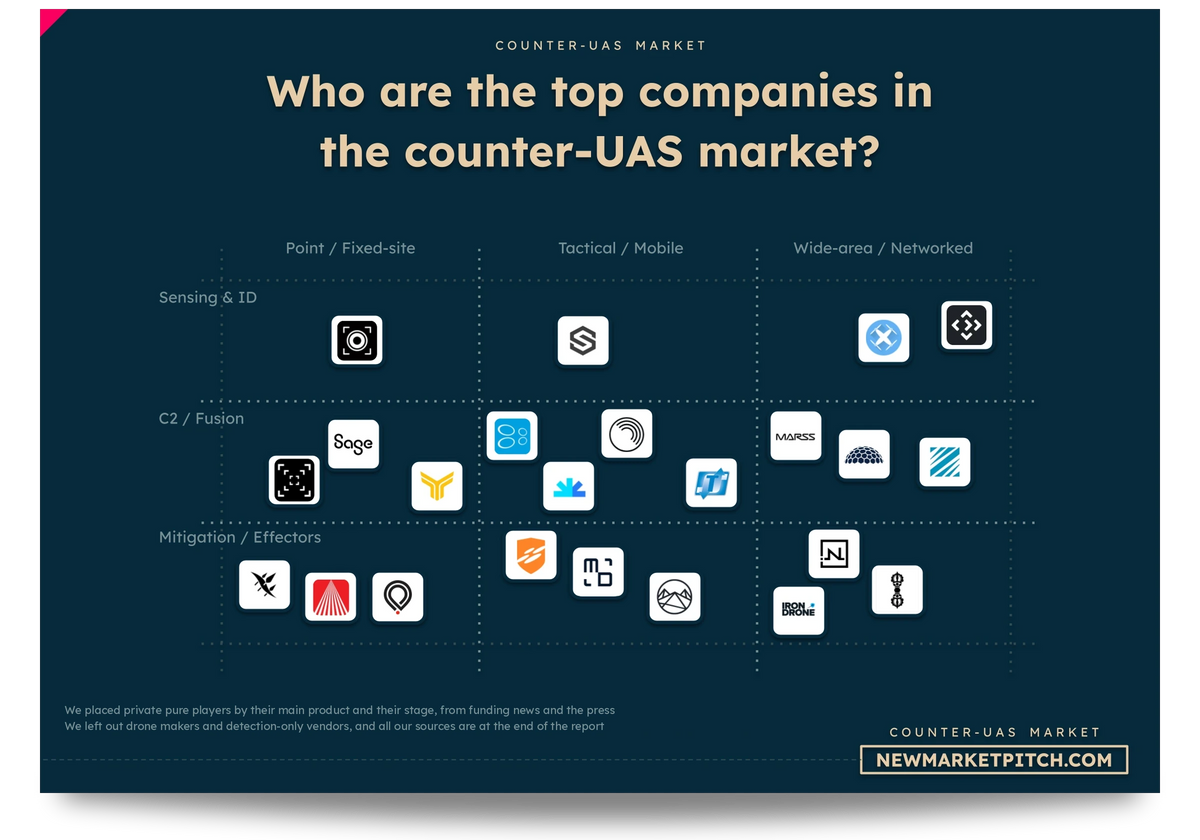
In our report covering the counter-UAS market, we turn what is vague and complex into simple, useful visuals. Market maps like this one show you at a glance where every startup stands.
Which counter-drone startups are actually in the race?
The counter-drone startup race currently has six serious contenders: Anduril, Fortem Technologies, Epirus, Allen Control Systems, Hidden Level, and SkySafe. D-Fend Solutions left the field when Motorola Solutions closed its purchase in August 2026.
We kept the field narrow. Each company needs a funded counter-drone product plus evidence of government, military, public-safety, or critical-infrastructure use. That removes dozens of companies with a prototype jammer, a laboratory laser, a drone-detection feature, or a partnership announcement that has yet to produce a real deployment. Where a prototype ends and a real deployment begins is the line we draw for what counts in our report on counter-drone systems.
The six companies cover different parts of the problem. Anduril connects sensors, command software, electronic warfare, and interceptors. Fortem launches autonomous drones that capture other drones with nets. Epirus attacks electronics with high-power microwaves. Allen Control Systems turns conventional guns into automated counter-drone weapons. Hidden Level and SkySafe focus mainly on finding, tracking, and identifying drones.
We exclude DroneShield because it is publicly listed. Dedrone, BlueHalo, Sentrycs, and now D-Fend have been acquired. We keep D-Fend in the table below as a reference point, because its disclosed numbers still set the bar for civilian adoption. Echodyne, whose radars sit inside many of these systems, sells mainly as a component supplier, so we treat it as a partner rather than a contender. We also exclude broad defense startups such as Shield AI when counter-drone systems are peripheral to their core business. Chaos Industries, which raised $510 million in November 2025 for counter-drone radar networks, is one to watch, but it has disclosed less about counter-drone deployments than the detection specialists below.
| Startup | Main counter-drone role | Approximate cumulative funding | Why it qualifies |
|---|---|---|---|
| Anduril | Integrated detection, command software, electronic warfare, and interceptors | About $11.3B company-wide | Major production orders, a Marine Corps program of record, and an Army enterprise contract |
| D-Fend Solutions (acquired) | RF detection and cyber takeover | About $67M before its $1.5B sale to Motorola Solutions in August 2026 | Reference only: deployments in more than 30 countries, now part of a listed company |
| Fortem Technologies | Radar, command software, and autonomous net interceptors | Roughly $95M to $120M (estimate), including a $50M Series B closed in September 2026 | DHS prime contract, Replicator 2 purchase, customer deliveries, and international deployments |
| Epirus | High-power microwave counter-swarm systems | About $595M | Army and Marine Corps contracts and the strongest disclosed swarm demonstration |
| Allen Control Systems | Automated gun-based drone defeat | About $242M | U.S. and allied military selection, a $2.2B valuation, and a $500M-ceiling Army Domestic Shield contract |
| Hidden Level | Passive radar and RF detection | At least $121M disclosed | A reported $100M Pentagon-wide agreement and deployments across U.S. military commands |
| SkySafe | Cloud-based detection, tracking, and forensics | About $49M | Established public-safety platform and an exclusive Cellebrite forensics partnership |
Is Anduril already the clear leader in counter-drone systems?
Yes. Anduril is ahead in counter-drone systems overall, and the gap comes from procurement and integration rather than publicity or valuation.
The company holds a set of commitments that no startup rival can match together. The Marine Corps gave Anduril a ten-year counter-drone program of record with a maximum value of $642 million. It separately awarded a five-year, $200 million contract for the Marine Air Defense Integrated System. The Pentagon also ordered more than 500 Roadrunner-M interceptors alongside additional Pulsar electronic-warfare systems under a contract worth almost $250 million.
In March 2026 the U.S. Army added a broader enterprise contract with a reported ceiling of up to $20 billion, and Breaking Defense reported that the first task order under it covered counter-drone work. In October 2026 the Army also awarded Anduril a contract worth up to $1.8 billion over five years to expand its next-generation command-and-control work, which is not a counter-drone award but strengthens the same software layer.
The $20 billion, $642 million, $200 million, and $1.8 billion amounts are all ceilings, so the government has not guaranteed that every dollar will be spent. The Roadrunner order carries more immediate weight because it names a production quantity. Together, the awards show repeated movement from testing into formal procurement.
Anduril also controls more of the defensive chain than its rivals. Lattice can bring together radars, cameras, electronic-warfare systems, human operators, and interceptors in one operating picture. The company can supply several of those components itself or connect outside products such as Epirus's Leonidas.
Fortem has become a real operational challenger, and Epirus owns an important technical lead against swarms. For now, none combines Anduril's software position, product range, production orders, and customer commitment.

Our research about counter-drone systems gets updated several times a month, so you always get the latest view of where things stand.
Now that Motorola owns D-Fend, which startup has the most traction?
Fortem Technologies now has the strongest disclosed commercial traction among independent counter-drone specialists, although D-Fend still sets the benchmark the startups are measured against.
Motorola Solutions completed its $1.5 billion purchase of D-Fend in August 2026. When it announced the deal, Motorola reported thousands of deployments in more than 30 countries, annual revenue growth above 50% over three years, and expected full-year revenue of $185 million. The closing release repeated the 30-country footprint but gave no new revenue figure. No remaining startup discloses numbers at that level.
Fortem's case rests on contracts and customers rather than revenue disclosure. In August 2026 the Department of Homeland Security named it a prime contractor on a five-year, multiple-award counter-drone contract. Fortem says its track carries an estimated starting ceiling of $1.011 billion, shared by seven primes, and that it was the only small business among them. Trade press describes the full DHS vehicle as worth about $1.5 billion across 12 companies. Earlier in 2026, Fortem also won a three-year, $18 million Army contract and a Lockheed Martin selection for critical-infrastructure protection.
That is a meaningful step, but a ceiling is not a sale. DHS will spend money through task orders, and several companies compete for them. Fortem still does not publish revenue.
Anduril may already generate more counter-drone revenue than anyone in this group, but it does not separate that figure from its wider defense business. Epirus and Allen Control Systems still disclose contracts and demonstrations more often than recurring sales.
Fortem leads the independent group because its evidence now covers paid deliveries, civilian and military customers, and a large federal contract vehicle.
Is Fortem now the fastest-rising counter-drone startup?
Yes. Fortem has the strongest all-round counter-drone momentum today, while Allen Control Systems is still expanding fastest from a smaller base.
Fortem's year reads like a checklist. The Pentagon made DroneHunter the first operational purchase under Replicator 2. Fortem started delivering DroneHunter 5.0 to customers in January 2026. Five interceptors completed an autonomous five-against-five capture test in February. A multimillion-dollar World Cup order added a high-profile civilian deployment. The DHS prime award followed in August, and in September 2026 Fortem closed a $50 million Series B led by Lockheed Martin, a total that includes Lockheed's $25 million first tranche announced earlier in the year. In October 2026 it widened its partnership with MBDA to build DroneHunter into European air defenses, with no order disclosed yet.
The Lockheed round matters for more than cash. A large prime that already selected Fortem as a supplier is now also an investor. That gives Fortem a route into bigger integrated programs, the same route that has helped Anduril.
Allen Control Systems raised $200 million at a $2.2 billion post-money valuation in May 2026, taking disclosed funding to roughly $242 million. The company said the money would expand Bullfrog manufacturing and speed up deployments with U.S. and allied militaries. In September 2026 the Army named ACS among the ten Domestic Shield awardees, with a $500 million contract ceiling; no orders under it have been disclosed. In October 2026 ACS also agreed with Echodyne to pair Bullfrog with Echodyne's radar. ACS has not published the number of systems delivered, their operational history, or annual revenue.
Epirus has strong technical momentum, particularly through fiber-optic drone results and mobile Leonidas versions. In August 2026 DefenseScoop reported, citing the company, an $11 million Marine Corps award for a high-power microwave program. In October 2026 Leonidas was reportedly picked for a JIATF-401 directed-energy pilot, which is an evaluation, not a purchase. It still needs a large production order.
ACS is rising fastest in valuation and contract access. Fortem has the broadest momentum, because its gains cover customers, product, funding, and federal procurement at the same time.

In our market report about counter-drone systems, we look at what the winners do differently, so you can learn from the best instead of guessing.
Which counter-drone startup has the most mature product and can deliver at scale?
Anduril has the most mature integrated military platform and the strongest delivery capacity. Fortem now has the most mature specialist product still run as a startup.
Anduril's maturity appears through military procurement. A program of record gives the Marine Corps a formal route for buying, installing, and maintaining the system over several years. The order for more than 500 Roadrunner-M interceptors shows that Anduril can repeat production beyond a few handcrafted units.
The company has raised about $11.3 billion in total, including a $5 billion Series H at a $61 billion valuation announced in May 2026. That capital supports Anduril's whole defense portfolio, but it gives the company far more room to finance factories, inventory, suppliers, engineers, and field teams than any specialist rival. How leaders turn capital into factories and field teams is part of the winning strategies we study in our counter-UAS market report.
Fortem is the strongest smaller hardware maker. DroneHunter 5.0 deliveries have begun, Replicator 2 and the DHS contract create routes to larger purchases, and the new Series B is aimed at scaling production. The company has not published a production rate.
D-Fend's thousands of deployments still make it the most widely fielded specialist product, but that maturity now sits inside Motorola Solutions rather than a startup.
Epirus has moved from four first-generation Army systems to two Generation II systems and is working on mobile and expeditionary versions. Allen Control Systems has the capital to expand Bullfrog manufacturing, but it has not disclosed a production rate or delivered quantity.
Anduril leads on military maturity and the ability to deliver large quantities. Fortem leads the independent specialists.
Which counter-drone startup can actually stop a swarm?
Epirus has the strongest disclosed counter-drone swarm result today, while Fortem has produced the most convincing autonomous multi-interceptor demonstration.
Epirus reported disabling all 61 drones flown across five scenarios during a live-fire event. The final test involved 49 drones of two types being stopped by one electromagnetic pulse. Representatives from the U.S. government and allied countries attended, although the detailed test data came from Epirus rather than an independent public evaluation.
Leonidas attacks electronics across an area. Guns, missiles, and interceptor drones generally need a separate successful engagement for each target. During a dense attack, one microwave pulse can therefore replace dozens of individual intercepts.
Fortem demonstrated a different form of swarm defense in February 2026. Five DroneHunter interceptors autonomously planned and completed five captures against five incoming drones, with one SkyDome system coordinating the engagement. Fortem reported no human involvement during the interceptions.
Epirus's test covered almost ten times as many targets, giving Leonidas a commanding lead on raw swarm volume. Fortem's result shows that several autonomous drones can also be removed physically without an electromagnetic area effect.
Epirus wins this category clearly, with Fortem the strongest challenger.

In our document detailing everything you need to know about counter-UAS, you will always find fresh funding data, taken straight from our own verified funding database.
Which counter-drone startup can stop fiber-optic and radio-silent drones?
Epirus has the clearest counter-drone answer to fiber-optic aircraft, while Fortem, Anduril, and Allen Control Systems can engage drones without relying on their radio link.
Fiber-optic first-person-view drones receive commands through a physical cable unwinding behind them. Radio jamming and cyber takeover lose their usual entry point because there is no wireless command link to interrupt or seize.
During a technology demonstration at a U.S. government site, Epirus used Leonidas to disable a fiber-optic-guided drone by affecting its onboard electronics. Epirus described the event as the first known result of its kind from an electronic-warfare-based counter-UAS system.
Fortem's nets, Anduril's interceptors, and ACS's gun systems also work independently of the target's communication method. Once their sensors track the aircraft, the physical engagement remains possible whether the drone uses radio control, a cable, onboard autonomy, or a pre-programmed route.
Detection matters too. Hidden Level's passive radar is designed to find drones that emit no radio signal, and that capability was central to the $100 million Pentagon agreement reported in late July 2026.
D-Fend, now inside Motorola, faces the clearest limitation because its cyber-takeover system requires a supported communication link.
Epirus has the strongest disclosed answer to several radio-silent targets, while Fortem offers the safest physical option around people.
Which counter-drone startup works best around airports, stadiums, and cities?
Among independent startups, Fortem now offers the strongest counter-drone system for crowded civilian environments. D-Fend remains the best-known non-kinetic option, but buyers now get it from Motorola Solutions.
Airports, stadiums, and city centers create a difficult constraint: stopping the drone cannot create a second emergency on the ground. Gunfire, explosive interceptors, and falling wreckage may be unacceptable. Broad electronic jamming can interfere with communications, navigation, and authorized drones.
Fortem physically captures the target with a net. Smaller aircraft can be carried away, while larger targets can be slowed and brought down more predictably. The company received a multimillion-dollar order to protect U.S. World Cup venues and says it was selected as the only kinetic mitigation system for those events. It had supported the previous World Cup in Qatar, and the DHS contract now gives it a direct federal route into homeland venues.
D-Fend's system isolates the unauthorized aircraft, takes control of its communications, and moves it toward a chosen landing area while authorized drones keep flying. Motorola plans to sell it alongside its radios, video, and command-center software for police and public-safety customers. That bundle is a strong threat to any startup selling into cities.
SkySafe and Hidden Level remain strong options when detection, evidence collection, and locating the operator are enough. In July 2026 Cellebrite named SkySafe its exclusive drone-forensics partner, which strengthens SkySafe's case with investigators. Another agency or product still has to deal with a drone that presents an immediate danger.
Fortem leads the startups here because it combines low collateral risk with a physical answer that does not depend on the drone's radio link. Its biggest competitor in this setting is no longer a startup but Motorola.

Learning from others' mistakes is the cheapest lesson there is. In our report covering the counter-UAS market, we look at what broke startups before you, so you don't repeat it.
Which counter-drone startup offers customers the best economics?
Allen Control Systems probably offers the lowest ammunition cost per drone, while Epirus has the strongest economic case against swarms and Fortem offers reusable low-collateral capture.
Bullfrog uses conventional weapons and widely available ammunition. A machine-gun round costs a tiny fraction of a missile or autonomous interceptor, and many military customers already own the weapons and ammunition. ACS adds automated detection, tracking, and aiming so those cheap rounds can hit small moving targets more consistently. Cheap ammunition set against costly missiles changes which counter-drone business models keep their margins, a question we compare in our report covering the counter-UAS market.
The missing figure is ammunition consumed per successful kill. Ten-dollar ammunition means little when an engagement requires hundreds of rounds. ACS has not published enough operational data to calculate a reliable cost per defeated drone.
Epirus becomes more attractive as the number of attacking drones rises. Leonidas uses electrical energy instead of a separate munition for every target. Its 49-drone demonstration suggests a very low marginal cost per aircraft during a tightly grouped swarm. Customers still need to account for purchase price, power supply, cooling, maintenance, and coverage area.
Fortem's interceptors are more expensive per engagement than a bullet, but a DroneHunter can often return and fly again, and a captured drone can be recovered for investigation. D-Fend's cyber takeover still has the lowest marginal cost around civilian infrastructure, but that option now comes through Motorola.
ACS looks cheapest against occasional battlefield drones. Epirus becomes the strongest option when a dense swarm enters its effective range. Fortem offers the best total economics among startups where collateral damage is the main cost.
Which counter-drone startup has won the best customers and contracts?
Anduril has secured the deepest counter-drone customer commitments, while Fortem has the strongest recent mix of military, homeland-security, and civilian wins.
The Marine Corps relationship puts Anduril first. A ten-year program of record creates a formal buying and support route. The MADIS contract, the Roadrunner production order, and the Army's enterprise contract show that more than one service now buys Anduril across fixed sites, mobile defense, electronic warfare, and interceptors.
Fortem's customer record has improved sharply. The Pentagon selected DroneHunter for the first operational Replicator 2 purchase. The Army, DHS, and Lockheed Martin all signed with Fortem in 2026, and its World Cup order follows its use at the previous tournament. A returning global event customer says more than a first-time pilot.
The wider market also got bigger. In late September 2026 the Army and JIATF-401 awarded Domestic Shield contracts to ten companies: seven with $500 million ceilings, including Allen Control Systems, DroneShield, SRC, and L3Harris WESCAM; Echodyne and PVP Advanced EO Systems at $250 million; and SmartShooter at $150 million. That adds up to about $4.15 billion, while Breaking Defense headlined up to $7 billion, which appears to be the ceiling of the wider Domestic Shield program. Anduril, Fortem, and Epirus were not among the ten. These vehicles make it easier for many vendors to sell, so they widen access more than they pick a winner.
Epirus has a strong U.S. Army relationship, with $66.1 million awarded for four first-generation systems and $43.5 million for two Generation II units, plus a reported $11 million Marine Corps award in August 2026. Partnerships with General Dynamics Land Systems, Kodiak, and Singapore's Defence Science and Technology Agency widen its route toward mobile and international use.
Hidden Level has contracts supporting the Army, Air Force, and several combatant commands, and in July 2026 it was reported to have won a $100 million Pentagon-wide agreement for passive sensing. That is its largest disclosed award, though actual spending will depend on orders.
Anduril leads on customer depth. Fortem has gathered the best recent sequence of wins among the specialists.

In our research about counter-drone systems, we always try to gather several sources and make estimates that make sense, so you can work with solid numbers.
Which counter-drone startup has the hardest advantage to copy?
Anduril has built the hardest overall counter-drone position to copy, while Epirus owns the most difficult individual technology.
A rival can create a radar, a jammer, or an interceptor. Reproducing Anduril's whole position would require command software, sensors, electronic warfare, several effectors, manufacturing capacity, field teams, government approvals, and years of procurement relationships. Lattice also makes Anduril more than a hardware supplier because customers can manage several defensive products through the same software layer.
Procurement strengthens that advantage. Once a military service trains operators, installs infrastructure, links external sensors, and builds support procedures around one command platform, switching becomes expensive. The ten-year Marine Corps program and the Army's enterprise and command-and-control contracts give Anduril time to deepen that position.
Epirus's high-power microwave technology is harder to reproduce at the product level. Leonidas combines specialized semiconductors, phased-array design, power management, thermal control, software-defined waveforms, and knowledge of how different electronics respond. A rival needs advanced hardware expertise and extensive testing, not just a capable software team.
Fortem combines radar, autonomous pursuit, command software, and purpose-built capture hardware. Its interception data may become more valuable as DroneHunter faces a wider mix of targets. Lockheed Martin's investment adds a distribution advantage that smaller rivals lack. The hard part is coordinating the whole engagement reliably, not attaching a net to a drone.
D-Fend's protocol library and deployment data remain a real moat, but Motorola now owns it, so it no longer protects a startup.
Allen Control Systems has strong software and control-system expertise, but automated weapon stations already exist across the defense industry. ACS needs superior accuracy, lower cost, and faster production to stay ahead of large contractors that understand turrets, optics, and fire control.
Anduril's advantage is the hardest to attack commercially. Epirus's core technology is the hardest to reproduce technically.
Does one counter-drone startup lead every part of the market?
No single counter-drone startup leads every subcategory today, even though Anduril remains the strongest company overall.
The reason is practical. A stadium, an airport, a frontline vehicle, an ammunition depot, and a naval vessel face different targets and rules. A system that safely lands a consumer quadcopter may struggle against fifty autonomous attack drones. A microwave weapon that handles a dense swarm may be excessive for locating one unauthorized aircraft near a prison.
Anduril leads integrated military defense. Fortem leads autonomous net capture and is now the leading independent civilian option. Epirus leads high-volume swarm defeat. Allen Control Systems leads the low-cost automated-gun category. Hidden Level is the strongest independent passive military-detection specialist, while SkySafe is best positioned around cloud-based public-safety intelligence and forensics. Controlled RF takeover is led by D-Fend, which is now part of Motorola Solutions.
This division should persist. Counter-drone customers increasingly want layered defenses, with one system detecting, another identifying, and several possible effectors available. Large multiple-award contracts from the Army, JIATF-401, and DHS reinforce that pattern. The eventual leader may be the company that controls the orchestration layer rather than the one with the best standalone weapon. That favors Anduril, although it also gives specialists a route into large programs through integration.
| Counter-drone segment | Current startup leader | Why it leads |
|---|---|---|
| Integrated military platform | Anduril | Broad product family, Lattice integration, and formal procurement |
| Commercial RF mitigation | D-Fend Solutions (acquired by Motorola Solutions, August 2026) | Deployments in more than 30 countries and controlled drone takeover |
| Autonomous physical interception | Fortem Technologies | Operational net capture, Replicator 2, DHS prime contract, and fifth-generation deliveries |
| High-density swarm defeat | Epirus | One pulse reportedly disabled a 49-drone swarm |
| Automated gun defense | Allen Control Systems | Rapid targeting with conventional weapons and inexpensive ammunition |
| Passive military detection | Hidden Level | Passive radar, RF sensing, and a reported $100M Pentagon-wide agreement |
| Cloud detection and forensics | SkySafe | Public-safety integrations, historical airspace data, and the Cellebrite partnership |

If you build or invest in the counter-UAS market, you need to know which business models pay off now and which ones are fading. That's why our report covering it has a whole section on it.
How reliable are the counter-drone startup numbers?
The counter-drone evidence is strong enough to identify the leaders, but many headline numbers are company-reported, forward-looking, or based on maximum contract values.
The most reliable evidence includes completed funding rounds, completed acquisitions, product deliveries, named government selections, and signed production orders. Anduril's Roadrunner quantity, Motorola's closing of the D-Fend deal, Fortem's customer deliveries and Series B, and Allen Control Systems' financing fall into this group. Separating signed orders from company claims is why we source our data and update it every quarter in our report on counter-UAS.
Contract ceilings require more caution. Anduril's $20 billion Army vehicle and $642 million Marine Corps award, Fortem's $1.011 billion DHS track, ACS's $500 million Domestic Shield ceiling, and Hidden Level's $100 million agreement all set maximums. The government can spend far less. We give them high weight for customer access and low weight when estimating sales.
Headlines on the September 2026 Army and JIATF-401 awards also differ: the ten named contracts add up to about $4.15 billion in ceilings, while the up to $7 billion figure appears to describe the wider Domestic Shield program.
D-Fend's $185 million revenue figure was Motorola's forecast for the full year at the time of the deal, not audited revenue, and the closing release did not repeat it.
Performance tests sit one level lower. Epirus's 61-of-61 result, including the 49-drone swarm, came from a company-run event. Fortem's five-against-five capture result also came from the company. Neither release provides all target specifications, ranges, weather conditions, failure definitions, or independent raw data.
Company-reported cumulative counts deserve similar care. Fortem's claim of more than 4,500 captures combines operational activity and testing without a public breakdown. We use it as evidence of many engagements, not as a count of paid battlefield interceptions.
Private-company comparisons will always contain gaps. We reward repeated evidence from different sources. One impressive demonstration cannot carry an overall ranking by itself.
Which counter-drone startups are actually ahead?
Anduril is clearly ahead in counter-drone systems overall. Fortem is now second, Epirus third, and D-Fend has left the startup race after its sale to Motorola Solutions.
Anduril holds first place because it has already assembled the parts that competitors are still building separately. It controls the command layer, supplies several sensors and effectors, has a formal Marine Corps program and an Army enterprise contract, received an order for more than 500 interceptors, and can finance large-scale manufacturing after raising $5 billion in 2026.
Fortem takes second place. Its Replicator 2 purchase, fifth-generation deliveries, autonomous five-against-five demonstration, World Cup work, DHS prime contract, and a Lockheed-led $50 million Series B form the strongest record among independent specialists. It still lacks revenue disclosure and Anduril's contract scale, and its DHS ceiling is not yet revenue.
Epirus ranks third. Leonidas has the most impressive disclosed swarm result and the clearest demonstrated answer to fiber-optic drones. A large Army production order would make it a serious threat to Fortem. Six disclosed Army systems and a small Marine Corps award remain too thin a base for now.
Allen Control Systems sits fourth and could move fastest. Bullfrog offers attractive engagement economics, the company has military users, a $2.2 billion valuation, and a $500 million-ceiling Army contract. ACS must now show delivered quantities, repeat orders, and sustained field performance.
Hidden Level ranks fifth as the strongest independent detection specialist, helped by its reported $100 million Pentagon agreement. SkySafe ranks sixth with a useful public-safety and forensics platform but less military traction and no native mitigation layer.
The market now has one overall leader, one clear specialist challenger, and two hardware challengers on different routes. Anduril's position looks secure. Fortem has gained the most ground, while Epirus and ACS have the clearest paths to change the order.
| Rank | Startup | Why it holds this position |
|---|---|---|
| 1 | Anduril | Best integrated platform, strongest procurement position, major production quantity, and unmatched capacity to scale |
| 2 | Fortem Technologies | Broadest recent progress: Replicator 2, DHS prime contract, new deliveries, swarm coordination, and a Lockheed-led Series B |
| 3 | Epirus | Clear technical leader against dense swarms and fiber-optic drones, with deployment volume still limited |
| 4 | Allen Control Systems | Fast-rising gun-based challenger with strong funding and contract access, but little disclosed scale data |
| 5 | Hidden Level | Credible passive-detection specialist with strong government customers and no integrated defeat capability |
| 6 | SkySafe | Established cloud intelligence and forensics platform with public-safety distribution and lighter disclosed traction |
| Out | D-Fend Solutions | Acquired by Motorola Solutions for $1.5B in August 2026; still the benchmark for civilian RF takeover |
Our methodology
This analysis compares the private counter-drone companies with the strongest evidence of real deployment, procurement, production, customer adoption, or operational use. We assess leadership across military integration, commercial traction, growth, product maturity, swarm defense, radio-silent targets, civilian deployment, economics, customer quality, and defensibility.
We kept the field narrow. A company needed a funded counter-drone product and evidence of use by government, military, public-safety, or critical-infrastructure customers. We excluded publicly listed companies, acquired businesses, broad defense companies without a clearly commercialized counter-drone line, and products supported mainly by prototypes or partnership announcements. D-Fend Solutions is shown for reference after its acquisition but no longer ranked.
We gave the most weight to evidence that reflects real customer commitment: production quantities, product deliveries, procurement decisions, repeat deployments, named customers, and disclosed commercial adoption. Funding and valuation help show whether a company can scale, but they do not outweigh contracts, deliveries, or operating history.
Contract ceilings are treated as evidence of procurement access rather than guaranteed revenue. Forward-looking revenue figures are identified as forecasts, and company-run demonstrations are used as technical evidence without treating them as independent tests.
Because the companies solve different parts of the problem, we first identified the leader in each major segment and then looked for the company that appeared near the top across the widest range of categories. The final ranking is an editorial synthesis of the evidence, not a mathematical score.
Key sources include company product and deployment material from Anduril, Fortem Technologies, Epirus, Allen Control Systems, Hidden Level, and SkySafe, as well as Motorola Solutions' release on completing the D-Fend acquisition, Fortem's release on its DHS counter-drone contract, Fortem's release on its Series B, the U.S. Army's list of Domestic Shield awards, and D-Fend Solutions.
We also used procurement and program announcements from the U.S. Department of Defense, the Replicator initiative, the U.S. Army, the Defense Innovation Unit, and the U.S. Marine Corps, plus reporting on 2026 counter-drone awards by DefenseScoop, Breaking Defense, and Defense One. Motorola Solutions' newsroom and SEC filings were used for the D-Fend acquisition, while Crunchbase and PitchBook served as funding references.

In our document detailing everything you need to know about counter-UAS, we don't want to repeat what boring consulting reports say. Instead, we show you the real and latest market signals that matter.
Written by the New Market Pitch teamWe track new markets so founders and investors can move faster. About us