Drone interceptors: which startup is ahead?
Whether you're building or investing in the counter-UAS market, our report covers everything you need to know: the players, the money, and what's coming next.
Summary
Quantum Systems is ahead overall in the drone interceptor race, with Anduril leading the premium end and SkyFall setting the pace in low-cost battlefield volume.
The market does not have one universal winner because the products solve different problems. Missile-like interceptors, cheap expendable drones, and reusable net-capture systems are now separate categories with different leaders. Missile-like interceptors, cheap expendable drones and net-capture systems are separate categories, and we draw those lines in our counter-UAS market report.
Quantum's lead rests on volume. On top of the 15,000 STRILA interceptors Germany is funding for Ukraine, its joint venture with WIY built SPYS, a faster interceptor that has already downed a jet-powered Geran-5. In October 2026, Quantum signed a letter of intent with Ukraine for tens of thousands of SPYS units. That is an intent, not a firm order, but no rival has a bigger disclosed pipeline.
The race itself has changed shape. Russia now sends jet-powered Shaheds that fly far faster than the propeller models. In late September 2026, President Zelensky said Ukraine stops about 55 to 57% of them, against more than 90% for the older type. The company that mass-produces an affordable jet-drone killer first will set the next ranking.
Anduril may still have the best single aircraft. Roadrunner-M brings speed, loitering, vertical recovery, and deep links to Lattice. Anduril raised $5 billion at a $61 billion valuation in May 2026, yet it still discloses little about Roadrunner's price, kill rate, or output.
SkyFall may be creating the most battlefield effect per dollar. It says the basic P1-SUN, sold to Ukraine's military for about $1,000, has hit more than 5,500 Shaheds since November 2025. Its faster JetKiller has a small number of confirmed jet-drone kills, but the company's totals remain self-reported.
Fortem leads the market that destructive interceptors cannot easily serve. DroneHunter captures and tows targets, which suits airports, stadiums, prisons, and cities. In August 2026, Fortem became the only small business among seven prime contractors on a US Homeland Security counter-drone contract with a starting ceiling of about $1.01 billion.
A new challenger now matters. Cambridge Aerospace raised $300 million at a $3.4 billion valuation in August 2026, and its Skyhammer interceptor missile has been in rapid deployment with UK forces and Gulf partners since April.
Cost per kill is still the dividing line. Premium systems will be needed for fast or high-value targets, but mass attacks will be beaten by layers of cheap interceptors, guns, jammers, and missiles.
The biggest missing figures are still the practical ones: unit price, probability of kill, attempts per success, production yield, and performance under jamming. Until they are public, a precise score would claim more than the evidence allows.
The order at the top is clear, but not settled. Quantum leads, Anduril can take first place by proving affordable volume, and SkyFall can break the Western order if its jet-drone interceptor scales and its claims get independent confirmation.

Written by the New Market Pitch teamWe track new markets so founders and investors can move faster. About us

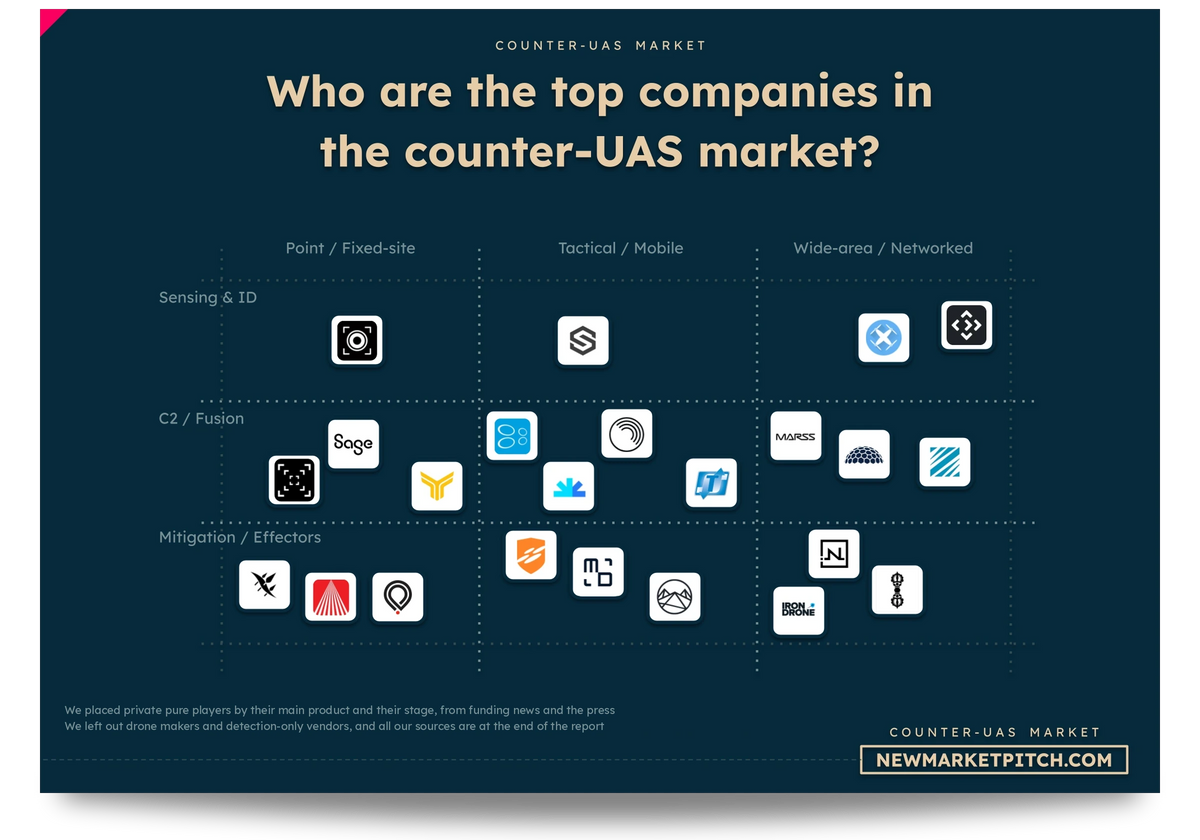
In our report covering the counter-UAS market, we turn what is vague and complex into simple, useful visuals. Market maps like this one show you at a glance where every startup stands.
Which drone interceptor startups actually belong in this comparison?
The serious drone interceptor race now comes down to nine private companies building weapons that physically catch, ram, or destroy hostile drones.
We include Anduril, Quantum Systems, SkyFall, Fortem Technologies, Cambridge Aerospace, Origin Robotics, TYTAN Technologies, Frankenburg Technologies, and Alpine Eagle. Each has moved beyond a paper concept through flight tests, deployments, battlefield use, government procurement, or a credible production program. Who counts as an interceptor startup, and who does not, is the first thing we settle in our report on counter-UAS.
The scope is narrow on purpose. We exclude companies focused only on radar, jamming, lasers, microwave weapons, or gun turrets, as well as listed defense groups. Neros, which raised $250 million at a $2.5 billion valuation in August 2026 partly to build its Bandit interceptor, stays out until Bandit shows public flight or delivery evidence. Wild Hornets remains an important Ukrainian benchmark, although its nonprofit structure makes startup comparisons awkward.
The companies follow three approaches. Anduril, Cambridge Aerospace, and Frankenburg build compact missile-like interceptors. Quantum, SkyFall, TYTAN, and Origin build cheaper expendable drones for mass attacks. Fortem and Alpine Eagle sell airborne systems where sensing, software, and interception work together.
Funding is unevenly disclosed, especially in Ukraine. The figures below use company announcements where available and private-market databases for the rest.
| Startup | Main interceptor approach | Approximate cumulative funding |
|---|---|---|
| Anduril | Roadrunner-M reusable high-speed interceptor, plus the Anvil family | About $12B after a $5B Series H at a $61B valuation (May 2026); talks at about $100B reported in July 2026, not confirmed as closed |
| Quantum Systems | STRILA and the faster SPYS, both through the Quantum WIY Industries joint venture | More than $1.8B after a $1.2B Series D at about $8B post-money (July 2026) |
| Cambridge Aerospace | Skyhammer low-cost interceptor missile | More than $636M after a $300M Series C at a $3.4B valuation (August 2026) |
| Fortem Technologies | DroneHunter reusable net-capture interceptor and SkyDome software | About $80M publicly recorded before a $50M Series B led by Lockheed Martin, closed in September 2026; part of that round was announced earlier, so the exact total is unclear |
| TYTAN Technologies | METIS autonomous low-cost interceptor | €46M |
| Frankenburg Technologies | Mark I compact guided anti-drone missile | €40M |
| Alpine Eagle | Sentinel airborne sensor network and Sparrowhawk interceptor | About $11M publicly recorded |
| Origin Robotics | BLAZE autonomous explosive interceptor | About $2.6M publicly recorded |
| SkyFall | P1-SUN family of low-cost Ukrainian interceptors, including the faster JetKiller | Undisclosed |
Is there a clear drone interceptor leader today?
Yes: Quantum Systems is the all-round leader, with Anduril leading the premium tier and SkyFall setting the pace in low-cost battlefield volume.
Quantum has gone furthest in turning battlefield technology into an industrial program. Germany is funding 15,000 STRILA interceptors for Ukraine. The joint venture with WIY Drones then produced SPYS, a faster model built against Russia's jet-powered Geran-4 and Geran-5. In October 2026, Quantum said it had signed a letter of intent for tens of thousands of SPYS units and could ship thousands this year from lines set up for STRILA. Its July 2026 round of $1.2 billion at about $8 billion pays for that ramp.
Anduril sits close behind. The Pentagon ordered more than 500 Roadrunner-M interceptors in a contract worth almost $250 million, and the company holds a US Marine Corps counter-drone program worth up to $642 million plus a Dutch contract. Its roughly $12 billion in funding, at a $61 billion valuation, gives it more capital than every rival combined. What it still lacks in public is the evidence buyers want most: unit cost, field kill rates, and annual output. In October 2026, FlightGlobal reported that Anduril had asked the FAA to fly Roadrunner outside military ranges to speed up testing.
SkyFall is the biggest challenge to both. It says the P1-SUN has hit more than 5,500 Shaheds, and its JetKiller has confirmed kills against the Geran-5. Those claims could put SkyFall ahead in wartime use, but the public evidence is thinner than the contract trail around Quantum and Anduril.
The verdict: Quantum leads, Anduril has the strongest high-end system, and SkyFall may deliver the most combat effect per dollar. Quantum's lead now rests on two products and an order pipeline no rival has matched in public.

Our research about counter-drone systems gets updated several times a month, so you always get the latest view of where things stand.
Which drone interceptor startup has stopped the most real drones?
SkyFall probably leads the startup field in reported combat kills, while Fortem has the clearest record of repeated physical captures.
SkyFall told Reuters in July 2026 that the P1-SUN had hit more than 5,500 Shaheds since its launch in November 2025. In March 2026, the company had cited about 1,500 Shaheds and 1,000 other drones, so the pace has grown fast. The figure is still company-stated. Ukraine publishes national totals, not company ledgers, and some outlets reported the same claim as 5,000 or 5,500 drones of all types rather than Shaheds only.
Fortem reports nearly 5,000 DroneHunter captures across military, security, testing, and other settings. We treat it as a broad capture record: DroneHunter has repeatedly found, chased, caught, and removed real aircraft.
Wild Hornets remains the outside benchmark. It reported more than 3,900 Geran kills by its Sting interceptor as of March 2026, and its newer Sting S has downed a few jet-powered Geran-5s. Ukrainian programs pile up real engagements far faster than Western suppliers disclose.
The jet threat resets this scoreboard. Against the Geran-5, only a handful of interceptors have confirmed kills: SkyFall's JetKiller, Wild Hornets' Sting S, Quantum WIY's SPYS, Alexa's Spatium, and an SBU-built jet drone. Drone adviser Serhiy Sternenko said in October 2026 that no mass-produced, effective jet interceptor exists yet. For now, SkyFall keeps the combat-volume lead and Fortem the capture-record lead.
Which drone interceptor startup has won the strongest contracts and customers?
Anduril still has the strongest customers by contract value, Quantum has the largest interceptor pipeline by unit count, and Fortem has won the biggest new civilian-security vehicle.
Anduril's clearest award covers more than 500 Roadrunner-M interceptors and Pulsar electronic-warfare systems for almost $250 million. Its counter-drone business also includes a ten-year US Marine Corps program worth up to $642 million, an $87 million Army software award for the JIATF-401 counter-drone task force in early 2026, and a Dutch Ministry of Defence contract. No new public Roadrunner order has been announced in recent months.
Quantum's relationship with Ukraine goes deeper than a sale. The 15,000 STRILA units are funded by Germany, built partly through WIY, and backed by servicing and training. The SPYS letter of intent signed in October 2026 could multiply that volume, but it is not yet a contract and carries no public value.
Fortem has the broadest customer mix. It won a three-year, $18 million US Army contract, the first purchase under Replicator 2, a multimillion-dollar World Cup order, and a Lockheed Martin infrastructure deal. In August 2026, it was named one of seven prime contractors on a five-year Homeland Security counter-drone contract with a starting ceiling of about $1.01 billion. That ceiling is shared and is not guaranteed revenue.
Cambridge Aerospace has moved fast. Skyhammer entered rapid deployment with UK forces and Gulf partners in April 2026, and in July the company was one of three UK firms given contracts under a low-cost air-defense program tied to a five-nation European framework. Origin also deserves attention: Latvia approved a first contract under its multi-year BLAZE framework in April 2026, after deliveries to Latvia, Estonia, and Belgium. Order sizes remain undisclosed.
| Startup | Strongest disclosed commercial evidence | What it tells us |
|---|---|---|
| Anduril | Large Roadrunner production award, plus major US and Dutch programs | Best access to large, repeat government budgets |
| Quantum Systems | 15,000 STRILA interceptors funded for Ukraine, plus a letter of intent for tens of thousands of SPYS | Largest disclosed interceptor pipeline by unit count, part of it not yet contracted |
| Fortem | US Army, Replicator 2, World Cup orders, and a DHS prime slot with a shared ceiling of about $1.01B | Broadest proof across military and civilian protection |
| Origin Robotics | Deliveries to three NATO countries, selection by France, and a Latvian multi-year framework | Fast international adoption for a very young company |
| TYTAN | Procurement agreements for thousands of METIS interceptors | Strong demand on paper, with limited public delivery detail |
| Frankenburg | Airbus demonstration, a PGZ plant deal in Poland, and a Riga factory | Technical credibility is rising faster than disclosed orders |

In our market report about counter-drone systems, we look at what the winners do differently, so you can learn from the best instead of guessing.
Which drone interceptor product is the most mature?
Fortem's DroneHunter is the most mature complete product, while Ukrainian interceptors have matured fastest under daily combat pressure.
Fortem has developed DroneHunter across several generations and has been delivering version 5.0 since January 2026. The product combines its own radar, SkyDome command software, autonomous pursuit, net capture, target towing, and controlled drop zones. It has been selected for military bases, critical infrastructure, and two consecutive football World Cups, so it has had to work under very different safety rules.
Anduril's Roadrunner-M has reached production and operational use. Its reusable vertical-takeoff airframe, twin turbojets, and autonomous guidance put it well beyond the prototype stage. The missing data are the everyday numbers buyers care about: sortie reliability, intercept rates, maintenance load, and cost per engagement. Missing field data like sortie reliability and intercept rates is why we sort counter-UAS technology into proven, in testing and still on paper in our report on counter-UAS.
SkyFall and other Ukrainian makers live with a harsher feedback loop. Designs change in weeks in response to new target speeds, jamming, altitude, and operator reports. SkyFall built JetKiller in about three months, unveiled it at Farnborough in July 2026, and planned serial production from August. The result is real battlefield maturity, even when formal certification lags.
Quantum offers the best bridge between those worlds. STRILA and SPYS bring Ukrainian combat learning into a company with international factories, formal procurement experience, and the capital for quality control, training, spares, and export work.
Is Cambridge Aerospace the fastest-rising drone interceptor startup?
Among newcomers, yes. Quantum Systems still has the strongest growth curve overall, and Origin Robotics is expanding fastest relative to its tiny disclosed funding.
Quantum's sequence is dense. It formed the joint venture with WIY Drones, raised $1.2 billion at about $8 billion in July 2026, showed STRILA destroying a jet-powered Shahed in August, and signed the SPYS letter of intent in October. Each step moves it from reconnaissance drones toward a broad autonomous-weapons platform.
Cambridge Aerospace went from founding in 2024 to a $3.4 billion valuation in August 2026, with more than $636 million raised and more than 250 staff. A second interceptor, Starhammer, is planned for 2027. Its growth is real, but it is newer to combat than the Ukrainian-linked players.
Fortem is accelerating in the United States. DroneHunter 5.0 deliveries, the $18 million Army contract, the DHS prime slot, and the $50 million Series B closed in September 2026 show procurement catching up after years of product work.
Frankenburg is moving fastest on factories. It opened a Riga assembly site in June 2026, signed with Poland's PGZ for a plant in Poland, and targets 1,500 Mark I missiles this year. It still needs to turn that network into steady customer deliveries.

In our document detailing everything you need to know about counter-UAS, you will always find fresh funding data, taken straight from our own verified funding database.
Which drone interceptor performs best in the air?
Anduril's Roadrunner-M still has the strongest overall flight envelope, while the lack of a shared test keeps kill-rate comparisons uncertain.
Roadrunner combines high-subsonic speed, twin turbojets, vertical launch and landing, loitering, high-G turns, and recovery when an engagement is cancelled. That gives commanders far more options than a one-way FPV-style interceptor, especially against faster threats. Anduril's comparisons with rival systems remain company claims.
The cheap drones are getting much faster. SkyFall's JetKiller reaches 370 km/h, against up to 310 km/h for the first P1-SUN, and Quantum says STRILA exceeds 350 km/h with up to 15 minutes of loiter. The Kyiv Independent reported that SPYS can briefly reach about 600 km/h. Jet-powered Shaheds can reach about 500 km/h, so speed now decides who can hunt them.
Frankenburg publishes the clearest compact-missile data. Mark I exceeded 1,000 km/h in a live-fire intercept, weighs under two kilograms in its Airbus integration, and reaches about 1.5 kilometers. The range is short, but the speed-to-weight ratio is exceptional. Cambridge Aerospace lists Skyhammer at about 435 mph with a range of about 18.6 miles, a much longer reach for a low-cost missile.
Origin's BLAZE focuses on autonomous terminal guidance. Radar handles the approach, electro-optical and infrared sensors find the target, AI supports recognition, and an operator confirms the strike. The system can launch its first interceptor within five minutes and another in under a minute.
| Product | Strongest current advantage | Main unanswered question |
|---|---|---|
| Anduril Roadrunner-M | Best mix of speed, manoeuvrability, loitering, vertical recovery, and systems integration | Unit price and verified success rate |
| Quantum STRILA / SPYS | Purpose-built Shahed interception, with SPYS aimed at jet-powered Gerans | Delivered volume and confirmed kill rate |
| SkyFall P1-SUN / JetKiller | Very low cost, rapid iteration, and a 370 km/h jet-drone variant | Independent breakdown of kills and failures |
| Fortem DroneHunter 5.0 | Reusable autonomous capture with controlled debris | Performance against the fastest attack drones |
| Cambridge Aerospace Skyhammer | Long reach and high speed for a low-cost missile | Unit price and published combat results |
| Origin BLAZE | Portable radar-to-vision autonomous guidance | Public range, speed, and repeat engagement data |
| Frankenburg Mark I | More than 1,000 km/h in a missile under 2 kg | Short range and limited operational history |
Which drone interceptor offers the best cost per kill?
SkyFall and the wider Ukrainian interceptor industry still offer the best economics by a wide margin.
Most Ukrainian interceptors cost a few thousand dollars or less, Reuters reported. A PAC-3 missile costs about $4 million, while a propeller Shahed costs an estimated $50,000 to $100,000. Even when crews need two tries, the gap stays huge.
SkyFall charges Ukraine's military about $1,000 for the basic P1-SUN, and export prices would likely be higher. At that level, a defender can accept misses, spread stocks across many units, and save missiles for harder targets. JetKiller has no public price.
The jet Shahed shifts the maths. The Kyiv Independent put the Geran-5 at about $115,000 each, more than older models. A faster interceptor can cost more and still win the exchange. Firebolt's jet interceptor, for example, sells to Ukraine for under $10,000, several times the price of propeller models.
Fortem uses a different model. DroneHunter returns after firing a net and can carry several net launchers, so its cost is spread across many captures. Fortem keeps system price, reload cost, and lifetime captures private, which blocks a true cost-per-intercept figure.
Roadrunner can return if an engagement is cancelled, but a lethal strike consumes the airframe. Anduril has never published enough pricing to show whether it makes sense against ordinary Shaheds. Frankenburg and Cambridge Aerospace aim for the middle ground: guided missiles built with commercial parts at a fraction of legacy prices. Neither has published a unit price.

Learning from others' mistakes is the cheapest lesson there is. In our report covering the counter-UAS market, we look at what broke startups before you, so you don't repeat it.
Which drone interceptor startup can manufacture at real scale?
Quantum Systems has the strongest contracted scale, SkyFall makes the boldest production claim, and Frankenburg has published the clearest factory ramp.
Quantum has a real industrial chain. Quantum WIY Industries supplies local engineering, servicing, battlefield feedback, and production know-how, while Quantum adds procurement systems, international sites, and financing. In October 2026, Quantum said its STRILA lines can turn out several thousand SPYS a month. Delivered totals for STRILA remain undisclosed. Going from prototypes to several thousand interceptors a month is one of the conditions we break down as growth drivers in our report covering the counter-UAS market.
SkyFall says it can build up to 50,000 interceptors a month and export 5,000 to 10,000 without hurting Ukraine's supply. That is stated capacity, not confirmed output. Reuters described the 50,000 figure as current capacity; it is still a ceiling, not a delivery count.
Frankenburg gives concrete milestones. It opened its Riga site in June 2026, expects to build 1,500 Mark I missiles this year, and aims for up to 100 missiles a day across two Latvian sites by year-end, with a Polish plant planned with PGZ. Hitting that rate once differs from holding it, but the ramp is measurable.
TYTAN planned a German factory targeting 3,000 interceptors a month, with production due to start in August 2026; actual output is not confirmed. Fortem more than doubled its footprint with a 51,000-square-foot site and is using its new round to speed up Utah manufacturing. Cambridge Aerospace says its $300 million round goes mainly into manufacturing and delivery. None of them has shown monthly output that would displace Quantum.
Which drone interceptor startup has the best autonomy and full system?
Anduril has the strongest integrated counter-drone stack, with Fortem close behind for smaller drones and civilian airspace.
Anduril's edge comes from Lattice, which links sensors, command software, electronic warfare, towers, interceptors, and operators. The US Army's counter-drone task force picked Lattice for a new command-and-control system in early 2026. Roadrunner can use existing radars or sit inside Anduril's own network, so buyers get a working defense layer from one supplier.
Fortem has built an equally coherent system around a narrower mission. TrueView radars detect the target, SkyDome decides the response, and DroneHunter makes the capture. In one company-reported test, a single SkyDome coordinated five DroneHunters against five attacking drones without human input. Fortem is also integrating with Lockheed Martin's Sanctum counter-drone architecture.
Quantum builds a more open system. STRILA's ground station plugs into existing radars and, according to the company, assigns targets to interceptors automatically. Work with Airbus and Japan tests new launch platforms and sensors. Anduril and Fortem still reveal more about their full command chains.
Alpine Eagle is worth watching. Sentinel uses an airborne mothership for radar detection and launches Sparrowhawk interceptors after handing over target tracks. The design can extend coverage beyond ground radar, but deployments and intercept counts are still early.

In our research about counter-drone systems, we always try to gather several sources and make estimates that make sense, so you can work with solid numbers.
Which drone interceptor startup is best for airports, stadiums, and cities?
Fortem is clearly ahead in crowded civilian settings because DroneHunter removes drones with nets and avoids an explosive intercept over people.
A battlefield interception can still send batteries, airframes, warheads, and debris toward the ground. Open military areas can accept more of that risk; stadiums, airports, prisons, and city centers usually need controlled capture.
DroneHunter catches the aircraft, tows it, and drops it at a chosen spot, so the drone and payload can be inspected. The 2026 World Cup work and the August 2026 Homeland Security prime slot give Fortem a direct route to agencies such as the Secret Service, Customs and Border Protection, and the Coast Guard.
Fortem therefore owns a protected niche. Anduril, Quantum, SkyFall, Cambridge Aerospace, Origin, TYTAN, and Frankenburg chase faster or more dangerous threats, but their destructive interceptors face tighter safety and legal limits around crowds. Fortem can lead this submarket while ranking below Quantum and Anduril overall.
Which interceptor can stop Russia's jet-powered Shahed drones?
None at scale yet. Quantum's SPYS and SkyFall's JetKiller have the best claim, but jet drones still get through far more often than the old propeller Shaheds.
The threat has moved fast. A Ukrainian air force commander said in July 2026 that 15 to 20% of Shaheds were jet-powered. By October, Quantum cited about 40%, and on some days two-thirds of daytime launches are jet drones. Zelensky said Russia launched more than 2,730 jet Shaheds in September 2026 and that Ukraine stopped about 55 to 57% of them, against more than 90% for the older type. Interception rates that fall against new jet-powered threats are the kind of signal we follow every quarter in our report on counter-UAS.
Quantum's answer is SPYS, built by Quantum WIY Industries and seen downing a Geran-5 in September 2026. With a letter of intent for tens of thousands of units and STRILA lines ready, it has the clearest path to volume. SkyFall's JetKiller has confirmed Geran-5 kills too, and serial production was planned from August. Wild Hornets' Sting S, Alexa's Spatium, and an SBU jet drone are also in the fight. In mid-September 2026, 67 Ukrainian companies were reported to be working on jet interceptors, and only two had then passed combat tests.
Anduril's Roadrunner has the speed for this threat, but its price makes it hard to use against thousands of $115,000 drones. Fortem's DroneHunter is not built for targets this fast. Cambridge Aerospace's Skyhammer and Frankenburg's Mark I could fit, but neither has published combat results against jet Shaheds.
The judgment: the next ranking will be decided here. Quantum is best placed today because it pairs a working jet-drone interceptor with real production lines. SkyFall can overtake it if JetKiller output matches its claims.
Which drone interceptor startup has the strongest moat?
Anduril has the hardest overall position to copy, Fortem owns the clearest specialized moat, and Quantum is building a strong combat-data advantage.
A rival can eventually copy many features of Roadrunner. Recreating Anduril's full position is much harder. A challenger would need comparable flight engineering, Lattice software, government ties, factories, test access, and enough capital to fund programs before procurement arrives. A $61 billion valuation makes that capital gap wider. Software, factories and government ties are hard to copy together, and we study what leaders consistently do differently in our counter-UAS market report.
Fortem's moat combines its own radar, autonomous pursuit software, specialized net launchers, regulatory approval, nearly 5,000 reported captures, and now a place on a federal civilian-security contract. A competitor can build a net-carrying drone, but matching the full system and its civilian record would take years.
Quantum gains something different from WIY and Ukraine: constant feedback from live engagements. Every launch teaches engineers about target behavior, jamming, weather, sensor errors, and failed terminal approaches. SPYS shows that loop working: lessons from STRILA went straight into the faster model. The weakness is exclusivity. Ukraine has dozens of interceptor makers, so that learning loop is shared.
Cambridge Aerospace, Origin, TYTAN, Frankenburg, and Alpine Eagle rely more on speed, local sovereignty, engineering choices, and early customers. Those edges can become durable once their products sit inside national programs, but larger defense groups can still challenge them.

If you build or invest in the counter-UAS market, you need to know which business models pay off now and which ones are fading. That's why our report covering it has a whole section on it.
Which drone interceptor startup uses its funding best?
Origin Robotics has produced the most adoption from the least visible capital, while Quantum has the strongest funding position for the next stage.
Private-market databases record only about $2.6 million for Origin. Deliveries to Latvia, Estonia, and Belgium, selection by France, and a Latvian multi-year framework look exceptional against that figure. The database total may miss undisclosed support, but Origin has reached multinational procurement on a fraction of its rivals' capital.
TYTAN has raised €46 million and signed agreements for thousands of METIS interceptors. If those turn into deliveries at the announced scale, TYTAN could become the best capital-efficiency story. Public revenue and delivery figures are still too thin to say.
Fortem spent years building radar, software, and reusable interceptors before procurement sped up. Its $50 million Series B and the DHS prime slot suggest the long build is turning into a repeatable business.
Quantum's $1.2 billion round shifts the balance. With more than $1.8 billion raised, it can fund factories, inventory, software, and deployments without waiting on each government payment, and it already has the joint venture and customers to use the money. Cambridge Aerospace has raised more than $636 million in about two years; it now has to show combat results to match.
Anduril has raised about $12 billion across a much wider portfolio that includes submarines, aircraft, missiles, sensors, software, and factories. That total says little about Roadrunner. The useful evidence remains Roadrunner's production award.
How trustworthy are the drone interceptor numbers?
We can name the leading group with confidence, but the numbers are still too uneven for a precise universal score.
Government contracts and named deliveries deserve the most weight. Even these can hide schedules, options, support services, and unit prices. Contract ceilings, such as the DHS vehicle Fortem shares with six other primes, and letters of intent, such as Quantum's SPYS deal, are not delivered volume.
Company-reported kill counts need more caution. SkyFall's 5,500-plus Shahed hits and Fortem's nearly 5,000 captures show heavy use, but neither comes with a public event-by-event record. Media reports of SkyFall's figure even differ on whether it counts only Shaheds or all drones.
Production claims sit one level lower. SkyFall's 50,000 units a month, TYTAN's 3,000 a month, and Frankenburg's 100 missiles a day describe stated or targeted capacity. They become strong evidence only once companies publish sustained output or customers confirm deliveries.
The most important missing numbers are price, probability of kill, attempts per intercept, reliability, production yield, maintenance hours, and results against jet-powered targets. We therefore weight delivered systems, repeated use, named customers, and firm contracts far above glossy specifications.

In our document detailing everything you need to know about counter-UAS, we don't want to repeat what boring consulting reports say. Instead, we show you the real and latest market signals that matter.
Which drone interceptor startups are actually ahead?
Quantum Systems is ahead overall, with Anduril close enough to take the lead and SkyFall still winning the low-cost battlefield race.
Quantum wins because its evidence is balanced and growing. It has 15,000 STRILA units funded, SPYS already downing jet-powered Gerans, a letter of intent for tens of thousands more, international factories, and more than $1.8 billion raised. No rival combines those advantages as well.
Anduril remains the strongest challenger. Roadrunner-M is probably the best aircraft here, Lattice offers the deepest software, and a $61 billion valuation gives it unmatched resources. Anduril moves to first if it shows Roadrunner can be built in the thousands at a cost fit for routine drone defense.
SkyFall could still upset the order. A $1,000 interceptor with more than 5,500 claimed Shahed hits, plus a jet-drone variant slated for serial production from August, may already create more battlefield value than premium Western systems. Independent confirmation of output and export deals would make it hard to keep in third.
Fortem ranks fourth overall and first for safe capture. Cambridge Aerospace enters at fifth on the strength of deployments and capital. Origin is the most impressive small challenger. TYTAN has demand that could lift it once deliveries show. Frankenburg's factory ramp could reshape Europe, while Alpine Eagle still needs larger deployments.
| Rank | Startup | Why it ranks here now |
|---|---|---|
| 1 | Quantum Systems | Best mix of contracted volume, a working jet-drone interceptor, combat learning, capital, and production |
| 2 | Anduril | Strongest premium interceptor, software stack, capital, and government access, with little transparency on cost and results |
| 3 | SkyFall | Likely battlefield-volume and cost leader, held back by limited independent verification and opaque financing |
| 4 | Fortem Technologies | Most mature reusable capture system, clear leader for civilian missions, now with a DHS prime slot |
| 5 | Cambridge Aerospace | Skyhammer in rapid deployment with UK and Gulf users, backed by a $3.4B valuation, but few public combat results |
| 6 | Origin Robotics | Exceptional multinational adoption relative to its age and disclosed funding |
| 7 | TYTAN Technologies | Thousands of METIS units reportedly under procurement, with delivery data still thin |
| 8 | Frankenburg Technologies | Fastest visible missile factory ramp, but fewer proven operational orders |
| 9 | Alpine Eagle | Promising airborne detection-and-interception design that remains earlier in commercial scale |
Our methodology
This analysis asks which private drone interceptor startup is ahead based on the evidence available today. We compare funding, combat use, customer traction, contract scale, manufacturing progress, flight performance, cost, product maturity, autonomy, system integration, and suitability for different operating environments.
We use a narrow definition of a drone interceptor: an airborne weapon or reusable aircraft designed to physically catch, ram, or destroy a hostile drone. Companies focused only on detection, jamming, lasers, high-power microwaves, or automated gun systems sit outside the comparison.
The overall ranking is an editorial synthesis rather than a mathematical score. No single metric can capture this market because a reusable net-capture system, a compact guided missile, and a low-cost expendable interceptor solve different missions and face very different cost, safety, and production constraints.
We give the most weight to observable execution: delivered systems, government procurement, battlefield use, named customers, repeat orders, current production, and operational deployments. Funding rounds, factory plans, technical demonstrations, and company-reported performance figures matter, but they carry less weight when independent confirmation is limited.
Contract values and unit commitments are treated separately. A large program value can include sensors, software, support, training, and electronic-warfare equipment, while a large unit order may reveal more about intended interceptor volume without showing price or delivery speed. Contract ceilings and letters of intent are not counted as achieved sales.
Combat and capture totals are used as evidence of operational use, not as directly comparable scores. Public figures can combine different target types, tests, security incidents, reconnaissance drones, decoys, and attack drones, and they rarely include a complete event-by-event record.
Production targets are distinguished from sustained output. Designed factory capacity, planned monthly volume, and procurement agreements become stronger evidence only when companies or customers confirm regular deliveries at that level.
Funding totals are approximate because private companies disclose capital unevenly and databases may count equity, debt, grants, and strategic financing differently. Anduril's total funding is also company-wide and cannot be assigned directly to Roadrunner.
Key sources used for this analysis include company product pages and announcements from Anduril, Quantum Systems, Fortem Technologies, Origin Robotics, TYTAN Technologies, Frankenburg Technologies, Alpine Eagle, and WIY Drones, as well as Fortem's DHS prime contract release, Goodwin's note on Quantum's $1.2B Series D, United24 on Quantum's SPYS letter of intent, the Kyiv Independent on interceptors and the Geran-5, Reuters on SkyFall's JetKiller, and Aerospace Testing International on Cambridge Aerospace's Series C.
We also relied on procurement and program information from the U.S. Department of Defense, U.S. Marine Corps, Dutch Ministry of Defence, U.S. Army, Ministry of Defence of Japan, Airbus, and Lockheed Martin, alongside reporting from the Financial Times and Military Times and public information from Ukraine's National Security and Defense Council.

In our report covering the counter-UAS market, we like to show you the big picture. We know your time is precious, so we make every page quick to read and packed with as much learning as possible per minute.
Written by the New Market Pitch teamWe track new markets so founders and investors can move faster. About us