Drone detection: which startup is ahead?
Everything we know about the counter-UAS market, in one place. Get our report whether you build or invest.
Summary
Robin Radar Systems is now the drone-detection startup to beat. D-Fend Solutions built the biggest business in the field, but Motorola Solutions completed its $1.5 billion acquisition of D-Fend in August 2026, so it no longer competes as a startup.
Robin’s lead rests on the detection job itself, not on a funding headline. Its IRIS radar finds drones that emit no usable radio signal, its 100-radar Dutch defense order is public down to the unit count, and in August and September 2026 it opened a larger US operations center and announced a 9,000-square-meter hub in Delft that it says triples its operational capacity.
The market agrees that Robin is worth a premium. Reuters reported in early October 2026 that BAE Systems was weighing a bid that could value Robin at about $2.3 billion, with private-equity interest also reported. That is a reported price in a sale process, not a completed deal.
MyDefence is the closest challenger. It is profitable, has more than 2,000 wearable detectors in Ukraine and makes equipment in Denmark and the United States. Its weak point is disclosure: no new order or sale outcome has been made public after the June 2026 reports that Bridgepoint was exploring a sale near $1 billion.
Fortem Technologies moved the most in recent months. In August 2026 it became a prime contractor on the Department of Homeland Security’s new counter-drone contract, and in late September it closed a $50 million Series B led by Lockheed Martin.
Echodyne now has a procurement channel to match its factory. In September 2026 it won a place on the Army’s Domestic Shield contract with a $250 million ceiling, on top of a plant designed for more than 30,000 radars a year.
Ceilings still are not revenue. The DHS vehicle totals $1.5 billion across 12 companies and the Army awards are shared among 10 firms, so no startup here has yet shown how much of that money it will actually receive.
Hidden Level keeps the strongest city-scale model. It won a $100 million Department of War agreement in July 2026 for passive sensing and opened a Washington, D.C. office in October.
The products are still not converging. Radar, RF intelligence, passive networks and interceptors solve different parts of the same problem, and buyers keep layering them rather than choosing one.
Consolidation is the main force in this market. Axon owns Dedrone, Ondas owns Sentrycs, Motorola owns D-Fend, and Robin and MyDefence are both in play. The independent field is shrinking fast. Detection startups being absorbed by larger owners is one of the market signals we follow each quarter in our report on drone detection.
The biggest risk for Robin is that it is sold before it can extend its lead on its own. A buyer would likely keep the product, but the ranking would lose its leader again.
For now, Robin leads the independent field, MyDefence is a close second, Fortem has the strongest momentum and Echodyne has the clearest path to volume if its new contract turns into orders.

Written by the New Market Pitch teamWe track new markets so founders and investors can move faster. About us

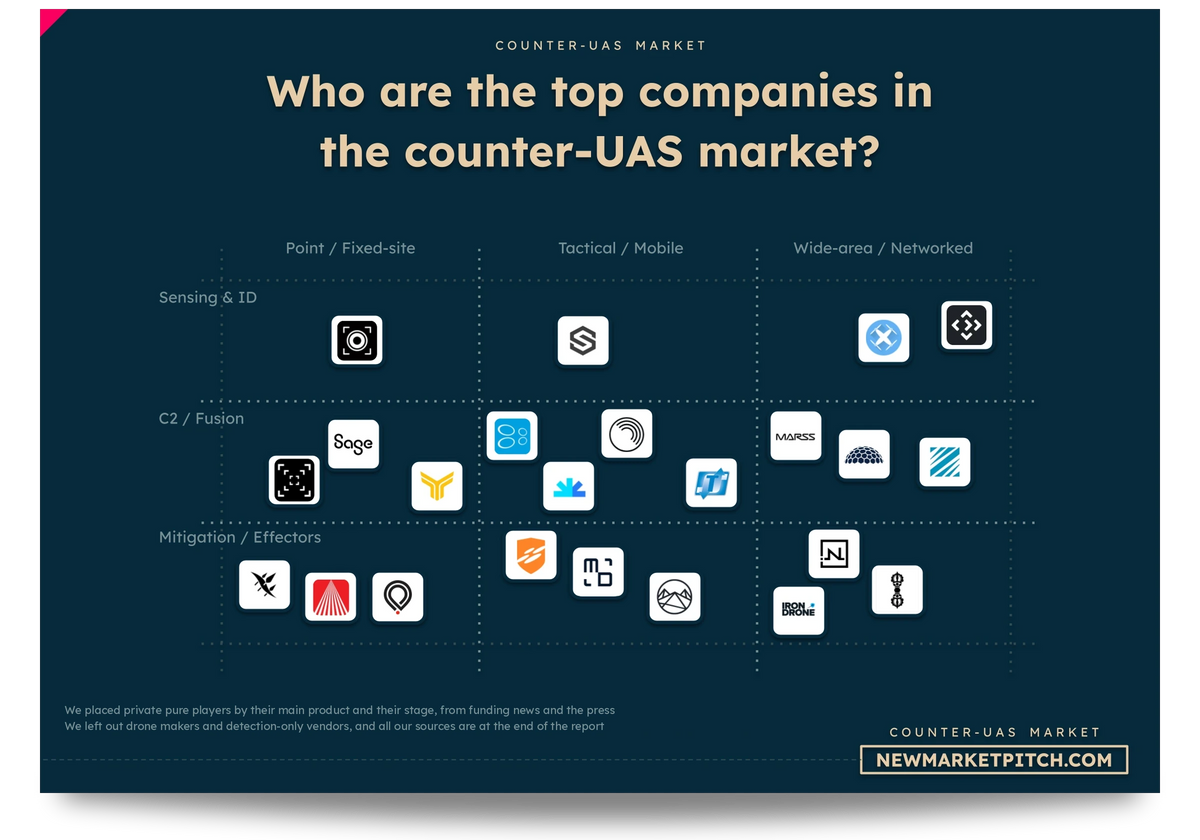
In our report covering the counter-UAS market, we turn what is vague and complex into simple, useful visuals. Market maps like this one show you at a glance where every startup stands.
Which drone-detection startups should we actually compare?
The credible independent drone-detection race now has seven companies, and only three or four have enough scale to argue about leadership.
We compare Robin Radar Systems, MyDefence, Echodyne, Hidden Level, Fortem Technologies, SkySafe and MatrixSpace. Each has its own detection technology and at least one real form of market validation, such as military deployments, repeat public-sector customers, scaled manufacturing or a major government contract vehicle. A detection startup with real deployments and one with only a prototype are not the same, and we sort the two in our report covering the counter-UAS market.
The boundary matters. Robin Radar, Echodyne and MatrixSpace mainly sell radar. MyDefence combines radio-frequency detection with jamming. Hidden Level and SkySafe focus on persistent airspace intelligence. Fortem links detection directly to autonomous interception. We compare their ability to find, classify and track drones first, then give extra weight to identification, mitigation and integration where they improve the customer’s result.
D-Fend Solutions now sits outside the ranking. Motorola Solutions said on August 20, 2026 that it had completed the $1.5 billion acquisition, so D-Fend joins Dedrone, bought by Axon, and Sentrycs, bought by Ondas, as an important competitor that is no longer a startup. We keep it as a benchmark because it still sets the bar for commercial scale. We also exclude listed DroneShield and large groups such as Thales, Hensoldt, Leonardo, Rheinmetall and BAE Systems.
Funding figures are messy. Several companies have private-equity owners, undisclosed rounds or strategic investments that may overlap with later rounds. The table uses cumulative disclosed funding where possible and labels incomplete totals.
| Startup | What it does | Cumulative funding disclosed |
|---|---|---|
| D-Fend Solutions | RF-cyber detection, identification and takeover, now combined with radar and optional jamming | Acquired by Motorola Solutions for $1.5B (closed August 2026); no longer ranked |
| Robin Radar Systems | Mobile 3D radar for small drones, aircraft and other low-altitude objects | €25M growth financing disclosed; Parcom-owned; reported sale interest valuing it near $2.3B (not a completed deal) |
| MyDefence | Wearable, vehicle-mounted and fixed RF detection and jamming systems | Undisclosed; Bridgepoint holds a majority stake and was reported in June 2026 to be exploring a sale |
| Echodyne | Compact electronically scanned radars for defense, security and autonomous systems | About $202M tracked across six rounds |
| Hidden Level | Passive radar and RF sensor networks for persistent airspace monitoring | More than $121M based on its disclosed rounds |
| Fortem Technologies | Radar, command software and autonomous net-equipped interceptors | Roughly $95M to $120M (estimate) after closing a $50M Series B led by Lockheed Martin in September 2026 (Lockheed’s $25M from April was its first tranche) |
| SkySafe | RF detection, historical airspace intelligence and drone forensics | $45M |
| MatrixSpace | Small, portable AI-assisted radar for local airspace monitoring | $58M |
Who leads drone detection now that Motorola owns D-Fend?
Robin Radar leads the independent field today, with MyDefence close behind and Fortem rising fastest.
D-Fend’s exit removes the one company that was clearly ahead on business scale. When Motorola agreed to buy it in June 2026, it said D-Fend expected about $185 million in 2026 revenue and had thousands of deployments in more than 30 countries. None of the remaining startups publicly shows anything close to that. The race is now between specialists.
Robin wins that contest because it leads the core job. Its radar sees physical objects even when they are silent on radio, it has a large and public national defense order, and it is adding capacity on two continents. Reuters reported in early October 2026 that BAE Systems was weighing a bid valuing Robin at about $2.3 billion; other outlets put it near €2 billion, which is roughly the same figure. That interest does not prove the lead, but it shows how buyers rank the company.
MyDefence is a strong second because it already ships at volume to soldiers. Fortem has the best recent run of contracts and funding. Echodyne has the most manufacturing capacity and now a large Army channel. Hidden Level owns the passive-network niche.
The lead is narrower than D-Fend’s was. Robin is ahead on detection quality and contract clarity, not on revenue, which it does not publish.

Our research about counter-drone systems gets updated several times a month, so you always get the latest view of where things stand.
Who has built the biggest real drone-detection business?
D-Fend built the biggest business, which is why Motorola bought it. Among the companies still independent, MyDefence and Robin Radar have the strongest public evidence of scale, and neither publishes revenue close to D-Fend’s.
D-Fend’s expected $185 million in 2026 revenue, as stated by Motorola, set the benchmark. Motorola paid $1.5 billion, about 8.1 times that figure. The deal closed in August 2026. That price reflects a working commercial platform with thousands of installations, not a set of pilots.
MyDefence is the most transparent of the remaining companies on profit. It reported DKK 125.4 million in net profit and DKK 252 million in gross profit in its latest accounts, while funding its expansion internally. The Financial Times reported in June 2026 that its sales were poised to more than double.
Robin has not published revenue. It says it has more than 800 radar systems installed after three straight years of 60% annual growth, and its scale shows up in deliveries: a 100-radar Dutch order, at least 50 radars delivered within about two weeks, and new facilities in Delft and the United States. Hidden Level and Fortem have serious government work, but contract values on their vehicles are ceilings, not sales.
The gap between D-Fend and everyone else was clear. The gap among the remaining startups is small and hard to measure from outside.
Which drone-detection startup is growing fastest now?
Fortem is growing fastest in contracts and capital, while MyDefence still has the strongest operating growth on record.
MyDefence’s workforce increased from 52 employees at the beginning of 2025 to 135 by May 2026, a 160% rise in about 17 months. It kept net profit at DKK 125.4 million, lifted gross profit by 17.4% to DKK 252 million and runs full-scale production in Denmark and the United States. In October 2026 it rolled out Wingman Edge, a wearable it says can detect drones at up to 6 kilometers, and opened a North American headquarters in Reston, Virginia.
The Financial Times reported in June 2026 that Bridgepoint was exploring a sale that could value MyDefence near $1 billion. No buyer or price has been announced since. Without new public orders, its growth story rests on the same accounts.
Fortem had the busiest few months in the field. On August 4, 2026 it said it had been selected as a prime contractor on a five-year DHS counter-drone contract, in a track with an estimated starting ceiling of $1.011 billion shared by seven companies. In late September it closed a $50 million Series B led by Lockheed Martin to scale production. Earlier in 2026 it had won a World Cup order, a Replicator 2 purchase and a Lockheed critical-infrastructure deal.
Robin is growing capacity fastest. It opened a larger US operations center in August 2026 and announced a Delft hub in September that it says triples its operational capacity.
MyDefence shows the best proven growth. Fortem shows the sharpest recent acceleration.

In our market report about counter-drone systems, we look at what the winners do differently, so you can learn from the best instead of guessing.
Who has the most mature drone-detection product?
Robin Radar and MyDefence now have the most mature products in the independent field, each inside its own use case. D-Fend’s EnforceAir remains the most mature complete product, but it is now sold by Motorola.
A mature counter-drone product has to survive crowded radio environments, bad weather, moving platforms, legal limits and users who cannot spend months on training. D-Fend’s systems already cover airports, defense sites, events, prisons and critical infrastructure, and the FAA has evaluated EnforceAir in its airport program. Motorola can now sell it through its public-safety channel.
Robin’s maturity shows in delivery speed and military standardization. The Dutch Ministry of Defence ordered 100 IRIS radars. Robin delivered the first 30 within 24 hours and reached at least 50 within about two weeks, while the first user groups finished training. That is a repeatable production product, not custom engineering for each customer. Radars that ship in quantity without custom engineering count as technology that already works in our drone detection market report.
MyDefence has more than 2,000 Wingman wearable detectors operating in Ukraine, with thousands more deployed elsewhere according to the company. Frontline feedback shaped new hardware covering 200 MHz to 6 GHz. That loop matters because adversaries keep changing frequencies, control links and flight patterns.
Which startup has the strongest drone-detection technology and pilot identification?
Robin Radar has the strongest pure detection product. With D-Fend now inside Motorola, Hidden Level is the best independent option for locating operators, while SkySafe leads on investigation.
Robin’s IRIS radar covers 360 degrees horizontally and 60 degrees vertically, with a five-kilometer instrumented range and 78 square kilometers of standard coverage. Its long-range software mode extends the instrumented range to 12 kilometers. It can be set up in under 15 minutes and can detect, track and classify while mounted on a vehicle moving at up to 100 kilometers per hour.
That suits customers who need one mobile sensor to watch a large area. Radar also keeps seeing physical targets that use unfamiliar protocols, fly autonomously or stay radio-silent.
D-Fend still sets the standard on identification. Its RF-cyber layer can read a drone’s make, model and serial number, separate authorized aircraft, locate the pilot and find the take-off point. Customers now buy that capability from Motorola, not from a startup.
Hidden Level comes closest among independents. Its distributed sensors triangulate radio sources and combine live alerts with history, which helps reveal recurring routes and operators across a city or base. The company states urban location accuracy of about 50 meters at a five-kilometer tracking range, though real results depend on sensor placement. Its passive radar also targets drones that are silent on radio, a capability the Department of War backed with a $100 million agreement in July 2026.
SkySafe has the stronger investigative angle. Its platform stores flight history, supports drone forensics and works with Cellebrite so police can link airspace activity to evidence recovered from devices.
Published performance numbers use different targets, environments and thresholds, so they describe positioning rather than a controlled head-to-head test.
| Startup | Strongest published capability | What we can reasonably conclude |
|---|---|---|
| Robin Radar | 5 km standard range, 12 km long-range mode and 78 km² standard coverage | Best proven all-round radar for mobile, medium-range drone detection |
| D-Fend | Drone make, model, serial number, pilot location and controlled takeover | Best live identification and response against supported radio-linked drones; now part of Motorola Solutions |
| Hidden Level | Passive radar, RF direction finding and detection of dark targets | Best independent approach for persistent tracking, operator location and pattern analysis |
| SkySafe | Historical airspace intelligence and device forensics | Best post-incident investigative capability |
| Echodyne | Compact electronically scanned radar with patented MESA technology | Strongest radar component platform for integrators and larger defense systems |
| MatrixSpace | 1.1 km small-drone range in a compact 360-degree sensor | Best fit for rapidly deployed, close-range local coverage |

In our document detailing everything you need to know about counter-UAS, you will always find fresh funding data, taken straight from our own verified funding database.
Which drone-detection startup works best around airports and cities?
Hidden Level is now the best independent option for cities, and SkySafe has the strongest record with state and airport customers. D-Fend remains the most complete airport product, but it is now a Motorola product.
Airports need accurate alerts without creating a second disruption. Broad jamming can interfere with legitimate systems, and physical interception can drop debris onto people or runways. D-Fend’s cyber-takeover approach avoids both for supported drones, which is a large part of why Motorola, a public-safety supplier, bought it.
Hidden Level treats the problem as shared infrastructure. It owns and runs networks of passive sensors on rooftops, buildings and towers, then sells the resulting airspace data. The company says it brought Stewart Air National Guard Base online within 24 hours and fed the same data into Palantir for federal, state and local users within 48 hours. In October 2026 it opened a Washington, D.C. office as its sensor network there expands, after its sensors reportedly spotted drones over Fort McNair.
SkySafe deserves more credit than its funding suggests. Rhode Island renewed its contract for another three years and widened coverage across airports, prisons and other high-risk sites. In June 2026 the University of Illinois Urbana-Champaign extended its partnership with the company. Renewals count for more than new pilots because the customer has already used the product.
Which startup is strongest on the battlefield?
MyDefence is the battlefield leader at soldier level, Robin Radar leads the wider detection layer and Fortem offers the strongest autonomous interception package.
MyDefence’s advantage starts with distribution. More than 2,000 Wingman detectors are deployed in Ukraine, giving individual soldiers passive warning of nearby drones. Its wideband equipment covers 200 MHz to 6 GHz and connects to ATAK, so detections appear on the tactical map many units already use. The newer Wingman Edge extends stated detection range to about 6 kilometers.
The company covers more of the battlefield than its wearable suggests. It sells vehicle-mounted and fixed systems, runs an innovation hub in Ukraine and manufactures in Denmark and the United States. Its product changes come from direct frontline use rather than occasional trials.
Robin covers the medium-range layer that wearable RF detectors cannot. IRIS tracks objects that emit no usable radio signal and has been used in Ukraine against small drones and larger loitering munitions. Its mobility lets units move radar with convoys instead of guarding one fixed base.
Fortem closes the loop. Its TrueView radar feeds SkyDome software, which sends DroneHunter interceptors to capture targets with nets. The Replicator 2 purchase, Lockheed Martin’s integration of Fortem into its Sanctum ecosystem and Lockheed’s lead role in the September 2026 Series B show that US buyers treat the system as deployable, not experimental.

Learning from others' mistakes is the cheapest lesson there is. In our report covering the counter-UAS market, we look at what broke startups before you, so you don't repeat it.
Who can manufacture drone-detection hardware at real scale?
Echodyne still has the largest stated radar manufacturing capacity, Robin Radar is adding capacity fastest, and MyDefence has the best evidence that its plants are busy.
Echodyne opened an 86,350-square-foot Washington facility after investing about $40 million. The company says the plant is designed to exceed 30,000 radars per year, more than 2,500 a month, and will create more than 100 jobs, with room for up to 200 at full scale.
The 30,000-unit figure is a design capacity, not confirmed output. The missing piece was demand, and it now has a channel: in September 2026 Echodyne joined the Army’s Domestic Shield contract with a $250 million ceiling, a channel that can turn spare capacity into repeat orders if task orders follow. Spare factory capacity only pays off once orders follow, and we study what has to happen for demand to pick up in our market report about drone detection.
Robin announced in September 2026 a 9,000-square-meter hub in Delft that it says triples its operational capacity, after opening a larger US operations center in August. Combined with its record of delivering half of a 100-radar order within about two weeks, that makes it the strongest execution story.
MyDefence expanded capacity tenfold with a new facility, added full-scale US manufacturing and more than doubled its workforce. Its expansion is already tied to deployed equipment, orders and profit.
| Startup | Hardest scale evidence | Our reading |
|---|---|---|
| Echodyne | Factory designed for more than 30,000 radars annually; $250M Army ceiling (September 2026) | Highest manufacturing ceiling, now with a procurement channel |
| MyDefence | Tenfold capacity expansion and full-scale plants in Denmark and the US | Strongest demand-led production expansion |
| Robin Radar | 50 radars delivered within two weeks; new Delft hub said to triple operational capacity | Best execution against a large direct order, now scaling fastest |
| Fortem | Hundreds of components per month; $50M Series B raised to scale production | Rapidly scaling, but the highest volumes remain ahead |
| MatrixSpace | Compact solid-state radar already in production for defense users | Easier product to manufacture, with smaller visible demand today |
Did the Army and DHS counter-drone contracts change who is ahead?
Not yet. They gave Fortem and Echodyne large new channels, but Robin Radar still has the cleanest large order that can be counted in delivered units.
The Dutch Ministry of Defence’s purchase of 100 IRIS radars remains the strongest contract in this group measured in real detection units. The buyer, product, quantity, training and deliveries are all public.
The US contracts are larger on paper. In August 2026 DHS awarded a $1.5 billion counter-drone contract to 12 companies. Fortem is a prime contractor in its hardware and software track, which has an estimated starting ceiling of $1.011 billion shared by seven firms. In late September the Army awarded Domestic Shield contracts to 10 companies; Echodyne’s ceiling is $250 million. Reports differ on the Army total: the 10 awards carry combined ceilings of about $4.15 billion, while Breaking Defense and others headlined up to $7 billion, which appears to be the ceiling of the wider Domestic Shield program.
These are ceilings, not orders. The government can issue task orders to any company on the vehicle and has no obligation to spend the full amount. They also bring competition: DroneShield, a listed rival, received a $500 million ceiling on the Army contract.
Hidden Level’s $100 million Department of War agreement in July 2026 is also a vehicle to scale its passive sensing across the military; the company has not said how much is already obligated.
Robin wins on one clear purchase. Fortem has the broadest set of US vehicles. Echodyne may extract the most volume if Domestic Shield becomes steady production orders.

In our research about counter-drone systems, we always try to gather several sources and make estimates that make sense, so you can work with solid numbers.
Which startup offers the best economics for customers?
MatrixSpace has the clearest low-friction cost story; public pricing is still too thin to crown a universal value winner.
MatrixSpace’s radar deploys within minutes, needs little supporting infrastructure and covers a 1.1-kilometer radius against small drones. Customers can add local radar around a base, prison, stadium or industrial site without building a tower. Its coverage is much smaller than Robin’s, but many customers only need to watch a defined perimeter. In 2024 it also won a $1.9 million AFWERX contract to develop a distributed mesh radar for base defense.
Hidden Level offers a different model. Customers subscribe to airspace data while Hidden Level owns, installs and maintains the sensors. A city or regional agency can share coverage across many sites instead of buying a system for each one. The trade-off is dependence on Hidden Level’s network and service.
D-Fend’s economic case, now sold by Motorola, rests on avoided disruption. One prevented airport shutdown could outweigh years of equipment cost, though pricing and incident data are not public.
MyDefence probably has the strongest cost logic for distributed military units. A wearable detector protects a squad without assigning a radar and trained crew to every position. Robin becomes cheaper when one radar replaces several shorter-range sensors, while Fortem can lower repeat interceptor costs by capturing drones with reusable platforms.
We can compare architectures with confidence. We cannot say which company is cheapest, because prices, service fees, maintenance costs and discounts remain largely private.
Which startup has used its funding most efficiently?
D-Fend turned funding into value most efficiently and proved it with a closed sale. Among the remaining startups, Robin Radar and MyDefence look most efficient, if their reported sale prices hold.
D-Fend publicly announced a $28 million round and a later $31 million round, plus an earlier undisclosed round. Its $1.5 billion sale price equals more than 25 times the two known rounds. The missing round would lower that ratio, but not enough to change the conclusion.
Robin has disclosed only €25 million of growth financing, and its owner Parcom has not published its purchase terms. If a buyer pays anything close to the reported $2.3 billion, Robin would join D-Fend as one of the most capital-efficient exits in defense tech. That remains a reported valuation, not a price.
MyDefence generated DKK 125.4 million in net profit while funding expansion internally. The amount Bridgepoint invested is undisclosed, so any direct ratio would be guesswork.
Echodyne has raised roughly $202 million and spent heavily on a factory. Hidden Level has raised more than $121 million for a national-security sensor network. Fortem closed a $50 million Series B in September 2026, half of it Lockheed’s April investment. Those models need more capital, and their spending only becomes efficient if their new contract vehicles turn into recurring orders.

If you build or invest in the counter-UAS market, you need to know which business models pay off now and which ones are fading. That's why our report covering it has a whole section on it.
Whose advantage will be hardest for competitors to copy?
Robin and Echodyne have the strongest hardware moats among independents, and Hidden Level has the best network moat. D-Fend’s software-and-data moat is now in Motorola’s hands.
D-Fend spent years decoding drone protocols and building safe takeover methods. A rival can buy RF hardware quickly, but rebuilding that protocol library and regulatory trust would take far longer. Motorola now owns that advantage and can sell it through a large public-safety channel, which makes it harder for independent RF companies to compete in airports and cities.
That advantage weakens against autonomous, modified or radio-silent drones, which favors radar and passive sensing. Robin and Echodyne own harder engineering advantages: small-drone radar requires antenna design, clutter suppression, micro-Doppler classification, tracking software and years of field data. Echodyne also holds many patents on its metamaterials electronically scanned array. Technical moats like these are part of why leaders pull ahead, and we study what they consistently do differently in our report on drone detection.
Hidden Level’s moat grows with geography. Once a network covers a city, base or corridor, the company builds local history, recurring flight patterns and software integrations. A newcomer could install one good sensor, but matching the coverage map and dataset would take time and access.
The strongest companies keep becoming layers inside larger security groups. Motorola owns D-Fend, Axon owns Dedrone, Ondas owns Sentrycs, Lockheed leads Fortem’s latest round, and BAE is reported to be weighing Robin. Distribution, command software and procurement access may be as hard to copy as the sensor.
Which drone-detection startup has the strongest momentum right now?
Fortem has the strongest momentum right now, with Robin Radar and Echodyne close behind.
Fortem stacked contract and capital proof in two months. In August 2026 it became a DHS prime contractor, with Lockheed Martin and Microsoft as subcontractors. In late September it closed a $50 million Series B led by Lockheed to scale production. Earlier in the year it had won World Cup work, a Replicator 2 purchase and a Lockheed critical-infrastructure deployment. It has moved from interceptor specialist to a supplier attached to several urgent US programs.
Robin’s momentum shows in capacity and buyer interest. It opened a larger US operations center in August, announced a Delft hub that it says triples capacity in September, and drew reported interest from BAE Systems and private-equity investors in early October.
Echodyne now combines the category’s largest dedicated startup radar factory with a $250 million Army ceiling and its public-safety partnership with Axon.
MyDefence has the strongest record but less visible news. In October 2026 it launched Wingman Edge and opened a North American headquarters in Reston, Virginia, but no new order or sale outcome has been made public since the June 2026 sale reports. Hidden Level added a $100 million defense agreement in July and a D.C. office in October.

In our document detailing everything you need to know about counter-UAS, we don't want to repeat what boring consulting reports say. Instead, we show you the real and latest market signals that matter.
Which drone-detection startups are actually ahead?
Robin Radar Systems is the startup ahead today; MyDefence is the closest challenger, Fortem is rising fastest and Echodyne has the clearest route to volume. D-Fend, the former leader, became part of Motorola Solutions in August 2026.
Robin ranks first because it leads the core detection job. IRIS has large-area coverage, mobility, silent-target detection, rapid delivery and one of the clearest national military orders in the market. Its new capacity in Delft and the United States and the reported $2.3 billion bid interest confirm its position. Its weakness is scope: Robin mostly supplies the sensor and relies on partners for identification, command software and mitigation.
MyDefence ranks second. It has profitable operations, thousands of battlefield units and production in Europe and the United States. It could pass Robin if its expected sales growth shows up in audited revenue and large new orders.
Fortem moves up to third. Its DHS prime position, $50 million Series B and Lockheed backing make it the most active company in US procurement, even though detection is only one part of its interceptor-led offer.
Echodyne ranks fourth. Its $250 million Army ceiling and 30,000-radar factory give it the clearest path to volume, but it has not yet disclosed orders that fill that capacity.
Hidden Level comes fifth with a distinct passive-network model and a new $100 million defense agreement. SkySafe owns a credible public-safety and forensic niche. MatrixSpace remains earlier, with a compelling portable radar but little evidence of scale.
The biggest threat to Robin’s position is a sale. If BAE or a private-equity buyer takes control, Robin would remain a strong product but leave the startup race, just as D-Fend did. A shift toward low-cost physical interception would favor Fortem.
| Rank | Startup | Why it holds this position |
|---|---|---|
| - | D-Fend Solutions | Acquired by Motorola Solutions for $1.5B (closed August 2026); still the scale benchmark but no longer a startup |
| 1 | Robin Radar Systems | The pure detection leader, with strong range, mobility, rapid production, a public 100-radar military order and fast-growing capacity |
| 2 | MyDefence | The battlefield leader, with profitable operations, thousands of deployed units and plants in Denmark and the US |
| 3 | Fortem Technologies | The strongest detect-and-intercept challenger, now a DHS prime contractor with a $50M Lockheed-led Series B |
| 4 | Echodyne | The radar-platform and manufacturing leader, with a $250M Army ceiling and by far the largest planned production capacity |
| 5 | Hidden Level | The passive-network leader, with wide-area coverage and a $100M Department of War agreement |
| 6 | SkySafe | The leading public-safety and drone-forensics specialist, supported by repeat state and institutional customers |
| 7 | MatrixSpace | A promising portable-radar challenger with attractive deployment economics, but less visible commercial scale |
Our methodology
This analysis tests which drone-detection startup is ahead by separating leadership into the dimensions that matter in practice: commercial scale, growth, product maturity, technical capability, manufacturing, customer adoption, contract quality, economics, funding efficiency, defensibility and recent momentum.
We prioritized recent execution over historical reputation. The market is changing quickly through acquisitions, defense procurement, factory expansion and shifts in the drone threat, so older achievements were used as context rather than allowed to outweigh newer operating evidence. Companies whose acquisition has closed leave the ranking and are kept only as benchmarks.
The companies do not all sell the same thing. Radar specialists, RF-intelligence platforms, passive sensor networks and integrated detect-and-intercept systems were first compared within the jobs they perform best, then assessed on how consistently they showed strength across the wider customer workflow.
Technical figures such as detection range, coverage, tracking accuracy and pilot-location capability were not treated as clean head-to-head benchmarks because companies test different targets under different conditions. We used those figures to establish product positioning, then checked them against deployments, repeat customers, operational use and production evidence.
Verified revenue, signed orders, delivered units, repeat contracts, disclosed deployments and functioning manufacturing capacity received more weight than partnership announcements, contract ceilings, projected factory output, reported sale valuations or future sales expectations. Funding totals were treated cautiously where private-equity investments, undisclosed rounds or overlapping strategic investments made direct comparisons unreliable.
Key sources include Motorola Solutions on the completed D-Fend acquisition, Fortem Technologies on its DHS counter-drone contract, company disclosures from Robin Radar Systems, MyDefence, Echodyne, Hidden Level, SkySafe and MatrixSpace; procurement and operational material from the FAA, the US Department of Defense, the US Army Contracting Command and the Dutch Ministry of Defence; and reporting or funding references from Reuters, the Financial Times, Crunchbase and PitchBook.
The final ranking reflects the cumulative weight of evidence rather than victory in one specialist category. Companies ranked higher when they combined credible technology with commercial execution, repeat customer validation and operational scale.

In our report covering the counter-UAS market, we like to show you the big picture. We know your time is precious, so we make every page quick to read and packed with as much learning as possible per minute.
Written by the New Market Pitch teamWe track new markets so founders and investors can move faster. About us