Military drones: which startup is ahead?
Whether you're building or investing in the military drone market, our report covers everything you need to know: the players, the money, and what's coming next.
Summary
Anduril is still clearly ahead in the military drone startup race, with Quantum Systems and Shield AI forming the closest chasing group.
Anduril’s lead rests on things the others do not combine: about $2.2 billion of 2025 revenue, several aircraft families, a fighter-sized drone now built on a production line, Pentagon software contracts and the largest factory in the group.
Below the top spot, the race has tightened. Quantum Systems still has the broadest record of recent combat use, but TEKEVER now says its drones have flown more than 50,000 operational hours in Ukraine since 2022, and it raised $580 million at a $6.4 billion valuation in September 2026. TEKEVER's $6.4 billion valuation tightens the race; we look at who is ahead and who trails in our report on who's ahead in military drones.
Neros made the biggest jump among low-cost makers. It raised $250 million at a $2.5 billion valuation in August 2026 and then won a firm Pentagon order worth more than $100 million for about 14,000 drones.
Shield AI is pushing upmarket. It is in talks to raise at a valuation of at least $20 billion, according to reports in September 2026, and says funding for its X-BAT fighter drone has reached $400 million.
Contract headlines still need care. A $500 million IDIQ, a £400 million UK program or a reported €2.9 billion framework is a ceiling, not revenue or accepted aircraft.
Combat evidence remains uneven. Flight hours and deliveries are useful, but startups rarely publish jamming losses, mission completion rates or target-hit data.
Helsing has the capital, orders and factories to challenge the top three, but the disputed HX-2 record remains the main question around the company. Its $18 billion valuation does not settle it.
Production is splitting into two models. Anduril and Helsing are betting on large central factories, while Firestorm is testing small deployable factories that build and modify aircraft close to the front.
The ranking could still move. Quantum can narrow the gap by hitting its revenue and factory targets, Shield AI can take second if Hivemind wins the Air Force’s main CCA autonomy role, and TEKEVER or Neros could pass Helsing if their new orders turn into steady deliveries.

Written by the New Market Pitch teamWe track new markets so founders and investors can move faster. About us

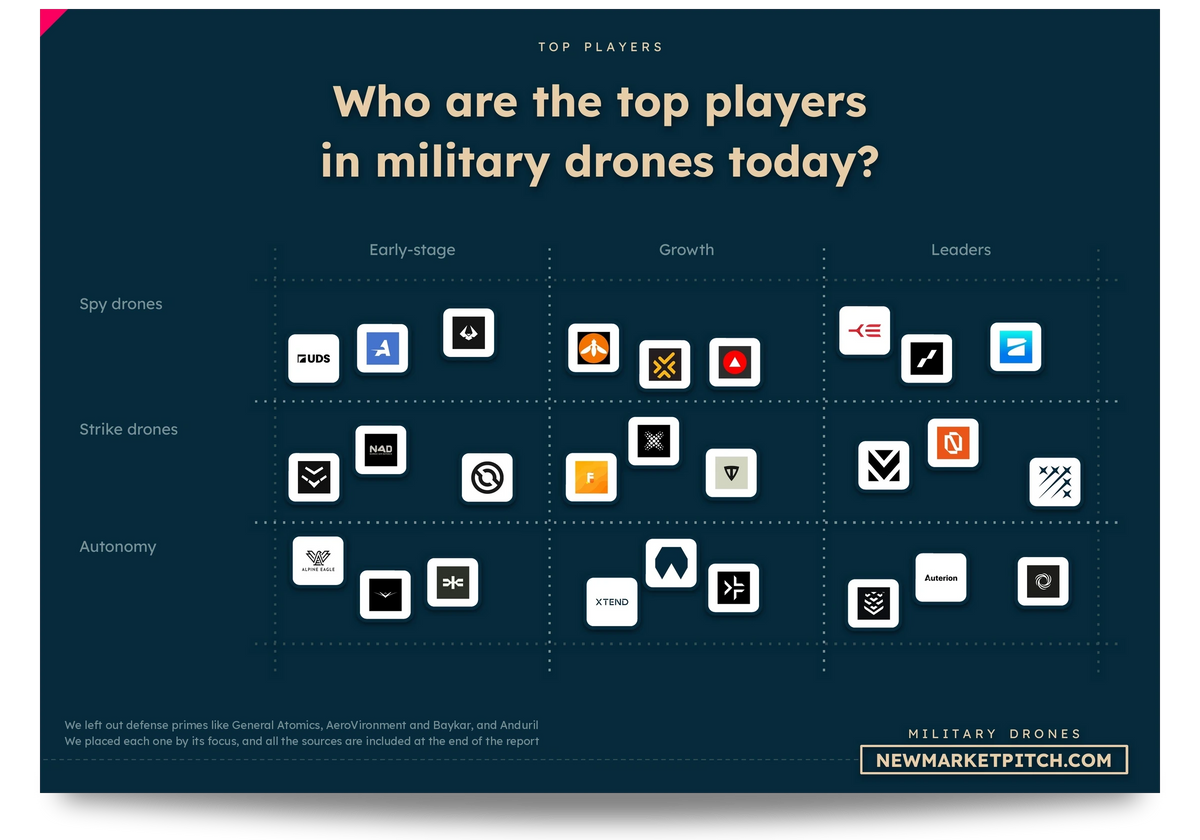
In our report covering the military drone market, we turn what is vague and complex into simple, useful visuals. Market maps like this one show you at a glance where every startup stands.
Which military drone startups should we actually compare?
The comparison should currently include Anduril, Shield AI, Helsing, Quantum Systems, Skydio, STARK, Neros, TEKEVER and Firestorm.
These nine companies have moved beyond prototypes. Each has raised substantial outside money and reached at least one harder milestone, such as military deployment, serial production, a significant procurement contract or an active weapons program. Nine companies with real milestones is a short list; we look at the top companies today in our military drones report.
They still occupy very different parts of the market. Anduril builds everything from tactical drones to autonomous combat aircraft. Shield AI combines the V-BAT aircraft with Hivemind autonomy software and is developing the X-BAT fighter drone. Quantum Systems and TEKEVER concentrate mainly on reconnaissance. Helsing and STARK make longer-range strike drones. Skydio focuses on small autonomous reconnaissance systems. Neros builds inexpensive FPV attack drones and is adding an interceptor, while Firestorm develops modular aircraft and deployable factories.
We exclude General Atomics, AeroVironment, Northrop Grumman and other established defense contractors. Baykar also sits outside this comparison. It was founded decades ago, has delivered aircraft across many countries and operates more like a major defense manufacturer than a startup.
Ukrainian drone companies deserve separate treatment. Many produce far more aircraft than the Western startups below, but their financing, ownership, revenue and delivery data remain too inconsistent for a like-for-like comparison. That may change: Forbes reported in October 2026 that Kyiv-based Airlogix was in talks to raise $100 million at a valuation above $2 billion.
The funding figures are approximate. Private-market databases count equity, debt and preferred financing differently, particularly for Shield AI.
| Startup | Main military drone position | Approximate cumulative funding |
|---|---|---|
| Anduril | Autonomous combat aircraft, tactical drones and loitering weapons | $6.8B |
| Helsing | AI-enabled strike drones and defense software | $3.3B |
| Shield AI | V-BAT aircraft, Hivemind autonomy and the X-BAT program | Over $3B |
| Quantum Systems | Tactical ISR drones and multi-domain autonomous systems | About $1.7B |
| Skydio | Small autonomous reconnaissance drones | $825M |
| STARK | Long-range loitering munitions | €640M |
| TEKEVER | Long-endurance tactical reconnaissance drones | About $680M |
| Neros | Low-cost FPV strike drones and interceptors | About $370M |
| Firestorm | Modular drones and deployable manufacturing | $160M |
Is Anduril still ahead of every other military drone startup?
Yes. Anduril is still ahead overall. None of the other startups matches its mix of revenue, aircraft programs, Pentagon access and factory capacity.
The strongest evidence is the FQ-44. In June 2026, the U.S. Air Force picked Anduril and General Atomics for the production phase of its Collaborative Combat Aircraft program. On July 27, 2026, the first production YFQ-44A rolled off the line at Arsenal-1, Anduril’s factory in Ohio, according to Defense News.
Two weeks before that, a YFQ-44A fired an inert AIM-120 missile at a simulated target beyond line of sight in the Air Force’s first live-fire CCA test. No other startup in this comparison has a weapons milestone at that level.
The numbers are still open. The Air Force has not disclosed the contract value or how many aircraft each company will build. It has said it can buy more than 150 combat-capable CCA by the end of the decade, and Defense News reported the line has capacity for 150 aircraft a year.
Anduril said its 2025 revenue more than doubled to about $2.2 billion. That covers far more than drones. In October 2026, the U.S. Army also awarded it a contract worth up to $1.8 billion over five years for its NGC2 command network, with a firm base period of $162.8 million.
Investors are pricing the lead aggressively. Anduril raised $5 billion at a $61 billion valuation in May 2026. Reuters reported in July that it was in talks at about $100 billion, and Anduril said no decision had been made. An employee share sale reported at about $90 billion opened in October, but it brings no new money into the company.
Quantum Systems, Shield AI and Helsing form the chasing group. Each is strong on one or two layers. None has Anduril’s full stack.
Earlier Ghost and Altius deployments reportedly struggled in Ukraine, and Arsenal-1 has not yet shown its full planned output. Those are real weaknesses. They do not erase Anduril’s lead.

Our research about military drones gets updated several times a month, so you always get the latest view of where things stand.
Which military drone startups have the strongest commercial traction and contracts?
Anduril has the largest business and the most important contract. Quantum Systems still has the strongest commercial operation focused mainly on drones, and Neros now has the clearest firm mass order.
Anduril’s company-stated 2025 revenue of about $2.2 billion includes command software, surveillance towers, counter-drone systems and underwater vehicles. It cannot be read as drone revenue.
Quantum Systems is a cleaner drone comparison. Financial Times reporting around its $1.2 billion round in July 2026 said it expects more than €700 million of revenue and about €200 million of EBITDA in 2026. Other coverage of the round did not repeat those figures, but its finance chief described triple-digit growth and double-digit profitability.
Shield AI has projected more than $540 million of annual revenue. Helsing reportedly expects about €440 million, but that business also covers electronic warfare, undersea and space systems. Neither company has published audited accounts.
The CCA autonomy picture is less settled than the aircraft picture. Shield AI won a place in the Air Force’s six-year autonomy software pool in June 2026 and is one of three vendors, with Anduril and RTX Collins Aerospace, competing head-to-head. The Air Force plans to name a primary software provider for Increment 1 by summer 2027.
Germany’s orders for Helsing and STARK remain large. Lawmakers approved €269 million per company with a cap of €1 billion each. In September 2026, STARK put its first batch at €275 million and said first Virtus deliveries would go to the German brigade in Lithuania. A dpa report cited a €2.9 billion STARK framework, a figure that does not appear in the Bundestag record.
Neros moved from a ceiling to real orders. Its U.S. Army IDIQ is worth up to $500 million through June 2031. Then, on September 30, 2026, it announced a Drone Dominance order worth more than $100 million for about 14,000 drones and payloads, plus 800 more reallocated from rivals that missed deadlines.
TEKEVER also gained a major customer. The UK selected its AR5 for the British Army’s CORVUS surveillance program, worth up to £400 million over ten years, with six aircraft in the first order and up to 24 by 2029.
| Startup | Strongest disclosed procurement signal | How we interpret it |
|---|---|---|
| Anduril | U.S. Air Force FQ-44 production contract, first aircraft built in July 2026; Army NGC2 deal worth up to $1.8B | The most strategically important startup drone program, value undisclosed |
| Shield AI | U.S. Air Force CCA autonomy pool, competing for the primary software role | Strong validation of Hivemind, but the main award is not decided |
| Helsing | 6,000 HX-2 systems, following 4,000 HF-1 drones, plus a €269M initial German order | Large demand, with continuing questions about field performance |
| STARK | €275M first batch (company-stated), within a German program capped at €1B | Major opening for a very young company; deliveries only now starting |
| Neros | U.S. Army IDIQ worth up to $500M, plus a $100M+ order for about 14,000 drones | The ceiling is now backed by a large firm order |
| Skydio | More than 2,500 X10D systems for over $52M | A firm mass order for small reconnaissance drones |
| Quantum Systems | U.S. Army Vector AI selection and a 2027 follow-on order from Ukraine’s National Guard | Strong repeat demand across NATO and Ukraine |
| Firestorm | Five-year U.S. Air Force IDIQ worth up to $100M | Useful validation, with revenue dependent on future orders |
| TEKEVER | British Army CORVUS program worth up to £400M over ten years | A top-tier customer; value depends on how many AR5s are ordered |
Does Quantum Systems or TEKEVER have the best combat record?
Quantum Systems still has the strongest recent combat record, but TEKEVER now claims the larger cumulative total. The two are close, and both figures come from the companies.
Quantum says its Vector completed more than 20,000 operational flight hours in Ukraine in 2025 alone, and over 19,000 missions. The aircraft was selected by the U.S. Army and placed third in Ukraine’s Army of Drones evaluation. Twenty thousand hours equals more than two aircraft flying nonstop for a full year.
TEKEVER says its drones have flown more than 50,000 operational hours in Ukraine since 2022. That is a four-year total, not a one-year figure, so it does not mean TEKEVER flies more today. It does show depth: the company says it made more than 100 product changes from frontline feedback, and the AR3 EVO offers up to 22 hours of endurance.
Neros has shipped tens of thousands of Archer FPV drones to Ukraine, according to reporting around its Army contract. It has not released hit rates, jamming losses or operator feedback data.
Shield AI had completed more than 130 V-BAT sorties in Ukraine by April 2025. V-BAT offers more than 12 hours of endurance with vertical launch, and in October 2026 Shield AI made its first deliveries to Taiwan’s Coast Guard.
Helsing’s record is still disputed. Bloomberg reported takeoff problems in Ukrainian trials, and in January 2026 Die Welt cited a Ukrainian document showing 5 hits in 14 attempts. Helsing rejected those accounts, said more than six Ukrainian units wanted more systems, and pointed to near-100% hit rates in trials in Germany, the UK and Kenya. In a U.S. Army exercise, 15 of 17 HX-2 aircraft reportedly hit their targets.
Anduril’s YFQ-44A missile test is the most advanced weapons milestone in the group. It is a test, not combat use, so it does not outweigh Quantum’s or TEKEVER’s operational records.
Our judgment: Quantum Systems leads on recent, multi-customer combat evidence, TEKEVER is a close second with the deepest long-run record, and Anduril leads in advanced weapons testing.

In our market report about military drones, we look at what the winners do differently, so you can learn from the best instead of guessing.
Which military drone startups have mature products and can produce them at scale?
Quantum Systems, Skydio and Neros have the clearest mature products, and Neros still reports the highest output of low-cost aircraft.
Quantum’s Vector combines years of deployment, more than 20,000 reported Ukrainian flight hours in 2025 and a U.S. Army selection. The company produces in Germany, Ukraine, the U.S., Australia, Romania, the U.K. and the Baltics. Producing in so many countries is no small feat, and we dig into the biggest unsolved problems in our report covering military drones.
Quantum Frontline Industries, its German-Ukrainian joint venture, was set up to build 10,000 drones for Ukraine in 2026. In October 2026, it signed a follow-on contract with Ukraine’s National Guard for 2027 and said it plans to multiply its German capacity by five. Neither the order size nor the 2026 delivery count has been disclosed.
Skydio’s X10D sits in an established U.S. Army program with a firm order for more than 2,500 systems. Small units can use it without the support larger aircraft need.
Neros reports about 1,200 aircraft a week, up from about 2,000 a month in late 2025. At that pace it would build around 62,000 drones a year. It has moved into a 250,000-square-foot plant in Torrance, California, and has named an interim goal of 10,000 drones a month by the end of 2026.
Its long-term goal is one million drones a year by 2028, about sixteen times today’s reported rate. That remains a target.
Shield AI’s V-BAT has operated in Ukraine, flown from ships and won customers including Japan, Poland, Greece and Taiwan. Shield AI has named Kansas and Washington State as flight-test and production sites for X-BAT, which has not yet flown.
Anduril has the broadest product range, but maturity varies. Ghost and Altius have been fielded, Barracuda is a newer loitering-weapon family, and the YFQ-44A only entered production in 2026.
Arsenal-1 covers about five million square feet and is meant to build tens of thousands of autonomous systems. It produced its first YFQ-44A in July 2026. Its full planned output is still unproven.
Helsing says its first Resilience Factory can build more than 1,000 HX-2 drones a month, or over 12,000 a year at full use. The disputed Ukrainian results still keep HX-2 out of the same reliability tier as Vector or X10D.
Firestorm’s two-container xCell factory can reportedly make up to 17 drones a week. Its edge is building and fixing aircraft near deployed units, not matching a central factory’s volume.
Quantum Systems has the best mix of maturity and growing production. Neros leads low-cost output. Anduril owns the largest industrial plan and has now started to prove it.

In our document detailing everything you need to know about military drone, you will always find fresh funding data, taken straight from our own verified funding database.
Which military drone startup has the best economics and strongest moat?
Neros still offers the clearest low-cost proposition, Quantum Systems the best capital efficiency among the scaled players, and Anduril the position that is hardest to copy.
An Archer costs about $2,000, or about $5,000 as a full system with warhead and support gear, according to reporting around its Army deal. Neros’ September 2026 order of more than $100 million for about 14,000 drones and payloads implies an average near $7,000 per unit, including payloads and other items.
A commander can send several FPV drones at one target, accept routine losses and replace them fast.
Skydio’s Army order gives a useful comparison. Dividing more than $52 million by 2,500 systems gives about $20,800 per package. That includes support and other items, so it is not the standalone X10D price.
Quantum Systems has raised about $1.7 billion and expects more than €700 million of revenue in 2026. Its cumulative funding equals roughly 2.4 times its projected yearly revenue, before currency adjustment.
Anduril has raised about $6.8 billion against roughly $2.2 billion of 2025 revenue, a ratio near 3.1. Shield AI’s financing of over $3 billion equals about 5.5 times its projected $540 million revenue. Helsing’s roughly $3.3 billion stands at about seven times its reported revenue forecast.
These ratios mix actual and projected revenue, different currencies and broader product lines. Even so, Quantum appears to get more near-term revenue from each dollar of outside capital than Shield AI or Helsing.
TEKEVER is no longer the frugal outlier. With its $580 million round in September 2026, its funding rose to roughly $680 million, and it has not published revenue. Its record of more than 50,000 company-stated combat hours still came from a far smaller capital base than its rivals had.
Anduril’s moat comes from four layers together: Lattice software, several aircraft programs, deep Pentagon relationships and a factory that can build very different products. The NGC2 award shows Lattice now sells on its own. A rival would need to copy all four layers, not one airframe.
Shield AI has the strongest specialized moat. Hivemind runs on about 30 vehicle classes, and in October 2026 Honeywell flew its first autonomous aircraft with it. The Aechelon purchase adds simulation and visual databases. The open question is whether X-BAT, with $400 million of combined government and company funding, stretches the company too far.
Quantum Systems and TEKEVER have years of feedback from Ukrainian operators, covering links, maintenance, software, sensors and electronic warfare.
Neros builds defensibility through volume and a China-free supply chain. Making more than a thousand systems a week also brings buying power and know-how.
Neros leads on price, Quantum Systems on capital efficiency, and Anduril on the breadth of its moat.

Learning from others' mistakes is the cheapest lesson there is. In our report covering the military drone market, we look at what broke startups before you, so you don't repeat it.
Who is gaining ground fastest: Neros, TEKEVER or Shield AI?
Anduril still has the strongest momentum at scale. Below it, Neros and TEKEVER are gaining ground fastest, while Shield AI is making the boldest bet.
Anduril turned FQ-44 into a production program, built the first YFQ-44A at Arsenal-1 in July 2026 and won the Army NGC2 deal in October. It also introduced Thunder, a hybrid-electric strike aircraft scheduled to fly in 2027. Reported talks at about $100 billion show how investors read that momentum, but no round at that level has been confirmed.
Neros moved fastest in the low-cost tier. In August 2026, it raised $250 million at a $2.5 billion post-money valuation, about triple its valuation nine months earlier, in a round co-led by Sequoia. In September, it won the $100 million-plus Drone Dominance order. It also plans to field Bandit, an interceptor aimed at Shahed-style drones, by the end of 2026.
TEKEVER made the biggest jump in Europe. Its $580 million round in September 2026, led by UC Investments and Baillie Gifford, valued it at $6.4 billion, more than four times its 2025 level. The British Army contract and the 50,000-hour claim support that price better than most drone valuations.
Shield AI is in talks to raise at a valuation of at least $20 billion, according to The Information in September 2026, up from $12.7 billion in March. In October, it delivered V-BATs to Taiwan’s Coast Guard and said X-BAT funding had reached $400 million, half from government sources.
Quantum Systems raised $1.2 billion at an $8 billion valuation in July 2026. Since then, it has signed a 2027 follow-on deal in Ukraine, opened a Huntsville R&D office, launched sea drones and supplied an interceptor-drone package announced by German Chancellor Merz in October. It has also discussed a possible merger with STARK.
Helsing has raised $1.8 billion at an $18 billion valuation and chose West Virginia for a U.S. HX-2 factory. In October, it announced a partnership with Destinus. Product proof now matters more than another funding round.
STARK’s first Bundeswehr deliveries are only now starting. It now needs to build Virtus at scale and show reliable results.
Anduril keeps the strongest overall momentum. Neros is accelerating fastest in volume, TEKEVER in valuation and customer quality, and Shield AI in ambition.
Who leads each part of the military drone startup market?
Anduril leads overall, but each major subcategory already has its own specialist leader.
A navy buying a ship-launched surveillance aircraft cares little about the cheapest FPV drone. A ground unit buying thousands of disposable aircraft has no need for an autonomous fighter.
| Military drone segment | Current leader | Closest challenger | Why the leader is ahead |
|---|---|---|---|
| Autonomous combat aircraft | Anduril | Shield AI with X-BAT | YFQ-44A is in Air Force production and has fired an air-to-air missile |
| Portable aircraft autonomy | Shield AI | Anduril | Hivemind runs on about 30 vehicle classes and is competing for the main CCA autonomy role |
| Tactical ISR drones | Quantum Systems | TEKEVER | More than 20,000 reported Ukraine flight hours in 2025 and a U.S. Army selection |
| Long-endurance tactical ISR | TEKEVER | Shield AI | More than 50,000 company-stated operational hours and the British Army CORVUS selection |
| Shipborne vertical-takeoff ISR | Shield AI | TEKEVER | V-BAT has repeat maritime customers, now including Taiwan’s Coast Guard |
| Small autonomous reconnaissance | Skydio | Quantum Systems | A firm U.S. Army order for more than 2,500 X10D systems |
| Low-cost FPV strike drones | Neros | Firestorm | The highest reported U.S. output and a firm order for about 14,000 drones |
| AI-enabled long-range strike | Helsing | STARK | Thousands of ordered systems, operating factories and wider software capabilities |
| Distributed battlefield manufacturing | Firestorm | Neros | xCell factories can build and modify drones close to military units |
| Broad autonomous defense platform | Anduril | Shield AI | The widest mix of aircraft, software, contracts and manufacturing |

In our research about military drones, we always try to gather several sources and make estimates that make sense, so you can work with solid numbers.
Can we trust the numbers released by military drone startups?
We can trust the overall ranking more than any precise comparison of battlefield success.
Funding rounds, named programs and formal government selections are generally verifiable. Revenue can be compared when companies or reputable financial media publish it, but forecasts are less reliable than completed years.
Valuations need the same care. Anduril’s $61 billion round closed; the $100 billion figure is reported talks. Shield AI’s $20 billion is also a talk, not a closed round. An employee share sale sets a price but adds no capital. Closed rounds and reported talks are not the same thing; we look at what these companies are worth in our report covering military drones.
A $500 million IDIQ sets the most a government may spend. Actual orders can end far below it. The British Army’s £400 million CORVUS figure and STARK’s reported €2.9 billion framework are ceilings too.
Factory capacity has the same limit. A plant designed for 10,000 drones has not necessarily delivered 10,000 accepted systems.
Combat evidence is the weakest area. Companies publish flight hours, deliveries and demos, but rarely mission completion rates, electronic-warfare losses, maintenance failures or hit rates.
Quantum’s 20,000-hour figure and TEKEVER’s 50,000-hour figure come from the companies and cover different periods. Repeat customers make both credible, but neither has been audited in public.
Helsing’s HX-2 shows how far claims can diverge. Helsing reports near-100% hit rates in trials and strong Ukrainian demand. Bloomberg reported launch problems, and Die Welt cited a Ukrainian document with a 35.7% hit rate. A U.S. Army exercise produced 15 direct hits from 17 launches.
Anduril’s FQ-44 production decision, first production aircraft and missile test are documented milestones. Earlier Ghost and Altius problems came from reporting on exercises and Ukrainian operators.
We therefore give the most weight to realized revenue, firm orders, repeat customers, operational hours, current production and externally observed tests.
Which military drone startups are actually ahead?
Anduril is still ahead overall, Quantum Systems and Shield AI remain the closest challengers, and TEKEVER and Neros have moved up behind them.
We give the most weight to commercial traction, product maturity, customer quality, scalability and recent execution. Funding and valuation count less than delivered systems or recognized revenue.
Anduril sits in a tier of its own. It has about $2.2 billion of 2025 revenue, several drone and weapons families, a combat drone in production, a software platform the Army is scaling and the largest factory in the group.
Quantum Systems ranks second. Vector has the broadest recent combat record, expected revenue tops €700 million, and repeat orders from Ukraine keep coming. It also seems to turn funding into revenue more efficiently than Anduril, Shield AI or Helsing.
Shield AI sits close behind. V-BAT is a credible international product, and Hivemind could be worth more than any single airframe. It would take second if it wins the Air Force’s primary CCA autonomy role, expected by summer 2027. X-BAT adds upside but also execution risk.
Helsing ranks fourth. It has more capital than Quantum, thousands of ordered strike drones and a growing factory network. The disputed HX-2 record keeps it outside the top three.
Neros ranks fifth and is closing on Helsing. Its firm order for about 14,000 drones, output near 1,200 a week and fresh $250 million round give it the strongest momentum among low-cost makers.
TEKEVER rises to sixth. A $6.4 billion valuation, the British Army program and more than 50,000 company-stated combat hours put it ahead of Skydio, though it still publishes no revenue.
Skydio ranks seventh. It has a mature U.S. procurement record and a firm order for more than 2,500 systems, but its position stays concentrated in small reconnaissance drones.
STARK ranks eighth. It has raised €640 million and won a major German order, but deliveries are only starting and its combat evidence remains thin.
Firestorm ranks ninth. Its xCell model is original, but it still needs far more production and deployment evidence.
Quantum can narrow the gap by hitting its revenue forecast and scaling its factories. Shield AI can take second through the CCA autonomy decision. Helsing can enter the top three by settling the HX-2 doubts, while Neros and TEKEVER can pass Helsing if their new orders turn into steady deliveries.
| Rank | Startup | Why it ranks here |
|---|---|---|
| 1 | Anduril | Clear leader in revenue, strategic programs, product breadth and a factory now in production |
| 2 | Quantum Systems | Broadest recent combat record, high drone-focused revenue and efficient scaling |
| 3 | Shield AI | Leading independent autonomy platform, international V-BAT business and a costly X-BAT bet |
| 4 | Helsing | Huge funding, large strike-drone orders and factories, offset by unresolved battlefield questions |
| 5 | Neros | Fastest-rising low-cost maker, with high output and a firm order for about 14,000 drones |
| 6 | TEKEVER | Deepest long-run combat record, a British Army program and a new $6.4B valuation |
| 7 | Skydio | Mature small-drone supplier with a firm U.S. Army mass order |
| 8 | STARK | Major funding and German demand, with deliveries only now starting |
| 9 | Firestorm | Original distributed-production model that has yet to reach comparable deployment volume |

If you build or invest in the military drone market, you need to know which business models pay off now and which ones are fading. That's why our report covering it has a whole section on it.
Our methodology
This analysis compares the military drone startups that have moved beyond prototypes and reached at least one harder milestone, such as operational deployment, serial production, a significant procurement contract or an active weapons-development program. We assess Anduril, Shield AI, Helsing, Quantum Systems, Skydio, STARK, Neros, TEKEVER and Firestorm.
We evaluate each company separately on commercial traction, combat performance, product maturity, manufacturing scale, economics, competitive moat, recent momentum and category leadership. The final ranking is a synthesis of those sections rather than the output of a proprietary score or fixed weighting formula.
Recent and observable evidence carries the most weight. We prioritize realized revenue, firm orders, repeat customers, operational flight hours, current production, government selections and externally observed tests over funding rounds, valuations, factory targets or product roadmaps.
Contract values are interpreted according to their structure. A production order is treated differently from an IDIQ ceiling or framework agreement, and planned factory capacity is not counted as completed output. Company forecasts and self-reported operational figures are included when relevant, but they are identified as forecasts or company disclosures rather than audited results.
Combat evidence is judged more cautiously than procurement or financing data because startups rarely disclose failure rates, jamming losses, maintenance problems or mission-level outcomes. We look for repeated deployments, customer adoption, flight hours, sorties, documented exercises and independent reporting rather than relying on a single successful demonstration.
Key sources include Defense News on the first production YFQ-44A, DefenseScoop on Anduril’s NGC2 award, TechCrunch on Anduril’s valuation talks, Neros on its Series C, Neros on its Drone Dominance order, Tech.eu on TEKEVER’s Series D, the Shield AI newsroom and the Helsing newsroom. We also use procurement and program information from the U.S. Air Force, U.S. Department of Defense, U.S. Army, Defense Innovation Unit, Bundeswehr and the UK Ministry of Defence.
Financial and battlefield claims are cross-checked against reporting from the Financial Times, Bloomberg, Reuters and Janes where available. We exclude established defense primes, public manufacturers and companies whose available financing, ownership or delivery data do not support a reliable like-for-like comparison.
Written by the New Market Pitch teamWe track new markets so founders and investors can move faster. About us