Who are the top investors in digital twins?
Whether you're building or investing in the digital twin market, our report covers everything you need to know: the players, the money, and what's coming next.
Summary
Temasek, Lightspeed Venture Partners, NVentures, Bentley Ventures, Goldman Sachs Alternatives, TCV, and O.G. Venture Partners are among the top investors in digital twins today. Temasek leads in the scale of its recent industrial simulation backing, while NVIDIA has arguably the strongest strategic influence across the industry.
Digital twin investment is expanding beyond traditional 3D modelling. Investors are now financing companies that use physical models and AI to make engineering, construction, and infrastructure decisions faster and more accurate.
The largest rounds increasingly belong to companies with clear industrial applications. PhysicsX raised $300 million in June 2026, Buildots secured $130 million in September, and Neara attracted AUD 90 million in February, showing that digital twin-related businesses can command serious growth capital.
But the biggest funding round doesn't necessarily identify the biggest investor. Temasek led PhysicsX's $300 million financing, yet its individual contribution remains undisclosed. The same limitation applies to other major rounds.
Lightspeed has an interesting advantage among conventional venture funds: its investments in Buildots and RobCo cover both understanding physical environments and automating work inside them. That gives it exposure to connected parts of industrial AI, although robotics funding shouldn't automatically count as digital twin investment.
NVIDIA occupies a different position. Through NVentures, it invests in relevant startups, while Omniverse and its computing infrastructure support the technology many digital twin developers rely on. Its industry influence goes well beyond venture capital.
Bentley Ventures is particularly relevant for founders building infrastructure technology. Its dedicated $100 million investment commitment and relatively small early-stage checks show a much more deliberate digital twin focus than most generalist funds.
Repeat investors deserve more attention than headline rankings usually give them. HTGF, Alven, and Forestay Capital continued backing Neural Concept across funding rounds, while Temasek increased its involvement in PhysicsX and longstanding investors remained behind Buildots and Neara.
The market is becoming more concentrated. New Market Pitch tracked $497.2 million in digital twin equity funding through September 21, 2026, up 18.2%, even as the number of funded companies fell 37.9%. Bigger rounds are masking a tougher environment for many startups.
Healthcare digital twins represent a separate investment opportunity, with Maj Invest backing Twin Health and Altimeter Capital leading financing for Unlearn. Their business models, medical evidence requirements, and potential returns differ considerably from industrial digital twins.
The strongest conclusion is that there is no defensible single winner by total capital deployed or realized investment returns. Temasek stands out for major industrial simulation financing, NVIDIA for strategic reach, and Bentley Ventures for specialist focus. The investors worth watching are those repeatedly backing technologies that have become useful in real industrial operations.

Written by the New Market Pitch teamWe track new markets so founders and investors can move faster. About us
Why are investors paying more attention to digital twins now?
Digital twin startups are attracting much bigger investors as their software becomes useful for engineering, construction, energy networks, and industrial AI.
In June 2026, PhysicsX raised $300 million at an approximately $2.4 billion valuation, with Temasek leading the round. In September, Buildots secured $130 million led by O.G. Venture Partners, bringing its total funding to $297 million. Neara raised AUD 90 million in February to expand its infrastructure modelling platform, while NavVis announced an $85 million financing in August for spatial data and physical AI.
These companies solve different problems. PhysicsX helps engineers test designs through AI simulation, Buildots tracks construction progress against digital plans, Neara models electricity networks and other infrastructure, and NavVis creates digital representations of physical spaces.
Together, these four rounds represent more than $500 million in announced financing, even before converting Neara's Australian-dollar round into US dollars. That's a substantial amount of capital going into software that helps companies understand and manage physical assets.
Investors are especially interested in technologies that make these digital models useful for everyday decisions. Faster engineering simulations, fewer construction delays, and better infrastructure maintenance all offer potential financial returns that companies can measure.
Who actually counts as a top digital twin investor?
The top digital twin investors depend on whether we measure the size of their investments, how often they back startups, or how much influence they have in the industry.
Temasek, for example, led PhysicsX's $300 million Series C in June 2026. Bentley Ventures has a dedicated $100 million investment commitment focused on infrastructure and digital twin technologies. NVIDIA, meanwhile, influences the industry through its investments, GPUs, and Omniverse software.
These are three very different kinds of leadership.
We also have to be careful with funding announcements. When Temasek leads a $300 million round, that doesn't mean Temasek invested the entire $300 million. Several investors can participate, and their individual contributions are rarely disclosed.
For this ranking, we examined investors' documented participation in relevant companies, their roles in major rounds, repeat investments, and their focus on digital twin technologies.
We also distinguish companies building actual digital twins from the broader industrial AI market. PhysicsX, Neural Concept, and RobCo are relevant because their simulation or robotics technologies overlap with digital twins, but their entire funding histories should not automatically be counted as pure-play digital twin investment.

In our report covering the digital twin market, you will always find fresh funding data, taken straight from our own verified funding database.
Who are the biggest investors in digital twin startups today?
Temasek, Lightspeed Venture Partners, NVentures, Goldman Sachs Alternatives, TCV, and O.G. Venture Partners are among the most prominent investors behind major recent digital twin and related industrial AI financings.
Temasek stands out through PhysicsX, Lightspeed through Buildots and RobCo, and Goldman Sachs Alternatives through Neural Concept. TCV and O.G. Venture Partners have led major investments in Neara and Buildots, respectively.
Other investors deserve attention for different reasons. Bentley Ventures has an explicit digital twin investment mandate. HTGF, Alven, and Forestay Capital have supported Neural Concept over multiple rounds, while noa and Brookfield have backed PassiveLogic's building automation technology.
The table compares documented activity rather than pretending that every investor's total capital deployment is publicly known.
| Investor | Relevant companies | Documented investment activity | Main focus |
|---|---|---|---|
| Temasek | PhysicsX | Led $300M Series C in 2026; invested previously in 2025 | Industrial simulation |
| Lightspeed Venture Partners | Buildots, RobCo | Joined $130M Buildots round; co-led $100M RobCo round | Construction and robotics |
| NVentures | PassiveLogic, Sight Machine | Invested in building autonomy and industrial AI | Industrial AI |
| Goldman Sachs Alternatives | Neural Concept | Led $100M Series C in 2025 | Engineering software |
| Bentley Ventures | Infrastructure digital twin startups | $100M five-year investment commitment | Infrastructure technology |
| TCV | Neara | Led AUD 90M Series D in 2026 | Infrastructure modelling |
| O.G. Venture Partners | Buildots | Led $130M financing in 2026 | Construction technology |
| HTGF | Neural Concept | Supported the company from seed through Series C | Engineering deep tech |
| Alven | Neural Concept | Participated in successive funding rounds | Engineering AI |
| Forestay Capital | Neural Concept | Backed Series B and Series C | Industrial software |
| noa | PassiveLogic | Led $74M Series C in 2025 | Building automation |
| Brookfield | PassiveLogic | Supported earlier and later financing | Real estate and infrastructure |
The clearest distinction is between growth investors funding large rounds and specialist investors building positions earlier. Both groups matter, but the public evidence is much stronger for identifying major deal leaders than calculating exactly how much each investor has committed.
Is Temasek becoming the biggest investor in industrial digital twins?
Temasek has made one of the strongest financial commitments to industrial simulation through PhysicsX, although we cannot establish that it has invested more money in digital twins than every other fund.
PhysicsX announced a $300 million Series C on June 8, 2026, at an approximately $2.4 billion valuation. Temasek led the round after first investing in the company in 2025.
The financing also attracted existing investors including Atomico, General Catalyst, Applied Materials, NVIDIA, Siemens, NGP, Radius, and July Fund.
PhysicsX develops AI models for engineering and simulation across aerospace, energy, semiconductors, automotive manufacturing, and other industrial applications. Its technology helps engineers evaluate designs without having to run every conventional physics simulation from scratch.
The size of the investment is remarkable. PhysicsX's round was three times Neural Concept's $100 million Series C from December 2025 and more than twice Buildots' $130 million financing in September 2026.
Temasek's repeat participation is also important. It had already backed PhysicsX before leading the company's much larger financing, suggesting a continued commitment as the business expanded.
For growth-stage industrial simulation, Temasek belongs near the top of our ranking. Its position is especially strong among investors backing AI technologies that could change how engineers design and test physical products.
If you want more recent data on this point, please see our latest digital twin market report.

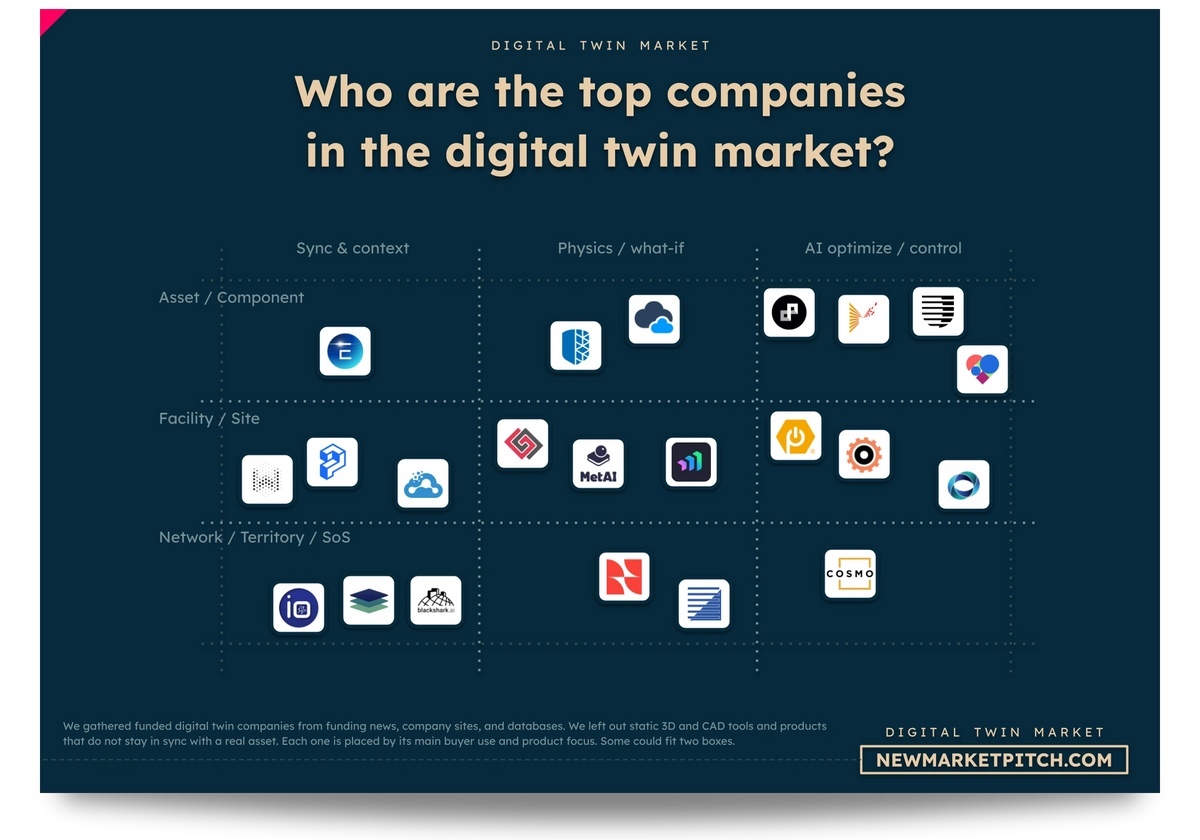
In our research about digital twins, we turn what is vague and complex into simple, useful visuals. Market maps like this one show you at a glance where every startup stands.
Does Lightspeed have a stronger digital twin portfolio than most venture funds?
Lightspeed Venture Partners has one of the more interesting digital twin-related portfolios among traditional venture firms, thanks to investments spanning construction intelligence and industrial robotics.
In September 2026, Lightspeed participated in Buildots' $130 million financing. Buildots uses construction-site imagery, computer vision, building models, and schedules to check whether physical construction work is progressing as planned.
The company reported working with more than 100 large-scale firms, including customers such as Intel, Digital Realty, JE Dunn, and HOCHTIEF.
Earlier, in January 2026, Lightspeed and Lingotto Innovation co-led RobCo's $100 million Series C. RobCo develops modular industrial robots that combine physical automation with AI-based perception and motion planning.
Together, those two rounds represent $230 million in total financing, although Lightspeed's individual contribution wasn't disclosed.
What's interesting is the relationship between the two investments. Buildots helps companies understand what's happening on construction sites, while RobCo develops software and machines that can act in industrial environments.
RobCo is primarily a robotics business, so we wouldn't classify its entire financing as pure digital twin funding. But Lightspeed's involvement in both companies gives it exposure to two connected areas of physical-world AI.
Among conventional venture firms, that makes Lightspeed a particularly relevant investor to watch.
Is NVIDIA the most influential digital twin investor right now?
NVIDIA may be the most influential technology company in digital twins today. Its position as a venture investor is harder to rank because its influence extends far beyond the money it invests.
Through NVentures, NVIDIA has backed companies including PassiveLogic and Sight Machine. PassiveLogic develops autonomous building control technology based on digital representations of physical systems, while Sight Machine uses industrial data and AI to improve manufacturing operations.
NVIDIA was also among the existing investors participating in PhysicsX's June 2026 financing.
These investments connect NVIDIA to three related applications: building automation, manufacturing intelligence, and engineering simulation.
Its wider technology business gives the company another advantage. NVIDIA Omniverse supports the development and connection of industrial digital twin applications, while its GPUs power many of the AI and simulation workloads behind them.
Other industrial corporations are becoming involved too.
PassiveLogic's $74 million Series C in September 2025 included strategic investors such as Johnson Controls and Prologis Ventures, alongside financial investors. PhysicsX attracted Siemens and Applied Materials. In October 2026, Flexcompute announced an undisclosed strategic investment from Samsung Ventures and Applied Ventures to support its computational physics technology.
These companies have direct commercial interests in the technologies they're financing. Building operators want better automation, manufacturers want faster simulations, and semiconductor companies need more efficient engineering tools.
NVIDIA currently has an unusually strong position because it participates both as an investor and as a supplier of the infrastructure used to build digital twins. Still, there isn't enough public information to claim NVentures has deployed the most equity capital in the sector.
If you want more recent data on this point, please see our latest digital twin market report.

In our market report about digital twins, we always try to gather several sources and make estimates that make sense, so you can work with solid numbers.
Why is Bentley Ventures such an important digital twin investor?
Bentley Ventures is one of the clearest specialist investors in digital twins because the technology sits directly within its stated investment strategy.
The venture operation describes a $100 million commitment over five years, with individual investments generally ranging from $250,000 to $5 million. It focuses on companies from seed stage through Series B.
Its target markets include utilities, transportation, digital cities, renewable energy, water infrastructure, factories, and construction.
That focus closely matches Bentley Systems' broader engineering and infrastructure software business. The company already operates in markets where digital models help customers design, build, and manage physical assets.
Bentley Ventures is different from a growth investor leading a $100 million financing. Its smaller checks target startups earlier in their development, when access to engineering expertise, infrastructure customers, and industry relationships can be particularly valuable.
We also shouldn't interpret its $100 million commitment as money already invested. It's a stated investment allocation, not a verified total of deployed capital.
For founders building digital twins for infrastructure, Bentley Ventures belongs near the top of the specialist investor shortlist. Its industry focus is much more specific than that of most generalist venture funds.
Who's winning the race to invest in construction digital twins?
O.G. Venture Partners currently has one of the strongest claims among growth investors in construction digital twins, thanks to its leadership of Buildots' $130 million financing in September 2026.
The round brought Buildots' total funding to $297 million and attracted Lightspeed, Intel Capital, Mohari Ventures, Human Capital, Qumra Capital, Viola Growth, Poalim Equity, and Avigdor Willenz.
Buildots also reported several consecutive years of approximately threefold annual revenue growth. The company didn't disclose its revenue base, so we can't calculate its current sales or profitability from that claim.
Its commercial adoption is easier to document. Buildots names major construction companies and infrastructure owners, including JE Dunn, HOCHTIEF, Intel, and Digital Realty, among its customers.
The technology tackles a specific problem: construction schedules often become disconnected from what's actually happening on site. Buildots combines site imagery with building models to detect discrepancies and help teams respond before delays become more expensive.
The company's financing history also reveals how investor roles change as a startup grows.
Earlier backers including TLV Partners and Future Energy Ventures supported Buildots before it reached its latest funding milestone. O.G. Venture Partners entered as lead investor at a much later stage, when Buildots already had substantial commercial traction.
O.G. Venture Partners deserves recognition for leading the major growth round. But early investors such as TLV Partners should also feature in any serious assessment of the funds that helped build the construction digital twin market.
If you want more recent data on this point, please see our latest digital twin market report.

Our document detailing everything you need to know about digital twin gets updated several times a month, so you always get the latest view of where things stand.
Is TCV becoming a major investor in infrastructure digital twins?
TCV has become a significant investor in infrastructure digital twins through Neara, although its documented sector position is still narrower than that of investors with several relevant portfolio companies.
In February 2026, Neara raised AUD 90 million in a Series D led by TCV. Existing investors Partners Group, EQT, Square Peg Capital, and Skip Capital also participated.
Neara builds physics-enabled digital models of infrastructure, particularly electricity networks. Its software helps operators understand the condition of their assets, assess risks, and plan maintenance or upgrades.
That makes Neara different from a company selling generic 3D visualization. Electricity networks have complex physical constraints, and operators need to make decisions about reliability, network capacity, and expensive infrastructure investments.
The investor group is also worth examining. TCV brought growth-stage capital, while returning investors included firms with experience in infrastructure, private equity, and technology businesses.
Neara's funding shows that infrastructure digital twins can attract investors with interests extending well beyond conventional software markets.
TCV is now an important name in this part of the sector. For earlier exposure to Neara, however, EQT, Square Peg Capital, Skip Capital, and Partners Group deserve recognition too.
Which digital twin investors keep backing the same startups?
HTGF, Alven, Forestay Capital, Temasek, and several Neara and Buildots backers stand out for investing in digital twin-related companies across more than one funding stage.
Neural Concept gives us one of the clearest examples. In December 2025, HTGF said it had supported the Swiss engineering AI company since its seed round and participated in every financing through its $100 million Series C.
Alven and Forestay Capital also backed Neural Concept's $27 million Series B in June 2024 and participated in the $100 million Series C led by Goldman Sachs Alternatives in December 2025.
Temasek followed a similar pattern with PhysicsX, investing in 2025 before leading its $300 million financing in 2026.
Buildots identified TLV Partners, Future Energy Ventures, Maor Investments, and Tidhar among its longstanding investors when announcing its September 2026 round. Neara's Series D also included several returning shareholders.
These repeated investments offer a useful way to distinguish investors making a one-off bet from those maintaining exposure as a company's technology and customer base develop.
They don't prove that investors have made money. But they tell us who stayed involved as these businesses moved from early development toward larger commercial operations.
| Investor | Company | Evidence of continued backing |
|---|---|---|
| HTGF | Neural Concept | Seed investor; participated through Series C |
| Alven | Neural Concept | Participated in 2024 Series B and 2025 Series C |
| Forestay Capital | Neural Concept | Participated in 2024 Series B and 2025 Series C |
| Temasek | PhysicsX | Invested in 2025; led 2026 Series C |
| Brookfield | PassiveLogic | Earlier investment and later financing involvement |
| NVentures | PassiveLogic | Earlier backing and continued shareholder involvement |
| TLV Partners | Buildots | Early investor and longstanding backer |
| Future Energy Ventures | Buildots | Longstanding investor |
| EQT | Neara | Returning investor in 2026 Series D |
| Square Peg Capital | Neara | Returning investor in 2026 Series D |
| Skip Capital | Neara | Returning investor in 2026 Series D |

In our report covering the digital twin market, we look at what the winners do differently, so you can learn from the best instead of guessing.
Are investors putting more money into AI simulation than traditional digital twins?
AI simulation is attracting some of the largest financings in the broader digital twin market, with PhysicsX and Neural Concept standing out as two major examples.
PhysicsX raised $300 million in June 2026, while Neural Concept secured $100 million in December 2025. Those two rounds alone account for $400 million in announced financing.
Neural Concept reported a fourfold increase in enterprise revenue over the preceding 18 months and more than 50 enterprise customers when announcing its funding.
Its customers included General Motors, GE Vernova, Safran, Renault, and Leonardo. The company develops AI-powered engineering tools that help manufacturers evaluate designs and speed up simulation workflows.
PhysicsX pursues a related opportunity, using AI models to accelerate engineering simulation in industries such as aerospace, automotive manufacturing, energy, and semiconductors.
Both businesses are trying to reduce the time and computing resources needed to explore complex designs.
The comparison with construction digital twins is interesting. Buildots' $130 million round finances software that monitors physical construction progress, while PhysicsX and Neural Concept focus on engineering decisions before or during product development.
The funding figures suggest that investors see substantial value in faster engineering simulation. We should still keep the categories separate: an AI simulation system isn't automatically a digital twin of a specific operating asset.
For investors targeting the wider convergence of simulation, physics AI, and digital twins, Temasek and Goldman Sachs Alternatives currently stand out.
If you want more recent data on this point, please see our latest digital twin market report.
Are healthcare digital twins attracting different investors?
Healthcare digital twins have attracted major investors such as Maj Invest, Altimeter Capital, and Radical Ventures, but the companies they back operate in very different markets from industrial digital twin startups.
Twin Health announced a $53 million investment led by Denmark's Maj Invest in August 2025. The company uses AI-driven digital models to personalize care for people with metabolic health conditions.
Its commercial model involves employers and health plans, with value tied to health outcomes and healthcare costs.
Unlearn takes another approach. The company develops digital twins of patients to support clinical research and announced a $50 million Series C led by Altimeter Capital in February 2024, with participation from investors including Radical Ventures.
Both companies use digital models connected to human biology, but their customers and business models differ considerably.
Twin Health operates in patient care, while Unlearn works with clinical research and pharmaceutical development. Investors therefore have to examine treatment outcomes, medical evidence, healthcare economics, and regulatory requirements.
Those are different questions from evaluating construction productivity or electricity-grid reliability.
Maj Invest, Altimeter Capital, and Radical Ventures belong in a broad digital twin investor landscape. But for an investor specifically interested in industrial digital twins, Temasek, Bentley Ventures, and the funds backing Neara or Buildots offer more directly relevant exposure.

In our research about digital twins, we don't want to repeat what boring consulting reports say. Instead, we show you the real and latest market signals that matter.
Are digital twin investors actually making money?
We have strong evidence that digital twin startups can attract large investments and strategic acquisitions, but very little public information about the returns individual venture funds have earned.
Matterport offers one of the most concrete exit examples.
CoStar Group completed its acquisition of Matterport on February 28, 2025, after announcing the agreement in April 2024. The original deal announcement described an estimated enterprise value of approximately $1.6 billion, while CoStar later reported approximately $1.9 billion in total purchase consideration under its transaction accounting.
Matterport developed technology for creating digital representations of physical spaces, with applications in real estate, property management, and related markets.
The acquisition shows that a large established company was willing to pay a substantial amount for digital twin technology and its commercial applications.
But the purchase price doesn't tell us how much every Matterport investor earned. Their returns depend on when they invested, how much they paid, dilution, and the terms of the exit.
The same problem applies to private valuations.
PhysicsX's approximately $2.4 billion valuation in June 2026 and Buildots' substantial financing history indicate investor confidence. They don't establish whether earlier shareholders have realized profits.
Neural Concept offers clearer evidence of operating growth, reporting a fourfold increase in enterprise revenue and more than 50 enterprise customers. Yet its investors' financial returns remain undisclosed.
For now, we can identify successful fundraising and significant acquisition activity. A ranking of the most profitable digital twin venture investors would require information that these funds generally don't publish.
Is digital twin funding still growing today?
Digital twin funding is increasingly concentrated in a smaller number of companies, even when the total amount invested appears to be growing.
New Market Pitch's September 2026 analysis reported $497.2 million in tracked equity funding through September 21, up 18.2% from the comparable previous-year period.
However, the number of funded companies fell 37.9%, to 18.
That combination reveals a much bigger change than the headline funding increase suggests.
Using the reported figures, we calculate average funding per tracked company at approximately $27.6 million, compared with roughly $14.5 million in the previous period. That's an increase of about 91%.
The research also found that Buildots, NavVis, and Neara accounted for 55.9% of the tracked capital. Excluding rounds above $50 million reduced the total to $219.2 million, slightly below the comparable earlier period.
Large financings are doing much of the work behind the market's apparent growth.
That fits what we're seeing in individual deals. Buildots attracted a major growth round after demonstrating commercial adoption. Neara secured financing from established infrastructure and technology investors. NavVis raised substantial capital for spatial data and physical AI.
The figures come from a tracked dataset, and the result would change if we included every adjacent engineering AI, robotics, or healthcare company. Still, the concentration is clear within that dataset.
For early-stage founders, the larger funding totals shouldn't be interpreted as proof that raising capital has become easier. Investors appear increasingly willing to write large checks for selected companies while funding fewer businesses overall.
If you want more recent data on this point, please see our latest digital twin market report.

Learning from others' mistakes is the cheapest lesson there is. In our market report about digital twins, we look at what broke startups before you, so you don't repeat it.
So who are the top investors in digital twins?
Temasek, Lightspeed Venture Partners, NVentures, Bentley Ventures, Goldman Sachs Alternatives, TCV, and O.G. Venture Partners are currently among the most important investors in digital twins and closely related industrial AI technologies.
Temasek has one of the strongest claims in large-scale industrial simulation financing through PhysicsX's $300 million Series C. Lightspeed stands out among conventional venture funds through its exposure to Buildots and RobCo.
NVIDIA has a particularly influential position because its involvement extends from startup investments to the computing and simulation infrastructure used across the industry. Bentley Ventures is one of the clearest specialists, with a dedicated $100 million investment commitment focused on infrastructure and digital twins.
Goldman Sachs Alternatives, TCV, and O.G. Venture Partners have demonstrated substantial growth-stage interest through Neural Concept, Neara, and Buildots.
For investors that backed companies earlier and maintained their involvement, HTGF, Alven, Forestay Capital, and several longstanding Buildots and Neara shareholders deserve recognition.
The most revealing change is where the capital is going. Investors are putting large amounts into digital twin-related businesses that help manufacturers simulate products, construction companies monitor progress, and infrastructure operators make better decisions.
Our ranking therefore favors investors with substantial documented commitments, relevant portfolios, and continued involvement in commercially useful technologies.
Temasek currently stands out for the scale of its PhysicsX financing, while NVIDIA has an unusually strong strategic position across the broader industry. But there is no defensible single winner by total equity invested or realized returns because those figures aren't publicly available across all investors.
Our methodology
This analysis identifies the leading investors in digital twins by comparing recent financing activity, investor participation, lead-investor roles, repeat investments, relevant portfolio companies, and dedicated investment strategies. It covers industrial simulation, construction intelligence, infrastructure modelling, building automation, and selected healthcare applications.
We distinguish companies developing digital twin technologies directly from businesses operating in related areas such as engineering AI, robotics, and physical AI. These adjacent investments provide useful context, but we don't automatically classify their entire funding histories as digital twin investment.
Announced funding rounds are treated as evidence of investor-backed activity, not as amounts invested by individual funds. The $300 million PhysicsX round, for example, establishes the size of the financing led by Temasek, but not Temasek's precise contribution. Similarly, Bentley Ventures' $100 million investment commitment represents an allocation rather than confirmed deployed capital.
We gave particular weight to investors that led major rounds, participated across several financing stages, backed multiple relevant companies, or maintained a specific focus on digital twin technologies. Commercial adoption, revenue growth disclosures, acquisition activity, and market funding concentration provided additional context. Investor returns and undisclosed individual contributions were not estimated.
The analysis draws primarily on company and investor announcements, complemented by acquisition filings, industry documentation, and market funding research. Major financing sources include PhysicsX's $300 million Series C announcement, Buildots' $130 million financing announcement, Neara's AUD 90 million Series D announcement, NavVis' $85 million Series D announcement, and Neural Concept's $100 million financing announcement.
For investor participation and continued backing, we also used Neural Concept's earlier Series B announcement, HTGF's investment disclosure, Bentley Ventures' official investment strategy, RobCo's $100 million Series C announcement, and PassiveLogic's $74 million Series C announcement.
For strategic involvement and digital twin infrastructure, we considered NVIDIA's Omniverse documentation and NVIDIA's industrial digital twin ecosystem announcement. Healthcare comparisons used Twin Health's financing announcement and Bloomberg Law's reporting on Unlearn.
For exits and wider funding trends, we used CoStar Group's original Matterport acquisition announcement, CoStar Group's subsequent acquisition filing, and New Market Pitch's September 2026 digital twin funding analysis. The market-wide figures are interpreted within the coverage of that tracked dataset rather than as a complete census of all digital twin-related investment.

If you build or invest in the digital twin market, you need to know which business models pay off now and which ones are fading. That's why our report covering it has a whole section on it.
Written by the New Market Pitch teamWe track new markets so founders and investors can move faster. About us