
AI tutors: which startup is ahead?
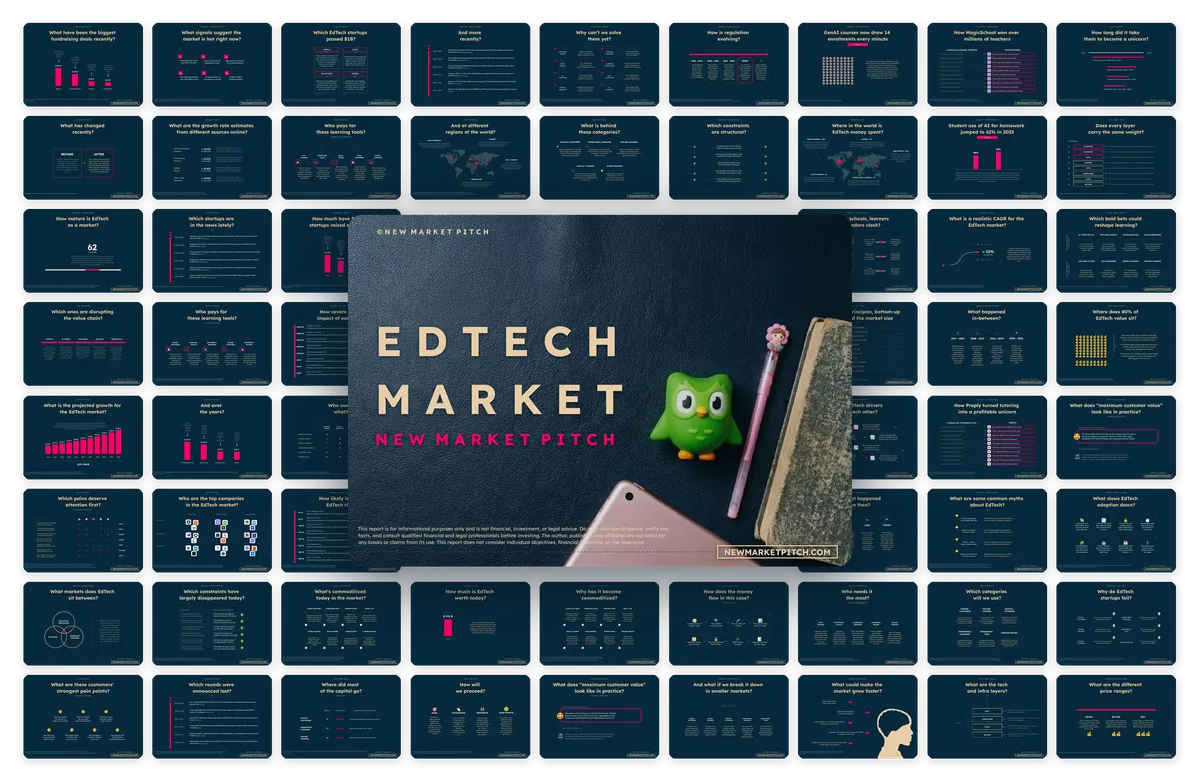
Whether you're building or investing in the edtech market, our report covers everything you need to know: the players, the money, and what's coming next.
Summary
Speak is the AI tutoring startup ahead today, with more than $100 million in annualized revenue and a proven market for paid AI language lessons. StudyFetch and Gizmo are serious challengers in academic tutoring, but neither has disclosed comparable commercial results.
Language learning has produced stronger publicly documented AI tutoring businesses than general academic study. Speak's revenue, Loora's recurring revenue in the tens of millions, and Praktika's retention improvements suggest that regular speaking practice is particularly well suited to subscription products.
Speak's advantage goes beyond its approximately 15 million downloads. Around 500 corporate customers were also offering its subscriptions to employees, giving the company access to employer-funded education alongside consumer subscriptions.
Loora is the clearest direct challenger. Its revenue more than doubled over the year preceding September 2026, and its 15 million reported learners and 200 million interactions show substantial demand for conversational English practice.
In academic tutoring, StudyFetch and Gizmo are competing for different parts of students' routines. StudyFetch has more than 8 million reported users and a broad AI study environment, while Gizmo has reached 13 million users by focusing on flashcards, active recall, and gamified revision.
Raw user counts can be misleading. QANDA's 100 million registered users, ELSA Speak's 50 million historical downloads, and Khanmigo's 2 million reported users cannot be compared directly. Active learners, repeat sessions, and paying subscribers would provide a much clearer ranking.
Khanmigo has a distribution advantage that independent startups cannot easily replicate. Around 770,000 students accessed it through U.S. school partnerships, but a two-year experiment found that students used the tutor in only 17% of exercise sessions where they made mistakes.
The biggest unresolved question is whether AI tutoring actually improves learning. Controlled studies have produced sharply different outcomes, from substantial gains in a Harvard physics experiment to lower final grades in a 2,379-student university trial.
More conversation does not automatically mean better education. A randomized MBA study found that voice interactions nearly doubled engagement compared with text, but learning outcomes were statistically equivalent and voice delivery cost around 2.8 times as much.
AI may be especially valuable when it helps human tutors teach better. The Tutor CoPilot experiment found a four-percentage-point improvement in mathematics mastery, rising to nine points among students working with lower-rated tutors.
General-purpose AI assistants create a growing threat to startups selling basic explanations and generated study materials. Products built around structured lessons, measurable progress, personalized practice, and recurring habits have a stronger reason to exist independently.
Speak currently wins on commercial evidence, but the educational leadership contest remains open. The eventual winner will need to demonstrate sustained learning gains, strong student retention, and a business that remains attractive even as general-purpose AI becomes more capable.

Written by the New Market Pitch teamWe track new markets so founders and investors can move faster. About us
Which AI tutor startup is actually ahead today?
Speak is currently the strongest commercial leader among AI tutoring startups, while StudyFetch is one of the most serious challengers in general academic tutoring.
The difference comes down to what each company has actually achieved. Speak, which specializes in conversational language learning, exceeded $100 million in annualized revenue in 2025, according to Forbes. Its roughly 15 million downloads were accompanied by paying subscribers and around 500 corporate customers, including KPMG and HD Hyundai.
StudyFetch has built a broader academic product. Its AI tutor, Sparky, helps students understand course materials, generate exercises, and prepare for exams. The company now reports more than 8 million users, although it has not disclosed revenue on a scale directly comparable with Speak.
Other companies lead in particular areas. Gizmo reported 13 million users in April 2026, QANDA has accumulated more than 100 million registered users through mathematics assistance, and Khanmigo benefits from Khan Academy's large education platform.
Speak gets the overall lead because its commercial success is better documented. That judgment applies to the business of AI tutoring. There is still no convincing evidence that Speak, StudyFetch, or any other startup delivers the best learning outcomes across every subject.
If you want more recent data on this point, please see our latest EdTech market report.
Why are AI tutoring startups growing so quickly?
AI tutoring startups are growing because conversational AI can now deliver personalized explanations, exercises, and speaking practice at a price that makes individual tutoring accessible to far more students.
We can see the shift in the growth of newer companies. StudyFetch reported more than 7 million users in May 2026 and now advertises over 8 million. Gizmo increased its cumulative audience from approximately 300,000 users in 2023 to 13 million by April 2026. Loora, an AI English tutor, reached approximately 15 million learners and 200 million interactions by September 2026.
These companies address different learning problems, but they share one advantage over traditional tutoring services: students can practice immediately, without arranging lessons or paying an instructor for every session.
The economics are particularly attractive in language learning. Human conversation tutors commonly charge by the hour, while Speak offers annual subscriptions priced at approximately $80-$200. Frequent practice becomes much more affordable.
But demand for convenient AI assistance doesn't necessarily mean students are learning more. That is harder to establish, and recent university research has produced some surprisingly negative results.

In our report covering the edtech market, we turn what is vague and complex into simple, useful visuals. Market maps like this one show you at a glance where every startup stands.
Which AI tutoring companies have the most users?
QANDA has the largest reported historical user base among the AI-assisted learning products examined, although Gizmo, StudyFetch, Speak, and Loora have also reached multimillion-user audiences.
Mathpresso's QANDA reports more than 100 million registered users, approximately 5 million monthly active users, and around 3 million questions processed daily. Its mathematics-solving product became popular in Asian markets before the recent wave of generative AI tutors.
ELSA Speak reported over 50 million downloads by 2023, while Speak and Loora have each reached approximately 15 million downloads or learners. Gizmo's 13 million reported users put it ahead of StudyFetch's 8 million-plus cumulative audience.
The problem with ranking these figures is that companies use different definitions. Downloads, registrations, monthly active students, and paying customers measure different kinds of success. QANDA's 5 million monthly active users, for example, provide more information about ongoing usage than a cumulative download total.
Several companies have clearly reached substantial scale. A reliable ranking of their active learner bases, though, remains unavailable.
| Company | Main specialty | Reported audience | What the figure measures |
|---|---|---|---|
| QANDA | Mathematics assistance | 100M+ registered users | Cumulative registrations |
| ELSA Speak | English pronunciation | 50M+ downloads by 2023 | Cumulative downloads |
| Speak | Language conversation | Approximately 15M downloads | Cumulative downloads |
| Loora | Conversational English | Approximately 15M learners | Company-reported users |
| Gizmo | Flashcards and active recall | 13M+ users | Cumulative users |
| StudyFetch | General academic tutoring | 8M+ users | Cumulative users |
| Khanmigo | School tutoring and teacher assistance | 2M users in 2024-25 | Includes teachers and parents |
| YoLearn.ai | Exam preparation in India | 200K+ users by June 2026 | Early-stage cumulative adoption |
How did Speak become the biggest commercial AI tutor?
Speak built its commercial lead by concentrating on spoken-language practice, expanding internationally, and finding customers willing to pay for regular conversations with an AI tutor.
Founded in 2016, Speak initially found substantial demand in South Korea, where it launched in 2019. By June 2024, the company reported more than 10 million learners across over 40 countries. It also raised $20 million at a $500 million valuation that month.
Six months later, Speak raised another $78 million, doubling its valuation to $1 billion. The stronger evidence came in 2025, when Forbes reported that the company had surpassed $100 million in annualized revenue.
Speak was already established before ChatGPT made generative AI tutoring fashionable. Its business developed through several generations of speech technology, language models, and international expansion.
Speak has also moved into corporate training. Approximately 500 companies were offering its subscriptions to employees by the time Forbes reported the revenue milestone. That gives Speak access to individual consumers and employer-funded language education.
We still lack audited profitability and paid-subscriber retention figures. Nevertheless, Speak has demonstrated that AI tutoring can support a business generating revenue at a nine-figure annualized rate.

Our research about education technology gets updated several times a month, so you always get the latest view of where things stand.
Is StudyFetch becoming the most popular AI tutor for students?
StudyFetch is becoming one of the leading general-study AI platforms, but its reported user growth has not yet established that it is the most frequently used academic tutor.
Founded in 2023 by Esan Durrani and Ryan Trattner, StudyFetch built Sparky around students' existing course materials. Users can upload textbooks, slides, lecture recordings, and notes, then turn them into explanations, practice questions, flashcards, and study schedules.
StudyFetch reported more than 7 million users in a May 2026 research announcement and now lists more than 8 million users on its website. The company has therefore added at least another million reported users since that earlier disclosure, although the figures do not reveal how many remain active.
Its research into student behavior is particularly revealing. In May 2026, StudyFetch analyzed 4.9 million messages from 144,544 students over 50 days. The company classified 92.9% of interactions as showing responsible learning intent, but fewer than 1% of students consistently produced high-quality prompts under its scoring system.
That exposes a weakness in AI studying that StudyFetch could exploit. Many students have access to powerful AI tools but struggle to ask questions that produce useful learning experiences.
StudyFetch's opportunity is to guide students through a course rather than expecting them to know how to prompt an AI tutor. Its long-term position will depend on whether those guided experiences improve learning and bring students back throughout the academic year.
Is Gizmo catching up with StudyFetch?
Gizmo has already overtaken StudyFetch in publicly reported cumulative users, although StudyFetch offers a broader academic tutoring product.
TechCrunch reported in April 2026 that Gizmo had reached more than 13 million users across 120 countries, compared with approximately 300,000 when the publication covered the company in 2023. That represents more than 43 times its earlier cumulative audience.
The company also raised $22 million in Series A funding, following an earlier $3.5 million seed round. Before the financing, Gizmo reportedly employed only seven people, making its distribution unusually efficient in terms of users reached per employee.
Gizmo focuses on helping students remember information through quizzes, flashcards, active recall, and spaced repetition. Features such as streaks, leaderboards, and challenges encourage repeated practice.
StudyFetch covers more of the study process, including explanations, course planning, and conversational tutoring. Both products can generate revision materials, but Gizmo places greater emphasis on repeated retrieval, while StudyFetch is trying to become a complete study environment.
Gizmo leads on reported cumulative audience growth, while StudyFetch has the broader academic tutoring proposition. Neither has released enough comparable active-user, retention, or revenue information to settle which business is stronger.

In our market report about education technology, we look at what the winners do differently, so you can learn from the best instead of guessing.
Is QANDA still ahead in AI mathematics tutoring?
QANDA remains one of the largest established AI-assisted mathematics platforms, particularly in Asia, but its massive registered-user base does not prove that it offers the strongest conversational mathematics tutor.
Mathpresso developed QANDA around a simple activity: students photograph a mathematics question and receive a solution or explanation. That product reached substantial scale before generative AI systems became widely available.
The company's reported 5 million monthly active users and approximately 3 million daily questions imply roughly 90 million questions processed in a 30-day month, assuming activity remains close to its reported daily average.
Compared with a newer platform such as StudyFetch, QANDA has far more historical experience with students seeking mathematical help. Its question data and established user relationships could support more advanced AI tutoring.
But the distinction between obtaining an answer and learning mathematics is especially important here. A student can rely heavily on a problem-solving application without developing the ability to solve similar problems independently.
QANDA leads many newer competitors in reported audience scale. Whether it is actually better at teaching mathematics is another question, and one that needs stronger independent evidence.
Could Khanmigo beat AI tutoring startups in schools?
Khanmigo has the strongest established school-distribution position among the AI tutors examined, although its educational results have been more modest than the excitement surrounding the product might suggest.
Khan Academy's 2024-25 annual report recorded 104.9 million yearly active learners across its main platform and 2 million people using Khanmigo, including students, educators, and parents. Khanmigo registrations grew 731% year over year.
Approximately 770,000 students accessed Khanmigo through U.S. school district partnerships. That gives Khan Academy an advantage that independent startups must work hard to reproduce: relationships with schools, curriculum-aligned exercises, and systems for tracking academic progress.
An August 2026 National Bureau of Economic Research study examined Khanmigo in 18 Tennessee middle schools across two years. Researchers found improvements of approximately 1.3 national percentile ranks per term, equivalent to 0.06-0.08 standard deviations over a school year.
The gains were encouraging but resembled those achieved through ordinary Khan Academy practice without the AI tutor. Researchers also found that students rarely used Khanmigo for substantial mathematical discussions.
Khanmigo is already positioned inside the educational institutions where AI tutoring could become routine. The remaining challenge is demonstrating that its AI adds enough value beyond existing learning software.
If you want more recent data on this point, please see our latest EdTech market report.

In our document detailing everything you need to know about edtech, you will always find fresh funding data, taken straight from our own verified funding database.
Are AI tutors actually helping students get better grades?
AI tutors can produce meaningful learning gains, but recent controlled experiments show that poorly integrated AI assistance can also make students perform worse.
A randomized study published in Scientific Reports in June 2025 compared an AI tutor with active classroom learning in a Harvard undergraduate physics course. The experiment involved 194 students and found that students using the carefully designed AI tutor learned significantly more in less time.
A much larger trial produced the opposite result. In an October 2026 working paper, researchers studying 2,379 undergraduate students and 30 instructors at a U.S. public university found that access to a course-integrated AI tutor reduced final grades by 0.37 standard deviations.
According to the University of Maryland researchers, that corresponded to roughly four percentage points lower final grades in comparable course sections. Participation in existing online learning activities also declined sharply, by 0.90 standard deviations.
These studies tested different products, subjects, and teaching arrangements, so they cannot be used to rank commercial startups directly. They do show how dramatically the design and use of an AI tutor can change its educational impact.
For now, claims that active users earn better grades deserve skepticism unless the companies have controlled for differences in motivation, ability, and study habits.
Why do students barely use Khanmigo when they get stuck?
Khanmigo's school experiment found that students often ignored the AI tutor at precisely the moments when additional mathematical guidance could have been useful.
The NBER study led by Philip Oreopoulos and Nina Low followed a two-year deployment in Tennessee middle schools. Although 96% of participating students tried Khanmigo at least once, the median student messaged it on only around one-third of the days they practiced.
The more revealing figure concerned mistakes. Students used the tutor in only 17% of exercise sessions where they answered incorrectly. Many interactions consisted of short answers or clicks on suggested prompts rather than detailed mathematical discussions.
This helps explain why providing access to an AI tutor produced limited additional benefits. Students could continue using ordinary practice exercises without engaging in the explanations and guided reasoning that the AI was designed to provide.
It also challenges the way AI tutoring startups present adoption. Thousands of users opening an AI tutor once are less meaningful than a smaller group consistently asking questions, correcting misunderstandings, and completing practice.
Khanmigo's results suggest that getting students to use the tutor properly may be harder than making the technology available.

Learning from others' mistakes is the cheapest lesson there is. In our report covering the edtech market, we look at what broke startups before you, so you don't repeat it.
Are AI language tutors building stronger businesses than academic AI tutors?
AI language tutoring currently has stronger publicly disclosed subscription revenue than most independent academic tutoring startups, particularly among companies focused on conversational practice.
Speak has already reported more than $100 million in annualized revenue. Loora, which teaches conversational English, announced a $22 million Series B in September 2026 and disclosed annual recurring revenue in the tens of millions of dollars.
Loora also said revenue had more than doubled over the preceding 12 months. Its 15 million learners had completed approximately 200 million interactions, equivalent to about 13 interactions per reported learner on a cumulative basis. That average does not establish retention, but it gives more context than the headline user count alone.
Praktika provides another example. In a January 2026 OpenAI case study, the language-learning company reported a 24% improvement in first-day retention after changing its AI tutoring architecture. It also said revenue doubled over several months.
These businesses have concentrated on a skill that requires regular repetition. Students practicing English conversation have a reason to return frequently, while general academic study can be concentrated around exams and assignments.
Academic tutoring could ultimately support a much broader range of subjects, but the stronger commercial evidence currently comes from specialized language-learning products.
If you want more recent data on this point, please see our latest EdTech market report.
Can Loora or Praktika overtake Speak?
Loora is becoming a serious commercial challenger to Speak, while Praktika has shown that improving the tutoring experience can produce measurable gains in retention.
Loora's September 2026 financing announcement put four useful figures on the table: 15 million learners, 200 million interactions, annual recurring revenue in the tens of millions, and revenue growth exceeding 100% over the previous year.
The company also reported more than 100 corporate, government, and university customers for its business product, which had been developed during the preceding year. Speak has a larger disclosed corporate customer base, but Loora is following a similar path toward employer-funded language training.
Their teaching approaches differ. Speak combines structured lessons with conversational exercises. Loora emphasizes open-ended conversations based on learners' interests and professional needs. Praktika uses personalized AI tutor characters that remember previous interactions.
Speak has the largest disclosed revenue base, while Loora's recent growth demonstrates that competing products can attract substantial paying demand.
| Company | Tutoring approach | Latest useful commercial evidence |
|---|---|---|
| Speak | Structured language lessons and conversation | $100M+ annualized revenue |
| Loora | Personalized English conversation | ARR in tens of millions; revenue more than doubled |
| Praktika | Conversational AI tutor characters | Revenue reportedly doubled over several months |
| ELSA Speak | Pronunciation and English communication | 50M+ historical downloads |
| Pingo AI | AI language conversation | Approximately $12M ARR reported in 2026 hiring materials |
| Alice.tech | Personalized exam preparation | $20K monthly recurring revenue reported on Y Combinator |
| YoLearn.ai | Voice-first exam tutoring | 200K+ reported users by June 2026 |

In our research about education technology, we always try to gather several sources and make estimates that make sense, so you can work with solid numbers.
Does speaking to an AI tutor help students learn faster?
Voice makes AI tutoring more interactive, but there is currently little evidence that speaking to an AI produces better academic results than typing when the teaching content is equivalent.
A September 2026 randomized experiment involving 86 online MBA students compared voice and text interactions with a structured AI tutor. Researchers Shihao Yang, Marshall Van Alstyne, and Chrysanthos Dellarocas found that voice nearly doubled conversational interaction.
However, learning outcomes were statistically equivalent, while voice cost approximately 2.8 times as much to deliver.
The study also found that students using the structured tutor gained 6.63 points more than ability-matched peers in the comparison group, which had access to ordinary consumer AI. The educational advantage came from the tutoring system rather than from voice alone.
For language companies such as Speak, Loora, and Praktika, conversation is central to the skill being taught. Speaking repeatedly is part of learning to speak a foreign language.
For mathematics, science, or written examinations, the case is less obvious. Voice can make tutoring more accessible and engaging, but an AI product still needs effective explanations, exercises, and feedback.
Can StudyFetch and Gizmo compete with ChatGPT?
StudyFetch and Gizmo can compete with ChatGPT by organizing learning around students' courses and practice habits, although generic AI chat features will become increasingly difficult to charge for.
ChatGPT and other general-purpose assistants already explain concepts, analyze documents, generate questions, and conduct spoken conversations. Many features that made early AI study assistants impressive are now available inside much larger AI platforms.
StudyFetch's response is to build a complete learning environment around students' own materials. Gizmo takes a different approach by making active recall, spaced repetition, and gamified revision central to the experience.
Khanmigo has another advantage through curriculum-aligned exercises and teachers who can follow student progress. Speak integrates language instruction into a sequence of lessons and repeated conversational practice.
Educational research gives some support to these approaches. The September 2026 MBA experiment found substantially better results with a structured tutor than with access to ordinary consumer AI.
The risk for independent startups is greatest when their product consists mainly of a chatbot connected to uploaded documents. Companies that build recurring study habits, reliable assessments, and personalized learning histories have more ways to keep students using their products.

If you build or invest in the edtech market, you need to know which business models pay off now and which ones are fading. That's why our report covering it has a whole section on it.
Will AI tutors replace human tutors?
AI tutors are already capable of handling many explanations and practice exercises, but the strongest evidence suggests that AI can also make human tutoring more effective.
A randomized experiment involving approximately 900 tutors and 1,800 K-12 students tested Tutor CoPilot, a system that provided real-time instructional suggestions to human tutors.
The researchers found that students whose tutors had AI assistance were four percentage points more likely to demonstrate mastery of mathematics topics. Among students working with lower-rated tutors, the improvement reached nine percentage points.
The system encouraged tutors to ask guiding questions and use better teaching strategies. Researchers estimated a cost of around $20 per tutor annually under the study's usage conditions.
Compare that with the weaker findings from the Khanmigo school experiment and the negative university trial. All involved AI in education, yet their outcomes differed substantially depending on how the technology was introduced.
AI tutoring startups could eventually replace some routine human tutoring sessions, especially for language conversation, revision, and basic explanations. In schools, the more reliable near-term opportunity may be combining AI guidance with human supervision.
What would prove that an AI tutoring startup is really the best?
The best AI tutoring startup would need to demonstrate that students learn more, keep using the product, and generate enough revenue to support the service over time.
The available evidence still falls short of that standard. Speak has disclosed meaningful revenue, but independent learning-outcome data are limited. StudyFetch and Gizmo have substantial reported audiences, yet comparable paid-retention figures and controlled academic studies are unavailable.
Khanmigo has undergone a large randomized school experiment, although the results did not establish a major additional benefit from generative AI. University research has also shown that some AI tutoring systems can lower grades when they interfere with existing study habits.
We would give the greatest weight to controlled learning gains that persist after tutoring ends. Monthly active learners, repeat sessions, paid subscriptions, and delivery costs would then tell us whether the product can work as a sustainable business.
A company with ten million registrations and weak learning results would be less impressive educationally than a smaller tutor that reliably improves test scores. Commercial investors might reach a different conclusion, particularly if the larger company generates much more revenue.
So the current winner depends on whether we are judging the tutoring business or the quality of teaching.

Theory only gets you so far. In our document detailing everything you need to know about edtech, we dig up the real signals from the field and show you the ones worth watching.
Which AI tutoring startup is most likely to stay ahead?
Speak is currently best positioned to defend its commercial lead, although StudyFetch, Gizmo, and Khanmigo could become more important in general academic education.
Speak has already demonstrated a large paying market for AI conversation practice. Its revenue base, international expansion, and corporate customers give it more evidence of a functioning business than the newer academic tutoring startups have publicly disclosed.
Loora presents the clearest direct commercial challenge. Its revenue more than doubled over the latest reported 12-month period, and its expansion into corporate language learning places it in competition with Speak beyond individual subscriptions.
General academic tutoring remains less settled. StudyFetch has built a broad study environment, Gizmo has reached a large audience through gamified practice, and Khanmigo has access to established school relationships. Each company has an advantage that could become more valuable as AI tutoring spreads.
A major uncertainty is whether students will keep paying for dedicated study tools as general-purpose AI becomes more capable. That will depend partly on whether specialized companies can demonstrate better results and make their products useful throughout the academic year.
For now, Speak has the clearest financial foundation. We would reassess that position if another company disclosed comparable recurring revenue alongside stronger retention or independently measured learning gains.
If you want more recent data on this point, please see our latest EdTech market report.
AI tutors: which startup is ahead?
Speak is currently ahead in the commercial AI tutoring race, but the broader competition to become the leading academic AI tutor remains open.
Its $100 million-plus annualized revenue, international learner base, and hundreds of corporate customers provide the strongest publicly reported evidence of a large AI-native tutoring business. The company has gone further than most younger competitors in turning AI-assisted practice into a recurring paid service.
StudyFetch is among the strongest independent challengers for general academic study, while Gizmo has reported a larger cumulative student audience. QANDA remains an important incumbent in mathematics, and Khanmigo has a powerful position in schools through Khan Academy.
The educational evidence is much less decisive than the commercial data. Recent controlled studies have found both strong learning gains and worse academic outcomes, depending on the design and use of the tutor. No company examined here has published sufficiently comparable results to claim overall superiority in teaching.
Speak therefore leads commercially today, with an important qualification: it has proved that large numbers of learners will pay for AI-guided language practice. The startup that eventually leads AI tutoring across schools and universities will have to prove something harder: that its students consistently learn more than they would with the alternatives.

In our report covering the edtech market, we don't want to repeat what boring consulting reports say. Instead, we show you the real and latest market signals that matter.
Sources and methodology
This analysis examines which AI tutoring startup is ahead based on the evidence available through October 2026. We compare commercial performance, reported user adoption, educational effectiveness, product differentiation, and competitive positioning across Speak, StudyFetch, Gizmo, QANDA, Khanmigo, Loora, Praktika, and other AI-assisted learning companies.
We assess commercial leadership primarily through disclosed revenue, paying customers, corporate adoption, and evidence of repeat usage. Audience figures are treated according to their original definitions: registered users, downloads, cumulative learners, monthly active users, and paid subscribers are not interchangeable. When companies provide different metrics, we do not present them as directly comparable rankings.
Educational effectiveness is assessed separately from commercial success. We examine randomized experiments and published academic research, including studies of Khanmigo, AI-assisted university teaching, structured AI tutors, voice-based tutoring, and human tutors using AI assistance. We distinguish controlled learning outcomes from company-reported engagement metrics and avoid attributing the results of one tutoring system to competing products.
Our conclusions combine company disclosures, independent technology and business reporting, and empirical research. We give greater weight to disclosed recurring revenue when assessing commercial leadership, active usage rather than cumulative registrations when assessing adoption, and controlled learning gains when assessing educational quality. Where comparable financial, retention, or educational evidence is unavailable, our rankings remain limited to what the disclosed figures actually support.
Key commercial and adoption sources include Forbes on Speak's revenue and corporate customers, Speak's Series C announcement, Speak's earlier financing and international expansion, StudyFetch's official platform, StudyFetch's research into student AI usage, TechCrunch on Gizmo's audience and financing, QANDA's platform disclosures, ELSA Speak's company history, and Khan Academy's annual report.
Additional company and product sources include Loora's September 2026 financing and growth announcement, OpenAI's Praktika case study, and Y Combinator's Alice.tech company profile.
The principal educational research sources are the NBER study of Khanmigo in middle schools, the NBER paper on productive AI tutoring in mathematics practice, the Scientific Reports experiment comparing AI tutoring with active classroom learning, the Annenberg Institute working paper on university AI tutoring and final grades, Yang, Van Alstyne, and Dellarocas on voice versus text tutoring, and the Tutor CoPilot research on AI-assisted human tutoring.

In our research about education technology, we like to show you the big picture. We know your time is precious, so we make every page quick to read and packed with as much learning as possible per minute.
Written by the New Market Pitch teamWe track new markets so founders and investors can move faster. About us