
EdTech: what are the biggest unsolved problems?
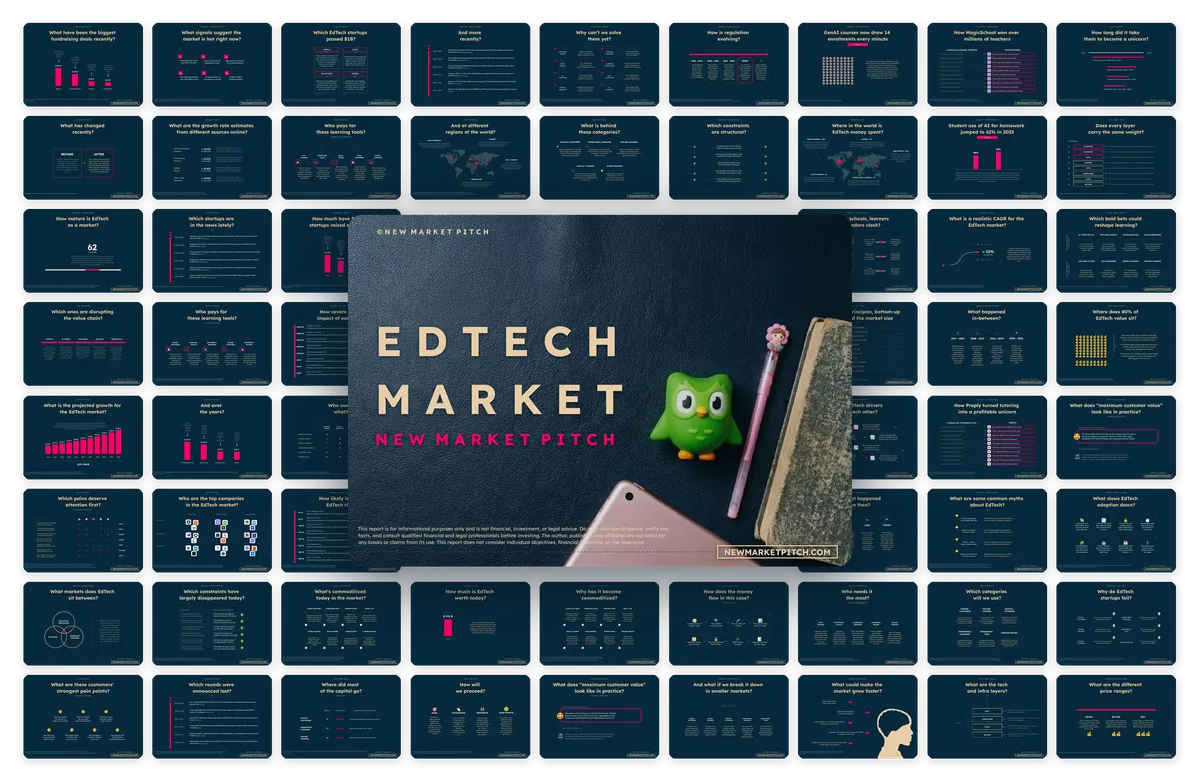
Whether you're building or investing in the edtech market, our report covers everything you need to know: the players, the money, and what's coming next.
Summary
EdTech's biggest unsolved problem is proving that technology actually improves learning. Personalized education, reliable assessment, teacher productivity and equal access remain major challenges, but none matters much if students aren't learning more.
The contrast is striking. US reading scores have continued to decline while school districts in one major study used more than 2,000 digital applications on average. Technology adoption has raced ahead of evidence that it improves educational outcomes.
Independent evaluation remains surprisingly rare. UNESCO highlighted research showing that only 7% of the EdTech companies examined had conducted randomized controlled trials, leaving schools with little reliable information about which products deserve their budgets.
AI tutoring is one of the more promising developments. Controlled experiments at Harvard and in Nigeria demonstrated meaningful learning gains, but both relied on carefully structured instruction. Whether those improvements survive large-scale deployment remains an open question.
Generative AI has created a new assessment problem. In a 2026 UK undergraduate survey, 94% reported using AI for assessed work. Schools increasingly need to measure what students can do independently and what they can accomplish with AI assistance.
Personalization is still more limited than the marketing suggests. Most adaptive platforms are good at changing exercise difficulty, but identifying the underlying reason a student is struggling is much harder. That diagnostic capability could become AI tutoring's real breakthrough.
Teacher productivity offers a more immediate opportunity. Many educators already report saving time with AI, yet formal institutional guidance remains uncommon. Helping teachers prepare lessons, provide feedback and manage repetitive work may generate value faster than attempting to replace classroom instruction.
Schools also have a software overload problem. Lightspeed Systems found that 95% of student application engagement came from fewer than 5% of available products. Better procurement and consolidation could save schools money without sacrificing much actual usage.
Access remains the largest social challenge. UNESCO estimates that 273 million children and young people are out of school, while approximately 50 million additional teachers will be needed by 2030. AI tutoring cannot close those gaps without connectivity, devices, trained educators and public investment.
More classroom technology is not automatically better. A majority of teachers in a 2026 Gallup survey wanted students to spend less time on learning devices, even though many also believed digital tools could improve instruction. The next generation of EdTech may need to help schools decide when not to use screens.
The investment market is forcing a reckoning. EdTech funding excluding China fell almost 87% between 2021 and 2024. Companies now face greater pressure to demonstrate measurable learning gains, sustainable economics and lasting customer value. The strongest opportunities lie in products that can prove those results rather than merely attracting users.

Written by the New Market Pitch teamWe track new markets so founders and investors can move faster. About us
Why are students still falling behind despite all the new EdTech tools?
EdTech has made educational content easier to access, yet we still have surprisingly little evidence that all this technology is helping students learn more.
The latest available US reading results are particularly concerning. In the 2024 National Assessment of Educational Progress (NAEP), average reading scores among fourth- and eighth-graders both fell by two points compared with 2022, extending declines that had already begun before the pandemic. No US state recorded a statistically significant improvement in reading at either grade level. Only 31% of fourth-graders reached NAEP Proficient, compared with 35% in 2019.
The international picture is similarly troubling. OECD's PISA 2022 assessment found that average mathematics scores across OECD countries fell by almost 15 points between 2018 and 2022, equivalent to roughly three-quarters of a school year of learning. Reading scores dropped by about ten points. These were exceptional declines, although pandemic disruptions and other factors make it impossible to isolate technology's role.
Meanwhile, digital tools have become routine in classrooms. Lightspeed Systems' 2024 analysis found that US school districts in its dataset used more than 2,000 applications on average. These numbers measure different things, so we cannot conclude that EdTech caused the learning decline. But the contrast raises an uncomfortable question about how schools have spent their money.
After years of buying devices, applications and digital subscriptions, educational systems are still struggling with basic literacy and numeracy.
Why is it still so hard to tell which EdTech products actually work?
Most EdTech companies still cannot demonstrate through rigorous independent research that their products make students better at reading, mathematics or other measurable skills.
UNESCO's 2023 Global Education Monitoring Report highlighted a review of UK EdTech companies in which only 7% had conducted randomized controlled trials, 12% had used third-party certification and 18% had participated in academic studies. The figures come from a particular review rather than a comprehensive census of the global industry, but they expose a longstanding weakness.
The problem becomes clearer when we look at how quickly educational software changes. UNESCO estimated that EdTech products were updated or replaced roughly every 36 months. A company can completely redesign its product while researchers are still evaluating an earlier version.
Some products do have credible results. A 2025 study published in Scientific Reports found that students using a specially designed AI physics tutor at Harvard learned significantly more in less time than students attending an active-learning class. However, that finding applies to a particular intervention and does not establish that AI tutoring products generally outperform classroom instruction.
Even successful pilot programs can be difficult to reproduce. The Harvard study involved 194 eligible students in a carefully designed university course, while the World Bank's Nigerian AI tutoring experiment involved six weeks of structured instruction with teacher support. Both produced encouraging results, but neither establishes that identical improvements would occur across an entire national education system.
Scaling changes several conditions simultaneously. Teachers may receive less training, students may have weaker foundational skills, technical support becomes more expensive and schools may struggle to fit a new product into existing schedules. UNESCO has also highlighted that much EdTech research comes from wealthier countries, making it difficult to generalize findings to schools with fewer resources.
The industry has relied heavily on testimonials, engagement figures and customer adoption. A platform might report millions of completed exercises without showing whether students can solve similar problems independently weeks later. Schools need evidence that learning improvements survive beyond controlled trials and remain measurable when products are deployed at scale.
If you want more recent data on this point, please see our latest EdTech market report.

A good product starts with a real problem. In our report covering the edtech market, we show you the ones customers still live with.
Can AI tutors actually teach students better than human teachers?
AI tutors can already produce better results than conventional classroom instruction in some controlled experiments, but we still cannot say they are generally better than human teachers.
The Harvard physics experiment published in June 2025 provides one of the clearest examples. Researchers tested a purpose-built AI tutor against an established active-learning classroom approach. Among 194 eligible students, those using the tutor learned significantly more in less time and reported higher engagement and motivation. Both approaches used established teaching principles, making the comparison more meaningful than testing an AI chatbot against a passive lecture.
The World Bank found encouraging results in a very different environment. In Nigeria, researchers evaluated a six-week after-school program using Microsoft Copilot, powered by GPT-4, alongside teacher guidance. Students improved by 0.31 standard deviations on a combined assessment covering English, AI knowledge and digital skills. The improvement in English alone was 0.23 standard deviations.
These results show that AI tutoring can work across very different educational settings, from an American university to Nigerian secondary schools. However, the programs were carefully structured and relatively short. They do not establish whether students would retain the same advantage after a full academic year.
Both successful programs relied on defined learning objectives and deliberate instructional design. AI tutors are becoming credible tools for individual practice and immediate feedback, although current evidence does not justify replacing the broader responsibilities of teachers.
Is ChatGPT helping students learn or just doing their homework?
Generative AI is increasingly doing parts of students' academic work, and universities are struggling to determine how much genuine learning is happening behind the finished assignments.
The Higher Education Policy Institute's Student Generative AI Survey 2026, based on 1,054 UK undergraduates surveyed in December 2025, found that 95% used AI in some form. More importantly, 94% reported using generative AI to help with assessed work.
The direction of change is striking. The proportion of students directly including AI-generated text in assessed submissions increased from 3% in 2024 to 8% in 2025 and 12% in 2026. That is a fourfold increase in two years, although most students still did not report directly inserting generated text into their submissions.
The same survey found that 49% believed AI had improved their university experience. Students described saving time, understanding difficult material and getting support outside teaching hours. Others worried about becoming dependent on AI or losing the habit of thinking independently.
A student who asks ChatGPT to explain a difficult equation may understand mathematics better afterward. Another who copies the complete solution can finish the assignment without understanding the equation at all. Both behaviors can produce similar-looking work, making it increasingly difficult for educators to distinguish AI-assisted learning from AI-assisted task completion.

If you build or invest in the edtech market, you need to know which business models pay off now and which ones are fading. That's why our report covering it has a whole section on it.
How can schools test students when AI can write their assignments?
Schools and universities need to rethink assessment because written homework is becoming a less reliable measure of what students can do independently.
According to HEPI's 2026 undergraduate survey, 65% of respondents said assessments had changed significantly in response to AI. Universities are already experimenting with supervised examinations, oral defenses, presentations and coursework that explicitly permits AI assistance.
Each approach solves part of the problem. Oral examinations can reveal whether students understand their arguments, but assessing hundreds of students individually takes time. Supervised exams reduce opportunities for undisclosed AI use, although they may test skills differently from real professional work. Assignments that permit AI reflect how many employers operate, but instructors still need to understand the student's contribution.
AI detection software offers no complete answer either. A detection score is an estimate, and using it as proof of misconduct risks false accusations. HEPI's research found that students themselves were concerned about being wrongly accused.
Educational assessment will increasingly need two distinct measures: what students can do independently and what they can accomplish when AI tools are available. Both abilities have value. But combining them into one grade makes it difficult to know what someone has actually learned.
If you want more recent data on this point, please see our latest EdTech market report.
Why hasn't personalized learning become standard in schools?
Personalized learning remains surprisingly limited because most EdTech platforms can adjust questions more easily than they can understand why an individual student is struggling.
Adaptive products such as DreamBox Math and Duolingo demonstrate useful ways to customize learning. They can change exercise difficulty, schedule revision and respond to incorrect answers. Khan Academy's Khanmigo has taken another approach by using conversational AI to guide students through explanations and questions.
However, these capabilities solve different problems. A student repeatedly getting fractions wrong might lack multiplication skills, misunderstand what a denominator represents or simply be distracted. Giving that student easier fraction questions may help, but it may also miss the actual difficulty.
UNESCO's 2023 technology report reviewed 23 primary mathematics applications and found that their activities concentrated heavily on drill and practice rather than higher-order thinking. The finding helps explain why adaptive exercises should not automatically be treated as comprehensive personalized instruction.
AI creates new possibilities because students can now ask follow-up questions in natural language. Yet an AI tutor must still recognize misconceptions, respond appropriately and avoid giving away the answer too quickly. The biggest opportunity lies in systems that can diagnose why students repeatedly make mistakes and adjust instruction accordingly.

Learning from others' mistakes is the cheapest lesson there is. In our market report about education technology, we look at what broke startups before you, so you don't repeat it.
Why are teachers still overwhelmed when AI is supposed to save them time?
AI is already saving many teachers time, but schools have been much slower to provide the training and clear rules needed to make those benefits consistent.
A Walton Family Foundation-Gallup survey conducted in July and August 2026 found that 59% of US K-12 educators had used AI during the preceding school year. Among educators who used it, 64% said it freed up more time for the parts of their work they valued, while 29% reported no change and 7% said they lost time.
The more revealing finding comes from Gallup's separate research published in May 2026. Only 18% of US K-12 teachers reported receiving formal administrative guidance about AI use for work tasks. Another 48% received informal guidance, while 34% received none.
Teachers are experimenting with lesson planning, worksheet generation, grading assistance and student feedback, often without a consistent school-level approach. Adoption is happening much faster than institutional support.
There are also tasks where automation creates extra work. AI-generated lessons need checking, automated feedback can be inaccurate, and student-facing tools require supervision. A teacher may save time drafting material but spend some of that time verifying the result.
The opportunity is to reduce repetitive work without creating new responsibilities. Recent survey results suggest that AI can deliver meaningful time savings, but school-wide implementation has yet to catch up with individual teacher adoption.
Can EdTech really help solve the global teacher shortage?
EdTech could help schools cope with the teacher shortage, especially by supporting larger classes and increasing access to tutoring, but the need for qualified educators is still growing.
UNESCO published an updated estimate in October 2026 showing that the world needs approximately 50 million additional teachers by 2030 across pre-primary, primary and secondary education. The earlier figure of 44 million referred to primary and secondary education, so the two estimates cover different educational levels.
The newer UNESCO data also revealed that 58% of the teachers needed by 2030 would replace educators leaving the profession. Education systems must recruit additional staff while also replacing teachers who retire or leave.
The pressures vary enormously by region. UNESCO has reported an average of 56 pupils per trained primary teacher in sub-Saharan Africa. Under those conditions, providing individual feedback to every student becomes extremely difficult.
Digital tutoring could help fill part of the gap. Recorded lessons can make specialist instruction accessible beyond one school, while AI systems can provide additional practice and explanations. The Nigerian tutoring results discussed earlier show that technology can strengthen instruction in resource-constrained settings.
But classroom teaching also involves safeguarding, motivation, behavior management and responding to individual circumstances. Those responsibilities are difficult to automate.
The most realistic contribution of EdTech is increasing the number of students who can receive effective instruction from a limited teaching workforce. Systems that help existing teachers serve more students well could have an enormous impact.
If you want more recent data on this point, please see our latest EdTech market report.

When you build or invest in the edtech market, you need clarity, not confusion. In our document detailing everything you need to know about edtech, we always try to put numbers on and quantify whatever is usually vague and confusing.
Why can't millions of children access good digital education?
The biggest EdTech access problem is still basic infrastructure: millions of children lack reliable connectivity, suitable devices or even access to a functioning school.
UNESCO's 2026 Global Education Monitoring Report estimates that 273 million children and young people worldwide are out of school, equivalent to approximately one in six. That number has risen for seven consecutive years, driven partly by population growth, conflict and shrinking education budgets.
The longer-term figures tell a more complicated story. Global primary and secondary enrollment increased by 327 million students, or 30%, between 2000 and 2024. Yet progress has slowed considerably since 2015, particularly in sub-Saharan Africa. Education systems have expanded, but the number of children they need to serve has also grown.
Connectivity remains a major obstacle. UNESCO's 2023 technology report found that only 40% of primary schools, 50% of lower secondary schools and 65% of upper secondary schools worldwide had internet access.
These numbers help explain why free educational software cannot solve global learning inequality by itself. A child may have access to Khan Academy or another free platform in principle while lacking the electricity, equipment, language support or adult supervision needed to use it.
The recent rise of AI tutoring makes this problem more pressing. Students with strong internet connections can access sophisticated personalized assistance almost instantly, while students in poorly connected communities may struggle to open a basic educational website.
Offline learning systems, low-cost devices and locally adapted instruction will remain important areas for EdTech. Without those foundations, AI risks widening educational differences between connected and disconnected students.
| Global education problem | Latest reported figure | Source |
|---|---|---|
| Children and young people out of school | 273 million | UNESCO, 2026 |
| Share of school-age children excluded | Approximately 1 in 6 | UNESCO, 2026 |
| Additional primary and secondary students since 2000 | 327 million | UNESCO, 2026 |
| Growth in primary and secondary enrollment since 2000 | 30% | UNESCO, 2026 |
| Primary schools with internet access | 40% | UNESCO, 2023 |
| Lower secondary schools with internet access | 50% | UNESCO, 2023 |
| Upper secondary schools with internet access | 65% | UNESCO, 2023 |
| Additional teachers needed by 2030, including pre-primary | 50 million | UNESCO, October 2026 |
Are schools paying for too many EdTech apps?
Many schools are paying for or managing far more EdTech applications than students regularly use, making software consolidation one of the clearest opportunities to reduce unnecessary spending and complexity.
Lightspeed Systems' 2024 EdTech App Report found that districts in its dataset used more than 2,000 applications on average. Yet 95% of student application engagement came from fewer than 5% of the available products.
We can calculate what that concentration implies. For a district with exactly 2,000 applications, fewer than 100 would account for almost all student engagement. The remaining 1,900-plus applications would collectively represent just 5% of engagement.
That does not mean every rarely used application is worthless. Specialized software for accessibility, examinations or occasional administrative work may be essential despite low usage.
Still, the concentration is difficult to ignore, especially when schools face budget pressures. Districts must manage licenses, security reviews, teacher training, passwords and compatibility across their digital systems.
The same Lightspeed report found that 65% of EdTech applications had at least one privacy-policy change during the school year. Maintaining oversight therefore requires continuous work.
Software that shows administrators which products are being used, what they cost and whether their educational value justifies renewal could be extremely useful. Removing ten unnecessary subscriptions may deliver more immediate savings than adding another AI learning tool.

In our report covering the edtech market, we look at what the winners do differently, so you can learn from the best instead of guessing.
Is all this classroom screen time actually hurting students?
Excessive classroom screen time is becoming a serious concern, and teachers are increasingly questioning whether schools have allowed digital devices to take up too much of the school day.
A Gallup survey published in September 2026 found that 96% of US public-school teachers reported students using learning devices in class. Yet 61% wanted students to spend less time on those devices. Only 6% wanted more screen time, while 33% preferred the current amount.
The breakdown by school level is particularly interesting. Among elementary teachers, 55% wanted less device use, compared with 67% of middle-school teachers and 65% of high-school teachers.
Concerns are clearly not limited to very young children. They also apply to older students who use technology more independently.
At the same time, 59% of surveyed teachers agreed that the digital tools they used helped students learn more effectively. Teachers can recognize the value of specific applications while believing overall device exposure has become excessive.
OECD's PISA 2022 research provides another important comparison. Across OECD countries, students who reported being distracted by digital devices in most or every mathematics lesson scored around 15 points lower than students who rarely experienced such distractions, after accounting for socioeconomic differences.
That relationship does not prove that devices caused the lower scores. Nevertheless, it gives schools a reason to distinguish productive educational use from avoidable distraction.
The industry has spent years encouraging schools to adopt more technology. The next challenge may involve helping teachers decide when students should close their devices.
If you want more recent data on this point, please see our latest EdTech market report.
How serious is the student data privacy problem in EdTech?
Student data privacy is a major unresolved EdTech problem, and the PowerSchool breach showed how a single vendor can expose sensitive information across many school systems.
The incident was discovered in December 2024 and involved unauthorized access to PowerSchool's student information systems. In January 2025, 20 Ontario school boards and the provincial education ministry notified the Information and Privacy Commissioner of Ontario.
The commissioner's April 2026 case review described how an attacker used compromised subcontractor credentials to access PowerSchool systems and steal personal information.
The Toronto District School Board later confirmed that students enrolled between September 1985 and December 2024 were affected by the incident. That historical reach is particularly worrying because educational databases can retain records long after students leave school.
The breach also exposed weaknesses in vendor oversight. Schools depend on specialized software providers to manage admissions, attendance, grades and personal information, but they remain responsible for protecting the data they collect.
AI introduces another complication. Educational chatbots can process student questions, written assignments and potentially sensitive information about learning difficulties. Providers therefore need clear rules around data retention, access and model training.
For EdTech companies, privacy is becoming a product requirement rather than something schools can address entirely through contracts. Strong access controls, limited data retention and independent security verification are increasingly important, particularly when users are children.

In our research about education technology, we always try to gather several sources and make estimates that make sense, so you can work with solid numbers.
Why do so many students abandon online courses?
Online course completion remains a stubborn problem because registering for educational content is much easier than committing enough time to master it.
Researchers Justin Reich and José Ruipérez-Valiente examined millions of registrations on HarvardX and MITx courses in research published in Science in 2019. Their analysis found persistent challenges with course completion and engagement despite the expansion of massive open online courses.
Some of this apparent failure reflects how people use free online education. A person might register to watch a single lecture or learn one practical skill without intending to complete the course. Counting that student as a dropout can exaggerate the problem.
Still, students with genuine completion goals face familiar obstacles: competing responsibilities, weak study habits, difficult material and insufficient feedback.
Duolingo approaches engagement through short lessons, streaks and reminders. Coursera offers structured certificates and professional programs, while platforms such as Udemy allow learners to progress at their own pace. These models serve different needs and should be judged against different outcomes.
The harder question is whether learners retain skills after completing their courses. Someone can finish every lesson, earn a certificate and still struggle to use the knowledge independently. Demonstrated mastery and subsequent application are more meaningful measures of educational success than course completion alone.
Can EdTech keep workers' skills up to date as AI changes their jobs?
Workforce EdTech has a growing opportunity because employers expect substantial changes in job requirements, but online training still struggles to prove that learners can apply new skills at work.
The World Economic Forum's Future of Jobs Report 2025 found that employers expected 39% of workers' core skills to change by 2030. Interestingly, that figure was lower than the 44% projected in the previous report.
The decline suggests that employers may be gaining a clearer understanding of technological change, even as they continue anticipating widespread disruption.
The same report found that the share of workers completing training as part of long-term learning strategies had increased from 41% in the previous survey to 50%.
Companies are already investing more heavily in continuous learning, creating demand for platforms such as Coursera, Udemy Business, LinkedIn Learning and specialized technical-training providers.
However, there is a difference between watching a cybersecurity course and being able to secure a production network. The same applies to learning Python, using AI tools or managing complex projects.
Training providers increasingly need to demonstrate practical competence through projects, simulations, examinations or workplace performance. Employers need evidence that training has changed what people can accomplish.
The biggest opportunity may lie in connecting education directly to skills verification, especially in technical fields where performance can be measured more objectively.

In our market report about education technology, we turn what is vague and complex into simple, useful visuals. Market maps like this one show you at a glance where every startup stands.
Why has so much investment disappeared from EdTech?
EdTech funding has fallen sharply from its pandemic-era peak, and investors now face a sector where attracting users is no longer enough to justify aggressive growth spending.
An August 2025 Goldman Sachs analysis, using HolonIQ and Crunchbase data, estimated that global EdTech financing excluding China reached $18 billion in 2021. It then fell to $10.5 billion in 2022, $2.6 billion in 2023 and $2.4 billion in 2024.
That represents an 86.7% decline from the 2021 peak. More revealingly, the 2024 figure was also below the $3 billion recorded in 2019, before the pandemic expansion.
The contraction in large financing rounds was especially sharp. Goldman Sachs counted 17 EdTech rounds above $100 million in 2022, compared with three in 2023 and four in 2024.
The funding correction went beyond the disappearance of exceptionally large pandemic-era deals. Capital became harder to obtain across the broader market as well.
The underlying businesses face difficult economics. Schools have limited discretionary budgets, procurement can take months, and the returns from educational software are often difficult to measure financially. Consumer learning platforms have more direct purchasing relationships but face intense competition for attention and subscriptions.
The financial correction has made measurable outcomes, customer retention and sustainable revenue considerably more important for EdTech startups. Companies whose main advantage is rapid user acquisition have a much harder case to make today.
| Year | Global EdTech funding, excluding China | Change from 2021 peak |
|---|---|---|
| 2018 | $3.1B | −82.8% |
| 2019 | $3.0B | −83.3% |
| 2020 | $5.8B | −67.8% |
| 2021 | $18.0B | Baseline |
| 2022 | $10.5B | −41.7% |
| 2023 | $2.6B | −85.6% |
| 2024 | $2.4B | −86.7% |
What are the biggest unsolved problems in EdTech today?
The biggest unsolved problem in EdTech is still proving that technology helps students learn more, consistently and at scale. Personalized learning, teacher support, trustworthy assessment and affordable access are the next major challenges.
Learning effectiveness belongs at the top of the list. US reading scores have continued to fall, independent EdTech evaluations remain uncommon, and many schools already manage thousands of digital applications. More technology has not automatically meant better educational results.
Personalized learning comes next. The positive AI tutoring experiments at Harvard and in Nigeria show that this problem is becoming more solvable. However, those results emerged from structured programs with defined learning objectives. We still need evidence that similar gains can be maintained across much larger and more varied student populations.
AI assessment is another urgent challenge. When 94% of surveyed UK undergraduates report using generative AI for assessed work, traditional assignments become harder to interpret. Schools need reliable ways to establish which skills students have actually mastered.
Teacher productivity may be the most immediately practical commercial opportunity. Recent Gallup research shows that many educators already save time with AI, while formal training and institutional guidance remain limited. Better integration and clearer workflows could deliver benefits without requiring a complete redesign of classroom instruction.
Equal access presents the largest social challenge. UNESCO's latest figures show that 273 million children and young people remain out of school, while its updated teacher projections point to a need for approximately 50 million additional educators by 2030. Technology can help address these problems, but their scale extends well beyond what software companies can solve independently.
The investment picture also suggests that EdTech has entered a more demanding phase. Financing excluding China dropped almost 87% between 2021 and 2024, pushing companies toward business models that can survive without unusually generous venture funding.
Verified learning improvement remains the industry's most important unresolved problem. Personalized tutoring, assessment and teacher productivity are the areas where software companies appear best positioned to make progress. Access and teacher shortages may be even larger problems in social terms, but solving them requires substantial public investment alongside technology.
The next generation of successful EdTech companies will have to show that students actually learn more, teachers genuinely save time and schools can afford the results. Better products are already emerging. What the industry still needs is convincing proof that those improvements last.
If you want more recent data on this point, please see our latest EdTech market report.

Our document detailing everything you need to know about edtech gets updated several times a month, so you always get the latest view of where things stand.
Sources and methodology
This analysis examines the biggest unsolved problems in EdTech using available evidence on student learning outcomes, technology effectiveness, AI tutoring, academic assessment, personalized learning, teacher productivity, educational access, engagement, privacy and industry financing. The goal is to identify which problems remain persistent, where technology is already producing measurable improvements and which opportunities have the strongest evidence behind them.
We approached the subject as a research problem rather than starting with an assumption about whether educational technology helps or harms students. We examined each issue separately, prioritizing original academic research, official education statistics, institutional surveys, documented experiments and market data. We then compared the findings across sources to identify recurring problems and meaningful differences between educational settings.
We distinguish measured learning improvements from technology adoption, student engagement and self-reported benefits. For example, a successful AI tutoring experiment demonstrates that a particular intervention can improve learning under the conditions tested. It does not establish that every AI tutor will produce the same results across different schools, subjects or student populations. Similarly, falling academic scores alongside increasing technology adoption do not prove that EdTech caused those declines.
We also account for differences in how the underlying evidence was collected. National assessments, international education surveys, controlled experiments and commercial usage reports measure different outcomes. Where figures refer to different populations, periods or definitions, we retain those distinctions rather than treating them as directly comparable. Funding comparisons use the geographic scope and financing definitions reported in the original market analysis.
Our final assessment weighs problems according to their persistence, scale, supporting evidence and potential for educational technology to address them. We place particular emphasis on whether improvements can be independently verified and sustained outside carefully controlled trials. Market adoption and investment activity provide additional context, but neither is treated as proof of educational effectiveness.
Key sources on academic outcomes and educational effectiveness include NCES's 2024 NAEP reading results, OECD's PISA 2022 results, and UNESCO's 2023 Global Education Monitoring Report on technology in education. For experimental evidence on AI tutoring, we used the 2025 Harvard physics tutoring study published in Scientific Reports and the World Bank's research on AI-assisted tutoring in Nigeria.
For student and teacher adoption, assessment and classroom technology, we relied on HEPI's Student Generative AI Survey 2026, Lightspeed Systems' 2024 EdTech App Report, Gallup's research on teacher AI use and time savings, Gallup's research on institutional AI guidance, and Gallup's September 2026 research on classroom screen time.
For global access and teacher shortages, we used the UNESCO Institute for Statistics' updated 2026 teacher workforce estimates and UNESCO's 2026 Global Education Monitoring Report. Student-data security findings draw on the Information and Privacy Commissioner of Ontario's PowerSchool case review and the Toronto District School Board's incident documentation.
For online learning, workforce skills and investment trends, the main references are MIT's research on MOOC participation and completion, the World Economic Forum's Future of Jobs Report 2025, and Goldman Sachs' August 2025 Education Technology & Services Sector Update, particularly the historical EdTech financing figures on page 44.

Theory only gets you so far. In our report covering the edtech market, we dig up the real signals from the field and show you the ones worth watching.
Written by the New Market Pitch teamWe track new markets so founders and investors can move faster. About us