Who makes money in energy storage as battery prices crash?
Whether you're building or investing in the energy storage market, our report covers everything you need to know: the players, the money, and what's coming next.
Summary
CATL, Tesla and Sungrow are among the clearest winners as battery prices crash. Large-scale manufacturing and integrated storage systems are generating substantial profits, while independent integrators and merchant battery owners face much tougher economics.
Stationary battery pack prices fell 45% to just $70/kWh in 2025, compared with an 8% decline across the broader lithium-ion market. That price collapse is making storage projects dramatically cheaper, but it is also forcing suppliers to compete over a shrinking equipment cost base.
Global battery storage installations reached 108 GW in 2025, up 40%, yet storage cell shipments exceeded 600 GWh against roughly 320 GWh of installations. Demand is booming, but the supply chain is expanding even faster, creating intense competition among manufacturers.
CATL demonstrates how manufacturing scale can overcome price pressure. Its battery shipments increased 39% in 2025, while net profit rose 42% to RMB 72.2 billion, supported by cost advantages, enormous production volumes and strong cash generation.
Tesla and Sungrow are capturing value beyond the battery cell itself. Tesla's energy segment generated $3.80 billion in gross profit in 2025, while Sungrow's storage revenue grew 49% to RMB 37.29 billion, overtaking its photovoltaic inverter business.
Independent storage integration is far less rewarding. Fluence recorded a $136.1 million net loss over the first nine months of fiscal 2026 despite a $6.4 billion backlog, while Wärtsilä moved to restructure its storage business after previously targeting operating margins of only 3% to 5%.
Owning batteries is no automatic route to profits either. Average ERCOT battery revenues fell from approximately $193/kW in 2023 to $29.4/kW in 2025, an 85% collapse as competing batteries reduced the value of electricity trading and grid services.
Long-term contracts offer a more dependable alternative to merchant trading. Developers that secure well-priced capacity or availability payments can combine cheaper equipment with more predictable cash flow, although contract terms and battery degradation still determine actual returns.
Energy storage software offers attractive recurring-revenue potential without requiring a new battery for every customer. But standalone profitability remains difficult to establish, and optimization companies must compete against bundled manufacturer software and in-house trading teams.
Cheaper lithium-ion batteries are also raising the competitive bar for long-duration alternatives, especially around four-hour applications. The wider conclusion is that electricity customers may capture much of the industry's cost savings, while suppliers need either exceptional manufacturing efficiency, defensible integration capabilities or reliable contracted revenue to retain meaningful profits.

Written by the New Market Pitch teamWe track new markets so founders and investors can move faster. About us
Are falling battery prices creating winners or destroying profits?
Falling battery prices are creating some very profitable energy storage businesses, but the biggest winners are not necessarily the companies selling the cheapest batteries.
BloombergNEF's 2025 battery price survey found that lithium-ion battery packs averaged $108 per kilowatt-hour, down 8% from 2024. The decline was much steeper for stationary storage, where pack prices fell 45% to $70/kWh.
Meanwhile, the International Energy Agency reported that worldwide battery storage installations reached 108 GW in 2025, up 40%. Global installed capacity was eleven times higher than in 2021.
We can already see how differently companies are benefiting from this growth. CATL increased net profit by 42% in 2025, while Tesla's energy business increased gross profit by 44%. Sungrow's storage revenue grew almost 50%. Fluence, despite a growing order backlog, continued to lose money.
The main question is who gets to keep the savings when batteries become cheaper. Manufacturers, system suppliers, project developers and electricity customers are all competing for a share, and their financial results are increasingly different.
How cheap have energy storage batteries become?
Energy storage battery prices have fallen much faster than electric vehicle battery prices, making large storage projects dramatically cheaper to build.
According to BloombergNEF, stationary battery packs averaged $70/kWh in 2025, compared with approximately $127/kWh in 2024. The broader lithium-ion pack market saw prices fall only 8%, while electric vehicle packs averaged $99/kWh.
For a 100 MWh storage installation, the difference is considerable. At the previous year's average, battery packs would cost approximately $12.7 million. At the latest average, they would cost $7 million, a saving of $5.7 million before accounting for inverters, installation, grid connections and other equipment.
China is driving much of this price pressure. BloombergNEF estimated Chinese production of stationary storage cells at 557 GWh in 2025, more than twice the volume installed globally that year under its measurement.
The cheapest observed lithium-iron-phosphate (LFP) storage cells reached just $36/kWh, while complete packs reached $50/kWh. These are the lowest observed prices, rather than market averages, but they show how aggressively suppliers are competing.
Battery prices have also fallen 93% since 2010 in real terms, according to BloombergNEF. The latest collapse is part of a much longer decline, accelerated by Chinese overcapacity and increasingly efficient manufacturing.
| Battery price benchmark | 2024 | 2025 | Change |
|---|---|---|---|
| Global average lithium-ion pack | ~$117/kWh | $108/kWh | -8% |
| Stationary storage pack | ~$127/kWh | $70/kWh | -45% |
| Electric vehicle pack | ~$100/kWh | $99/kWh | About -1% |
| LFP pack, all applications | - | $81/kWh | - |
| NMC pack, all applications | - | $128/kWh | - |
| Lowest observed stationary LFP pack | - | $50/kWh | - |
| Lowest observed stationary LFP cell | - | $36/kWh | - |
| China average pack, all applications | - | $84/kWh | - |

A good product starts with a real problem. In our report covering the energy storage market, we show you the ones customers still live with.
Is energy storage demand growing fast enough to absorb all those batteries?
Energy storage demand is growing extremely fast, but manufacturers are still producing more batteries than the market can immediately absorb.
The IEA recorded 108 GW of newly installed battery storage capacity worldwide in 2025, a 40% increase over 2024. Approximately 87 GW came from utility-scale projects, and China accounted for around 60% of worldwide additions.
The United States is growing quickly too. The Energy Information Administration recorded approximately 15 GW of utility-scale battery additions in 2025, following 10.3 GW in 2024. Its February 2026 outlook showed developers planning another 24 GW during 2026, although some planned projects may be delayed.
The bigger issue is the gap between battery production and installations.
Benchmark Mineral Intelligence estimated that storage cell shipments exceeded 600 GWh in 2025, while complete system shipments were approximately 460 GWh and installations exceeded 320 GWh. These figures cover different points in the supply chain and are not directly interchangeable, but the gap points to substantial equipment inventories, timing differences and deployment delays.
LFP batteries now account for around 90% of new stationary storage deployments, according to the IEA, compared with less than half five years earlier. That shift has also made storage supply chains increasingly standardized.
For manufacturers, rapid installation growth is encouraging. Yet increasing production and holding inventory can put even more pressure on prices.
Consider a supplier whose shipments grow 40% while average selling prices fall 45%. Revenue would decline approximately 23% if the product mix stayed unchanged. Selling substantially more batteries can still leave a company with less revenue.
How is CATL making so much money when battery prices keep falling?
CATL is making enormous profits because its manufacturing scale and cost advantages are currently strong enough to overcome falling battery prices.
The Chinese battery manufacturer reported RMB 423.7 billion in revenue for 2025, up 17%, while net profit attributable to shareholders rose 42% to RMB 72.2 billion.
Battery shipments reached 661 GWh, up 39%. CATL also reported a 30.4% share of global energy storage battery shipments, making it one of the largest beneficiaries of expanding storage demand.
The gap between shipment growth and revenue growth tells us something important. Across CATL's broader battery business, the simple ratio of revenue to shipped GWh fell by approximately 16%. This is not a precise battery selling-price measure because CATL has different products and revenue sources, but it shows how much faster physical shipments are growing than reported sales.
CATL's profitability comes partly from enormous production volumes, established supplier relationships and years of manufacturing investment. It reported 772 GWh of production capacity and spent RMB 22.1 billion on research and development in 2025.
The company also generated RMB 133.2 billion in operating cash flow, providing substantial resources to fund new products and overseas expansion.
Smaller producers face a much tougher situation. They must compete against CATL's pricing while carrying their own factory expenses, financing costs and research budgets.
CATL can afford a price war that weaker competitors may struggle to survive. Its results prove that manufacturing batteries can remain highly profitable during collapsing prices, but scale is doing much of the heavy lifting.
If you want more recent data on this point, please see our latest energy storage market report.

If you build or invest in the energy storage market, you need to know which business models pay off now and which ones are fading. That's why our report covering it has a whole section on it.
Is Tesla's Megapack business getting more profitable?
Tesla's energy storage business has become substantially more profitable, although its latest quarterly margins show that the improvement is not guaranteed every year.
Tesla reported $12.77 billion in energy generation and storage revenue in 2025, up 27% from $10.09 billion in 2024.
Segment gross profit increased from $2.64 billion to $3.80 billion, while gross margin improved from 26.2% to 29.8%.
Battery storage deployments reached 46.7 GWh, compared with 31.4 GWh in 2024, an increase of nearly 49%.
Interestingly, Tesla's annual filing acknowledged that lower Megapack selling prices partly offset the benefit of higher deployments. Tesla was selling more storage capacity at lower average prices but still generating considerably more gross profit.
Megapack is a complete storage product. Tesla buys or produces battery cells, integrates the hardware, supplies controls and provides related services. Its earnings therefore depend on more than the selling price of battery cells.
There are limits to what we can conclude. Tesla reports storage and solar generation together, so its 29.8% segment gross margin cannot be treated as Megapack's standalone operating profit margin. More recent interim results have also shown pressure on energy gross margins.
Even with that distinction, Tesla has built an energy business producing billions of dollars in annual gross profit. Lower battery prices have helped it scale, although the benefits have not appeared equally in every quarter.
Is Sungrow now making more money from batteries than solar inverters?
Energy storage has overtaken solar inverters as Sungrow's largest revenue business, making the Chinese company one of the most interesting winners of cheaper batteries.
Sungrow's 2025 results showed total revenue of RMB 89.18 billion, up 14.6%, and net profit attributable to shareholders of approximately RMB 13.46 billion, up 22%.
Its energy storage system revenue reached RMB 37.29 billion, growing 49.4%. The photovoltaic inverter business generated approximately RMB 31.14 billion.
Storage consequently represented roughly 42% of Sungrow's total revenue.
The company shipped around 43 GWh of storage systems during 2025, benefiting from demand for complete installations rather than selling battery cells alone.
Sungrow has an advantage because it already manufactures power conversion equipment and understands grid integration. Inverters, control systems, thermal management and electrical engineering remain important parts of a storage project even when the battery itself becomes cheaper.
Storage is now Sungrow's biggest revenue category, although its consolidated net profit also comes from inverters and other operations. The company does not provide enough standalone operating profit detail to establish that storage has the highest margins.
Still, the speed of the transition is striking. A company historically associated with solar inverters has built a larger storage equipment business using many of the same technical strengths.

Learning from others' mistakes is the cheapest lesson there is. In our market report about energy storage, we look at what broke startups before you, so you don't repeat it.
Why is Fluence still losing money when everyone is buying energy storage?
Fluence is struggling to turn strong demand into consistent profits because delivering large battery projects remains an expensive and competitive business.
In fiscal 2025, Fluence generated $2.3 billion in revenue, down from $2.7 billion the previous year. Gross margin improved slightly from 12.6% to 13.1%, but the company recorded a $68 million net loss after earning approximately $30 million in fiscal 2024.
The losses continued during fiscal 2026. For the nine months ending June 30, Fluence reported a net loss of $136.1 million.
Customer demand, however, remained strong.
Fluence reported $1.44 billion in new orders during its third fiscal quarter, nearly three times the comparable quarter a year earlier. Its backlog reached $6.4 billion, compared with $5.3 billion at the end of fiscal 2025.
The company also disclosed approximately $850 million of data-center-related orders and awards secured through July 2026. That includes a major behind-the-meter project and approximately $550 million of awards from a hyperscale customer.
Those numbers make the profitability problem difficult to ignore. Fluence can win billions of dollars in business and still lose money.
A storage integrator has to buy equipment, manage suppliers, engineer the installation, meet delivery deadlines and honor performance guarantees. A project can look attractive when signed but become much less profitable when procurement costs, delays or technical problems arise.
Fluence's growing backlog gives it an opportunity to improve its results. But orders are only valuable if the company can deliver them at margins that cover its operating expenses. Until that happens consistently, strong demand offers little comfort to shareholders.
If you want more recent data on this point, please see our latest energy storage market report.
Are Chinese battery companies squeezing storage system integrators out of business?
Chinese competition is putting real pressure on independent energy storage integrators, especially companies that depend on buying batteries and reselling complete installations.
As battery cells become cheaper and more standardized, customers increasingly understand how much the underlying equipment costs. This leaves integrators defending the price of engineering, installation, warranties and software.
Large Chinese suppliers such as CATL, BYD and Sungrow can cover more of the supply chain themselves. Independent integrators still need to earn enough from project delivery to cover their operating expenses and financial risks.
Wärtsilä offers an interesting example. In March 2025, it introduced a long-term operating margin target of just 3% to 5% for its energy storage business, compared with a 14% target for its combined Marine and Energy businesses.
Then, in June 2026, Wärtsilä announced plans to establish a joint venture for energy storage. It also stopped reporting the business as a standalone segment and discontinued the previous storage-specific targets.
The sequence is revealing. Wärtsilä had already recognized that storage integration offered a much lower margin opportunity than its established industrial businesses before changing the business structure.
Other suppliers are responding differently. Tesla relies heavily on standardized Megapack products and manufacturing scale, while Sungrow combines storage equipment with its power electronics expertise.
Independent integrators can still make money, particularly in markets where customers value local engineering, grid compliance, financing support and reliable warranties. But simple equipment assembly is becoming an increasingly difficult business to defend.

When you build or invest in the energy storage market, you need clarity, not confusion. In our document detailing everything you need to know about energy storage, we always try to put numbers on and quantify whatever is usually vague and confusing.
Can battery storage owners still make good money from electricity trading?
Battery storage owners can still make good money from electricity trading, but returns have collapsed in some of the world's most competitive markets.
A merchant battery project earns revenue by charging when electricity is cheap and selling when prices rise. It can also provide frequency regulation, reserves and other grid services.
Lower battery costs make these projects cheaper to build. Consider a 100 MW battery with two hours of storage, equivalent to 200 MWh. Reducing its battery pack cost from $127/kWh to $70/kWh saves roughly $11.4 million before installation and other equipment costs.
That is a meaningful saving, but it becomes less impressive when trading revenue falls even faster.
Texas provides the clearest example. According to Modo Energy, average ERCOT battery revenues were approximately $193/kW in 2023, $56/kW in 2024 and an estimated $29.4/kW in 2025.
For a hypothetical 100 MW battery, those benchmarks correspond to approximately $19.3 million, $5.6 million and $2.94 million in annual gross market revenue.
These are gross revenue figures, before operating costs, financing and depreciation. They are also market averages rather than forecasts for any particular battery.
Still, the decline is severe. A project earning the latest market average would generate about 85% less annual gross revenue per MW than one earning the 2023 benchmark.
Battery prices have fallen dramatically, but not enough to automatically protect projects from this kind of revenue collapse.
Why are batteries making so much less money in Texas?
Texas battery revenues have fallen because there are now so many batteries competing for the same electricity trading opportunities, while unusually favorable price spikes have become less frequent.
Modo Energy estimated that ERCOT battery revenues reached roughly $29.4/kW in 2025, down approximately 85% from 2023.
Battery capacity in the Texas market has expanded around seventyfold since 2020, with approximately 9 GW added during 2024 and 2025 alone, according to Modo's analysis.
At first, batteries could earn very high returns from short-lived electricity price spikes and lucrative grid-service contracts. As more batteries entered the market, competition reduced the price of those services.
The same problem is increasingly visible in electricity arbitrage.
When solar generation produces very cheap afternoon electricity, batteries charge. When prices rise in the evening, many of those batteries discharge simultaneously. The additional supply helps bring evening prices down, reducing the profit available from buying low and selling high.
Modo estimated that energy arbitrage accounted for approximately 76% of ERCOT battery revenue in June 2025, compared with 25% a year earlier. Storage operators were becoming more dependent on trading electricity as ancillary-service opportunities became crowded.
Weather also played a part. Texas experienced fewer of the extreme conditions that had previously created extraordinary electricity prices.
California, Australia and European countries have different market structures, generation mixes and grid constraints, so Texas results cannot be applied everywhere.
But Texas exposes an uncomfortable feature of the storage business: successful battery projects can make future battery projects less profitable. As capacity builds, operators collectively reduce the price spreads and grid-service revenues that originally attracted them.
| ERCOT battery revenue benchmark | 2023 | 2024 | 2025 estimate |
|---|---|---|---|
| Annual gross revenue per kW | $193 | $56 | $29.4 |
| Revenue index, 2023 = 100 | 100 | 29 | 15 |
| Decline vs. 2023 | - | -71% | -85% |
| Hypothetical 10 MW battery | $1.93M | $560K | $294K |
| Hypothetical 25 MW battery | $4.83M | $1.40M | $735K |
| Hypothetical 50 MW battery | $9.65M | $2.80M | $1.47M |
| Hypothetical 100 MW battery | $19.3M | $5.60M | $2.94M |
| Hypothetical 200 MW battery | $38.6M | $11.2M | $5.88M |
If you want more recent data on this point, please see our latest energy storage market report.

In our report covering the energy storage market, we look at what the winners do differently, so you can learn from the best instead of guessing.
Are long-term contracts the safer way to make money from battery storage?
Long-term storage contracts currently offer a more dependable business model than relying entirely on electricity trading, especially in markets where battery revenues have already fallen sharply.
A merchant battery owner depends on wholesale electricity prices and grid-service payments. A contracted battery project can instead receive agreed payments for making storage capacity available or following a customer's dispatch instructions.
NextEra Energy Resources illustrates how this market is developing. In December 2025, NextEra and Meta announced approximately 2.5 GW of clean energy contracts, including two energy storage agreements. The associated New Mexico projects included 168 MW of battery capacity.
The financial attraction is straightforward. A developer can combine declining construction costs with a contract that provides greater visibility over future revenue.
Lenders can also assess a project more confidently when payments come from a creditworthy counterparty rather than depending on unpredictable electricity price spikes.
Data centers are becoming an additional source of these opportunities. Large computing facilities need reliable electricity, and some are willing to pay for behind-the-meter batteries that support on-site power generation or reduce grid-related constraints.
The IEA estimated that battery-based uninterruptible power supply installations, mainly for data centers, reached 45 GW in 2025, up 30%. These systems typically provide much shorter backup periods than grid-scale batteries, so the markets should not be combined when measuring energy storage demand.
Contracted projects still carry risks. If the owner agrees to payments that are too low, battery degradation or unexpected operating costs can destroy the expected profit.
Some merchant installations also earn excellent returns during volatile periods. But for developers looking for stable cash flow and easier financing, a good long-term contract is increasingly valuable.
Can energy storage software be more profitable than selling batteries?
Energy storage software has the potential to be more profitable on a percentage-margin basis than hardware, but public financial results do not yet prove that software providers generally earn more money than major battery manufacturers.
Battery optimization software helps operators decide when to charge, discharge and offer services to the grid. It can also monitor battery health, reduce unnecessary cycling and manage portfolios of storage assets.
Unlike hardware manufacturing, software does not require purchasing a new set of battery cells for every additional customer. That gives successful software providers a potentially attractive cost structure.
Fluence reported approximately $148 million in annual recurring revenue at the end of fiscal 2025, covering software and related recurring services. That run rate was equivalent to roughly 6% of the company's $2.3 billion annual revenue, although recurring-revenue run rates and recognized annual revenue are different measures.
The proportion remains relatively small, but it demonstrates that customers are willing to pay for ongoing services after a storage project is installed.
Tesla also offers its Autobidder trading platform, while Habitat Energy specializes in battery optimization and electricity market participation. The companies approach the same market from different positions: Tesla combines hardware and software, while Habitat focuses on trading and optimization services.
The growing residential and commercial storage market could create further opportunities. Systems such as Tesla Powerwall and Enphase IQ Battery can be coordinated through virtual power plants, allowing operators to aggregate thousands of batteries and provide services to utilities.
The difficult part is demonstrating how much extra revenue a particular software provider actually delivers. Equipment manufacturers increasingly include control software with their systems, and large asset owners can develop their own trading capabilities.
There is also little reliable public information on standalone operating margins for the major storage optimization platforms.
Software looks attractive because it can generate recurring revenue without the manufacturing burden. But providers will have to consistently outperform cheaper or bundled alternatives if they want to earn software-like profit margins.

Your time is limited. In our research about energy storage, we put numbers on each part of the market, so you can see where it makes sense to focus.
Are cheaper lithium-ion batteries making long-duration storage startups obsolete?
Cheaper lithium-ion batteries are making life harder for long-duration storage startups, especially those hoping to compete directly with conventional four-hour battery systems.
As lithium-ion prices fall, building batteries with additional storage capacity becomes more affordable.
A 100 MW battery that can discharge for four hours requires 400 MWh of energy capacity. At $70/kWh, the battery pack component costs approximately $28 million. At the previous year's average, it would have cost around $50.8 million.
The difference is more than $22 million before accounting for the rest of the installation.
The IEA reports that four-hour batteries are becoming increasingly common, although two-hour systems still account for much of the market. Cheap LFP batteries are therefore moving into applications where alternative technologies had expected to be more competitive.
Companies such as Form Energy, Energy Dome and ESS Tech are developing technologies designed for longer discharge durations or different operating conditions.
Form Energy's iron-air batteries target roughly 100 hours of storage, far beyond the usual operating duration of lithium-ion grid batteries. Energy Dome uses compressed carbon dioxide, while ESS Tech develops iron-flow batteries.
These technologies still have potential advantages for storing electricity over much longer periods. However, the comparison has become more demanding as lithium-ion prices keep falling.
A long-duration startup must prove competitive lifetime costs, usable efficiency, reliability and financing terms. Achieving a longer discharge duration by itself is no longer a convincing commercial advantage.
Lithium-ion looks extremely difficult to beat in shorter and medium-duration applications. Long-duration alternatives have a more credible opportunity when electricity needs to be stored for far longer and the extra hours carry substantial value. Competing head-on with cheap four-hour LFP systems looks like an increasingly bad bet.
If you want more recent data on this point, please see our latest energy storage market report.
Which energy storage business models make the most money today?
Large battery manufacturers and integrated equipment suppliers have the strongest publicly demonstrated profits, while contracted project developers and specialized software providers offer attractive business models with less comparable financial disclosure.
CATL is the clearest example of a company earning large net profits from battery manufacturing at scale. Tesla has demonstrated substantial gross profit from energy systems, and Sungrow has grown into a major storage supplier while remaining profitable at the corporate level.
Independent integration looks more difficult. Fluence has a substantial backlog but has struggled to produce consistent net income. Wärtsilä's decision to restructure its storage business adds to the concerns about integration economics.
Project ownership is even more dependent on the specific market. Contracted storage can generate relatively predictable revenue, while merchant projects are exposed to changing electricity prices and competition from other batteries.
Software has attractive recurring-revenue potential, but public disclosures are still too limited to establish a reliable profit ranking against hardware manufacturers.
We should also distinguish between gross profit, net profit and investment returns. These figures measure different things, so ranking companies purely by reported profit amounts would create a misleading comparison.
| Business model | How it makes money | Evidence | Biggest risk |
|---|---|---|---|
| Large battery manufacturers | High-volume battery production | CATL's RMB 72.2B net profit | Manufacturing overcapacity |
| Integrated storage suppliers | Complete battery systems | Tesla Energy's $3.80B gross profit | Falling equipment margins |
| Storage and power electronics | Systems, inverters and controls | Sungrow's rapid storage expansion | Competition from larger suppliers |
| Independent integrators | Engineering and project delivery | Fluence's losses despite large backlog | Delivery costs and thin margins |
| Contracted project owners | Long-term capacity and availability payments | NextEra's contracted storage projects | Poor contract pricing |
| Merchant battery owners | Electricity trading and grid services | ERCOT revenue decline | Saturation of profitable markets |
| Optimization software | Recurring fees and trading services | Fluence's $148M ARR | Bundled and in-house software |
| Residential and commercial storage | Hardware and customer electricity savings | Growing virtual power plant opportunities | Local electricity tariffs |
| Long-duration alternatives | Specialized extended storage | Form Energy, Energy Dome and ESS Tech projects | Cheaper lithium-ion competition |

In our market report about energy storage, we always try to gather several sources and make estimates that make sense, so you can work with solid numbers.
Who actually makes money in energy storage as battery prices crash?
The biggest proven winners are CATL, Tesla and Sungrow, while developers with well-priced long-term contracts are generally better positioned for predictable revenue than owners relying on unusually high electricity trading returns.
Their financial results show where much of the money is going.
CATL has shown that massive manufacturing scale can remain profitable in an industry experiencing falling prices. Tesla has built a storage business capable of generating billions in annual gross profit, and Sungrow has turned storage into its largest revenue category.
Fluence shows the other side of the industry. Strong demand and billions of dollars in orders have yet to deliver consistent profitability. Texas battery owners face a different challenge, as rapidly expanding storage capacity has dramatically reduced the revenues available from electricity trading.
The underlying problem is that falling battery prices affect several businesses at once. Manufacturers must sell more efficiently, integrators face tougher pricing, and battery owners increasingly compete against other batteries.
Electricity customers may ultimately capture a large share of the savings through lower project costs, more reliable power and reduced electricity bills. That benefit can be substantial even when it does not appear as profit on an energy storage company's financial statements.
The greatest financial advantage appears to belong to companies that control large-scale manufacturing, deliver reliable integrated systems or secure predictable payments for the services their batteries provide.
The energy storage market is growing remarkably fast, but cheap batteries are making the business more competitive at almost every level. For manufacturers and project owners without a clear cost advantage or dependable source of revenue, more demand may simply mean more competition rather than more profit.
If you want more recent data on this point, please see our latest energy storage market report.
Our methodology
This analysis examines which energy storage businesses are retaining profits as battery prices collapse. We divided the market into battery manufacturing, integrated equipment, independent system integration, project ownership, electricity trading, optimization software and long-duration storage. For each dimension, we identified recent market and financial developments, aggregated the relevant evidence, assessed the economic relationships and reached conclusions based on what the combined findings support.
Battery price comparisons use BloombergNEF's 2025 surveys, distinguishing global pack averages, stationary storage prices, electric vehicle prices and the lowest observed quotations. Deployment and supply-demand comparisons draw on the International Energy Agency, the US Energy Information Administration and Benchmark Mineral Intelligence. We keep GW capacity additions, GWh energy shipments, cell production and completed system installations separate because they measure different stages or characteristics of the market. Illustrative project-cost calculations apply battery pack prices to stated energy capacity and exclude the remaining balance-of-system, construction and financing costs.
Corporate profitability comparisons use 2025 annual results and available 2026 interim disclosures from CATL, Tesla, Sungrow, Fluence and Wärtsilä. We distinguish company-wide net profit from segment gross profit, storage revenue, operating cash flow, orders and annual recurring revenue. Tesla's reported energy margin includes generation activities, Sungrow's net profit covers multiple businesses, and Fluence's backlog represents contracted business rather than realized earnings. These differences are retained when assessing which business models have demonstrated profitability.
For battery ownership, we combined Modo Energy's ERCOT revenue data with evidence on storage capacity expansion, electricity arbitrage and ancillary-service markets. The revenue benchmarks represent gross market earnings per unit of power capacity, before operating costs, financing and depreciation; they are not project-level profit estimates. Hypothetical battery revenues scale those benchmarks by project size. We assessed contracted ownership separately using NextEra Energy Resources' agreements with Meta, recognizing that a signed contract provides revenue visibility without establishing the owner's investment return.
We also examined where lower battery costs change the competitive position of emerging business models. Software comparisons use disclosed recurring-revenue indicators, Tesla's Autobidder offering and storage optimization activities. Long-duration storage is assessed against declining lithium-ion costs and the disclosed technological approaches of Form Energy, Energy Dome and ESS Tech. We avoided ranking these models by assumed margins where comparable standalone financial statements were unavailable.
Key sources for battery costs, deployment and supply conditions include BloombergNEF's 2025 battery price survey, BloombergNEF's battery price analysis, the IEA's Global Energy Review 2026, the IEA's battery storage commentary, Benchmark Mineral Intelligence's storage shipment research, and the EIA's 2026 generating capacity outlook.
Primary financial sources include CATL's 2025 annual results, Tesla's 2025 Form 10-K, Sungrow's 2025 annual report, Fluence's fiscal 2025 results, Fluence's third-quarter fiscal 2026 results, Wärtsilä's financial targets, and Wärtsilä's energy storage joint venture announcement.
For electricity-market economics and emerging technologies, we used Modo Energy's ERCOT revenue research, Modo Energy's June 2025 revenue-stack analysis, NextEra's Meta partnership announcement, Tesla's Autobidder documentation, Form Energy's iron-air battery information, Energy Dome's CO2 Battery documentation, and ESS Tech's Energy Center launch announcement. Together, these sources allow us to compare realized corporate profits, competitive pressure, project revenue conditions and less-established commercial models without treating them as equivalent financial measures.

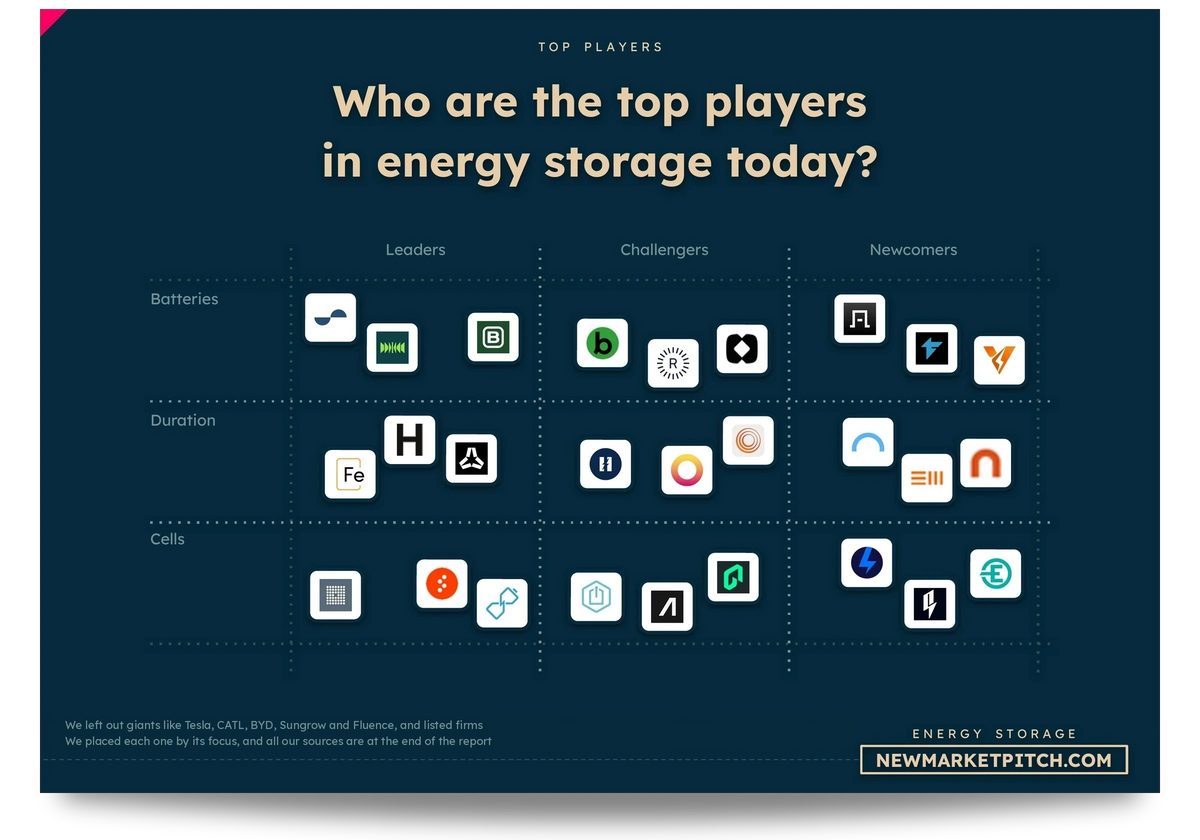
In our document detailing everything you need to know about energy storage, we turn what is vague and complex into simple, useful visuals. Market maps like this one show you at a glance where every startup stands.
Written by the New Market Pitch teamWe track new markets so founders and investors can move faster. About us