How big is the energy storage market as prices crash?
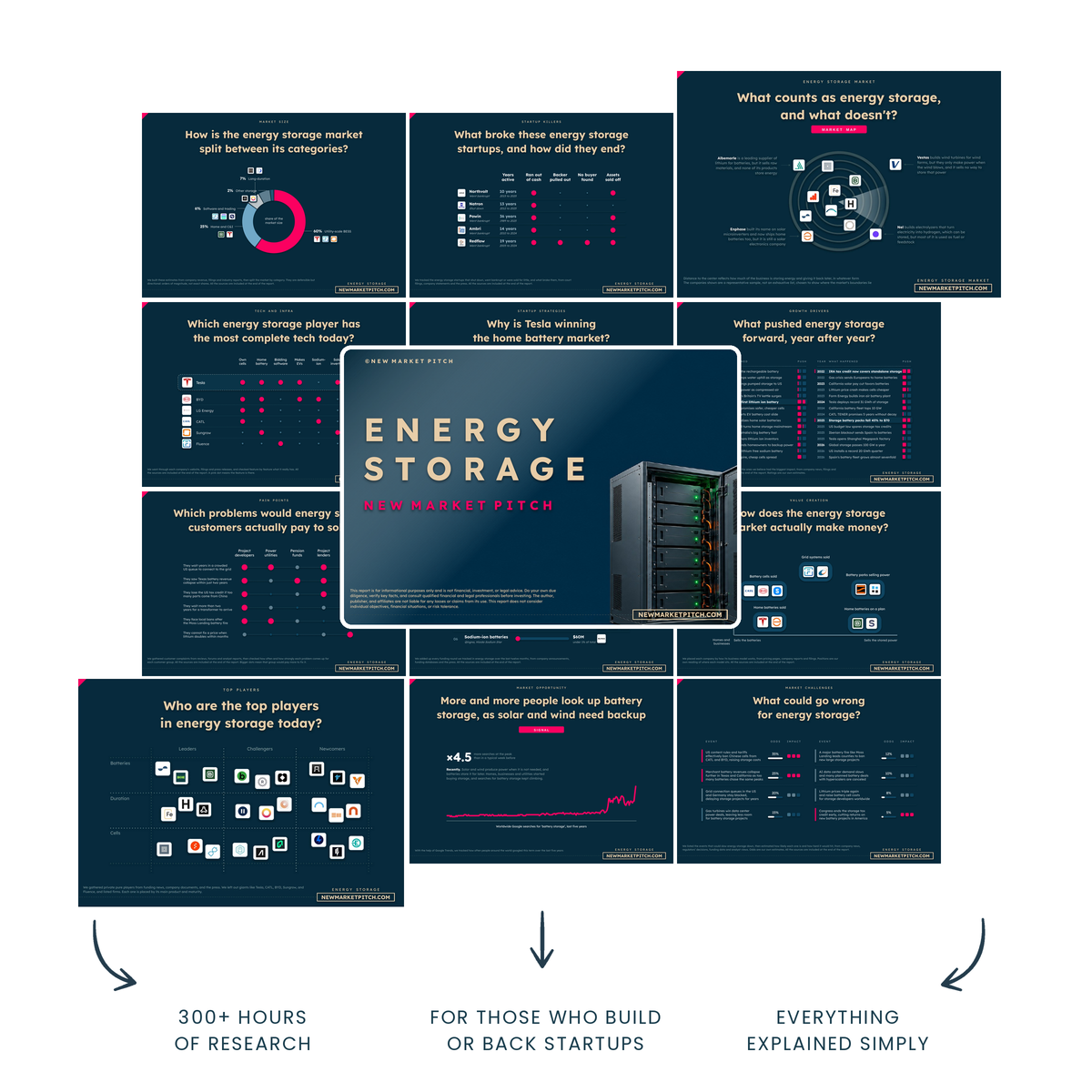
Whether you're building or investing in the energy storage market, our report covers everything you need to know: the players, the money, and what's coming next.
Summary
The global energy storage market represents approximately $45 billion to $85 billion in annual battery project investment, based on our estimate of 2025 deployment and installed costs. Battery prices are collapsing, installations are accelerating, and the industry could exceed $100 billion in annual project spending by 2030. But the companies selling batteries will not necessarily benefit as much as the companies installing and operating them.
Global battery storage installations exceeded 100 GW in 2025, growing roughly 40% in a year. The installed fleet reached approximately 270 GW and 630 GWh, turning grid batteries into a substantial infrastructure industry rather than an emerging technology.
Prices are falling almost too quickly for manufacturers. Stationary-storage battery packs dropped 45% to $70/kWh in 2025, meaning suppliers would need approximately 82% more sales volume just to maintain the same revenue at those prices.
The distinction between battery prices and project costs is crucial. A $70/kWh battery pack is only one component of an operating storage facility. Our estimate uses fully installed costs of $180–$280/kWh, including equipment, electrical systems, construction, and installation.
China has become the industry's manufacturing center and largest installation market. It commissioned approximately 66 GW of non-pumped storage in 2025, while Chinese-headquartered companies captured an estimated 76% of the global battery storage integration market. Yet the United States and Europe are also building substantial markets, adding approximately 87 GWh combined.
Utility-scale projects now drive approximately 80% of global battery storage power additions. That changes the economics of the industry: developers increasingly need revenue from electricity trading, grid services, capacity payments, and contracts rather than relying solely on renewable-energy installation requirements.
There is a catch in the storage business model. As batteries become more common, they can reduce the electricity-price spreads they earn money from. Research on Texas found that modeled gross arbitrage opportunities dropped approximately 71% between 2023 and 2025, even as installed battery capacity expanded dramatically.
Longer-duration projects offer another source of growth. Moving from two-hour batteries toward four-hour systems can double the energy capacity needed for the same power output. Battery demand measured in GWh may therefore grow faster than the headline installation figures measured in GW.
Company results show where the value is moving. Tesla's energy generation and storage segment generated $12.77 billion in 2025 revenue and approximately $3.80 billion in gross profit, while smaller competitors such as Fluence are building businesses around system integration, services, and software. Manufacturing scale matters, but execution and recurring services offer other ways to compete.
The 2030 opportunity depends on the balance between deployment growth and price declines. At 800 GWh of annual installations and $125/kWh in fully installed costs, the market would represent $100 billion in yearly project spending. Our conclusion is that storage will become much larger in physical capacity, but its financial winners will increasingly be determined by who can build, operate, and monetize batteries most effectively.

Written by the New Market Pitch teamWe track new markets so founders and investors can move faster. About us
Why is the energy storage market growing so fast right now?
The global energy storage market is booming because battery prices have fallen much faster than expected, just as power grids need more ways to handle the rapid growth of solar and wind electricity.
The International Energy Agency reported 108 GW of new battery storage installations in 2025, roughly 40% more than the previous year. Wood Mackenzie independently estimated 106 GW, confirming the same order of magnitude.
Battery prices are making an enormous difference. BloombergNEF's December 2025 survey found that stationary-storage battery packs fell 45% in one year to $70 per kilowatt-hour. That drop has made projects viable in places where the economics looked unattractive only a few years ago.
China installed approximately 66 GW of new non-pumped storage capacity in 2025, the United States installed 18.9 GW across utility, commercial and residential segments, and Europe installed 36 GWh. These figures show that storage demand has moved well beyond a handful of early markets.
Meanwhile, solar generation keeps growing, creating more hours when electricity is abundant and cheap, followed by periods when demand exceeds renewable production. Batteries can profit from that difference while helping grid operators balance supply and demand.
How big is the global battery energy storage market today?
The global battery energy storage market now adds more than 100 GW of power capacity annually, with roughly 270 GW and 630 GWh installed worldwide by the end of 2025, according to Wood Mackenzie.
To understand the market's size, we need to distinguish power capacity from energy capacity. Gigawatts measure how much electricity batteries can deliver at once, while gigawatt-hours tell us how long they can sustain that output. A 100 MW battery designed to operate for four hours stores 400 MWh.
In financial terms, we estimate that newly installed battery storage projects represent approximately $45 billion to $85 billion in annual global capital spending around the 2025 deployment baseline. This is our calculated range rather than an officially reported industry total.
It assumes approximately 250–300 GWh of annual installations and average fully installed project costs of $180–$280/kWh, allowing for differences between countries, system designs and storage durations.
Those costs include battery equipment, power conversion, construction and other installation expenses. They exclude pumped hydro, most non-battery storage technologies and the future electricity revenues generated by operating projects.
Energy storage is already a market worth tens of billions of dollars annually, even before counting the commercial value of electricity services delivered over the lifetime of the installed batteries.

Your time is limited. In our report covering the energy storage market, we put numbers on each part of the market, so you can see where it makes sense to focus.
Are battery prices really crashing, or are the cheapest quotes misleading?
Battery storage prices have genuinely collapsed, but the cheapest advertised batteries cost much less than a complete operating storage project.
BloombergNEF measured average stationary-storage battery pack prices at $70/kWh in 2025, compared with approximately $127/kWh in 2024. That 45% decline was unusually steep, even for an industry accustomed to rapid cost reductions.
Across all lithium-ion applications, the average pack price fell by only 8% to $108/kWh. Stationary storage therefore experienced much stronger price pressure than the broader battery market.
Chinese manufacturing competition explains much of the difference. BloombergNEF estimated that China produced 557 GWh of stationary-storage battery cells in 2025, more than twice worldwide stationary-battery installations that year. Manufacturers have been competing aggressively to keep factories occupied and secure orders.
But a battery project also needs inverters, transformers, cooling, fire protection, containers, electrical connections and construction work. Those costs have not fallen at anything close to the same speed as battery cells.
The gap between cell prices and completed projects is important when comparing market estimates.
| Price measure | Latest benchmark | What it measures |
|---|---|---|
| All lithium-ion packs | $108/kWh | Average across applications |
| Stationary-storage packs | $70/kWh | Batteries for energy storage |
| LFP packs, all uses | $81/kWh | Lithium iron phosphate chemistry |
| NMC packs, all uses | $128/kWh | Nickel-based chemistry |
| Lowest observed LFP cells | $36/kWh | Exceptional cell-level transactions |
| Lowest observed storage packs | $50/kWh | Exceptional pack-level transactions |
| Global four-hour storage LCOE | $78/MWh | Lifetime cost of delivered electricity |
The first six benchmarks come from BloombergNEF's 2025 battery price research. The final figure comes from its 2026 Levelized Cost of Electricity report. The last measure uses a different unit because it describes the lifetime cost of delivering electricity rather than the purchase cost of battery capacity.
Could falling battery prices actually shrink the energy storage market in dollars?
Yes. The energy storage market can grow enormously in installed capacity while battery manufacturers earn less revenue because prices are falling faster than sales volumes are increasing.
The arithmetic is surprisingly harsh. When battery-pack prices fall 45%, manufacturers must sell approximately 82% more capacity just to maintain the same revenue.
Global storage installations grew around 40% in power capacity in 2025, according to the IEA. That would not have been enough to offset a 45% price decline if the same growth rate applied to battery energy capacity and product mix remained unchanged.
We should not treat that comparison as proof that actual battery-pack revenue declined. New projects have been moving toward longer storage durations, meaning energy capacity can increase faster than power capacity.
Still, we can calculate exactly how much additional volume manufacturers need to compensate for lower prices. The following scenarios assume an illustrative starting market of 200 GWh sold at $127/kWh, equivalent to $25.4 billion in revenue.
| Volume growth | New pack price | Pack revenue | Revenue change |
|---|---|---|---|
| 0% | $70/kWh | $14.0B | -45% |
| 20% | $70/kWh | $16.8B | -34% |
| 40% | $70/kWh | $19.6B | -23% |
| 60% | $70/kWh | $22.4B | -12% |
| 82% | $70/kWh | $25.5B | ~0% |
| 100% | $70/kWh | $28.0B | +10% |
| 150% | $70/kWh | $35.0B | +38% |
These are modeled scenarios, not reported industry revenues. They show why a booming market for installed batteries can still be a difficult business for companies selling the equipment.
If you want more recent data on this point, please see our latest energy storage market report.

In our research about energy storage, we always try to gather several sources and make estimates that make sense, so you can work with solid numbers.
Is China already dominating the energy storage market?
China already dominates global energy storage manufacturing and accounts for an enormous share of new installations, giving it more influence over battery prices than any other country.
The China Energy Storage Alliance reported 66.43 GW and 189.48 GWh of newly commissioned non-pumped storage during 2025.
New power capacity increased 52%, while energy capacity grew 73%. China has been installing larger batteries capable of delivering electricity for longer periods.
By the end of 2025, China had accumulated approximately 144.7 GW of newer storage technologies, mostly batteries. Its installed base increased 85% in one year.
Chinese companies are even more dominant in manufacturing and system integration. Wood Mackenzie's June 2026 assessment found that Chinese-headquartered companies controlled approximately 76% of the global battery storage integration market in 2025. Eight of the ten largest suppliers were based in China.
There is one important change beneath these impressive figures. China has removed blanket requirements forcing renewable energy projects to install accompanying storage. Developers increasingly need to justify battery projects through actual electricity-market revenues.
China will therefore be an interesting test of whether storage can keep growing when purchases become more commercially driven. Its manufacturers already have the scale to compete aggressively worldwide, but domestic demand will depend more on whether batteries can make money.
Is the energy storage market growing outside China too?
Yes. Battery storage is growing quickly in the United States and Europe, although China still installs far more capacity than either market.
Wood Mackenzie and the American Clean Power Association reported 18.9 GW and approximately 51 GWh of US storage installations in 2025. Power-capacity additions increased 52% from the previous year.
SolarPower Europe's June 2026 assessment found that Europe installed 36 GWh, representing 48% growth.
Together, the United States and Europe added approximately 87 GWh in one year. China commissioned 189.48 GWh of non-pumped storage over the same period, although its figure includes some technologies other than batteries.
We can see different patterns emerging across these markets. In the United States, large utility-scale projects are particularly important in California and Texas, where operators can earn money from changes in hourly electricity prices and grid services.
Europe has also become increasingly focused on utility-scale storage. Large projects overtook household batteries as the biggest source of new installations, helped by the growing need to manage renewable generation and electricity-price volatility.
China's manufacturing scale is difficult to match, but its competitors are building substantial domestic markets. For suppliers with reliable local distribution, regulatory expertise and installation capabilities, there is now meaningful demand across several major regions.

In our market report about energy storage, we don't want to repeat what boring consulting reports say. Instead, we show you the real and latest market signals that matter.
Are utilities finally buying batteries because they make financial sense?
Utilities and independent developers are increasingly installing batteries because they can earn money or reduce electricity-system costs, although government incentives still play a major role.
The shift is visible in the types of projects being built. The IEA found that approximately 80% of global battery-storage power additions in 2025 were utility-scale.
China provides another example. According to the China Energy Storage Alliance, standalone storage represented approximately 58% of its newer storage market applications by the end of 2025.
In Europe, utility-scale batteries accounted for 55% of newly installed energy capacity during 2025. They overtook residential and commercial installations combined.
Utilities have different buying criteria from households. A household might purchase a battery for backup electricity or savings on its power bill. A utility-scale developer needs a financial model based on wholesale electricity trading, capacity payments, grid services or long-term contracts.
Subsidies remain important, particularly in the United States, where tax credits can have a substantial impact on project returns. But the growing share of standalone and utility-scale installations is stronger evidence of storage's commercial value beyond simply meeting renewable-energy mandates.
If you want more recent data on this point, please see our latest energy storage market report.
Are four-hour batteries becoming the standard for energy storage?
Four-hour batteries are becoming much more common, but shorter-duration systems still represent a large part of global energy storage.
The IEA reported that most installed battery projects were still concentrated around two-hour duration in 2025, with a growing proportion designed for four hours or longer.
China shows how quickly the market is changing. The China Energy Storage Alliance reported 66.43 GW and 189.48 GWh of new non-pumped storage in 2025. Dividing energy capacity by power capacity gives approximately 2.85 hours.
For comparison, the Alliance reported an average project duration of 2.11 hours in 2021. The figures come from different reporting populations, but the direction is clear: new storage projects are increasingly designed to deliver electricity for longer.
That creates additional battery demand beyond the growth in project numbers. A 100 MW battery with two hours of storage contains 200 MWh. Extending the same power capacity to four hours requires 400 MWh, effectively doubling its energy capacity.
Longer durations also make batteries more useful for shifting solar electricity from midday into the evening, when household and commercial demand often remains high.
This is why gigawatt-hours tell us more about the industry's growth than gigawatts alone.

In our document detailing everything you need to know about energy storage, we like to show you the big picture. We know your time is precious, so we make every page quick to read and packed with as much learning as possible per minute.
Are solar farms making energy storage essential?
Solar power is becoming one of the biggest reasons electricity grids need more batteries, particularly in regions where large amounts of generation arrive during the same sunny hours.
As solar capacity increases, wholesale electricity prices can fall sharply around midday. In some markets, prices even become negative because electricity supply temporarily exceeds what buyers and the grid can absorb.
Batteries can store that electricity and deliver it later, when solar production decreases and electricity becomes more valuable.
BloombergNEF's 2026 power-cost analysis reported 87 GW of combined solar-and-storage project additions in 2025, with an average levelized electricity cost of $57/MWh for the combined configuration.
Europe provides another useful comparison. SolarPower Europe's June 2026 assessment found that the EU had approximately eight times more installed solar power capacity than battery power capacity by the end of 2025. The ratio had improved from 10:1 the previous year, showing that storage was starting to catch up.
The opportunity is already substantial because existing solar farms create a need for flexibility even before another panel is installed.
However, project economics still vary enormously between locations. A battery beside a solar farm experiencing frequent low-price afternoons may be much more valuable than one connected to a grid with little price variation.
Can energy storage companies actually make money when electricity is cheap?
Battery storage operators can make good money in markets with large differences between cheap and expensive electricity hours, but growing competition is making those profits harder to maintain.
Imagine a battery charging when wholesale electricity costs $20/MWh and discharging when prices reach $100/MWh. With 85% round-trip efficiency, it would generate approximately $76.50 in gross arbitrage margin per MWh discharged, before degradation and other operating expenses.
The average electricity price matters less than the spread between charging and discharging hours.
Batteries can also earn revenue by helping grid operators maintain frequency, providing reserves or guaranteeing capacity during periods of high demand.
BloombergNEF's 2026 analysis found that the global levelized cost of electricity from four-hour battery storage had fallen to approximately $78/MWh, down 27% from the previous year. Cheaper equipment makes more of these revenue opportunities financially attractive.
But there is an important catch: as more batteries enter the same electricity market, they often charge and discharge during similar hours. That reduces the price differences everyone is trying to capture.
Texas provides one of the clearest examples. A September 2026 study in Energy Economics examined a market where battery power capacity expanded from approximately 0.1 GW in 2020 to more than 14 GW by July 2025.
The researchers estimated that theoretical gross energy-arbitrage revenues fell from $213 per kW-year in 2023 to $61 per kW-year in 2025, a decline of approximately 71%. These are modeled opportunities rather than operators' total realized revenues. Growing solar capacity also influenced prices.
Still, the pattern is striking. Batteries are becoming cheaper to install, while some of the best electricity-trading opportunities are becoming less profitable.
For developers, this makes market selection, revenue contracts and dispatch strategies increasingly important. Buying an inexpensive battery is only the beginning.
If you want more recent data on this point, please see our latest energy storage market report.

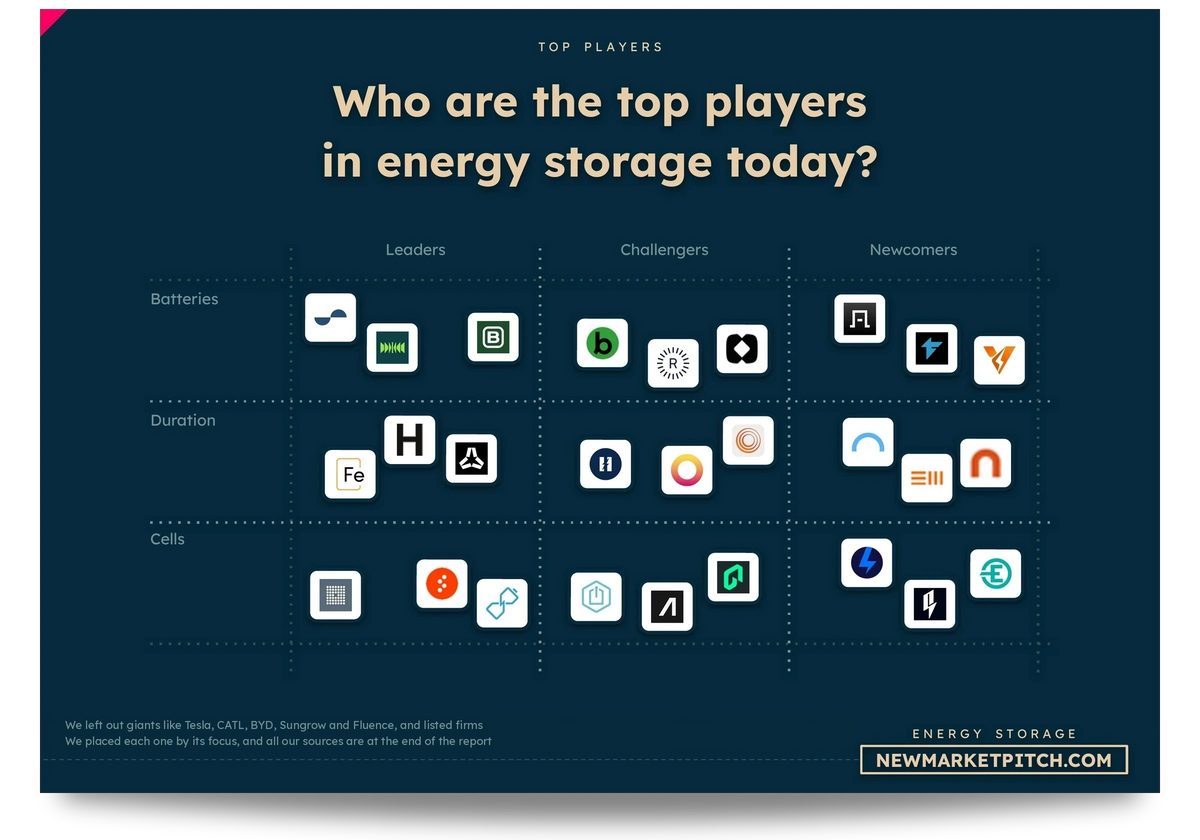
In our report covering the energy storage market, we turn what is vague and complex into simple, useful visuals. Market maps like this one show you at a glance where every startup stands.
Is Tesla proving that energy storage can become a major business?
Tesla has already built a multibillion-dollar energy storage business, with revenue and gross profit growing strongly even as battery equipment prices have fallen.
Tesla deployed 46.7 GWh of energy storage products in 2025, according to its January 2026 delivery statement.
Its annual filing showed $12.77 billion of energy generation and storage revenue, up from $10.09 billion in 2024 and $6.04 billion in 2023.
Revenue more than doubled over those two years. The segment's gross profit grew from approximately $1.14 billion in 2023 to $3.80 billion in 2025.
That produced a gross margin of approximately 29.8% in 2025, calculated from Tesla's reported revenue and cost of sales.
Tesla's energy segment also includes solar-related activities and leasing, so these financial results cannot be attributed entirely to Megapacks and Powerwalls. Its gross profit also excludes operating expenses.
Even so, the results show that large-scale energy storage can generate meaningful industrial profits. Tesla benefits from its manufacturing operations, battery procurement, software capabilities and established relationships with major electricity customers.
And it has managed to grow this business during a period of severe battery-price competition.
Can smaller energy storage companies compete with Tesla, CATL and BYD?
Smaller energy storage companies can still build substantial businesses, but competing against Tesla, CATL and BYD on battery manufacturing costs is becoming extremely difficult.
Wood Mackenzie's June 2026 analysis ranked Tesla, Sungrow and BYD as the three largest global battery storage system integrators in 2025. Together, they controlled approximately 30% of the market.
That leaves substantial business for other suppliers, especially those offering engineering, installation, software, warranties and long-term operating services.
Fluence provides a useful example. Its fiscal 2025 results showed approximately $5.3 billion in backlog, up from $4.5 billion a year earlier. It also reported roughly $148 million in annual recurring revenue from services and digital offerings.
Fluence operates differently from a company focused primarily on manufacturing battery cells. Its business includes integrating storage systems, delivering projects and providing ongoing services.
These capabilities become more important as buyers demand reliable performance over operating lifetimes that can extend well beyond a decade.
The competitive pressure is strongest for suppliers selling largely interchangeable battery equipment. Companies that manage difficult installations, improve battery dispatch, provide dependable warranties or understand local electricity-market rules have more ways to distinguish themselves.
We expect the energy storage industry to support multiple successful business models, although manufacturing scale will remain a considerable advantage.
If you want more recent data on this point, please see our latest energy storage market report.

Our research about energy storage gets updated several times a month, so you always get the latest view of where things stand.
Are home batteries growing as fast as large grid batteries?
Home battery sales are much less reliable than utility-scale storage growth, and lower equipment prices have not prevented demand from weakening in some major markets.
SolarPower Europe reported that EU residential battery installations declined 6% in 2025 to approximately 9.8 GWh. Total European storage installations increased 48% over the same year.
That gap is revealing. Large grid projects were growing rapidly while the household market contracted.
Residential demand depends heavily on retail electricity tariffs, solar compensation rules, subsidies and whether households need backup power.
The United States experienced a different pattern. Wood Mackenzie's March 2026 assessment found that residential battery installations reached approximately 1 GWh in the final quarter of 2025 as customers accelerated purchases before changes to federal tax incentives.
However, the same report projected a 2% contraction in US residential storage installations for 2026 following the expiration of the residential federal tax credit.
These regional differences explain why cheaper batteries do not automatically produce stronger household sales.
For now, utility-scale projects offer a more dependable picture of the industry's underlying growth. Residential batteries remain attractive in selected markets, particularly where electricity bills are high, solar self-consumption is valuable or power outages are a serious concern.
Will sodium-ion batteries replace lithium batteries in energy storage?
Sodium-ion batteries are becoming a credible alternative for some storage applications, but lithium iron phosphate batteries remain far ahead in manufacturing scale, cost competitiveness and commercial adoption.
The IEA estimated that LFP chemistry accounted for approximately 90% of newly deployed battery storage in 2025.
LFP batteries have benefited from years of manufacturing improvements, large production volumes and relatively inexpensive materials. Their long cycle life also makes them well suited to daily charging and discharging.
Sodium-ion technology could reduce dependence on lithium and offer advantages in selected operating conditions. But it faces a difficult commercial challenge: lithium battery prices have fallen so far that sodium-ion manufacturers must prove they can produce an equally reliable system at an attractive cost.
Other technologies are competing for a different part of the market. Flow batteries, compressed-air systems and thermal storage may become more useful when electricity needs to be stored for eight, twelve or even twenty hours.
Those applications are harder for conventional lithium-ion systems to serve economically because increasing storage duration requires additional battery capacity.
The commercial question is whether grid operators will pay enough for those longer discharge periods to support alternative technologies.
We expect lithium-ion batteries to remain the main technology for conventional short- and medium-duration storage, while newer systems develop around applications where their specific advantages justify the cost.

In our market report about energy storage, you will always find fresh funding data, taken straight from our own verified funding database.
How big could the energy storage market become by 2030?
The global energy storage market could become several times larger in installed energy capacity by 2030, with annual project spending potentially exceeding $100 billion if installation volumes grow fast enough.
Europe already has a striking forecast. SolarPower Europe's June 2026 outlook projects annual battery installations reaching 138 GWh by 2030, up from 36 GWh in 2025.
That would make the European annual market almost four times larger in energy capacity within five years.
In the United States, Wood Mackenzie's March 2026 outlook anticipated approximately 500 GWh of cumulative new storage installations between 2026 and 2031. It also forecast that annual utility-scale energy installations would double between 2025 and 2030.
China is starting from an even larger base, although its future growth will depend partly on how changes to renewable-storage requirements and electricity-market compensation affect new investments.
To understand what these forecasts could mean financially, we calculated several global scenarios combining annual installations with fully installed project costs.
| Annual global deployment | Installed cost | Annual project spending |
|---|---|---|
| 300 GWh | $200/kWh | $60B |
| 400 GWh | $150/kWh | $60B |
| 500 GWh | $150/kWh | $75B |
| 600 GWh | $130/kWh | $78B |
| 700 GWh | $140/kWh | $98B |
| 800 GWh | $125/kWh | $100B |
| 1,000 GWh | $120/kWh | $120B |
These are our illustrative calculations, rather than published industry forecasts. They cover newly installed battery projects and exclude future operating revenues.
The comparison reveals how dramatically falling prices can change the market's financial trajectory. Annual installations could double from 300 GWh to 600 GWh while project spending increases only from $60 billion to $78 billion, depending on installation costs.
At 800 GWh and $125/kWh, annual project spending would reach approximately $100 billion.
That gives the industry a credible route to a much larger annual market, although equipment-price declines, project delays and electricity-market revenues will determine how much of the potential becomes actual spending.
How big is the energy storage market as prices crash?
The global energy storage market is already worth roughly $45 billion to $85 billion in annual battery project investment by our estimate, and falling prices are pushing installation volumes toward a much larger market. But battery manufacturers will not necessarily make more money at the same pace.
The scale is clear. Worldwide battery installations exceeded 100 GW of new power capacity in 2025, while the installed fleet reached approximately 270 GW and 630 GWh. China dominates manufacturing, but American and European installations are also growing rapidly.
The financial picture is more complicated. Storage battery packs fell 45% in price in a single year, which means manufacturers need roughly 82% more sales volume to maintain the same pack revenue. Meanwhile, evidence from Texas shows that batteries can reduce the electricity-price differences that make storage projects profitable.
We see three different markets emerging inside the same industry: manufacturers selling increasingly cheap battery equipment, developers building larger storage projects, and operators earning revenue from electricity trading and grid services. Their fortunes will not move together.
By 2030, annual global storage project spending could exceed $100 billion under scenarios with sufficiently strong deployment growth, even if battery costs keep falling.
Our conclusion is that the energy storage market is becoming much bigger in physical capacity and usefulness to electricity grids. The opportunity is already enormous, but the companies making the most money may increasingly be those that can install, operate and monetize storage efficiently rather than simply manufacture more batteries.
If you want more recent data on this point, please see our latest energy storage market report.

In our document detailing everything you need to know about energy storage, we look at what the winners do differently, so you can learn from the best instead of guessing.
Our methodology
This analysis estimates the size of the global battery energy storage market as equipment prices decline. We separate new installations, installed capacity, battery equipment revenue, complete project investment, and operating economics because each measures a different part of the industry. Our central estimate of $45 billion to $85 billion refers specifically to annual investment in newly installed battery storage projects around the 2025 deployment baseline, not to the industry's total revenue or enterprise value.
We built the assessment by aggregating recent evidence across seven dimensions: global deployment, battery and project pricing, regional demand, utility-scale commercial economics, storage duration and competing technologies, company performance, and deployment outlooks through 2030. For each dimension, we compared fresh figures from independent sources, examined the relationships between them, and used those comparisons to support broader conclusions about market growth and value creation.
For global deployment, we compared the International Energy Agency's Global Energy Review 2026 battery storage analysis and historical installation data with Wood Mackenzie's global storage assessment. The IEA's 108 GW and Wood Mackenzie's 106 GW installation estimates establish the scale of annual additions, while Wood Mackenzie's approximately 270 GW and 630 GWh cumulative figures anchor the installed base. We keep GW and GWh separate throughout the analysis because changes in storage duration can make power-capacity and energy-capacity growth diverge.
For pricing, we used BloombergNEF's 2025 battery price survey, its research on manufacturing overcapacity and price competition, and its 2026 battery storage cost analysis. We distinguish battery-cell and pack prices from fully installed project costs, and capital costs expressed per kWh from levelized electricity costs expressed per MWh. Our annual investment range applies 250–300 GWh of assumed installations to $180–$280/kWh in installed costs, producing approximately $45 billion to $84 billion before rounding the upper bound to $85 billion.
For regional demand, we combined the China Energy Storage Alliance's annual deployment data, the American Clean Power Association and Wood Mackenzie's US installation results, and SolarPower Europe's European Battery Market Outlook 2026–2030 and EU Battery Storage Market Review. We also reviewed China's renewable electricity pricing reform to understand the shift away from blanket storage requirements. Regional comparisons account for differences in geographical coverage, reporting definitions, and whether non-battery technologies are included.
To assess commercial sustainability, we examined the changing share of utility-scale and standalone installations, electricity-market participation, storage costs, and the effect of growing battery deployment on electricity-price spreads. The US Energy Information Administration's research on battery price arbitrage helps establish the revenue applications, while a September 2026 Energy Economics study of ERCOT provides a quantified example of arbitrage revenue compression. We treat the Texas study's results as modeled gross arbitrage opportunities, not as actual total operator revenues or a forecast for every electricity market.
For competition and company economics, we used Wood Mackenzie's global storage system-integrator rankings, Tesla's 2025 Form 10-K, Tesla's annual deployment disclosure, and Fluence's fiscal 2025 financial results. These sources allow us to compare manufacturing and integration market shares with actual company revenue, gross profit, backlog, and service revenue. We do not treat a diversified company's segment revenue as pure battery equipment sales, or gross profit as net profit.
Our price-volume sensitivity calculations begin with an illustrative 200 GWh market at $127/kWh, or $25.4 billion in pack revenue, and apply alternative sales-volume growth rates at $70/kWh. Our 2030 scenarios multiply assumed annual deployment of 300–1,000 GWh by fully installed costs of $120–$200/kWh. These calculations are our own, rather than published market totals or forecasts. They are used to test how falling prices can affect revenue and capital spending even when physical installations grow rapidly.
For the longer-term outlook, we drew on SolarPower Europe's projections through 2030 and the US storage forecasts reported by Wood Mackenzie and the American Clean Power Association, alongside the global deployment and pricing evidence. We distinguish published forecasts from our scenarios and avoid assuming that installed capacity, battery equipment revenue, project spending, and operator profitability will grow at the same rate.
Across the assessment, we prioritized original agency statistics, industry research, government policy documents, corporate financial disclosures, and academic work. We compared overlapping measurements where possible, kept differences in market definitions visible, and separated observed performance from calculated estimates and future scenarios. The resulting conclusion reflects evidence aggregated across deployment, pricing, demand, profitability, and competitive position rather than any single headline market-size figure.

If you build or invest in the energy storage market, you need to know which business models pay off now and which ones are fading. That's why our report covering it has a whole section on it.
Written by the New Market Pitch teamWe track new markets so founders and investors can move faster. About us