Who are the top energy storage startups beyond lithium?
Whether you're building or investing in the energy storage market, our report covers everything you need to know: the players, the money, and what's coming next.
Summary
Form Energy, Eos Energy Enterprises, Rondo Energy, Antora Energy, Energy Dome and Peak Energy lead the field of energy storage challengers beyond lithium. There is no single winner: each is solving a different problem, from four-hour grid backup to multi-day electricity supply and industrial heat.
Storage duration changes the competition. A 100 MW system running for four hours needs 400 MWh, whereas running for 100 hours requires 10 GWh; the cheapest technology for one task may be a poor fit for the other.
Form Energy has the strongest multi-day pipeline, with iron-air batteries designed for 100-hour discharge and approximately 80 GWh of reported project backlog. That sounds enormous, but at 100 hours it represents roughly 800 MW of power, and much of it still needs to be delivered.
Eos is further along in selling actual electricity-storage equipment. Its $807 million backlog and growing revenue show customer demand, but a negative 71% quarterly gross margin shows how far manufacturing economics have to improve.
Industrial heat is a separate market, and a potentially attractive one. Rondo has a 100 MWh commercial heat battery operating, while Antora has named thermal projects totaling 10.8 GWh; neither figure should be treated as equivalent to electrical battery capacity.
Energy Dome has begun to repeat its roughly 10-hour CO₂ storage model across different utility and technology customers. Google's proposed Irish project is promising, though signed contracts are not yet evidence of a mature operating fleet.
Peak Energy's agreement with Jupiter Power runs to as much as 4.75 GWh, but most of that volume is optional and scheduled for future years. Sodium-ion must win on full system costs and reliable delivery, not just cheaper raw materials.
Hydrostor and Highview pursue large compressed-air and liquid-air plants. Their project sizes are impressive, yet site engineering, permits and financing make replication slower than expanding modular battery production.
AI data centers are creating new demand, particularly for Form Energy and Energy Dome. The evidence is strongest in procurement commitments; dependable performance at operating data centers remains the bigger test.
The competitive split is now clearer: Form leads on multi-day potential, Eos on zinc-battery commercialization, Rondo on demonstrated industrial heat, and Antora on announced heat-storage scale. Lithium remains difficult to beat for conventional short-duration applications.

Written by the New Market Pitch teamWe track new markets so founders and investors can move faster. About us
Why are energy storage startups looking beyond lithium-ion batteries?
Energy storage startups are finding real opportunities beyond lithium-ion because storing electricity for four hours and storing it for four days are very different problems, and lithium batteries are much better suited to the first.
Lithium-ion still dominates new battery installations. According to the International Energy Agency, global battery storage additions reached 108 GW in 2025, up 40% from the previous year, with lithium iron phosphate (LFP) accounting for roughly 90% of installations. Falling prices, established factories, and reliable performance have made lithium harder to compete against, particularly for shorter-duration storage.
But electricity grids increasingly need storage that can last through prolonged periods of weak wind or solar generation. Industrial facilities also need enormous amounts of heat, often continuously, and AI data centers are adding another source of demand for dependable electricity.
Different companies are attacking those problems. Form Energy is developing iron-air batteries that discharge over 100 hours. Energy Dome uses compressed carbon dioxide for roughly 10-hour storage. Rondo Energy stores electricity as industrial heat, while Peak Energy is commercializing sodium-ion batteries designed for conventional grid installations.
The technologies are at very different stages. Some companies have operating industrial systems, others have large orders scheduled for future delivery, and several are still proving their first full-scale projects. An operating plant and a proposed one are quite different achievements.
Which non-lithium energy storage startups are actually leading?
Form Energy, Eos Energy Enterprises, Rondo Energy, Antora Energy, Energy Dome, and Peak Energy currently stand out among non-lithium storage challengers, with Hydrostor, Highview Power, and Invinity Energy Systems competing in more specialized markets.
The comparison rests on progress toward selling, building, and operating storage systems. Form has unusually large future commitments for multi-day storage. Eos already reports meaningful equipment revenue. Rondo has demonstrated continuous industrial heat delivery, while Antora is developing thermal installations measured in gigawatt-hours rather than megawatt-hours.
Energy Dome has attracted customers including Google and ENGIE, Peak has a major sodium-ion agreement with Jupiter Power, and Hydrostor has advanced a large compressed-air project through permitting in California.
These companies sell different products. Eos and Peak compete more directly with conventional batteries. Form aims to cover much longer electricity shortages. Rondo and Antora primarily replace fossil fuels used for industrial heat. Hydrostor and Highview develop large mechanical storage facilities.
We include publicly traded challengers such as Eos and Invinity because their commercial progress remains relevant, even though they no longer fit the strict definition of privately held startups.
| Company | Technology | Strongest evidence | Current position |
|---|---|---|---|
| Form Energy | Iron-air | Major multi-day storage commitments | Leading multi-day contender |
| Eos Energy | Zinc-based batteries | $807M backlog and commercial revenue | Established commercial challenger |
| Rondo Energy | Thermal batteries | 100 MWh operating heat installation | Leader in demonstrated industrial heat |
| Antora Energy | Thermal batteries | 5 GWh commissioning and 5.8 GWh project | Large-scale thermal contender |
| Energy Dome | CO₂ storage | Utility agreements and Google project | Leading 10-hour contender |
| Peak Energy | Sodium-ion | Up to 4.75 GWh with Jupiter Power | US sodium-ion challenger |
| Hydrostor | Compressed air | Permitted 500 MW / 4 GWh project | Large-project contender |
| Highview Power | Liquid air | 50 MW / 300 MWh project under construction | Cryogenic storage contender |
| Invinity Energy | Vanadium flow | Growing sales and UK project construction | Flow-battery contender |
These figures describe different stages, from operating installations to conditional future supply. They should not be added together as deployed capacity.

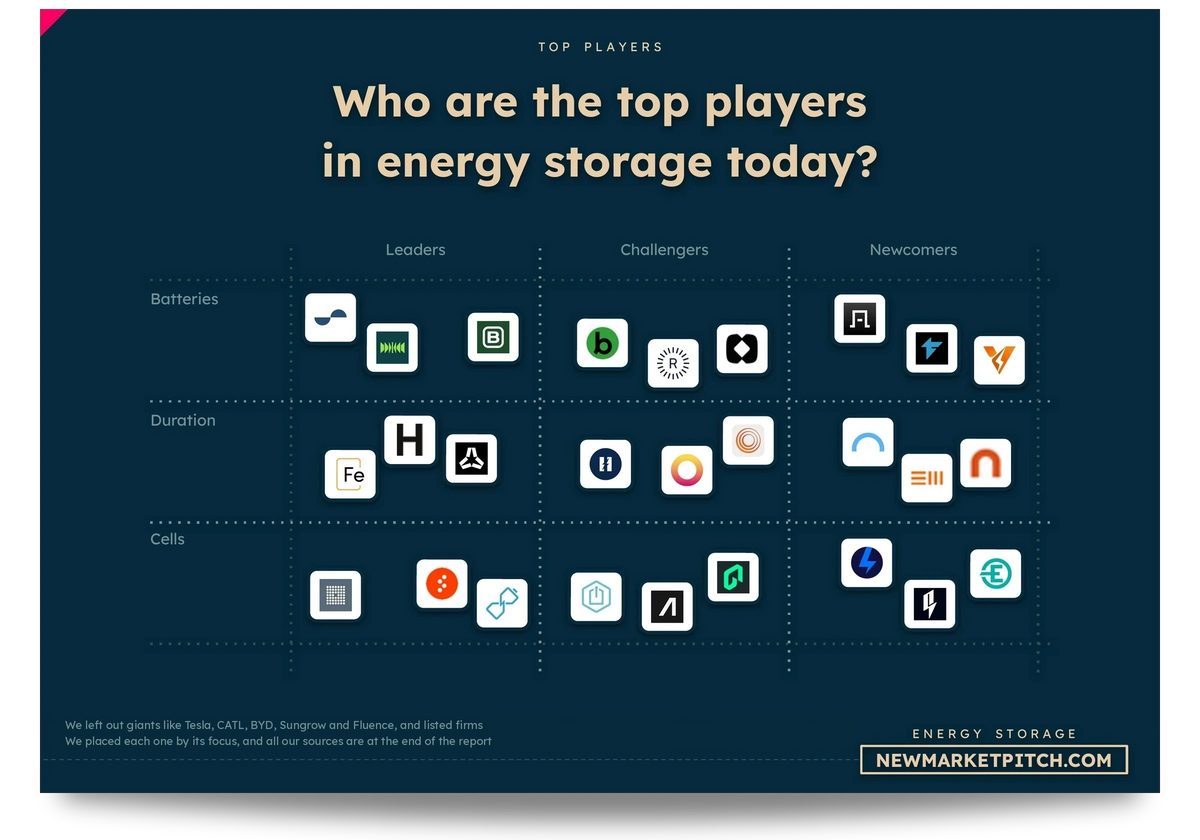
In our report covering the energy storage market, we turn what is vague and complex into simple, useful visuals. Market maps like this one show you at a glance where every startup stands.
Is Form Energy the strongest long-duration battery startup?
Form Energy is the strongest contender for multi-day electrochemical storage, with customer commitments at a scale that few alternative battery startups can match.
Its iron-air batteries are designed to discharge for 100 hours, enough to supply electricity over more than four consecutive days. That is a different job from the short daily charging and discharging cycles served by most lithium-ion grid batteries.
The company's commercial pipeline expanded substantially in 2026. Form signed a capacity agreement to supply 12 GWh of storage to AI infrastructure developer Crusoe, beginning in 2027. It also announced a 10 MW / 1,000 MWh project with FuturEnergy Ireland and a proposed 30 GWh storage installation associated with Google's Minnesota data-center development.
In August, Form raised another $750 million, bringing its cumulative funding above $2 billion. Reporting by The Wall Street Journal and TechCrunch indicated that its commercial project backlog had reached approximately 80 GWh.
There is a catch with that headline. At a 100-hour discharge duration, 80 GWh represents around 800 MW of electrical output. The energy capacity is enormous, but the power output is much smaller than the figure might initially suggest.
Form began deploying its first commercial iron-air batteries for Great River Energy in Minnesota in October 2025. Manufacturing is underway, but the company has yet to prove that its full order book can be delivered economically and operated reliably.
For now, Form deserves first place for multi-day storage potential. Its lead rests on the strength of customer commitments, financing, and industrial preparation. The next few years of factory output and operating results will determine how much of that lead becomes a durable business.
If you want more recent data on this point, please see our latest energy storage market report.
Is Eos Energy already selling zinc batteries at scale?
Eos Energy Enterprises is among the clearest examples of a non-lithium battery manufacturer generating substantial commercial revenue, although making those batteries profitably remains a serious problem.
The Pennsylvania-based company develops zinc-based batteries for long-duration electricity storage. Its second-quarter 2026 results showed $68.8 million in revenue, up 351% from the same quarter a year earlier. Revenue across the first half reached $125.7 million, already exceeding the company's entire 2025 revenue.
Demand has also become more concrete. Eos reported an $807 million backlog representing 3.4 GWh of capacity, up 25% from the previous quarter. Its technology had cumulatively discharged more than 6.5 GWh of electricity, giving the company operating experience that many emerging storage manufacturers still lack.
Manufacturing costs tell a much less comfortable story. Eos recorded a $48.8 million gross loss during the quarter, equivalent to a negative 71% gross margin. Even though that margin improved dramatically from negative 203% a year earlier, production remained far from profitable.
Customer concentration adds another concern. Approximately $55 million of quarterly revenue came from a project financed by an affiliate of Cerberus before being transferred to the Frontier Power USA venture. That single project accounted for roughly 80% of reported revenue.
The commercial progress is real, particularly in growing sales and manufacturing output. But Eos still needs to show that a much larger factory can produce batteries at a cost customers will pay without continuing to generate enormous losses.

Our research about energy storage gets updated several times a month, so you always get the latest view of where things stand.
Can Energy Dome turn CO₂ batteries into a serious alternative?
Energy Dome has become one of the strongest contenders in 10-hour electricity storage, supported by a repeatable plant design and customers willing to commit to projects rather than just demonstrations.
The Italian company's technology compresses and liquefies carbon dioxide when electricity is available, then expands the stored CO₂ through machinery to generate power when it is needed. Its standard commercial design targets approximately 20 MW of output and 200 MWh of storage.
Energy Dome tested the technology in Sardinia before moving toward larger projects. ENGIE agreed to purchase storage services from its Ottana facility in December 2024. In the United States, Alliant Energy has pursued a roughly 200 MWh installation at its Columbia Energy Storage Project in Wisconsin.
Google added another important customer in June 2026, announcing a 23 MW / 200 MWh Energy Dome project in Ireland. The facility has planning permission, a grid connection, and a 10-year capacity contract, with operation expected in 2028.
Across these projects, a pattern is emerging: Energy Dome is selling essentially the same storage concept to different types of electricity customers, including utilities, traders, and technology companies. That should make future installations easier to standardize if the first commercial plants perform well.
Construction and commissioning remain the sticking points. Some previously announced schedules have slipped, and a portfolio of signed agreements still offers limited evidence about actual maintenance costs and long-term efficiency.
Energy Dome has already crossed the difficult threshold of attracting serious commercial buyers. The next test is whether a series of full-scale plants can operate reliably at the prices those buyers expect.
Are Rondo Energy and Antora Energy ahead in industrial heat storage?
Rondo Energy currently has stronger evidence of continuous industrial operation, while Antora Energy has moved ahead on the size of its announced thermal battery projects.
Both companies use electricity to heat materials that can retain energy at very high temperatures. Industrial customers then use that stored heat for processes such as producing steam, processing fuels, or manufacturing materials.
Rondo began commercial operation of a 100 MWh heat battery at a California industrial facility in October 2025. The system supplies continuous steam and reportedly achieved heat-delivery efficiency above 97% during initial operations. Rondo also announced an operating installation with SCG at a cement plant in Thailand, delivering 2.3 MW of continuous thermal power.
Antora has taken a different route toward very large projects. In May 2026, Antora and biofuels producer POET announced the commissioning of a 5 GWh thermal storage system in South Dakota, built around more than 200 battery units. Full operation was planned for later in the year.
Then, in October, Antora announced a further 5.8 GWh project at Pratt Energy's Kansas biorefinery, backed by investors including Copenhagen Infrastructure Partners.
Those two named Antora projects amount to 10.8 GWh of planned thermal storage, though only part of that capacity had entered service when announced.
The difference between heat and electricity is important here. These installations cannot be compared directly with grid batteries on electrical output or round-trip electrical efficiency. Their customers primarily want cheaper, dependable industrial heat.
Rondo has the edge on demonstrated operating history and Antora on the scale of its named projects. Both have made enough progress to deserve places among the top alternative storage companies.
If you want more recent data on this point, please see our latest energy storage market report.

In our market report about energy storage, we look at what the winners do differently, so you can learn from the best instead of guessing.
Can Peak Energy make sodium-ion batteries competitive with lithium?
Peak Energy is currently one of the strongest US sodium-ion storage startups, but lithium-ion prices and competition from established Asian manufacturers remain formidable obstacles.
Peak is developing sodium-ion battery systems for stationary electricity storage. Its design emphasizes passive cooling, low maintenance requirements, and stable performance across repeated charging cycles, rather than trying to maximize energy density for electric vehicles.
After delivering a grid-scale pilot in Colorado in 2025, Peak announced a major agreement with Jupiter Power. The arrangement covers up to 4.75 GWh of installations between 2027 and 2030, including an initial phase of approximately 720 MWh and an option for another 4 GWh.
Most of the headline capacity remains optional, with deliveries scheduled for future years. Peak has not yet installed anything approaching 4.75 GWh.
The company is also planning a US manufacturing facility with 4 GWh of annual capacity, targeted to begin production in 2027. The strategy could appeal to electricity buyers who want to reduce their dependence on Chinese lithium battery supply chains.
But sodium-ion is becoming a competitive industry of its own. CATL introduced a sodium-ion stationary storage system in June 2026 and has outlined plans to increase shipments. Established manufacturers have obvious advantages in factory construction, procurement, and production experience.
Peak's best chance may come from simplifying the entire storage system, reducing cooling and maintenance expenses, and delivering batteries reliably in the US market. A cheaper raw material alone will not be sufficient.
Can Hydrostor and Highview Power build storage plants big enough to compete with batteries?
Hydrostor and Highview Power have credible designs for large electricity-storage plants, but the cost and complexity of constructing those facilities make expansion slower than manufacturing conventional battery units.
Hydrostor stores energy by compressing air and releasing it later to generate electricity. Its Willow Rock project in California is designed to deliver 500 MW for eight hours, providing 4 GWh of storage capacity.
California's Energy Commission approved the project in December 2025. Hydrostor subsequently announced a 50 MW offtake agreement with California Community Power and an engineering partnership with Hatch. Those milestones improved the project's commercial position, although Willow Rock had not yet become an operating plant.
Highview Power takes a different approach by liquefying air, storing it in insulated tanks, and expanding it to recover electricity. Its Carrington project near Manchester is designed for 50 MW of power and 300 MWh of storage. The project received backing from a £300 million investment package announced in 2024 and reached a groundbreaking milestone in November 2025.
These projects require substantial upfront engineering work, large equipment installations, grid connections, and sometimes years of permitting. They also offer the possibility of long asset lives using familiar industrial machinery.
Hydrostor has one of the more ambitious individual projects among mechanical storage challengers, while Highview is advancing an important commercial demonstration of liquid-air storage. Neither company has yet shown that its projects can be replicated quickly enough to compete broadly with battery factories.

In our document detailing everything you need to know about energy storage, you will always find fresh funding data, taken straight from our own verified funding database.
Are flow battery startups finally getting real customers?
Flow batteries have reached commercial customers, but the industry's installation volumes remain tiny compared with lithium-ion, and even the leading specialists are still working toward consistent large-scale manufacturing.
Flow batteries store energy in liquid electrolytes, separating energy capacity from the equipment that converts it into electricity. That makes them particularly interesting for applications requiring long service lives and repeated deep discharges.
Invinity Energy Systems provides a useful example. The UK-based vanadium-flow specialist reported 31.4 MWh of battery sales in 2025, compared with 5.2 MWh in 2024. That is an increase of roughly 504%, a strong result for a relatively small company.
The absolute numbers reveal the remaining gap. Annual sales of 31.4 MWh equal just 0.0314 GWh. Invinity also began construction of its 20.7 MWh Copwood project in England, with operation targeted for 2026, but projects at that scale are still far below the installations being planned by larger storage developers.
ESS Tech, which develops iron-flow batteries, illustrates how difficult the next stage can be. Its financial disclosures have highlighted restructuring and financing pressures as the company tries to develop a sustainable manufacturing business.
Flow batteries remain attractive where long operating life, frequent cycling, and reduced dependence on lithium materials carry substantial value. So far, however, commercial adoption has developed much more slowly than the technology's advocates once expected.
If you want more recent data on this point, please see our latest energy storage market report.
Which energy storage startups win at four, ten, or 100 hours?
The best alternative to lithium changes sharply with storage duration, which is why companies such as Peak Energy, Energy Dome, and Form Energy can all succeed without fighting for identical projects.
Consider a grid operator that needs 100 MW of electricity for four hours. That requires 400 MWh of stored energy. Extending delivery to 100 hours increases the requirement to 10,000 MWh, or 25 times more storage capacity.
Conventional LFP batteries remain extremely competitive for frequent, shorter cycles, benefiting from established factories and relatively high efficiency. Zinc and flow batteries become interesting at longer daily durations. Energy Dome and compressed-air systems target roughly eight to 12 hours or more, while Form Energy is specifically pursuing multi-day applications.
Thermal storage follows a different set of economics. Where customers need heat directly, storing electricity as heat can avoid the losses involved in converting it back into electricity.
There are no universal duration boundaries at which one technology automatically becomes cheaper. Charging frequency, financing costs, location, degradation, and electricity prices can all change the answer. But duration helps narrow down which startups are genuine alternatives for a particular customer.
| Storage need | Relevant companies | Main economic challenge |
|---|---|---|
| Under 2 hours | Lithium incumbents; selected sodium-ion systems | Installed cost and power delivery |
| 2–4 hours | Peak Energy; lithium LFP suppliers | Total lifetime cost |
| 4–8 hours | Eos; Invinity; lithium suppliers | Efficiency, durability, manufacturing cost |
| 8–12 hours | Energy Dome; Hydrostor; Highview | Project cost and operational performance |
| 12–24 hours | Selected flow and mechanical storage developers | Cost of adding storage hours |
| 24–100 hours | Form Energy; selected mechanical systems | Low-cost energy capacity and reliability |
| Continuous industrial heat | Rondo; Antora | Delivered heat cost versus fossil fuels |
These categories indicate where companies are focusing commercially rather than hard limits on what their technologies can do.

Learning from others' mistakes is the cheapest lesson there is. In our report covering the energy storage market, we look at what broke startups before you, so you don't repeat it.
Are non-lithium batteries actually cheaper than lithium-ion?
Non-lithium storage has a plausible cost advantage in certain long-duration and industrial applications, but there is still insufficient operating evidence to declare any emerging chemistry universally cheaper than lithium-ion.
Lithium has become a tougher competitor as production volumes have increased. According to the IEA, average battery prices fell another 8% in 2025, while LFP battery packs were more than 40% cheaper than nickel-manganese-cobalt alternatives.
That creates a moving target for startups. Form Energy can use inexpensive iron materials to store energy over several days, but its lower electrical efficiency means the customer must buy more electricity to compensate for losses. Eos needs to reduce manufacturing costs, as its financial statements clearly show. Mechanical storage developers may benefit from long equipment lifetimes, but their construction expenses can be substantial.
Industrial heat offers a more promising comparison. Rondo and Antora can store energy and deliver heat directly, allowing them to compete against natural gas boilers or other industrial heat sources rather than electricity batteries.
Projected costs deserve skepticism too. Developers frequently publish targets based on expected future production volumes. Those numbers are useful for understanding the business plan, but they carry much less weight than costs measured across operating plants.
For now, lithium remains the stronger choice for many short-duration grid installations. Alternative systems have their best economic prospects where longer storage duration or direct heat delivery creates a specific advantage.
If you want more recent data on this point, please see our latest energy storage market report.
Are AI data centers becoming a major customer for non-lithium storage?
AI data centers are becoming one of the most interesting sources of new non-lithium storage contracts, especially for multi-day batteries, although utilities and industrial companies still account for much of the sector's operating activity.
Crusoe's capacity agreement with Form Energy is particularly revealing because it reserves large amounts of future storage for AI infrastructure. Form has also been selected for a proposed installation associated with Google's Minnesota development. Separately, Google is working with Energy Dome in Ireland.
Those decisions suggest that technology companies are beginning to treat long-duration storage as part of the infrastructure required to power AI facilities, alongside generation, transmission connections, and other equipment.
The economics differ from conventional grid storage. A developer building a data center may value dependable electricity availability and faster access to power as much as revenue from trading electricity between expensive and cheap hours.
There are important limits. Storage must be charged from an electricity source, and even a 100-hour battery cannot guarantee uninterrupted supply if charging remains unavailable for longer periods. Data centers also have strict reliability requirements that usually call for several layers of backup.
We expect AI infrastructure to become an increasingly important customer group, but the evidence so far is stronger for future procurement than for large-scale operation. Contracted projects still need to be built, connected, and tested under real data-center demand.

Your time is limited. In our research about energy storage, we put numbers on each part of the market, so you can see where it makes sense to focus.
Why are non-lithium energy storage startups struggling to scale?
Alternative battery companies often struggle because factory construction, project financing, and customer deliveries consume enormous amounts of capital before sales become large enough to support the business.
Natron Energy is one of the clearest cautionary examples. The American sodium-ion developer opened a manufacturing facility in Michigan in 2024 and promoted domestic battery production for industrial applications. Yet Natron ceased operations in September 2025 after failing to secure sufficient financing.
The closure came despite the company's technology development and manufacturing ambitions. It showed how difficult the transition from a working battery to a consistently financed industrial business can be.
Eos faces another version of the same problem. Its growing sales have yet to generate positive gross margins. Form Energy must ramp manufacturing for unusually large future orders, while developers such as Hydrostor must finance expensive individual projects before earning operating revenue.
Domestic supply chains can help attract customers, particularly in the US. Iron, zinc, sodium, and conventional industrial machinery offer ways to reduce exposure to lithium processing and Chinese battery manufacturing. But customers will not pay unlimited premiums for supply-chain independence.
The companies with the best survival prospects are those able to turn their earliest installations into measurable performance data, lower production costs, and repeat orders. Public financial results and completed projects will tell us much more than another round of venture funding.
Who are the top energy storage startups beyond lithium?
Form Energy, Eos Energy Enterprises, Rondo Energy, Antora Energy, Energy Dome, and Peak Energy are the strongest non-lithium energy storage challengers today, although each leads a different part of the market.
Form Energy is our first choice for multi-day electricity storage potential, thanks to its 100-hour technology and unusually large customer commitments. Eos has stronger evidence of commercial battery revenue and substantial operating experience, but profitability is still a major concern.
For industrial heat, Rondo has demonstrated continuous commercial operation, while Antora has secured some of the largest named thermal storage projects. Energy Dome is well positioned in approximately 10-hour storage, and Peak has become an important US sodium-ion contender through its customer agreements and manufacturing plans.
Hydrostor and Highview could become significant players in large mechanical-storage infrastructure. Invinity deserves attention for flow batteries, although its actual sales remain much smaller than the volumes being pursued by the leading manufacturers.
These businesses are remarkably far apart in commercial maturity. Some are operating equipment and recording sales today. Others are building their first large projects or preparing to fulfill orders several years from now. Mixing those achievements into one ranking would give a misleading picture of who is winning.
Lithium-ion remains dominant overall and will be extremely difficult to displace in short-duration electricity storage. The strongest alternative-storage startups are finding customers in applications where lithium's economics are less compelling, especially multi-day electricity supply and industrial heat.
For now, Form Energy leads on long-term multi-day potential, Eos on demonstrated zinc-battery commercialization, and Rondo and Antora on industrial heat. The leaders may change as projects enter operation, but these companies have already moved well beyond laboratory demonstrations and speculative technology claims.
If you want more recent data on this point, please see our latest energy storage market report.

In our market report about energy storage, we always try to gather several sources and make estimates that make sense, so you can work with solid numbers.
Our methodology
We compared non-lithium storage developers across five dimensions: customer traction, operating maturity, storage duration and use case, industrial scalability, and economics. The purpose was to distinguish machines already earning revenue from factories being ramped and projects still in development.
For commercial traction, we examined reported revenue, delivered systems, named customers, contracts, backlogs and financing. We treated installed or operating capacity as stronger proof of execution than planned or optional capacity; a signed contract and an operating plant are recorded separately.
For technical relevance, we compared electricity-storage systems according to power (MW), energy (MWh or GWh) and discharge duration. Thermal storage was considered within its own industrial-heat market, without equating heat capacity with electricity output or applying electrical round-trip efficiency comparisons to steam delivery.
For scalability and economics, we weighed manufacturing output, margins, permits, construction progress and the ability to repeat projects. Company targets and future project schedules were treated as intentions until supported by execution, while public filings and operating results received greater weight.
The comparison draws on recent company and customer disclosures, public financial filings and institutional energy-market reporting. Core references include the IEA battery-storage review; Form Energy's Crusoe agreement and Irish project; Eos's second-quarter 2026 results; Google's Energy Dome announcement; Rondo's commercial heat battery and Thailand installation; Antora's Big Stone project and Pratt project; Peak's Jupiter Power agreement; the California Energy Commission's Willow Rock record; and Invinity's Copwood project record.

If you build or invest in the energy storage market, you need to know which business models pay off now and which ones are fading. That's why our report covering it has a whole section on it.
Written by the New Market Pitch teamWe track new markets so founders and investors can move faster. About us