Who are the top investors in energy storage?
Whether you're building or investing in the energy storage market, our report covers everything you need to know: the players, the money, and what's coming next.
Summary
GM Ventures, EIT InnoEnergy and LG Technology Ventures are tied as the most active energy storage investors, with 4 equity rounds joined each. Across the market, we identified 482 named investors, and none has pulled far ahead of the rest.
Their approaches are quite different. GM Ventures and EIT InnoEnergy were named as leads in every round we found for them; LG Technology Ventures was never named as lead in the rounds we found for it.
GM Ventures has focused on batteries and the technologies used to make them. LG Technology Ventures has backed battery cells, materials and the software needed to run storage systems.
Specialist investors play a major role too. EIT InnoEnergy backs companies developing battery materials and thermal storage, while Evok Innovations and High-Tech Gründerfonds support businesses at very different stages of development.
Famous generalist investors turn up when the checks get bigger. Addition and Valor Equity Partners have repeatedly backed Base Power, and T. Rowe Price has led a major Form Energy round. Andreessen Horowitz and Sequoia Capital have also appeared in large storage financings.
At the beginning of a company's life, the picture changes. High-Tech Gründerfonds and Daphni are tied for the most seed rounds, at 3 each, with investments spanning thin batteries, industrial heat and other storage technologies.
There is a fresh split among the most frequent backers. LG Technology Ventures and Union Square Ventures are tied for the most rounds joined this year, at 2 each. Several longtime backers have not joined a recorded round lately.
Investors also have to choose between unrelated products. Sodium-ion cells, iron-air batteries, thermal storage and services built around installed batteries have different customers and different risks.
Some investors also come back together for another round. Beijing Green Energy and Low-Carbon Industry Investment Fund have backed separate storage startups together, while other recurring pairs return to the same company.
For now, the energy storage market has several leaders depending on what a founder needs. The firms that join the most rounds, lead the financing and help a company expand a factory are often different names.

Written by the New Market Pitch teamWe track new markets so founders and investors can move faster. About us

In our report covering the energy storage market, you will always find fresh funding data, taken straight from our own verified funding database.
Which VCs invest the most in energy storage right now?
GM Ventures, EIT InnoEnergy and LG Technology Ventures share the lead among energy storage investors, with 4 equity rounds joined each.
The next 13 investors are tied at 3 rounds each. GM Ventures and EIT InnoEnergy were named as leads in every round we found for them; LG Technology Ventures was not named as lead in any of its 4 recorded rounds. GM Ventures is still joining financings this year, while EIT InnoEnergy has no counted round this year.
Their portfolios show why a tie in activity doesn't mean a tie in approach. GM Ventures has backed Peak Energy and Addionics, with an interest in battery systems and manufacturing. EIT InnoEnergy's investments include GDI, TaiSan, AquaBattery and HeatVentors. LG Technology Ventures spans Unigrid Battery and ACT-ion Battery Technologies. Even the most frequent investors are following different paths through battery technology.
The table below ranks the 20 most active energy storage investors by the number of equity rounds they joined, with the rounds they led, their main stages, the startups they backed and the biggest round they joined.
If you want to go more into detail and get more data to understand what investors are betting on now, please check our energy storage report.
| # | Investor | Rounds | Led | Main stages | Energy storage startups backed | Biggest round joined | Latest round |
|---|---|---|---|---|---|---|---|
| 1 | GM Ventures | 4 | 4Named as lead in every round found | Series B 2Series D+ 1 | Peak Energy, Nanoramic, Addionics | $108MPeak Energy · 2026 | Oct 2026 |
| 2 | EIT InnoEnergy | 4 | 4Named as lead in every round found | Seed 2Series A 2 | GDI, TaiSan, AquaBattery, HeatVentors | $12MGDI · 2025 | Sep 2025 |
| 3 | LG Technology Ventures ▲ | 4 | 0Never led (lead known for 3 of 4 rounds) |
Seed 2Series B 1 | Peak Energy, Unigrid Battery, ACT-ion Battery Technologies, Powerline | $108MPeak Energy · 2026 | Oct 2026 |
| 4 | Addition ▼ | 3 | 3Named as lead in every round found | Series B 1Series C 1 | Base Power | $1.0BBase Power · 2026 | Aug 2026 |
| 5 | Evok Innovations | 3 | 3Named as lead in every round found | Series A 2Series B 1 | Moment Energy, e-Zinc, Zero Industrial | $40MMoment Energy · 2026 | May 2026 |
| 6 | Prelude Ventures | 3 | 3Named as lead in every round found | Series A 2Series D+ 1 | Lunar Energy, Tempo Energy, RedoxBlox | $102MLunar Energy · 2026 | Feb 2026 |
| 7 | High-Tech Gründerfonds | 3 | 3Named as lead in every round found | Seed 3 | BTRY, Alteva, Fion Energy | $1.8MAlteva · 2025 | Dec 2025 |
| 8 | Catalus Capital | 3 | 3Named as lead in every round found | Series A 1Series D+ 1 | Nanoramic, Linova Energy | $54MNanoramic · 2025 | Nov 2025 |
| 9 | Daphni | 3 | 3Named as lead in every round found | Seed 3 | Epyr, Moonwatt, Airthium | $8.3MMoonwatt · 2025 | Mar 2025 |
| 10 | Union Square Ventures ▲ | 3 | 2Usually leads (67% of its rounds) |
Seed 1Series A 1 | Cactos, Mana Battery | $14MCactos · 2026 | Oct 2026 |
| 11 | Valor Equity Partners | 3 | 2Named as lead in every round found (lead known for 2 of 3 rounds) |
Series A 1Series B 1 | Base Power | $1.0BBase Power · 2026 | Aug 2026 |
| 12 | Innovation Industries | 3 | 2Named as lead in every round found (lead known for 2 of 3 rounds) |
Growth 2Series A 1 | Battolyser Systems, CarbonX | $33MBattolyser Systems · 2024 | Dec 2024 |
| 13 | Samsung Ventures | 3 | 0Never led (lead known for 2 of 3 rounds) |
Series C 1Series D+ 1 | CMBlu Energy, Nanoramic | $59MCMBlu Energy · 2026 | Apr 2026 |
| 14 | Toyota Ventures | 3 | 0Never led | Seed 1Series A 1 | e-Zinc, Relectrify, Pila Energy | $31Me-Zinc · 2024 | Oct 2025 |
| 15 | Helen Ventures | 3 | 0Never led | Series B 2Series A 1 | enspired, Voltfang | $28Menspired · 2024 | Jun 2025 |
| 16 | Chevron Technology Ventures | 3 | 0Never led (lead known for 2 of 3 rounds) |
Series A 2Growth 1 | Hydrogenious LOHC Technologies, Zitara, Linova Energy | $19MHydrogenious LOHC Technologies · 2025 | Feb 2025 |
| 17 | Voyager Ventures | 2 | 2Named as lead in every round found | Seed 1Series A 1 | Moment Energy, Mana Battery | $15MMoment Energy · 2025 | Oct 2026 |
| 18 | Clean Energy Ventures | 2 | 2Named as lead in every round found | Seed 1Series B 1 | Branch Energy, Ayrton Energy | $33MBranch Energy · 2026 | Sep 2026 |
| 19 | T. Rowe Price | 2 | 2Named as lead in every round found | Series D+ 2 | Form Energy | $750MForm Energy · 2026 | Aug 2026 |
| 20 | Plural | 2 | 2Named as lead in every round found | Seed 1Series A 1 | Ore Energy, Molyon | $43MOre Energy · 2026 | Aug 2026 |
No investors match this search.
Data from January 2024 through 14 November 2026, which is enough to show who is active today and who has been for years. Rounds: equity rounds in which the investor is named. Led: rounds it led or co-led. ▲ more rounds in 2026 so far than its 2025 pace, ▼ fewer.

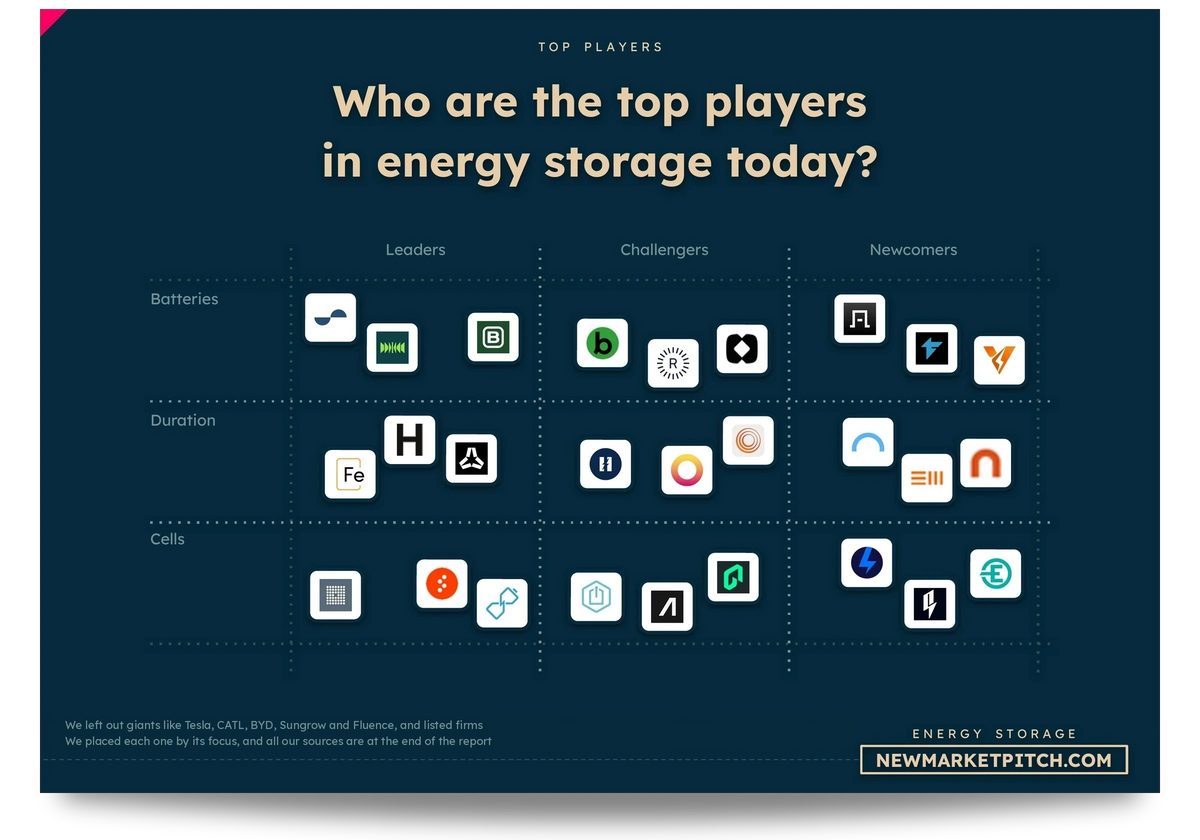
In our research about energy storage, we turn what is vague and complex into simple, useful visuals. Market maps like this one show you at a glance where every startup stands.
Are corporate investors taking over energy storage funding?
Corporate investors are prominent in energy storage, but independent funds still lead plenty of battery startup rounds.
GM Ventures and LG Technology Ventures sit at the top of the activity ranking alongside EIT InnoEnergy. Samsung Ventures and Toyota Ventures have also joined recurring financings. That puts familiar industrial names near some of the companies developing the next generation of batteries.
Look at what the corporate investors actually backed. Samsung Ventures joined CMBlu Energy, which makes organic flow batteries for longer storage. Toyota Ventures has supported Relectrify's battery control technology and Pila Energy's plug-in home batteries. LG Technology Ventures has backed Powerline, which helps storage owners operate their batteries in electricity markets. Those investments reach from the cell itself to the business of running storage after installation.
There is an important limit to corporate leadership. Samsung Ventures and Toyota Ventures were not named as leads in the rounds where a lead was disclosed. Independent investors such as Addition, Evok Innovations and Daphni have repeatedly led financings. Corporate backing can bring industrial knowledge or a potential partner, but the name of a large manufacturer on a deal does not tell us who negotiated or led it.
Is GM Ventures still leading energy storage deals?
GM Ventures remains a leading energy storage investor and was named as lead in all 4 rounds we found for it.
The latest was Peak Energy's $108M Series B. Peak is developing passively cooled sodium-ion storage systems, and the financing is meant to help it expand manufacturing. In June 2026, General Motors also announced a separate agreement to develop sodium-ion cells with Peak. Peak has chosen Sacramento for a battery factory, with production planned for next year. That makes GM's involvement more concrete than a venture investment in an untested idea.
Its other bets show the connection. Nanoramic makes electrode materials designed for use across battery chemistries, while Addionics develops battery architecture intended to improve cell performance and manufacturing. Peak Energy works at the system level. We see GM Ventures backing technologies that might change how batteries are made, assembled and operated, even when the final products go to separate customers.
A lead role says something about how an investor joins a deal, but it doesn't reveal the size of its check. Peak's Series B amount belongs to the whole company financing. GM Ventures' repeat lead appearances are the stronger evidence of its role in energy storage.

Your time is limited. In our market report about energy storage, we put numbers on each part of the market, so you can see where it makes sense to focus.
Why is LG Technology Ventures backing sodium-ion batteries?
LG Technology Ventures is spreading its energy storage investments across sodium-ion cells, advanced materials and battery software.
Unigrid Battery is a good example. It designs sodium-ion cells with manufacturing methods intended to work on existing battery production lines. The company has since reported commercial-scale deliveries. LG Technology Ventures also backed ACT-ion Battery Technologies, which develops processes for making cathode active materials, and Powerline, which builds software to manage storage assets in electricity markets.
Then there is Peak Energy. LG Technology Ventures joined a GM Ventures-led financing, giving it a place alongside an automaker with its own battery-development plans. Peak's passively cooled approach is aimed at stationary storage, where weight and driving range matter less than cost, safety and long operating life. That makes sodium-ion a different bet from the batteries used in most electric vehicles.
LG Technology Ventures has joined as a participant, never as the named lead, in the rounds we counted. It can follow developments in cell chemistry and in the systems that earn money from installed batteries without having to choose just one part of the industry.
Is EIT InnoEnergy still a major battery investor?
EIT InnoEnergy remains a major backer of emerging energy storage technologies, although it has no counted equity round this year.
It is tied for the overall activity lead and was named as lead in every round we found for it. That history is particularly relevant to young companies working on battery materials or storage technologies that do not fit a standard lithium-ion product.
GDI develops silicon anodes, and TaiSan is working on quasi-solid-state sodium-ion batteries. AquaBattery takes another route to storing energy. HeatVentors sells thermal batteries intended to help industrial buildings and data centers manage heating and cooling. EIT InnoEnergy has discussed GDI's production plans and HeatVentors' move into larger commercial applications. These are practical customer problems, even if some of the technology is still early.
The quieter deal count needs to be taken seriously. EIT InnoEnergy joined 2 rounds last year but has not appeared in a new counted financing this year. Its existing companies can continue building products and finding customers without a new round involving the fund. For a founder looking for an investor right now, a strong portfolio history and recent participation are useful facts to check separately.
Are Samsung Ventures and Toyota Ventures leading battery startup rounds?
Samsung Ventures and Toyota Ventures have backed energy storage startups, but neither was named as lead in the rounds with a published lead.
Each joined 3 counted financings. Samsung Ventures appears with Nanoramic and battery materials investments, while Toyota Ventures has supported e-Zinc, Relectrify and Pila Energy. They are serious participants, even though the deal announcements point to other firms as the leads.
The technologies could hardly be more different. Nanoramic sells advanced electrode materials to battery manufacturers. CMBlu Energy develops organic flow batteries for long-duration power. Relectrify's CellSwitch system aims to get more useful life from battery packs, while Pila Energy makes batteries that can be plugged into homes. Toyota Ventures also backed e-Zinc, which develops a different way to store electricity for longer periods.
Both firms can learn about storage products and help promising companies find industrial connections. But their recent appearances show why it is worth asking who actually leads a financing. GM Ventures has repeatedly been named as a lead, whereas Samsung Ventures and Toyota Ventures have more often been named as participants. These are different roles, even when the investor names are equally recognizable.
Has Chevron stopped investing in energy storage?
Chevron Technology Ventures has not joined a counted energy storage equity round this year, despite backing storage startups previously.
Its 3 recorded rounds involve Hydrogenious LOHC Technologies, Zitara and Linova Energy. Hydrogenious develops technology to store and transport hydrogen using liquid organic carriers. Zitara works on battery management, and Linova Energy develops battery technology. That range helps explain why Chevron's venture program has included storage even though Chevron is best known for oil and gas.
Chevron has publicly identified energy storage as one of the areas for its venture investment program. Its most recent counted round involved Hydrogenious LOHC Technologies last year. Chevron Technology Ventures was not named as lead where the lead investor was reported.
A published investment mandate tells us what a fund is willing to examine. The latest completed deals tell founders more about whether it is currently writing checks in their market. On that second measure, Chevron Technology Ventures has been quiet this year.

In our document detailing everything you need to know about energy storage, we always try to gather several sources and make estimates that make sense, so you can work with solid numbers.
Are Andreessen Horowitz and Sequoia ignoring energy storage?
Andreessen Horowitz and Sequoia Capital do back energy storage, but neither appears among the most frequent investors in our counted rounds.
Andreessen Horowitz has supported Base Power, which installs home batteries and uses them to provide electricity services. Sequoia Capital joined Form Energy's financing led by T. Rowe Price. Form develops iron-air batteries intended to supply electricity over several days. Both businesses have moved beyond the question of whether a battery can work in a laboratory. They need factories, customers and the ability to deliver thousands of working systems.
The investors who lead those financings deserve attention too. Addition and Valor Equity Partners have backed Base Power repeatedly, while T. Rowe Price has led Form Energy through later funding rounds. The big-name generalists are part of the story, but the leaders and returning investors often tell us more about how a company is being financed.
That distinction is useful to founders. An investor willing to join a large round for a company with customers may have little recent record of leading early battery technology deals. The brand is recognizable; the relevant question is whether it funds companies at the stage and with the risks a founder actually faces.
Do specialist climate funds actually lead battery startup rounds?
Specialist funds frequently lead energy storage startups through the hard work of developing a new product and finding customers.
Evok Innovations led Moment Energy's $40M Series B as it expanded stationary systems made with second-life electric-vehicle batteries. The same investor has also backed e-Zinc and Zero Industrial. That's a much wider mix than some big generalist funds, which keep showing up because they back the same startup again and again.
Prelude Ventures has backed Lunar Energy, which builds home batteries and software that can connect them into a virtual power plant. Daphni has supported Epyr's industrial thermal storage, while High-Tech Gründerfonds has backed BTRY's thin solid-state batteries and Fion Energy's industrial storage business. These companies have quite different customers and manufacturing problems. Specialist funds can be useful when evaluating those risks before a product is widely deployed.
The most famous fund does not automatically make the best partner for a young battery company. We would look for a history of leading comparable technologies, not a headline about another startup's enormous financing. That is where Evok Innovations, Daphni, Prelude Ventures and High-Tech Gründerfonds have a clear role.
Can European investors compete with US battery funds?
European investors are competitive in early energy storage rounds, particularly with companies developing new batteries and industrial heat storage.
EIT InnoEnergy shares the overall lead in joined rounds, while Daphni and High-Tech Gründerfonds are tied for the most seed participations. We found Daphni backing Epyr, Moonwatt and Airthium, and High-Tech Gründerfonds backing BTRY, Alteva and Fion Energy. Their portfolios cover industrial heat, battery cells and services for installed storage systems.
The relevant comparison is what each investor can help a company build. An early cell developer needs help proving manufacturing, and an industrial heat business needs customers prepared to change how they run equipment. EIT InnoEnergy has also helped connect battery and heat-storage developers with industrial customers. Daphni and High-Tech Gründerfonds have also supported teams before the products were widely deployed.
American investors remain important across these technologies. GM Ventures has backed advanced battery materials, while Union Square Ventures has supported businesses that install and operate storage. Geography helps explain the investor's network, but a founder should judge the actual portfolio and willingness to lead the next round.
Which energy storage investors are still investing this year?
LG Technology Ventures and Union Square Ventures are tied for the most energy storage rounds joined this year, with 2 each.
Of the 20 investors in the leading group, 12 have joined a recorded round this year and 8 have not. GM Ventures is still active with 1 round, matching its count last year. Across the wider market, 74 energy storage rounds this year had at least one named investor, against 108 last year, and the current year is not yet complete.
The newest investment choices are quite different. Union Square Ventures has backed Cactos, which offers commercial and industrial customers battery storage for a monthly payment, and Mana Battery, which works on sodium-ion cells. LG Technology Ventures has joined battery technology and storage-software financings. GM Ventures remains involved in advanced storage hardware. These are active investors today, although joining a round and leading it are separate questions.
The table below shows, year by year, how many rounds 12 of the most active energy storage investors joined, so it is easy to see who is still investing and who has slowed down.
If you want to go more into detail and see which investors are still writing checks and which have slowed down, please check our energy storage report.
| Investor | 2024 | 2025 | 2026* | Total |
|---|---|---|---|---|
| LG Technology Ventures | 1 | 1 | 2 | 4 |
| Union Square Ventures | 1 | 2 | 3 | |
| GM Ventures | 2 | 1 | 1 | 4 |
| Addition | 2 | 1 | 3 | |
| Evok Innovations | 1 | 1 | 1 | 3 |
| Prelude Ventures | 2 | 1 | 3 | |
| Valor Equity Partners | 1 | 1 | 1 | 3 |
| Samsung Ventures | 1 | 1 | 1 | 3 |
| Voyager Ventures | 1 | 1 | 2 | |
| Clean Energy Ventures | 1 | 1 | 2 | |
| T. Rowe Price | 1 | 1 | 2 | |
| Plural | 1 | 1 | 2 |
* 2026: January to 14 November. Darker cells mean more rounds that year. Data from January 2024 through 14 November 2026.

Our report covering the energy storage market gets updated several times a month, so you always get the latest view of where things stand.
Which energy storage investors actually lead funding rounds?
GM Ventures and EIT InnoEnergy are the clearest repeat lead investors in energy storage among the firms we counted.
Both were named as leads in 4 rounds. Addition, Evok Innovations, Prelude Ventures, High-Tech Gründerfonds, Catalus Capital and Daphni followed with 3 named lead rounds each. The distinction is especially useful when comparing investors with similar participation counts.
Their deals look quite different. GM Ventures has led financings for companies developing new battery components. EIT InnoEnergy has supported young storage manufacturers such as GDI. Evok Innovations has backed Moment Energy's expansion in second-life batteries, while Addition has repeatedly led Base Power financings. These examples point to investors that have taken a visible role at different stages of the market.
Joining a large financing is still important, but it does not tell us who led it. LG Technology Ventures, Samsung Ventures and Toyota Ventures were not named as lead in any round where that information was available. Announcements name the lead more reliably than smaller participants, so the real share of rounds a firm leads may be a bit lower. For founders, the named lead roles are more useful than a recognizable logo on a portfolio page.
Do growth investors dominate the biggest energy storage rounds?
Large energy storage rounds now draw major growth investors alongside funds that specialize in batteries and electricity.
Addition and Valor Equity Partners joined Base Power's $1.0B financing, while T. Rowe Price led Form Energy's $750M round. These are the full amounts raised by the startups, not the checks written by those investors. The deals show how far storage financing can move beyond the early stages of proving a cell or building a pilot system.
Base Power installs batteries at homes and provides electricity services using the connected devices. It has opened a battery factory in Austin and announced partnerships with utilities. Form Energy builds iron-air batteries designed for power needs that last far longer than a typical lithium-ion installation. Form has named commercial agreements involving Google, Crusoe and energy providers, alongside a manufacturing operation in West Virginia.
A storage company with factories, orders and installation teams needs investors prepared for large physical projects. That opens the door to names such as T. Rowe Price and Valor Equity Partners. Earlier specialists still matter, but being the lead investor at a battery startup's first round is a different job from supporting a major manufacturing expansion.
Is Base Power changing who matters in energy storage investing?
Base Power has made Addition and Valor Equity Partners important names in home energy storage, with both repeatedly backing the same startup.
Each joined 3 counted rounds, all involving Base Power. That is a very different record from Evok Innovations, whose appearances span Moment Energy, e-Zinc and Zero Industrial. Addition and Valor Equity Partners have returned as Base Power built a much larger operation rather than spreading their counted storage investments across many separate companies.
Base Power owns and installs home batteries, offers electricity services and can use the connected devices to support the grid. Its new Base Core battery is produced in Austin, and the company has announced utility partnerships beyond its original customer base. Those developments help explain the repeated support: the company now needs factories, installers and local customers, as well as working battery technology.
Its investors also include familiar venture firms such as Andreessen Horowitz. The size of Base Power's announced financing belongs to the company and cannot be assigned to Addition, Valor Equity Partners or any other participant individually. The more distinctive finding is their repeated involvement in a single storage business as its customers and operating needs grow.

In our research about energy storage, we look at what the winners do differently, so you can learn from the best instead of guessing.
Who is willing to fund long-duration batteries?
T. Rowe Price, Samsung Ventures and Plural are backing energy storage companies that aim to deliver power for longer periods.
T. Rowe Price led Form Energy's latest major equity round. Form is building iron-air batteries that can supply electricity over several days, and it has announced work with utilities, Google and Crusoe. Its investors are backing a real manufacturing business, even though broad commercial rollout is still ahead.
Samsung Ventures has joined CMBlu Energy, whose organic flow batteries target long-duration power applications. The company's $59M Series C is a different scale and stage from Form Energy's financing. Plural, meanwhile, backed Ore Energy's $43M Series A. Ore also works on iron-air batteries and has discussed grid pilot projects in Europe.
These investors are not all placing the same bet. Iron-air storage, organic flow batteries and conventional shorter-duration systems will have different costs and uses. What connects the investments is a customer need for storing electricity beyond the usual daily charge-and-discharge cycle. The investor names show that longer-duration storage has attracted both established financial firms and investors close to industrial battery businesses.
Which energy storage investors back seed rounds, and which back growth rounds?
Seed is the busiest funding stage for energy storage investors, with 99 of the 250 rounds that have both a named investor and a published stage.
High-Tech Gründerfonds and Daphni are tied for the most seed deals at 3 each. Later-stage energy storage financing is spread across other investors: 46 of those rounds were at Series C or later, and T. Rowe Price, Sutter Hill Ventures and GE Vernova are tied at Series D and later with 2 rounds each. Innovation Industries, Borski Fund and Goldman Sachs Alternatives are tied in rounds specifically labeled growth equity, also with 2 each.
The companies help explain why investors change as a battery business grows. High-Tech Gründerfonds has supported young companies such as Alteva and Fion Energy. Daphni has backed Moonwatt and Airthium. These teams have to prove that their batteries or heat-storage systems work and that customers will pay for them. Later investors face the task of financing factories and commercial installations. T. Rowe Price's support for Form Energy is a clear example of that shift.
The table below shows, for 12 of the most active energy storage investors, how many rounds they joined at each stage, from seed to growth.
If you want to go more into detail and see where each investor places its bets, from seed to growth, please check our energy storage report.
| Investor | Seed | Series A | Series B | Series C | Series D+ | Growth |
|---|---|---|---|---|---|---|
| GM Ventures | · | · | 2 | · | 1 | · |
| EIT InnoEnergy | 2 | 2 | · | · | · | · |
| LG Technology Ventures | 2 | · | 1 | · | · | · |
| Addition | · | · | 1 | 1 | 1 | · |
| Evok Innovations | · | 2 | 1 | · | · | · |
| Prelude Ventures | · | 2 | · | · | 1 | · |
| High-Tech Gründerfonds | 3 | · | · | · | · | · |
| Catalus Capital | · | 1 | · | · | 1 | · |
| Daphni | 3 | · | · | · | · | · |
| Union Square Ventures | 1 | 1 | · | · | · | 1 |
| Valor Equity Partners | · | 1 | 1 | · | 1 | · |
| Innovation Industries | · | 1 | · | · | · | 2 |
Most active at each stage, among all energy storage investors: Seed, High-Tech Gründerfonds and Daphni · Series A, 8 investors tied with 2 rounds · Series B, GM Ventures, Helen Ventures and Banpu NEXT · Series C, no investor joined more than one round · Series D+, T. Rowe Price, Sutter Hill Ventures and GE Vernova · Growth, Innovation Industries, Borski Fund and Goldman Sachs Alternatives. Bigger dots mean more rounds. Data from January 2024 through 14 November 2026.
Can a battery startup raise seed money without a factory?
Yes, young energy storage companies can still raise seed money before they have built a battery factory.
High-Tech Gründerfonds has backed BTRY's ultra-thin solid-state cells and Fion Energy's model for operating industrial battery systems. Daphni has supported Epyr, which develops thermal storage for industrial heat, along with other early storage teams. Voyager Ventures has also backed Mana Battery, which is developing anode-free sodium-ion cells. These startups need to prove quite different things before spending heavily on manufacturing.
For BTRY, the test is whether its thin cells can be manufactured reliably and used in products. Epyr needs industrial customers to trust a new way of storing and delivering heat. Fion Energy must show that installing and operating batteries creates enough value for customers. Mana Battery has described work on larger cells and external sampling, steps that help a prospective customer assess its technology.
Seed investors can finance those milestones without promising that every prototype will become a factory. The strongest evidence is a product test, a customer trial or a manufacturing path that matches the startup's actual technology. The investors that understand those steps are worth more to a young founder than a fund's headline size.
Are investors backing battery makers or storage operators?
Energy storage investors are backing both the companies that make batteries and the ones that earn money by installing and operating them.
LG Technology Ventures offers a useful comparison within one portfolio. Unigrid Battery develops sodium-ion cells, ACT-ion Battery Technologies works on cathode materials, and Powerline helps manage storage portfolios in electricity markets. The first businesses have to make better physical battery products. Powerline has to help owners operate batteries profitably after they are installed.
Union Square Ventures has backed Cactos, which provides battery systems to commercial and industrial customers and manages the stored electricity. Base Power offers another model: home backup batteries connected to electricity services. Both businesses have to acquire customers, install equipment and keep it working, even if they do not invent a new battery chemistry themselves.
GM Ventures has leaned more toward battery technology and manufacturing. That leaves a clear choice for investors: help create a better cell or find a business that can deploy, finance and operate storage at scale. We can see investors pursuing both approaches, but joined rounds alone do not tell us which business model will ultimately make more money.

In our market report about energy storage, we don't want to repeat what boring consulting reports say. Instead, we show you the real and latest market signals that matter.
Which energy storage investors most often invest together?
No investor pair has pulled ahead in energy storage: 8 pairs are tied with 2 rounds joined together each.
Beijing Green Energy and Low-Carbon Industry Investment Fund are one example, appearing together in Suqian Times Energy Storage and Xinhuachu Energy Storage. Other repeated partnerships are concentrated on a single startup. GM Ventures and Samsung Ventures joined 2 Nanoramic rounds together, as did Catalus Capital and GM Ventures. That repeated financing history says more than an occasional appearance on a deal announcement.
A repeated pairing can mean investors believe in a technology and want to support its next round. It does not mean their checks were equal or that they routinely invest together in unrelated storage businesses. With 482 named investors in the wider market, the leading shared-round count remains modest. The useful distinction is between following the same company through successive financings and backing several different startups together.
The table below lists the pairs of energy storage investors named together in at least two equity rounds, with the startups they backed together.
If you want to go more into detail and see which investor networks back the same startups, please check our energy storage report.
| Investor pair | Rounds together | Startups backed together |
|---|---|---|
| Beijing Green Energy + Low-Carbon Industry Investment FundSuqian Times Energy Storage, Xinhuachu Energy Storage | 2 | Suqian Times Energy Storage, Xinhuachu Energy Storage |
| GM Ventures + Samsung VenturesNanoramic | 2 | Nanoramic |
| Catalus Capital + GM VenturesNanoramic | 2 | Nanoramic |
| Addition + Valor Equity PartnersBase Power | 2 | Base Power |
| GM Ventures + Top MaterialNanoramic | 2 | Nanoramic |
| Catalus Capital + Samsung VenturesNanoramic | 2 | Nanoramic |
| Catalus Capital + Top MaterialNanoramic | 2 | Nanoramic |
| FORWARD.one + Helen VenturesVoltfang | 2 | Voltfang |
Pairs of investors named in the same equity round. Data from January 2024 through 14 November 2026.
So, who are the biggest investors in energy storage startups today?
GM Ventures, EIT InnoEnergy and LG Technology Ventures are tied as the most active investors in energy storage startups, with 4 rounds joined each.
That result changes when we look at leadership and recent activity. GM Ventures and EIT InnoEnergy have repeatedly been named as leads, while LG Technology Ventures has continued joining rounds this year. Addition and Valor Equity Partners stand out around Base Power, T. Rowe Price around Form Energy, and High-Tech Gründerfonds and Daphni among very early-stage companies.
A well-known fund can matter enormously to one storage startup without being the investor that turns up most often across the market. For founders, the more useful questions are whether a firm leads, what kinds of batteries or storage services it has financed, and whether it is actively joining rounds now. We would choose an investor based on that record, not a brand name or the full value of somebody else's financing.
The table below shows what we found.
| Question | Answer |
|---|---|
| Are corporate funds actually leading battery startups? | Corporate investors are involved, but many join rounds led by others. Samsung Ventures joined 3 energy storage rounds in our research. Its participation brings industrial knowledge without proving it led those financings. |
| Does GM lead battery rounds or follow? | GM Ventures is a repeat lead, rather than a passive participant. We found it named as lead in 4 energy storage rounds. That separates its record from several other corporate backers. |
| Is LG Technology Ventures betting beyond battery cells? | LG Technology Ventures also backs materials and the software running storage. It led 1 of its 4 counted financings. Powerline shows why operating batteries matters alongside improving their chemistry. |
| Can seed investors help before battery factories exist? | Yes, seed funds support technologies still proving they can work commercially. High-Tech Gründerfonds and Daphni each joined 3 seed rounds. Their portfolios span battery cells, industrial heat and storage services. |
| Has EIT InnoEnergy stopped joining new deals? | EIT InnoEnergy has become quieter in recent energy storage financings. It joined 2 rounds last year and none this year. Its existing battery and thermal-storage companies continue pursuing commercial customers. |
| Which familiar investors are still making deals? | LG Technology Ventures and Union Square Ventures have remained visibly active. Each joined 2 energy storage rounds this year. That makes them relevant names for founders seeking a current backer. |
| Can long-duration batteries attract major growth funds? | Yes, established financial investors now finance multi-day battery manufacturing. T. Rowe Price led Form Energy's $750M financing. The company is using the backing to expand production and deliveries. |
| Can home batteries attract billion-dollar funding rounds? | Base Power has attracted growth investors with its home-battery network. Addition and Valor Equity Partners joined its $1.0B financing. Its electricity services give investors another business to back beyond cells. |
| Is sodium-ion storage moving toward factory production? | Sodium-ion storage is now drawing investors focused on making systems commercially. GM Ventures led Peak Energy's $108M Series B. Peak has also announced plans for a domestic battery factory. |
| Are organic flow batteries attracting corporate backers? | Samsung Ventures has backed a long-duration battery technology developer. It joined CMBlu Energy's $59M Series C financing round. That financing supports a different storage approach from traditional lithium-ion systems. |
| Do investing partners support more than one startup? | Some energy storage investors also back separate companies together. Beijing Green Energy and Low-Carbon Industry Investment Fund joined 2 shared rounds. Those deals involved Suqian Times Energy Storage and Xinhuachu Energy Storage. |

Learning from others' mistakes is the cheapest lesson there is. In our document detailing everything you need to know about energy storage, we look at what broke startups before you, so you don't repeat it.
Our methodology
Our data runs through November 14, 2026. We then reviewed this article and updated its answers on November 17, 2026, the date shown under the title. We systematically track every identifiable equity round in this energy storage market since January 2024, deal by deal, a period long enough to identify investors active today. We include rechargeable battery cells and packs, storage systems and operators, dedicated battery materials and controls, and mechanical, thermal, compressed-air, electrochemical or hydrogen-based storage. Every company counted meets our startup definition: an independent, growth-oriented company founded in 2000 or later, privately funded or recently listed within the last 5 years. We include companies close to the boundaries when their main product genuinely stores energy or directly enables storage, rather than excluding them by default.
We count the equity rounds each named investor joined and those it was named as leading, never the amount that investor personally contributed, which is rarely public. IPOs and post-listing offerings are excluded because they are not private rounds an investor joins. We identify investors through company announcements and reliable reporting, combine alternate names for the same firm, and merge duplicate descriptions of a round. Vague mentions such as "existing investors" or "angel investors" do not create named investor entries. We start displaying the current-year investor column in March, once it contains three months of observations.
Announcements name lead investors more reliably than smaller participants, so rounds that an investor joined without leading are undercounted and lead rates are an upper bound.
Rounds confirmed by a company announcement, a press article or a regulatory filing are counted in full. Where no article exists, a round is counted only when at least two recognised databases agree on its date (within one month) and amount (within 5%), and it is marked as low confidence; a round found in a single database stays in the company's history but is left out of totals. For companies that have raised more than $100M, every round counted is backed by an article.
We never rely on an investor list from Crunchbase, PitchBook or a similar commercial database alone: such lists can add investors who were not in a particular round or mix equity with debt and grants. Of the 329 equity rounds we counted, 279 have at least one named investor, or 85%. That means every investor's participation count is a floor, not a complete accounting of all private equity activity. Stage comparisons use only rounds with a named investor and a published stage; 251 rounds meet both conditions.
An investor's count differs from the total deal count in our energy storage funding tracker because a round can be credited to every named participant, while a round with no named investor appears in the funding total but not in an investor's activity. We use rounds joined rather than dollars attributed to investors because the size of an entire financing is public far more often than the individual checks. This also answers why a well-known specialist may rank below a generalist: our ranking measures repeated disclosed participation within a consistent window, not reputation, fund size or total assets managed.
Key sources include Peak Energy's Series B, GM Ventures lead, LG Technology Ventures participation and manufacturing plans, General Motors' sodium-ion technology partnership with Peak Energy, LG Technology Ventures' portfolio across batteries, materials and energy software, UNIGRID Battery's announcement of LG Technology Ventures' investment, Powerline's storage operations software and LG Technology Ventures participation, EIT InnoEnergy's work with GDI's silicon-anode technology, EIT InnoEnergy's support for TaiSan's sodium battery development, HeatVentors' thermal-storage applications and expansion, Samsung Ventures' participation in CMBlu Energy's funding, Toyota Ventures' investments in Relectrify and Pila Energy, Chevron Technology Ventures' investment areas and portfolio, GM Ventures, Catalus Capital and Samsung Ventures in Nanoramic's financing, Nanoramic's battery electrode technology and continued industrial partnerships, Base Power's later-stage financing, lead investors, home battery product and utility partnerships, T. Rowe Price's lead in Form Energy's financing and other participants, Prelude Ventures' investment rationale for Lunar Energy, Evok Innovations' lead role and Moment Energy's second-life battery business, High-Tech Gründerfonds' support for BTRY's solid-state cells, High-Tech Gründerfonds and Fion Energy's industrial battery model, Daphni's backing of Epyr's industrial thermal storage, Ore Energy's funding, iron-air technology and grid pilot projects, Union Square Ventures' investment rationale for Cactos, and Mana Battery's development milestones and investor representation.

If you build or invest in the energy storage market, you need to know which business models pay off now and which ones are fading. That's why our report covering it has a whole section on it.
Written by the New Market Pitch teamWe track new markets so founders and investors can move faster. About us