Who are the top investors in grid-scale battery storage?
Whether you're building or investing in the grid-scale battery storage market, our report covers everything you need to know: the players, the money, and what's coming next.
Summary
Helen Ventures is the most active named grid-scale battery storage investor, with 3 rounds joined. Yet 126 named investors appear in the market, and none has built a commanding lead in the number of financings joined.
Helen Ventures has not joined a new round this year. That makes the current picture quite different from the overall participation ranking.
LG Technology Ventures is busier lately, with 2 rounds this year. It backed Peak Energy's sodium-ion battery systems and Powerline's diagnostics software, so its recent choices cover both hardware and how batteries are run.
T. Rowe Price has a different distinction: it was named as lead in 2 rounds for Form Energy. Helen Ventures was named as lead in none of its 3 recorded rounds. Joining a financing and leading it are separate things.
Union Square Ventures and Evok Innovations are also repeat leaders, with 2 rounds joined each. Their portfolio companies work on different battery technologies and ways to sell storage.
Grid batteries need different kinds of investors. A manufacturer must prove it can make reliable systems, a software provider needs paying customers, and a storage owner must finance real assets.
Seed was the busiest stage among rounds with a known stage, but no firm led Seed participation on its own. The later rounds involved a much smaller circle of backers prepared for industrial projects.
Industrial companies are part of that circle. GE Vernova, LG Technology Ventures, Banpu NEXT and Toyota Ventures have joined battery startup financings alongside venture firms and other investment groups.
Investors sometimes return together. The most frequent pairs followed the same company into later rounds, not an endless series of unrelated startups.
Helen Ventures leads on frequency, LG Technology Ventures on activity this year, and T. Rowe Price on repeated leadership of very large Form Energy deals. There is no single investor at the top of every measure.

Written by the New Market Pitch teamWe track new markets so founders and investors can move faster. About us

In our report covering the grid-scale battery storage market, you will always find fresh funding data, taken straight from our own verified funding database.
Which VCs invest the most in grid-scale battery storage right now?
Helen Ventures is the most active named grid-scale battery storage investor, with 3 rounds joined, though it has not joined a new round this year.
It stands alone at the top by participation, with 16 investors tied behind it at 2 rounds each. The group includes T. Rowe Price, Union Square Ventures and Evok Innovations. Helen Ventures backed enspired and Voltfang, which work on battery optimization and integrated storage systems. Across the wider market, we identified 126 named investors. That spread means a small lead in round count is a useful sign of repeat involvement, but hardly evidence that one fund dominates grid battery investments.
The table below ranks the 20 most active grid-scale battery storage investors by the number of equity rounds they joined, with the rounds they led, their main stages, the startups they backed and the biggest round they joined.
If you want to go more into detail and get more data to understand what investors are betting on now, please check our grid-scale battery storage report.
| # | Investor | Rounds | Led | Main stages | Grid-scale battery storage startups backed | Biggest round joined | Latest round |
|---|---|---|---|---|---|---|---|
| 1 | Helen Ventures | 3 | 0Never led | Series B 2Series A 1 | enspired, Voltfang | $28Menspired · 2024 | Jun 2025 |
| 2 | T. Rowe Price | 2 | 2Named as lead in every round found | Series D+ 2 | Form Energy | $750MForm Energy · 2026 | Aug 2026 |
| 3 | Union Square Ventures | 2 | 2Named as lead in every round found | Series A 1Growth 1 | Cactos | $14MCactos · 2026 | Jun 2026 |
| 4 | Evok Innovations | 2 | 2Named as lead in every round found | Series A 1Series B 1 | Moment Energy, e-Zinc | $40MMoment Energy · 2026 | May 2026 |
| 5 | Grantham Foundation | 2 | 2Named as lead in every round found | Seed 1Series A 1 | Allegro Energy, Flux XII | $12MAllegro Energy · 2024 | Nov 2025 |
| 6 | FORWARD.one | 2 | 2Named as lead in every round found | Series A 1Series B 1 | Voltfang | $17MVoltfang · 2025 | Jun 2025 |
| 7 | Eurazeo | 2 | 1Named as lead in every round found (lead known for 1 of 2 rounds) |
Seed 1Growth 1 | terralayr, Ambos Energy | $133Mterralayr · 2026 | Jan 2026 |
| 8 | Energie 360° | 2 | 1Leads half its rounds | Seed 1Series A 1 | Suena Energy | $8.8MSuena Energy · 2025 | Sep 2025 |
| 9 | Beijing Green Energy | 2 | 1Named as lead in every round found (lead known for 1 of 2 rounds) |
Seed 1Series A 1 | Suqian Times Energy Storage, Xinhuachu Energy Storage | Undisclosed | Dec 2024 |
| 10 | Low-Carbon Industry Investment Fund | 2 | 1Named as lead in every round found (lead known for 1 of 2 rounds) |
Seed 1Series A 1 | Suqian Times Energy Storage, Xinhuachu Energy Storage | Undisclosed | Dec 2024 |
| 11 | LG Technology Ventures | 2 | 0Never led | Seed 1Series B 1 | Peak Energy, Powerline | $108MPeak Energy · 2026 | Oct 2026 |
| 12 | GE Vernova | 2 | 0Never led | Series D+ 2 | Form Energy | $750MForm Energy · 2026 | Aug 2026 |
| 13 | Copec WIND Ventures | 2 | 0Lead not published | — | Moment Energy, Accure Battery Intelligence | Undisclosed | Jul 2026 |
| 14 | RIVE Private Investment | 2 | 0Never led (lead known for 1 of 2 rounds) |
Seed 1Growth 1 | terralayr | $133Mterralayr · 2026 | Jan 2026 |
| 15 | Banpu NEXT | 2 | 0Never led | Series B 2 | enspired | $28Menspired · 2024 | Oct 2025 |
| 16 | Interzero | 2 | 0Never led | Series A 1Series B 1 | Voltfang | $17MVoltfang · 2025 | Jun 2025 |
| 17 | Toyota Ventures | 2 | 0Never led | Series A 1Series C 1 | e-Zinc, Relectrify | $31Me-Zinc · 2024 | Jun 2024 |
| 18 | Lochpine Capital | 1 | 1Named as lead in its only round found | Series A 1 | Green Voltis | $15MGreen Voltis · 2026 | Nov 2026 |
| 19 | GM Ventures | 1 | 1Named as lead in its only round found | Series B 1 | Peak Energy | $108MPeak Energy · 2026 | Oct 2026 |
| 20 | Leitmotif | 1 | 1Named as lead in its only round found | Series A 1 | Tavion | $40MTavion · 2026 | Sep 2026 |
No investors match this search.
Data from January 2024 through 14 November 2026, which is enough to show who is active today and who has been for years. Rounds: equity rounds in which the investor is named. Led: rounds it led or co-led. ▲ more rounds in 2026 so far than its 2025 pace, ▼ fewer.

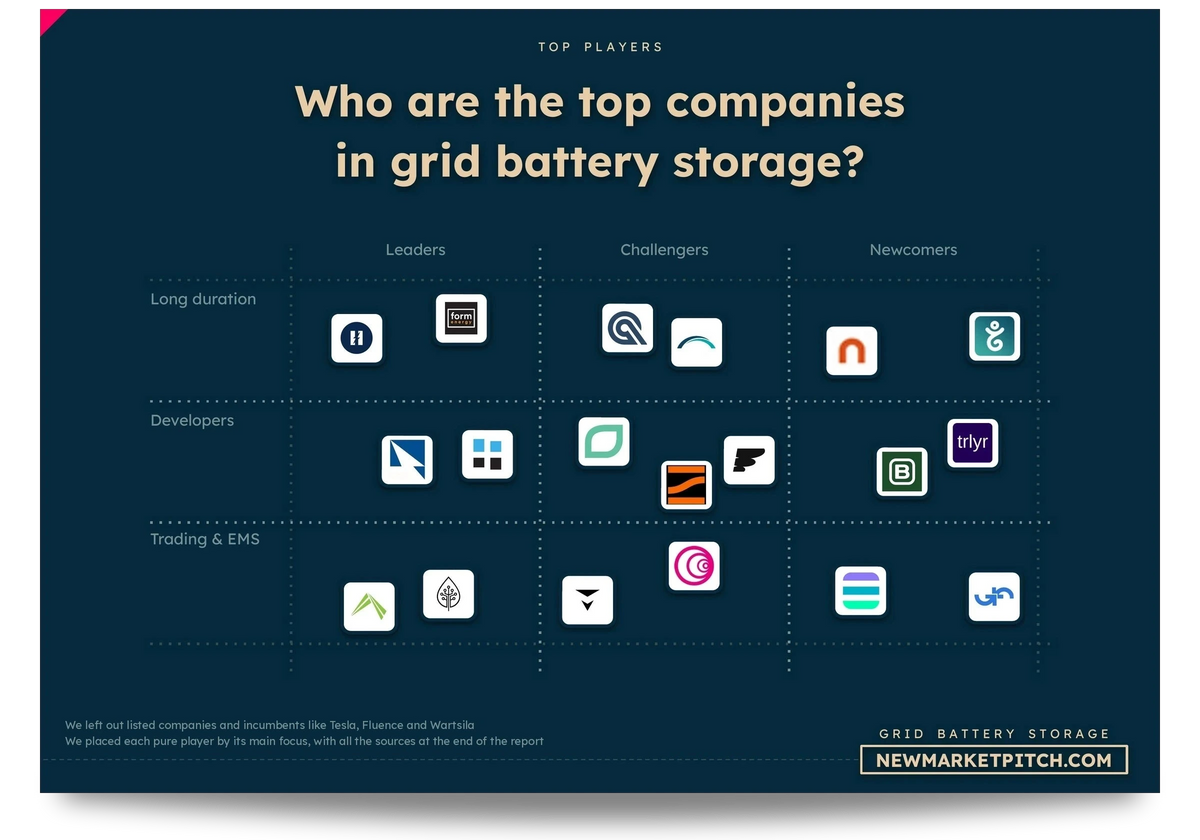
In our research about grid batteries, we turn what is vague and complex into simple, useful visuals. Market maps like this one show you at a glance where every startup stands.
Does the busiest grid battery investor actually lead deals?
No, the busiest grid-scale battery storage investor, Helen Ventures, has joined 3 rounds without being named lead in any of them.
Its earlier backing covers enspired and Voltfang, and none of its recorded rounds named Helen Ventures as lead. Voltfang's announcements identified FORWARD.one as lead of its October 2024 Series A and June 2025 Series B, with Helen Ventures continuing to participate. The enspired investment connects Helen Ventures to software for battery trading and optimization.
T. Rowe Price, meanwhile, led 2 financings for Form Energy. Evok Innovations was named as lead in 2 rounds involving Moment Energy and e-Zinc. These investors have different records: Helen Ventures joined rounds frequently, but others took the named lead role. A founder looking for an investor to lead a new deal should not assume the most frequently listed name is automatically the best choice.
Why does T. Rowe Price keep backing Form Energy?
T. Rowe Price has led 2 Form Energy rounds because the grid-battery maker now needs industrial-scale money to manufacture and deliver iron-air systems.
Form Energy named T. Rowe Price as lead of its October 2024 Series D+ and its $750M Series D+ in August 2026. Form Energy calls the later financing Series D+; Series D+ is the grouped stage used for this market comparison. The battery systems are designed to store electricity over several days, so building them commercially takes factories, supply arrangements and utility customers.
The follow-on came after Form Energy had started work at Form Factory 1 and announced commercial plans, including an agreement with Crusoe on data-center storage. Those developments help explain why a backer returned, although the announcements do not reveal T. Rowe Price's own check. It remains the repeat lead of a major manufacturer, not the investor backing the largest number of different battery startups.

Your time is limited. In our market report about grid batteries, we put numbers on each part of the market, so you can see where it makes sense to focus.
What is Union Square Ventures funding in grid batteries?
Union Square Ventures is backing Cactos, a grid battery business that sells storage systems and the software and services to operate them.
Union Square Ventures joined 2 Cactos financings and was named as lead in both. Cactos assembles battery systems and gives customers a way to use storage without purchasing every part of the system upfront. In its investment explanation, Union Square Ventures highlighted the combination of hardware, controls and commercial services.
Evok Innovations offers a useful contrast. It joined 2 financings, leading rounds involving Moment Energy and e-Zinc. Moment Energy repurposes EV batteries for stationary storage, while e-Zinc develops zinc-air systems for longer-duration power. Toyota Ventures also backed e-Zinc, but Toyota's other recorded storage company was Relectrify, which develops battery controls. The investor names overlap in one company, not in a shared belief that all grid batteries should use the same technology.
Which grid-scale battery storage investors are still investing this year?
LG Technology Ventures is the most active grid-scale battery investor this year among the leading names, joining 2 rounds.
Helen Ventures still leads on overall appearances but has not joined a new round this year. Of the 20 investors in our leading group, 11 have participated this year and 9 have not. LG Technology Ventures supported Peak Energy's sodium-ion battery systems and Powerline's diagnostics software. That mix shows current activity in both manufacturing and the software that helps operate batteries. Older participation records and current investment activity tell different stories.
The table below shows, year by year, how many rounds 12 of the most active grid-scale battery storage investors joined, so it is easy to see who is still investing and who has slowed down.
If you want to go more into detail and see which investors are still writing checks and which have slowed down, please check our grid-scale battery storage report.
| Investor | 2024 | 2025 | 2026* | Total |
|---|---|---|---|---|
| LG Technology Ventures | 2 | 2 | ||
| T. Rowe Price | 1 | 1 | 2 | |
| Union Square Ventures | 1 | 1 | 2 | |
| Evok Innovations | 1 | 1 | 2 | |
| Eurazeo | 1 | 1 | 2 | |
| GE Vernova | 1 | 1 | 2 | |
| Copec WIND Ventures | 1 | 1 | 2 | |
| RIVE Private Investment | 1 | 1 | 2 | |
| Lochpine Capital | 1 | 1 | ||
| GM Ventures | 1 | 1 | ||
| Leitmotif | 1 | 1 | ||
| Helen Ventures | 2 | 1 | 3 |
* 2026: January to 14 November. Darker cells mean more rounds that year. Data from January 2024 through 14 November 2026.
Why is LG Technology Ventures backing grid batteries now?
LG Technology Ventures is backing both sodium-ion grid batteries and software for checking how batteries perform.
It joined 2 financings this year: Peak Energy and Powerline. Peak's October 2026 announcement named GM Ventures as lead and LG Technology Ventures among the other backers. Powerline raised a $7M Seed round in February 2026 for diagnostics and digital-twin software. LG Technology Ventures was not the named lead of either round.
The pairing makes commercial sense. A grid battery must perform safely over years, and operators need tools that help them spot problems before they become expensive. One business supplies the hardware; the other analyzes battery condition. We cannot tell from the round announcements how much LG Technology Ventures itself invested, but its choices show interest in both sides of running storage systems.
Is GM Ventures becoming a grid battery investor too?
Yes, GM Ventures has entered grid-scale battery storage by leading Peak Energy's financing for sodium-ion systems.
Peak Energy raised a $108M Series B in October 2026. The company develops stationary storage, and General Motors had already announced work with Peak on sodium-ion cells and manufacturing. GM Ventures therefore has a clear industrial connection to the technology, even though Peak's product is made for the grid rather than for vehicle traction batteries.
Peak says its design avoids active cooling and has announced a Sacramento factory. That could matter for cost and maintenance, but customers will still judge the systems by reliability and delivered power. GM Ventures' participation shows an automotive company's battery expertise can reach into stationary storage without implying a broader change to General Motors' vehicle strategy.

In our document detailing everything you need to know about grid-scale battery storage, we always try to gather several sources and make estimates that make sense, so you can work with solid numbers.
Does GE Vernova invest in grid storage startups directly?
GE Vernova joined 2 Form Energy grid-battery financings as a participant, without being named as lead.
Form Energy's October 2024 Series D+ announcement named GE Vernova among the new participants. Its August 2026 announcement listed the industrial power company as a returning supporter. T. Rowe Price led both rounds. The product is an iron-air battery designed for multi-day electricity storage, making Form Energy relevant to grid operators that need supply across longer gaps in generation.
GE Vernova's repeated participation is a clear sign of continuing interest. It differs from GM Ventures' more recent role leading Peak Energy's sodium-ion round. Neither record tells us the amount GE Vernova itself contributed, and a company's full announced financing should not be attributed to every investor named in it.
Are pension investors funding grid batteries instead of traditional VCs?
Pension-backed investors are funding grid battery projects, while venture firms continue backing storage products and new chemistries.
APG's investment in Return shows why. The Dutch pension manager backed a company that develops battery assets and leases storage capacity to energy businesses. That business needs sites, equipment, grid connections and revenue agreements. Union Square Ventures, by contrast, backed Cactos' battery systems and services, while Evok Innovations backed Moment Energy and e-Zinc as they developed different storage technologies.
These investors are taking different risks. Return must get infrastructure built and working commercially. e-Zinc has to prove the cost and performance of zinc-air batteries. Cactos has to sell and operate its systems successfully. Both pension capital and venture funding have a place here, but one does not make the other unnecessary.
Are grid battery investors choosing hardware or software?
Grid-scale battery investors back both hardware and software, and some funds put money into companies on each side.
Helen Ventures backed enspired's optimization business and Voltfang's integrated battery systems. Union Square Ventures funded Cactos, which combines storage hardware with software and services. LG Technology Ventures joined Powerline's diagnostics round and Peak Energy's sodium-ion financing. There is no single preference for cells over control software among these repeated investors.
The businesses earn their money differently. enspired and Suena Energy help owners trade electricity at better times. A new chemistry developer must show that its battery survives years of use and can be built reliably. Both can fail, but for very different reasons. Knowing the startup's product explains more about an investment than simply labeling its backer a climate fund.
Which grid-scale battery storage investors back seed rounds, and which back growth rounds?
Seed is the busiest stage among grid-scale battery storage rounds with a named investor, 26 of the 72 whose stage is known, but no single investor leads Seed participation.
The later stages look different. Series C and later accounted for 11 rounds with a known stage, and T. Rowe Price and GE Vernova were tied at Series D and later with 2 rounds joined each. Helen Ventures and Banpu NEXT were also tied at Series B, with 2 rounds apiece. Growth Equity also brought backers such as Eurazeo to terralayr and Union Square Ventures to Cactos. Investors prepared to back a new battery concept are not always the ones funding factories or operating assets.
The table below shows, for 12 of the most active grid-scale battery storage investors, how many rounds they joined at each stage, from seed to growth.
If you want to go more into detail and see where each investor places its bets, from seed to growth, please check our grid-scale battery storage report.
| Investor | Seed | Series A | Series B | Series C | Series D+ | Growth |
|---|---|---|---|---|---|---|
| Helen Ventures | · | 1 | 2 | · | · | · |
| T. Rowe Price | · | · | · | · | 2 | · |
| Union Square Ventures | · | 1 | · | · | · | 1 |
| Evok Innovations | · | 1 | 1 | · | · | · |
| Grantham Foundation | 1 | 1 | · | · | · | · |
| FORWARD.one | · | 1 | 1 | · | · | · |
| Eurazeo | 1 | · | · | · | · | 1 |
| Energie 360° | 1 | 1 | · | · | · | · |
| Beijing Green Energy | 1 | 1 | · | · | · | · |
| Low-Carbon Industry Investment Fund | 1 | 1 | · | · | · | · |
| LG Technology Ventures | 1 | · | 1 | · | · | · |
| GE Vernova | · | · | · | · | 2 | · |
Most active at each stage, among all grid-scale battery storage investors: Seed, no investor joined more than one round · Series A, no investor joined more than one round · Series B, Helen Ventures and Banpu NEXT · Series C, no investor joined more than one round · Series D+, T. Rowe Price and GE Vernova · Growth, no investor joined more than one round. Bigger dots mean more rounds. Data from January 2024 through 14 November 2026.

Our report covering the grid-scale battery storage market gets updated several times a month, so you always get the latest view of where things stand.
Do grid battery investors stay for the next round?
Some grid-scale battery investors do back the same startup again, especially when a product moves from early development toward sales.
FORWARD.one was named lead in Voltfang's October 2024 Series A and June 2025 Series B. Helen Ventures and Interzero continued alongside it. Union Square Ventures also backed Cactos across Series A and Growth Equity. Those deals show investors returning when a company moves into another phase, rather than spreading their money across unrelated startups.
Repeat financing is particularly useful in batteries because technical and commercial questions take time to settle. Investors can judge whether a factory is progressing, a system has met safety tests or a customer is ready to use it. Still, the examples do not establish that most investors follow their companies all the way to an advanced round.
Who actually leads the largest grid battery rounds?
T. Rowe Price has the strongest repeated lead role in the biggest grid battery deals, through its 2 Form Energy rounds.
Evok Innovations was named as lead in 2 rounds involving e-Zinc and Moment Energy; the largest round it joined was Moment Energy's $40M Series B in May 2026. Eurazeo joined 2 deals and led 1 of the rounds with a known lead; its biggest relevant round was terralayr's $133M Growth Equity financing in January 2026. These investors backed very different companies.
Form Energy is building iron-air batteries, Moment Energy is scaling systems based on repurposed EV cells, and terralayr develops battery infrastructure and flexibility services. The amounts describe entire company fundraisings, not each investor's personal check. A fund that leads a huge deal has a visible role, but we cannot conclude it contributed the whole amount.
Do famous battery investors always lead their rounds?
No, prominent grid-scale battery investors often join a financing without being named as the lead.
Helen Ventures was not named as lead in its recorded rounds. GE Vernova joined Form Energy's financings as a participant, and Toyota Ventures appeared in rounds for e-Zinc and Relectrify without leading them. LG Technology Ventures joined Peak Energy's Series B, which GM Ventures led. Those are different degrees of involvement, even though the company announcements name all of the investors.
FORWARD.one, in contrast, was named as lead in Voltfang's repeated rounds. T. Rowe Price was named as lead in Form Energy's repeated financings. Leading may mean negotiating terms, but the names in an announcement do not show who wrote the largest individual check. That is why we keep lead roles separate from ordinary participation.

In our research about grid batteries, we look at what the winners do differently, so you can learn from the best instead of guessing.
Are corporate investors serious about battery storage startups?
Yes, major industrial companies and their venture arms are backing grid-scale battery startups across hardware, software and operating systems.
LG Technology Ventures joined 2 rounds involving Peak Energy and Powerline. GE Vernova joined 2 Form Energy rounds. Banpu NEXT took part in 2 financings involving enspired, and Toyota Ventures joined 2 involving e-Zinc and Relectrify. GM Ventures led a Peak Energy round. The companies being funded span cell production, system design, battery dispatch and diagnostics.
The interests vary. General Motors has publicly described its work with Peak on sodium-ion cells. Toyota Ventures says it invests in deep tech and climate technologies. Banpu NEXT works in energy, where battery trading software can be useful. Corporate investors may bring industrial knowledge as well as money, but a financing announcement alone does not prove a new supply contract or commercial partnership.
Which grid-scale battery storage investors most often invest together?
No single pair dominates grid battery funding: 5 investor pairs tied at the top, each having joined 2 rounds together.
Beijing Green Energy and Low-Carbon Industry Investment Fund jointly backed Suqian Times Energy Storage and Xinhuachu Energy Storage. In Europe, FORWARD.one, Helen Ventures and Interzero repeatedly joined Voltfang financings, creating several recurring pairs around the same company. GE Vernova and T. Rowe Price also appeared together in Form Energy's funding. These ties often come from supporting one startup again, not from a broad habit of investing together in unrelated companies.
The table below lists the pairs of grid-scale battery storage investors named together in at least two equity rounds, with the startups they backed together.
If you want to go more into detail and see which investor networks back the same startups, please check our grid-scale battery storage report.
| Investor pair | Rounds together | Startups backed together |
|---|---|---|
| Beijing Green Energy + Low-Carbon Industry Investment FundSuqian Times Energy Storage, Xinhuachu Energy Storage | 2 | Suqian Times Energy Storage, Xinhuachu Energy Storage |
| FORWARD.one + Helen VenturesVoltfang | 2 | Voltfang |
| Helen Ventures + InterzeroVoltfang | 2 | Voltfang |
| FORWARD.one + InterzeroVoltfang | 2 | Voltfang |
| GE Vernova + T. Rowe PriceForm Energy | 2 | Form Energy |
Pairs of investors named in the same equity round. Data from January 2024 through 14 November 2026.
Can grid battery optimization software attract venture funds?
Yes, venture funds back grid battery optimization because every installed battery needs to be operated and traded intelligently.
Helen Ventures participated in enspired's rounds, Banpu NEXT joined 2 of enspired's recorded financings, and Energie 360° joined 2 rounds involving Suena Energy. Union Square Ventures also funded Cactos, where storage systems come with software and operating services. Those investors are not all software specialists, but they are backing businesses that work after a battery has been installed.
enspired's October 2025 announcement discussed expanding its battery-trading business into additional power markets. Suena Energy also focuses on trading and optimization. A battery may be technically excellent and still earn disappointing revenues if it is charged, discharged or offered into the market at the wrong time. Investors can fund the software layer without paying to build each physical battery.
Are large grid battery rounds attracting different kinds of investors?
Yes, large grid-scale battery deals draw corporate, infrastructure and investment firms as well as conventional venture funds.
T. Rowe Price and GE Vernova appeared in Form Energy's industrial financings. Eurazeo and RIVE Private Investment backed terralayr, while Leitmotif led Tavion's $40M Series A. Fund-owned developers such as SMT Energy are left out, because a developer financed by a single infrastructure fund is a fund platform rather than a startup. GM Ventures led Peak Energy's later round. The businesses explain the mix: some are building batteries, while others must develop grid projects and run the assets.
A project investor can judge the economics of sites and contracted revenue. A manufacturer needs backers willing to pay for machinery, technical testing and production before every customer order is fulfilled.
The table below shows selected investors and the largest battery financing each joined.
| Investor | Startup | Round size | Stage |
|---|---|---|---|
| T. Rowe Price | Form Energy | $750M | Series D+ |
| Eurazeo | terralayr | $133M | Growth Equity |
| GM Ventures | Peak Energy | $108M | Series B |
| Evok Innovations | Moment Energy | $40M | Series B |
| Leitmotif | Tavion | $40M | Series A |
| Helen Ventures | enspired | $28M | Series B |
| FORWARD.one | Voltfang | $17M | Series B |
| Union Square Ventures | Cactos | $14M | Growth Equity |

In our market report about grid batteries, we don't want to repeat what boring consulting reports say. Instead, we show you the real and latest market signals that matter.
Can battery investors matter without leading a round?
Yes, participating investors can influence grid-scale battery startups even when another firm is named as lead.
GE Vernova continued backing Form Energy while T. Rowe Price led the financings. Helen Ventures remained involved with Voltfang and enspired. Toyota Ventures backed e-Zinc and Relectrify, and LG Technology Ventures joined Peak Energy and Powerline. Each may bring expertise or useful commercial relationships alongside capital, although those benefits are not guaranteed by the investment itself.
There is an important limit to what a funding announcement reveals. We can see that an investor participated and who was named as lead. We usually cannot see individual check sizes, governance arrangements or how much work an investor did with management. A recurring participant can be important without becoming the lead investor.
So, who are the biggest investors in grid-scale battery storage?
Helen Ventures is the most active grid-scale battery storage investor by round count, while T. Rowe Price has repeatedly led the biggest Form Energy financings.
LG Technology Ventures has been more active this year, backing Peak Energy and Powerline. Union Square Ventures and Evok Innovations also led repeat battery financings, and industrial companies play visible roles in both battery technology and operating assets. No investor leads every measure, and the largest deal does not reveal who wrote the largest individual check.
For a grid-battery founder, the best backer depends on what needs funding. New chemistry, battery manufacturing, trading software and storage project ownership require different expertise and different amounts of money.
The table below shows what we found.
| Question | Answer |
|---|---|
| Is any investor consistently busiest across grid batteries? | Yes, Helen Ventures has joined the most recorded rounds. Helen Ventures appeared in 3 grid battery financings. That lead does not mean it is busiest today. |
| Has the overall activity leader invested recently? | Not this year, despite Helen Ventures' earlier repeat activity. Helen Ventures has joined no new round this year. Other investors have taken the lead in current activity. |
| Who is currently making the most battery investments? | LG Technology Ventures is the leading current-year participant. LG Technology Ventures joined 2 rounds, Peak Energy and Powerline. One makes batteries, while the other builds diagnostic software. |
| Does Form Energy have a regular lead investor? | Yes, T. Rowe Price has returned to lead Form Energy. T. Rowe Price was named lead in 2 Form Energy financings. Its repeat role supports an expensive manufacturing program. |
| Are grid battery software startups attracting repeat funds? | Yes, optimization businesses continue drawing experienced battery backers. Helen Ventures and Banpu NEXT both backed trading software maker enspired. Their products connect battery hardware with commercial operations. |
| Are venture firms the only serious battery investors? | No, major corporate investors also appear in funding rounds. GE Vernova joined 2 separate Form Energy financings. Its involvement was participation rather than the named lead. |
| Did GM Ventures back sodium-ion grid batteries? | Yes, GM Ventures led Peak Energy's latest financing. The complete Series B financing round raised $108M. That figure describes the full deal, not GM's check. |
| Is any single investor dominating seed-stage funding? | No, the Seed stage has no undisputed lead investor. Seed accounted for 26 rounds with a known stage. Later industrial rounds draw a more concentrated group. |
| Do battery investors keep working with familiar partners? | Sometimes, and repeat rounds create much of that overlap. FORWARD.one and Helen Ventures joined 2 Voltfang financings together. That is a company relationship rather than a market monopoly. |
| Is the lead investor always the biggest payer? | We cannot tell, because individual check sizes are rarely disclosed. Evok Innovations was named lead in 2 financings. The total round sizes cannot establish its own commitment. |
| Do battery asset owners need different investors? | Yes, developers of storage projects need infrastructure expertise. Eurazeo joined terralayr's $133M Growth Equity financing in January 2026. That is different from funding a battery material. |

Learning from others' mistakes is the cheapest lesson there is. In our document detailing everything you need to know about grid-scale battery storage, we look at what broke startups before you, so you don't repeat it.
Our methodology
Our data runs through November 14, 2026. We then reviewed this article and updated its answers on November 17, 2026, the date shown under the title. We systematically reviewed private equity rounds in grid-scale battery storage from January 2024 to November 14, 2026. We include companies developing, manufacturing, integrating, owning or operating batteries for electricity-grid supply and balancing, including battery-centered trading and optimization platforms. Household-only batteries, vehicle traction batteries and non-battery storage systems are excluded; borderline companies remain where grid batteries are a principal business. Every company counted meets our startup definition of an independent growth business founded in 2000 or later, with recently listed or acquired businesses handled under our stated inclusion rules.
We measure equity rounds an investor joined and the subset in which it was publicly named as lead, not the money that investor personally committed. IPOs and offerings after a listing are excluded. A named investor counts once per qualifying financing, so the same financing can appear for several investors even though it is only one market deal. We merge alternate investor names, avoid generic references such as "existing investors" or "angel investors," and merge multiple reports of one round. We begin publishing the current year's comparison in March, after sufficient months of observations have accumulated.
Announcements name lead investors more reliably than smaller participants, so rounds that an investor joined without leading are undercounted and lead rates are an upper bound.
Rounds confirmed by a company announcement, a press article or a regulatory filing are counted in full. Where no article exists, a round is counted only when at least two recognised databases agree on its date (within one month) and amount (within 5%), and it is marked as low confidence; a round found in a single database stays in the company's history but is left out of totals. For companies that have raised more than $100M, every round counted is backed by an article.
We identified 78 rounds with at least one named investor out of 86 qualifying equity rounds; the remaining rounds still belong in the funding market but cannot be attributed to an individual backer. Commercial investor lists from services such as Crunchbase and PitchBook are never accepted on their own, because they can attribute past backers to later rounds or mix in debt and grants. As a result, confirmed participation counts are a floor rather than a complete view of every undisclosed investor.
We use named stages, with Series D and later grouped together, to show when different investors appear. Company names, investor identities, rounds and stages are checked against announcements, filings and reliable reporting; we do not infer a private check from a company's published financing total. Headquarters define geographic location, but investor rankings are based on rounds joined, not country or asset location.
A famous fund may appear below a less familiar firm because we count confirmed participation in this defined market, not all climate-tech investments or a fund's assets under management. An investor that backs a single exceptional battery manufacturer may lead enormous rounds and still join fewer financings than a backer of several smaller companies. Those are different forms of influence, and we keep them separate.
Key sources include Voltfang's Series A lead and continuing investors, Voltfang's Series B investor relationships, enspired's battery optimization model and returning investors, T. Rowe Price and GE Vernova in Form Energy's earlier round, Form Energy's later round and continuing backers, Form Energy's industrial manufacturing operations, Form Energy's commercial storage plans, Union Square Ventures' stated investment rationale for Cactos, Cactos' subsequent financing and investor participation, Evok Innovations and Moment Energy's second-life battery business, Evok Innovations, Toyota Ventures and e-Zinc's funding, GM Ventures and LG Technology Ventures in Peak Energy's round, Peak Energy's factory and GM partnership background, LG Technology Ventures' confirmed participation in Peak Energy, Toyota Ventures' climate-tech and battery investment focus, Eurazeo and RIVE Private Investment in terralayr, Pension-backed capital in battery capacity development, Venture capital interest in battery optimization software, Powerline confirms its Seed round and LG Technology Ventures participation, and Investor interest in battery dispatch and trading.

If you build or invest in the grid-scale battery storage market, you need to know which business models pay off now and which ones are fading. That's why our report covering it has a whole section on it.
Written by the New Market Pitch teamWe track new markets so founders and investors can move faster. About us