What’s funding like in the GEO market right now?
Whether you're building or investing in the GEO market, our report covers everything you need to know: the players, the money, and what's coming next.
Summary
GEO startup funding has grown in size and reach, but the money is still concentrated. In the last 12 months, we tracked 26 financings worth at least $452M, and Profound raised $276M across 2 rounds.
That headline needs perspective. Compared with the 12 months before, the deal count rose 24% while the money raised rose 119%. Most of that jump came from Profound's two large rounds.
Profound has moved beyond counting brand mentions to helping marketing teams act on what AI answers show. Its enterprise customers are a real reason to take the company seriously, even if no funding announcement proves long-term profitability.
Take out rounds above $50M and the latest total falls to at least $176M. Smaller financings were weaker than in the preceding period, so a big market total should not be confused with a bigger ordinary check.
There is some better news for early-stage founders. We counted 21 funded GEO companies in the latest period, including new teams building product catalogues, structured brand information and tools to connect AI search with sales.
First financings are still happening, too. The latest period brought 9 of them, while the largest follow-on checks went to companies with more established products and customers.
The businesses getting funded cover very different jobs. Some watch how often assistants mention a brand; others help retailers prepare product information or help marketing teams decide what to change next.
Enterprise platforms absorb most of the disclosed capital, but visibility monitoring remains busy in deal count. Those are different signs of investor interest, and they should not be blended into one story about GEO startups.
The biggest checks remain American. British founders are attracting funding for several kinds of GEO products, while India, China and Japan now appear in the latest deal flow.
Brands are already paying for dedicated GEO software, and AI shopping is giving merchants another reason to care. But Microsoft and Google are also adding free reporting tools. The next winners will have to offer more than a dashboard that counts citations.

Written by the New Market Pitch teamWe track new markets so founders and investors can move faster. About us

In our report covering the GEO market, you will always find fresh funding data, taken straight from our own verified funding database.
All funding deals in the generative engine optimization market over the last 24 months
Below is the table listing all the deals. You can find our methodology at the end of this page.
If you want a deeper understanding of the market and its current dynamics, get our generative engine optimization market report.
| Company | Category | Date | Stage | Deal size | What they do | Region | Lead investors | Country | Rank |
|---|---|---|---|---|---|---|---|---|---|
| Z Creative Partners | AI answer visibility monitoring | November 2026 | Seed | ~$320K | Z-GEO analyzes brand visibility and recommendations in generative AI answers. | Asia-Pacific | Not disclosed | Japan | |
| Azoma | Commerce and product GEO | October 2026 | Series A | $11M | Optimizes product information and recommendations to improve consumer-brand discovery in AI shopping agents. | Europe | Puma Growth Partners | United Kingdom | |
| Miracly | GEO content and workflow optimization | October 2026 | Seed | $2M | Combines AI search monitoring with content agents | Europe | Beenext Ventures, Lotus | Sweden | |
| Obsero | GEO services and managed optimization | October 2026 | Seed | $1.1M | Provides AI search intelligence and GEO consulting | Europe | SFC Capital | United Kingdom | |
| Unveilr AI | AI answer visibility monitoring | October 2026 | Seed | Undisclosed | Search visibility analytics for AI engines | Asia-Pacific | AJVC | India | |
| QueryLift | AI answer visibility monitoring | September 2026 | Seed | $637K | Tracks brand citations across generative search systems | Asia-Pacific | JAFCO, Z Venture Capital | Japan | |
| Profound | Enterprise GEO orchestration | September 2026 | Series D+ | $180M | AI search visibility and marketing analytics | North America | Sequoia Capital, Kleiner Perkins | United States | |
| Emberos | AI answer visibility monitoring | September 2026 | Seed | $5.5M | AI brand visibility and optimization platform | North America | Not disclosed | United States | |
| BrandRank.AI | AI answer visibility monitoring | July 2026 | Seed | $3M | Benchmarks brand performance across AI answer engines | North America | Grit Capital Partners, QCA Ventures | United States | |
| Petra Labs | AI-readable content and entity infrastructure | July 2026 | Seed | $5.2M | Improves AI discovery through structured brand information | North America | Work-Bench | United States | |
| Promptwatch | AI answer visibility monitoring | July 2026 | Seed | ~$6.9M | Tracks AI mentions and automates optimization recommendations | Europe | seed + speed Ventures | Netherlands | |
| geoSurge | AI-readable content and entity infrastructure | July 2026 | Seed | $12M | Improves how models represent and recall brands | Europe | AlbionVC | United Kingdom | |
| PureblueAI | GEO services and managed optimization | July 2026 | Seed | Undisclosed | Offers local-language generative engine optimization services | Asia-Pacific | Not disclosed | China | |
| Serpier | GEO content and workflow optimization | June 2026 | Seed | $1.6M | Automates SEO and AI search content workflows | Europe | True Collective | Denmark | |
| Searchable | Enterprise GEO orchestration | May 2026 | Seed | $14M | Monitors and optimizes discovery across AI engines | Europe | Headline | United Kingdom | |
| Bluefish | Enterprise GEO orchestration | April 2026 | Series B | $43M | AI search visibility and marketing optimization | North America | Threshold Ventures, New Enterprise Associates | United States | |
| Lemrock | Commerce and product GEO | March 2026 | Seed | $6.9M | Makes product catalogues accessible to AI assistants | Europe | Galion.exe | France | |
| Gushwork | GEO services and managed optimization | February 2026 | Seed | $9M | Provides AI-assisted search and generative visibility services | Asia-Pacific | Susquehanna Asia VC | India | |
| Profound | Enterprise GEO orchestration | February 2026 | Series C | $96M | AI search visibility and marketing analytics | North America | Lightspeed Venture Partners | United States | |
| Brandlight | Enterprise GEO orchestration | February 2026 | Series A | $30M | Optimizes enterprise brand presentation in AI answers | North America | Pelion Venture Partners | United States | |
| PureblueAI | GEO services and managed optimization | February 2026 | Seed | Undisclosed | Offers local-language generative engine optimization services | Asia-Pacific | Vertex Ventures China | China | |
| Limy | AI search attribution and conversion | January 2026 | Seed | $10M | Attributes AI search traffic to customer acquisition | North America | Flybridge Capital Partners | United States | |
| Emberos | AI answer visibility monitoring | January 2026 | Seed | $1.2M | AI brand visibility and optimization platform | North America | Not disclosed | United States | |
| GetMint | GEO content and workflow optimization | December 2025 | Seed | $4.7M | Optimizes brand visibility across conversational AI search | Europe | Founders Future | France | |
| Azoma | Commerce and product GEO | December 2025 | Seed | $4M | Optimizes product information and recommendations to improve consumer-brand discovery in AI shopping agents. | Europe | Not disclosed | United Kingdom | |
| Searchable | Enterprise GEO orchestration | December 2025 | Seed | $4M | Monitors and optimizes discovery across AI engines | Europe | Freestyle VC | United Kingdom | |
| Peec AI | AI answer visibility monitoring | November 2025 | Series A | $21M | Tracks brand mentions and citations in AI | Europe | Singular | Germany | |
| Relixir | GEO content and workflow optimization | November 2025 | Seed | $2M | Automates website optimization for generative AI search | North America | Not disclosed | United States | |
| AirOps | GEO content and workflow optimization | November 2025 | Series B | $40M | AI search visibility and content workflows | North America | Greylock | United States | |
| Ranketta | Commerce and product GEO | November 2025 | Seed | $1.2M | Tracks product citations and AI shopping recommendations | Europe | Lighthouse Ventures | Czech Republic | |
| The Prompting Company | AI-readable content and entity infrastructure | October 2025 | Seed | $6.5M | Makes brands and products discoverable by AI | North America | Peak XV Partners | United States | |
| Omnia | AI answer visibility monitoring | October 2025 | Seed | $4M | Monitors and improves brand visibility in AI search | Europe | Visionaries Club | Spain | |
| Promptwatch | AI answer visibility monitoring | September 2025 | Seed | $1.4M | Tracks AI mentions and automates optimization recommendations | Europe | Not disclosed | Netherlands | |
| Bluefish | Enterprise GEO orchestration | August 2025 | Series A | $20M | AI search visibility and marketing optimization | North America | New Enterprise Associates, Salesforce Ventures | United States | |
| Profound | Enterprise GEO orchestration | August 2025 | Series B | $35M | AI search visibility and marketing analytics | North America | Sequoia Capital | United States | |
| Evertune | AI answer visibility monitoring | August 2025 | Series A | $15M | Measures AI brand visibility and competitive recommendations | North America | Felicis | United States | |
| PureblueAI | GEO services and managed optimization | August 2025 | Seed | $1.4M+ | Offers local-language generative engine optimization services | Asia-Pacific | Inno Angel Fund, BlueFocus | China | |
| Scrunch AI | AI-readable content and entity infrastructure | July 2025 | Series A | $15M | Makes brand content readable to AI agents | North America | Decibel | United States | |
| Peec AI | AI answer visibility monitoring | July 2025 | Seed | $8.3M | Tracks brand mentions and citations in AI | Europe | 20VC | Germany | |
| Profound | Enterprise GEO orchestration | June 2025 | Series A | $20M | AI search visibility and marketing analytics | North America | Kleiner Perkins | United States | |
| AthenaHQ | AI answer visibility monitoring | June 2025 | Seed | $2.2M | Tracks brand share of voice across assistants | North America | Not disclosed | United States | |
| Zoca | GEO services and managed optimization | May 2025 | Seed | $6M | Optimizes local business discovery across AI search | North America | Accel | United States | |
| Brandlight | Enterprise GEO orchestration | April 2025 | Seed | $5.8M | Optimizes enterprise brand presentation in AI answers | North America | Cardumen Capital, G20 Ventures | United States | |
| geoSurge | AI-readable content and entity infrastructure | April 2025 | Seed | Undisclosed | Improves how models represent and recall brands | Europe | Not disclosed | United Kingdom | |
| AthenaHQ | AI answer visibility monitoring | March 2025 | Seed | $500K | Tracks brand share of voice across assistants | North America | Y Combinator | United States | |
| Peec AI | AI answer visibility monitoring | January 2025 | Unknown | Undisclosed | Tracks brand mentions and citations in AI | Europe | Antler | Germany | |
| Azoma | Commerce and product GEO | December 2024 | Seed | $1.4M | Optimizes product information and recommendations to improve consumer-brand discovery in AI shopping agents. | Europe | MaRS IAF | United Kingdom |

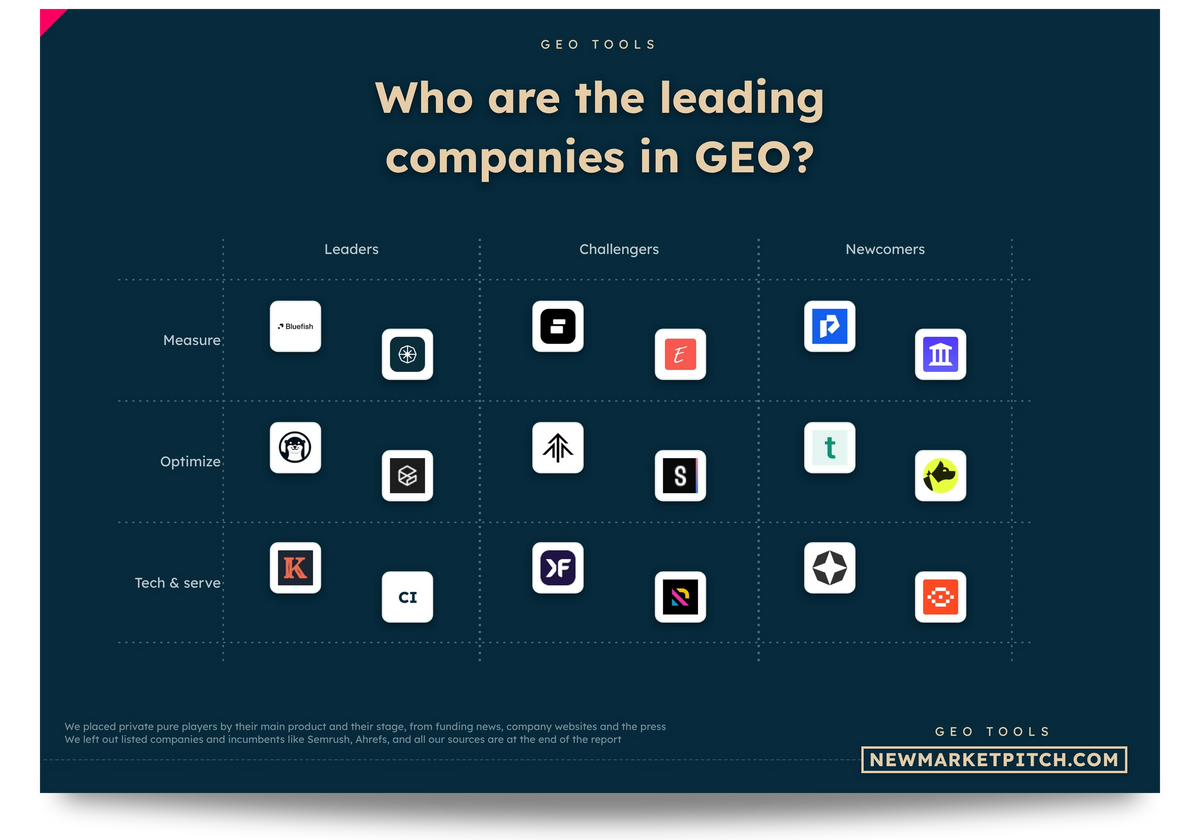
In our research about GEO startups, we turn what is vague and complex into simple, useful visuals. Market maps like this one show you at a glance where every startup stands.
Is GEO funding really booming, or does it just look that way?
GEO startup funding looks much bigger today, but most of the jump comes from two Profound rounds, so it is not yet a broad boom.
We tracked 26 deals worth at least $452M in the last 12 months, compared with 21 deals worth at least $207M in the 12 months before. The deal count rose 24% and the money raised rose 119%, but Profound's two rounds account for most of that gain. More startups are getting funded, and some are attracting serious money. What matters is how far the money spreads beyond the standout companies.
There are signs of a real market forming. Serpier raised a $1.6M Seed in June 2026 for AI-search content workflows, while Miracly's $2M Seed in October 2026 backed monitoring and content agents. They are very different bets from an enterprise platform serving the biggest brands. The range shows that investors are willing to back both specialist tools and larger software businesses.
The reason brands are paying attention is straightforward. Google said in June 2026 that AI Overviews had more than 2.5 billion monthly users. That is an enormous audience whose answers brands now want to understand. It does not tell us how many of those brands will keep paying a GEO vendor. For now, investor interest is real; a durable funding boom remains unproven.
Is Profound making the whole GEO funding market look bigger?
Profound is doing much of the work behind GEO's impressive fundraising total, even though other startups are getting funded too.
Profound raised $276M across 2 financings in the last 12 months: a $96M Series C in February 2026 and a $180M Series D in September 2026. The later round was led by Sequoia Capital and Kleiner Perkins. Profound said at the time that its platform served more than 1,000 enterprise brands, including Comcast and Walmart. Its February announcement had already introduced Agents, a way for marketing teams to act on the visibility information they collect.
There is a reason large investors are interested. A tool that only reports where a company is mentioned has a narrower job than software used to plan and run a marketing team’s work. Profound is trying to sell the second kind of product. Yet no disclosed customer count tells us whether every account will renew or whether the business is profitable.
Bluefish's $43M Series B in April 2026 and Brandlight's $30M Series A in February 2026 show that Profound has well-financed enterprise competitors. They also show just how unusual its latest check is. Anyone using the market total to judge what a new GEO startup could raise would get the wrong impression.
Would GEO funding still look healthy without the giant rounds?
Without the giant rounds, GEO fundraising looks weaker than the headline total suggests.
Excluding rounds above $50M leaves at least $176M in the last 12 months, against at least $207M in the 12 months before, a 15% drop. If we exclude only rounds above $100M, the latest period still has at least $272M. Profound's $96M Series C in February 2026 and $180M Series D in September 2026 explain why the answer changes so much depending on where we draw the line. The earlier period's largest financing was AirOps' $40M Series B in November 2025.
The smaller checks offer another useful test. The exact median disclosed GEO round was $5.5M in the latest period and $6.0M in the preceding one. An Obsero Seed, a Serpier Seed and a major enterprise round can all belong to the same industry without telling the same fundraising story. Investors are still backing small experiments, but they are reserving extraordinary amounts for companies that look capable of selling much broader software.
A giant round is a real investment, and we should count it. We just should not let it stand in for the experience of every founder trying to raise money.
The table below shows how many GEO rounds fell into each disclosed deal-size bracket in the two periods.
| Deal size | Previous deals | Current deals |
|---|---|---|
| under $5M | 8 | 10 |
| $5M to under $20M | 6 | 9 |
| $20M to under $50M | 5 | 2 |
| $50M to under $100M | no deal | 1 |
| $100M or more | no deal | 1 |
Rounds with undisclosed amounts are excluded.
Are more GEO startups actually getting investment?
More GEO startups got funded in the latest period, so the market is reaching beyond a familiar group of names.
We counted 21 funded companies in the last 12 months, compared with 17 in the 12 months before. The roster includes teams building quite different products: Petra Labs works on structured information that AI systems can find, Lemrock makes merchant catalogues easier for assistants to use, and Limy tries to connect AI discovery to customer actions. These are separate problems, with different possible buyers.
Returning companies still matter. Searchable's $4M Seed in December 2025 preceded a $14M Seed in May 2026. Azoma's $4M Seed in December 2025 was followed by an $11M Series A in October 2026. Investors were willing to back these companies again within the latest period, while newer businesses also entered the market.
That combination is better news for founders than a situation where one startup takes every additional dollar. It gives us evidence of a wider field, even if the biggest rounds still distort the dollar totals. The harder question is whether newcomers can get beyond an initial check and build enough customer demand to come back for another.

In our market report about GEO startups, we always try to gather several sources and make estimates that make sense, so you can work with solid numbers.
Can a brand-new GEO startup still get its first check?
Yes, GEO investors are still financing first-time entrants, although those checks are far smaller than the biggest follow-on rounds.
The last 12 months included 9 first financings worth $36M, against 6 worth $26M in the 12 months before. First financing means the first round we know of for the company, which is not the same thing as a Seed label. Plenty of companies call a later investment Seed, and treating every Seed as a new entrant would misread the market.
The examples are practical rather than interchangeable. Limy's $10M Seed in January 2026 focused on connecting AI-driven discovery with customer conversion. Lemrock's $6.9M Seed in March 2026 backed AI-readable product catalogues, while Petra Labs' $5.2M Seed in July 2026 centered on structured brand information. Obsero entered with a $1.1M Seed in October 2026 for AI-search intelligence and consulting.
The 14 follow-on financings drew at least $415M in the latest period. This leaves room for new startups, but the much bigger checks go to teams with an existing funding history. For a new founder, the immediate question is still whether a useful product solves a problem a brand or agency will pay to fix.
Is enterprise GEO software getting all the money?
Enterprise GEO software is getting most of the disclosed funding, while smaller GEO products still attract more individual bets.
Enterprise GEO orchestration drew 6 deals worth $367M in the last 12 months, representing 81% of disclosed capital. These companies try to become software that a marketing team uses across research, content and performance tracking, rather than a tool for checking brand mentions. Profound, Bluefish and Brandlight are the obvious examples of that ambition.
Bluefish said in April 2026 that customers included Adidas, American Express and LVMH. Brandlight described work with Kimberly-Clark and LG in its February 2026 announcement. These are company-reported relationships, but they give an investor something more concrete to examine than a promise to rank brands in AI answers.
Meanwhile, AI answer visibility monitoring recorded 7 deals and GEO services and managed optimization recorded 4. The industry is still producing specialists. The financial gap comes from how much investors are prepared to put into a platform that might become an everyday marketing product. Whether those platforms earn the checks will depend on customers continuing to use and pay for them.
The table below shows the deal count and disclosed capital by GEO category in the last 12 months.
| GEO segment | Deals | Capital | Capital share |
|---|---|---|---|
| Enterprise orchestration | 6 | $367M | 81% |
| Commerce GEO | 3 | $22M | 5% |
| Visibility monitoring | 7 | $18M+ | 4% |
| Entity infrastructure | 2 | $17M | 4% |
| Managed services | 4 | $10M+ | 2% |
| Search attribution | 1 | $10M | 2% |
| Content workflows | 3 | $8.3M | 2% |
Category names are shortened. Capital shares refer only to disclosed capital; plus signs mark minimums.
Are AI visibility dashboards already losing investors?
AI visibility dashboards can still get funded, but their easy-to-copy features are becoming a much tougher sell.
AI answer visibility monitoring produced 7 financings worth at least $18M in the last 12 months, versus 8 deals worth at least $52M in the 12 months before. Promptwatch's ~$6.9M Seed in July 2026, BrandRank.AI's $3M Seed in July 2026 and Emberos' $5.5M Seed in September 2026 show that investors have not abandoned monitoring. The weaker total still raises a question about what a stand-alone dashboard can charge for.
Microsoft made the problem concrete in February 2026. Bing Webmaster Tools added AI Performance, showing site owners citations, cited pages and the queries that led to them. A company offering only part of that information for a fee must give customers a compelling reason to pay. Cross-platform comparisons, practical recommendations and reporting tied to actual sales are harder to replace with a basic free report.
Peec AI shows that buyers do pay for more than a quick brand check. In its November 2025 Series A announcement, it reported more than 1,300 brands and agencies onboarded and annual recurring revenue above $4M. A year later, in November 2026, Peec AI reported $20M. Those figures are company-reported, but they are evidence that the demand extends beyond curious users checking their brand names once.

Our document detailing everything you need to know about GEO gets updated several times a month, so you always get the latest view of where things stand.
Do GEO startups have paying customers yet?
Yes, some GEO startups already sell to major brands and smaller paying businesses; customer demand is no longer just a pitch.
Profound named Comcast and Walmart among its enterprise customers in September 2026. Bluefish's April 2026 announcement listed Adidas, American Express, Hearst and Ulta Beauty. Brandlight named The Hartford and Estée Lauder in February 2026. None of these announcements provides a complete view of renewals or profit margins, but the named relationships give a clear picture of who is buying GEO software.
Searchable offers a different example. In May 2026 its founder said the company had passed $2M in annual recurring revenue and signed more than 500 paying customers after opening paid accounts in January. That is an unusually specific commercial claim for a young company, and it ties the product to actual subscriptions rather than only interest in AI search.
There is still a large gap between a few successful vendors and a whole industry with dependable revenue. Enterprise software contracts, agency subscriptions and managed services have different economics. We can say that paid demand exists today. We cannot yet say that most GEO startups have found a way to keep customers year after year.
Do GEO founders need revenue before investors will fund them?
No, a GEO founder does not necessarily need revenue for a first check, but paying customers help make a case for a much larger one.
Look at the early bets. Petra Labs' $5.2M Seed in July 2026 backed structured brand information, and Miracly's $2M Seed in October 2026 supported AI-search content agents. Neither funding entry establishes whether the startup had sales at the time, so we should not invent a revenue threshold that every investor applies.
The companies asking for bigger checks have been more explicit about customers. Searchable reported paying accounts and recurring revenue alongside its May 2026 financing. Profound emphasized enterprise customers and marketing automation in September. In October, Azoma said it worked with L'Oréal, Unilever, Mars, Beiersdorf and Reckitt and had grown its team while building AI-shopping tools.
Those are examples of what companies choose to show when they raise, rather than proof that every investor insists on the same milestone. A small team can still persuade investors with a new technical approach. Asking for much more money is easier when brands have already demonstrated that the product belongs in their budgets.
Why are the biggest GEO funding rounds still American?
US GEO startups are still winning the biggest checks, even as funding reaches more companies outside America.
United States companies recorded 9 deals involving 7 startups and $374M in the last 12 months. That was 83% of disclosed capital but 35% of the deals. In the 12 months before, the country recorded 12 deals involving 10 companies and $168M. So the US lead now comes from the size of its rounds, especially in enterprise software, not from winning most of the deals.
Profound is selling a broader marketing platform, Bluefish targets large corporate brands, and Brandlight works on how those brands appear in AI answers and shopping. Big companies may have budgets for products that bring several marketing jobs together. That helps explain the size of the opportunities these startups describe, although it cannot tell us why any particular investor said yes.
Over the last 12 months, Europe recorded more deals than North America, while the biggest American rounds pull the capital totals sharply in the other direction. Headquarters location is not a measure of where every customer lives. It does, however, show where the companies attracting the largest venture checks are based.

In our report covering the GEO market, we look at what the winners do differently, so you can learn from the best instead of guessing.
Can British GEO startups really compete with US companies?
British GEO startups can attract real venture money and brand customers, but they have not matched the largest US checks.
The United Kingdom recorded 6 deals across 4 companies and $46M in the last 12 months. Searchable raised a $14M Seed in May 2026 for software that combines AI visibility with work a marketing team can carry out. geoSurge's $12M Seed in July 2026 funded infrastructure to help brands understand their representation in AI systems. Azoma took a different route, working on how products appear in AI shopping assistants.
The commercial approaches matter. Searchable is trying to become part of a marketing team's routine, geoSurge focuses on the way AI systems recognize brands, and Azoma sells into retail and consumer-goods workflows. Azoma named L'Oréal and Reckitt among its customers when announcing its October 2026 financing. Those are distinct ways to win a budget.
UK founders have options beyond making another citation dashboard. Still, the difference in round sizes is clear. These companies have a credible base for raising money and selling abroad; they have not yet produced an American-style mega-round in the period we studied.
Is GEO funding finally spreading beyond the US and Europe?
GEO startups in Asia-Pacific are starting to attract funding, although their checks are still smaller than those in North America.
Asia-Pacific recorded 6 deals involving 5 companies and at least $10M in the last 12 months, while the 12 months before had just 1 deal in the region. Gushwork raised a $9M Seed in February 2026 in India. China's PureblueAI, which sells local-language GEO services, added two early rounds with undisclosed amounts in February and July 2026, after a seed of at least $1.4M in August 2025. Japan also appeared through QueryLift's $637K Seed in September 2026 and Z Creative Partners' ~$320K Seed in November 2026.
These companies are pursuing different markets. Gushwork helps B2B suppliers improve how potential buyers discover them through assistants, whereas PureblueAI offers optimization for local-language search. Japan's newer companies are developing ways to monitor recommendations and brand citations. It would be a mistake to assume all of them face the same customer needs or can sell the same product globally.
The geographic spread is encouraging because shoppers and business buyers use AI in more than one language. But the latest rounds still look like the first investments in young businesses, not evidence that every region now has a mature GEO funding ecosystem. Investors are testing where the demand will develop.
Can a GEO startup really change what ChatGPT says about a brand?
A GEO startup can help a brand improve its information and measure AI answers, but it cannot promise to control what ChatGPT or Gemini will say.
Google's guidance for AI Overviews and AI Mode is unusually plain: ordinary search fundamentals still matter, and there is no special markup requirement that guarantees an appearance. It also warns that eligibility does not mean a page will be shown. Answers can differ across prompts and services, so a permanent promised placement is a weak product claim.
That does not make GEO useless. geoSurge's $12M Seed in July 2026 backed its work on how models represent brands. Profound launched Agents in February 2026 to help marketing teams turn what they learn into changes. Limy works on what happens when an assistant's recommendation leads a user toward a brand. These are jobs customers may pay for even though nobody controls the final answer.
A useful GEO company should be able to say what it measured, what it changed and what happened afterward. Investors ought to be skeptical when a vendor skips those steps and promises a guaranteed position. The product can be valuable without claiming a power the technology does not give it.
Is AI shopping becoming a real GEO business?
AI shopping is now a credible GEO business for startups that help products get found by external assistants.
Commerce and product GEO recorded 3 deals involving 2 companies and $22M in the last 12 months, compared with 2 deals and $2.6M in the 12 months before. Azoma's $11M Series A in October 2026 backed its work on product information and recommendations; Lemrock's $6.9M Seed in March 2026 targeted catalogues that assistants can understand. Both are trying to get brands represented in tools shoppers use outside a retailer's own website.
The platforms are making that job more tangible. OpenAI introduced richer ChatGPT shopping discovery and merchant product feeds in March 2026. Google said in April 2026 that incomplete Merchant Center feeds can make products harder to find in its AI shopping experiences. Keeping product attributes, prices and availability useful to assistants is therefore a real task for merchants.
Adobe added a commercial clue in October 2026: AI-referred visitors generated 83% higher revenue per visit on US retail sites in September. That is a measure of shopper behavior, not proof that a GEO vendor caused the purchases. Still, it helps explain why a product team would care about how its catalogue appears inside AI recommendations.

In our research about GEO startups, we don't want to repeat what boring consulting reports say. Instead, we show you the real and latest market signals that matter.
Can GEO software tell whether an AI recommendation made a sale?
GEO companies are beginning to tackle sales attribution, but there is still no simple way to prove that a particular AI answer caused a purchase.
AI search attribution and conversion recorded 1 deal in the last 12 months, Limy's $10M Seed in January 2026. Led by Flybridge Capital Partners, the first financing backed tools intended to connect assistant activity with what customers do afterward. That is a different job from counting how often ChatGPT mentions a company.
Imagine someone asks an assistant which headphones to buy, then visits a shop directly the next day. A normal traffic report might miss the recommendation. A different shopper might follow a link and buy immediately. Both people heard from an assistant, but they leave different trails. A visibility dashboard cannot, by itself, tell a retailer which recommendation produced an order.
Adobe's October 2026 study measured actual transactions after visits referred from AI sources, so we know some journeys can be observed. OpenAI's product-feed guidance also shows how merchants can supply structured product information, though a feed is only one part of the purchase process. A GEO attribution tool could become valuable if it connects these pieces without claiming to see every invisible step.
Will investors fund GEO agencies, or do they only want software?
Investors will fund GEO services businesses too, particularly when those services help customers get practical results from AI search.
GEO services and managed optimization had 4 deals involving 3 companies and at least $10M in the last 12 months. Gushwork's $9M Seed in February 2026 was a notable example, joined by Obsero's $1.1M Seed in October 2026 and two PureblueAI rounds with undisclosed amounts. These businesses combine tools with hands-on work for clients, rather than expecting every customer to operate the software alone.
There is a reason this can sell. A manufacturer may want its products recommended by AI assistants but have nobody on staff to review prompts, rewrite pages or monitor leads. Gushwork's February announcement described that B2B discovery problem. Its June 2026 product update added an AI editor for making website changes in plain English, showing how services can feed back into software features.
The investment risk is simple: if every new customer requires substantial manual work, the company has to hire more people to grow. Better automation could improve that equation. Fundraising tells us investors are willing to explore this model, but it says little about the margins these agencies will eventually earn.
Are top venture capital firms actually backing GEO startups?
Yes, major venture capital firms already back GEO companies, although most have led only a limited number of rounds in the market.
Sequoia Capital and Kleiner Perkins backed Profound's $180M Series D in September 2026, after Lightspeed Venture Partners led its $96M Series C in February 2026. New Enterprise Associates and Threshold Ventures co-led Bluefish's $43M Series B in April 2026. Earlier, Greylock led AirOps' $40M Series B in November 2025 and Singular led Peec AI's $21M Series A that same month.
Those names make it difficult to dismiss GEO as a category financed only by small specialist funds. Still, a respected investor writing one large check should not be confused with an industry receiving the same support at every stage.
We identified 26 unique disclosed lead investors in the last 12 months and 20 in the 12 months before. No lead investor led multiple tracked rounds within either period. The field of active lead investors has widened, but the evidence does not show that they are repeatedly returning to GEO deals. They may be making selective bets on individual founders and products; the next financings will tell us more about their commitment to the category.
Are GEO startups raising their next round faster now?
GEO startups can raise another round quickly, but the observed pace has actually slowed rather than sped up.
The median time between successive rounds was 9 months in the last 12 months, versus 7 months in the 12 months before. In the latest period, 71% of measured gaps were shorter than 12 months, against 80% previously. This covers 54% of deals in the latest period and 48% in the preceding one, and those percentages describe gaps between rounds, not the share of companies raising twice.
Some companies are notable exceptions. Searchable's $4M Seed in December 2025 was followed by a $14M Seed in May 2026. Azoma raised a $4M Seed in December 2025 before an $11M Series A in October 2026. Such quick returns can reflect growing demand, a desire to hire or simply a favorable chance to secure capital.
It is tempting to look at a fast follow-on and declare that a startup is winning. But a new check is not a customer renewal or a profit figure. Given the still-short histories and incomplete coverage, we would not treat fundraising speed as a reliable measure of GEO business health today.

Learning from others' mistakes is the cheapest lesson there is. In our market report about GEO startups, we look at what broke startups before you, so you don't repeat it.
Is there enough real demand for GEO startups to survive?
Brands have good reasons to pay attention to AI search, but GEO vendors still have to prove their software earns a lasting place in marketing budgets.
Pew Research Center found in July 2025 that people clicked traditional results in 8% of Google visits with an AI summary, versus 15% when there was no summary. Just 1% clicked a source link inside an AI summary. That is a clear reason for brands to care about how they are discussed in the answer itself, though the study was about Google search behavior rather than every AI assistant.
Demand is becoming easier to connect to purchases. Adobe reported in October 2026 that visits from AI sources converted 90% better than other US retail traffic in September. Google said in June 2026 that AI Mode had more than one billion monthly users. These numbers suggest people are discovering products in new ways; they do not establish that hiring a GEO startup causes more revenue.
Searchable's paid accounts, Azoma's consumer-brand customers and Bluefish's enterprise relationships show different routes to selling that promise. The real test comes after the excitement fades: does a brand keep paying because the product regularly improves decisions, saves work or brings in customers? That answer will decide which startups survive.
Could Google's and Microsoft's free tools kill GEO startups?
Free tools from Google and Microsoft threaten simple GEO dashboards, but more complete products still have work that those tools do not cover.
Microsoft launched AI Performance in Bing Webmaster Tools in February 2026, giving publishers reports about citations and the pages used in AI-generated answers. It added more topic-level reporting in October. Google says that normal search practices remain the foundation for appearing in its AI features and that publishers do not need an extra proprietary file. A paid tool that merely repackages basic visibility reports is going to face tough questions from customers.
Yet a marketing team may need to compare different assistants, diagnose why a product appears for one question and disappears for another, update content across markets or understand what happened to leads. Profound is building workflow tools for larger teams. Azoma focuses on the details of retail product discovery. Limy is working on what happens between AI discovery and a customer action. Those jobs extend beyond a free site-visibility report.
The biggest long-term risk is that answer engines can change both their products and the information they make available. Startups built on one reporting gap may lose their advantage overnight. Ones that help brands do useful work across platforms have a stronger chance of staying relevant.
So, what does GEO funding look like right now?
GEO funding is reaching more startups and attracting bigger checks, but it is still too concentrated to call the market broadly healthy.
The last 12 months brought 26 deals worth at least $452M, versus 21 deals worth at least $207M in the 12 months before. Profound raised $276M across 2 financings, leading the field for money raised during the latest period. First-time entrants can still get funded, and investors are experimenting with commerce, attribution, infrastructure and services alongside enterprise software.
We also see clear limits. The latest period's smaller rounds brought in less money once deals above $50M were excluded, and the typical disclosed round is below the preceding period's median. Meanwhile, a handful of platforms can point to paying brands, but few startups have a long public record of renewals or profit. Large investors are paying for a future in which AI answers influence more purchasing decisions; that future is not yet evenly distributed across GEO businesses.
For now, the best description is a young market with genuine customers, an expanding group of funded companies and a sharp divide between small experiments and the few platforms winning giant checks. The free tools already entering the market will make it harder to sell a dashboard alone.
The table below shows what we found.
| Question | Answer |
|---|---|
| Is this a broad new funding boom? | GEO's funding total looks impressive, but ordinary financing is weaker. Funding without rounds above $50M brought at least $176M recently. Big checks still dominate how people see the sector. |
| Are giant checks distorting the picture? | The biggest GEO checks go to established enterprise platforms. The latest period had 1 round of $100M or more. Very few startups can use that as a benchmark. |
| Are ordinary GEO rounds getting bigger? | The typical disclosed GEO check is smaller these days. Its latest exact median was $5.5M per round. Mega-round headlines tell founders little about ordinary funding. |
| Can fresh GEO companies still get started? | Yes, investors still make first bets on GEO founders. We counted 9 first financings in the latest period. Those checks support experiments across quite different product ideas. |
| Are investors backing more than existing winners? | More different companies are getting a chance to raise. The latest period included 21 funded GEO startups. That wider field offers more ways to test demand. |
| Does enterprise software get the biggest checks? | Enterprise GEO software is where the biggest checks land. Enterprise orchestration received $367M during the latest period. That money supports broader products aimed at major marketing teams. |
| Have AI citation dashboards lost their appeal? | Citation monitoring is still fundable, though its outlook has changed. Visibility monitoring recorded 7 deals in the latest period. Free platform reports make basic dashboards less attractive. |
| Can British founders compete for GEO money? | British GEO companies are raising money for different products. United Kingdom startups raised $46M in the latest period. The biggest American enterprise deals remain much larger. |
| Is shopping turning into a GEO business? | AI shopping is becoming a real GEO product market. Commerce and product GEO raised $22M in the latest period. Merchant data now affects discovery across external assistants. |
| Are big venture firms making repeated bets? | Established venture firms are willing to fund GEO startups. We found 26 unique disclosed leads in the latest period. One round per lead hardly proves lasting enthusiasm. |
| Is repeat fundraising getting faster for GEO? | Fast repeat financings happen, but they are not typical. The observed median gap was 9 months recently. A quick second check tells us little about profits. |

If you build or invest in the GEO market, you need to know which business models pay off now and which ones are fading. That's why our report covering it has a whole section on it.
Our methodology
Our data runs through November 19, 2026. We then reviewed this article and updated its answers on November 24, 2026, the date shown under the title. We compare the last 12 months, November 20, 2025 to November 19, 2026, with the 12 months before, November 20, 2024 to November 19, 2025. Both periods have at least 20 deals, enough for percentage changes, and both fall within our complete coverage of the market's deals, which starts in January 2024. We keep 12 months against 12 because an 18-month comparison would reach back before that date.
We count equity financings of private companies worth at least $300K. Debt, grants, loans, unconverted convertibles, SAFEs and public offerings are excluded. Each financing counts once; reports of the same round are merged rather than treated as separate deals.
We define generative engine optimization as technology and specialist services primarily designed to measure, manage or improve how brands, products and content appear in generative AI answers and AI-mediated search. That includes AI-answer monitoring, competitive intelligence, GEO workflows, entity and catalogue infrastructure, AI-search attribution, product discovery and focused managed services. We include borderline businesses when their GEO activity is central rather than omit a genuinely relevant company; generic LLMs, conventional SEO, broad advertising tools and consumer shopping apps without a substantial external-discovery function do not qualify.
Every company counted is a startup under our definition: independent, founded in 2007 or later, built to grow around a new product or technology, financed by venture capital, angels, grants or founders, and either private or listed within the last five years. A company acquired within the last three years may remain included as part of its acquirer. We classify stage from the reported financing, group early and later rounds consistently, assign regions from headquarters country and split categories by the company's main GEO function.
Undisclosed-amount financings count as deals but do not add money to funding totals. That makes some figures minimums, shown with a plus sign in tables and written as 'at least' in sentences. We distinguish first financings from follow-ons separately from financing stages, and evaluate repeated rounds only where the relevant history is available.
Rounds confirmed by a company announcement, a press article or a regulatory filing are counted in full. Where no article exists, a round is counted only when at least two recognised databases agree on its date (within one month) and amount (within 5%), and it is marked as low confidence; a round found in a single database stays in the company's history but is left out of totals. For companies that have raised more than $100M, every round counted is backed by an article.
We prioritize company announcements, regulatory filings and reliable reporting over database summaries. A total may differ from a headline in the press because a press figure can include debt, earlier financings or products outside this specific market. This analysis deliberately compares consecutive periods rather than each company's lifetime funding; the separate GEO funding tracker and company rankings answer different questions. The latest partial month is not treated as a complete month.
Key sources include Profound's February 2026 Series C and launch of Agents., Profound's September 2026 financing, investors and enterprise adoption., Bluefish's April 2026 financing and named customers., Brandlight's February 2026 financing and enterprise clients., Searchable's May 2026 financing and company-reported recurring revenue and customers., Peec AI's November 2025 financing and reported commercial progress., Azoma's October 2026 strategy, named customer brands and fundraising., geoSurge's July 2026 financing and positioning on AI brand representation., Gushwork's February 2026 financing and B2B discovery strategy., Gushwork's June 2026 AI editor product update., Limy's January 2026 financing and agent-attribution strategy., Google's June 2026 update on AI search reach and website-owner tools., Google Search Central rules and limits for appearance in AI features., Microsoft's February 2026 citation analytics launch., Microsoft's October 2026 expansion of AI citation reporting., OpenAI's March 2026 product discovery and merchant-feed initiative., OpenAI merchant-product feed and purchase-flow distinction., Google's April 2026 advice on retail product-data quality for AI shopping., Adobe's October 2026 retail conversion and revenue-per-visit findings., and Pew Research Center study of clicking behavior around Google AI summaries..

In our report covering the GEO market, we like to show you the big picture. We know your time is precious, so we make every page quick to read and packed with as much learning as possible per minute.
Written by the New Market Pitch teamWe track new markets so founders and investors can move faster. About us