GEO Funding Tracker (50+ deals)
Whether you're building or investing in the GEO market, our report covers everything you need to know: the players, the money, and what's coming next.
Summary
Since January 2024, GEO startups have raised at least $688M across 55 deals and 32 companies. Profound has collected $335M of that money, more than any other GEO startup.
There is a market beyond Profound. The funded companies sell tools for AI search visibility, content updates, product discovery, attribution and hands-on optimization. But one company still changes the size of the headline dramatically.
Most founders are raising on a very different scale. The median disclosed round is $5.4M, and the market is crowded with young teams getting their products into customers' hands.
The real split is in what those teams sell. AI answer monitoring brings in plenty of companies, while enterprise GEO platforms win the checks that make headlines.
Investors appear more willing to pay for software that helps brands act on AI-search findings than for another dashboard showing where a brand appeared. That preference is clear in the financing sizes, even if the best long-term business model is still up for grabs.
GEO companies have also had remarkably little time to prove themselves. Their median age at financing is 1 year, so customer retention and long-term pricing have barely been tested across the sector.
Some startups are already returning to investors. We counted 15 companies with repeat financings, and those repeat rounds tend to arrive quickly.
The money is heavily American. North America accounts for 27 deals and $570M+, while Europe accounts for 21 deals and $107M+. Europe has built a real group of competitors despite the funding gap.
Money arrives in bursts, too. The median completed month has 1 deal, and 8 months have no qualifying deal recorded in our database. One large enterprise round can change the picture overnight.
GEO is now a funded business category, with customers, acquisitions and several approaches to AI discovery. The open question is which startups can keep customers paying when search platforms and established marketing software companies add similar features.

Written by the New Market Pitch teamWe track new markets so founders and investors can move faster. About us

In our report covering the GEO market, you will always find fresh funding data, taken straight from our own verified funding database.
Our funding tracker covering the generative engine optimization market
Below is the table listing all the deals. You can find our methodology at the end of this page.
If you want a deeper understanding of the market and its current dynamics, get our generative engine optimization market report.
| Company | Category | Date | Stage | Deal size | What they do | Region | Lead investors | Country | Rank |
|---|---|---|---|---|---|---|---|---|---|
| Z Creative Partners | AI answer visibility monitoring | November 2026 | Seed | ~$320K | Z-GEO analyzes brand visibility and recommendations in generative AI answers. | Asia-Pacific | Not disclosed | Japan | |
| Azoma | Commerce and product GEO | October 2026 | Series A | $11M | Optimizes product information and recommendations to improve consumer-brand discovery in AI shopping agents. | Europe | Puma Growth Partners | United Kingdom | |
| Miracly | GEO content and workflow optimization | October 2026 | Seed | $2M | Combines AI search monitoring with content agents | Europe | Beenext Ventures, Lotus | Sweden | |
| Obsero | GEO services and managed optimization | October 2026 | Seed | $1.1M | Provides AI search intelligence and GEO consulting | Europe | SFC Capital | United Kingdom | |
| Unveilr AI | AI answer visibility monitoring | October 2026 | Seed | Undisclosed | Search visibility analytics for AI engines | Asia-Pacific | AJVC | India | |
| QueryLift | AI answer visibility monitoring | September 2026 | Seed | $637K | Tracks brand citations across generative search systems | Asia-Pacific | JAFCO, Z Venture Capital | Japan | |
| Profound | Enterprise GEO orchestration | September 2026 | Series D+ | $180M | AI search visibility and marketing analytics | North America | Sequoia Capital, Kleiner Perkins | United States | |
| Emberos | AI answer visibility monitoring | September 2026 | Seed | $5.5M | AI brand visibility and optimization platform | North America | Not disclosed | United States | |
| BrandRank.AI | AI answer visibility monitoring | July 2026 | Seed | $3M | Benchmarks brand performance across AI answer engines | North America | Grit Capital Partners, QCA Ventures | United States | |
| Petra Labs | AI-readable content and entity infrastructure | July 2026 | Seed | $5.2M | Improves AI discovery through structured brand information | North America | Work-Bench | United States | |
| Promptwatch | AI answer visibility monitoring | July 2026 | Seed | ~$6.9M | Tracks AI mentions and automates optimization recommendations | Europe | seed + speed Ventures | Netherlands | |
| geoSurge | AI-readable content and entity infrastructure | July 2026 | Seed | $12M | Improves how models represent and recall brands | Europe | AlbionVC | United Kingdom | |
| PureblueAI | GEO services and managed optimization | July 2026 | Seed | Undisclosed | Offers local-language generative engine optimization services | Asia-Pacific | Not disclosed | China | |
| Serpier | GEO content and workflow optimization | June 2026 | Seed | $1.6M | Automates SEO and AI search content workflows | Europe | True Collective | Denmark | |
| Searchable | Enterprise GEO orchestration | May 2026 | Seed | $14M | Monitors and optimizes discovery across AI engines | Europe | Headline | United Kingdom | |
| Bluefish | Enterprise GEO orchestration | April 2026 | Series B | $43M | AI search visibility and marketing optimization | North America | Threshold Ventures, New Enterprise Associates | United States | |
| Lemrock | Commerce and product GEO | March 2026 | Seed | $6.9M | Makes product catalogues accessible to AI assistants | Europe | Galion.exe | France | |
| Gushwork | GEO services and managed optimization | February 2026 | Seed | $9M | Provides AI-assisted search and generative visibility services | Asia-Pacific | Susquehanna Asia VC | India | |
| Profound | Enterprise GEO orchestration | February 2026 | Series C | $96M | AI search visibility and marketing analytics | North America | Lightspeed Venture Partners | United States | |
| Brandlight | Enterprise GEO orchestration | February 2026 | Series A | $30M | Optimizes enterprise brand presentation in AI answers | North America | Pelion Venture Partners | United States | |
| PureblueAI | GEO services and managed optimization | February 2026 | Seed | Undisclosed | Offers local-language generative engine optimization services | Asia-Pacific | Vertex Ventures China | China | |
| Limy | AI search attribution and conversion | January 2026 | Seed | $10M | Attributes AI search traffic to customer acquisition | North America | Flybridge Capital Partners | United States | |
| Emberos | AI answer visibility monitoring | January 2026 | Seed | $1.2M | AI brand visibility and optimization platform | North America | Not disclosed | United States | |
| GetMint | GEO content and workflow optimization | December 2025 | Seed | $4.7M | Optimizes brand visibility across conversational AI search | Europe | Founders Future | France | |
| Azoma | Commerce and product GEO | December 2025 | Seed | $4M | Optimizes product information and recommendations to improve consumer-brand discovery in AI shopping agents. | Europe | Not disclosed | United Kingdom | |
| Searchable | Enterprise GEO orchestration | December 2025 | Seed | $4M | Monitors and optimizes discovery across AI engines | Europe | Freestyle VC | United Kingdom | |
| Peec AI | AI answer visibility monitoring | November 2025 | Series A | $21M | Tracks brand mentions and citations in AI | Europe | Singular | Germany | |
| Relixir | GEO content and workflow optimization | November 2025 | Seed | $2M | Automates website optimization for generative AI search | North America | Not disclosed | United States | |
| AirOps | GEO content and workflow optimization | November 2025 | Series B | $40M | AI search visibility and content workflows | North America | Greylock | United States | |
| Ranketta | Commerce and product GEO | November 2025 | Seed | $1.2M | Tracks product citations and AI shopping recommendations | Europe | Lighthouse Ventures | Czech Republic | |
| The Prompting Company | AI-readable content and entity infrastructure | October 2025 | Seed | $6.5M | Makes brands and products discoverable by AI | North America | Peak XV Partners | United States | |
| Omnia | AI answer visibility monitoring | October 2025 | Seed | $4M | Monitors and improves brand visibility in AI search | Europe | Visionaries Club | Spain | |
| Promptwatch | AI answer visibility monitoring | September 2025 | Seed | $1.4M | Tracks AI mentions and automates optimization recommendations | Europe | Not disclosed | Netherlands | |
| Bluefish | Enterprise GEO orchestration | August 2025 | Series A | $20M | AI search visibility and marketing optimization | North America | New Enterprise Associates, Salesforce Ventures | United States | |
| Profound | Enterprise GEO orchestration | August 2025 | Series B | $35M | AI search visibility and marketing analytics | North America | Sequoia Capital | United States | |
| Evertune | AI answer visibility monitoring | August 2025 | Series A | $15M | Measures AI brand visibility and competitive recommendations | North America | Felicis | United States | |
| PureblueAI | GEO services and managed optimization | August 2025 | Seed | $1.4M+ | Offers local-language generative engine optimization services | Asia-Pacific | Inno Angel Fund, BlueFocus | China | |
| Scrunch AI | AI-readable content and entity infrastructure | July 2025 | Series A | $15M | Makes brand content readable to AI agents | North America | Decibel | United States | |
| Peec AI | AI answer visibility monitoring | July 2025 | Seed | $8.3M | Tracks brand mentions and citations in AI | Europe | 20VC | Germany | |
| Profound | Enterprise GEO orchestration | June 2025 | Series A | $20M | AI search visibility and marketing analytics | North America | Kleiner Perkins | United States | |
| AthenaHQ | AI answer visibility monitoring | June 2025 | Seed | $2.2M | Tracks brand share of voice across assistants | North America | Not disclosed | United States | |
| Zoca | GEO services and managed optimization | May 2025 | Seed | $6M | Optimizes local business discovery across AI search | North America | Accel | United States | |
| Brandlight | Enterprise GEO orchestration | April 2025 | Seed | $5.8M | Optimizes enterprise brand presentation in AI answers | North America | Cardumen Capital, G20 Ventures | United States | |
| geoSurge | AI-readable content and entity infrastructure | April 2025 | Seed | Undisclosed | Improves how models represent and recall brands | Europe | Not disclosed | United Kingdom | |
| AthenaHQ | AI answer visibility monitoring | March 2025 | Seed | $500K | Tracks brand share of voice across assistants | North America | Y Combinator | United States | |
| Peec AI | AI answer visibility monitoring | January 2025 | Unknown | Undisclosed | Tracks brand mentions and citations in AI | Europe | Antler | Germany | |
| Azoma | Commerce and product GEO | December 2024 | Seed | $1.4M | Optimizes product information and recommendations to improve consumer-brand discovery in AI shopping agents. | Europe | MaRS IAF | United Kingdom | |
| Scrunch AI | AI-readable content and entity infrastructure | November 2024 | Seed | $4M | Makes brand content readable to AI agents | North America | Mayfield | United States | |
| Evertune | AI answer visibility monitoring | October 2024 | Seed | $4M | Measures AI brand visibility and competitive recommendations | North America | Eniac Ventures | United States | |
| AirOps | GEO content and workflow optimization | October 2024 | Series A | $16M | AI search visibility and content workflows | North America | Unusual Ventures | United States | |
| Azoma | Commerce and product GEO | September 2024 | Seed | $871K | Optimizes product information and recommendations to improve consumer-brand discovery in AI shopping agents. | Europe | Not disclosed | United Kingdom | |
| Profound | Enterprise GEO orchestration | August 2024 | Seed | $3.5M | AI search visibility and marketing analytics | North America | Not disclosed | United States | |
| Bluefish | Enterprise GEO orchestration | August 2024 | Seed | Undisclosed | AI search visibility and marketing optimization | North America | Not disclosed | United States | |
| WP SEO AI | GEO content and workflow optimization | August 2024 | Seed | Undisclosed | Automates WordPress SEO and GEO visibility workflows | Europe | Not disclosed | Netherlands | |
| BrandRank.AI | AI answer visibility monitoring | July 2024 | Seed | $1.2M | Benchmarks brand performance across AI answer engines | North America | Not disclosed | United States |

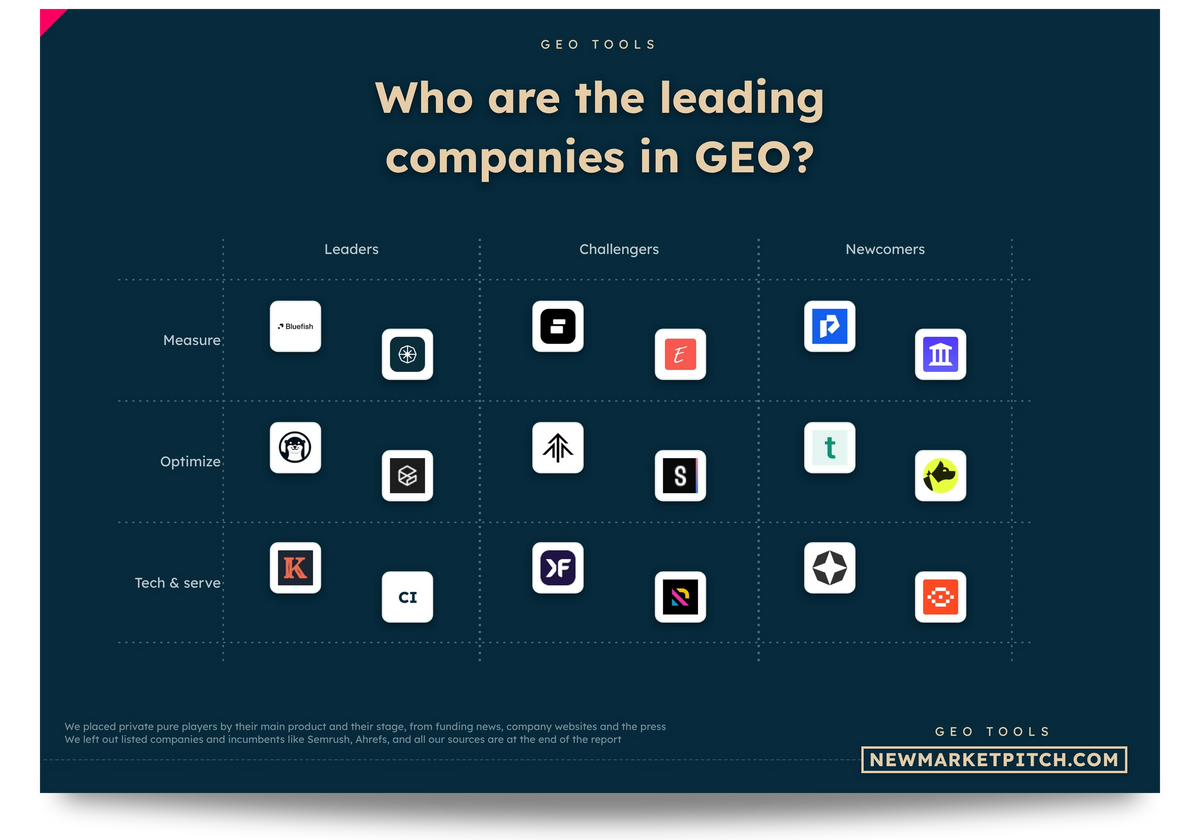
In our research about GEO startups, we turn what is vague and complex into simple, useful visuals. Market maps like this one show you at a glance where every startup stands.
Is GEO funding a real market or mostly Profound?
GEO funding is a real market with plenty of startups beyond Profound, but Profound takes an unusually large part of the money.
We have identified 55 financings across 32 GEO companies so far. Profound raised money in 5 separate rounds. Bluefish sells enterprise AI marketing tools, AirOps helps teams turn search findings into content work, and Azoma works on products appearing in AI shopping recommendations. Their businesses overlap, but they don't sell interchangeable software.
Customers have a reason to care. At its May 2026 developer conference, Google said AI Overviews had passed 2.5 billion monthly users. Pew Research Center found in July 2025 that users clicked a traditional search result on 8% of Google searches with an AI summary, compared with 15% when no summary appeared. That leaves brands with a practical question: who gets mentioned when the search engine answers directly?
Investors are backing several solutions to AI discovery. Which products customers will keep paying for is still an open question.
What are GEO investors actually paying for?
GEO investors are funding software and services that help brands get found in AI answers and understand what happens afterward.
Peec AI and Evertune tell marketers when assistants mention their brands. Scrunch AI, now part of Sitecore, and geoSurge work on information that assistants can read and use. AirOps helps teams change content after spotting a search gap, while Limy connects AI discovery to customer visits. Azoma focuses on products that appear in shopping recommendations. These tools solve different problems for the same marketing team.
The distinction is worth keeping clear. OpenAI said in March 2026 that retailers could supply product feeds for discovery in ChatGPT. Google Search Central says sites do not need special markup to appear in AI Overviews or AI Mode. Neither platform says that paying a GEO vendor is a shortcut into its answers.
How big is a normal GEO startup funding round?
A normal GEO startup round is far smaller than the checks going to the best-known enterprise platforms: the median disclosed deal is $5.4M.
Among deals with public amounts, 23 were under $5M and 16 were between $5M and under $20M. Those groups account for 48% and 33% of disclosed deals, respectively. A founder taking a new GEO product to investors should start with that distribution, not a unicorn announcement.
Consider the products receiving ordinary checks. BrandRank.AI raised a $3M Seed in July 2026 to compare brand performance in AI answers. Omnia raised a $4M Seed in October 2025 for AI search visibility. Petra Labs raised a $5.2M Seed in July 2026 to improve how assistants read brand information. They address different customer problems without needing a giant initial raise.
The median funding raised per company during the period was $6.6M. That company figure includes businesses returning for another check, so it answers a different question from how much one financing usually brings in.
Are most GEO startup deals still seed rounds?
Yes. Seed deals are the norm in GEO, even though later-stage companies collect most of the disclosed money.
Seed accounts for 41 financings, or 75% of deals. Series A has 8 deals and Series B has 3. Among deals with a named stage, early rounds make up 91% of transactions but 43% of disclosed capital. Later rounds account for 9% of those deals and 57% of the money. Startups can get funded early; large follow-on checks are much harder to reach.
New companies can still enter. We classified 19 financings as first rounds, worth $74M, and 25 as follow-ons, worth at least $600M. Another 11 deals lack a clear first-versus-follow-on history. Petra Labs' $5.2M Seed in July 2026 shows the entry side. Bluefish's $43M Series B in April 2026 shows what happens when a business has already raised and returned to investors.
The question for founders is whether their first product can grow into something customers buy again. Seed funding gives a company a chance to find out; it offers little guarantee of reaching the later rounds.
The table below shows GEO financings by stage, ordered by disclosed capital.
| Stage | Deals | Capital | Capital share |
|---|---|---|---|
| Series D | 1 | $180M | 26% |
| Series A | 8 | $148M | 21% |
| Seed | 41 | $146M+ | 21% |
| Series B | 3 | $118M | 17% |
| Series C | 1 | $96M | 14% |
| Growth | no deal | – | – |
| Unknown | 1 | Undisclosed | 0% |
Capital share is the share of disclosed capital. The Unknown entry is a round of undisclosed stage.

In our market report about GEO startups, we always try to gather several sources and make estimates that make sense, so you can work with solid numbers.
Are nine-figure GEO funding rounds becoming normal?
No. GEO has produced just 1 deal of $100M or more, and it came from Profound.
Profound raised a $180M Series D in September 2026, co-led by Sequoia Capital and Kleiner Perkins. It had also raised a $96M Series C in February 2026. Those 2 deals above $50M brought in $276M. With deals above $50M removed, the rest of the market raised at least $412M. Excluding deals above $100M leaves at least $508M.
The larger check came with an operating business. Profound said in September 2026 that more than 1,000 enterprise brands used its platform. That claim is company-reported, but it puts the round in context. The investors were backing a vendor with customers rather than an untested idea for measuring chatbot mentions.
AirOps' $40M Series B in November 2025 and Bluefish's substantial enterprise financing show that other GEO startups can raise meaningful sums. Profound's leap into nine-figure funding remains the exception, not a new starting point for the rest of the sector.
Which GEO businesses are getting the biggest checks?
Enterprise GEO orchestration gets the biggest checks, while AI answer visibility monitoring draws more individual deals.
The enterprise category has 12 deals across 4 companies and accounts for 66% of disclosed capital. Its vendors, including Profound, Bluefish, Brandlight and Searchable, aim to help a large organization monitor AI search and decide what to do about it. Monitoring tools serve a clearer entry-level need: checking mentions, citations and competitor appearances.
The other funded specialties tackle different steps. AirOps works on content changes; Scrunch made brand information easier for agents to read; Azoma improves product visibility in shopping answers; Gushwork sells managed help. OpenAI's March 2026 product-discovery launch made the merchant problem more concrete. Google has also reminded site owners that ordinary SEO fundamentals still matter in generative search.
We think the money follows the work a customer can actually finish with the product. Tracking a lost mention is useful. Fixing the underlying information and showing the result gives a marketing team more reason to keep paying.
The table below shows funded GEO categories, ordered by disclosed capital.
| GEO category | Deals | Companies | Capital | Capital share |
|---|---|---|---|---|
| Enterprise GEO orchestration | 12 | 4 | $451M+ | 66% |
| AI answer visibility monitoring | 17 | 10 | $75M+ | 11% |
| GEO content and workflow optimization | 7 | 6 | $66M+ | 10% |
| AI-readable content and entity infrastructure | 6 | 4 | $43M+ | 6% |
| Commerce and product GEO | 6 | 3 | $26M | 4% |
| GEO services and managed optimization | 6 | 4 | $18M+ | 3% |
| AI search attribution and conversion | 1 | 1 | $10M | 1% |
Capital share is calculated from deals with disclosed amounts; a plus sign indicates a minimum where some amounts remain undisclosed.
Are AI search visibility dashboards already overcrowded?
AI answer visibility monitoring has attracted the most GEO deals, so another simple dashboard has a tough job standing out.
We counted 17 monitoring financings involving 10 companies. The category's median disclosed round is $3M. Peec AI tracks mentions and citations, Evertune measures visibility and competitive recommendations, and AthenaHQ, now part of Bloomreach, and BrandRank.AI approach the same problem with their own analytics tools. They compete for closely related marketing budgets.
People are paying for measurement today. Peec AI said in November 2025 that it had onboarded more than 1,300 brands and agencies since February and reached over $4M in annual recurring revenue. Evertune's August 2025 Series A announcement described a push into a broader enterprise marketing product. Both examples suggest monitoring can bring customers in, even if the value of a bare dashboard may be harder to defend later.
We expect the more useful products to help teams decide what to change, then check whether it worked. A vendor that only returns a score can be compared easily with every other scorecard in the market.

Our document detailing everything you need to know about GEO gets updated several times a month, so you always get the latest view of where things stand.
Why are big companies buying GEO platforms instead of simple tracking tools?
Large companies are buying GEO platforms because they need help fixing what AI assistants say, not just a report telling them where they appeared.
Profound, Bluefish, Brandlight and Searchable have taken different routes toward that broader job. Global brands juggle product information, legal approvals, multiple teams and plenty of public web pages. A monitoring chart alone cannot coordinate those changes.
The product announcements are getting more specific. Profound launched Agents in February 2026 to connect analysis with execution. Bluefish introduced its Agentic Marketing platform in April 2026. Brandlight added AI Ads in October 2026, extending from organic visibility into paid campaigns. Searchable said in May 2026 that it already had more than 500 paying customers and over $2M in annual recurring revenue after opening paid accounts earlier that year.
Those are company claims, and they don't establish that every customer is profitable. Still, there is enough evidence of paying customers and broader products to explain why investors are writing larger checks for enterprise GEO. One tool that helps several teams work together can be harder to replace than a single report.
Can AI search content tools raise serious venture funding?
Yes. GEO content software can attract large VC checks when it helps people improve useful pages instead of simply generating more copy.
Content and workflow optimization has 7 deals across 6 companies and raised at least $66M. AirOps' $40M Series B in November 2025 followed a $16M Series A in October 2024. GetMint raised a $4.7M Seed in December 2025, and Miracly a $2M Seed in October 2026. All work on some combination of search analysis, content editing and AI visibility, though their products are hardly identical.
Google's guidance sets a practical limit. Content made at scale without adding value can violate its spam rules, and its AI search guidance puts useful material ahead of special markup tricks. A tool that endlessly publishes weak pages faces that same problem no matter what its marketing calls the output.
AirOps has made the case for a workflow that joins finding an opportunity, editing a page and checking the result. That's a more concrete job for a customer than asking an assistant to produce another article. Investors have shown they will fund it.
Will AI-readable websites become a real GEO business?
AI-readable content infrastructure has become a real GEO product category, but customers still need proof that it improves discovery.
We found 6 financings involving 4 companies in this category, worth at least $43M. Scrunch AI raised a $15M Series A in July 2025 for a platform designed to make brand content easier for agents to use. geoSurge raised a $12M Seed in July 2026 around how models understand a brand. The Prompting Company raised a $6.5M Seed in October 2025 to improve discovery of brands and products in AI applications.
Sitecore's acquisition of Scrunch in June 2026 gives this idea outside validation. Sitecore described an Akamai test comparing Scrunch-enhanced pages with similar pages, and reported better appearances and citations in AI answers. It's one company's case study, not a guarantee for every site.
Google offers an important check on the sales pitch: its official guidance says sites need no special AI file or schema to appear in its generative search results. Customers may still pay for cleaner, more consistent information across many systems. They should ask vendors to show the improvement, rather than assume a new format will force an assistant to mention them.

In our report covering the GEO market, we look at what the winners do differently, so you can learn from the best instead of guessing.
Is AI shopping becoming a separate GEO market?
Yes. Commerce and product GEO is already drawing specialist startups that help merchants appear in AI shopping answers.
The commerce category has 6 deals involving 3 companies and $26M of disclosed funding. Azoma's $11M Series A in October 2026 backed work on making products easier for shopping agents to understand and recommend. Lemrock raised a $6.9M Seed in March 2026 to make catalogs more accessible, while Ranketta raised a $1.2M Seed in November 2025 for tracking product citations and recommendations.
The buying experience itself is changing. OpenAI expanded shopping in ChatGPT in March 2026 and said merchants could share product feeds to improve how their catalogs appear. The company also said major retailers and Shopify merchants were taking part in the discovery system. Azoma reported in October 2026 that it worked with brands including L'Oréal, Unilever and Mars.
A shopping assistant helps consumers choose. GEO software helps the merchant show up accurately when the assistant makes that choice. That difference explains why a small but distinct group of companies is attracting funding.
Why is so little GEO funding going to AI search attribution?
AI search attribution has attracted very little standalone GEO funding, even though businesses increasingly want to know whether AI mentions lead to sales.
We found 1 financing in AI search attribution and conversion: Limy's $10M Seed in January 2026. The company works on connecting AI discovery with visits and conversions. Other GEO platforms also offer pieces of that work, so a small specialist category does not mean marketers have stopped asking the question.
Adobe's October 2026 retail analysis shows why the question matters. AI-referred visitors generated 83% higher revenue per visit than other visitors to the U.S. retail sites Adobe studied. At the same time, Pew found in July 2025 that people clicked links cited inside Google AI summaries on only 1% of visits with those summaries. Some AI influence leaves a measurable visit; much of it may not.
A referral tag can show where a visitor arrived from. It cannot reveal every private AI conversation that influenced a purchase. Any vendor selling perfect attribution would need extraordinary evidence. For now, investors have backed only a narrow group of specialists working primarily on that problem.
Can GEO consulting agencies actually raise VC money?
Yes. GEO services businesses can raise venture money, although their checks are generally smaller than those going to enterprise platforms.
We counted 6 GEO services and managed optimization deals across 4 companies, raising at least $18M. Gushwork raised a $9M Seed in February 2026 to help companies generate leads through AI search. Zoca raised a $6M Seed in May 2025 around local business discovery. Obsero's $1.1M Seed in October 2026 backed a mix of AI search intelligence and consulting. PureblueAI offers local-language GEO services in China.
There is a straightforward customer need here. A small business might want the outcome without hiring people to test AI answers, edit pages and update product information. Gushwork's announcement talked about turning that work into leads, which is easier for a customer to understand than a collection of visibility charts.
The harder question is how many clients a service company can support without hiring more people every time it wins an account. Software can help with repetitive tasks, but these financings alone don't establish the answer. They do show that managed GEO has a place beside self-serve software.
How young are GEO startups when they get funded?
GEO startups are getting funded almost as soon as they start: the median company age at financing is 1 year.
All 32 funded companies in our research were founded since 2022. For deals under $5M, the median age was 0 years. These are businesses raising before they have had much time to prove that customers renew, pay higher prices or stay through a bad year.
Look at the fundraising pace. Brandlight raised a $5.8M Seed in April 2025 and a $30M Series A in February 2026. Peec AI raised an $8.3M Seed in July 2025, then a $21M Series A in November 2025. Profound moved from a $35M Series B in August 2025 to a $96M Series C in February 2026. We measured a 9-month median gap between consecutive rounds, and 69% of observed gaps were under 12 months. Those percentages describe measured intervals, not all GEO companies.
Fast fundraising is exciting for founders. It also gives investors less time to see whether the product remains useful once initial curiosity about AI search settles. The next test will come from customer renewals, not another quick round.

In our research about GEO startups, we don't want to repeat what boring consulting reports say. Instead, we show you the real and latest market signals that matter.
Do GEO startups have paying customers before raising big rounds?
Some GEO startups already have paying customers before their larger rounds, so venture money is backing more than product demos.
Peec AI said in November 2025 that it had brought in more than 1,300 brands and agencies and reached over $4M in annual recurring revenue when it announced its Series A. A year later, in November 2026, it reported $20M. Searchable reported more than 500 paying customers and over $2M in annual recurring revenue when it announced its May 2026 financing. Profound said in September 2026 that more than 1,000 enterprise brands used its products. Each company counts customers differently, and these are their own disclosures.
The three businesses operate in different parts of GEO. Peec AI is known for monitoring, Searchable sells a broader workflow, and Profound focuses on large marketing organizations. Scrunch also reported customer use before Sitecore acquired it in June 2026. There is evidence that brands will buy several kinds of GEO tools.
Revenue, usage and profitability are separate questions. None of those announcements tells us how many customers will renew or how expensive they were to win. But investors are no longer funding this entire market on the promise of future demand alone.
Can a GEO startup really make it past Series B?
Yes, a GEO startup can get past Series B and reach Series C and Series D, but Profound is the only company to have done both in the deals we examined.
The sector has recorded 3 Series B deals, 1 Series C and 1 Series D deal. There is no separate growth-stage deal. Profound announced a $1B valuation in February 2026 and a $1.8B valuation in September 2026. Those valuations came from the company's funding announcements; they show what investors paid to back one standout business.
Other companies have moved beyond seed. Bluefish raised a $20M Series A in August 2025, followed by its $43M Series B in April 2026. AirOps' $40M Series B in November 2025 shows that content workflow products can also reach larger investors. Yet those examples stop earlier than Profound's rounds.
For now, GEO has a visible path into Series B and an exceptionally narrow path beyond it. One company's progress cannot tell us how many of today's seed-backed monitoring, commerce and services startups will make the same journey.
Does the United States dominate GEO funding?
American GEO startups dominate disclosed funding, largely because the biggest enterprise platforms are based there.
The United States has 27 deals across 14 companies, with at least $570M raised. That's 49% of deals and 83% of disclosed capital. Profound, Bluefish, Brandlight and AirOps help explain the gap: all are U.S.-based businesses with larger enterprise or workflow products. Europe accounts for 21 deals and at least $107M, so the American advantage is much greater in money than in the number of financings.
The customer pitch is important. Bluefish's April 2026 Series B announcement targeted Fortune 500 marketing teams. Profound's September announcement pointed to adoption by large enterprise brands. Those are markets where software vendors can seek big contracts and investors can imagine larger companies.
American startups currently get the largest checks. Whether their tools outperform European rivals remains an open question. Funding tells us who has the resources to compete, without settling which products customers will choose.
Are European GEO startups falling behind the United States?
Europe has a strong group of funded GEO startups, although they have yet to land American-sized enterprise rounds.
We counted 21 European deals involving 13 companies and at least $107M. The United Kingdom accounts for 9 deals and at least $49M, Germany has 3 deals and at least $29M; the Netherlands has 3 deals and at least $8.3M. Searchable, Azoma and geoSurge give the UK a mix of orchestration, shopping and AI-readable content. Peec AI is the clearest German monitoring example, while Promptwatch operates from the Netherlands.
Customer adoption has begun to cross borders. Peec AI named brands and agencies using its platform when it announced its November 2025 Series A. Searchable reported paying customers and recurring revenue in May 2026. Azoma said in October 2026 that its clients included large international consumer brands.
The problem for Europe is less about finding a useful GEO product and more about growing it into a large enterprise software company. Local startups have customers and investors already. The funding record still puts the biggest checks in the United States.

Learning from others' mistakes is the cheapest lesson there is. In our market report about GEO startups, we look at what broke startups before you, so you don't repeat it.
Why are Asian GEO startups raising smaller rounds?
Asia-Pacific GEO startups are raising smaller checks so far, with funding concentrated in services and early visibility tools.
The region has 7 deals involving 5 companies and at least $11M. Its median disclosed deal is $1M, and it accounts for 2% of the market's disclosed capital. Gushwork sells AI-search lead generation in India, PureblueAI offers optimization services in China, and QueryLift and Z Creative Partners monitor AI answer visibility in Japan.
Gushwork's $9M Seed in February 2026 is a visible regional raise. Smaller entries include QueryLift's $637K Seed in September 2026 and Z Creative Partners' ~$320K Seed in November 2026. The contrast says a great deal about how early these funded businesses are compared with the large American enterprise vendors.
Different languages and search habits may favor local specialists, but we don't have evidence that those factors caused the funding gap. What we can say is simpler: investors have financed a range of Asian GEO approaches, without the large later-stage rounds seen in North America.
Does GEO funding happen every month or in bursts?
Fundraising in GEO comes in bursts. A quiet month is common, and a single large check can make the next month look enormous.
Across 34 completed months, the median was 1 financing and $4.9M in disclosed money. There were 8 months with no qualifying deal recorded in our database, six of them in early 2024, before the first GEO rounds. July 2026 had the highest deal count, with 5. September 2026 had the most money, at $186M, because a major Profound round fell in that month.
These peaks tell different stories. July 2026 included geoSurge's $12M Seed and Petra Labs' $5.2M Seed, while November 2025, with 4 deals, combined substantial follow-on rounds with smaller specialist checks. Neither month needs a giant single transaction to show that several parts of GEO are attracting investors.
Anyone watching the sector week by week should expect long gaps between announcements. The monthly pattern points to a young market with occasional clusters of activity, not a steady stream of comparable funding deals.
So, what do 50+ GEO funding deals really tell us?
GEO funding now supports a real software and services market, but most of the money still flows to a small group of enterprise platforms.
We count 55 deals across 32 companies, worth at least $688M. Profound leads companies by funding raised at $335M, and its $180M Series D in September 2026 is the largest deal. Sequoia Capital is the first-ranked lead investor, with 2 rounds led worth $215M in combined round sizes. Kleiner Perkins also led 2 rounds, worth $200M together. Those sums describe the full rounds each firm led, not the investors' individual checks.
The most telling difference is what the funded companies sell. Monitoring startups are plentiful, while enterprise platforms collect the large rounds. Commerce and content tools are finding buyers too. Sitecore's acquisition of Scrunch and the expansion of AI shopping show that larger technology companies are now directly involved in the problems these startups are trying to solve.
We think the next winners will earn their place by showing customers a result worth paying for repeatedly. More funding can help them get there, but it doesn't prove which product will still be needed once AI search features become commonplace.
The table below shows what we found.
| Question | Answer |
|---|---|
| Is GEO getting genuine investor backing? | Yes, investors are funding distinct businesses with practical products. We found 15 GEO companies returning to investors for more financing. Repeat rounds make the market more credible than isolated seed announcements. |
| Can ordinary founders expect giant GEO checks? | No, most checks are much smaller than the headlines. The median disclosed round across the market is just $5.4M. Founders should build plans around ordinary financings instead of exceptions. |
| Has Profound captured a disproportionate share? | Yes, Profound stands apart from every other financed GEO startup. It raised $335M across 5 rounds. That company makes the headline total less typical of the market. |
| Are AI monitoring tools winning the largest sums? | No, monitoring attracts deals more than the biggest checks. It recorded 17 financings and $75M+ in funding. Larger platforms have taken most of the disclosed dollars. |
| Are enterprise GEO platforms securing serious money? | Yes, enterprise products are the main funding magnets today. Their 12 deals raised $451M+ across 4 companies. Investors appear willing to finance tools that manage work beyond reporting. |
| Is GEO already past its seed stage? | Only partly, because the later rounds remain rare. Seed still accounts for 41 financings in the GEO market. A large enterprise exception should not be mistaken for market maturity. |
| Can new GEO ideas still find investors? | Yes, first financings are still happening across product categories. We counted 19 first financings worth $74M across the market. New founders are entering even as established companies raise again. |
| Has anyone broken through to Series D? | Yes, but the late-stage success is exceptionally concentrated. We found 1 Series C and 1 Series D deal. Both belong to Profound, leaving other companies earlier in development. |
| Does America lead only because of deal volume? | No, American startups also receive much larger disclosed checks. The United States recorded 27 deals and $570M+. Enterprise funding makes the financial gap bigger than the deal gap. |
| Are European GEO companies building real businesses? | Yes, Europe already supports several funded product specialists. Its 21 deals involved 13 separate GEO companies. What remains missing is a comparable giant enterprise financing. |
| Is AI shopping bringing in GEO investors? | Yes, investors are funding tools that help merchants appear in assistants. Commerce and product GEO raised $26M across 6 deals. It serves brand discovery rather than checkout software alone. |
| Can GEO fundraising be predicted month to month? | No, individual months vary sharply in deal activity. The median completed month contained only 1 qualifying GEO deal. Large financings can create dramatic peaks without changing ordinary funding patterns. |

If you build or invest in the GEO market, you need to know which business models pay off now and which ones are fading. That's why our report covering it has a whole section on it.
Our methodology
Our data runs through November 19, 2026. We then reviewed this article and updated its answers on November 24, 2026, the date shown under the title. We cover qualifying GEO financings announced from January 1, 2024 through November 19, 2026, rather than the complete lifetime funding history of every company. The minimum included deal size is $300K.
We count equity financings of private startups that meet that threshold. Debt, grants, loans, unconverted convertible instruments, SAFEs and public offerings do not count. Every financing is included once; when reports describe the same announcement in different ways, we reconcile them instead of counting duplicate transactions.
GEO means software or specialist services principally designed to measure, manage or improve how brands, companies, products and content are discovered, cited or represented in generative AI answers. It includes visibility monitoring, competitive intelligence, AI-facing content and entity infrastructure, workflow tools, attribution, product discoverability and focused optimization services. We include borderline businesses when GEO is a core commercial activity rather than discarding them automatically; generic LLMs, end-user search engines, ordinary SEO providers and broad AI marketing tools without a real answer-discovery business are outside the scope.
Every counted company satisfies our startup definition: independent, founded in 2007 or later, built for rapid growth around a new product or technology, funded through venture capital, founders or other qualifying private backing, and not an established publicly traded company. Recently listed companies and recently acquired startups can remain eligible under our stated timing rules. Companies are classified by their principal GEO business, while geographic groupings follow headquarters country.
Rounds confirmed by a company announcement, a press article or a regulatory filing are counted in full. Where no article exists, a round is counted only when at least two recognised databases agree on its date (within one month) and amount (within 5%), and it is marked as low confidence; a round found in a single database stays in the company's history but is left out of totals. For companies that have raised more than $100M, every round counted is backed by an article.
We identify stages from published descriptions and group seed and Series A as early stage, with Series B onward as later stage; a round without a reliable stage remains unknown. We distinguish first financings from follow-ons when the company history supports the classification. Deal size and stage counts are based on financings, while repeat-company statistics and company totals are based on distinct businesses.
Undisclosed rounds contribute to deal counts but not to disclosed capital, so dollar totals with a plus sign are minimums rather than invented complete-market estimates. We favor primary announcements and filings, then reliable reporting, and apply the two-database corroboration rule when no article exists. A final or latest month may look small simply because transactions arrive irregularly, not because every startup has stopped raising; likewise, a broader press total can differ because it includes earlier deals, non-GEO businesses or financing types excluded here.
Key sources include Profound's February 2026 Series C and introduction of Profound Agents, Profound's September 2026 Series D, valuation and enterprise adoption, Bluefish's April 2026 Series B and enterprise platform, Brandlight's October 2026 AI Ads launch, Peec AI's November 2025 financing, customer adoption and recurring revenue, Searchable's May 2026 funding, customers and revenue disclosures, AirOps' November 2025 Series B and content execution approach, Scrunch AI's July 2025 Series A and Agent Experience Platform, Sitecore's acquisition of Scrunch and customer implementation examples, geoSurge's July 2026 Seed and brand-representation strategy, Azoma's October 2026 business progress and merchant clients, Gushwork's February 2026 Seed and managed discovery business, Limy's January 2026 round and agent attribution platform, Evertune's August 2025 Series A and enterprise product direction, Google's May 2026 user figures for AI Overviews and AI Mode, Pew's July 2025 study of clicks when Google AI summaries appear, Adobe's October 2026 study of AI-referral shopping behavior, OpenAI's March 2026 expansion of shopping and merchant product discovery, OpenAI's requirements and role of retail product feeds, Google's guidance on inclusion and technical requirements for generative search, and Google's guidance on AI optimization claims and low-value content.

In our report covering the GEO market, we like to show you the big picture. We know your time is precious, so we make every page quick to read and packed with as much learning as possible per minute.
Written by the New Market Pitch teamWe track new markets so founders and investors can move faster. About us