What are the top GEO startups by total funding raised?
Whether you're building or investing in the GEO market, our report covers everything you need to know: the players, the money, and what's coming next.
Summary
Profound is the best-funded GEO startup, with $335M raised. Its $180M Series D in September 2026 is the largest single financing in this market. Bluefish and AirOps are the nearest challengers, but they are still playing a very different fundraising game.
Profound's lead came from repeated rounds as it moved from measuring AI answers into software that helps marketing teams act on what they find. The company is now selling a much broader product than an AI-mention tracker.
Bluefish and AirOps have credible ways to compete, though they are building different businesses. Bluefish sells to major brands trying to manage AI search as a marketing channel; AirOps helps teams plan, produce and improve content for search and AI answers.
Brandlight is chasing enterprise customers too, while Germany's Peec AI has combined a relatively focused analytics product with reported commercial growth. Their businesses show why the biggest funding total does not automatically settle the product race.
Only 1 of the 32 GEO startups we rank has raised over $100M. The other 31, or 97%, remain below that level, and the median total raised is at least $6.3M. Most companies are working with far less capital than the market leader.
That smaller group tackles some very practical problems. Searchable automates search tasks, Gushwork helps businesses find leads, and Limy tries to connect AI discovery to actual customers. Each sells a different reason to pay for GEO.
Shopping is becoming part of the conversation as well. Azoma helps consumer brands appear in AI product recommendations, Lemrock makes catalogs readable by assistants, and The Prompting Company builds information and experiences for AI agents.
Buyers have started to notice these specialist products. Sitecore acquired Scrunch AI, and Bloomreach bought AthenaHQ. Those deals give GEO technology a route into existing marketing platforms, even when the startups involved never reach a giant funding round.
The United States is home to the largest group of funded GEO startups. Yet the United Kingdom, Germany, India and Japan all have companies taking a different route into the market, from enterprise automation to local-language visibility.
For now, Profound wins the funding comparison decisively. What remains open is who can reliably turn AI-search visibility into better recommendations, visits and sales, especially as established software companies add GEO features of their own.

Written by the New Market Pitch teamWe track new markets so founders and investors can move faster. About us

In our report covering the GEO market, you will always find fresh funding data, taken straight from our own verified funding database.
Top startups in the GEO market ranked by total funding raised
Here is the current ranking of the GEO startups that raised the most, with the total each one has raised and our confidence level.
If you want to go deeper into the GEO startup landscape, check our report covering the GEO market.
| # | Startup | Total raised | Last round | Status | Confidence |
|---|---|---|---|---|---|
| $100M to $500M | |||||
| 1 | ProfoundAI search visibility and marketing analytics | $335M | Sep 2026$180M · Series D | Active | Full |
| Below $100M | |||||
| 2 | BluefishAI search visibility and marketing optimization | $63M+ | Apr 2026$43M · Series B | Active | Full |
| 3 | AirOpsAI search visibility and content workflows | $63M | Nov 2025$40M · Series B | Active | Full |
| 4 | BrandlightOptimizes enterprise brand presentation in AI answers | $36M | Feb 2026$30M · Series A | Active | Full |
| 5 | Peec AITracks brand mentions and citations in AI | $29M+ | Nov 2025$21M · Series A | Active | Full |
| 6 | EvertuneMeasures AI brand visibility and competitive recommendations | $19M | Aug 2025$15M · Series A | Active | Full |
| 7 | Scrunch AIMakes brand content readable to AI agents | $19M | Jul 2025$15M · Series A | Acquired | Full |
| 8 | SearchableMonitors and optimizes discovery across AI engines | $18M | May 2026$14M · Seed | Active | Full |
| 9 | AzomaOptimizes product information and recommendations to improve consumer-brand discovery in AI shopping agents. | $17M+ | Oct 2026$11M · Series A | Active | Full |
| 10 | geoSurgeImproves how models represent and recall brands | $12M+ | Jul 2026$12M · Seed | Active | Full |
| 11 | GushworkProvides AI-assisted search and generative visibility services | $11M | Feb 2026$9M · Seed | Active | Full |
| 12 | LimyAttributes AI search traffic to customer acquisition | $10M | Jan 2026$10M · Seed | Active | Full |
| 13 | PromptwatchTracks AI mentions and automates optimization recommendations | $8.3M | Jul 2026~$6.9M · Seed | Active | Full |
| 14 | LemrockMakes product catalogues accessible to AI assistants | $6.9M | Mar 2026$6.9M · Seed | Active | Full |
| 15 | EmberosAI brand visibility and optimization platform | $6.7M | Sep 2026$5.5M · Seed | Active | Full |
| 16 | The Prompting CompanyMakes brands and products discoverable by AI | $6.5M | Oct 2025$6.5M · Seed | Active | Full |
| 17 | ZocaOptimizes local business discovery across AI search | $6M | May 2025$6M · Seed | Active | Full |
| 18 | Petra LabsImproves AI discovery through structured brand information | $5.2M | Jul 2026$5.2M · Seed | Active | Full |
| 19 | GetMintOptimizes brand visibility across conversational AI search | $4.7M | Dec 2025$4.7M · Seed | Active | Full |
| 20 | BrandRank.AIBenchmarks brand performance across AI answer engines | $4.2M | Jul 2026$3M · Seed | Active | Full |
| 21 | OmniaMonitors and improves brand visibility in AI search | $4M | Oct 2025$4M · Pre-Seed | Active | Full |
| 22 | AthenaHQTracks brand share of voice across assistants | $2.7M | Jun 2025$2.2M · Seed | Acquired | Full |
| 23 | MiraclyCombines AI search monitoring with content agents | $2M | Oct 2026$2M · Pre-Seed | Active | Full |
| 24 | RelixirAutomates website optimization for generative AI search | $2M | Nov 2025$2M · Seed | Active | Full |
| 25 | SerpierAutomates SEO and AI search content workflows | $1.6M | Jun 2026$1.6M · Seed | Active | Full |
| 26 | PureblueAIOffers local-language generative engine optimization services | $1.4M+ | Jul 2026Undisclosed · Angel+ round | Active | Full |
| 27 | RankettaTracks product citations and AI shopping recommendations | $1.2M | Nov 2025$1.2M · Pre-Seed | Active | Full |
| 28 | ObseroProvides AI search intelligence and GEO consulting | $1.1M | Oct 2026$1.1M · Seed | Active | Full |
| 29 | QueryLiftTracks brand citations across generative search systems | $637K | Sep 2026$637K · Seed | Active | Full |
| 30 | Z Creative PartnersZ-GEO analyzes brand visibility and recommendations in generative AI answers. | $320K | Nov 2026~$320K · Seed | Active | Low |
| Undisclosed | |||||
| 31 | Unveilr AISearch visibility analytics for AI engines | Undisclosed | Oct 2026Undisclosed · Pre-Seed | Active | Low |
| 32 | WP SEO AIAutomates WordPress SEO and GEO visibility workflows | Undisclosed | Aug 2024Undisclosed · Seed | Active | Low |
No startups match this search.

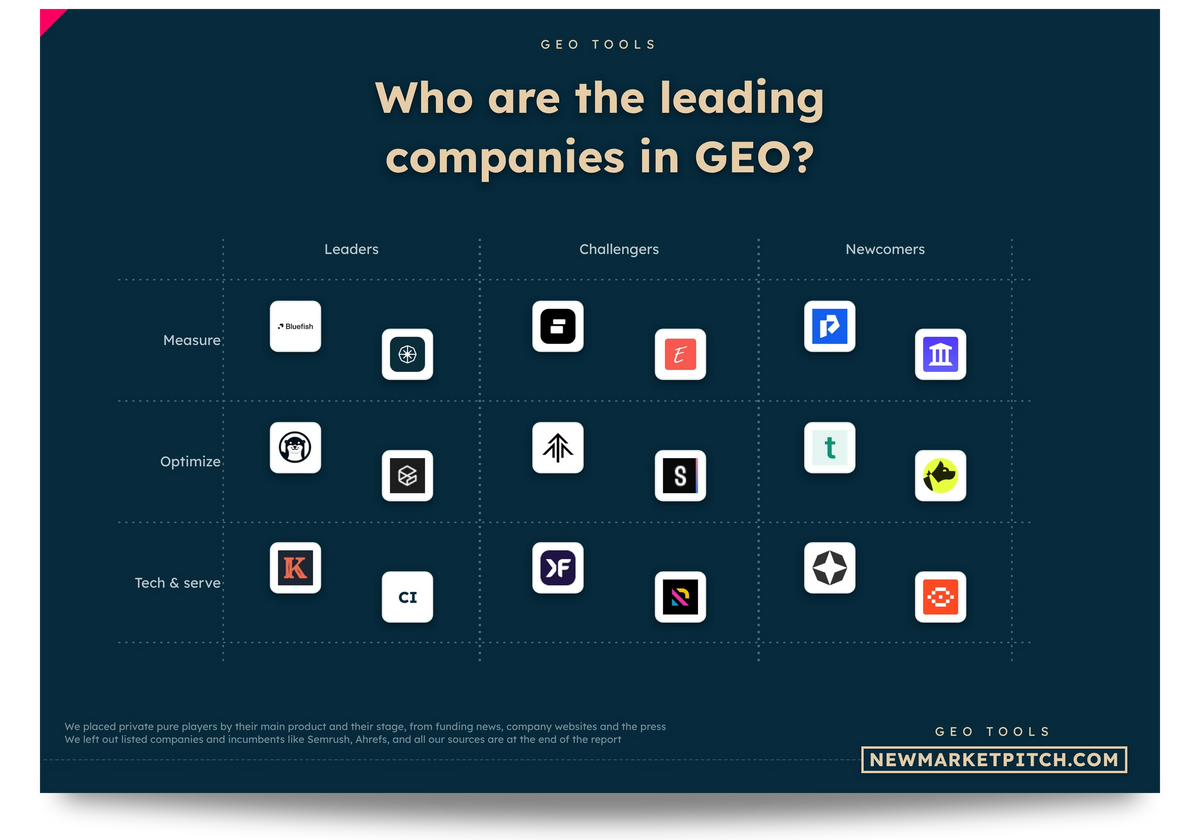
In our research about GEO startups, we turn what is vague and complex into simple, useful visuals. Market maps like this one show you at a glance where every startup stands.
Why has Profound raised so much more than other GEO startups?
Profound is way ahead in GEO fundraising because investors are backing an AI marketing platform that does far more than track brand mentions.
We count $335M in equity funding across 5 rounds. Profound's $180M Series D in September 2026, co-led by Sequoia Capital and Kleiner Perkins, is the largest individual round among the GEO companies we track. It followed a Series C earlier in the year, so the big check came after several earlier bets on the business.
Profound gave investors something concrete to judge. In its September announcement, the company said more than 1,000 enterprise brands used its software, including Walmart, Comcast and The Estée Lauder Companies. It was also building AI Marketer and Ads Studio, tools intended to turn information about AI answers into actual marketing work, from updating content to running ads. That helps explain why investors see a larger business than a citation dashboard.
There is still a gap between a company saying it can manage marketing work and proving that customers rely on it every day. But Profound has already moved the fundraising contest onto a different scale. A smaller competitor would need a clear commercial advantage and several major follow-on rounds to catch it.
Could Bluefish or AirOps actually catch Profound in GEO funding?
Bluefish and AirOps are Profound's closest GEO fundraising rivals, but neither is close enough for one ordinary round to change the leader.
Bluefish has raised at least $63M, while AirOps has raised $63M. Bluefish sits just ahead because its known rounds already add up to slightly more, and one of its rounds has an undisclosed amount, so the exact gap between the two companies can't be measured. Bluefish's own April 2026 announcement gives $68M in total, and the difference sits in early funding that we cannot match to a dated round. Bluefish's $43M Series B in April 2026 funded its push into agentic marketing for large brands. AirOps's $40M Series B in November 2025 backed a platform for creating and improving search content.
Profound is chasing both of those customer needs at once. It measures how brands appear in AI answers, helps teams decide what to change and has added marketing execution tools. Bluefish is building a broad enterprise offer too, while AirOps has concentrated on the day-to-day content work. Investors have funded three different versions of the same opportunity.
The question now is which company can keep winning big customers as marketing teams try these products. Bluefish and AirOps could become stronger businesses without ever matching Profound's funding history. But when the test is simply equity raised, the lead is secure.

In our market report about GEO startups, we always try to gather several sources and make estimates that make sense, so you can work with solid numbers.
Is Bluefish becoming a serious GEO rival to Profound?
Yes, Bluefish has become a serious GEO rival for large brands, even though Profound has raised much more money.
Bluefish closed a $43M Series B in April 2026, co-led by Threshold Ventures and NEA. Salesforce Ventures, Amex Ventures and TIAA Ventures also participated. The company sells software that helps major advertisers understand and manage how AI assistants describe their brands. In its announcement, Bluefish aimed the product directly at Fortune 500 marketing teams.
That is a tougher sale than giving a small business a dashboard. A global brand wants reliable comparisons across products, countries and AI systems, plus tools that fit existing marketing processes. Profound is pushing into the same budgets; Brandlight is building enterprise tools for AI answers, advertising and commerce. Bluefish has the investors and product ambition to compete, but a list of well-known backers is not a list of paying customers.
The interesting part of Bluefish's fundraising is what it lets the company attempt: integrations, enterprise support and a bigger marketing product. Whether customers eventually prefer Bluefish or Profound will depend on daily results, especially when a brand needs to act on the findings rather than simply read a report.
Is AirOps still just an AI content startup?
AirOps is now a major GEO contender because its content software starts with what people ask AI search engines and helps teams improve the answers they influence.
The company's $40M Series B in November 2025, led by Greylock, came as AirOps expanded its content-engineering platform. Marketing teams can identify questions worth answering, prepare pages and update older material. AirOps has a more direct role in the publishing work than a service that only checks brand citations.
That also puts AirOps up against more competitors. Profound has built tools that connect AI-search research with marketing campaigns. Searchable wants its copilot to perform SEO and GEO jobs automatically. The Prompting Company works on content and experiences that assistants can actually use. All three are trying to remove work from a team that would otherwise combine several separate tools.
AirOps has the fundraising history to be taken seriously. Yet publishing more content cannot force ChatGPT or Gemini to recommend a particular brand, especially when answers draw on third-party sites. The strongest case for AirOps is a repeatable improvement in customer discovery, backed by work that teams would otherwise have to do themselves.
Can Brandlight win enterprise GEO customers without Profound-sized funding?
Brandlight can compete for enterprise GEO customers with far less funding than Profound because both sell to brands worried about how AI systems describe them.
Brandlight has raised $36M, including a $30M Series A in February 2026 led by Pelion Venture Partners. The company has named LG, Kimberly-Clark, The Hartford and Estée Lauder among its customers. It also describes products for AI-native advertising and commerce alongside brand visibility. Those areas matter to companies managing many products and marketing teams rather than a single website.
Bluefish is moving into similar enterprise work, and Profound already lets customers connect AI-search findings with campaigns. Peec AI and Evertune are more closely associated with measurements such as brand mentions, comparisons and sources cited by assistants. Brandlight is trying to win the jobs that come after those measurements.
The smaller funding total leaves less room for expensive expansion, but it also means Brandlight does not need to copy every part of Profound's platform. Its best route is winning a problem that a major brand is willing to pay to solve now. If AI advertising tools become standard features inside existing marketing suites, keeping that distinction will be harder.

Our document detailing everything you need to know about GEO gets updated several times a month, so you always get the latest view of where things stand.
Is Peec AI Europe’s biggest GEO fundraising success?
Yes, Peec AI is the best-funded European GEO startup we track, and its reported customer growth gives that fundraising a stronger foundation.
The Berlin startup has raised at least $29M, including a $21M Series A in November 2025 led by Singular. Peec AI helps marketing teams check whether AI engines mention their brands, where they appear in answers and which sources get cited. It has named customers including TUI, ElevenLabs and Axel Springer.
In November 2026, Peec AI said it had reached $20M in annual recurring revenue, double the $10M it reported in May. The company also reported more than 4,000 customers in 80-plus countries. No other GEO startup has published a larger recurring revenue figure. Those are company-reported business figures rather than audited results, but the sequence gives us more to assess than a funding announcement alone: customers are paying for the product, and the recurring revenue has risen quickly.
Peec AI's challenge is keeping those customers as competitors move from monitoring into automated fixes. Searchable and geoSurge are pursuing different approaches in the United Kingdom, while American firms are adding broader workflows. Peec AI already has evidence of demand. Its next test is whether teams keep paying when AI-search reporting becomes easier to buy elsewhere.
Are GEO investors still paying mainly for AI visibility dashboards?
GEO investors are funding more than AI visibility dashboards now, with leading startups building tools for content, advertising and customer journeys.
The shift makes sense when you look at what customers are trying to do. A marketer first needs to know whether ChatGPT, Gemini or another assistant recommends a product. That report becomes less useful if the team cannot work out what to fix. Evertune and Peec AI help with measurement; AirOps helps teams create and update material; Profound has moved into marketing execution; Limy focuses on whether AI-driven discovery leads to customers.
There is a commercial reason to build past the dashboard. In April 2026, HubSpot launched its own answer engine optimization offering, combining monitoring with recommendations based on customer information. A brand already paying for HubSpot may need a strong reason to buy a separate service that produces similar charts. Independent startups can still win by offering better data, deeper optimization or a useful task the broader platforms handle badly.
So we see GEO funding supporting several kinds of software, not one standard product. That leaves room for specialist companies. It also raises the bar: a beautiful visibility score has to lead to an action somebody wants to pay for.

In our report covering the GEO market, we look at what the winners do differently, so you can learn from the best instead of guessing.
Can Evertune compete with larger AI-search platforms?
Evertune can compete in enterprise GEO, but its smaller funding total makes product depth more important than trying to match every feature from Profound.
Evertune has raised $19M, including a $15M Series A in August 2025 led by Felicis Ventures. The company named Canada Goose, Miro and Choreograph among the businesses using or working with its technology. It tracks how AI engines recommend brands and has discussed products for emerging AI advertising and shopping channels.
Those are natural next steps for customers who already monitor AI answers. The trouble is that Peec AI also measures brand visibility, Bluefish sells an enterprise marketing platform, and Brandlight is moving toward AI advertising and commerce. A buyer may see several similar-looking reports on a first sales call even when the tools differ under the hood.
Evertune's funding matches what Scrunch AI raised before the latter joined Sitecore. The comparison tells us little about which product customers like more. Evertune's opportunity is to become the tool a marketing team trusts enough to use routinely, especially when a brand has to decide what to do with a confusing or inaccurate AI answer.
Is Searchable’s AI automation enough to compete in GEO?
Searchable has a real chance in GEO if its automation saves marketers work they already pay people to do, but it still has to prove those gains last.
The United Kingdom startup has raised $18M, including a $14M Seed in May 2026. Founder Chris Donnelly said at the time that Searchable had reached more than $2M in annual recurring revenue within four months. That is a company-reported figure, but it is a more practical starting point than a promise about what the software might someday do.
Searchable markets an AI copilot that can audit sites, identify content gaps and help make SEO and GEO changes. AirOps also works on content processes, while established SEO vendors keep adding AI-search tools. Searchable therefore needs to show that it performs useful tasks reliably enough for teams to stop doing those tasks by hand.
The company has raised meaningful funding very early in its life, which gives it time to refine the product. Still, marketing teams have plenty of ways to generate text or run a basic audit. Searchable will become a tougher rival if its automation improves discoverability across repeated customer projects, even when search engines change their systems.

In our research about GEO startups, we don't want to repeat what boring consulting reports say. Instead, we show you the real and latest market signals that matter.
Did Sitecore’s Scrunch AI deal prove GEO startups can get acquired early?
Yes, Sitecore's acquisition of Scrunch AI shows that a GEO startup can interest a major software vendor before raising anything like Profound's total.
Scrunch AI raised $19M in the rounds we count, including a $15M Series A in July 2025. Scrunch's own website cites $26M raised, and the difference is funding we cannot tie to a dated round. Sitecore announced the purchase in June 2026. The company's Agent Experience Platform helps make brand information easier for AI assistants to understand and use, which fits Sitecore's existing content-management business. Sitecore can now sell that capability to customers that already use its software.
Bloomreach took a similar route when it acquired AthenaHQ in November 2026. AthenaHQ had raised $2.7M and built tools for monitoring AI recommendations and improving the pages and products assistants cite. Bloomreach wants those capabilities alongside ecommerce personalization and customer engagement. Both buyers wanted products that fit a much larger customer workflow.
We cannot infer either startup's sale price from its funding total. The deals do show that independent GEO technology has attracted established buyers. For founders, acquisition is a credible alternative to raising round after round. For customers, it means some specialist tools will arrive as features inside software they already use.
Will Adobe and Bloomreach make independent GEO startups redundant?
Independent GEO startups are still needed, although Adobe, Bloomreach and Sitecore make isolated AI-search tools harder to sell.
Adobe completed its acquisition of Semrush in April 2026, bringing search and generative engine optimization into its wider customer-experience business. Bloomreach and Sitecore can also add GEO features to products that many marketers already use. They can also reach customers through existing sales teams, which a new startup has to build from scratch.
A specialist still has a way in. Profound is pushing into marketing execution; AirOps specializes in content work; Peec AI has built a widely used AI-visibility product. Each can focus on new assistant behavior faster than a broad software suite that serves many older needs. The more precise the job, the easier it may be to justify a separate purchase.
Yet the competitive pressure is real. If a brand gets adequate AI-answer reporting from Adobe or HubSpot, paying another vendor for a similar dashboard becomes a hard sell. The independent company has to make a measurable difference, whether that means better recommendations, faster work or customers who actually convert.
Are AI shopping startups getting serious GEO funding?
Yes, AI shopping is attracting GEO funding because brands now want their products recommended by outside assistants as well as found in search results.
Azoma has raised at least $17M, including an $11M Series A in October 2026. It works with consumer brands such as L'Oréal, Unilever and Mars to improve how AI shopping agents describe and recommend products. Lemrock raised $6.9M in a Seed in March 2026 to make merchant catalogs accessible to assistants. Ranketta has raised $1.2M and tracks product citations and recommendations. These startups work at different points between product information and a buying decision.
There is a related business in preparing information for AI agents themselves. The Prompting Company has raised $6.5M and builds experiences that assistants can find and use. Scrunch AI worked on agent-readable content before its acquisition. Clear product descriptions, structured catalog data and accessible pages matter more when software is doing the initial comparison for a shopper.
OpenAI expanded product discovery in ChatGPT in March 2026, adding to the reasons brands care about these systems. An AI-shopping service that helps consumers browse a store is a different business. The GEO startups here are paid by brands and merchants to be discovered by external assistants.

Learning from others' mistakes is the cheapest lesson there is. In our market report about GEO startups, we look at what broke startups before you, so you don't repeat it.
Can geoSurge really change what AI models say about brands?
geoSurge wants to influence how AI models describe brands, but the hard part is proving those changes last when the models themselves keep changing.
The London company has raised at least $12M, including a $12M Seed in July 2026 led by AlbionVC. geoSurge calls its approach corpus engineering: it studies the information models learn from or retrieve and tries to improve the material shaping their answers. Its pitch is different from a service that runs prompts every day and counts brand mentions.
Peec AI and Evertune help brands see what assistants say. AirOps helps marketers publish and update content that might influence those answers. geoSurge is trying to work closer to the information an assistant draws on, including knowledge that may already be embedded in a model. That sounds powerful, though outsiders cannot simply rewrite the memory of a proprietary AI model.
Investors have backed a bigger ambition than monitoring. Customers will judge it by something simpler: do the answers become more accurate, and do improvements survive the next model update? Without that evidence, changing model knowledge remains an interesting promise rather than a demonstrated advantage.
Is Gushwork making GEO useful for manufacturers?
Gushwork is making GEO relevant to manufacturers and industrial suppliers by focusing on qualified leads, a result those businesses already understand.
The India-based startup has raised $11M, including a $9M Seed in February 2026. Its AI Feeds service researches questions potential buyers ask, produces relevant material and helps businesses track leads that arrive through search and AI discovery. Gushwork has described customers in manufacturing, industrial distribution and commercial services, where a single serious inquiry can be worth more than a long list of website visits.
That is a different sales pitch from the one Bluefish makes to global advertisers. AirOps helps marketing teams produce content; Limy measures AI-driven visits and conversions; Zoca works with local service businesses trying to fill their booking calendars. Gushwork packages research, content and lead generation for organizations that may have small marketing teams but complicated products to explain.
The numbers from its funding round establish that investors have supported the idea. They do not establish that every lead came from an AI answer or that customers will keep renewing. Gushwork's next proof point is repeatable sales inquiries across many industrial clients, without needing an expensive hands-on service for each one.

If you build or invest in the GEO market, you need to know which business models pay off now and which ones are fading. That's why our report covering it has a whole section on it.
Can GEO startups prove they bring paying customers?
GEO startups can measure more of the path from AI recommendation to sale now, but they still cannot reliably attribute every purchase to a particular answer.
Limy has raised $10M through a Seed in January 2026. It concentrates on visits and conversions driven by AI agents. Gushwork aims to turn search discovery into qualified B2B leads, while Zoca focuses on local appointments and repeat business. These are useful things to measure, because a marketing manager can connect them to revenue rather than just asking whether the brand appeared in a chatbot reply.
There is evidence that AI referrals are commercially meaningful. Adobe's research reported that visitors arriving at US retail websites from AI sources converted better than visitors from other channels in July 2026. Yet a person may see a recommendation in ChatGPT, search the brand again on Google and buy later through an app. Much of that influence disappears from a last-click report.
The companies that can connect AI discovery with real business outcomes will have a better reason for customers to keep paying. The danger is promising certainty that no analytics tool can deliver. A useful estimate, tested against actual sales, beats a confident-looking dashboard that assigns credit to the wrong channel.
Can a GEO startup for local businesses raise meaningful funding?
Yes, Zoca has shown that a GEO-related product built for local businesses can attract venture backing without selling to global advertising teams.
Zoca raised $6M in a Seed in May 2025 led by Accel. It helps wellness studios and other local service providers find customers, manage bookings and encourage repeat visits. Those buyers need more appointments, not a detailed report on whether an international AI assistant prefers one consumer brand to another. Accel's explanation of the investment stressed doing marketing work for the business rather than giving the owner more software to operate.
Several small GEO startups sell other focused products. GetMint works on brand visibility in conversational search; Petra Labs helps organizations present structured information to assistants; BrandRank.AI checks how AI engines portray and recommend brands. Their buyers may care about accuracy, lead quality or being recommended in a specific niche, rather than collecting every possible citation.
Local-business products face price-sensitive customers and a more demanding sales process than their simple user interfaces suggest. But the test is also unusually clear. If the software regularly turns discovery into bookings at an affordable cost, a small GEO company can build a real business without matching the money raised by Profound.

In our report covering the GEO market, we like to show you the big picture. We know your time is precious, so we make every page quick to read and packed with as much learning as possible per minute.
Why have so few GEO startups raised over $100M?
Few GEO startups have raised over $100M because most are young companies selling focused tools, and Profound is the only one we track with a nine-figure total.
Among 32 GEO startups, only 1 company, or 3%, sits in the nine-figure funding bracket. Another 31, or 97%, remain below it. We also count 16 companies that have raised through just one recorded equity round. The median total raised is at least $6.3M. These are funding histories, not the amount every company needs to build a usable product.
That difference is easy to see in the businesses. Promptwatch checks AI mentions, Lemrock makes catalogs readable to assistants, The Prompting Company builds agent-facing experiences, and Zoca helps local businesses get discovered. Their products do not all require a global enterprise sales team and a large advertising platform. Some may never need to raise a late-stage round at all.
Acquisitions also let a smaller GEO startup reach a larger software company's customers without raising a giant late-stage round. The smaller companies have not yet proved they can match Profound's breadth, but their modest funding does not make them irrelevant. A specialized service can become useful long before it becomes a huge venture-backed company.
The table below shows examples of GEO startups building focused products with much smaller cumulative funding totals.
| GEO startup | Total raised |
|---|---|
| Promptwatch | $8.3M |
| Lemrock | $6.9M |
| Emberos | $6.7M |
| The Prompting Company | $6.5M |
| Zoca | $6M |
| Petra Labs | $5.2M |
| GetMint | $4.7M |
| BrandRank.AI | $4.2M |
Is GEO fundraising still dominated by the United States?
Yes, American GEO startups lead by number of funded companies, although strong challengers are emerging outside the United States.
We rank 14 US startups, or 44% of the group. The United Kingdom has 4, or 13%. France, India, Japan and the Netherlands each have 2. On the larger-funding end, Profound, Bluefish, AirOps and Brandlight are American. That gives the United States the clearest group of companies with money to sell into big marketing teams.
Other countries are developing different strengths. Germany's Peec AI sells brand-visibility software internationally. Searchable in the United Kingdom is building an automated GEO copilot, and geoSurge wants to improve the information AI models use. India-based Gushwork is chasing industrial leads; Japan's QueryLift sells visibility and citation tools for enterprise teams. These are ways of serving a specific customer problem rather than copying every feature of an American marketing suite.
Country counts tell us where a startup is based, not where its customers live or which model works best. Peec AI, for example, has reported customers in many markets. American funding dominance is clear right now; local languages, sales relationships and different buyer needs can still give other companies room to grow.
Can Asian GEO startups challenge American competitors?
Asian GEO startups are far behind the biggest American companies in disclosed funding, but local-language search and specialized customers give them a place to compete.
India's Gushwork works on AI-driven lead generation for businesses, including industrial suppliers. Japan's QueryLift raised $637K in a Seed in September 2026 and says it tracks brand mentions, cited sources and competitor comparisons in generative search. Z Creative Partners has raised $320K and offers GEO analysis for brands in Japan. China's PureblueAI has raised at least $1.4M across 3 rounds and focuses on local-language GEO services.
India also has Unveilr AI, whose Seed amount is undisclosed. An undisclosed financing cannot sensibly be treated as no money raised. Those companies are at different stages, so it would be misleading to put them in a head-to-head funding contest with a mature American enterprise platform.
The opportunity is practical. Japanese marketing teams need products that understand Japanese-language searches and local business information; Chinese brands face their own AI platforms and discovery habits. Startups close to those customers can build useful tools before large US vendors prioritize the same details. The real challenge is selling that expertise repeatedly as software, rather than relying on custom consulting work.

When you build or invest in the GEO market, you need clarity, not confusion. In our research about GEO startups, we always try to put numbers on and quantify whatever is usually vague and confusing.
Are Semrush and HubSpot GEO startups?
No, Semrush and HubSpot are established marketing software companies, so their corporate histories do not belong in a comparison of GEO startup funding.
Adobe completed its acquisition of Semrush in April 2026 and explicitly linked the purchase to SEO, generative engine optimization and agentic search. In the same month, HubSpot introduced HubSpot AEO to help users monitor how brands appear in systems such as ChatGPT and Gemini and decide what to improve. Both have substantial businesses that existed before GEO became a separate product category.
Their absence from the startup fundraising group should never be confused with a lack of competition. A marketer already using HubSpot can consider its AI-search features before paying for a standalone platform. Adobe can offer Semrush's data alongside broader tools for content, ads and customer experience. Independent GEO startups have to provide something those existing subscriptions do badly or not at all.
Profound and AirOps may compete with those incumbents on execution, while Peec AI can compete on focused visibility measurement. Counting all the capital ever raised by older software businesses as GEO startup funding would muddy the comparison. Looking at what their products now offer is still essential to understanding whether smaller specialists can hold onto customers.
So, which GEO startups have raised the most money?
Profound is the number-one GEO startup by total equity funding raised, with $335M, and its lead is decisive.
Bluefish has raised at least $63M, with AirOps close alongside it. Bluefish's total is a minimum, so a precise gap between the two cannot be claimed. Brandlight follows at $36M, and Peec AI has raised at least $29M. Evertune and Scrunch AI have matching totals. Searchable, Azoma and geoSurge are among the other well-funded specialists pursuing different GEO problems.
What these totals tell us is which companies investors have backed most heavily so far. Profound is building a broad marketing system; Bluefish sells to major brands; AirOps focuses on content work; Peec AI measures visibility; Azoma targets AI-shopping recommendations. Those businesses overlap, but they will not all be judged by the same customer. The next competitive test is which products bring results that are worth paying for after the novelty of AI-search reports wears off.
The table below shows what we found.
| Question | Answer |
|---|---|
| Could a rival catch the funding leader soon? | Profound still leads by a wide margin today. It has completed 5 equity rounds since founding. Challengers need several substantial new rounds to reach that scale. |
| Can one giant deal change the whole contest? | Yes, one round can move a startup far ahead. Profound closed a $180M Series D in September 2026. That cash supports a much broader marketing software product. |
| Do Bluefish and AirOps sell identical products? | No, both pursue GEO budgets through different daily jobs. Bluefish secured a $43M Series B in April 2026. AirOps instead focuses on software for improving and publishing content. |
| Has enterprise GEO attracted major investors? | Yes, startups selling to big brands have drawn major investment. Brandlight closed a $30M Series A in February 2026. Its software now reaches toward AI advertising and commerce. |
| Can a European GEO company grow quickly? | Peec AI has shown strong customer demand in Europe. Its $21M Series A arrived in November 2025. The company's reported recurring revenue has since grown sharply. |
| Does AI visibility lead straight to sales? | Not automatically, even when the customer journey starts there. Limy raised $10M in January 2026 to measure conversions. Sales attribution still misses purchases made after later searches. |
| Are product recommendations attracting specialist startups? | Yes, investors now fund ways to appear in AI shopping. Azoma has raised at least $17M for this work. Product discovery becomes part of GEO before checkout happens. |
| Can small companies serve buyers larger platforms ignore? | Yes, local services need bookings rather than global brand dashboards. Zoca raised $6M in a Seed in May 2025. Reliable appointments may support a business without huge financing. |
| Have bigger software companies started buying GEO expertise? | They have, and the first acquisitions involve specialized tools. AthenaHQ raised $2.7M before joining Bloomreach in November 2026. Its capabilities can now reach an established customer base. |
| Are most GEO startups already heavily financed? | No, big funding totals are still unusually rare here. The median startup has raised at least $6.3M. Many teams can test narrower products with limited budgets. |
| Is the GEO startup field only American? | No, there are meaningful companies across several other regions. The United States accounts for 44% of ranked startups. Language and customer needs leave space for local specialists. |

A good product starts with a real problem. In our market report about GEO startups, we show you the ones customers still live with.
Our methodology
Our data runs through November 19, 2026. We then reviewed this article and updated its answers on November 24, 2026, the date shown under the title. We define GEO as products and specialist services primarily built to measure, manage or improve how brands, organizations, products and content appear in generative AI answers and AI-mediated search. This includes citation analytics, AI-answer intelligence, AI-readable content and catalog infrastructure, attribution and focused services; borderline companies are included where GEO is core. General AI models, consumer search engines and ordinary SEO products without meaningful GEO specialization are excluded. Every ranked company meets our startup definition: independent, founded in 2007 or later, built for rapid growth around a new product or technology and financed by investors, founders or comparable early backers. Recently listed, acquired and closed businesses remain visible with their status; their counted total stops at the IPO, including its primary proceeds, or at acquisition.
We count equity raised since founding, including every qualifying private equity round regardless of age and primary IPO proceeds when applicable. We exclude loans, venture debt, grants, unconverted convertibles and SAFEs, post-IPO offerings and sales of existing shares; converted SAFEs are counted inside the round that absorbed them. Duplicate coverage of a single financing is merged. A total marked with “+” is a minimum because at least one round lacks a publicly disclosed amount. The ranking measures each startup's full equity-funding history, not simply recent deal activity.
Rounds confirmed by a company announcement, a press article or a regulatory filing are counted in full. Where no article exists, a round is counted only when at least two recognised databases agree on its date (within one month) and amount (within 5%), and it is marked as low confidence; a round found in a single database stays in the company's history but is left out of totals. For companies that have raised more than $100M, every round counted is backed by an article.
We do not adopt the total or valuation displayed by Crunchbase, PitchBook or another commercial database as our figure. Those records can combine debt, grants, commitments, secondary transactions or estimates that do not belong in equity raised. Databases are never the sole support for a round counted with full confidence; matching database-only records receive low confidence. When a company announces a different cumulative total, we retain the sum of sourceable qualifying equity rounds and explain material differences under the ranking. Its confidence label indicates how much of the figure rests on verified announcements or reporting: Full, Strong, Partial or Low.
A famous marketing company may be absent because it is an established incumbent rather than an eligible startup, or because general marketing software and consumer-facing search are not GEO's main commercial purpose. An acquired company may remain because the financing happened while it was independent. These choices preserve a comparison of the capital startups actually raised to build GEO products, rather than mixing their equity with acquisition prices, debt or the corporate histories of much older companies.
Key sources include Profound's September 2026 financing, enterprise customers and product direction, Bluefish's April 2026 Series B and enterprise positioning, AirOps's November 2025 Series B, AirOps's content-engineering product expansion, Brandlight's February 2026 financing and AI-advertising strategy, Peec AI's Series A, clients and analytics business, Peec AI's reported revenue and customer traction, Evertune's Series A, product direction and named customers, Searchable's financing, revenue claims and automation product, Sitecore's June 2026 acquisition of Scrunch, Bloomreach's acquisition of AthenaHQ, Adobe's completed Semrush acquisition and GEO strategy, Azoma's AI-commerce product and enterprise customers, OpenAI's March 2026 changes to ChatGPT product discovery, geoSurge's seed financing and corpus-engineering thesis, Gushwork's financing, product and early customers, Limy's financing and AI-search attribution strategy, Accel's investment and Zoca's local-service business model, The Prompting Company's AI-agent experience product, BrandRank.AI's seed financing and brand-recommendation focus, QueryLift's Japanese seed financing and GEO features, Adobe Digital Insights on AI-sourced retail visitors and conversion, and HubSpot's April 2026 launch of answer engine optimization features.

In our document detailing everything you need to know about GEO, we try to remove everything that could confuse you, especially if you're investing or building in this market.
Written by the New Market Pitch teamWe track new markets so founders and investors can move faster. About us