What are the latest funding trends in GEO?
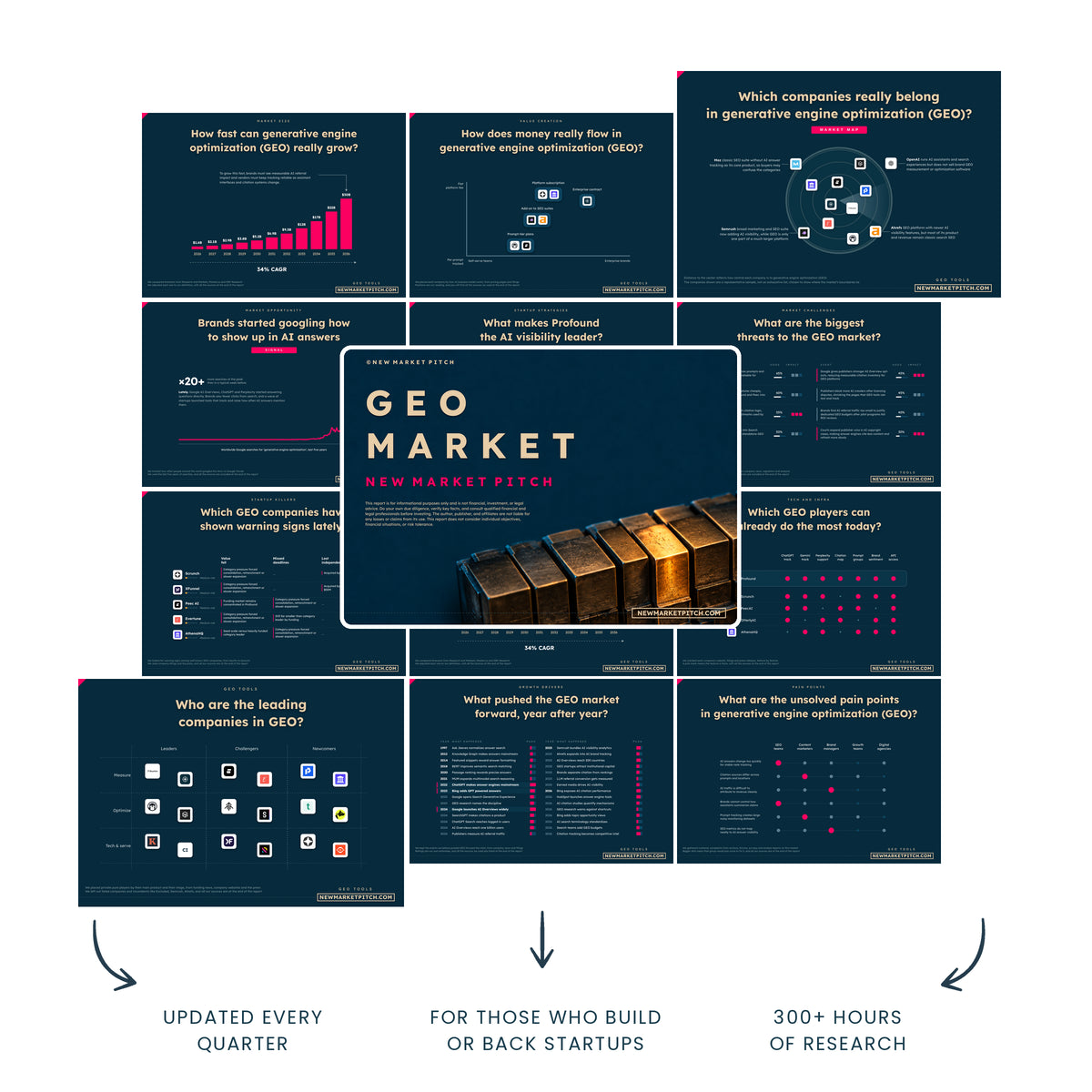
Whether you're building or investing in the GEO market, our report covers everything you need to know: the players, the money, and what's coming next.
Summary
GEO startups have raised at least $440M across 23 deals this year to date. Profound leads with $276M from 2 rounds. Investors are putting real money behind AI-search visibility, although a few big companies account for much of the increase.
The market has also grown beyond those headline deals. We counted 20 funded companies, compared with 16 over the same period last year. That is wider participation, even if the dollar total tells a much bigger story.
GEO has already passed the previous full year's at least $218M and matched its 23 deals. The current period is still incomplete, so this is a comparison with a finished year rather than a forecast.
Look below the biggest rounds and the mood changes. Excluding deals above $50M leaves at least $164M, less than in the comparable period last year. The boom is real for a few enterprise companies; smaller financings tell a quieter story.
The median disclosed round is $6.9M, compared with $6.3M in the same period last year. Investors have not suddenly started handing every GEO founder a much bigger check.
Seed rounds remain common. The 18 seed deals account for 78% of this year's financings, although they represent just 18% of disclosed capital. New tools keep appearing while established platforms raise the largest sums.
The clearest winner is enterprise GEO orchestration. Its 5 financings attracted $363M. AI answer visibility monitoring generated more deals, but the biggest buyers and investors now seem interested in platforms that can do more than count brand mentions.
Funding remains uneven across the calendar. Q3 2026 delivered at least $213M, while Q4 2026 is still partial. One huge announcement can change the picture for an entire quarter.
GEO is spreading beyond the United States. Europe is getting a few more deals than a year ago, and new Asian markets are showing up too. More countries are producing startups, but fewer have companies ready for very large rounds.
The main trend is selective growth. Investors still finance new monitoring, commerce and service tools, but the biggest bets are on GEO companies that aim to become part of a brand's everyday marketing work. Whether those products can keep customers as Google and OpenAI add their own features is now the question behind the money.

Written by the New Market Pitch teamWe track new markets so founders and investors can move faster. About us

In our report covering the GEO market, you will always find fresh funding data, taken straight from our own verified funding database.
All funding deals in the generative engine optimization market over the last years
Below is the table listing all the deals. You can find our methodology at the end of this page.
If you want a deeper understanding of the market and its current dynamics, get our generative engine optimization market report.
| Company | Category | Date | Stage | Deal size | What they do | Region | Lead investors | Country | Rank |
|---|---|---|---|---|---|---|---|---|---|
| Z Creative Partners | AI answer visibility monitoring | November 2026 | Seed | ~$320K | Z-GEO analyzes brand visibility and recommendations in generative AI answers. | Asia-Pacific | Not disclosed | Japan | |
| Azoma | Commerce and product GEO | October 2026 | Series A | $11M | Optimizes product information and recommendations to improve consumer-brand discovery in AI shopping agents. | Europe | Puma Growth Partners | United Kingdom | |
| Miracly | GEO content and workflow optimization | October 2026 | Seed | $2M | Combines AI search monitoring with content agents | Europe | Beenext Ventures, Lotus | Sweden | |
| Obsero | GEO services and managed optimization | October 2026 | Seed | $1.1M | Provides AI search intelligence and GEO consulting | Europe | SFC Capital | United Kingdom | |
| Unveilr AI | AI answer visibility monitoring | October 2026 | Seed | Undisclosed | Search visibility analytics for AI engines | Asia-Pacific | AJVC | India | |
| QueryLift | AI answer visibility monitoring | September 2026 | Seed | $637K | Tracks brand citations across generative search systems | Asia-Pacific | JAFCO, Z Venture Capital | Japan | |
| Profound | Enterprise GEO orchestration | September 2026 | Series D+ | $180M | AI search visibility and marketing analytics | North America | Sequoia Capital, Kleiner Perkins | United States | |
| Emberos | AI answer visibility monitoring | September 2026 | Seed | $5.5M | AI brand visibility and optimization platform | North America | Not disclosed | United States | |
| BrandRank.AI | AI answer visibility monitoring | July 2026 | Seed | $3M | Benchmarks brand performance across AI answer engines | North America | Grit Capital Partners, QCA Ventures | United States | |
| Petra Labs | AI-readable content and entity infrastructure | July 2026 | Seed | $5.2M | Improves AI discovery through structured brand information | North America | Work-Bench | United States | |
| Promptwatch | AI answer visibility monitoring | July 2026 | Seed | ~$6.9M | Tracks AI mentions and automates optimization recommendations | Europe | seed + speed Ventures | Netherlands | |
| geoSurge | AI-readable content and entity infrastructure | July 2026 | Seed | $12M | Improves how models represent and recall brands | Europe | AlbionVC | United Kingdom | |
| PureblueAI | GEO services and managed optimization | July 2026 | Seed | Undisclosed | Offers local-language generative engine optimization services | Asia-Pacific | Not disclosed | China | |
| Serpier | GEO content and workflow optimization | June 2026 | Seed | $1.6M | Automates SEO and AI search content workflows | Europe | True Collective | Denmark | |
| Searchable | Enterprise GEO orchestration | May 2026 | Seed | $14M | Monitors and optimizes discovery across AI engines | Europe | Headline | United Kingdom | |
| Bluefish | Enterprise GEO orchestration | April 2026 | Series B | $43M | AI search visibility and marketing optimization | North America | Threshold Ventures, New Enterprise Associates | United States | |
| Lemrock | Commerce and product GEO | March 2026 | Seed | $6.9M | Makes product catalogues accessible to AI assistants | Europe | Galion.exe | France | |
| Gushwork | GEO services and managed optimization | February 2026 | Seed | $9M | Provides AI-assisted search and generative visibility services | Asia-Pacific | Susquehanna Asia VC | India | |
| Profound | Enterprise GEO orchestration | February 2026 | Series C | $96M | AI search visibility and marketing analytics | North America | Lightspeed Venture Partners | United States | |
| Brandlight | Enterprise GEO orchestration | February 2026 | Series A | $30M | Optimizes enterprise brand presentation in AI answers | North America | Pelion Venture Partners | United States | |
| PureblueAI | GEO services and managed optimization | February 2026 | Seed | Undisclosed | Offers local-language generative engine optimization services | Asia-Pacific | Vertex Ventures China | China | |
| Limy | AI search attribution and conversion | January 2026 | Seed | $10M | Attributes AI search traffic to customer acquisition | North America | Flybridge Capital Partners | United States | |
| Emberos | AI answer visibility monitoring | January 2026 | Seed | $1.2M | AI brand visibility and optimization platform | North America | Not disclosed | United States | |
| GetMint | GEO content and workflow optimization | December 2025 | Seed | $4.7M | Optimizes brand visibility across conversational AI search | Europe | Founders Future | France | |
| Azoma | Commerce and product GEO | December 2025 | Seed | $4M | Optimizes product information and recommendations to improve consumer-brand discovery in AI shopping agents. | Europe | Not disclosed | United Kingdom | |
| Searchable | Enterprise GEO orchestration | December 2025 | Seed | $4M | Monitors and optimizes discovery across AI engines | Europe | Freestyle VC | United Kingdom | |
| Peec AI | AI answer visibility monitoring | November 2025 | Series A | $21M | Tracks brand mentions and citations in AI | Europe | Singular | Germany | |
| Relixir | GEO content and workflow optimization | November 2025 | Seed | $2M | Automates website optimization for generative AI search | North America | Not disclosed | United States | |
| AirOps | GEO content and workflow optimization | November 2025 | Series B | $40M | AI search visibility and content workflows | North America | Greylock | United States | |
| Ranketta | Commerce and product GEO | November 2025 | Seed | $1.2M | Tracks product citations and AI shopping recommendations | Europe | Lighthouse Ventures | Czech Republic | |
| The Prompting Company | AI-readable content and entity infrastructure | October 2025 | Seed | $6.5M | Makes brands and products discoverable by AI | North America | Peak XV Partners | United States | |
| Omnia | AI answer visibility monitoring | October 2025 | Seed | $4M | Monitors and improves brand visibility in AI search | Europe | Visionaries Club | Spain | |
| Promptwatch | AI answer visibility monitoring | September 2025 | Seed | $1.4M | Tracks AI mentions and automates optimization recommendations | Europe | Not disclosed | Netherlands | |
| Bluefish | Enterprise GEO orchestration | August 2025 | Series A | $20M | AI search visibility and marketing optimization | North America | New Enterprise Associates, Salesforce Ventures | United States | |
| Profound | Enterprise GEO orchestration | August 2025 | Series B | $35M | AI search visibility and marketing analytics | North America | Sequoia Capital | United States | |
| Evertune | AI answer visibility monitoring | August 2025 | Series A | $15M | Measures AI brand visibility and competitive recommendations | North America | Felicis | United States | |
| PureblueAI | GEO services and managed optimization | August 2025 | Seed | $1.4M+ | Offers local-language generative engine optimization services | Asia-Pacific | Inno Angel Fund, BlueFocus | China | |
| Scrunch AI | AI-readable content and entity infrastructure | July 2025 | Series A | $15M | Makes brand content readable to AI agents | North America | Decibel | United States | |
| Peec AI | AI answer visibility monitoring | July 2025 | Seed | $8.3M | Tracks brand mentions and citations in AI | Europe | 20VC | Germany | |
| Profound | Enterprise GEO orchestration | June 2025 | Series A | $20M | AI search visibility and marketing analytics | North America | Kleiner Perkins | United States | |
| AthenaHQ | AI answer visibility monitoring | June 2025 | Seed | $2.2M | Tracks brand share of voice across assistants | North America | Not disclosed | United States | |
| Zoca | GEO services and managed optimization | May 2025 | Seed | $6M | Optimizes local business discovery across AI search | North America | Accel | United States | |
| Brandlight | Enterprise GEO orchestration | April 2025 | Seed | $5.8M | Optimizes enterprise brand presentation in AI answers | North America | Cardumen Capital, G20 Ventures | United States | |
| geoSurge | AI-readable content and entity infrastructure | April 2025 | Seed | Undisclosed | Improves how models represent and recall brands | Europe | Not disclosed | United Kingdom | |
| AthenaHQ | AI answer visibility monitoring | March 2025 | Seed | $500K | Tracks brand share of voice across assistants | North America | Y Combinator | United States | |
| Peec AI | AI answer visibility monitoring | January 2025 | Unknown | Undisclosed | Tracks brand mentions and citations in AI | Europe | Antler | Germany | |
| Azoma | Commerce and product GEO | December 2024 | Seed | $1.4M | Optimizes product information and recommendations to improve consumer-brand discovery in AI shopping agents. | Europe | MaRS IAF | United Kingdom | |
| Scrunch AI | AI-readable content and entity infrastructure | November 2024 | Seed | $4M | Makes brand content readable to AI agents | North America | Mayfield | United States | |
| Evertune | AI answer visibility monitoring | October 2024 | Seed | $4M | Measures AI brand visibility and competitive recommendations | North America | Eniac Ventures | United States | |
| AirOps | GEO content and workflow optimization | October 2024 | Series A | $16M | AI search visibility and content workflows | North America | Unusual Ventures | United States | |
| Azoma | Commerce and product GEO | September 2024 | Seed | $871K | Optimizes product information and recommendations to improve consumer-brand discovery in AI shopping agents. | Europe | Not disclosed | United Kingdom | |
| Profound | Enterprise GEO orchestration | August 2024 | Seed | $3.5M | AI search visibility and marketing analytics | North America | Not disclosed | United States | |
| Bluefish | Enterprise GEO orchestration | August 2024 | Seed | Undisclosed | AI search visibility and marketing optimization | North America | Not disclosed | United States | |
| WP SEO AI | GEO content and workflow optimization | August 2024 | Seed | Undisclosed | Automates WordPress SEO and GEO visibility workflows | Europe | Not disclosed | Netherlands | |
| BrandRank.AI | AI answer visibility monitoring | July 2024 | Seed | $1.2M | Benchmarks brand performance across AI answer engines | North America | Not disclosed | United States |

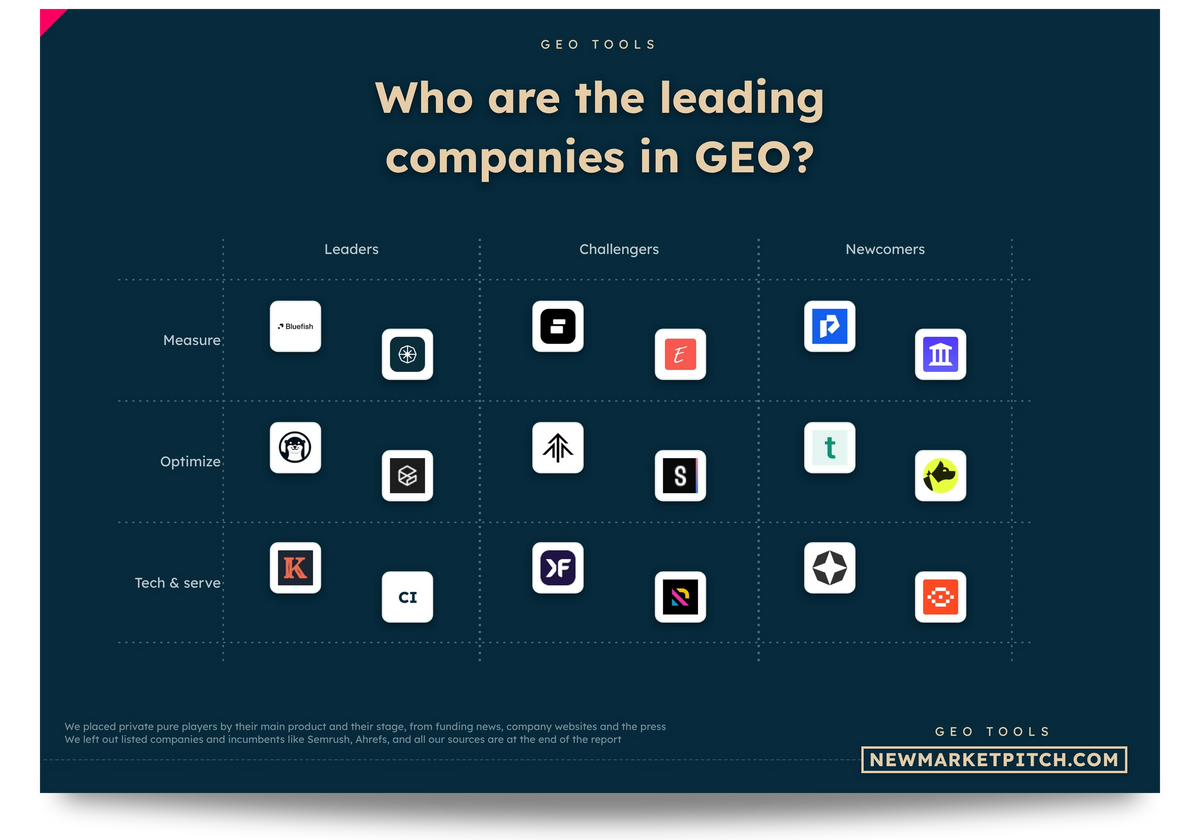
In our research about GEO startups, we turn what is vague and complex into simple, useful visuals. Market maps like this one show you at a glance where every startup stands.
Is everyone suddenly investing in GEO startups?
GEO startup funding is clearly growing, although the number of deals is rising much more slowly than the money invested.
We counted 23 financings worth at least $440M this year to date, against 20 deals and at least $205M over the same period of 2025. The number of funded companies rose from 16 to 20. Back at the same point in 2024, we had recorded 8 deals and at least $29M. Deals rose 15% while the money raised rose 114%, so the dollars are growing far faster than the number of rounds.
The kinds of companies raising money have changed too. Profound and Bluefish now sell broader platforms to large marketing teams, while smaller companies such as Limy and Lemrock tackle attribution and product discovery. That gives investors several ways to bet on AI search instead of funding another brand-mention dashboard.
There is a customer problem behind the interest. Pew Research Center found in July 2025 that Google users were less likely to click ordinary results when an AI summary appeared. Marketers who once judged search visibility by rankings and website visits now have to understand what AI answers say about their products. We can see investors reacting to that problem, even though the funding figures alone cannot establish how many customers will pay for a dedicated GEO product.
Has GEO funding already topped last year's total?
Yes, GEO startups have already raised more than in the whole previous calendar year, and the current year is not finished.
The full 2025 calendar year produced 23 deals and at least $218M. Funding this year to date has reached 202% of that full-year total, and the deal count has already matched it, at 100%. Those comparisons put an unfinished year beside a completed one; we have not projected or annualized anything. The 2024 full year was much smaller, with 9 deals and at least $30M.
Much of the change comes from rounds that were barely imaginable when GEO companies first started raising seed money. AirOps' $40M Series B in November 2025 was the largest individual financing recorded in that year's comparable period. Profound later raised a $96M Series C in February 2026 and went on to announce a much larger round. Its September company announcement described a business expanding from AI-search analytics into marketing software for enterprises.
Passing last year's total is a genuine milestone for this young market. It also sets up a harder question: are more GEO businesses getting strong funding, or are a handful of successful companies making the industry look richer than it is?
Are most GEO startups getting much bigger checks now?
No, the typical GEO round has barely moved; the spectacular increase comes from unusually large financings.
The median disclosed financing is $6.9M this year to date, compared with $6.3M over the same period last year. Among rounds with a published amount, 7 came in under $5M and 9 fell from $5M to under $20M. Another 2 were from $20M to under $50M. The amounts most founders raise remain far removed from the largest headlines.
Remove rounds above $50M and the picture reverses: GEO startups raised at least $164M this year, versus at least $205M over the comparable period last year. Excluding only rounds above $100M, the current total is still at least $260M. Different cutoffs give different answers because a very small group of financings carries so much money.
That does not mean investors have abandoned companies between seed and the very top of the market. Bluefish's $43M Series B in April 2026 and Brandlight's $30M Series A in February 2026 were substantial commitments. They show that strong companies can raise beyond seed, without making those deal sizes normal for GEO founders today.
Is Profound carrying the GEO funding boom by itself?
Profound is the biggest force behind this year's GEO funding surge, but other startups have also attracted sizeable rounds.
Profound raised $276M across 2 financings this year: a $96M Series C in February 2026 and a $180M Series D in September 2026. The later round, co-led by Sequoia Capital and Kleiner Perkins, was the largest individual GEO deal of the period. There is no other company in the current-year totals with comparable money raised.
Profound also has more to show than a fundraising pitch. Its September announcement said the platform worked with more than 1,000 enterprise brands, and TechCrunch named Comcast, Estée Lauder and Walmart among its customers. Profound began with visibility analytics and has moved into tools intended to help marketing teams take action on what they learn.
Other businesses are following different routes. Bluefish sells AI marketing tools to large brands, while Brandlight has added AI-native advertising and commerce to its offering. Those moves suggest investors see a chance to build much larger businesses around AI discovery. Yet Profound remains an unusual example. One company reaching this scale does not mean the rest of the GEO market has reached it too.

In our market report about GEO startups, we always try to gather several sources and make estimates that make sense, so you can work with solid numbers.
Is GEO funding really picking up every quarter?
GEO funding is growing over several years, but the quarterly pattern remains jumpy rather than steadily accelerating.
Q1 2026 produced 7 deals and at least $153M. Q2 2026 then fell to 3 deals and $59M, before Q3 2026 reached 8 deals and at least $213M. The differences are large because individual rounds can dominate a quarter. The comparison with 2025 makes that clear: Q3 2025 had 7 deals and at least $96M, while Q4 2025 had 9 deals but only $87M.
The latest partial quarter looks quieter in dollars, but investors have not stopped announcing deals. Azoma's $11M Series A in October 2026 funded product discovery for AI shoppers. Miracly's $2M seed in October 2026 backed content and monitoring tools, and Obsero's $1.1M seed that month funded a service-led GEO business. Those rounds do different jobs from Profound's large enterprise financings.
Google's October 2026 update to AI Mode and AI Overviews, which added clearer links and more context about sources, is a reminder that the underlying search products keep changing. Customers may need new tools, but those product changes do not arrive on a venture capital schedule. We would not call a weak partial quarter a funding crash.
The table below shows GEO deal counts and disclosed funding by quarter.
| Period | Deals | Capital |
|---|---|---|
| Q3 2024 | 5 | $5.6M+ |
| Q4 2024 | 4 | $25M |
| Q1 2025 | 2 | $500K+ |
| Q2 2025 | 5 | $34M+ |
| Q3 2025 | 7 | $96M+ |
| Q4 2025 | 9 | $87M |
| Q1 2026 | 7 | $153M+ |
| Q2 2026 | 3 | $59M |
| Q3 2026 | 8 | $213M+ |
| Q4 2026 (partial) | 5 | $15M+ |
“+” means at least because some amounts are undisclosed. Q1 2024 and Q2 2024 had no deals. The disclosed amounts of the partial Q4 2026 add up to about $15M so far.
Is most GEO funding still going to seed rounds?
Seed rounds account for most GEO deals, but the largest share of the money now goes to companies beyond the earliest stages.
This year we tracked 18 seed financings across 16 companies, with at least $79M raised. Seed represents 78% of deals and 18% of disclosed capital. The comparable period last year produced 12 seed deals and at least $39M. Investors are still giving early ideas a chance, even as the largest checks move toward more established products.
Look at what founders are building. Gushwork raised a $9M seed in February 2026 for AI-assisted search and lead generation. Limy is working to connect AI discovery with customer conversions. Lemrock, meanwhile, builds product information that outside assistants can read and recommend.
Those companies start with different customers and different problems. A retailer needs accurate product information, while a B2B team wants leads it can trace back to search. That variety helps explain why seed investing is still active. What remains harder to prove is how many specialist products can keep customers once larger suites offer similar features. Seed funding says investors want to find out; it does not settle the question for them.
Are GEO startups finally making it to Series C?
A GEO startup has now reached Series C and beyond, but very few companies in the market have got that far.
This year's deals include 2 Series A rounds, 1 Series B round, 1 Series C round and 1 Series D round. Only Profound appears in those last two stages, following its successive financings. Among deals with a named stage, later-stage rounds represent 13% of the count and 73% of disclosed capital. By the same point last year, the recorded GEO market had reached Series B but not these later stages.
Profound's progression shows why a company can outgrow the usual monitoring-tool pitch. Its product now targets a much wider set of marketing tasks, and the company has named major enterprise customers. Bluefish's $43M Series B in April 2026 gives another example of investors supporting a business aimed at large corporate teams.
Most other GEO companies are still building their first product and customer base. Their next test will be whether clients renew, expand usage and pay for work beyond visibility reports. The market has proved that reaching later rounds is possible. It has not yet produced a long list of startups doing it.

Our document detailing everything you need to know about GEO gets updated several times a month, so you always get the latest view of where things stand.
Why are enterprise GEO platforms getting so much funding?
Enterprise GEO platforms are receiving the biggest checks because they promise to help marketing teams act on AI-search data, not just watch it.
The enterprise GEO orchestration category drew 5 deals and $363M this year, or 83% of disclosed capital. AI answer visibility monitoring recorded the most financing events, but its rounds were much smaller. Enterprise products are selling a wider job: find where a brand appears, work out what needs fixing and help a team make changes across channels.
Profound is the most prominent example. In October 2026, Bluefish introduced paid-media briefs that connect AI-answer monitoring with advertising choices. Brandlight also links AI-search presence with advertising and commerce, while Searchable targets monitoring and improving discovery across AI engines. Their customers need help deciding what to do, and then showing what marketing spending achieved.
There is some evidence of demand beyond funding announcements. AirOps described customers including Ramp, Webflow and Kayak in its November 2025 Series B announcement, showing that connected content workflows already attract recognizable companies. Still, a famous customer logo does not prove long-term revenue. Large rounds show where investors are placing their strongest bets, while the customers will decide whether those bets pay off.
The table below shows the current year's GEO deal counts and funding by product category.
| GEO category | Deals | Capital | Capital share |
|---|---|---|---|
| Enterprise GEO Orchestration | 5 | $363M | 83% |
| Commerce GEO | 2 | $18M | 4% |
| AI Answer Monitoring | 7 | $18M+ | 4% |
| Entity Infrastructure | 2 | $17M | 4% |
| Managed GEO | 4 | $10M+ | 2% |
| AI Search Attribution | 1 | $10M | 2% |
| GEO Content Workflows | 2 | $3.6M | 1% |
Capital shares are shares of disclosed capital. “+” indicates a minimum.
Are simple GEO tracking tools losing investors?
GEO visibility-monitoring startups are still raising money today, but they have lost share to companies offering broader tools.
AI answer visibility monitoring accounted for 7 deals and 30% of the current year's financings, down from 8 deals and 40% in the comparable period last year. Disclosed funding also declined from the earlier period. With so few rounds in either period, the shift deserves attention without being mistaken for an industry-wide collapse.
Peec AI shows why tracking still has buyers. In November 2025, the company reported more than 1,300 brands and agencies onboarded, along with at least $4M in annual recurring revenue. By November 2026, Peec AI reported $20M. Peec AI's $21M Series A in November 2025 also came with plans to move beyond analytics. BrandRank.AI's $3M seed in July 2026, meanwhile, backed technology for comparing how AI engines describe and recommend brands.
The difficulty for a monitoring-only business is easy to understand. A marketing team may want to know why a chatbot recommends a rival, but it will eventually ask what to do about it. And Google is adding its own ways to measure AI-search visibility. Standalone tools can still win by covering more engines, finding better answers or connecting results to sales. Simply showing a brand-mention chart is becoming a tougher pitch.
Have investors stopped funding GEO content tools?
Investors are still backing GEO content tools, although recent rounds are far smaller than the earlier funding for AirOps.
GEO content and workflow optimization recorded 2 deals worth $3.6M this year, against 2 deals and $42M over the comparable period last year. That looks like a sharp drop in money, but the deals came from different kinds of companies. AirOps raised a $40M Series B in November 2025. This year, Miracly raised a $2M seed in October 2026 and Serpier raised a $1.6M seed in June 2026.
Writing and publishing useful content remain important to AI search. In guidance published in May 2026, Google said ordinary SEO fundamentals still matter for AI Overviews and AI Mode. It also warned that special AI text files and other advertised shortcuts are unnecessary for getting into Google's generative results.
That leaves content startups with a practical challenge. They need to help customers research topics, publish useful material and keep it accurate across channels. Selling a supposed trick for influencing AI answers is a weaker proposition. Some of this work is being folded into larger marketing platforms, so smaller funding in the separate content category does not mean customers have stopped needing the tools.

In our report covering the GEO market, we look at what the winners do differently, so you can learn from the best instead of guessing.
Can AI-search attribution attract serious venture funding?
AI-search attribution has attracted venture money, but GEO investors have backed only a small number of businesses focused on tracing AI visibility to sales.
Limy's $10M seed in January 2026, led by Flybridge Capital Partners, is currently the category's only recorded AI search attribution and conversion deal. Limy aims to show whether people who discover a brand through an AI assistant eventually become customers. That question could matter more to a marketing director than another report on how often the brand appears in an answer.
Tracking it is difficult. Pew Research Center's July 2025 study found that users clicked a traditional Google result in 8% of searches with an AI summary, compared with 15% without one. Fewer ordinary clicks mean that familiar website metrics can miss part of the buying journey. Google's newer measurement features also show that the search platforms want to help customers answer similar questions themselves.
An independent attribution business has to connect a mention in an assistant with activity on a website and, ideally, with a sale. It also needs to do that across different AI services. Limy's financing shows investors are interested in the problem. We have not yet seen enough deals in this category to call it a broad funding trend.
Is AI shopping becoming a real GEO funding category?
AI shopping is now a distinct GEO funding opportunity as brands try to make products easy for outside assistants to find and recommend.
Commerce and product GEO produced 2 deals worth $18M this year. Lemrock raised a $6.9M seed in March 2026 to make product catalogs understandable to assistants, and Azoma raised an $11M Series A in October 2026 to improve how AI shopping agents find and describe products. Azoma's October company announcement named work with L'Oréal, Unilever, Mars, Beiersdorf and Reckitt.
The services that shoppers use are changing too. OpenAI expanded product discovery in ChatGPT in March 2026, adding richer comparisons and working with its Agentic Commerce Protocol. Google's September 2026 merchant update made AI performance insights available across several countries, including the United States and India. Brands can now see more of how their products appear in AI shopping experiences.
That gives independent GEO companies a specific task: keep product details accurate across the systems an assistant might use, then show merchants what improved. Big platforms can supply some of that information themselves, so there is no guarantee that every specialist will survive. But the customer need reaches beyond conventional search rankings and is already drawing dedicated funding.
Can a GEO agency actually raise venture capital?
Yes, GEO agencies and managed-service businesses can raise venture capital, although their rounds are generally smaller than those of enterprise software platforms.
GEO services and managed optimization recorded 4 financings across 3 companies this year, bringing in at least $10M. Gushwork raised a $9M seed in February 2026, Obsero raised a $1.1M seed in October 2026, and PureblueAI added two rounds with undisclosed amounts in February and July 2026. These businesses help clients improve AI-search visibility without building a full internal team.
The distinction between agency and software company can be blurry. Gushwork uses automated agents and publishing tools to help B2B clients find leads. Obsero combines advice with search intelligence. Even Profound lists an outside agency, iPullRank, among its partners.
For a venture investor, the question is whether a service company can serve far more customers without hiring a person for every new account. Software and repeatable workflows make that possible, but not inevitable. The money suggests investors are willing to try service-led GEO models while reserving their largest checks for products they believe can sell widely with less hands-on work.
Is Europe finally catching up in GEO funding?
Europe is getting more GEO deals, but North America still receives far more money.
European startups recorded 8 GEO financings worth $56M this year, compared with North America's 9 deals worth $374M. Over the comparable period last year, Europe had 7 deals and at least $36M; North America had 12 deals and $168M. The American lead in capital remains clear, while Europe's deal count has moved much closer.
Europe also has more than one type of contender. Berlin-based Peec AI is building visibility software and expanding beyond analytics. In the United Kingdom, Azoma handles AI shopping, Searchable targets enterprise discovery and geoSurge works on the information that assistants read. That is a varied group of businesses, not one local company explaining every funding announcement.
The gap in money reflects where the largest enterprise rounds have landed so far. It does not prove European customers are less interested or that European products are weaker. We see a market with growing European participation and a much deeper pool of late-stage financing in the United States. Europe has narrowed the gap in activity, but not in the size of the checks.

In our research about GEO startups, we don't want to repeat what boring consulting reports say. Instead, we show you the real and latest market signals that matter.
Is the UK becoming Europe's GEO startup hotspot?
The United Kingdom is emerging as a leading European location for GEO fundraising, with several companies tackling different parts of AI discovery.
UK-based startups recorded 4 deals and $38M this year. Searchable raised a $14M seed in May 2026 for AI-engine discovery tools, while geoSurge raised a $12M seed in July 2026 for improving the way AI systems represent brands. Azoma works on AI-shopping product discovery, while Obsero takes a service-led approach.
Those financings did not all come from one company or product idea. They span enterprise visibility, AI-readable brand information, commerce and consulting. Azoma is especially interesting because its October announcement described work with global consumer-goods brands. The company also wants to improve attribution, so its product is moving beyond monitoring whether an assistant recommends a product.
Google's own merchant updates have made product visibility inside AI experiences something brands can measure directly. That gives British startups a growing customer problem to solve, while also creating competition from a major platform. Britain has a convincing cluster of GEO businesses; the very largest enterprise financing rounds still belong elsewhere.
Are GEO startups in Asia getting meaningful funding?
Asian GEO startups are now raising money in several countries, although their rounds remain smaller than the biggest American deals.
Asia-Pacific recorded 6 deals across 5 companies, with at least $10M this year. The current-year market spans 9 headquarters countries and 3 regions overall, compared with 7 countries and 3 regions at the same point last year, when Asia-Pacific had just 1 deal. Expansion into Asia is the main part of that wider international spread.
India's Gushwork raised a $9M seed in February 2026 for AI-assisted lead generation. Japan's QueryLift received a $637K seed in September 2026 for brand-citation monitoring. China's PureblueAI, which raised a seed of at least $1.4M in August 2025, added two rounds with undisclosed amounts this year for GEO services in local-language search. These businesses are trying to solve different customer problems, and their home countries do not necessarily define where they sell.
Language and search habits make local products plausible. A July 2026 academic survey of GEO research found that techniques tested in controlled settings have not yet shown durable results across real-world search systems. That makes sweeping promises about any universal optimization trick difficult to defend. Regional specialists may find opportunities in the gaps, but their funding currently points to early experimentation rather than an Asian late-stage boom.
Can a first-time GEO founder still raise money?
New GEO founders can still get funded, even though companies that have raised before receive most of the disclosed investment.
We identified 7 first financings worth $27M this year. Another 13 financings were follow-ons worth at least $411M, while 3 deals could not be placed confidently in either group.
The first checks went to different kinds of products. Limy's $10M seed in January 2026 addressed AI-search attribution, while Petra Labs' $5.2M seed in July 2026 backed better structured brand information for AI systems. Lemrock is another example, working on product catalogs. Founders can still find a narrow job that a big marketing platform does not fully solve.
The harder task comes after that first check. Companies need to show their product changes something customers care about, especially when Google offers some AI-search information for free. The biggest current-year checks go to businesses with prior funding, but new entrants have not been shut out.
Are Sequoia and Kleiner Perkins seriously backing GEO?
Sequoia Capital and Kleiner Perkins are making large GEO bets, but that does not mean the same investors are leading round after round across the sector.
Both firms co-led Profound's $180M Series D in September 2026. Lightspeed Venture Partners led the company's $96M Series C in February 2026, while Threshold Ventures and New Enterprise Associates co-led Bluefish's $43M Series B in April 2026. These are established venture firms committing to companies that sell AI-search and marketing software to enterprises.
Across this year's financings, we identified 24 distinct lead investors and no investor that led more than 1 recorded round. The big names tell us more about faith in a few particular businesses than about every venture firm rushing into GEO.
Profound's customer claims and broader product plans help explain why investors might be willing to support such a large round. Sequoia's and Kleiner Perkins' involvement is a sign that GEO has moved beyond obscure seed pitches. The unanswered question is how many other companies will develop the customers and products needed to attract the same kind of support.

Learning from others' mistakes is the cheapest lesson there is. In our market report about GEO startups, we look at what broke startups before you, so you don't repeat it.
Are brands actually paying GEO startups yet?
Brands are already paying some GEO startups, especially the larger enterprise platforms, but the evidence is much thinner for newer companies.
In September 2026, Profound reported serving more than 1,000 enterprise brands. Peec AI's November 2025 announcement said more than 1,300 brands and agencies had joined its platform and reported at least $4M in annual recurring revenue. Azoma named customers including Unilever and Reckitt in its October 2026 update. AirOps also named customers such as Webflow and Klaviyo in its November 2025 Series B announcement.
Those figures and examples show that GEO has moved beyond pitch decks. But they measure different things. An onboarded account is not necessarily a paying customer, and a list of logos does not show renewal rates or profit. We cannot treat the disclosures as equivalent evidence of business strength.
Customers also have choices beyond specialist vendors. Google's May 2026 guidance says the basics of good SEO still apply to its generative search products, which may keep some companies using tools they already own. For GEO businesses, the strongest proof will be customers renewing because the product saves work or helps win sales. Some vendors can already point to real adoption; the newer field still has plenty to prove.
Could Google and OpenAI make GEO startups obsolete?
Google and OpenAI could make basic GEO products less valuable, but independent tools still have a job when brands need to work across multiple AI systems.
Google's May 2026 guidance says websites do not need special AI text files or unusual markup to appear in its generative search features. In September 2026, Google also made AI performance insights available in Merchant Center across several markets. OpenAI's March 2026 shopping update gave consumers richer product comparisons inside ChatGPT. A startup that sells only a simple visibility report or an optimization trick faces powerful competition.
The platforms are not identical, however. A brand might want to know what ChatGPT, Gemini and other assistants say about its products, why their answers differ and how a content change affects sales. A July 2026 academic review found no reliable, lasting GEO method that works across platforms and real-world conditions, which makes careful testing more important than easy promises.
Broad enterprise products such as Profound and Bluefish, product specialists such as Azoma, and attribution tools such as Limy are each trying to serve that wider need. Some features will become free or commonplace. GEO companies have a better chance when they help customers do work that Google or OpenAI cannot solve for every competing brand on their own.
So, what are the latest trends in GEO funding?
GEO funding is growing, but investors are putting the largest checks into enterprise platforms while still backing smaller specialists at seed stage.
The current year has passed the previous full year's total, with Profound far ahead in money raised during the period. Outside the largest financings, the gains are much less impressive. That difference explains why founders can see a busy market without feeling that every funding round has become easy.
We also see the work splitting into clearer jobs. Enterprise products try to connect visibility with marketing action. Commerce tools help brands reach AI shoppers, while attribution tools aim to link discovery with sales. Monitoring and managed services continue to attract funding. More countries now have GEO startups, though the United States still hosts the biggest deals.
The next challenge is practical. Brands need to see improvements they can use, and vendors must keep up with AI platforms that continually change their products. Investors clearly believe some GEO companies can become important marketing suppliers. The evidence does not yet support treating every new GEO tool as a future enterprise platform.
The table below shows what we found.
| Question | Answer |
|---|---|
| Has GEO turned into a substantial venture opportunity? | Yes, GEO startups have attracted serious funding this year. The total reached at least $440M across the period. A few large rounds account for much of it. |
| Did fundraising spread beyond the biggest names? | Yes, investors funded 20 GEO companies this year. The comparable period last year reached 16 companies. More founders are getting checks, although amounts vary widely. |
| Has GEO already overtaken a completed year? | Yes, GEO funding has passed the previous full year. That completed calendar year recorded 23 GEO deals in total. The current period is still incomplete, so comparisons need care. |
| Are ordinary GEO founders suddenly getting richer? | Not really, the typical round moved only slightly. The median round is $6.9M, against $6.3M a year earlier. The spectacular headlines mostly concern far larger financings. |
| Can a GEO business reach major funding stages? | Yes, Profound has reached the later venture stages. Its September Series D financing raised $180M from major investors. Very few other GEO companies have advanced as far. |
| Does seed investing still have a pulse? | Definitely, seed rounds remain the common GEO financing type. They account for 78% of this year's GEO deals. Most disclosed dollars instead go to later stages. |
| Are enterprise platforms beating specialist visibility products? | They are winning the biggest funding commitments today. The category took 83% of disclosed capital this year. Monitoring startups still account for more separate deals. |
| Is AI shopping a genuine funding niche? | Yes, commerce and product GEO has drawn dedicated investment. We recorded 2 financings in that category this year. Brands now need products understood by shopping assistants. |
| Have European GEO startups caught American rivals? | Europe is taking part more often in GEO fundraising. European GEO startups recorded 8 deals this year to date. North America remains well ahead in disclosed capital. |
| Can Asian GEO companies win venture backing? | Yes, investors have funded GEO startups across Asia-Pacific. The region recorded 6 GEO financings this year to date. Its biggest checks remain smaller than American enterprise rounds. |
| Could free AI-search tools undercut GEO vendors? | Yes, Google now supplies more AI visibility features. Independent companies still need useful work across platforms. Purely basic reporting tools have a tougher future. |

If you build or invest in the GEO market, you need to know which business models pay off now and which ones are fading. That's why our report covering it has a whole section on it.
Our methodology
Our data runs through November 19, 2026. We then reviewed this article and updated its answers on November 24, 2026, the date shown under the title. We examined qualifying GEO startup financings from January 1, 2024 through that date. The current-year comparison runs from January 1, 2026 through November 19, 2026, against the identical calendar windows in 2025 and 2024. Full calendar years are shown separately and never annualized.
We count equity financings of eligible private companies at or above $300K. We exclude debt, grants, loans, unconverted convertibles, SAFEs and public offerings. Our market covers companies and specialized services built primarily to measure, manage or improve how brands, products and content are found, cited or represented by generative AI answers and AI-mediated search. That includes AI-answer visibility, competitive monitoring, AI-readable content infrastructure, GEO workflows, attribution, product discoverability and specialist services. We include borderline companies where GEO is a core business, rather than silently discard relevant crossover activity. General-purpose models, consumer AI search engines, ordinary SEO without substantial GEO work and generic marketing tools are outside the scope.
Every company counted meets our startup definition: independent, founded in 2007 or later, built around scalable new technology or products and backed through venture funding, angels, founders or other permitted early capital. Recently listed businesses remain eligible only under our five-year listing rule, and recently acquired companies only under our three-year acquisition rule. Established public platforms may appear as competitive context but never as GEO startup financing entries.
Each separate financing counts once. We reconcile multiple reports of the same announcement and merge duplicates. A transaction with an undisclosed size increases the deal count but does not add a guessed dollar figure, so totals followed by “+” are minimums. Stage labels follow announced rounds, with Seed and Series A treated as early stage and Series B onward as later stage; shares of those groups are calculated among deals with a named stage. We classify companies into our GEO product categories and regions by headquarters country. First financing versus follow-on is a limited check of available funding history, not a claim to know every earlier private transaction.
Rounds confirmed by a company announcement, a press article or a regulatory filing are counted in full. Where no article exists, a round is counted only when at least two recognised databases agree on its date (within one month) and amount (within 5%), and it is marked as low confidence; a round found in a single database stays in the company's history but is left out of totals. For companies that have raised more than $100M, every round counted is backed by an article.
We prioritize company announcements, regulatory filings and reliable press reports. A database-only record needs the two-database agreement just described. We retain company names, round dates and stages as reported for each financing, and use a consistent GEO classification across years so that a business does not change categories simply because it adopts a new marketing slogan.
A press tally can differ because it includes acquisitions, funding before our starting date, rounds below our minimum, a broader AI-marketing market or non-equity capital. The latest quarter is partial, and a weak partial month does not establish a downturn. Comparisons involving a small number of financings are deliberately discussed in counts and amounts rather than promoted as precise percentage-growth claims. The purpose is to show what investors financed in this defined GEO market, not to substitute forecasts for observed transactions.
Key sources include Profound's February 2026 Series C announcement, Profound's September 2026 financing and enterprise brands, Profound's enterprise customer examples, Bluefish's April 2026 enterprise marketing announcement, Brandlight's February 2026 product and funding disclosure, AirOps' November 2025 platform and customer examples, Bluefish's October 2026 expansion into paid media, Peec AI's November 2025 funding, adoption and recurring revenue, Gushwork's February 2026 funding and product, Azoma's October 2026 customer and product disclosures, Limy's January 2026 AI discovery and conversion product, BrandRank.AI's July 2026 brand-monitoring announcement, Profound's partner relationship with iPullRank, Pew Research Center's AI summary browsing study, Google's AI-search indexing and visibility basics, Google's May 2026 guidance on AI-search optimization, Google's October 2026 AI-search linking changes, Google's September 2026 merchant AI visibility features, OpenAI's March 2026 shopping and product discovery update, and July 2026 survey on the limits of GEO research.

In our report covering the GEO market, we like to show you the big picture. We know your time is precious, so we make every page quick to read and packed with as much learning as possible per minute.
Written by the New Market Pitch teamWe track new markets so founders and investors can move faster. About us