Who are the top investors in GEO?
Whether you're building or investing in the GEO market, our report covers everything you need to know: the players, the money, and what's coming next.
Summary
Y Combinator is the most active investor in GEO startups, having joined 4 equity rounds. The next 7 investors are tied at 2 rounds each. But the firms that have led the biggest company fundraises are different from the accelerator at the top.
Kleiner Perkins and Sequoia Capital have each been named lead in 2 Profound rounds. They co-led its $180M Series D, backing a company that now sells a much broader marketing platform than its original AI-answer monitoring product.
New Enterprise Associates and Salesforce Ventures have taken a different route through Bluefish. Both returned to the enterprise marketing startup, and New Enterprise Associates helped lead its larger financing. Their interest is in selling AI-search tools to big companies with existing marketing budgets.
The investor making the most GEO deals this year is Lightspeed Venture Partners, with 2 rounds, both in Profound. Y Combinator, despite leading overall, has not joined a new round this year. A lifetime activity ranking and a current-year ranking tell noticeably different stories.
Seed investors still have the widest choice of companies. Seed accounts for 34 of the 47 rounds with a known stage. Much of the market is therefore being shaped by small early bets rather than by the famous venture firms writing headlines around Profound.
Those newer companies are trying different products. Work-Bench is backing Petra Labs' approach to AI-search attribution. AlbionVC backed geoSurge's work on how AI models understand brands, while seed + speed Ventures supports Promptwatch's monitoring approach.
There is also a real market outside Silicon Valley. JAFCO and Z Venture Capital have backed QueryLift in Japan. AlbionVC, Puma Growth Partners and other European investors have financed startups aimed at brand representation, AI-search tracking and AI shopping.
The product is changing underneath those investments. Profound now offers marketing agents that can act on visibility findings; Azoma helps consumer brands get their products understood by shopping assistants. Investors are testing which parts of GEO customers will keep paying for.
Established software companies are joining that contest. Adobe bought Semrush, Sitecore bought Scrunch, and HubSpot acquired XFunnel. Those deals suggest AI-answer visibility belongs in the marketing toolkit, while making life harder for independent sellers of basic dashboards.
So the top GEO backers depend on the question. Y Combinator leads on rounds joined, Kleiner Perkins and Sequoia Capital stand out for leading Profound, and repeat Bluefish investors have made a serious enterprise-software bet. There is plenty of room for focused seed investors, but being on a long investor list does not tell us who will earn the best returns.

Written by the New Market Pitch teamWe track new markets so founders and investors can move faster. About us

In our report covering the GEO market, you will always find fresh funding data, taken straight from our own verified funding database.
Which VCs invest the most in GEO right now?
Y Combinator is the busiest GEO startup backer by rounds joined, with 4; it has not joined a new round this year.
Behind it, 7 investors are tied at 2 rounds each: Kleiner Perkins, Sequoia Capital, New Enterprise Associates, Lightspeed Venture Partners, Salesforce Ventures, Inno Angel Fund and Khosla Ventures. The names make for an unusual mix. An accelerator leads on breadth, major venture firms back Profound, and a corporate investor has returned to Bluefish.
Y Combinator's investments span The Prompting Company, AthenaHQ and Relixir. Kleiner Perkins and Sequoia Capital have focused their recorded GEO deals on Profound instead. Those are very different ways to back a new software category, even when the investor names appear next to each other in a deal ranking.
The table below ranks the 20 most active GEO investors by the number of equity rounds they joined, with the rounds they led, their main stages, the startups they backed and the biggest round they joined.
If you want to go more into detail and get more data to understand what investors are betting on now, please check our GEO report.
| # | Investor | Rounds | Led | Main stages | GEO startups backed | Biggest round joined | Latest round |
|---|---|---|---|---|---|---|---|
| 1 | Y Combinator ▼ | 4 | 1Leads half its rounds (lead known for 2 of 4 rounds) |
Seed 4 | The Prompting Company, AthenaHQ, Relixir | $6.5MThe Prompting Company · 2025 | Nov 2025 |
| 2 | Kleiner Perkins | 2 | 2Named as lead in every round found | Series A 1Series D+ 1 | Profound | $180MProfound · 2026 | Sep 2026 |
| 3 | Sequoia Capital | 2 | 2Named as lead in every round found | Series B 1Series D+ 1 | Profound | $180MProfound · 2026 | Sep 2026 |
| 4 | New Enterprise Associates | 2 | 2Named as lead in every round found | Series A 1Series B 1 | Bluefish | $43MBluefish · 2026 | Apr 2026 |
| 5 | Lightspeed Venture Partners | 2 | 1Leads half its rounds | Series C 1Series D+ 1 | Profound | $180MProfound · 2026 | Sep 2026 |
| 6 | Salesforce Ventures | 2 | 1Leads half its rounds | Series A 1Series B 1 | Bluefish | $43MBluefish · 2026 | Apr 2026 |
| 7 | Inno Angel Fund | 2 | 1Leads half its rounds | Seed 2 | PureblueAI | $1.4MPureblueAI · 2025 | Feb 2026 |
| 8 | Khosla Ventures | 2 | 0Never led (lead known for 1 of 2 rounds) |
Seed 1Series D+ 1 | Profound | $180MProfound · 2026 | Sep 2026 |
| 9 | Puma Growth Partners | 1 | 1Named as lead in its only round found | Series A 1 | Azoma | $11MAzoma · 2026 | Oct 2026 |
| 10 | Beenext Ventures | 1 | 1Named as lead in its only round found | Seed 1 | Miracly | $2MMiracly · 2026 | Oct 2026 |
| 11 | Lotus | 1 | 1Named as lead in its only round found | Seed 1 | Miracly | $2MMiracly · 2026 | Oct 2026 |
| 12 | SFC Capital | 1 | 1Named as lead in its only round found | Seed 1 | Obsero | $1.1MObsero · 2026 | Oct 2026 |
| 13 | AJVC | 1 | 1Named as lead in its only round found | Seed 1 | Unveilr AI | Undisclosed | Oct 2026 |
| 14 | JAFCO | 1 | 1Named as lead in its only round found | Seed 1 | QueryLift | $637KQueryLift · 2026 | Sep 2026 |
| 15 | Z Venture Capital | 1 | 1Named as lead in its only round found | Seed 1 | QueryLift | $637KQueryLift · 2026 | Sep 2026 |
| 16 | Grit Capital Partners | 1 | 1Named as lead in its only round found | Seed 1 | BrandRank.AI | $3MBrandRank.AI · 2026 | Jul 2026 |
| 17 | QCA Ventures | 1 | 1Named as lead in its only round found | Seed 1 | BrandRank.AI | $3MBrandRank.AI · 2026 | Jul 2026 |
| 18 | Work-Bench | 1 | 1Named as lead in its only round found | Seed 1 | Petra Labs | $5.2MPetra Labs · 2026 | Jul 2026 |
| 19 | seed + speed Ventures | 1 | 1Named as lead in its only round found | Seed 1 | Promptwatch | $6.9MPromptwatch · 2026 | Jul 2026 |
| 20 | AlbionVC | 1 | 1Named as lead in its only round found | Seed 1 | geoSurge | $12MgeoSurge · 2026 | Jul 2026 |
No investors match this search.
Data from January 2024 through 19 November 2026, which is enough to show who is active today and who has been for years. Rounds: equity rounds in which the investor is named. Led: rounds it led or co-led. ▲ more rounds in 2026 so far than its 2025 pace, ▼ fewer.

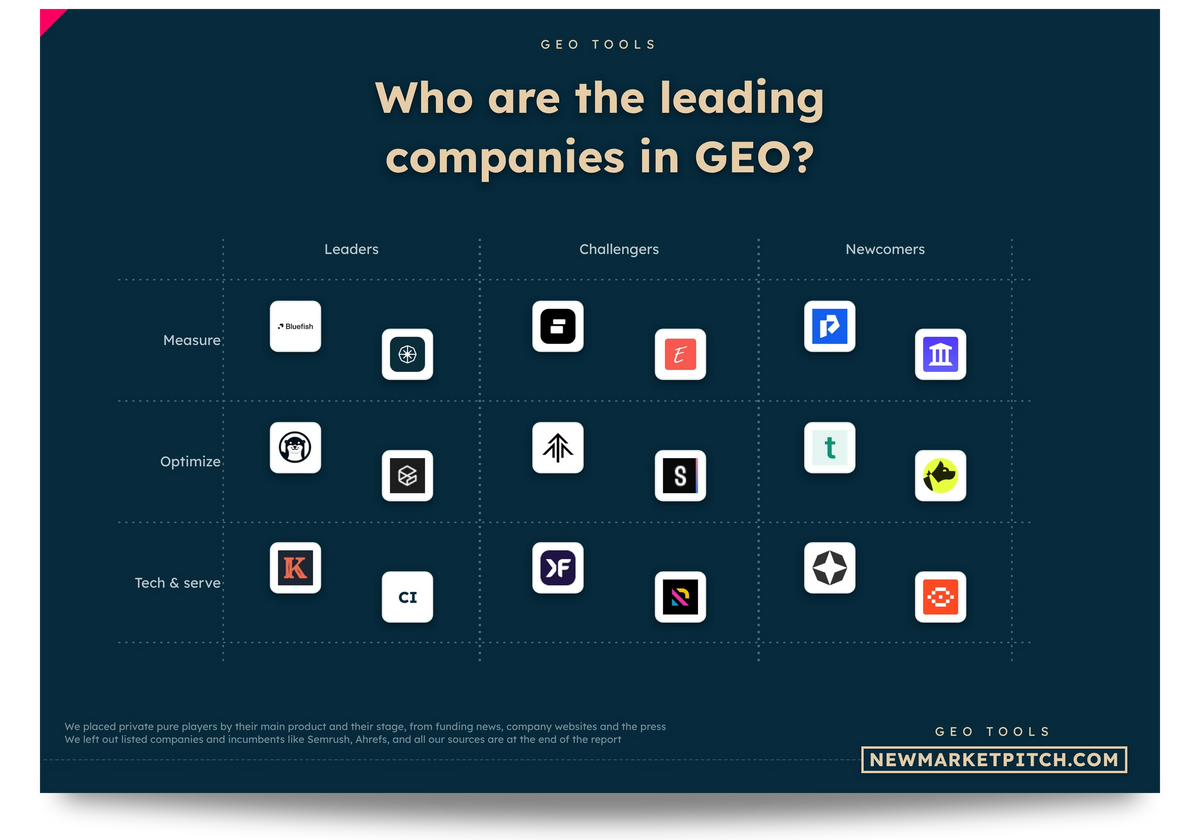
In our research about GEO startups, we turn what is vague and complex into simple, useful visuals. Market maps like this one show you at a glance where every startup stands.
Are Sequoia Capital and Kleiner Perkins the real GEO leaders?
Sequoia Capital and Kleiner Perkins are the clearest repeat lead investors behind Profound, but Y Combinator still leads GEO by rounds joined.
Each firm has been named lead in 2 of the Profound rounds we counted. Their latest shared deal was the company's September 2026 Series D, which Profound said would help build its AI platform for marketing. Profound's earlier pitch was to measure what AI assistants say about brands; its newer products also help marketing teams respond.
The company's September announcement said more than 1,000 enterprise brands were using Profound, including Walmart. That gives the backers a stronger commercial story to point to than a prototype or a dashboard demo. Profound's customer figure is a company-reported adoption measure, however, not proof of investor returns or profitable operations.
Calling these firms the biggest GEO investors by money would go too far. An announced round amount covers every investor in the financing. What we can establish is repeated public leadership of a company that has reached a later funding stage, something quite different from showing up in many small first rounds.
Has Y Combinator stopped backing GEO startups?
Y Combinator has not joined a new GEO startup round this year, but there is no evidence that it has abandoned the category.
The accelerator's latest recorded GEO deal is Relixir, in November 2025. Its existing bets cover The Prompting Company, AthenaHQ and Relixir. That spread suggests an early interest in several ways companies might get found through AI, rather than a commitment to one standard tool.
The Prompting Company builds ways for AI agents to discover and use products. AthenaHQ, now part of Bloomreach, helps brands see how they appear in answers from assistants such as ChatGPT and Gemini. Relixir is aimed at turning that visibility into inbound demand. They would overlap in a marketing budget, but they do not solve exactly the same customer problem.
Y Combinator's own profile of The Prompting Company says its founders previously built Typedream and Cotter. That track record helps explain why the accelerator might fund a team before the market has a clear winner. A quiet year in the round records tells us when new investments were disclosed; it cannot tell us what the accelerator is considering privately.

In our market report about GEO startups, we always try to gather several sources and make estimates that make sense, so you can work with solid numbers.
Which GEO investors are still investing this year?
Lightspeed Venture Partners is the most active GEO investor this year, with 2 rounds, while Y Combinator has not joined a new one.
Among the 20 most active investors, 19 have joined a round this year. Both of Lightspeed's rounds were in Profound, its Series C and its September Series D, and it led one of them. Inno Angel Fund has backed China's PureblueAI twice, once last year and once this year. Kleiner Perkins and Sequoia Capital have returned to Profound, while New Enterprise Associates and Salesforce Ventures have returned to Bluefish. Those investors already knew the companies they were backing.
New names have also appeared around smaller products. Work-Bench backed Petra Labs, AlbionVC backed geoSurge, and seed + speed Ventures supported Promptwatch. Work-Bench's published investment case focuses on connecting AI-search changes with business results. AlbionVC is testing a different idea: whether better understanding how models represent brands can improve what those models say. The current year contains both repeat bets and first appearances, rather than a complete change of investors.
The table below shows, year by year, how many rounds 12 of the most active GEO investors joined, so it is easy to see who is still investing and who has slowed down.
If you want to go more into detail and see which investors are still writing checks and which have slowed down, please check our GEO report.
| Investor | 2024 | 2025 | 2026* | Total |
|---|---|---|---|---|
| Lightspeed Venture Partners | 2 | 2 | ||
| Kleiner Perkins | 1 | 1 | 2 | |
| Sequoia Capital | 1 | 1 | 2 | |
| New Enterprise Associates | 1 | 1 | 2 | |
| Salesforce Ventures | 1 | 1 | 2 | |
| Inno Angel Fund | 1 | 1 | 2 | |
| Khosla Ventures | 1 | 1 | 2 | |
| Puma Growth Partners | 1 | 1 | ||
| Beenext Ventures | 1 | 1 | ||
| Lotus | 1 | 1 | ||
| SFC Capital | 1 | 1 | ||
| AJVC | 1 | 1 |
* 2026: January to 19 November. Darker cells mean more rounds that year. Data from January 2024 through 19 November 2026.
Is New Enterprise Associates a leading investor in GEO?
New Enterprise Associates is a leading repeat backer of Bluefish, although its GEO activity is concentrated in that company.
NEA has joined 2 Bluefish rounds and was named lead in both. Bluefish's April 2026 Series B was a $43M round co-led by NEA and Threshold Ventures, with Salesforce Ventures, Amex Ventures and other backers participating. Bluefish is selling an agentic marketing platform to large brands rather than relying on consumer subscriptions or a broad SEO audience.
NEA's investment article describes a business built for enterprise marketing teams and discusses Adidas as a customer example. That helps explain the concentrated bet. A company already selling to large organizations can add optimization, automation and reporting to an existing product relationship. The challenge is persuading those organizations to keep paying as competing tools spread.
The Bluefish investment is a bet on the brand's side of AI search: helping businesses influence how assistants describe them to prospective customers.
Can Salesforce Ventures actually help GEO startups sell to big brands?
Salesforce Ventures brings an enterprise-software connection to GEO through Bluefish, but an investment alone does not prove it has delivered customers.
Salesforce Ventures has joined 2 Bluefish rounds, including the Series B announced in April 2026. The other participants in that financing included New Enterprise Associates, Threshold Ventures, Amex Ventures and TIAA Ventures. Their presence reflects interest from investors familiar with the budgets and buying habits of large corporations.
Bluefish's pitch is straightforward: brands want to know what AI assistants tell customers, where the answers are wrong, and what the marketing team can do next. That sits near the work Salesforce customers already do with customer data and marketing software. It is easy to see why a corporate venture fund would pay attention.
We have no basis for treating Salesforce Ventures' backing as a confirmed distribution deal, software integration or sales referral. For now, its role is best described as a repeat corporate investor. That is meaningful, especially while many GEO startups are still trying to establish who the buyer is, but it is a narrower claim than guaranteed access to Salesforce's customers.
Would GEO investors rather fund software or agencies?
GEO investors are mostly backing companies that can sell reusable software, even when the service around the product remains important.
Profound builds monitoring and marketing agents. Bluefish sells tools for enterprise brands. Azoma helps consumer products become discoverable through AI shopping. Those are products a customer can use repeatedly, making them easier to grow than a business that writes a custom answer-optimization report for each client.
The line is not completely clean. Work-Bench says Petra Labs started by doing AI-search work for customers directly, then built software from what the team learned. Its product still involves tailored attribution models and an embedded way of working with clients. That's a more complicated model than self-service analytics, but it tackles a problem companies may pay more to solve.
Investors have good reasons to avoid a tool that only screenshots AI answers and exports a spreadsheet. They also have reasons to back a company that combines technology with specialist work while the market settles. The common requirement is a service the company can deliver consistently as its customer base grows.

Our document detailing everything you need to know about GEO gets updated several times a month, so you always get the latest view of where things stand.
Which GEO investors back seed rounds, and which back growth rounds?
Seed is the busiest stage for GEO funding, with 34 of the 47 rounds whose stage is known; Y Combinator leads seed activity with 4 rounds.
Series C or later accounts for 2 rounds, so the later-stage investor group remains narrow. Kleiner Perkins and Sequoia Capital have backed Profound through its Series D, while New Enterprise Associates and Salesforce Ventures backed Bluefish's Series B. Those are already established products selling to enterprise customers.
Seed backers are trying a wider range of ideas. Work-Bench backed Petra Labs' attribution work, AlbionVC supported geoSurge's approach to brand representation, and JAFCO joined QueryLift's seed financing in Japan. The stage split tells us why an accelerator leads on participation while famous venture firms lead some of the largest announced rounds.
The table below shows, for 12 of the most active GEO investors, how many rounds they joined at each stage, from seed to growth.
If you want to go more into detail and see where each investor places its bets, from seed to growth, please check our GEO report.
| Investor | Seed | Series A | Series B | Series C | Series D+ | Growth |
|---|---|---|---|---|---|---|
| Y Combinator | 4 | · | · | · | · | · |
| Kleiner Perkins | · | 1 | · | · | 1 | · |
| Sequoia Capital | · | · | 1 | · | 1 | · |
| New Enterprise Associates | · | 1 | 1 | · | · | · |
| Lightspeed Venture Partners | · | · | · | 1 | 1 | · |
| Salesforce Ventures | · | 1 | 1 | · | · | · |
| Inno Angel Fund | 2 | · | · | · | · | · |
| Khosla Ventures | 1 | · | · | · | 1 | · |
| Puma Growth Partners | · | 1 | · | · | · | · |
| Beenext Ventures | 1 | · | · | · | · | · |
| Lotus | 1 | · | · | · | · | · |
| SFC Capital | 1 | · | · | · | · | · |
Most active at each stage, among all GEO investors: Seed, Y Combinator · Series A, no investor joined more than one round · Series B, no investor joined more than one round · Series C, no investor joined more than one round · Series D+, no investor joined more than one round. Bigger dots mean more rounds. Data from January 2024 through 19 November 2026.
Can a new GEO startup still attract a serious VC?
A new GEO startup can still get a respected venture investor if it solves a problem that existing AI-visibility dashboards leave open.
Work-Bench led Petra Labs' $5.2M seed round and argued that knowing a brand appeared in an AI answer says little about which marketing work caused it. AlbionVC led geoSurge's $12M seed round with a different thesis: brands need to understand how AI models learn about them over time. seed + speed Ventures backed Promptwatch's seed round of about $6.9M, focusing on monitoring and real user data.
Each investor is asking the startup to solve a specific problem. Work-Bench is looking for better links between activity and outcomes. AlbionVC wants more control over how a brand is understood by models. Promptwatch is tackling the quality of visibility measurement. None of those ideas is proved by receiving a seed check, but the checks show that investors are still open to products beyond the earliest GEO dashboards.
A founder pitching another mention counter will have a harder time explaining why the product deserves its own budget. Showing how it helps a marketing team make a decision gives investors something more concrete to evaluate.
Are GEO VCs backing lots of rivals or picking one favorite?
Most named GEO investors have backed a particular startup, while Y Combinator has spread its early bets across several competing approaches.
The accelerator has appeared with The Prompting Company, AthenaHQ and Relixir. Elsewhere, Work-Bench has focused its recorded GEO activity on Petra Labs, AlbionVC on geoSurge, and Puma Growth Partners on Azoma. The first strategy samples several possible products; the second gives a firm a closer relationship with a chosen company.
There is a reason to consider both. At the start of a market, nobody knows whether customers will value monitoring, attribution, better content, or automatic fixes most. Y Combinator's companies approach those needs from different directions. Work-Bench, by contrast, has spelled out a clear reason for Petra Labs: marketers struggle to connect AI-search changes to revenue.
An investor with only one disclosed deal should not be assumed to lack interest elsewhere. What we can say is that the firms with the clearest published arguments are often choosing a problem first and then backing a company built to solve it.
Will investors keep funding GEO dashboards that only count mentions?
Simple GEO mention dashboards will face a tougher funding pitch as investors favor tools that tell marketing teams what to do next.
Work-Bench's July 2026 Petra Labs announcement made that complaint explicit: many companies already use visibility tools but cannot tell which marketing changes moved an AI recommendation or produced revenue. Profound has been moving in the same direction. Its October 2026 agent update lets users describe a marketing task and give the software tools to carry it out.
Even the larger marketing vendors are getting more specific. In November 2026, Sitecore-owned Scrunch launched Citation Optimization, which identifies outside publications that influence AI answers and suggests where a brand should focus its outreach. Scrunch also published research showing that a great deal of AI-influenced discovery never arrives with a recognizable AI referral. Those are problems a dashboard that counts mentions cannot solve alone.
We should not assume these products have proven perfect attribution or control over model answers. They have, however, raised the standard for a useful GEO tool. Investors now have concrete examples of software trying to connect measurement with marketing work and customer outcomes.

In our report covering the GEO market, we look at what the winners do differently, so you can learn from the best instead of guessing.
Is Profound the GEO startup every major VC wants?
Profound is the best-known later-stage GEO bet, but major investors are still choosing other companies and other ideas.
Sequoia Capital and Kleiner Perkins have each led 2 Profound financings. Profound's September 2026 announcement also named Lightspeed Venture Partners, Khosla Ventures and other returning investors. Lightspeed has joined 2 Profound rounds this year, more than any other GEO investor. That is a formidable group, especially for a business that began by showing brands how they appeared in AI search.
The product has moved beyond monitoring. Profound's Aim system now offers agents that can draft and run marketing tasks, while the company says global brands are using its tools. That wider product ambition helps explain why established VCs would see Profound as more than an SEO add-on.
But New Enterprise Associates backed Bluefish instead, and Work-Bench backed Petra Labs. AlbionVC has published a different investment case for geoSurge. None of those investors has to believe that Profound will lose to justify its choice. GEO may end up with a broad platform and several specialist tools, or the larger marketing suites may pull many of those features into products customers already buy. Profound's fundraising success has not settled that question.
Can GEO startups get beyond seed funding?
A GEO startup can raise well beyond seed, but very few companies in this market have done so yet.
Profound's Series D is the clearest high-profile example. It has moved from measuring brand visibility into software that runs marketing tasks, giving its investors a larger market to pursue. Bluefish has also progressed to Series B, with New Enterprise Associates helping lead a round aimed at expanding its platform for major brands.
Most other named deals still involve younger products. Petra Labs works on attribution, geoSurge on how models represent companies, and QueryLift on the way AI tools describe and cite brands. Their seed investors are paying for the chance that those problems become durable software categories, before the companies have the customer history of Profound or Bluefish.
The result is a market with a small later-stage tier rather than a dependable path to large follow-on rounds for every startup. A GEO founder looking for growth funding will need evidence that customers keep using the software and paying for it, not just proof that AI search is becoming popular.
Which GEO investors most often invest together?
New Enterprise Associates and Salesforce Ventures are the leading repeat GEO investor pair, having joined 2 Bluefish rounds together.
They are the sole pair at that count in our research. Their partnership makes sense from Bluefish's product and buyer: NEA has backed an enterprise marketing platform, while Salesforce Ventures invests in software that could interest large organizations already paying for customer and marketing tools.
Bluefish's April 2026 financing brought in Threshold Ventures as a co-lead alongside NEA and also named Amex Ventures and TIAA Ventures. The repeated presence of NEA and Salesforce Ventures is clearer evidence of continuing interest than a one-off investor list. It still does not reveal either investor's check size, ownership or influence on company decisions. Among 85 named GEO investors, repeat co-investment remains concentrated rather than a feature shared across the market.
The table below lists the pairs of GEO investors named together in at least two equity rounds, with the startups they backed together.
If you want to go more into detail and see which investor networks back the same startups, please check our GEO report.
| Investor pair | Rounds together | Startups backed together |
|---|---|---|
| New Enterprise Associates + Salesforce VenturesBluefish | 2 | Bluefish |
Pairs of investors named in the same equity round. Data from January 2024 through 19 November 2026.

In our research about GEO startups, we don't want to repeat what boring consulting reports say. Instead, we show you the real and latest market signals that matter.
Are specialist GEO investors getting pushed aside by big VCs?
Specialist GEO backers still have room to win early deals, even as Sequoia Capital and Kleiner Perkins back a larger company such as Profound.
AlbionVC's investment in geoSurge is based on a different product belief from Profound's broad marketing platform. geoSurge studies how models learn and represent brands. Work-Bench wants Petra Labs to connect changes in AI answers with actual business results. seed + speed Ventures has backed Promptwatch's approach to monitoring.
These firms are choosing problems that large platforms may not yet solve particularly well. That can give a small startup time to build a strong product and customer relationships. The risk is obvious too: Profound can add more tools, and companies such as Sitecore can buy smaller competitors and sell their technology to existing customers.
There is no evidence here that specialists have already lost or that backing a company earlier automatically produces a better return. The useful difference is what each firm is trying to own. Generalist VCs have shown confidence in a bigger all-in-one business; specialist backers are testing whether a narrower problem can sustain a company of its own.
Why are European investors backing GEO startups?
European investors are backing GEO startups because AI visibility now affects both ordinary brand search and the way shopping assistants recommend products.
AlbionVC led geoSurge's seed round, seed + speed Ventures backed Promptwatch, and Puma Growth Partners led Azoma's $11M Series A. Those companies tackle different customer needs. geoSurge focuses on how language models understand brands, Promptwatch measures their presence in AI search, and Azoma works on products recommended by shopping agents.
Azoma's October 2026 announcement named customers such as L'Oreal, Unilever, Mars, Beiersdorf and Reckitt. It also described work across London and Toronto, which is a reminder that European-backed software can sell globally. Puma's investment case looks at product data and discoverability across language models and retailer assistants, rather than ordinary search rankings alone.
The investments show real regional participation without proving that Europe has overtaken the U.S. GEO market. Investors can make a credible case for companies built around retail catalogs, multilingual brands or how AI tools handle product information. The market does not need to produce only copies of the best-known American dashboard.
Are Japanese investors putting money into GEO?
Japanese venture firms are funding GEO software, with JAFCO and Z Venture Capital backing QueryLift's domestic AI-search tools.
Our research records a $637K seed round for QueryLift. The company's September 2026 release described software that tracks what ChatGPT, Gemini, Claude and Google AI Overviews say about brands, which sources appear in answers, and which competitors get recommended. Z Venture Capital also published its reasons for backing the company.
A Japanese company can have the same underlying problem as an American one while dealing with a different set of websites, publishers and search habits. That creates room for tools built with local language and business needs in mind. QueryLift's pitch is to show marketers how their company appears when buyers ask AI tools for an answer, then help them decide where to improve the information those tools find.
The financing does not establish that Japan leads GEO or that these investors will back many more startups. It is evidence of something narrower and useful: recognized Japanese VCs are willing to fund a locally built product in a category once associated mainly with U.S. startup names.
Will AI shopping bring more investors into GEO?
AI shopping gives GEO investors a clearer route from being mentioned in an answer to helping a brand sell a product.
Azoma is a strong example. The company helps consumer brands manage how AI shopping assistants find, understand and recommend their products, with Puma Growth Partners leading its recent Series A. Azoma says it works with consumer businesses including Unilever, Mars and Reckitt, companies that have long depended on getting the right product information in front of shoppers.
OpenAI's March 2026 product-discovery release described richer product comparisons inside ChatGPT and more complete product data for the shopping experience. That changes the challenge for a brand. Beyond ranking on a conventional search page, a product has to be represented correctly when an assistant gathers options and explains them to a buyer.
A shopping app built for consumers is different from a GEO service that helps external assistants find and describe a merchant's products. Azoma belongs in the latter group. Its case explains why investors may look beyond software for tracking corporate mentions, toward tools that influence a purchase decision. Whether those tools can consistently prove extra sales is still the harder test.

Learning from others' mistakes is the cheapest lesson there is. In our market report about GEO startups, we look at what broke startups before you, so you don't repeat it.
Are Adobe, Sitecore and HubSpot squeezing GEO startups?
Adobe, Sitecore and HubSpot are making life harder for independent GEO startups by adding AI-search tools to software that brands already use.
Adobe completed its purchase of Semrush in April 2026, saying the combination would connect SEO, GEO and other forms of brand discoverability. Sitecore acquired Scrunch in June to link AI-answer insights with content management. HubSpot's regulatory filing confirms its acquisition of XFunnel, an answer-engine optimization platform. These are established software companies, not startups in our GEO investor ranking.
The pressure is getting more immediate. Scrunch's recent Citation Optimization launch gives marketers a way to identify which outside sources affect AI recommendations and plan outreach around them. Sitecore can put that capability next to a customer's content and campaign tools. A small vendor selling only AI mention reports now has to explain why its separate subscription is worth keeping.
There is still a reason for VCs to invest. A focused startup might solve attribution, product discovery or model representation better than a broad marketing suite. Acquisition is also one possible exit. Yet no investor can assume that every GEO tool will remain independent; the bigger platforms have already shown that they want to own parts of this market.
So, who are the biggest investors in GEO startups today?
Y Combinator is the most active GEO startup investor by rounds joined, while Sequoia Capital and Kleiner Perkins stand out for their repeated leadership at Profound.
There are several defensible ways to judge an investor here. Y Combinator has backed different young GEO businesses. Sequoia Capital and Kleiner Perkins have returned to a later-stage company that now offers more than answer monitoring. New Enterprise Associates and Salesforce Ventures have repeatedly backed Bluefish, while Lightspeed Venture Partners is busiest in the current year, with 2 Profound rounds.
That spread is exactly what we would expect while the winning products are still being decided. Seed investors can back attribution, AI-readable content, model representation or shopping discovery. Big venture firms can finance companies selling broader software to enterprise marketing teams. Established companies such as Adobe and Sitecore add a new complication by building and buying some of those capabilities themselves.
For now, Y Combinator owns the activity lead, but the stronger test of GEO investors will be whether their companies can keep selling useful products as the market changes. A high round count tells us who showed up. Repeat backing, customer adoption and the ability to solve a lasting problem tell us more about the companies those investors chose.
The table below shows what we found.
| Question | Answer |
|---|---|
| Does the most familiar VC lead overall? | Y Combinator is the most active GEO investor by participation. It has backed 3 different GEO startups so far. That approach gives it several chances to back a lasting product. |
| Have famous funds overtaken the accelerator? | Sequoia Capital has become a repeat leader behind Profound. It was named lead in 2 rounds for that company. Such concentration makes its role different from Y Combinator's broader bets. |
| Is Kleiner Perkins betting on several GEO winners? | Kleiner Perkins is making a concentrated GEO investment in Profound. It was named lead in 2 rounds that we counted. The returns depend heavily on how that company develops. |
| Is this year's leader also the overall leader? | No, Lightspeed Venture Partners is busiest in the current GEO year. It has joined 2 Profound rounds, while the all-period leader has had a quieter year. Current activity is worth separating from a longer investment record. |
| Have enterprise investors kept returning to Bluefish? | New Enterprise Associates has returned to enterprise-focused GEO company Bluefish. It has joined 2 Bluefish rounds so far. That repeated backing points to conviction in one enterprise platform. |
| Can corporate investors make a difference here? | Salesforce Ventures is a repeat corporate backer of Bluefish. It joined 2 of the GEO company's financing rounds. Its investment does not by itself prove customer referrals or partnerships. |
| Are most GEO founders still raising early money? | Seed remains the busiest funding stage for GEO startups. It accounts for 34 of 47 rounds with known stages. Most investors are still choosing products before the market settles. |
| Are late-stage GEO investments common already? | Large follow-on GEO rounds remain unusual across the market. Series C or later accounts for just 2 rounds. Profound's path should not be mistaken for the typical startup's experience. |
| Do top GEO funds often work together? | Repeated co-investment is clearest at enterprise software maker Bluefish. New Enterprise Associates and Salesforce Ventures shared 2 rounds. Their joint presence does not disclose the size of either check. |
| Can European GEO specialists attract credible investors? | AlbionVC backed geoSurge's approach to brand representation inside AI. The company's seed financing came to $12M. Its technical focus differs from a broad marketing platform's product. |
| Is Japan funding its own GEO tools? | Japanese investors are also backing locally built GEO products. JAFCO joined QueryLift's $637K seed financing. QueryLift focuses on what AI assistants say and cite about brands. |

If you build or invest in the GEO market, you need to know which business models pay off now and which ones are fading. That's why our report covering it has a whole section on it.
Our methodology
Our data runs through November 19, 2026. We then reviewed this article and updated its answers on November 24, 2026, the date shown under the title. We have tracked GEO equity rounds systematically since January 2024, deal by deal, to show who is active in the market today. GEO means products and specialist services whose main business is improving or measuring how brands, organizations and products appear and are cited in generative AI answers. We include AI-answer analytics, competitive visibility tools, AI-readable content and catalog infrastructure, search attribution and focused managed services. We include companies at the edge of this definition when GEO is central to the business. Every company counted is a startup under our definition: an independent, growth-oriented business founded in 2007 or later that has never listed or listed within the last 5 years; recent acquisitions remain within the defined window.
We count the equity rounds each investor joined and those it led, rather than the amount it invested, which is rarely made public. We exclude IPOs and offerings after listing. Investor names come from company announcements and credible reporting; we merge aliases for the same firm and separate reports of a single round. We do not count vague labels such as "existing investors" or "angel investors." The column for the current year starts in March, once there are three months of data.
Announcements name lead investors more reliably than smaller participants, so rounds that an investor joined without leading are undercounted and lead rates are an upper bound.
Rounds confirmed by a company announcement, a press article or a regulatory filing are counted in full. Where no article exists, a round is counted only when at least two recognised databases agree on its date (within one month) and amount (within 5%), and it is marked as low confidence; a round found in a single database stays in the company's history but is left out of totals. For companies that have raised more than $100M, every round counted is backed by an article.
We never accept a commercial database's investor list on its own. Crunchbase, PitchBook and similar services can add investors who were absent from a specific financing or group equity with debt and grants. We identified named investors in 48 of the 55 equity rounds, or 87%. That makes the counted participation for each investor a floor, since some confirmed financings disclose no participant names.
The deal totals in a GEO funding tracker and the investor totals here answer different questions. A round appears once in a deal tracker but is counted once for every named investor who joined it here. Rounds with no named investor remain in the market total yet have no place in the investor ranking. Whole-round amounts never tell us how much an individual investor contributed.
A specialist fund can rank below a generalist or an accelerator without being less committed to GEO. We rank equity rounds joined inside this clearly defined market, not reputation, fund size, historical returns or investments in adjacent AI businesses. Named leads, recent activity, company stages and repeat backing add useful context, while keeping the count itself consistent across investors.
Key sources include Profound's Series D, co-leads, product plans and reported adoption, Sequoia Capital's published rationale for Profound, Profound's marketing agent product update, Bluefish's Series B leads and other investors, NEA's Bluefish thesis and enterprise customer context, The Prompting Company's product and founding team, AthenaHQ and Y Combinator affiliation, Work-Bench's Petra Labs investment and attribution argument, AlbionVC's explanation of its geoSurge investment, Promptwatch's investor-backed product, Azoma's announced raise, customers and AI shopping product, Puma Growth Partners' Azoma investment thesis, QueryLift's funding and product announcement, Z Venture Capital's QueryLift investment rationale, Product discovery through AI shopping in ChatGPT, Sitecore's acquisition of Scrunch, Scrunch's newer source-based optimization features, Scrunch's research on AI discovery and referrals, Adobe's acquisition of Semrush and GEO plans, HubSpot's filing about XFunnel, BrandRank.AI's seed financing and investors, and Google changes to source links in AI search answers.

In our report covering the GEO market, we like to show you the big picture. We know your time is precious, so we make every page quick to read and packed with as much learning as possible per minute.
Written by the New Market Pitch teamWe track new markets so founders and investors can move faster. About us