What are the most valuable GEO startups?
Whether you're building or investing in the GEO market, our report covers everything you need to know: the players, the money, and what's coming next.
Summary
Profound is the most valuable GEO startup, valued at $1.8B. Among the 28 specialists we rank, it is the only confirmed unicorn. Bluefish and AirOps are the closest challengers, although their valuations are estimates rather than prices investors announced.
Profound has a real business behind that lead. Walmart and Comcast are among its enterprise customers, and the company has moved from measuring AI answers to helping marketing teams do the work those measurements suggest.
Bluefish is chasing some of the same large brands. AirOps is taking a different route, giving marketers tools to create and update the content that AI assistants might find and recommend.
Brandlight belongs in that contest as well. Its work with Samsung and ShipStation gives us concrete examples of companies trying to change what AI systems say, instead of simply watching the answers.
Germany's Peec AI makes the European race more interesting. It has reported rapid growth in recurring revenue, even though the valuation we use is still an estimate from an older round.
The wider field is much younger. Some startups monitor citations, others improve product catalogs or help businesses turn AI-search visits into leads and sales. Those products are not interchangeable, even if they share the GEO label.
There are 12 American startups in our group and 4 from the United Kingdom. France, Germany, India and several Asian markets also have specialists, but the strongest valuation evidence still comes from the U.S. leader. Britain's Searchable is the only other company with an announced price, $85M in May 2026.
AI shopping could give GEO vendors a clearer path to proving their worth. Azoma works on how assistants recommend products, while Lemrock helps merchants make catalogs readable by those assistants.
The biggest threat comes from the platforms themselves. Google now offers dedicated reporting for generative search, and changes to AI models can quickly make a once-useful visibility score less useful.
Profound leads today, but we would not call the next winner yet. The startups that keep customers will have to show that better AI visibility produces useful work, qualified buyers or sales, not just a higher mention count.

Written by the New Market Pitch teamWe track new markets so founders and investors can move faster. About us

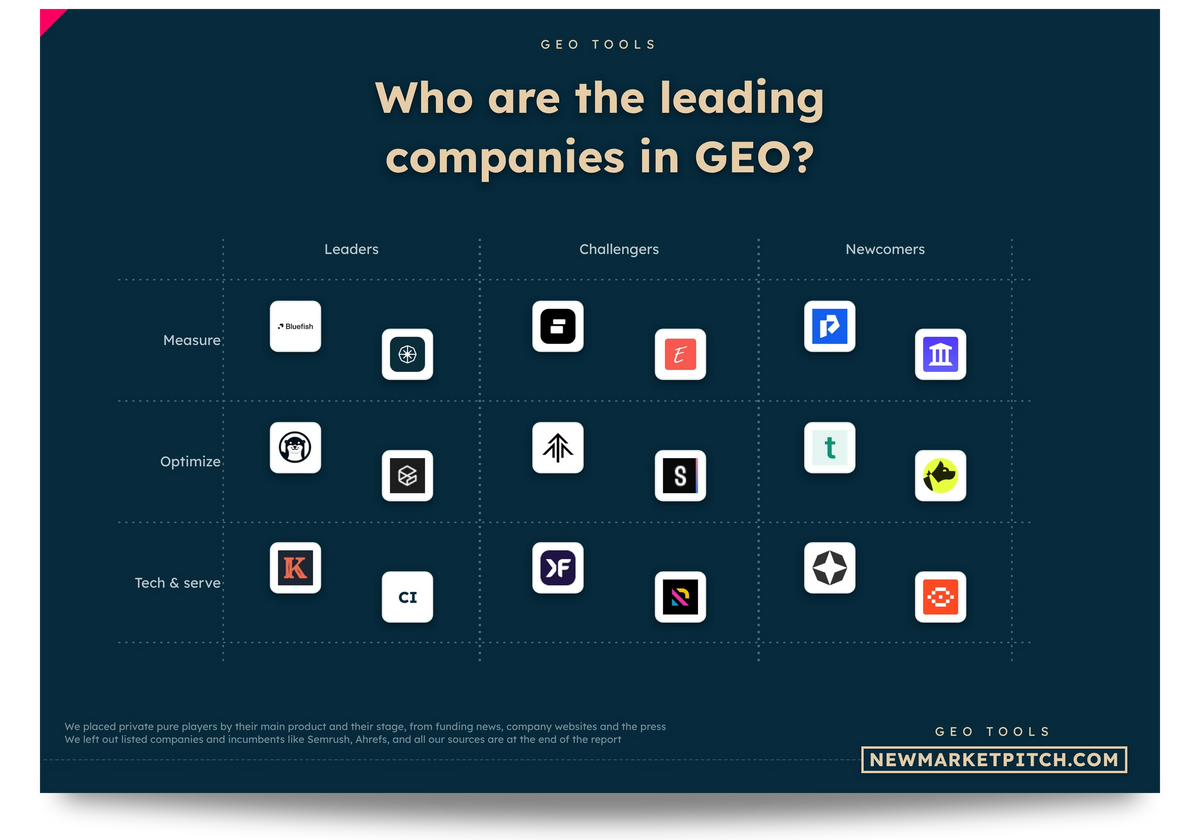
In our report covering the GEO market, we turn what is vague and complex into simple, useful visuals. Market maps like this one show you at a glance where every startup stands.
Top startups in the GEO market ranked by valuation
Here is the current ranking of the most valuable GEO startups. For each one you will also find our confidence level and the valuation basis we used.
If you want to go deeper into the GEO startup landscape, check our report covering the GEO market.
| # | Startup | Valuation | Confidence | Valuation basis | Last round | Total funding |
|---|---|---|---|---|---|---|
| Private startups | ||||||
| 1 | ProfoundAI search visibility and marketing analytics | $1.8Bas of Sep 2026 | Full | Announced private round valuation | $180MSeries D · Sep 2026 | $335Mvalued at 5.4× this |
| 2 | BluefishAI search visibility and marketing optimization | $287M–$538Mas of Apr 2026 | Low | Estimated from last round | $43MSeries B · Apr 2026 | $63M+valued at 6.2× this |
| 3 | AirOpsAI search visibility and content workflows | $267M–$500Mas of Nov 2025 | Low | Estimated from last round | $40MSeries B · Nov 2025 | $63Mvalued at 5.8× this |
| 4 | BrandlightOptimizes enterprise brand presentation in AI answers | $150M–$250Mas of Feb 2026 | Low | Estimated from last round | $30MSeries A · Feb 2026 | $36Mvalued at 5.4× this |
| 5 | Peec AITracks brand mentions and citations in AI | $105M–$175Mas of Nov 2025 | Low | Estimated from last round | $21MSeries A · Nov 2025 | $29M+valued at 4.6× this |
| 6 | EvertuneMeasures AI brand visibility and competitive recommendations | $75M–$125Mas of Aug 2025 | Low | Estimated from last round | $15MSeries A · Aug 2025 | $19Mvalued at 5.1× this |
| 7 | SearchableMonitors and optimizes discovery across AI engines | $85Mas of May 2026 | Full | Announced private round valuation | $14MSeed · May 2026 | $18Mvalued at 4.7× this |
| 8 | AzomaOptimizes product information and recommendations to improve consumer-brand discovery in AI shopping agents. | $56M–$93Mas of Oct 2026 | Low | Estimated from last round | $11MSeries A · Oct 2026 | $17M+valued at 4.1× this |
| 9 | geoSurgeImproves how models represent and recall brands | $48M–$80Mas of Jul 2026 | Low | Estimated from last round | $12MSeed · Jul 2026 | $12M+valued at 5.2× this |
| 10 | LimyAttributes AI search traffic to customer acquisition | $40M–$67Mas of Jan 2026 | Low | Estimated from last round | $10MSeed · Jan 2026 | $10Mvalued at 5.2× this |
| 11 | GushworkProvides AI-assisted search and generative visibility services | $36M–$60Mas of Feb 2026 | Low | Estimated from last round | $9MSeed · Feb 2026 | $11Mvalued at 4.2× this |
| 12 | LemrockMakes product catalogues accessible to AI assistants | $28M–$46Mas of Mar 2026 | Low | Estimated from last round | $6.9MSeed · Mar 2026 | $6.9Mvalued at 5.2× this |
| 13 | PromptwatchTracks AI mentions and automates optimization recommendations | $28M–$46Mas of Jul 2026 | Low | Estimated from last round | ~$6.9MSeed · Jul 2026 | $8.3Mvalued at 4.3× this |
| 14 | The Prompting CompanyMakes brands and products discoverable by AI | $26M–$43Mas of Oct 2025 | Low | Estimated from last round | $6.5MSeed · Oct 2025 | $6.5Mvalued at 5.2× this |
| 15 | ZocaOptimizes local business discovery across AI search | $24M–$40Mas of May 2025 | Low | Estimated from last round | $6MSeed · May 2025 | $6Mvalued at 5.2× this |
| 16 | EmberosAI brand visibility and optimization platform | $22M–$37Mas of Sep 2026 | Low | Estimated from last round | $5.5MSeed · Sep 2026 | $6.7Mvalued at 4.2× this |
| 17 | Petra LabsImproves AI discovery through structured brand information | $21M–$35Mas of Jul 2026 | Low | Estimated from last round | $5.2MSeed · Jul 2026 | $5.2Mvalued at 5.2× this |
| 18 | GetMintOptimizes brand visibility across conversational AI search | $19M–$31Mas of Dec 2025 | Low | Estimated from last round | $4.7MSeed · Dec 2025 | $4.7Mvalued at 5.2× this |
| 19 | OmniaMonitors and improves brand visibility in AI search | $16M–$27Mas of Oct 2025 | Low | Estimated from last round | $4MPre-Seed · Oct 2025 | $4Mvalued at 5.2× this |
| 20 | BrandRank.AIBenchmarks brand performance across AI answer engines | $12M–$20Mas of Jul 2026 | Low | Estimated from last round | $3MSeed · Jul 2026 | $4.2Mvalued at 3.7× this |
| 21 | MiraclyCombines AI search monitoring with content agents | $8M–$13Mas of Oct 2026 | Low | Estimated from last round | $2MPre-Seed · Oct 2026 | $2Mvalued at 5.2× this |
| 22 | RelixirAutomates website optimization for generative AI search | $8M–$13Mas of Nov 2025 | Low | Estimated from last round | $2MSeed · Nov 2025 | $2Mvalued at 5.2× this |
| 23 | SerpierAutomates SEO and AI search content workflows | $6.4M–$11Mas of Jun 2026 | Low | Estimated from last round | $1.6MSeed · Jun 2026 | $1.6Mvalued at 5.2× this |
| 24 | PureblueAIOffers local-language generative engine optimization services | $5.6M–$9.4Mas of Aug 2025 | Low | Estimated from last round | UndisclosedAngel+ round · Jul 2026 | $1.4M+valued at 5.2× this |
| 25 | RankettaTracks product citations and AI shopping recommendations | $4.6M–$7.7Mas of Nov 2025 | Low | Estimated from last round | $1.2MPre-Seed · Nov 2025 | $1.2Mvalued at 5.2× this |
| 26 | ObseroProvides AI search intelligence and GEO consulting | $4.5M–$7.5Mas of Oct 2026 | Low | Estimated from last round | $1.1MSeed · Oct 2026 | $1.1Mvalued at 5.2× this |
| 27 | QueryLiftTracks brand citations across generative search systems | $2.6M–$4.3Mas of Sep 2026 | Low | Estimated from last round | $637KSeed · Sep 2026 | $637Kvalued at 5.2× this |
| 28 | Z Creative PartnersZ-GEO analyzes brand visibility and recommendations in generative AI answers. | $1.3M–$2.1Mas of Nov 2026 | Low | Estimated from last round | ~$320KSeed · Nov 2026 | $320Kvalued at 5.2× this |
| Listed in the last 5 years or acquired in the last 3 years · not ranked | ||||||
| XFunnelOptimizes websites for AI answer engine discovery | $17Mas of Dec 2025 | Full | Acquisition value | Undisclosed | ||
No startups match this search.

Our research about GEO startups gets updated several times a month, so you always get the latest view of where things stand.
Why are investors paying so much for GEO startups now?
GEO startups are attracting serious valuations because AI assistants now influence which brands people discover before they ever open a company's website.
In a July 2025 study of U.S. Google users, Pew Research Center found that people clicked a conventional search result in 8% of visits when an AI summary appeared, compared with 15% when it did not. A company can therefore lose a chance to be considered without seeing an obvious drop in its old keyword ranking. In May 2026, Google said AI Overviews had reached more than 2.5 billion monthly users and AI Mode had passed one billion. Those are audiences for Google services, not paid customers for GEO startups, but they show why the question has landed on marketing teams' desks.
Profound sells enterprise teams a way to understand and act on that change. Bluefish focuses on how brands are presented by several assistants; AirOps helps companies produce and improve the material those assistants may use. We think the spending opportunity is real, though the price investors give a GEO startup still depends on customer retention and revenue. The enormous audience for AI search tells us where the problem comes from. It does not tell us what a software vendor can charge to solve it.
Is Profound still the most valuable GEO startup?
Yes. Profound leads the GEO startup market at $1.8B, and its value comes from an announced private funding round rather than an estimate.
Bluefish follows in our ranking with $287M–$538M and AirOps with $267M–$500M. We derived those two ranges from the sizes of their last equity rounds, in April 2026 and November 2025 respectively. They are our estimates dated to those rounds, not valuations announced by the companies or investors. The ranges overlap, so we would not claim to know which challenger could command the higher price today.
Profound's September 2026 announcement named Sequoia Capital and Kleiner Perkins as co-leaders of its financing. It also described an expansion from AI-search analytics into marketing agents that help teams research, write and report. Customers have more reasons to use the product every week than they would have with a report of brand mentions alone. Bluefish and AirOps are pursuing similar customer budgets, and both have their own approaches to acting on AI-search results. Yet neither has a disclosed valuation that overturns Profound's lead.

In our market report about GEO startups, we look at what the winners do differently, so you can learn from the best instead of guessing.
Is Profound overvalued right now?
Profound's GEO valuation looks ambitious, but calling the company overvalued would ignore how much enterprise business it has already built.
The company said in September 2026 that more than 1,000 enterprise brands used its platform, including Walmart, Comcast and The Estée Lauder Companies. It also reported that revenue had tripled over the preceding six months and that a third of the Fortune 100 were customers. These are company-reported figures, but they still tell us more than a slide showing a prototype. TechCrunch separately covered the funding and the move toward software that helps marketers carry out campaigns, not just check AI answers.
We do not have a disclosed profit figure or customer-retention rate that would settle whether the valuation is cheap or expensive. What makes the price believable is the work Profound is taking on. A reporting tool may get used during a monthly review; software that researchers, writers and marketing managers use to plan and execute campaigns has more chances to become part of a customer's routine. Bluefish and AirOps want that position too. For now, Profound has clearer evidence of enterprise reach than most of the GEO field, while its eventual financial return remains unproven.
Could Bluefish catch Profound in AI search?
Bluefish could challenge Profound for large GEO customers, but it has not shown a company-announced valuation that puts it on Profound's level.
Bluefish's April 2026 announcement said the platform served approximately 10% of the Fortune 500. It named Adidas, American Express, Hearst, LVMH and Ulta Beauty among its customers and described software that monitors AI answers, guides changes and measures business impact. This gives Bluefish a credible sales pitch to global brands: marketing teams need to know what ChatGPT, Gemini and other assistants are saying about the same products.
We estimate Bluefish at $287M–$538M using the size of its April 2026 equity round, so the range describes our view at that round's date, not a price the company announced. We count at least $63M in confirmed equity funding. The company's own announcement gives $68M in total, and the gap sits in early funding that we cannot match to a dated round. Bluefish's case for catching Profound rests on selling more than reports. It wants several departments inside a large company to work from one view of how AI systems represent the brand. That could make it hard to replace. Still, customer names do not reveal how much each brand pays or whether its contract keeps growing. Bluefish is a credible enterprise rival today; a valuation catch-up remains a possibility, not an established fact.
Could AirOps be worth more than Bluefish?
AirOps could become the more valuable GEO startup because it helps marketers change content, while Bluefish has built its business around managing brands across AI answers.
AirOps introduced a content engineering platform in November 2025. A marketing team can use it to identify gaps in AI-search visibility, write or update pages and check the result. Bluefish offers ways to act on its findings too, but its strongest public message is a common view of a brand across AI providers and enterprise teams. The two products may compete for the same budget without doing exactly the same job.
Our estimate for AirOps is $267M–$500M, based on the size of its November 2025 equity round and dated to it. The company did not announce that valuation. We count $63M in equity raised. The estimated range overlaps Bluefish's range, so the difference in their displayed positions does not settle the issue. AirOps could get a stronger grip on customer spending if teams return regularly to improve content and measure what worked. The danger is easy to see: content automation is a crowded software business. AirOps needs to prove customers get better discovery results, rather than merely producing more pages faster.

In our document detailing everything you need to know about GEO, you will always find fresh funding data, taken straight from our own verified funding database.
Can Brandlight really compete with Profound and Bluefish?
Brandlight is a credible GEO rival to Profound and Bluefish because it can show brands how particular AI answers changed after real marketing work.
Brandlight's published customer stories describe Samsung and its agency Starcom working on the Galaxy S25's presence in unbranded AI answers. Brandlight reported a 17% visibility improvement for that program. Its ShipStation case study looks at where assistants found their information, including independent publishers and aggregators, so the customer could decide which pages deserved attention. These are results reported by the vendor, but they give buyers something more useful than a screen full of mentions.
We estimate Brandlight at $150M–$250M from the size of its February 2026 equity round, dated to that round rather than announced by investors. Our equity total is $36M. Profound has built a wider marketing platform, and Bluefish sells a broad enterprise view of AI presence. Brandlight's opportunity is to make source-by-source improvement work reliably across many customers. Its case studies show that the idea can be useful. They do not yet prove those gains will survive a change to an AI model or that the service can grow without a large amount of hands-on agency work.
Is Peec AI becoming Europe's biggest GEO startup?
Peec AI is the leading European GEO startup by estimated valuation in our group, and its reported sales growth makes the case stronger than the valuation alone.
We estimate the German company at $105M–$175M from the size of its November 2025 equity round. That is our last-round estimate, dated to the round, not a value Peec or its investors announced. British specialists Searchable, which has an announced valuation, and Azoma come next among the European companies we track, while France's Lemrock and the Netherlands' Promptwatch work on narrower parts of AI discovery.
Peec has reported tangible commercial growth. It said more than 1,300 brands and agencies had signed up after its launch in 2025. In November 2026, it reported $20M in annual recurring revenue, up from $10M in May 2026, and more than 4,000 customers. That is the largest recurring revenue figure in our GEO revenue ranking. The newer revenue figure should not be used to pretend our older round-based valuation is a recently agreed price. It does show that customers are paying for dedicated AI-answer visibility software, including outside Germany. Peec's next challenge is similar to the one facing the U.S. leaders: clients will eventually want to know what to change, and what those changes earned, not simply how often they appear in ChatGPT.

Learning from others' mistakes is the cheapest lesson there is. In our report covering the GEO market, we look at what broke startups before you, so you don't repeat it.
Are there any GEO unicorns besides Profound?
No. Profound is the only GEO startup we can place above the billion-dollar mark with confidence among the 28 specialists we rank.
Our count includes 1 unicorn, or 4% of the companies, and 27 below $1B, or 96%. We apply the unicorn threshold to the whole valuation range. In this market, the difference is particularly important because 26 valuations are estimates based on last equity rounds and only 2 are stated by a source, Profound's $1.8B and Searchable's $85M. A range with a high upper end would not, by itself, create another confirmed unicorn.
Look at the companies closest to the leader. Bluefish sells to well-known global brands, AirOps has built a product for content teams, Brandlight has published enterprise case studies and Peec AI has reported recurring revenue. All four give us reasons to take GEO software seriously. None has a current, disclosed valuation in our figures that makes it another unicorn. Investors may eventually price some of them much higher, especially if the software becomes a regular part of marketing work. Today, though, the market has one documented unicorn and a much larger group still building the case for billion-dollar prices.
Is the U.S. winning the GEO startup race?
The U.S. leads GEO startup valuations today, but European companies are proving that AI-answer optimization has customers well beyond America.
We rank 12 U.S. startups, 4 in the United Kingdom, 2 in France, 1 in Germany and 1 in the Netherlands. Profound holds the disclosed valuation lead, and Bluefish, AirOps and Brandlight sit near the top of our estimated group. Peec AI has the strongest European position in that ordering. These are counts of companies in our specialist market, not a census of every marketing-tech business in those countries.
Headquarters alone miss part of the story. The U.K.'s Azoma works on product information used in AI shopping, while France's Lemrock builds catalog connections for conversational discovery. Those businesses can compete for the same international customers as the U.S. vendors, even if their products differ. The current lead is American, but the category does not have to stay geographically concentrated as merchants and agencies build GEO into their normal work.
The table below shows the highest-valued GEO startups across these markets.
| Startup | Country | Valuation |
|---|---|---|
| Profound | United States | $1.8B |
| Bluefish | United States | $287M–$538M |
| AirOps | United States | $267M–$500M |
| Brandlight | United States | $150M–$250M |
| Peec AI | Germany | $105M–$175M |
| Evertune | United States | $75M–$125M |
| Searchable | United Kingdom | $85M |
| Azoma | United Kingdom | $56M–$93M |
| geoSurge | United Kingdom | $48M–$80M |
Profound's $1.8B and Searchable's $85M are announced valuations. The ranges are our estimates from each company's last equity round, dated to that round. Evertune ranks above Searchable because we order ranges by their proportional midpoint, about $97M for Evertune.

In our research about GEO startups, we always try to gather several sources and make estimates that make sense, so you can work with solid numbers.
Can Azoma make money from AI shopping recommendations?
Azoma has a promising GEO business in AI shopping because brands need their products described accurately before ChatGPT and retailer assistants can recommend them.
The British company says its tools monitor both general AI assistants and shopping experiences such as Amazon's and Walmart's. It then recommends changes to product listings, company websites and outside sources and tracks what happens to visibility. Azoma also has named consumer-brand relationships, including L'Oréal, Unilever and Mars. That puts its work nearer the point where someone chooses a specific product than a general report about brand mentions.
We estimate Azoma at $56M–$93M from the size of its October 2026 equity round. That is our estimate at the time of the round, not a price announced by its investors. Searchable sits one place higher with a valuation announced at its May 2026 seed round, a stated price rather than an estimate. OpenAI's merchant guidance explains how product feeds can help ChatGPT discover merchandise. Such direct feeds create demand for accurate product data but also allow platforms to provide some basic functions themselves. For Azoma, the paid service has to help brands improve recommendations across several shopping systems and show where those improvements help sell products. Simply submitting another catalog will not be enough.
Can GEO tools really show which AI answers lead to sales?
GEO tools can measure parts of the path from an AI answer to a sale, but no startup can reliably reconstruct every customer's journey across assistants and websites.
Limy is trying to close that gap. It connects the prompts, answers and citations where a brand appears with what a visitor does on the brand's website and what happens afterward. That is a much more useful question for a sales manager than whether a company appeared in a particular set of ChatGPT prompts. Some buyers still arrive through a different browser, come back days later or buy without clicking the cited link, so a clean attribution number is not always possible.
We estimate Limy at $40M–$67M from the size of its January 2026 equity round, dated to that round; the company did not announce this valuation. We count $10M in equity raised. Pew Research Center's study of reduced clicks from Google AI summaries helps explain why traditional traffic reporting misses part of the story. Google's new generative-search reports offer more data on its own services, yet they do not show every recommendation made by ChatGPT or Perplexity. Limy's opportunity is to connect separate steps well enough that a customer can make a better spending decision. That is a clearer promise than guaranteeing which prompt caused a sale.
Can GEO startups change what ChatGPT remembers about a brand?
Brand information in ChatGPT can be improved with GEO tools, but no startup can force a model to memorize a change.
That is the challenge geoSurge is taking on. The London company says it works on preparing brand information for model training as well as on the better-known job of measuring mentions and citations in live answers. It calls this approach corpus engineering. A brand may update its site today while an assistant still describes an older product, relies on a third-party source or answers from information already learned during training.
We estimate geoSurge at $48M–$80M from the size of its July 2026 equity round, dated to that round rather than an announced valuation. Its confirmed funding total is at least $12M. AirOps tries to improve the content that assistants may retrieve, while Brandlight studies which outside sources shape an answer. geoSurge's pitch reaches further into what models know before a search starts. That could be useful, especially for businesses that have changed names or products. The difficult part is proving which improvement caused which change, across systems the startup does not control. We would pay more attention to repeatable customer results than to any claim that GEO software can make an AI model permanently remember something.

If you build or invest in the GEO market, you need to know which business models pay off now and which ones are fading. That's why our report covering it has a whole section on it.
Does AI shopping need GEO startups like Lemrock?
AI shopping gives GEO startups like Lemrock a real job, but merchants will only pay for catalog software that does more than send a feed to ChatGPT.
Lemrock takes product information from retailers, organizes it for AI assistants and connects a shopper's conversational request with relevant merchandise. Its focus differs from Azoma's: Azoma measures and improves product recommendations from a marketer's side, while Lemrock concentrates on the product data and connections that make those recommendations possible. OpenAI already tells merchants how product feeds can support discovery in ChatGPT. That confirms the need for accurate product information while setting a high bar for anyone charging to supply it.
Our estimate for the French company is $28M–$46M, based on the size of its March 2026 equity round and dated to that round, not a publicly announced company price. We count $6.9M in total equity. A large retailer may need its catalog kept current across assistants, countries, languages and stock changes. Those are jobs for which a specialist could earn an ongoing fee. A merchant with a small catalog may be able to handle the basic upload itself. Lemrock's opportunity grows if it saves retailers repeated integration work and gets more suitable products into AI conversations. A feed by itself is unlikely to support a lasting high valuation.
Can Gushwork turn AI-search leads into a big business?
Gushwork could build a valuable GEO company by delivering sales leads to smaller businesses, though its service costs will decide how big it can get.
The India-founded startup moved from outsourced business tasks toward AI-search marketing. In February 2026, TechCrunch reported that it served more than 300 paying customers, including industrial suppliers and business-service companies. Gushwork combines content production, link building and lead tracking, so a customer can judge the work by incoming inquiries instead of learning how to use a complex analytics dashboard. Its case studies describe equipment suppliers and other businesses that need qualified buyers, not a higher score for its own sake.
We estimate Gushwork at $36M–$60M from the size of its February 2026 equity round, dated to that round, rather than an announced valuation. Its confirmed equity total is $11M. Profound and Bluefish sell software to large marketing departments. Gushwork's customers may prefer someone to do the work for them. That creates an opening in a very different part of the market, but it can also mean hiring people to serve every new account. Gushwork will need to show that automation keeps delivery costs under control as demand grows. Otherwise, good lead generation could create a useful agency business without producing the profits investors expect from software.

In our document detailing everything you need to know about GEO, we don't want to repeat what boring consulting reports say. Instead, we show you the real and latest market signals that matter.
Do the most valuable GEO startups make enough money yet?
The leading GEO startups have evidence of paying customers, but public revenue figures are still too patchy to say whether most of their valuations are justified.
Peec AI recently reported $20M in annual recurring revenue, double its May 2026 level. Profound has said its revenue tripled over six months, and it named a large group of enterprise customers. Bluefish has published major brand relationships, Brandlight reports results from individual clients and Gushwork has described paying customers who want leads. Those facts point to real demand, but they measure different things. Customer names, growth rates and recurring revenue cannot be treated as though they were the same financial measure.
Peec AI's $105M–$175M estimate is dated to its November 2025 equity round; we built it from that round's size, not its more recent revenue report. For Profound, the stated valuation is 5.4x its $335M total equity raised. That figure compares valuation with funding, not revenue, and says nothing on its own about profit. We think GEO has moved beyond experimental marketing budgets. Yet the public information still leaves big questions about margins, contract lengths and how much work each company does for its customers. A high customer count cannot settle those questions, and neither can an impressive one-off case study.
Will Google make GEO software unnecessary?
Google is making simple GEO reporting easier to get for free, but its own tools cannot show a brand everything happening in ChatGPT, Claude and other AI assistants.
In June 2026, Google introduced dedicated Search Console reports for generative results, including visibility in AI Overviews and AI Mode. The reports had reached websites worldwide by the end of August. In September 2026, Google also announced reporting for visual and multimodal searches. A website owner can now see more of what is happening inside Google's services without buying another dashboard. Google also warns in its guidance that no special markup guarantees a place in generative answers.
That is bad news for GEO startups that sell little more than Google visibility charts. Profound and Bluefish cover several AI services; AirOps helps marketers make content changes; Limy tries to connect discovery to business results. Those jobs are not replaced by Google's reporting alone. Still, the platforms can keep adding free features, and their changes can erase a vendor's advantage quickly. We expect buyers to demand tools that compare engines, explain which sources influenced a recommendation and help them improve something. A paid report that merely repeats Google's numbers has a much weaker case.

In our report covering the GEO market, we like to show you the big picture. We know your time is precious, so we make every page quick to read and packed with as much learning as possible per minute.
What happens to GEO valuations when AI citations keep changing?
GEO startups can lose customers if their citation scores swing wildly, so the valuable products will be the ones that help brands make decisions despite those changes.
Evertune's research shows why this is difficult. The company studies the links that assistants cite and reported that list-style articles accounted for half of the ChatGPT citations in one group of heavily cited pages. Another analysis found earned media made up 32% of cited domains. A company can do everything right on its own website and still be described through a review, publisher or aggregator it does not control. Google also explains that AI Overviews and AI Mode can use different techniques, making results vary by search and format.
We estimate Evertune at $75M–$125M from the size of its August 2025 equity round. That is our last-round estimate, dated to the round, not a valuation investors declared. We count $19M in equity raised. Evertune is trying to help marketers understand where answers come from, while Brandlight uses source analysis in its customer work and geoSurge looks at information models may already know. We would trust a vendor more if it could separate a real customer improvement from normal changes in an assistant's wording. A tool that sends alerts for every missing mention may get attention, but steady customer renewals require better answers than that.
Are Google, OpenAI and Semrush actually GEO startups?
Google, OpenAI and Semrush influence the GEO market, but they are not dedicated GEO startups in the way Profound, Peec AI and other specialists are.
Google and OpenAI build the search and assistant products that people use to find information. A brand may want to appear in those products, but the companies operating them do not primarily sell an independent service for improving a customer's visibility across other assistants. Semrush has a much broader SEO and marketing-software business, even as it adds AI-related features. Putting any of these companies in a specialist valuation comparison would tell us more about the size of search and software than about GEO startups.
There are some less obvious cases. AirOps does more than monitor AI answers because it also creates and updates content. Azoma works on product discovery in shopping assistants, and Gushwork combines AI-search leads with hands-on marketing services. We include those companies because making a brand or product discoverable through external AI answers is central to what they sell. The boundary is useful when comparing valuations: the business that runs an assistant earns money in a different way from the startup trying to help outside brands get mentioned by it. Acquired specialists leave the main ranking too. HubSpot bought Israel's XFunnel in December 2025 for a published $17M, so we show it apart at that price.
Are Chinese and Japanese GEO startups catching up?
Chinese and Japanese GEO startups are entering AI-answer optimization, but the specialists we track are still much smaller than the leading American companies.
Our group includes 1 company in China, PureblueAI, and 2 in Japan, QueryLift and Z Creative Partners. PureblueAI focuses on local-language GEO work; QueryLift tracks brand citations in generative search; and Z Creative Partners analyzes how assistants describe and recommend brands. These businesses serve a real need that English-language tools may miss. A brand in Japan needs to know what local assistants say in Japanese, not only whether it appears in an English prompt.
We estimate PureblueAI at $5.6M–$9.4M from its July 2026 equity round and QueryLift at $2.6M–$4.3M from its September 2026 round. Z Creative Partners has an estimated $1.3M–$2.1M value. These are our estimates from the companies' last equity rounds, dated to those rounds, rather than prices investors announced. They describe a small group of funded specialists; they do not measure the whole Chinese or Japanese AI industry. Local-language knowledge could help these companies win customers before larger vendors build good coverage. Their present valuations, however, give us no reason to call them close to the American GEO leaders.

When you build or invest in the GEO market, you need clarity, not confusion. In our research about GEO startups, we always try to put numbers on and quantify whatever is usually vague and confusing.
Are smaller GEO startups just copying Profound?
No. Smaller GEO startups are building different tools for local businesses, product discovery and specific kinds of brand information, although those niches do not guarantee high valuations.
Searchable monitors how AI engines describe brands, while Promptwatch combines tracking with suggestions for what a marketer should fix. The Prompting Company works on getting brands and products discovered. Zoca aims at local search, and Petra Labs organizes information about a company so assistants can understand it. Ranketta watches shopping recommendations, while Obsero combines AI-search intelligence with consulting. Those services could appeal to buyers who have little use for a huge enterprise platform.
We should still be demanding about what customers get. A local store might gladly pay to be recommended more often, but a large platform could add similar monitoring features. A catalog tool may become hard to replace when it keeps complex data accurate across different systems; a basic mention tracker is easier to copy. The smaller startups worth watching are the ones whose customers can see a useful result and keep coming back. Their estimated values show early-stage bets on those jobs, not a proven line of future unicorns.
The table below shows selected smaller GEO specialists, in their valuation order.
| Startup | Focus | Valuation |
|---|---|---|
| Gushwork | Lead generation | $36M–$60M |
| Promptwatch | AI monitoring | $28M–$46M |
| The Prompting Company | Brand discovery | $26M–$43M |
| Zoca | Local discovery | $24M–$40M |
| Petra Labs | Brand information | $21M–$35M |
| Ranketta | Shopping citations | $4.6M–$7.7M |
| Obsero | GEO consulting | $4.5M–$7.5M |
These are our estimates from the sizes of the companies' last equity rounds, dated to those rounds; none is an announced valuation.
So, which GEO startups are worth the most today?
Profound is the most valuable GEO startup today, with the only confirmed unicorn valuation in the specialist group we track.
Bluefish and AirOps follow on our estimates from the sizes of their last equity rounds, dated to those rounds rather than announced by the companies. Their ranges overlap, and neither has a disclosed value that clearly separates it from the other. Brandlight has real enterprise case studies, while Peec AI has reported strong recurring-revenue growth. Both are serious competitors without a demonstrated billion-dollar price.
The rest of the GEO field covers jobs that are easy to overlook when discussing the biggest names. Azoma and Lemrock help products show up in shopping conversations. Limy tries to connect AI answers to sales, and Gushwork delivers leads to businesses without large marketing teams. Google's expanding reporting creates pressure on the simplest monitoring products. The companies that hold their value will be the ones customers keep paying because they can see what improved. Profound has the clearest lead for now; the next big valuation is still up for grabs.
The table below shows what we found.
| Question | Answer |
|---|---|
| Is any GEO startup a confirmed unicorn? | Yes, Profound alone has a confirmed unicorn valuation in GEO. Only 1 startup clears that threshold in our group. The others have not announced comparable prices to investors. |
| Could Bluefish already rival Profound with brands? | Bluefish already serves some of the world's largest brands. Its announcement cited approximately 10% of the Fortune 500. That reach has not produced a rival disclosed valuation. |
| Could AirOps get ahead through content work? | AirOps has a credible path beyond AI mention tracking. We count $63M in its confirmed total equity funding. Its future value depends on teams paying for ongoing work. |
| Has Brandlight proved GEO can change answers? | Brandlight has shown GEO work changing real customer outcomes. Its Samsung program reported a 17% lift in visibility. Others must see similar results before that valuation looks secure. |
| Is Europe's GEO leader earning real money? | Peec AI has become a serious European GEO contender. It recently reported $20M in annual recurring revenue. Strong sales do not turn its estimated value into an announced one. |
| Does a bigger valuation always mean more revenue? | No, GEO valuation and disclosed revenue tell different stories. Profound's observed value is 5.4x its total equity raised. That measure compares funding with valuation, not sales. |
| Can shopping tools turn GEO into sales? | Azoma is working to improve AI shopping product recommendations. Lemrock has an estimated $28M–$46M value from its last round. Merchants still need proof that improved discovery leads to purchases. |
| Are GEO startups already proving sales attribution? | GEO attribution is getting better, but remains incomplete across channels. Limy has raised $10M in equity so far. Customers still move between assistants, websites and apps before purchasing. |
| Is Google making GEO dashboards less valuable? | Google now gives websites their own generative-search performance reports. It introduced those dedicated reports in June 2026. Paid GEO tools must offer useful work beyond Google's view. |
| Can local specialists avoid competing with Profound? | Yes, smaller companies can target buyers Profound does not serve. Zoca has an estimated $24M–$40M value in local GEO. Niche focus helps only when customers can see better results. |
| Can Asian GEO specialists catch up quickly? | Chinese and Japanese GEO specialists are still smaller in our group. We estimate PureblueAI at $5.6M–$9.4M from its last round. Local-language expertise can win business without guaranteeing global leadership. |

A good product starts with a real problem. In our market report about GEO startups, we show you the ones customers still live with.
Our methodology
Our data runs through November 19, 2026. We then reviewed this article and updated its answers on November 24, 2026, the date shown under the title. We define GEO as software and specialist services primarily designed to measure, manage or improve how brands, products and content are discovered, cited and represented in generative AI answers and AI-mediated search. We include companies at the boundary with AI marketing and AI shopping when external answer-engine discoverability is core to their business. Every company in the main ranking is an independent startup founded in 2007 or later under our growth-company definition; acquired and recently listed companies are shown separately rather than treated as current independent private startups. The ranking considers each company's entire funding history, not only deals from a recent reporting window.
Every startup in this ranking has raised equity funding, and each valuation comes with a confidence level that shows how it was obtained. A Full rating means the company announced the valuation itself, or several independent sources report the same figure. A Strong rating means a credible press report gives the valuation, or it follows directly from the terms of a funding round, such as the amount raised and the stake sold.
When no valuation has been disclosed, it is estimated. A Partial rating means the startup was compared with similar companies at the same stage, using indicators such as revenue, deal terms or recent transactions in the sector. A Low rating means the only reliable data point is the last equity round: the valuation is then derived from the amount raised and the share of the company that startups usually give up at that stage, which is why it is shown as a range and dated to that round.
Several safeguards keep these figures honest. Valuations that appear only in commercial databases, with no article or company statement behind them, are not used, and neither are share sales between existing shareholders, which often take place at a discount or a premium. Rounds older than five years are not used to estimate a valuation, debt and grants never count as equity, and companies whose claims are disputed are left out of the ranking. Startups that have since been acquired or have gone public are listed separately, valued at their acquisition price or market capitalization rather than at a past private round.
We order companies with estimated ranges by the geometric mean of the low and high ends, so an optimistic high estimate does not pull a company up disproportionately. Total funding includes equity only, excluding debt, grants and post-IPO offerings; a total marked “+” is a minimum where not every round amount is confirmed. We count a round when a company announcement, filing or press report confirms it, or, where there is no article, when two recognized databases independently agree on both its date and amount; that last route carries low confidence and is never used for a company with more than $100M raised. A round found in only one database stays out. We establish valuations from company announcements, filings and reliable reporting, never a standalone commercial database price.
A last-round-based estimate can appear ahead of another company's observed price because we compare companies using the proportional midpoint of the entire estimated range, not its optimistic ceiling. Such Low-confidence ranges reflect the ownership startups typically sell at the stage of the last round and are dated to that round; they are not quotes from an investor. We show confidence alongside each price so readers can distinguish those inferred positions from the stated valuations of Profound and Searchable. Estimates can also differ from later press figures or company totals because the timing, the confirmed equity-only scope and the evidence standard are not always identical.
Key sources include Profound valuation, enterprise customer count and reported revenue growth, Profound product expansion and major customer examples, Bluefish enterprise adoption and marketing platform products, AirOps content engineering platform and AI visibility workflow, Google reported the audiences of AI Overviews and AI Mode, Samsung Galaxy S25 visibility case study, ShipStation citation and content influence case study, Peec AI early customer adoption and agency use, Peec AI announced recurring revenue growth and customer totals, Azoma's AI shopping engines and optimization work, Azoma named consumer brand relationships, Evertune original platform research on AI citations, geoSurge model representation and visibility thesis, Limy positioning on AI-answer visibility and revenue attribution, Lemrock catalog infrastructure and conversational commerce features, Gushwork customer adoption, product shift and leads, Independent research on clicks after Google AI summaries, Google rollout of generative-search reporting, Google policy for AI Overview and AI Mode inclusion, OpenAI guidance on merchant feeds and AI shopping discovery, Searchable's own description of its AI visibility platform, Searchable's May 2026 seed round and announced valuation, Gushwork's published examples of customer outcomes, and Google expanded Search Console reporting for multimodal and visual discovery.

In our document detailing everything you need to know about GEO, we try to remove everything that could confuse you, especially if you're investing or building in this market.
Written by the New Market Pitch teamWe track new markets so founders and investors can move faster. About us