What are the top GEO startups by revenue today?
Whether you're building or investing in the GEO market, our report covers everything you need to know: the players, the money, and what's coming next.
Summary
Peec AI is number one in our GEO startup revenue ranking, with $20M of ARR as of November 2026. AirOps follows with $10M of ARR as of November 2025, ahead of Searchable at >$2M of ARR in May 2026 and Gushwork at ~$1.5M of ARR in February 2026. Profound appears separately with an unranked estimate of ~$6.8M in annual revenue for 2025. The difference between a company disclosure and an automated estimate matters here.
GEO, or generative engine optimization, has attracted plenty of attention from brands trying to appear in ChatGPT, Gemini and other AI answers. Far fewer specialist vendors publish sales figures that let us compare them fairly.
AirOps has found a practical way to charge for that problem. It helps marketing teams spot missed questions, update content and check whether their work changes how AI services cite them.
Profound sells to major enterprises too, including Walmart and Comcast. Its expansion from monitoring into AI-assisted marketing work makes commercial sense, although its customer list does not tell us how much revenue it earns.
The buyers are doing more than chasing mentions. Chime has used AirOps to update a large library of content, while LegalZoom has reported staff-time savings and stronger results from some AI-referred visitors.
There is a bigger reason businesses are looking at this category. Google already reaches vast audiences with AI-generated answers, and Adobe has measured a growing sales advantage among retail visitors who arrive through AI referrals.
That opportunity comes with an awkward catch: an assistant can recommend a brand without sending anyone to its website. Being visible, getting clicked and making a sale are three different outcomes.
GEO vendors also face free tools from Google and Microsoft. Simply counting citations is becoming a tougher sell; helping teams decide what to fix and then doing the work gives them a stronger reason to pay.
The market is changing fast in other ways. Sitecore has bought specialist GEO company Scrunch, while retailers are preparing their product information for shopping inside AI assistants.
For now, Peec AI has the top place in our revenue ranking, with twice the ARR that AirOps disclosed a year earlier. The wider contest is harder to call because the public figures mix recurring subscriptions, estimates and missing disclosures. The best businesses will have to keep proving that GEO work earns its place in a marketing budget.

Written by the New Market Pitch teamWe track new markets so founders and investors can move faster. About us

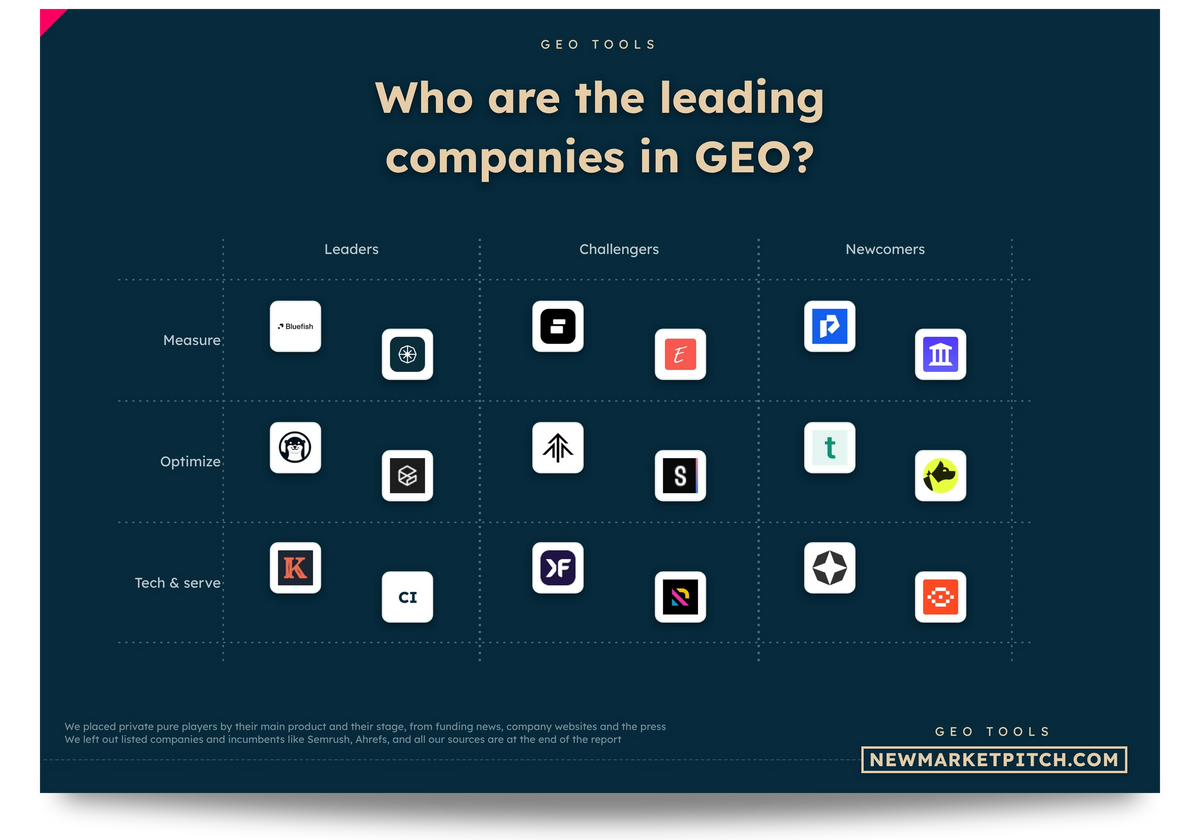
In our report covering the GEO market, we turn what is vague and complex into simple, useful visuals. Market maps like this one show you at a glance where every startup stands.
The ranking of top startups in the GEO market by revenue
Below is a table ranking the startups of this market by their current revenue scale. You can find our methodology at the end of this page.
If you want a deeper understanding of the market and its current dynamics, get our report on the GEO market.
| Ranking | Company | Latest Metric | Metric Type | Freshness | Disclosed When | Source Quality | Confidence | Segment | Why This Ranking | Local Metric | Country |
|---|---|---|---|---|---|---|---|---|---|---|---|
| 1 | Peec AI | $20M | ARR | Very Fresh · 0mo | Nov 2, 2026 | Company Disclosed | Medium | AI answer visibility monitoring | The company disclosed $20M of ARR as of November 2026, a Very Fresh recurring-revenue measure rather than recognized full-year sales. It is twice AirOps' figure, though AirOps' disclosure is a year older, with Medium confidence. | de | |
| 2 | AirOps | $10M | ARR | Fresh · 12mo | Nov 7, 2025 | Company Disclosed | Medium | GEO content and workflow optimization | The company disclosed $10M of ARR as of November 2025, a Fresh recurring-revenue measure. It ranks behind Peec AI's larger and more recent ARR, with Medium confidence. | us | |
| 3 | Searchable | >$2M | ARR | Very Fresh · 6mo | May 18, 2026 | Company Disclosed | Medium | Enterprise GEO orchestration | The company disclosed >$2M of ARR as of May 2026, a minimum ranked at its floor. That still places it above Gushwork's approximate figure, with Medium confidence. | gb | |
| 4 | Gushwork | ~$1.5M | ARR | Fresh · 9mo | Feb 25, 2026 | Company Disclosed | Medium | GEO services and managed optimization | The founder gave ~$1.5M of ARR in February 2026, an approximate company figure for a GEO services business. It ranks below Searchable's stated minimum, with Medium confidence. | in | |
| NR | Profound | ~$6.8M | Annual Revenue | Fresh · 11mo | Oct 8, 2026 | Third-Party Estimate | Low | Enterprise GEO orchestration | GetLatka estimates ~$6.8M in annual revenue for 2025, a Fresh but unverified automated figure. Without a second independent estimate or company disclosure, it remains unranked. | us |

Our research about GEO startups gets updated several times a month, so you always get the latest view of where things stand.
Are GEO startups actually making money yet?
Yes, GEO startups already sell paid software to brands that want to be found in AI-generated answers.
AirOps offers one of the clearest examples. Companies use its tools to investigate which buyer questions AI services answer, where their brands are missing and which content needs work. Profound sells visibility and marketing workflows to large enterprises; Peec AI serves brands and agencies across several countries. These are commercial products with identifiable buyers, even if few of their makers publish comparable accounts.
What customers pay for varies. A bank may need approved financial content refreshed across hundreds of pages. A software seller may want its product cited in comparison answers. An agency may need to report on several clients without manually repeating prompts in ChatGPT. Each has a reason to buy a subscription.
Our GEO revenue comparison makes a narrower claim than those customer stories. It ranks a company when the figure meets a defined evidence standard. Paying customers, press coverage and money raised help explain demand, but they cannot be treated as published annual revenue.
How much money does AirOps make today?
AirOps reported $10M of ARR for its GEO software business as of November 2025, the second-highest figure among the GEO startups we rank, behind Peec AI.
ARR is a snapshot of the annualized value of recurring subscriptions. AirOps' figure is a year older than Peec AI's November 2026 disclosure, so the gap between the two compares different moments as well as different companies. It does not mean AirOps recognized that amount during a completed financial year, or that the business earned it as profit. For a fast-changing software company, ARR tells us something useful about current subscriptions while leaving margins and renewal rates unanswered.
The number came from a company-related disclosure, a stronger basis than an automated company-profile estimate. AirOps also has published customer stories explaining why businesses buy its platform, including Chime, Asana, Angi and LegalZoom. Anthropic has described the company's use of Claude in its workflows.
We cannot infer the current year's actual sales from that one subscription figure. It does, however, establish that AirOps has moved beyond pilots and into a business where customers are paying for recurring GEO work.

In our market report about GEO startups, we look at what the winners do differently, so you can learn from the best instead of guessing.
Why do brands pay AirOps instead of just using ChatGPT?
Brands pay AirOps because keeping a large website useful for AI search takes more work than asking ChatGPT a few questions.
A marketing team can manually check whether an assistant mentions its brand. The harder job comes next: identifying which questions are important, comparing sources, choosing pages to update, getting content approved and publishing changes across markets. AirOps connects those steps in reusable workflows. Its Quill product brings research, drafting and human review into the same process.
Chime used the software to refresh financial content while keeping compliance checks in place. Asana worked on updating and localizing articles rather than simply translating them. Those are different problems, but both recur whenever products, regulations or customer questions change.
The product's appeal is therefore fairly straightforward. A team that maintains a large library might pay for faster production and consistent reviews even before it can attach a sale to a new AI citation. That gives AirOps another reason to keep a customer beyond the novelty of an AI-search dashboard.
Is Profound making more money than AirOps?
The published GEO sales figures for Profound and AirOps cannot tell us which company earns more.
Profound has a GetLatka estimate of ~$6.8M in annual revenue for 2025. That figure comes from an automated company-data service, with no second independent estimate or direct company sales disclosure to confirm it. We therefore show Profound without a rank. AirOps has a direct ARR disclosure, and ARR measures annualized subscriptions rather than recognized sales, so treating the two amounts as directly comparable would be misleading.
Profound's customer business is nevertheless substantial. In September 2026, TechCrunch reported more than 1,000 enterprise customers, including Comcast, Walmart and The Estée Lauder Companies. The company also said its revenue had tripled in six months, without publishing the starting or ending amount.
The customer names make Profound worth watching, but they do not settle this specific revenue contest. We keep the estimate visible rather than presenting an unsupported winner between the two firms.
Why are big brands paying for Profound?
Profound gives large brands a way to check what AI assistants say about them and decide how to improve those answers.
The company initially sold analytics around brand mentions, competitors and cited sources. Its August 2025 customer announcement named Ramp, U.S. Bank, Indeed, MongoDB, DocuSign and Chime. By September 2026, Profound was promoting tools that help teams research, write and coordinate marketing work. That shift matches what a large customer needs after seeing an unfavorable answer: somebody has to fix the underlying information.
A published example comes from Bustle Digital Group. The publisher investigated which outside sources shaped AI responses to product questions, updated relevant content and tracked the change in visibility. It is a more complete job than producing a chart of brand mentions once a month.
Profound has not published a comparable full-year sales total in the evidence used here. Still, its enterprise clients show why GEO can win a place in an existing marketing budget. Companies want help understanding AI recommendations and improving the content that influences them.

In our document detailing everything you need to know about GEO, you will always find fresh funding data, taken straight from our own verified funding database.
Is Profound's billion-dollar valuation backed by actual sales?
Profound's valuation reflects expectations for its GEO business, while its publicly reported sales remain too limited to verify the price against annual revenue.
TechCrunch reported a $180 million Series D at a $1.8 billion valuation in September 2026, after an earlier financing that year. The same report described strong enterprise adoption and rapid revenue growth. Those are encouraging signs for investors, but a financing price says how investors value a business, not what it billed customers over a financial year.
Profound now sells more than analytics. It wants to become a place where marketing teams analyze questions, write content and act on opportunities. If buyers adopt more of that workflow, the startup could expand spending within existing accounts. We do not have published retention or audited revenue data to measure that outcome.
Investors can point to real enterprise customers and a search market changing quickly. Even so, a valuation and a famous customer list cannot establish annual sales.
Have any GEO startups reached $100M a year?
No specialist GEO startup has demonstrated $100M in recognized annual revenue through the company disclosures we can compare. The largest figure we rank, Peec AI's ARR, is a fifth of that level.
That does not put a hard ceiling on what GEO businesses might earn. The available disclosures often use ARR, growth percentages, customer counts or broad company sales that include conventional SEO and other marketing products. Those measures answer different questions. A company can be expanding quickly without publishing enough financial information for a clean comparison.
The market it serves is already enormous. Google's June 2026 investor presentation described more than 2.5 billion monthly AI Overviews users and more than one billion monthly AI Mode users. But those people use Google's products; they are not automatically paying a GEO vendor.
We would need a dated company financial statement and a clear description of what portion came from GEO before calling a startup a nine-figure annual seller. For now, evidence of paying enterprises is much easier to find than verified annual sales of that scale.

Learning from others' mistakes is the cheapest lesson there is. In our report covering the GEO market, we look at what broke startups before you, so you don't repeat it.
Who pays for GEO tools today: brands or agencies?
Both brands and marketing agencies buy GEO tools, although they use the software in different ways.
A brand buys for its own work: a retailer wants better product information, a bank wants accurate answers and a software company wants to appear in product comparisons. AirOps and Profound both publish examples of large organizations using their tools with in-house marketing teams.
Agencies can buy the same software to handle several clients. They check where customers appear across AI services, prepare recommendations and show results to each account. Sitecore said Scrunch had served more than 500 brands and agencies when it announced its acquisition. Peec AI also describes agency use of its monitoring and reporting software.
A brand account and an agency account are very different sales. An agency might represent many brands through a single subscription, while a global company could purchase a broad internal deployment. So a customer total alone tells us very little about the revenue each channel brings in. The more interesting question is whether software can remain part of both groups' regular work.
Why are big brands automating content for AI search?
Big companies automate GEO content work because their websites change faster than small editorial teams can keep up.
Chime, for instance, had more than 700 existing posts. In its AirOps case study, the financial-services company described a process for updating older content with briefs, compliance reviews and publishing support. The improvement was about getting necessary work done, rather than pretending every refreshed page immediately generated a new customer.
LegalZoom has a similar need for careful review. Its published customer account describes using AI-supported processes while retaining controls over legal information. Across departments, that can replace a large amount of manual preparation without giving an unchecked chatbot control over published advice.
There is also a practical reason this work repeats. Product details change, legal requirements shift, competitors publish better explanations and AI engines select different sources. A platform that makes those updates cheaper and more reliable has a subscription argument even for a buyer who cannot yet trace every AI mention to a sale.

In our research about GEO startups, we always try to gather several sources and make estimates that make sense, so you can work with solid numbers.
Do GEO tools actually bring companies more sales?
Some customers report better conversions or lower costs after using GEO tools, but a rise in AI citations alone does not prove more sales.
AirOps' customer stories show how different the outcomes can be. Angi reports better conversion on targeted content; LegalZoom reports savings from work completed across teams; Asana and Chime report changes in AI citations. Those improvements can justify a project for different reasons, but they should not all be called revenue growth.
Vendor case studies also have limits. Companies select the stories they publish, and a before-and-after improvement does not isolate the software from every other marketing change. Still, they give us concrete examples of buyers moving past curiosity and testing useful work.
The table below shows seven reported outcomes from AirOps customer stories, each measured on its own terms.
| Customer | Reported result |
|---|---|
| Chime | 3x citations |
| Asana | +71% citations |
| Angi | +79% conversion |
| LegalZoom | $600K+ savings |
| Skio | +46% traffic |
| Parallel | +130% citations |
| Webflow | +500% AI signups |
These are vendor-published results with different definitions and time windows. They are not AirOps revenue.
Are visitors from AI search actually more valuable?
People arriving at U.S. retailers from AI search now generate more revenue per visit, according to Adobe.
In its October 2026 report, Adobe found that AI-referred visits to U.S. retail websites grew 71% year over year in September. They converted 90% better and generated 83% more revenue per visit than non-AI traffic. Adobe analyzed transactions across more than one trillion retail visits, rather than relying on a GEO software company's marketing claims.
The change over time is particularly striking. Adobe said AI-referred shoppers had converted 9% worse than other shoppers in August 2025. By the later September observation, the gap had reversed sharply. That gives merchants a stronger reason to care about where assistants send people.
But the report does not tell us how much business GEO vendors created. The study measures shoppers who clicked through from an AI service, whether or not the retailer bought GEO software. For the startups, it establishes a valuable potential outcome, not proof of their own sales performance.
Is Google's AI search taking clicks away from websites?
Google's AI summaries are associated with fewer clicks to outside websites, which complicates how GEO tools prove their value.
Pew Research Center examined Google browsing behavior in March 2025 and published its findings in July. People clicked a traditional search result on 8% of visits when an AI summary appeared, compared with 15% of visits without one. This was observed browsing behavior, so we should not treat the difference as an exact causal effect of adding a summary.
Even a brand that appears in an AI answer may never receive a visit. A person can read the recommendation and search for the product later, buy in a shop or simply stop looking. Links that are clicked are easier to measure, but they represent only part of the decision. Bing's AI Performance documentation likewise says citation reports show visibility, not clicks, and cannot prove that a particular website update caused an increase.
For GEO businesses, the problem is fairly simple to explain and harder to solve: their customers need to understand mentions, citations, referrals and sales separately. Promising a sale for every extra citation would go well beyond the evidence.

If you build or invest in the GEO market, you need to know which business models pay off now and which ones are fading. That's why our report covering it has a whole section on it.
Will AI shopping make GEO startups a lot bigger?
AI shopping could create more customers for GEO startups as merchants try to influence which products assistants recommend.
OpenAI's March 2026 product-discovery announcement described bringing richer shopping information into ChatGPT, with retail partners and merchant catalogs. Brands have practical work to do: accurate product titles, clear specifications, up-to-date stock information and helpful answers about fit, returns and alternatives. GEO companies can help with those tasks when the goal is discovery in external assistants.
This also brings retailers into a market previously associated mainly with marketing content. A company selling many products may want to know why ChatGPT recommends a competitor, whether an item is described correctly and which product information the assistant can read.
There is a catch for anyone selling the service. OpenAI's merchant guidance says submitting a product feed carries no purchase fee. A GEO vendor cannot justify charging just to provide access to that free channel. It has to make the catalog easier to understand, identify missed opportunities or help the retailer measure what buyers actually do.
Why pay for GEO software when Bing gives away citation reports?
Paid GEO software still has a role, but Microsoft's free citation data makes basic monitoring less valuable on its own.
Bing Webmaster Tools launched an AI Performance report in February 2026, showing cited pages, citation trends and the kinds of search queries that lead to references in Copilot and supported Bing experiences. Google also explains how ordinary search eligibility applies to AI features. A small business interested mainly in one search engine may get enough information from those free tools.
Larger brands have other problems. They need to compare ChatGPT, Gemini, Perplexity, Google and Copilot, find missing product explanations, assign content work and see whether the results improve. A single platform's dashboard cannot give a neutral picture of competing assistants. AirOps sells publishing workflows, while Profound has expanded into marketing actions.
We can already see the direction of competition. Search platforms will keep improving their own reports, and specialists will have to offer work that customers cannot complete by exporting a citation chart. A paid subscription needs to save time or improve a useful business outcome.

In our document detailing everything you need to know about GEO, we don't want to repeat what boring consulting reports say. Instead, we show you the real and latest market signals that matter.
Can regular SEO still get brands into AI answers?
Regular SEO still helps brands appear in Google's AI answers, especially when it makes pages easy to crawl and genuinely useful.
Google's Search Central guidance says AI Overviews and AI Mode do not require a special kind of markup or a separate technical trick. Search eligibility, readable content and structured data that matches the page remain important. So a company with weak product pages or confusing documentation should fix those basics before paying for an exotic GEO tactic.
The limits come when assistants combine sources in ways a conventional search-results page does not. They may cite third-party comparisons, summarize a product without linking to its maker or answer variations of a question differently. A marketer who cares about that journey needs to watch the answers as well as the original search positions.
This makes GEO an extension of some existing SEO work, especially for companies with big content libraries. The best case for specialist software comes when it helps teams find gaps, make changes and monitor several assistants without assuming that one secret prompt or markup tag will solve the problem.
Can one GEO tool track ChatGPT, Gemini and Perplexity?
A GEO tool can track several AI assistants, but their answers and citations can change in different ways.
AirOps and Profound, for example, focus on comparisons across services. That saves a team from copying the same questions by hand into a growing list of products and trying to compare inconsistent answers.
The challenge is making those comparisons useful. Google says AI Overviews and AI Mode can use different approaches and show different sources. Asana's customer story with AirOps likewise describes varying citation changes across AI products after content updates. A single overall visibility score can hide those differences.
Customers therefore need to know which questions and platforms matter to their buyers. A useful GEO subscription helps a company see that a new page improved one product comparison but did little elsewhere. Tracking more assistants may help sell software, yet the practical value comes from explaining what changed and which action is worth taking next.

In our report covering the GEO market, we like to show you the big picture. We know your time is precious, so we make every page quick to read and packed with as much learning as possible per minute.
Will brands still pay for GEO tools in a few years?
Brands may keep paying for GEO software if it becomes part of their regular content work, although public renewal data remains thin.
The work itself is unlikely to disappear. Retail catalogs change, software vendors launch products, and regulated businesses must update information carefully. AI assistants also change which sources they cite. Those are recurring jobs that can support subscriptions rather than one-off audits.
Still, renewal is a tougher test than first-time interest. A customer can switch providers, bring the work in-house or use a module added to an existing marketing product. Microsoft's free citation reporting is already improving, and Sitecore's purchase of Scrunch shows how a specialist feature can move inside a larger suite.
We would learn much more from published retention rates, subscription expansion and contract durations. A disclosed ARR figure shows that paying subscriptions exist at a particular point. It cannot tell us whether the same companies will be paying in two years. GEO vendors need to stay useful after the early curiosity fades.
Are GEO agencies replacing GEO software?
GEO agencies compete with software vendors for some marketing budgets, while also buying their tools to serve clients.
A brand can hire an agency to inspect AI answers, rewrite pages and send reports instead of doing the work in-house. That competes with a direct software sale. But agencies still need prompt tracking, citation comparisons and repeatable reporting across different brands. A platform can make the agency's work cheaper and more consistent.
Scrunch has described agencies among its users, and Peec AI publishes agency-oriented customer examples. Services firms sell the work itself: Gushwork, which runs AI-search visibility as a managed service, told TechCrunch in February 2026 that it had reached ~$1.5M of ARR. Those relationships create an indirect sales channel for software companies. One agency subscription may support work for several clients, so counting those end clients as separate software customers would give the wrong picture.
For a buyer, the choice is often about staffing. An in-house team wants control and a reusable tool; a smaller company may want an agency to handle the whole project. As GEO work spreads, both approaches can coexist. The available company revenue figures cannot tell us which model will earn the most across the entire market.
Why did Sitecore buy GEO startup Scrunch?
Sitecore bought Scrunch to add AI-search visibility and optimization to software it already sells to large marketing teams.
The deal was announced in June 2026. Sitecore said it would connect Scrunch's answer monitoring and AI-readable content tools with its own content management products. Scrunch was set to keep operating as a stand-alone platform while gaining access to a broader enterprise customer base.
Sitecore also published concrete customer examples. Akamai reported more appearances and citations after enabling Scrunch's AI-friendly pages, while Runpod described stronger paying-customer results linked to its optimization work. These are company case studies, so they demonstrate what customers reported rather than a controlled measure of the acquisition's financial return.
Independent GEO startups now face a familiar software problem. They can sell specialist features quickly, but established vendors already have contracts, sales teams and publishing systems in place. The acquisition confirms that big marketing platforms want these capabilities. It does not disclose Scrunch's stand-alone revenue, so the deal cannot be used to insert the company into the revenue ranking.

When you build or invest in the GEO market, you need clarity, not confusion. In our research about GEO startups, we always try to put numbers on and quantify whatever is usually vague and confusing.
Can European GEO startups compete with American ones?
European GEO startups can already compete on revenue: Berlin's Peec AI is first in our GEO revenue ranking, ahead of America's AirOps, after announcing in November 2026 that its annual recurring revenue had doubled in six months.
Peec AI works with brands and agencies across international markets. Its customer materials include Attio, whose team focused on being discovered for high-intent CRM comparisons in AI answers. London's Searchable is third in our ranking, with >$2M of ARR disclosed in May 2026.
The same is true in reverse. A U.S. platform can serve a European marketing team, and a global agency can use a single monitoring service for several languages and countries. The location of the vendor's office tells us little about where its revenue is earned.
What buyers want is increasingly similar on both sides of the Atlantic: a way to understand recommendations, fix missing information and show results. Europe holds two of the four ranked places, but only four startups publish a usable figure. A claim that either region dominates GEO startup revenue would need comparable disclosures from many more companies.
So, which GEO startups make the most money today?
Peec AI is number one in our GEO startup revenue ranking with $20M of ARR, ahead of AirOps, Searchable and Gushwork, while Profound remains unranked because its only selected annual sales figure is an automated estimate.
That conclusion follows the stated evidence rules. A recurring-revenue disclosure from a company gets a rank; a single unverified company-data estimate does not. It would be misleading to use customer totals, investor valuations or the size of the AI search audience as substitutes for revenue.
The market itself has plenty of reasons to attract paying customers. Brands want content updates that staff can approve, retailers want accurate products in AI shopping, and marketing teams want to know whether AI-referred visitors buy anything. Free search-engine reports and larger marketing suites will make the basic monitoring business more competitive. The vendors that do useful work are in a better position to keep subscriptions.
The table below shows what we found.
| Question | Answer |
|---|---|
| Can any GEO startup show paying scale? | Yes, Peec AI and AirOps disclosed their GEO subscriptions directly. Both reported annual recurring revenue, not audited yearly sales. That shows commercial scale without proving either company is profitable. |
| Does Profound have a confirmed sales position? | Profound is unranked on the available annual revenue estimate. A single automated source does not meet our evidence rule. Its large customer base still suggests meaningful commercial demand. |
| Are huge AI audiences becoming vendor income? | Not automatically, despite the reach of AI search. Google reports more than 2.5 billion AI Overviews users monthly. Those people use Google products without necessarily buying GEO tools. |
| Are big brands buying more than dashboards? | Yes, enterprises want analysis they can act on. Profound reported more than 1,000 enterprise customers. That reach supports demand without revealing annual sales. |
| Can GEO content work save real money? | Some customers report clear operational savings from automation. LegalZoom reported $600K+ saved through work across multiple departments. Such savings can justify subscriptions without extra clicks. |
| Do higher AI citations mean higher sales? | No, citations show visibility changes rather than purchases themselves. Asana reported a +71% citation increase after content updates. Purchases need separate measurement before claiming sales growth. |
| Are AI referrals turning into valuable visits? | Yes, Adobe found stronger retail conversion among AI visitors. Those visits generated 83% higher revenue per visit. It remains unclear which gains came from specialist GEO software. |
| Is Google's AI search reducing website clicks? | Pew found fewer clicks when AI summaries appeared. Click rates were 8% with summaries versus 15% without. That is why counting citations alone cannot prove sales. |
| Will free dashboards end paid GEO subscriptions? | They make simple citation monitoring harder to sell. Bing offers its own AI Performance reporting for websites. Cross-engine analysis and execution can still justify specialist tools. |
| Can shopping feeds become a paid shortcut? | No, entering a product feed may cost nothing. OpenAI says merchants pay no purchase fees on feeds. GEO vendors must earn fees for improvements beyond access. |
| Could enterprise software absorb specialist GEO tools? | Yes, large vendors are already buying GEO capabilities. Sitecore acquired specialist startup Scrunch in June 2026. Independent startups now compete against existing marketing-software relationships. |

A good product starts with a real problem. In our market report about GEO startups, we show you the ones customers still live with.
Our methodology
Our data runs through November 19, 2026. We then reviewed this article and updated its answers on November 24, 2026, the date shown under the title. We define generative engine optimization as software and specialist services primarily designed to measure or improve brand, product and content visibility in generative answers. We include AI citation analytics, answer comparisons, content and catalog optimization, attribution and focused managed services, including businesses near the market boundary when GEO is a core product. Every ranked company meets our startup definition: independently built since 2007 for rapid growth and funded by founders or outside capital, including qualifying recent listings and recent acquisitions. Established groups remain outside the startup ranking even when their sales are much larger.
We reviewed company announcements, annual and financial reports, regulatory filings, investor materials and reputable media over the companies' histories, including the last ten years. Companies describe commercial scale through full-year revenue, recurring subscriptions, run-rates, short periods and segment figures. We keep those measures distinct; bookings, cumulative sales, merchandise volume, announced contracts, forecasts and user counts are not converted into revenue. We also never infer sales by multiplying a subscriber count by an advertised price.
We select one figure per company, preferring a period ending within 18 months, then the most authoritative disclosure, from filings and companies to credible reporting, analyst work and automated company-data estimates. For otherwise comparable figures, full-year revenue takes precedence over ARR or a run-rate, then a partial period or a published GEO segment, which is treated as a minimum. Ranked companies follow the selected figure. We evaluate an estimated range at its geometric midpoint, not its optimistic upper end, and a stated minimum at its lower bound. Figures more than three years old and measures that are not revenue remain without a rank.
We label recency as Very Fresh, Fresh, Aging or Historical, measured from the end of the reporting period, and confidence as High, Medium or Low. High means a recent, exact full-year company or filed disclosure; Medium covers ARR, run-rates, partial figures, minimums, press figures and periods 18 to 30 months old; Low covers estimates, wide ranges and older evidence. Where necessary, we convert local currencies using European Central Bank reference rates near the end of the period and preserve the original currency amount. An estimate from just one analyst or automated company-data provider is displayed without a rank; two genuinely independent, agreeing estimates may rank at Low confidence, while conflicting estimates remain an unranked range. A company-stated sales figure without a stated period can rank at Low confidence, but an undated estimate cannot. Wider company sales without a published GEO segment and future forecasts are also unranked.
A natural objection is that a well-known startup can have many clients or a large valuation yet appear without a sales rank. That is intentional. Commercial traction, financing and future expectations matter to the business but do not answer how much revenue it has recognized or annualized. We retain credible but non-comparable evidence visibly rather than force it into an artificial order. Likewise, we allow ARR and actual annual revenue in the same ranking only with their metric and period plainly attached, because discarding timely subscription disclosures would hide much of what a young GEO market has actually revealed.
This is a ranking of the best comparable disclosed evidence across each startup's history, not a single fiscal-year league table. We preserve the figure and its period even when a later product launch, customer announcement or financing suggests the company has changed. An outside claim that conflicts with a ranked figure is not silently substituted for it; any material coverage discrepancy is flagged separately for review.
Key sources include AirOps company-related disclosure of ARR, Anthropic account of AirOps products, customers and workflows, Chime content refresh and citation outcomes, Asana AI citation changes across search services, Angi content conversion and localized production results, LegalZoom operational savings and AI referrals, AirOps customer outcomes including Skio and Parallel, AirOps enterprise customer performance examples, Quill product positioning and AirOps execution strategy, Profound's early product and enterprise customers, Profound financing, enterprise adoption and reported growth, Profound's publisher and brand optimization use case, Sitecore acquisition of Scrunch and its enterprise positioning, Google AI Overviews and AI Mode audience figures, Google eligibility rules and differences across generative features, Microsoft's first-party AI citation performance reporting, Adobe's 2026 retail AI referral conversion and revenue findings, Adobe's earlier retail AI referral trajectory, Pew's observed click behavior with AI summaries, OpenAI product discovery and merchant catalog changes, OpenAI's product-feed access and merchant-fee conditions, European GEO customer use case for Attio, Agency and enterprise adoption examples from Peec AI, Peec AI's November 2026 recurring revenue announcement, Searchable's May 2026 recurring revenue disclosure, and Gushwork's February 2026 recurring revenue disclosure.

In our document detailing everything you need to know about GEO, we try to remove everything that could confuse you, especially if you're investing or building in this market.
Written by the New Market Pitch teamWe track new markets so founders and investors can move faster. About us