Healthcare AI agents: which startup is ahead?
In our healthcare AI agents market deck, you will find everything you need to understand the market
Summary
Hippocratic AI is still ahead overall in healthcare AI agents, but Assort Health has closed more of the gap and is now the clear second. Qventus leads the next group.
The serious field is narrower than the funding headlines suggest. Eight startups make the cut because their agents complete clinical or administrative work rather than simply answer questions or write notes. Agents that finish the work instead of just answering questions is the line we draw when defining what counts in our report on healthcare AI agents.
Hippocratic leads through breadth. In August 2026 it launched Agentic Orchestrators, more than 30 teams of agents sold against outcomes such as fewer readmissions or more trial enrollments. It reports more than 250 million patient interactions and $444 million in total funding.
Assort is the strongest commercial challenger. It reported a $120 million Series C at a $1.2 billion valuation in June 2026 and twentyfold revenue growth in 15 months. Since then it has launched a referrals agent, signed more than 1,300 primary-care providers and partnered with Nextech in ophthalmology.
Qventus ranks third because it controls expensive hospital workflows rather than chasing call volume. It now reports more than 150 hospital facilities, $17.1 million in added annual reimbursement from malnutrition coding, and deeper deals with HonorHealth and OhioHealth.
The deployment numbers are large but not comparable. Hippocratic counts interactions, Assort counts specialty patient interactions, Infinitus reports patients and minutes, and Tennr reports care pathways. Even single companies cite different totals in different places.
Safety evidence still splits in two. Hippocratic has the largest disclosed testing program, now including 775,000 test calls reviewed by more than 7,700 licensed clinicians. Anterior has the cleanest independent validation for a narrower clinical-review task.
No company leads every workflow. Tennr is strongest in referral orchestration, though Assort now competes there directly. Infinitus leads repetitive payer and pharmaceutical calls, Anterior payer clinical review, Hyro health-system call centers and Notable broad administrative automation.
The hardest advantages to copy are not the models. They are the clinical conversations, specialty scheduling rules, payer criteria, EHR integrations and hospital operating knowledge built up in production.
The biggest threat comes from incumbents such as Epic, Oracle, Salesforce and ServiceNow, which can bundle acceptable agent features into systems hospitals already buy. Well-funded newcomers like Heidi, which raised a $100 million Series C in September 2026 to move from documentation into agentic workflows, add pressure from below.
Our ranking is Hippocratic AI first, Assort Health second, Qventus third, Tennr fourth, Anterior fifth, Infinitus sixth, Hyro seventh and Notable eighth. Assort has the clearest path to first place, and it is closer to it today than at any point so far.

Written by the New Market Pitch teamWe track new markets so founders and investors can move faster. About us

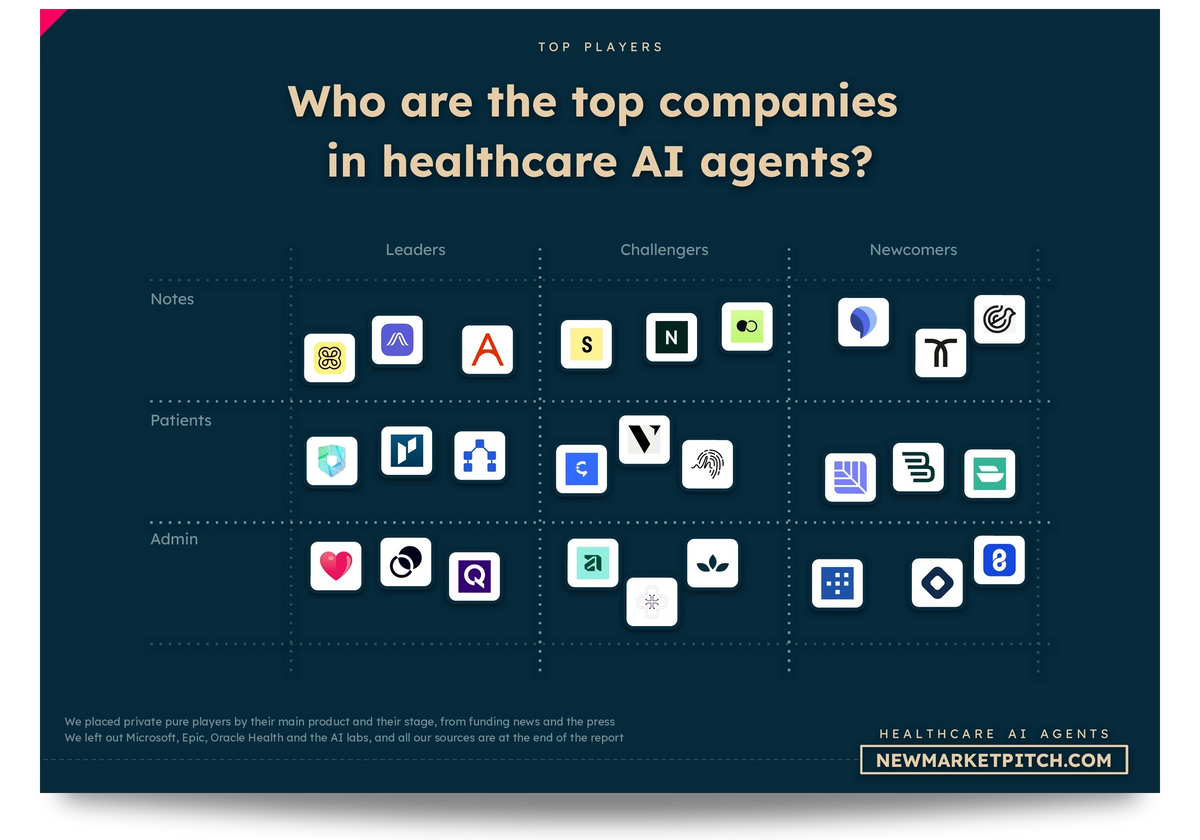
In our report covering the healthcare AI agent market, we turn what is vague and complex into simple, useful visuals. Market maps like this one show you at a glance where every startup stands.
Which healthcare AI agent startups are serious contenders today?
Eight healthcare AI agent startups deserve a place in this comparison, and the real field is narrower than the funding headlines suggest.
We include companies whose agents complete healthcare work: they hold conversations, read documents, apply clinical or administrative rules, update health systems, coordinate follow-ups and escalate difficult cases. A chatbot that answers basic questions does not meet that bar.
The comparison covers Hippocratic AI, Assort Health, Qventus, Tennr, Infinitus Systems, Notable, Hyro and Anterior. They compete across patient engagement, scheduling, referrals, hospital operations, payer reviews and administrative calls.
We exclude Abridge, Ambience Healthcare and Nabla because clinical documentation remains their main product. Heidi sits on the same edge: its September 2026 funding was meant to push it into agentic clinician workflows, but documentation is still its core. Aidoc and PathAI belong in diagnostics, OpenEvidence in medical search. A wave of smaller agent startups, including GenHealth.ai, Confido Health and Bunkerhill Health, raised between $12.5 million and $25 million from July to October 2026, too early to rank.
Funding is a starting point, not proof that an agent works inside a hospital. Hippocratic AI has raised the most, followed by Assort Health and Qventus. Hippocratic now states $444 million in total funding, $40 million more than the $404 million reported at its Series C, without a separate announced round. At the other end, Anterior has built a serious payer business on $64 million.
| Startup | Main healthcare AI agent focus | Cumulative funding | Latest major funding disclosure |
|---|---|---|---|
| Hippocratic AI | Patient-facing agents and outcome-based orchestrators for providers, payers and life sciences | $444M (company-stated) | $126M Series C at a $3.5B valuation (November 2025) |
| Assort Health | Scheduling, intake, referrals, refills, eligibility, payments and patient outreach | More than $222M | $120M Series C at a $1.2B valuation (June 2026) |
| Qventus | Hospital operations, surgical capacity, patient flow and care-gap automation | About $198M | $105M Series D led by KKR (January 2025) |
| Tennr | Referral intake, payer requirements, benefits checks and patient orchestration | About $162M | $101M Series C at a reported $605M valuation (June 2025) |
| Notable | Patient access, prior authorization, revenue cycle and care operations | About $119M | $100M Series B |
| Infinitus Systems | Voice agents for benefits, prior authorization and healthcare calls | $102.9M | $51.5M Series C |
| Hyro | Voice and digital agents for health-system patient access | $95M | $45M strategic growth round |
| Anterior | Clinical-review agents for health plans | $64M | $40M funding round (February 2026) |
Is Hippocratic AI still ahead of Assort Health in healthcare AI agents?
Yes, Hippocratic AI still leads healthcare AI agents, but Assort Health is closer than it has ever been.
Hippocratic has the broadest platform in the field. Its directory lists more than 1,000 agents and more than 300 live clinical use cases across providers, payers and pharmaceutical companies. In August 2026 it added Agentic Orchestrators: more than 30 coordinated agent teams aimed at results such as readmission prevention, Medicare star ratings, recovering patients lost to follow-up and clinical-trial enrollment. That moves Hippocratic from selling tasks to selling outcomes.
Its customers are deepening, not just multiplying. In July 2026 WellSpan Health signed a multi-year expansion. WellSpan says its Hippocratic agent, Ana, already handles more than 160,000 patient calls a month, and the deal adds post-discharge follow-up, chronic-disease check-ins and co-development of the orchestrator. Post-discharge follow-up and chronic-disease check-ins are problems health systems pay to solve, and we map the rest in our healthcare AI agents market report.
Assort is narrower, but it is widening fast. In August 2026 it launched a dedicated referrals agent. In September it said it works with more than 1,300 primary-care providers, outside its original specialty base. In October it agreed to co-develop an ophthalmology offering with Nextech, an EHR vendor. It also hired a former health-system CEO as its first chief medical officer.
We would place Hippocratic at 100 and Assort around 88. Hippocratic's lead rests on clinical breadth, safety work and a mix of provider, payer and pharma buyers. Assort is level or ahead on commercial momentum and comparable on reported volume, but it still works mostly at the front door rather than in clinical care.
A clear gap opens after those two. Qventus has the deepest record in hospital operations, Tennr is strong in referrals, and Anterior is growing in payer reviews. Each could own its workflow without becoming the overall leader.

Our research about AI agents in healthcare gets updated several times a month, so you always get the latest view of where things stand.
Does Hippocratic AI or Assort Health have more patient interactions?
Both now report counts in the hundreds of millions, so volume no longer separates them. Hippocratic has the stronger clinical deployment; Assort has the bigger footprint in patient access.
Hippocratic said in August 2026 that its agents have completed more than 250 million patient interactions. Its own website still carries a 180 million figure in places, which shows how loosely these totals are kept. An earlier technical disclosure gave a cleaner production benchmark of more than 10 million real patient calls. An "interaction" can be a conversational turn or a smaller unit, so the call figure matters more.
Assort's company materials now cite more than 300 million specialty patient interactions. Fierce Healthcare, reporting on its referrals launch in August 2026, gave 225 million, so the exact number depends on the source. Assort says it works with several hundred customers across 23 specialties and resolves 95% to 97% of patient-access interactions without a staff handoff. Those are scheduling, triage, referral and follow-up conversations, not the clinical calls Hippocratic counts.
Other startups disclose smaller or less comparable figures. Hyro said in July 2026 that its agents had held more than 100 million patient conversations. Infinitus said its agents supported 1.17 million patients during 2025 and had handled more than 100 million minutes of conversation. Tennr says it powers millions of care pathways each month.
Hippocratic leads on clinically oriented use. Assort has built a similarly large footprint at the healthcare front door, and the gap in raw volume is no longer a reason to rank one above the other.
Which healthcare AI agent startup is building the strongest business?
Assort Health has the best commercial growth story in healthcare AI agents.
Assort's twentyfold revenue increase over 15 months, disclosed with its June 2026 Series C, is still the strongest growth figure in the field. Its funding rose from $26 million to more than $222 million in about 14 months. The company has since added a chief revenue officer and moved into a new San Francisco headquarters, both signs that it is selling to bigger accounts.
Customer results explain the growth. Assort says it captures up to $4.3 million in revenue per 100 providers, with a 5% lift in appointment volume. Michigan Orthopaedic Surgeons reported $2.3 million in new revenue. SENTA reported $1.3 million in recovered appointment revenue and a 97% cut in hold time. In referrals, one orthopedic group says about 90% of its roughly 75 daily referrals are now automated end-to-end with a 77% conversion rate. Concord Orthopaedics reports 84% of referrals automated. Both are client examples published by Assort, not company-wide rates.
Tennr has the next strongest growth case. Its revenue more than tripled across two quarters before its June 2025 Series C, and customers report more referrals processed with the same staff. Tennr has not disclosed a newer growth figure, and Assort's move into referrals now puts pressure on its core market.
Hippocratic may have more revenue than either, but it publishes no comparable revenue or recurring revenue figure. Qventus is an older enterprise business whose recent growth remains private.
Assort leads on proven commercial acceleration. We cannot say it leads on absolute revenue.

In our market report about AI agents in healthcare, we look at what the winners do differently, so you can learn from the best instead of guessing.
Whose healthcare AI agents are mature enough for real clinical work?
Hippocratic AI has the most mature patient-facing clinical agent platform, while Qventus has the deepest record inside hospital operations.
Hippocratic has moved well beyond appointment reminders. Its agents discuss medication adherence, monitor recovery after discharge, collect histories, support chronic-care programs and spot situations that need a nurse. The company says more than 31,000 patients have been escalated to nursing care. It limits scope on purpose: no diagnosis, no prescribing, and no hospice, mental-health disorders or children under two. Ruling out diagnosis and prescribing shows how much risk these agents carry, and we rate such risks by likelihood in our market report about healthcare AI agents.
Its architecture pairs a large primary model with more than 30 supervising models that watch for escalation needs, medication names and adverse events. Polaris 5.0 added more than 20 clinical skills. The benchmarks are company-designed, so they need caution, but few rivals disclose testing across so many tasks.
Qventus solves a different problem. Its agents work on operating-room schedules, inpatient capacity, discharge planning, coding and care gaps, which needs reliable EHR integration and local hospital rules. In August 2026 it said its malnutrition automation had added $17.1 million in annualized reimbursement across clients, with Jackson Health System reporting a 57% rise in code capture. It is now extending the suite to pressure injuries.
Assort and Tennr are mature within narrower workflows. Assort applies provider-specific rules and writes appointments back into the EHR, now including direct API actions in NextGen Enterprise. Tennr reads faxes and clinical documents, checks coverage, requests missing information and moves referrals forward.
Anterior also works in production with bounded autonomy. Its agent recommends approval or sends the case to a clinician. It never denies care on its own.
Who has the strongest proof that healthcare AI agents are safe?
Hippocratic AI leads on testing scale, while Anterior has the cleanest independent accuracy evidence.
Hippocratic said in August 2026 that more than 7,700 U.S.-licensed clinicians had validated its system across 775,000 test calls, with 99.89% correct advice and no severe harm. It also reports no serious harm across its 250 million interactions and a 99.9% safety score across more than 10 million real calls. It samples 0.5% to 1% of live calls for safety review and says its contracts accept liability.
Those numbers are unusually large for a healthcare voice product. The limit is independence. Hippocratic built the platform, chose the tests and ran much of the research. We read the results as serious evidence of internal safety engineering, not an external verdict.
Anterior's evidence covers a narrower job, but the validation is stronger. KLAS Research verified 99.24% clinical accuracy and a 74% cut in manual review time. Anterior also published a bias evaluation on 7,166 human-reviewed cases, though several demographic groups were too small for firm conclusions.
Assort reports a 95% to 97% resolution rate and more than 95% scheduling accuracy in a customer audit. Those figures fit patient access, where the risks are sending someone to the wrong specialist, booking an invalid slot or missing a payer rule. Its new chief medical officer is a sign it knows clinical credibility is the gap.
Hippocratic has the strongest safety system and the most testing. Anterior has the best independent proof for one tightly defined task.

In our document detailing everything you need to know about healthcare AI agent, you will always find fresh funding data, taken straight from our own verified funding database.
Which healthcare AI agent creates the clearest customer ROI?
Qventus has the strongest hospital-wide ROI evidence, and Assort Health has the clearest proof of new revenue at the front desk.
Qventus works on expensive assets: operating rooms, beds and clinical labor. A large nonprofit health system reported an 8.6-times annualized return, 228 extra hours of robotic operating-room capacity and 24% growth in selected surgical lines. Another academic medical center enabled 333 extra cases, including 74 high-value surgeries.
Its newer work is in coding and care gaps. Jackson Health System reported a 3.3-times annualized return from malnutrition-care automation, and one client added $7.6 million in annualized reimbursement in its first four months. A Wisconsin nonprofit system cut length of stay by 0.6 days for the patients covered. Boston Medical Center earlier reported tens of thousands of labor hours saved.
Assort's returns appear sooner and are easier to trace. The agents answer calls staff used to miss, apply scheduling rules and book directly into the EHR. More appointments mean measurable revenue, from $120,000 a year in after-hours revenue at one practice to more than $2 million at another.
Tennr's results focus on throughput. Medical Service Company cut order-creation time by 90% and tripled daily output. Kilgore's Respiratory raised order volume 5.5 times. Home Medix reports taking referrals 75% faster at four times the volume.
Qventus wins when we value large hospital economics. Assort wins on the simplest link between an AI agent and added revenue.
Who can handle a large health system or payer deployment today?
Qventus has the deepest health-system implementation record, while Anterior and Infinitus have the strongest routes into large payers and life-sciences companies.
Qventus has worked inside hospitals for more than a decade and says it serves more than 150 hospital facilities. In September 2026 HonorHealth, a nine-hospital Phoenix system, signed up for its AI Solution Factory to co-develop new agents. OhioHealth is extending Qventus from inpatient capacity into surgery. Northwestern Medicine, HonorHealth and Allina Health are also investors, which usually signals a deeper relationship than a pilot.
Anterior added a second strong channel in July 2026. Stellarus, a technology company spun out of Blue Shield of California, will integrate Anterior's clinical AI into its AtlasIQ platform for real-time prior authorization. That sits alongside the HealthEdge partnership inside GuidingCare. Anterior says the health plans it supports cover more than 50 million lives, and one large payer deployment handles about six million prior authorizations a year, though not all are automated.
Infinitus serves national payers, large pharmaceutical businesses and more than 125,000 providers. At Cencora, its agents reportedly did work equal to more than 100 full-time staff. In April 2026 it launched Studio, a no-code agent builder, alongside agent suites for health plans and pharma outreach.
Hippocratic is also proving it can run at system scale. WellSpan's volume and on-site teams show a working enterprise model, and the company says it works with 7 of the top 20 pharmaceutical firms. Hyro covers access channels at Intermountain Health, Sutter Health, Baptist Health, Tampa General Hospital and Prisma Health.
Qventus is the strongest choice for a hospital-wide rollout. Anterior and Infinitus look strongest when the buyer is a payer, pharmaceutical company or large administrator.

Learning from others' mistakes is the cheapest lesson there is. In our report covering the healthcare AI agent market, we look at what broke startups before you, so you don't repeat it.
What can the healthcare AI agent leaders do that competitors cannot easily copy?
Hippocratic AI, Assort Health and Qventus have the hardest advantages to copy because each has built up a different kind of operating knowledge.
Hippocratic's edge is clinical conversations and safety testing. Its platform has learned how patients describe symptoms, misread instructions, change subject or reveal a problem indirectly. Supervising models check each part of a call and decide when a human takes over. A rival can use the same foundation models but cannot quickly recreate years of clinician-reviewed healthcare calls. The orchestrators add a new layer: contracts tied to outcomes, which are harder to swap out than task tools. What the leading healthcare AI agent companies do differently, from data to contract design, is what we study in our report on healthcare AI agents.
Assort owns a detailed map of specialty access rules. It cites about 70,000 care protocols and decision pathways covering provider preferences, appointment types, insurance limits and timing rules. In dermatology, for example, it handles iPLEDGE scheduling windows and payer rules after procedures. EHR-level partnerships, such as NextGen and Nextech, make that knowledge stickier.
Qventus learns how each hospital runs. Surgeon preferences, operating-room release patterns, case length, bed availability and discharge habits differ by system. Once Qventus is part of those workflows, replacing it means rebuilding local rules and retraining teams. Qventus says nearly half its clients use more than one of its products.
Tennr is building a similar edge around payer criteria. Its models link clinical documents, insurance policies and referral requirements to see what is missing and where a patient should go next. Assort's referral agent now tests how deep that edge is.
Large platforms remain the biggest threat. Epic, Oracle, Salesforce, ServiceNow and the major model providers already control budgets or core systems. In September 2026 Oracle Health announced U.S. availability of a clinical AI agent for nurses built into its EHR. It handles charting and patient summaries, not patient calls, but it shows how an EHR vendor can ship agents inside contracts hospitals already have. The startups must stay far enough ahead in workflow quality that buyers keep choosing a specialist over a good-enough feature in an existing contract.
Who has more momentum now, Assort Health or Hippocratic AI?
Assort Health has the most momentum now, with Hippocratic AI close behind and Qventus and Anterior making the most useful moves after them.
Assort has combined fast revenue growth, a billion-dollar valuation and a steady run of launches. Between August and October 2026 it shipped a referrals agent, expanded direct EHR actions, passed 1,300 primary-care providers and signed the Nextech partnership. That turns a voice scheduling vendor into a patient-access platform heading toward health systems.
Hippocratic is broadening faster in strategy. The orchestrator launch, the WellSpan expansion, climate-response agents released in July 2026 for heat-related outreach, and seven senior hires announced in October 2026 all point to a company building for larger contracts, including in government and pharma. Launches, partnerships and senior hires like these are among the market signals we track every quarter in our report on healthcare AI agents.
Qventus is turning existing customers into larger ones. HonorHealth's co-development deal and OhioHealth's expansion show hospitals buying more, not just trying it.
Anterior's Stellarus deal gives it a second route into health plans beyond HealthEdge, and the company is widening its target to broader utilization management and care planning.
Hyro launched Care Intelligence in June 2026, turning its agent conversations into data on access problems and unmet demand, and named a new chief revenue officer in July. Notable launched Flow Compass in October 2026, a layer that lets operators query and oversee their automations in plain language. It remains credible in production: a 350-bed community hospital runs 50 Notable workflows in production, with 13,000 staff hours returned and prior-authorization time cut by 80%. Tennr has been quieter in public.
Assort is moving fastest commercially. Hippocratic is moving fastest strategically.

Your time is limited. In our research about AI agents in healthcare, we put numbers on each part of the market, so you can see where it makes sense to focus.
Who leads each healthcare AI agent niche?
Healthcare AI agents still have several specialist leaders, so the best vendor depends on the workflow.
Hippocratic is strongest when an agent must hold a clinically informed conversation with a patient. Assort leads when the problem starts with a phone call, appointment or referral at a specialty or primary-care practice. Qventus is the clear leader when a hospital wants to manage beds, operating rooms and care operations.
Tennr still has the strongest referral-orchestration product, especially for documents and payer rules, but Assort is now a direct challenger in specialty referrals. Infinitus is credible for repetitive calls between providers, payers, pharmacies and life-sciences firms. Anterior leads payer clinical review. Hyro stands out in health-system call centers. Notable covers the widest range of administrative workflows without a visible lead in one segment.
| Healthcare AI agent niche | Current leader | Why it leads |
|---|---|---|
| Patient-facing clinical conversations | Hippocratic AI | Broad clinical coverage, outcome-based orchestrators and the largest disclosed safety program |
| Specialty scheduling and patient access | Assort Health | Deep specialty rules, direct EHR actions, primary-care expansion and rapid commercial growth |
| Hospital operations | Qventus | More than 150 hospital facilities and measurable gains in capacity, labor and reimbursement |
| Referral and patient orchestration | Tennr | Strong document models and payer-rule mapping, now challenged by Assort in specialty referrals |
| Payer and pharmaceutical calls | Infinitus Systems | Large-enterprise customer base, substantial voice-agent usage and a no-code agent builder |
| Payer clinical review | Anterior | KLAS-verified accuracy, plans covering 50 million lives and HealthEdge and Stellarus channels |
| Health-system call centers | Hyro | Broad channel coverage, deep integrations and more than 100 million patient conversations (company-stated) |
| General administrative automation | Notable | Agents spanning access, prior authorization, revenue cycle and care operations |
How much can we trust the healthcare AI agent numbers?
The order is credible, but the exact gaps are uncertain because each startup defines usage and ROI its own way.
Hippocratic reports patient interactions and real calls. Assort reports specialty patient interactions. Infinitus uses patients served and conversation minutes. Tennr talks about monthly care pathways. Hyro reports patient conversations and patients reached. These units differ, so a market-share figure built from them would be false precision.
The totals also move between sources. Hippocratic cites 250 million interactions in its August 2026 release and 180 million elsewhere on its site. Assort's materials say more than 300 million while Fierce Healthcare reported 225 million the same month. We treat both as orders of magnitude, not exact counts.
Financial disclosure is thinner still. Assort gives a growth multiple without the revenue behind it. Tennr disclosed a growth rate without current revenue. Hippocratic, Qventus, Infinitus, Hyro, Notable and Anterior keep revenue private.
Case studies help most when they name the buyer, give a before-and-after result and explain the workflow. Qventus's capacity and coding gains, Assort's appointment revenue, Tennr's referral throughput and Notable's staff hours meet that bar. Vendors still choose which studies to publish.
Independent evidence remains rare. Anterior's KLAS-verified accuracy is the strongest example. Hyro commissioned an independent survey of nearly 400 healthcare leaders, but it measured industry outcomes, not Hyro's own product. Hippocratic's clinician-validated testing is large, but company-run.
We have enough evidence to name the leaders. We have much less for a precise score between first and second, or fifth and sixth.

In our market report about AI agents in healthcare, we always try to gather several sources and make estimates that make sense, so you can work with solid numbers.
Which healthcare AI agent startups are actually ahead?
Hippocratic AI is ahead overall, Assort Health is a close and rising second, and Qventus leads the next group.
Hippocratic keeps first place because it combines clinical depth, broad use-case coverage, large-scale deployment, the biggest safety program and access to providers, payers and pharma. With outcome-based orchestrators it is selling results, not single workflows.
Assort ranks second and has the best chance of taking the lead. Its agents produce measurable revenue, its business is growing very fast, and it has spread from specialty scheduling into referrals, primary care and EHR partnerships. It still trails Hippocratic in clinical breadth and independent safety evidence.
Qventus takes third. It has fewer headline interactions, but its agents run expensive hospital workflows, produce clear financial returns, and its customers keep buying more. Tennr stays fourth on the strength of its referral and payer-rule engine, but it now faces Assort on its home ground and has disclosed little new.
Anterior ranks fifth. It is smaller, but independent accuracy evidence and two payer platform channels, HealthEdge and Stellarus, give it real upside. Infinitus ranks sixth with strong enterprise customers and proven voice automation, followed by Hyro and Notable.
The ranking could change quickly. Assort would take first place by winning large health systems and publishing strong safety evidence for more clinical work. Hippocratic would pull further ahead by showing revenue, retention and independently validated outcomes from its orchestrators. Anterior could enter the top four if its platform partners turn into large transaction volumes. Tennr would drop if Assort's referral agent wins its customers.
| Rank | Startup | Why it is ahead |
|---|---|---|
| 1 | Hippocratic AI | Best mix of clinical breadth, deployment maturity, safety testing and outcome-based products |
| 2 | Assort Health | Fastest commercial growth, large patient-access scale and expansion into referrals and primary care |
| 3 | Qventus | Deepest hospital-operations record, 150+ facilities and the strongest evidence of system-wide ROI |
| 4 | Tennr | Leading referral-orchestration platform, now under direct pressure from Assort |
| 5 | Anterior | Best payer clinical-review agent, with independent accuracy evidence and two platform channels |
| 6 | Infinitus Systems | Strong enterprise penetration and proven automation of difficult healthcare calls |
| 7 | Hyro | Broad health-system reach, deep access integrations and a new analytics layer |
| 8 | Notable | Wide administrative coverage, credible production results and a new oversight layer, with less visible commercial acceleration |
Our methodology
This analysis asks which healthcare AI agent startup is ahead today. We compare eight healthcare-focused companies across deployment scale, workflow maturity, safety evidence, commercial traction, customer outcomes, enterprise reach, defensibility and recent strategic progress.
We include products that take action inside clinical or administrative workflows: holding conversations, reading documents, applying healthcare rules, updating systems, coordinating follow-ups or escalating difficult cases. Documentation tools, diagnostic AI, medical-information search and general-purpose agent builders sit outside the comparison.
We treated funding as context, not proof of leadership. Production use, named customer results, measurable operational changes and independent validation carried more weight than valuation or broad product claims.
Deployment figures were read according to what each company measures. Interactions, real calls, patients served, conversation minutes and care pathways are useful signs of scale, but they are not the same unit and were not converted into a market-share estimate. Where a company cites different totals in different places, we say so.
For commercial traction, we prioritized disclosed growth rates and customer economics. Assort's revenue growth and appointment revenue, Qventus's hospital-wide and coding returns, Tennr's referral throughput and Notable's staff-hour savings were used because each ties an agent to a specific workflow and a measurable result.
For safety and clinical maturity, we separated broad internal testing from narrower independent validation. Hippocratic's clinician-reviewed testing shows the scale of its safety program, while Anterior's KLAS-verified accuracy is the clearest external check on a defined payer-review workflow.
The final ranking is an editorial judgment, not a mechanical score. Overall leadership went to companies strong across several dimensions, while the niche ranking recognizes that specialists can lead one workflow without leading the category.
Key sources include: Hippocratic AI on Agentic Orchestrators, interactions, testing and funding, WellSpan on its expanded Hippocratic AI partnership, Hippocratic AI on its Series C and valuation, MobiHealthNews on Assort Health's Series C, Assort Health on its referrals agent and operating data, Assort Health on its primary-care expansion, Qventus on coding automation results, Qventus on HonorHealth and its hospital footprint, Anterior on its Stellarus partnership, KLAS Research on Anterior's clinical accuracy, Tennr's customer results, Infinitus on production use, Hyro on Care Intelligence, Hyro on its conversation volume and leadership hires, Oracle Health on its clinical AI agent for nurses, Notable on Flow Compass, and Notable on production workflows and staff-hour results.

If you build or invest in the healthcare AI agent market, you need to know which business models pay off now and which ones are fading. That's why our report covering it has a whole section on it.
Written by the New Market Pitch teamWe track new markets so founders and investors can move faster. About us