Home robots: what’s funding like now?
Whether you're building or investing in the home robot market, our report covers everything you need to know: the players, the money, and what's coming next.
Summary
Home robots are drawing more funding, but the boom has a catch. We counted 39 deals worth at least $688M in the last 12 months. Sunday Robotics raised the most, with a $165M Series B in March 2026.
Funding rose 12% from the 12 months before, and the number of deals increased 3%. More startups also got a check, so the improvement goes beyond a handful of repeat fundraisers.
Take out rounds above $50M, though, and funding fell 33%. Some investors are making much bigger bets; smaller companies have not enjoyed the same lift.
The number of funded companies rose to 30 from 24. That is encouraging for a market still trying to work out which household chores are worth building a robot for.
Getting the first check remains harder than the headlines suggest. Follow-on rounds still take most of the money with a public amount, while new entrants usually start much smaller.
Much of the excitement has moved toward robots that pick up and handle objects. These machines promise more than vacuum cleaners, though they also have a lot more to prove inside an ordinary home.
China produced most of the recent rounds, while American companies raised a slightly larger disclosed dollar total. Lots of Chinese teams are trying different approaches, and a few American teams are attracting much bigger individual commitments.
We can already see two distinct markets emerging. Matic and Aiper sell robots for specific jobs, while Sunday Robotics and other teams are trying to build a more flexible household helper.
That distinction matters more than any impressive demo. Selling a robot that cleans a floor or pool is a different challenge from making one that handles the objects, layouts and interruptions of daily life.
Our verdict: home-robot funding has improved, but unevenly. More teams are getting financed; bigger checks are carrying the total; and the most ambitious home assistants still need to prove they work for customers.

Written by the New Market Pitch teamWe track new markets so founders and investors can move faster. About us

In our report covering the home robot market, you will always find fresh funding data, taken straight from our own verified funding database.
All funding deals in the home robotics market over the last 24 months
Below is the table listing all the deals. You can find our methodology at the end of this page.
If you want a deeper understanding of the market and its current dynamics, get our home robotics market report.
| Company | Category | Date | Stage | Deal size | What they do | Region | Lead investors | Country | Rank |
|---|---|---|---|---|---|---|---|---|---|
| Syncere | Household Manipulation Robots | November 2026 | Seed | $11M | AI-powered laundry-folding robotic furniture | North America | a16z speedrun | United States | |
| Ola Dimensions | Household Manipulation Robots | October 2026 | Seed | $1M+ | Learning-based general-purpose household robots | Asia-Pacific | Not disclosed | China | |
| Knowin AI | Household Manipulation Robots | September 2026 | Seed | $25M+ | AI household service and companion robots | Asia-Pacific | Not disclosed | China | |
| bibo | Companion & Social Robots | September 2026 | Seed | Undisclosed | Home companion and service robots | Asia-Pacific | Fashion Media Group, Hongyi Asset Management Group | China | |
| XCANBOT | Household Manipulation Robots | September 2026 | Seed | Undisclosed | Develops embodied home service robots | Asia-Pacific | Not disclosed | China | |
| Xieyue Intelligence | Household Manipulation Robots | September 2026 | Seed | Undisclosed | Embodied AI for household robots | Asia-Pacific | Not disclosed | China | |
| In2Mate | Companion & Social Robots | August 2026 | Seed | Undisclosed | Full-size humanoid companion robots for homes | Asia-Pacific | Not disclosed | Hong Kong | |
| Knowin AI | Household Manipulation Robots | August 2026 | Seed | $74M | AI household service and companion robots | Asia-Pacific | Matrix Partners China | China | |
| PokeBot | Household Manipulation Robots | August 2026 | Seed | Undisclosed | General-purpose household manipulation robots | Asia-Pacific | Shunwei Capital, Matrix Partners China | China | |
| Futuring Robot | Household Manipulation Robots | July 2026 | Seed | Undisclosed | General-purpose household service robots | Asia-Pacific | Not disclosed | China | |
| Robopoet | Companion & Social Robots | July 2026 | Seed | $14M+ | AI companion robots for homes | Asia-Pacific | Fibocom, Huaying Capital, Meridian Capital | China | |
| LeXiang Technology | Companion & Social Robots | July 2026 | Seed | ~$70M | Mobile companion robots for household assistance | Asia-Pacific | Not disclosed | China | |
| Tau Robotics | Household Manipulation Robots | July 2026 | Seed | $2.6M | Provides humanoid robotic home cleaning | North America | Not disclosed | United States | |
| Tombot | Companion & Social Robots | June 2026 | Series A | $7M | Creates realistic robotic companion animals | North America | Not disclosed | United States | |
| Ola Dimensions | Household Manipulation Robots | June 2026 | Seed | Undisclosed | Learning-based general-purpose household robots | Asia-Pacific | China Merchants Venture Capital | China | |
| Vita Dynamics | Companion & Social Robots | May 2026 | Seed | ~$70M | Autonomous robot companions for homes | Asia-Pacific | Oriental Jiafu, Huatai Zijin, Fosun RZ Capital | China | |
| Airseekers | Lawn & Outdoor Robots | May 2026 | Series A | $1.4M+ | Autonomous robotic lawn mowers | Asia-Pacific | Infore Environment | China | |
| Entropy Technology | Household Manipulation Robots | May 2026 | Seed | Undisclosed | Autonomous flying home assistant robots | Asia-Pacific | Chuxin Capital | China | |
| PokeBot | Household Manipulation Robots | April 2026 | Seed | Undisclosed | General-purpose household manipulation robots | Asia-Pacific | Yunqi Partners | China | |
| Ludens AI | Companion & Social Robots | April 2026 | Seed | $3.8M | Emotionally responsive AI companion robots | Asia-Pacific | Linear Capital | Japan | |
| xLean Robotics | Floor Cleaning Robots | April 2026 | Series A | Undisclosed | Stair-climbing home cleaning robot | Asia-Pacific | International Guofang Capital, Huaye Tiancheng Capital, 5Y Capital, Wanshi Capital | China | |
| Xieyue Intelligence | Household Manipulation Robots | April 2026 | Seed | Undisclosed | Embodied AI for household robots | Asia-Pacific | Not disclosed | China | |
| Yarbo | Lawn & Outdoor Robots | March 2026 | Series B | Undisclosed | Builds modular outdoor maintenance robots | Asia-Pacific | Not disclosed | China | |
| Cyan Robotics | Companion & Social Robots | March 2026 | Seed | $14M+ | Companion character robots for homes | Asia-Pacific | Houxue Capital, Tianji Capital | China | |
| XCANBOT | Household Manipulation Robots | March 2026 | Seed | $1.4M+ | Develops embodied home service robots | Asia-Pacific | Not disclosed | China | |
| Sunday Robotics | Household Manipulation Robots | March 2026 | Series B | $165M | Develops autonomous household assistant robots | North America | Coatue | United States | |
| Knowin AI | Household Manipulation Robots | March 2026 | Seed | Undisclosed | AI household service and companion robots | Asia-Pacific | Zhongding Capital | China | |
| Futuring Robot | Household Manipulation Robots | March 2026 | Seed | Undisclosed | General-purpose household service robots | Asia-Pacific | Boyu Capital | China | |
| Matic | Floor Cleaning Robots | January 2026 | Series C | $60M | Intelligent autonomous floor cleaning robots | North America | Sutter Hill Ventures | United States | |
| TerraMow | Lawn & Outdoor Robots | January 2026 | Series B | $14M+ | Builds autonomous vision-guided lawnmowers | Asia-Pacific | Not disclosed | China | |
| Futuring Robot | Household Manipulation Robots | January 2026 | Seed | $29M | General-purpose household service robots | Asia-Pacific | ZhenFund | China | |
| KEYi Technology | Companion & Social Robots | January 2026 | Unknown | $14M+ | Interactive robotic pets and toys | Asia-Pacific | Wuzhong Financial Holdings, Yuanhe Taihu Bay | China | |
| Seauto | Pool Cleaning Robots | January 2026 | Series B | Undisclosed | Manufactures cordless robotic pool cleaners | Asia-Pacific | Not disclosed | China | |
| Erbai Intelligent | Floor Cleaning Robots | December 2025 | Seed | $1.4M+ | Household service robots for cleaning | Asia-Pacific | Junchenda Capital | China | |
| Airseekers | Lawn & Outdoor Robots | December 2025 | Series A | $2.8M+ | Autonomous robotic lawn mowers | Asia-Pacific | Hangzhou Shenhao Technology | China | |
| Aiper | Pool Cleaning Robots | December 2025 | Unknown | $100M | Cordless robotic pool cleaners | North America | Fluidra | United States | |
| Hengzhi Future | Companion & Social Robots | November 2025 | Series A | Undisclosed | Home companion robots and robotic pets | Asia-Pacific | Not disclosed | China | |
| Deyin Technology | Companion & Social Robots | November 2025 | Series A | $2.8M+ | Home robotics products and systems | Asia-Pacific | Songlin Ventures | China | |
| Lumi Intelligent | Companion & Social Robots | November 2025 | Seed | $2.8M+ | Consumer home robots for daily assistance | Asia-Pacific | Not disclosed | China | |
| Sunday Robotics | Household Manipulation Robots | November 2025 | Seed | $35M | Develops autonomous household assistant robots | North America | Benchmark, Conviction | United States | |
| Miko | Companion & Social Robots | November 2025 | Unknown | $11M | Interactive educational robots for children | Asia-Pacific | iHeartMedia | India | |
| Lymow | Lawn & Outdoor Robots | November 2025 | Series A | $2.8M+ | Autonomous robotic lawn mowing systems | Asia-Pacific | Jiuhe Venture Capital | China | |
| Wavefuture | Pool Cleaning Robots | November 2025 | Series A | Undisclosed | Home and pool cleaning robots | Asia-Pacific | Not disclosed | China | |
| LeXiang Technology | Companion & Social Robots | September 2025 | Seed | $28M | Mobile companion robots for household assistance | Asia-Pacific | Zhongding Capital | China | |
| Jingjie Xunhang | Window Cleaning Robots | September 2025 | Seed | $2.7M+ | Window and facade cleaning robots | Asia-Pacific | Not disclosed | China | |
| Beatbot | Pool Cleaning Robots | September 2025 | Series A | ~$140M | Autonomous robotic pool cleaners | Asia-Pacific | Meituan DragonBall Capital | China | |
| Ropet | Companion & Social Robots | September 2025 | Series A | $10M+ | Develops interactive AI robotic pets | Asia-Pacific | Beijing Artificial Intelligence Industry Investment Fund, Frees Fund | China | |
| Enabot | Companion & Social Robots | September 2025 | Series C | Undisclosed | Mobile home and pet companion robots | Asia-Pacific | HongShan, Longfor Group | China | |
| Lymow | Lawn & Outdoor Robots | September 2025 | Series A | Undisclosed | Autonomous robotic lawn mowing systems | Asia-Pacific | Ivy Capital | China | |
| Robopoet | Companion & Social Robots | September 2025 | Seed | Undisclosed | AI companion robots for homes | Asia-Pacific | HongShan | China | |
| Syncere | Household Manipulation Robots | August 2025 | Seed | $3.5M | AI-powered laundry-folding robotic furniture | North America | Not disclosed | United States | |
| Yarbo | Lawn & Outdoor Robots | July 2025 | Series B | $14M+ | Builds modular outdoor maintenance robots | Asia-Pacific | Not disclosed | China | |
| Sentigent Technology | Companion & Social Robots | July 2025 | Seed | $2.7M+ | AI home robots and companion devices | Asia-Pacific | Not disclosed | China | |
| Lymow | Lawn & Outdoor Robots | June 2025 | Seed | ~$2.8M | Autonomous robotic lawn mowing systems | Asia-Pacific | Not disclosed | China | |
| Tombot | Companion & Social Robots | June 2025 | Series A | $6.1M | Creates realistic robotic companion animals | North America | Caduceus Capital Partners | United States | |
| XCANBOT | Household Manipulation Robots | June 2025 | Seed | Undisclosed | Develops embodied home service robots | Asia-Pacific | Not disclosed | China | |
| Robopoet | Companion & Social Robots | June 2025 | Seed | Undisclosed | AI companion robots for homes | Asia-Pacific | Shanghai Film New Vision Fund, GSR Ventures | China | |
| Posha | Household Manipulation Robots | May 2025 | Series A | $8M | Automated countertop cooking robots | North America | Accel | United States | |
| LeXiang Technology | Companion & Social Robots | May 2025 | Seed | Undisclosed | Mobile companion robots for household assistance | Asia-Pacific | Not disclosed | China | |
| Lymow | Lawn & Outdoor Robots | April 2025 | Seed | Undisclosed | Autonomous robotic lawn mowing systems | Asia-Pacific | Jiukun Ventures | China | |
| X-ORIGIN-AI | Household Manipulation Robots | April 2025 | Seed | ~$14M | AI-powered home service robots | Asia-Pacific | Oriental Fortune Capital | China | |
| Narwal Robotics | Floor Cleaning Robots | April 2025 | Growth Equity | $100M | Autonomous vacuuming and mopping robots | Asia-Pacific | Tencent, Beijing Robot Industry Development Investment Fund | China | |
| Swish Robotics | Household Manipulation Robots | March 2025 | Seed | $2.5M | Autonomous home cleaning robots | North America | Accel, Steve Loughlin, Edward Lando | United States | |
| The Bot Company | Household Manipulation Robots | March 2025 | Series B | $150M | Builds household chore robots | North America | Greenoaks | United States | |
| Vita Dynamics | Companion & Social Robots | March 2025 | Seed | Undisclosed | Autonomous robot companions for homes | Asia-Pacific | Cathay Capital, Capital Today | China | |
| Yarbo | Lawn & Outdoor Robots | March 2025 | Series B | $28M | Builds modular outdoor maintenance robots | Asia-Pacific | Yuantai Fund | China | |
| Lymow | Lawn & Outdoor Robots | February 2025 | Seed | Undisclosed | Autonomous robotic lawn mowing systems | Asia-Pacific | Not disclosed | China | |
| LeXiang Technology | Companion & Social Robots | February 2025 | Unknown | ~$28M | Mobile companion robots for household assistance | Asia-Pacific | IDG Capital | China | |
| Seauto | Pool Cleaning Robots | February 2025 | Series A | $9.6M | Manufactures cordless robotic pool cleaners | Asia-Pacific | Not disclosed | China | |
| Vita Dynamics | Companion & Social Robots | January 2025 | Seed | ~$14M | Autonomous robot companions for homes | Asia-Pacific | Horizon Robotics, Hillhouse Investment | China | |
| SMOROBOT | Pool Cleaning Robots | January 2025 | Unknown | Undisclosed | Produces intelligent swimming pool robots | Asia-Pacific | Not disclosed | China | |
| Wavefuture | Pool Cleaning Robots | January 2025 | Seed | Undisclosed | Home and pool cleaning robots | Asia-Pacific | Zhuichuang Ventures | China | |
| X-ORIGIN-AI | Household Manipulation Robots | December 2024 | Seed | Undisclosed | AI-powered home service robots | Asia-Pacific | Alpha Startups | China | |
| Ropet | Companion & Social Robots | December 2024 | Seed | $2.4M | Develops interactive AI robotic pets | Asia-Pacific | Not disclosed | China | |
| Narwal Robotics | Floor Cleaning Robots | December 2024 | Growth Equity | Undisclosed | Autonomous vacuuming and mopping robots | Asia-Pacific | Not disclosed | China | |
| Airseekers | Lawn & Outdoor Robots | November 2024 | Seed | Undisclosed | Autonomous robotic lawn mowers | Asia-Pacific | Gree Group | China | |
| Narwal Robotics | Floor Cleaning Robots | November 2024 | Unknown | Undisclosed | Autonomous vacuuming and mopping robots | Asia-Pacific | Not disclosed | China |

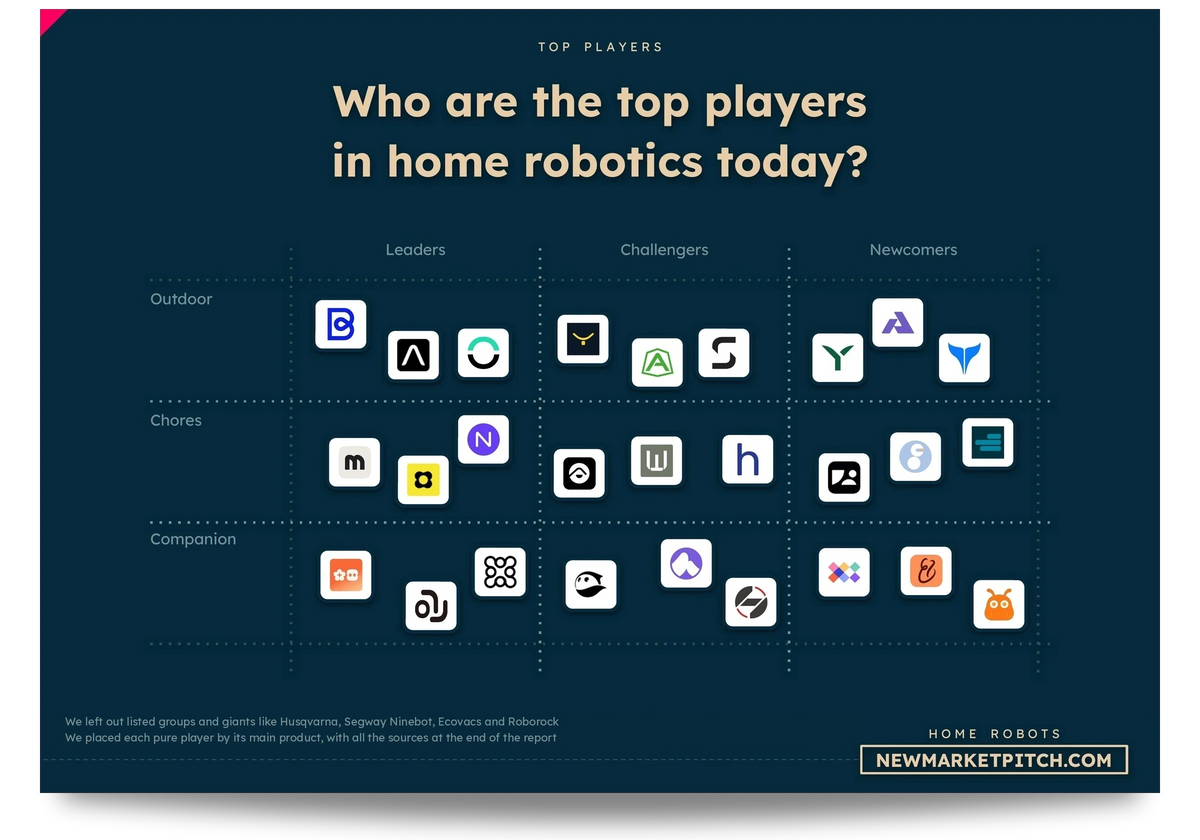
In our research about home robots, we turn what is vague and complex into simple, useful visuals. Market maps like this one show you at a glance where every startup stands.
Is home-robot funding actually healthier right now?
Home-robot funding has improved, but the biggest checks make the market look stronger than it feels for smaller startups.
In the last 12 months, we tracked 39 financings worth at least $688M, against 38 deals and at least $613M in the 12 months before. Deal count rose 3% and disclosed money rose 12%. The number of companies getting funded also grew. Investors are backing more ideas, from robotic laundry furniture to machines that can move objects around a home.
Still, the good news has limits. Leave out rounds above $50M and less money was raised, even though the overall total grew. The International Federation of Robotics reported in September 2026 that consumer service-robot sales grew 37% in 2025, mostly in the familiar world of domestic machines. That confirms customers buy home robots. It does not tell us whether the newest general-purpose assistants are ready for them.
We see a healthier market for getting noticed and a much tougher one for raising meaningful money without a standout story. The contrast appears clearly when we put the periods side by side.
The table below shows how the latest funding period compares with the one before.
| Measure | Earlier | Latest |
|---|---|---|
| Deals | 38 | 39 |
| Companies | 24 | 30 |
| Disclosed capital | $613M+ | $688M+ |
| Exclude above $50M | $223M+ | $149M+ |
| Exclude above $100M | $323M+ | $523M+ |
| Median round | $10M | $14M |
| First financings | 8 | 7 |
| Follow-on deals | 26 | 28 |
| Unique lead investors | 31 | 33 |
Medians are rounded; exact values are given in the text. A plus sign means at least that amount, because some round amounts were not disclosed.
Would home-robot funding still look strong without giant rounds?
No, home-robot funding below the biggest rounds is weaker than the headline suggests.
Remove financings above $50M, and at least $149M remains in the last 12 months, compared with at least $223M in the 12 months before. Funding below $50M is down 33%. But remove only rounds above $100M and the remaining total rises 62%, to at least $523M from at least $323M. Investors are particularly active with rounds between $50M and $100M. That is not a market lifted by one extraordinary check.
The deals themselves show why. Matic's $60M Series C in January 2026 backed a floor-cleaning robot already in homes. Vita Dynamics' ~$70M seed round in May 2026 went to robot companions. Aiper's $100M round of undisclosed stage in December 2025 came through a deal with pool-equipment maker Fluidra. These companies need money for different reasons, and we cannot assume that one successful product proves demand for the others.
The funding recovery is real at the high end. Below it, investors are still making smaller companies work for every check.
Are big home-robot rounds getting more common?
Yes, big home-robot rounds are getting more common, but checks above $100M are not.
We counted 6 rounds above $50M in the last 12 months, worth $539M, versus 3 rounds worth $390M in the 12 months before. Yet rounds strictly above $100M fell from 2 to 1. That distinction helps explain why funding can grow even when the biggest single checks are less frequent.
Sunday Robotics' $165M Series B in March 2026 remains the most striking recent example. It supports an attempt to bring Memo, an autonomous household assistant, into actual homes. The ~$70M seed round of LeXiang Technology (Zeroth) in July 2026 backed mobile companions for household help, while Matic raised to expand an established cleaning machine. These are very different reasons to raise a large check: one is developing a versatile assistant and another is scaling a product with a defined job.
Big checks are no longer confined to one type of home robot. That makes the market more interesting, although the biggest commitments still tell us little about what ordinary startups can raise.

Your time is limited. In our market report about home robots, we put numbers on each part of the market, so you can see where it makes sense to focus.
Are more home-robot startups getting money, or just the usual names?
More home-robot startups are getting funded, rather than just the same companies raising again.
The number of companies receiving funding rose 25% in the last 12 months. Among those businesses, 77% completed one round during the period, compared with 63% in the 12 months before. The repeat-fundraising rate fell to 23% from 38%. We are seeing more separate teams attract investors, even though the best-known companies still make the largest headlines.
Their products could hardly be more different. Knowin AI is developing a foldable two-armed household robot, Syncere is building furniture that folds laundry, and Tombot makes a lifelike robotic dog. Meanwhile, Weave Robotics began delivering its stationary laundry-folding machine to customers in California in February 2026. Those are different bets on what people will actually pay to automate.
More funded companies give the industry more chances to find the right product. The unanswered question is how many can turn a first prototype into something households will buy and keep using. That is where a broader field of startups starts to matter.
Can a brand-new home-robot startup still raise money?
Yes, a new home-robot startup can still get its first check, but most funding goes to companies investors already know.
We counted 7 first financings in the last 12 months, against 8 in the 12 months before. The latest first rounds accounted for 18% of deals and at least $33M in disclosed money. Follow-on rounds attracted at least $623M, or 91% of disclosed capital. A first check opens the door; it rarely pays for the whole journey from a promising machine to a product ready for consumers.
The starting amounts also vary sharply. Erbai Intelligent raised a first seed round of at least $1.4M in December 2025 for floor cleaning. Lumi Intelligent raised at least $2.8M in its first seed round in November 2025 for a companion robot. Futuring Robot raised a $29M first seed round in January 2026 for general household service robots. The seed label covers modest first experiments and far more expensive development programs.
We would not call this an easy environment for newcomers. But the money has not been reserved exclusively for teams that raised before, and first rounds still bring fresh approaches into the market.

In our document detailing everything you need to know about home robot, we always try to gather several sources and make estimates that make sense, so you can work with solid numbers.
Are small home-robot funding rounds getting any easier?
Only partly, because small home-robot rounds are still happening but larger checks have done most of the work behind the recovery.
The median disclosed round rose 37%, to $14.0M in the last 12 months from $10.2M in the 12 months before. At the same time, 39% of rounds with disclosed amounts were under $5M, compared with 32% previously. There are more small checks by share, even while the overall median is higher. The part that got thinner is the middle: rounds between $5M and $50M make up a smaller share than before.
A new companion robot, an autonomous lawnmower and a mobile assistant do not need the same budget. For instance, TerraMow focuses on mowing, while Knowin AI describes a foldable, dual-arm household robot meant to handle more varied tasks. The engineering needs are not remotely identical. Matic's January 2026 announcement also makes the contrast clear: it was raising to expand a product that it said was already in people's homes.
A bigger median round should not be confused with easier access to money. For an early team, what matters is whether the next check arrives before the first one runs out.
Are home-robot startups taking longer to raise again?
Yes, the measured gap between home-robot funding rounds has lengthened, even as more companies receive investment.
The median time between rounds rose from 5 months in the 12 months before to 8 months in the last 12 months. Among gaps we could measure, 68% were under 12 months in the latest period, down from 74%. The gaps we could measure cover 64% of all gaps in the last 12 months and 71% in the 12 months before, so this is a trend, not a rule for every company. Still, the movement is worth taking seriously.
Repeated fundraising has not disappeared. Knowin AI and Futuring Robot each appeared in successive financings during the latest window, while other startups raised once and concentrated on building. Weave Robotics is a useful contrast: it points to customers already using its laundry-folding machine, not just to a new funding round.
The number of companies receiving multiple checks within a period also slipped. For founders, the practical message is simple: do not count on another raise arriving just because the category is fashionable. Product progress and a longer cash runway count for more.
Are existing home-robot startups taking nearly all the money?
Follow-on rounds still collect the vast majority of disclosed funding in home robotics.
Follow-on financings took 91% of the capital with a public amount in the last 12 months, compared with 86% in the 12 months before. Follow-on rounds made up 72% of deals recently, versus 68% earlier. Investors funded more separate startups, but they still directed most dollars to teams that had already crossed the first fundraising hurdle.
That division is understandable when we look at what comes after a prototype. Teams with a working product need money for manufacturing, distribution and support. Other companies are still trying to make the hardware dependable enough for a household test. Both journeys cost much more than putting together an impressive demo.
The important distinction is between opening new doors and financing the companies that make it through them. Home robotics is doing a little more of the first, while most disclosed capital still pays for the second.

Our report covering the home robot market gets updated several times a month, so you always get the latest view of where things stand.
Is seed funding suddenly paying for much bigger home robots?
Home-robot seed rounds are now paying for bigger and more ambitious machines, though a large check still proves nothing about reliability.
Seed deals accounted for 67% of home-robot financings in the last 12 months, compared with 53% in the 12 months before. Seed disclosed capital reached at least $320M, up from at least $107M, and the median seed round was $13M versus $3.2M. Among deals with a named stage, early-stage financings made up 86% recently, compared with 82% previously.
These young teams are often trying to solve more than one mechanical problem at once. Knowin AI describes its X1 as a foldable household robot with two arms and its own embodied AI system. Sunday Robotics says its training approach uses human examples recorded with a wearable glove, because household objects and tasks are hard to capture in a controlled laboratory. Those approaches cost real money to develop, even before a machine can cope with a messy kitchen or a dropped shirt.
The bigger seed check does not make the product ready. It shows investors are willing to pay to see whether teams can make genuinely useful domestic assistance work.
Are investors abandoning vacuum cleaners for robots that do chores?
Investors are putting more money into home robots that handle objects, although vacuum cleaners are still a real business.
Household manipulation robots made up 18 deals in the last 12 months, versus 8 in the 12 months before. The category's share of financings rose to 46% from 21%, and it attracted at least $309M in disclosed capital. Robots that pick things up, fold clothes or help around the house now receive much more attention than they did in the earlier period.
We can see the attraction in LG's CLOiD demonstration at CES 2026. The appliance maker showed a mobile robot with arms coordinating kitchen and laundry tasks. Weave, by contrast, started by solving one job: folding laundry. A system that works reliably on a single task can reach customers sooner than a machine promising to tackle every chore.
Floor cleaners and pool cleaners have not stopped developing. Narwal introduced an updated Freo cleaning robot in August 2026, while Beatbot continued launching new pool-cleaning products. The new money is chasing a bigger promise. Whether households prefer one flexible robot or several specialist machines remains an open commercial question.

In our research about home robots, we look at what the winners do differently, so you can learn from the best instead of guessing.
Do home humanoid robots still need a human helping in the background?
Often, yes: investors put serious money behind home humanoid and mobile robots, but several still rely on remote human help for harder chores.
The Bot Company's $150M Series B in March 2025 put household chores at the center of a large financing. Sunday Robotics has since made a similarly ambitious bet on a mobile assistant, Memo. These businesses qualify as home robots because domestic tasks are their main purpose. Industrial humanoids that mention home use as a distant possibility are a different market.
The range of potential products is growing. 1X markets its NEO for households and offers preorder options that acknowledge the need for remote expert support on harder tasks. Weave's Isaac 1 also describes human assistance alongside autonomous work. These are revealing product decisions. Getting a machine safely into a home can come before making it completely independent.
Investors are clearly ready to finance this idea. We still have little reason to treat a preorder, a beta test and repeated paid use as equivalent proof. The more useful question is which company can deliver chores reliably without relying too often on a person behind the scenes.
Does Sunday Robotics have a home assistant people can actually use?
Not at scale, because Sunday Robotics still needs to prove that Memo works in real homes day after day.
Sunday's $165M Series B in March 2026 was the largest home-robot financing in the latest period, with Coatue leading. In its announcement, the company said it was moving beyond demonstrations and preparing a beta program for homes. It is using a Skill Capture Glove to gather examples of human movements, with the aim of teaching Memo varied chores. That addresses a real difficulty: every home has different objects, furniture and interruptions.
A specialist robot offers a useful comparison. A machine that washes floors has a narrower job and fewer things to get wrong than a domestic assistant handling delicate objects. Sunday's approach aims much further, which is exactly why the investment has drawn attention. We see a promising route into home testing, not proof that general household autonomy has been solved.
The funding will matter more if Memo can work in many real homes without constant help. Until then, a compelling demo and a dependable product remain different things.
Is The Bot Company still raising the biggest home-robot checks?
No, The Bot Company had the largest home-robot round in the earlier period, but Sunday Robotics has taken that spot recently.
The Bot Company's $150M Series B in March 2025 was the biggest deal in the 12 months before. Its stated goal remains a robot that helps with chores in the home, and its website names Greenoaks, Spark and Kleiner Perkins among its backers. We did not identify a qualifying financing for The Bot Company in the last 12 months. That tells us about fundraising, not whether its engineers have slowed down.
Other teams have gone public with more concrete household plans. Sunday announced a beta effort, 1X has marketed its NEO home robot to consumers, and Weave began delivering its laundry-folding product in February 2026. None of those steps alone establishes which team is winning the long-term race.
The Bot Company remains a serious name to watch. But the biggest check changes hands, and a robot that can cope with ordinary homes will ultimately matter more than the fundraising headlines.

In our market report about home robots, we don't want to repeat what boring consulting reports say. Instead, we show you the real and latest market signals that matter.
Do Matic and Aiper prove customers will pay for home robots?
Yes, Matic and Aiper show that customers buy home robots for specific jobs, while a general household assistant remains much less proven.
Matic reported in January 2026 that it had shipped over 6,000 robots and that its machines had cleaned over 110M square feet. Those are company-reported figures, but they describe robots doing a real task in customers' homes. Matic sells a dedicated vacuum-and-mop machine, so buyers know what it is supposed to do.
Fluidra offered a different kind of evidence for Aiper. The listed pool-equipment maker said Aiper generated approximately $195 million in sales in 2024 and already sold through consumer retail channels. Fluidra completed its minority investment in December 2025, linking the robotic pool-cleaner business with an established distributor.
These examples strengthen the case for household robotics, though only within their specific jobs. Neither company needs to make a robot recognize every object in a kitchen. The newer assistants must still prove that a wider range of skills gives customers enough value to justify the extra complexity and cost.
Are investors losing interest in pool-cleaning robots?
Pool-cleaning robots attracted fewer rounds recently, but investors have not walked away from the business.
We tracked 2 pool-cleaning robot deals worth at least $100M in the last 12 months, versus 5 worth at least $150M in the 12 months before. The drop is clear in both deal activity and disclosed money. Yet the latest period includes a major investment by a company that already sells pool equipment worldwide.
In December 2025, Fluidra completed its investment in Aiper, a cordless pool-cleaner maker with an established consumer channel. The earlier window included Beatbot's ~$140M Series A in September 2025. Beatbot has continued introducing products, including its AquaSense X line in January 2026. Product launches and financing announcements do not follow the same schedule, especially when companies already sell hardware.
The more interesting change is that the category's latest money is tied to an established industry partner rather than a string of new venture rounds. That may turn out well for Aiper, while making the funding figures look quieter. Fewer checks alone cannot tell us whether customers are losing interest in clean pools.
Is home-robot money shifting from China to the United States?
Partly: China still gets far more home-robot deals, but American startups took 50% of the disclosed money in the last 12 months, up from 33% in the 12 months before.
Chinese startups completed 31 deals across 22 companies in the last 12 months, worth at least $339M. American startups completed 6 deals across 6 companies, worth $346M. China accounted for 79% of the financing announcements, while the United States took 50% of the disclosed capital, just ahead of China's 49%. The geography of ideas and the geography of big checks are different.
Chinese companies are trying several kinds of home robotics. Knowin AI and Futuring Robot build household assistance systems, LeXiang Technology develops mobile companions, and TerraMow focuses on lawns. The American group contains substantial commitments to domestic assistance as well as established specialist cleaning products. We cannot use the funding figures to decide whose robots work better.
What they do show is a much wider flow of Chinese experiments and a smaller American field able to attract very large checks. Both approaches could produce successful consumer robots, but the routes to market look quite different.

Learning from others' mistakes is the cheapest lesson there is. In our document detailing everything you need to know about home robot, we look at what broke startups before you, so you don't repeat it.
Will LG and the appliance giants squeeze home-robot startups?
LG and other appliance giants are serious competitors for home-robot startups, but their arrival has not stopped venture funding.
LG presented CLOiD at CES 2026 as a home robot that can coordinate tasks involving kitchen appliances and laundry. In August 2026, the company also announced robotics work with NVIDIA, including training with data gathered in simulated home settings. LG already has appliances, distribution and customer support. A startup trying to enter the same households has to offer something compelling enough to compete with that reach.
The challengers are taking different routes. Some build specialist machines for one chore; others want a mobile assistant able to move between tasks. LG's advantage with connected appliances may matter most when a robot needs to operate existing household devices. A new company could still win by making a particular job much easier, or by moving faster with a machine people really want.
We found no evidence that LG's announcements caused a drop in funding for any specific startup. The competitive pressure is plain enough without inventing that connection: clever demos will not be sufficient once established brands offer their own domestic robots.
Are more investors getting interested in home robots?
More investors are now backing home robots, although the largest checks still go to a select group of companies.
We identified 79 unique investors in the last 12 months, up from 54 in the 12 months before. Distinct disclosed lead investors increased to 33 from 31. We could identify the lead for 59% of recent deals, so these counts are not a complete picture of every check written. Still, the direction points to wider participation.
The investors themselves are not all making the same bet. Coatue backed a domestic assistant, Fluidra invested in robotic pool cleaning, and Chinese venture firms funded new home-service machines. Matrix Partners China was the most active disclosed lead in the latest period, leading 2 rounds. So a longer list of investors doesn't mean everyone is betting on the same kind of robot.
A startup with a working product and a clear customer may find more potential backers than before. An ambitious machine with no useful household deployment still has to convince someone to pay for a long, expensive build.

If you build or invest in the home robot market, you need to know which business models pay off now and which ones are fading. That's why our report covering it has a whole section on it.
Do people actually buy home companion robots?
Some home companion robots already attract buyers or preorders, but broad sales success remains hard to establish.
Companion and social robot startups completed 12 deals worth at least $199M in the last 12 months, compared with 13 deals worth at least $101M in the 12 months before. Fewer financings brought in more disclosed money. Yet the products vary widely, from character-like pets to mobile helpers, so funding does not tell us which consumer need will last.
Tombot's Jennie is a lifelike robotic dog aimed partly at people who cannot care for a living pet. In June 2026, the company said more than 23,000 people had preordered or signed up for Jennie, with a launch planned for fall 2026. We found no record of deliveries yet. Cyan Robotics' Amoo, meanwhile, is designed as an expressive moving companion, according to its design partner. These are credible attempts to make robots useful through emotional interaction rather than heavy household work.
Preorders are promising, but they are different from repeat sales or customers using a product for months. For companion robots, that distinction is especially important: a charming first encounter does not guarantee long-term demand. Investors are clearly interested; a strong consumer market still needs more proof.
Can home-robot startups keep raising before their products reach homes?
Only some home-robot startups can keep raising on the promise of future household use; most still need to show the machine doing something useful.
The latest funding pattern is split. Investors are willing to write sizable checks for a general home assistant, while existing cleaning products can point to shipped machines and customers. Among the gaps between rounds that we could measure, fundraising also became slower. That gives teams less room to rely on another quick announcement to fund the next development step.
Sunday Robotics has publicly committed to testing Memo in households. Knowin AI presents a foldable home-service design. On the other side, Weave has delivered its laundry folder to homes since February 2026, and specialist cleaning brands sell machines with one clear purpose. Those are not equally strong forms of evidence, and we should not pretend otherwise.
For the ambitious assistants, the next test is whether people use them again after the first demonstration. Reliable work, repairs that do not become a nightmare, and a price households will accept would make the next fundraising story much more convincing. Venture money can buy time to answer those questions, not the answers themselves.
So, what does home robots funding look like right now?
Home-robot funding is growing, but a few large rounds are doing much of the work while smaller fundraisers face a tougher market.
We found more deals, more funded companies and larger median checks in the last 12 months than in the 12 months before. That is a meaningful improvement. But the drop in funding once larger rounds are excluded shows how uneven the recovery remains. Seed investing is active, and early teams can still attract support; following that first check with dependable funding is a harder test.
The contrast between products matters just as much. A floor cleaner or pool cleaner can prove itself through sales and usage. A household assistant that handles varied objects has a much bigger job ahead of it. China is producing the broader flow of startups, while American companies have attracted the larger public dollar total. We expect investors to keep backing both approaches, but the market will become genuinely healthier when more robots deliver useful work at home, not just convincing demonstrations.
The table below shows what we found.
| Question | Answer |
|---|---|
| Is home-robot funding improving for everyone? | No, the funding recovery still favors bigger venture checks. Disclosed capital rose 12% across the two comparison periods. Smaller companies cannot assume this makes their next raise easier. |
| Would smaller deals tell a different story? | Yes, the market below large checks actually got weaker. Funding excluding rounds above $50M fell 33% between periods. The headline increase hides trouble for the funding middle. |
| Are more home-robot teams finding investors? | Yes, more separate startups are winning financial support today. Funded companies increased 25% across the latest comparison window. That gives different product ideas a chance to develop. |
| Is a first check still possible today? | Yes, new domestic-robotics teams can still raise initial funding. We counted 7 first financings in the latest period. Established startups nevertheless took the great majority of money. |
| Are follow-up rounds coming as quickly now? | No, measured intervals between home-robot rounds have grown longer. The median gap reached 8 months in the latest period. Founders should not plan around constantly faster repeat funding. |
| Are young robot companies getting bigger checks? | Yes, seed funding now backs more ambitious household machines. Seed deals attracted at least $320M in the latest period. That investment still cannot guarantee reliable work in homes. |
| Are robots that do chores attracting money? | Yes, investors are chasing machines that handle household objects. Household manipulation robots represented 46% of latest-period financings. The commercial proof still trails specialist cleaning products. |
| Has Sunday's domestic robot proved its promise? | Not at scale, although investors have backed its ambitions. Sunday Robotics raised a $165M Series B in March 2026. Household use must still prove Memo can work reliably. |
| Do established cleaning robots offer stronger evidence? | Yes, specialist robots already perform paid work in homes. Matic reported shipping over 6,000 robots by January 2026. That offers stronger usage evidence than a laboratory demo. |
| Is China also ahead in fundraising dollars? | No, China's advantage is much clearer in deal activity. Chinese startups completed 31 deals in the latest period. American companies drew a slightly higher disclosed dollar total instead. |
| Are venture firms betting across the market? | Yes, investors have shown interest in different robot models. We identified 79 unique investors in the latest period. A much smaller set of companies received large commitments. |

In our research about home robots, we like to show you the big picture. We know your time is precious, so we make every page quick to read and packed with as much learning as possible per minute.
Our methodology
Our data runs through November 19, 2026. We then reviewed this article and updated its answers on November 24, 2026, the date shown under the title. We compared the last 12 months, November 20, 2025 to November 19, 2026, with the 12 months before, November 20, 2024 to November 19, 2025. We used equal windows because both contain enough financings for comparison; the wider deal tracker and our other home-robots pages cover different periods and therefore answer different questions.
We counted equity financings of qualifying private companies at or above $300K. Debt, grants, loans, unconverted convertibles, SAFEs and public offerings do not qualify. Each funding announcement counts once, and we merged duplicate reports of the same financing rather than treating them as separate transactions.
We define home robots as physical machines built to carry out tasks or provide assistance in homes, including floor, window, pool and lawn cleaning, domestic manipulation, home security and embodied companions. Pre-commercial systems with a documented home-first design and commercialization plan qualify. We include borderline domestic robotics companies rather than silently excluding them, but not industrial-only systems, enterprise-only platforms, plain smart appliances or software without an embodied household task. Humanoids qualify only when home use is central to their proposition.
Every company counted meets our startup definition: independent, founded in 2007 or later, designed to grow rapidly around a new product or technology, and funded privately or by its founders. Recently listed and recently acquired businesses can remain eligible within the specified windows. We classify companies by their core domestic application and by headquarters geography, and group financing stages into seed, later named rounds and undisclosed stages. Early-versus-later comparisons use only rounds with a named stage.
Undisclosed round amounts count toward the number of deals, but not toward capital totals, so many totals are minimums. We use the announced dollar amounts without inventing precision for missing figures. Company statements, regulatory filings and reliable reporting take precedence over database entries; we record uncertainty in individual rounds without treating it as a reason to omit the broader market.
Rounds confirmed by a company announcement, a press article or a regulatory filing are counted in full. Where no article exists, a round is counted only when at least two recognised databases agree on its date (within one month) and amount (within 5%), and it is marked as low confidence; a round found in a single database stays in the company's history but is left out of totals. For companies that have raised more than $100M, every round counted is backed by an article.
A reader may find a different total in a news article because it uses a different market boundary, mixes corporate investments with venture deals, includes non-equity capital or ends at a different date. Likewise, a familiar robotics giant may be absent because it is not a qualifying startup or does not primarily build robots for homes. Our comparison applies one set of boundaries to both periods, so the direction of change is more meaningful than trying to match every outside headline.
Key sources include IFR September 2026 consumer-service-robot sales and domestic applications, Sunday's March 2026 Series B and planned household beta program, Memo's proposed home tasks and training approach, Sunday's original announcement and its dated seed round, Fluidra December 2025 completion of the Aiper investment, Aiper's earlier sales, channels and Fluidra partnership terms, Matic's January 2026 product-use claims and financing announcement, Matic's floor-cleaning product and consumer sales channel, The Bot Company's domestic focus and publicly named backers, Weave's shipped laundry-folding robot and customer-use claims, Weave's Isaac 1 product, pricing, delivery and human-assistance plan, 1X NEO's consumer preorder, capabilities and service design, LG CLOiD's domestic design and January 2026 demonstration, LG's August 2026 robotics data-training collaboration, Knowin-X1 household robot positioning and embodied-AI approach, Beatbot's dated pool-robot product milestones, Narwal's August 2026 consumer cleaning-robot launch, Cyan Robotics' Amoo companion concept from its design partner, Tombot's Jennie product and customer interest, and Tombot's June 2026 Series A3, preorders and planned fall 2026 launch.

When you build or invest in the home robot market, you need clarity, not confusion. In our market report about home robots, we always try to put numbers on and quantify whatever is usually vague and confusing.
Written by the New Market Pitch teamWe track new markets so founders and investors can move faster. About us