What are the top home robotics startups by total funding raised?
Whether you're building or investing in the home robot market, our report covers everything you need to know: the players, the money, and what's coming next.
Summary
Dreame Technology leads home robotics startups by lifetime funding, with at least $563M raised. The Bot Company follows at $300M, and Sunday Robotics at $200M. Their robots have very different jobs: Dreame sells cleaners, while its American challengers want to take on everyday chores.
Dreame's lead began with an exceptional financing years before today's wave of household humanoids. A large historical total tells us who convinced investors to write checks, but it says less about who is raising money right now.
Most home robot startups operate on much smaller budgets. Among the 59 companies we track, 51, or 86%, have raised less than $100M. The companies at the top are unusual, even in a business where building hardware is expensive.
Look at their locations and China stands out. It has 36 companies in our group, or 61%, compared with 17 in the United States. Those are company counts, not national totals of dollars invested.
China's cleaning brands have already built products that shoppers recognize. Beatbot has raised at least $140M to develop pool cleaners, while Narwal Robotics competes in automated floor care. Both have a simpler sales pitch than a robot that promises to tidy an entire home.
That broader promise is drawing big checks in the United States. The Bot Company and Sunday Robotics want machines that can deal with dishes, clutter and unfamiliar household objects. 1X Technologies has gone a step further by opening an ordering path for its NEO home humanoid.
Customers will judge those machines differently from a vacuum. A pool robot needs to clean a pool well; an all-purpose helper must handle many objects safely, work in homes it has never seen and avoid demanding constant human attention.
Specialized robots still have plenty to offer. Matic has put cleaning robots into customers' homes, and Aiper has secured an alliance with established pool-equipment maker Fluidra. Both give investors something more concrete than a demonstration video.
Companionship opens another market entirely. Intuition Robotics works with older adults, Miko makes educational robots for children, and robotic pet developers sell interaction rather than labor. The funding race reaches far beyond humanoids.
Dreame remains the clear leader in cumulative funding. The more interesting contest now is whether the newer household assistants can turn large checks into robots that people use every day, while established cleaning companies defend the tasks they already perform reliably.

Written by the New Market Pitch teamWe track new markets so founders and investors can move faster. About us

In our report covering the home robot market, you will always find fresh funding data, taken straight from our own verified funding database.
Top startups in the home robots market ranked by total funding raised
Here is the current ranking of the home robots startups that raised the most, with the total each one has raised and our confidence level.
If you want to go deeper into the home robots startup landscape, check our report covering the home robots market.
| # | Startup | Total raised | Last round | Status | Confidence |
|---|---|---|---|---|---|
| $500M to $1B | |||||
| 1 | Dreame TechnologyRobot vacuums and smart-home appliances | $563M+ | May 2023Undisclosed · Series C+ | Active | Partial |
| $100M to $500M | |||||
| 2 | The Bot CompanyBuilds household chore robots | $300M1 | Mar 2025$150M · Series B | Active | Strong |
| 3 | Sunday RoboticsDevelops autonomous household assistant robots | $200M | Mar 2026$165M · Series B | Active | Strong |
| 4 | BeatbotAutonomous robotic pool cleaners | $140M+ | Sep 2025~$140M · Series A | Active | Full |
| 5 | 1X TechnologiesGeneral-purpose humanoid home robots | $137M | Jan 2024$100M · Series B | Active | Strong |
| 6 | LeXiang TechnologyMobile companion robots for household assistance | $126M+ | Jul 2026~$70M · Pre-Series A | Active | Partial |
| 7 | Narwal RoboticsAutonomous vacuuming and mopping robots | $100M+ | Apr 2025$100M · Growth equity | Active | Partial |
| 8 | AiperCordless robotic pool cleaners | $100M | Dec 2025$100M · Strategic equity | Active | Full |
| Below $100M | |||||
| 9 | Knowin AIAI household service and companion robots | $99M+ | Sep 2026$25M+ · Seed | Active | Strong |
| 10 | Vita DynamicsAutonomous robot companions for homes | $84M+ | May 2026~$70M · Seed | Active | Low |
| 11 | Intuition RoboticsAI companions for older adults | $82M | Aug 2024$20M · Series C / venture financing | Active | Partial |
| 12 | MikoInteractive educational robots for children | $76M | Nov 2025$11M · Strategic equity | Active | Partial |
| 13 | MaticIntelligent autonomous floor cleaning robots | $66M | Jan 2026$60M · Series C | Active | Full |
| 14 | YarboBuilds modular outdoor maintenance robots | $42M+ | Mar 2026Undisclosed · Series B++ | Active | Full |
| 15 | KEYi TechnologyInteractive robotic pets and toys | $34M+ | Jan 2026$14M+ · Financing (stage not disclosed) | Active | Partial |
| 16 | Futuring RobotGeneral-purpose household service robots | $29M+ | Jul 2026Undisclosed · Pre-Series A | Active | Full |
| 17 | RopetDevelops interactive AI robotic pets | $15M+ | Sep 2025$10M+ · Series A (two closes) | Active | Strong |
| 18 | TombotCreates realistic robotic companion animals | $15M | Jun 2026$7M · Series A extension | Active | Full |
| 19 | Familiar Machines & MagicCompanion robots for home wellness | $15M | Oct 2024$15M · Series A | Active | Full |
| 20 | SyncereAI-powered laundry-folding robotic furniture | $15M | Nov 2026$11M · Pre-Seed | Active | Strong |
| 21 | TerraMowBuilds autonomous vision-guided lawnmowers | $14M | Jan 2026$14M+ · Series B | Active | Partial |
| 22 | Cyan RoboticsCompanion character robots for homes | $14M+ | Mar 2026$14M+ · Seed | Active | Full |
| 23 | RobopoetAI companion robots for homes | $14M+ | Jul 2026$14M+ · Pre-A | Active | Full |
| 24 | X-ORIGIN-AIAI-powered home service robots | $14M+ | Apr 2025~$14M · Seed | Active | Full |
| 25 | NovabotAutonomous robotic lawn mowers | $10M+ | Aug 2023$10M+ · Angel | Active | Low |
| 26 | SeautoManufactures cordless robotic pool cleaners | $9.6M+2 | Jan 2026Undisclosed · Series B | Active | Partial |
| 27 | PoshaAutomated countertop cooking robots | $8M+2 | May 2025$8M · Series A extension | Active | Partial |
| 28 | LymowAutonomous robotic lawn mowing systems | $5.6M+ | Nov 2025$2.8M+ · Series A | Active | Low |
| 29 | Yukai EngineeringCreates expressive emotional companion robots | $5.6M+ | Sep 2022Undisclosed · Strategic VC | Active | Full |
| 30 | Labrador SystemsAssistive home delivery and carrying robots | $5.1M | Jan 2022$3.1M · Seed | Active | Strong |
| 31 | AirseekersAutonomous robotic lawn mowers | $4.2M+ | May 2026$1.4M+ · Series A-II | Active | Low |
| 32 | Digital Dream LabsProgrammable educational robot toys | $3.8M | Apr 2022$2M · Bridge | Active | Partial |
| 33 | Ludens AIEmotionally responsive AI companion robots | $3.8M | Apr 2026$3.8M · Angel | Active | Partial |
| 34 | SMOROBOTProduces intelligent swimming pool robots | ~$3.5M | Jan 2025Undisclosed · Corporate Minority | Active | Full |
| 35 | Tangible RobotsHome robots for household tasks | $3M+ | 2025$3M · Seed | Active | Full |
| 36 | Deyin TechnologyHome robotics products and systems | $2.8M+ | Nov 2025$2.8M+ · Series A | Active | Low |
| 37 | Lumi IntelligentConsumer home robots for daily assistance | $2.8M+ | Nov 2025$2.8M+ · Seed | Active | Low |
| 38 | Jingjie XunhangWindow and facade cleaning robots | $2.7M+ | Sep 2025$2.7M+ · Seed | Active | Low |
| 39 | Sentigent TechnologyAI home robots and companion devices | $2.7M+ | Jul 2025$2.7M+ · Seed | Active | Low |
| 40 | Tau RoboticsProvides humanoid robotic home cleaning | $2.6M | Jul 2026$2.6M · Pre-Seed | Active | Full |
| 41 | Swish RoboticsAutonomous home cleaning robots | $2.5M | Mar 2025$2.5M · Seed | Active | Full |
| 42 | Ageless InnovationJOY FOR ALL interactive robotic companion pets | $1.9M | May 2018$1.9M · Seed | Active | Full |
| 43 | XCANBOTDevelops embodied home service robots | $1.4M+2 | Sep 2026Undisclosed · Angel++ | Active | Low |
| 44 | Erbai IntelligentHousehold service robots for cleaning | $1.4M+ | Dec 2025$1.4M+ · Seed | Active | Low |
| 45 | Ola DimensionsLearning-based general-purpose household robots | $1M+ | Oct 2026$1M+ · Seed | Active | Low |
| 46 | EnabotMobile home and pet companion robots | $500K+2 | Sep 2025Undisclosed · Series C | Active | Full |
| 47 | Weave RoboticsBuilds domestic laundry and tidying robots | $500K | Oct 2024$500K · Seed | Active | Full |
| 48 | InnateTeachable general-purpose personal AI robots | $125K | Nov 2024$125K · Seed | Active | Low |
| Undisclosed | |||||
| 49 | PokeBotGeneral-purpose household manipulation robots | Undisclosed | Aug 2026Undisclosed · Pre-Series A | Active | Low |
| 50 | Blue Frog RoboticsSocial companion robot Buddy | Undisclosed | Dec 2017Undisclosed · Other | Active | Low |
| 51 | biboHome companion and service robots | Undisclosed | Sep 2026Undisclosed · Seed | Active | Low |
| 52 | Entropy TechnologyAutonomous flying home assistant robots | Undisclosed | May 2026Undisclosed · Seed | Active | Low |
| 53 | Heisenberg RoboticsMultifunctional AI robotic lawn mowers | Undisclosed | Sep 2022Undisclosed · Pre-A | Active | Low |
| 54 | Hengzhi FutureHome companion robots and robotic pets | Undisclosed | Nov 2025Undisclosed · Series A | Active | Low |
| 55 | In2MateFull-size humanoid companion robots for homes | Undisclosed | Aug 2026Undisclosed · Seed | Active | Low |
| 56 | Picea RoboticsRobotic vacuum manufacturing and technology | Undisclosed | Apr 2018Undisclosed · Series A | Active | Low |
| 57 | WavefutureHome and pool cleaning robots | Undisclosed | Nov 2025Undisclosed · Series A | Active | Low |
| 58 | Xieyue IntelligenceEmbodied AI for household robots | Undisclosed | Sep 2026Undisclosed · Angel+ | Active | Low |
| 59 | xLean RoboticsStair-climbing home cleaning robot | Undisclosed | Apr 2026Undisclosed · Series A | Active | Low |
No startups match this search.
- A further $250M round was reported but not confirmed as completed.
- Minimum: some rounds have no public amount.

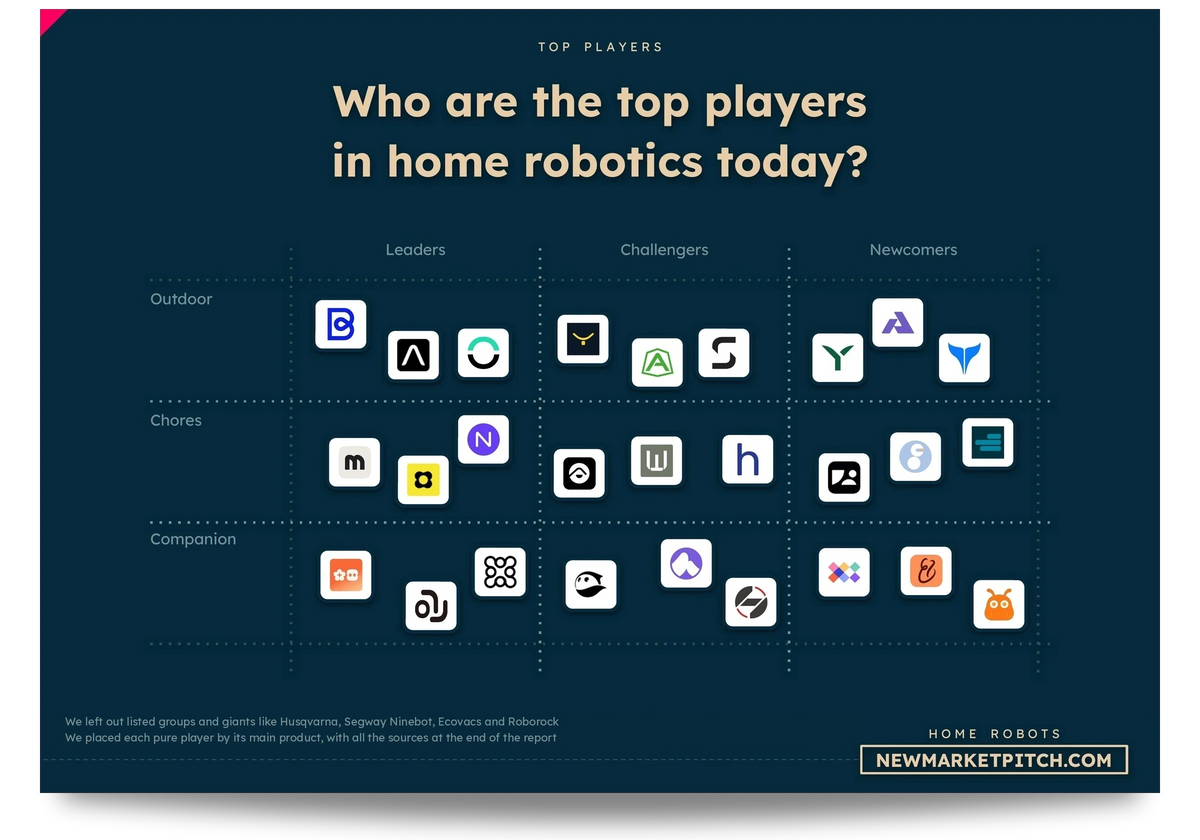
In our research about home robots, we turn what is vague and complex into simple, useful visuals. Market maps like this one show you at a glance where every startup stands.
Why is Dreame Technology still the best-funded home robot startup?
Dreame Technology still leads home robotics funding because one exceptional round gave its cleaning-robot business a head start that newer household assistants have not caught.
Dreame Technology's $563M Series C in October 2021 remains the largest individual financing in our home robots group. We record 3 equity rounds in its history; the last was a Series C in May 2023 with an undisclosed amount. That makes the fundraising lead unusually dependent on a big, older check.
The business behind the check is easier to understand than a general-purpose humanoid. Dreame sells robot vacuums and other home appliances through a large international retail network. In June 2026, the company cited IDC research placing it first worldwide in robot-vacuum sales and revenue during the opening quarter. This is a company announcement about an outside ranking, but it does show that Dreame is fighting for customers in an established market.
Compare that with the companies chasing it. The Bot Company wants to automate household chores, and Sunday Robotics is preparing Memo for use in ordinary homes. Their ambitions are broader, but their machines have much less consumer history behind them. Dreame has already spent years selling products and building distribution. Its place at the top tells us where the most historical equity went, not that investors just handed it the largest new check.
Is The Bot Company close to overtaking Dreame Technology?
The Bot Company is the closest American challenger in lifetime home robotics funding, but it still trails Dreame Technology.
We count $300M across 2 rounds for The Bot Company, including its $150M Series B in March 2025. The startup was founded in 2024 by Kyle Vogt, the former Cruise chief executive, and colleagues with experience building autonomous machines. TechCrunch covered its second $150M raise in March 2025.
The money buys time to tackle an unusually messy problem. A robot that clears a bedroom or puts objects away has to recognize what it sees, handle things without breaking them and figure out where they belong. That calls for different skills from a vacuum following a floor map. It also means investors are paying for a long period of testing before the company can expect the kind of repeat retail sales that cleaning brands already enjoy.
There is a reason the funding gap matters less than it first appears. The Bot Company raised its recorded capital soon after founding, while Dreame's biggest financing belongs to an earlier generation of consumer robots. The American startup has attracted serious backing very quickly. Whether it catches Dreame in money raised will matter less to households than whether its robot can finish useful chores without someone standing by.

Your time is limited. In our market report about home robots, we put numbers on each part of the market, so you can see where it makes sense to focus.
Could Sunday Robotics become the best-funded home robot startup?
Sunday Robotics is a strong contender among new home assistant startups, but it still trails Dreame Technology and The Bot Company in total funding.
Our count gives Sunday Robotics $200M across 2 rounds, including a $165M Series B in March 2026. The company said that funding would move Memo out of staged demonstrations and into household testing. Its published plans cover chores such as clearing tables, handling dishes and working in homes the robot has not encountered before.
Sunday's approach to learning is worth watching. It developed a glove that captures how people move their hands through ordinary tasks, then uses those examples to train its robots. In the March 2026 announcement, Sunday argued that collecting useful data from real homes was central to making Memo better. The company has also said its initial rollout is a limited beta. Customers cannot yet buy Memo as a standard retail appliance.
That is the gap between a promising robot and a big household business. Sunday has raised enough to build hardware, collect training data and put machines into trial homes. 1X Technologies is pursuing consumer orders, while Matic already has a narrower cleaning product in use. We would take a successful Memo home rollout more seriously than another carefully filmed demonstration, even if the latter looks impressive.
Can people actually buy a 1X Technologies home humanoid now?
People can place an order for the 1X Technologies NEO home humanoid, but it is not yet a widely delivered household appliance.
1X Technologies has raised $137M across 4 rounds, including a $100M Series B in January 2024. In October 2025, the company presented NEO as a robot consumers could order for their homes. It offered an ownership option and a subscription model rather than restricting the project to research laboratories.
The difficult part is what happens after a buyer places an order. According to 1X's own consumer materials, NEO can perform basic tasks autonomously, but unfamiliar or complicated chores may need scheduled remote human help. Remote assistance can be a practical bridge while the technology improves. Buyers still need to know how often a robot will require it and what kind of service they are paying for.
Sunday Robotics has taken a different first step by inviting families into a beta for Memo. Matic avoided the all-purpose problem and shipped a robot designed for cleaning. Those choices make the funding comparison useful: 1X has attracted substantial backing and put a consumer offer in public view, but opening orders and delivering dependable domestic labor are separate milestones.

In our document detailing everything you need to know about home robot, we always try to gather several sources and make estimates that make sense, so you can work with solid numbers.
Are the best-funded home robots mostly humanoids?
No, the leading home robotics startups still include plenty of specialized cleaners alongside humanoid and multipurpose household assistants.
Dreame Technology makes floor-cleaning robots, Beatbot and Aiper focus on pools, and Narwal Robotics builds vacuuming and mopping machines. The Bot Company, Sunday Robotics and 1X Technologies take the wider bet: one machine might eventually help with many chores instead of a single routine.
The distinction is visible in what their companies discuss publicly. Beatbot's November 2026 launches focused on detecting debris, cleaning pools more thoroughly and bringing the machine back to the surface. In January 2026, Matic discussed robots already working in customers' homes. Sunday, meanwhile, presented its household beta as the next big step for Memo.
These are different degrees of technical risk. A pool cleaner has a defined environment and a limited set of movements. A robot clearing a kitchen has to cope with fragile glasses, dirty dishes, obstacles and people who do things differently. It may eventually serve a larger need, but a bigger promise is harder to deliver. For now, investors are backing both types of companies, and the biggest funding totals give no reason to declare the specialized robot obsolete.
Do only a few home robot startups raise really big sums?
Yes, a small group sits far ahead of most funded home robotics startups, even though the money is spread across several kinds of robot.
Of the 59 companies we track, 51, or 86%, have raised less than $100M. Only 8 have crossed $100M, and the median lifetime total is at least $5.1M. That gulf is easy to miss when big rounds for home humanoids dominate the conversation.
Look further down the list. Matic is building a specialized indoor cleaner; Yarbo makes modular outdoor machines; TerraMow tackles lawns; Posha automates cooking; and Labrador Systems develops robots that carry belongings around the home. Each product does a narrower job than a general-purpose household helper. The companies also face distinct manufacturing, service and customer-acquisition problems, so comparing their funding requires some care.
A larger check can pay for extensive robot training and long development cycles. A smaller one may be enough to bring a narrowly focused appliance to market. Neither amount tells us whether shoppers will keep using the finished product. What the funding gap does tell us is that many home robot makers must find a practical use with far less room for mistakes than the best-backed teams.
The table below shows seven specialized home robotics startups with different lifetime funding totals.
| Startup | Total raised | Rounds |
|---|---|---|
| Matic | $66M | 2 |
| Yarbo | $42M+ | 5 |
| Ropet | $15M+ | 3 |
| TerraMow | $14M | 1 |
| Seauto | $9.6M+ | 2 |
| Posha | $8M+ | 3 |
| Labrador Systems | $5.1M | 2 |
A plus sign marks a minimum because some round amounts are undisclosed.

Our report covering the home robot market gets updated several times a month, so you always get the latest view of where things stand.
Is China beating the United States in home robotics startups?
China has more funded home robot startups than the United States, although several American household-assistant makers are near the top by money raised.
China accounts for 36 companies, or 61% of the startups we track. The United States has 17, or 29%. These figures count companies, not the dollars invested in each country; we cannot treat undisclosed rounds and minimum totals as exact national funding amounts.
The Chinese group includes the established cleaner Dreame Technology, pool specialist Beatbot, floor-care maker Narwal Robotics and younger companion developers such as LeXiang Technology (Zeroth). American startups include The Bot Company, Sunday Robotics, 1X Technologies, Aiper and Matic. Those lineups show why a country comparison based on a single famous humanoid would be misleading.
The border between domestic markets is also less important to consumers than the product might suggest. At CES in January 2026, China-based LeXiang Technology introduced its Zeroth companion robots for American buyers. Aiper has an alliance with Spain's Fluidra, and American companies use international supply chains for their hardware. China has more companies in this group; the United States has several of its most closely watched household-assistant ventures. Neither fact gives us a reliable winner in total funding by country.
Can any Chinese home robot maker catch Dreame Technology?
Beatbot, LeXiang Technology and Narwal Robotics are among the Chinese home robotics startups worth watching, although Dreame Technology remains ahead on historical equity raised.
The challengers are competing for very different customers. Beatbot sells robotic pool cleaners and, in November 2026, introduced new products aimed at more complete cleaning and easier retrieval. Narwal sells automated floor-care systems and, according to its October 2026 anniversary announcement, has reached households across several international markets. LeXiang Technology is working on companion and assistant robots that can move around a home rather than clean a single surface.
Some younger Chinese companies are pulling in sizable checks before building the kind of distribution those cleaner brands have. We count at least $99M for Knowin AI and at least $84M for Vita Dynamics. Vita has publicized advance interest in its robot dog, but advance orders alone cannot tell us whether customers will stay engaged after delivery.
The names are worth grouping because they show where Chinese home robotics might go next. Dreame proved that a sophisticated consumer cleaning machine can find an international audience. Beatbot and Narwal are pushing that established approach further, while LeXiang Technology and the companion makers hope households will pay for a different kind of robot. The latter group has the bigger product question to answer.

In our research about home robots, we look at what the winners do differently, so you can learn from the best instead of guessing.
Are robotic pool cleaner startups attracting serious money?
Yes, investors are putting serious money into robotic pool cleaners, whose job customers can easily understand.
Beatbot has raised at least $140M, while Aiper has raised $100M. Both build autonomous pool-cleaning products, a category customers can judge by how thoroughly a robot handles dirt, walls and the waterline.
Beatbot kept expanding its AquaSense lineup in November 2026, introducing features aimed at detecting debris and reducing manual intervention. Aiper chose another route to scale. In April 2025, Fluidra, an established public pool-equipment supplier, announced an equity investment and a partnership intended to connect Aiper's robot technology with its broader distribution and product-development business. That relationship matters because pool robots are sold in a market with existing dealers, service networks and competing brands.
Seauto and SMOROBOT show that smaller entrants are also trying to win customers. They will need to compete on reliability, battery performance, maintenance and price, not only clever navigation. Pool robots lack the spectacle of a humanoid carrying dishes, but their purpose is immediately clear to a buyer. That makes the largest funding checks in the category easier to connect to a recognizable consumer need.
Can robot vacuum startups still win after iRobot's downfall?
Yes, home cleaning robots are still attracting startup funding after iRobot's collapse, although the market has become much tougher for new brands.
Matic's $60M Series C in January 2026 is a useful example. The company said its vision-guided cleaners were already operating in customers' homes, giving it real usage experience instead of only laboratory tests. Matic says it has raised $115M in total. We count $66M from the 2 rounds we could document, because the rest of that funding has not been tied to specific rounds. Dreame Technology and Narwal Robotics also compete internationally with products shoppers can already buy.
The contrast with iRobot is sharp. In January 2026, the maker of Roomba completed a court-supervised transaction that transferred ownership to Picea. iRobot had made the robot vacuum familiar to consumers, yet a famous brand and a long product history were no protection against financial strain and stronger competition. Picea Robotics appears separately in our startup group, with an undisclosed equity total; buying iRobot does not add an acquisition price to its fundraising.
That leaves plenty of room for new cleaners, provided they offer something buyers can notice. Better navigation, quieter operation, dependable maintenance and strong distribution count for more than being another robot vacuum. Matic is trying to improve a familiar chore; the humanoid companies are asking customers to adopt an entirely new one. Neither approach gets a free pass from investors or consumers.
Can robot lawnmower startups raise serious money?
Robot lawnmower startups have attracted meaningful home robotics funding, although their totals are generally below those of the largest indoor cleaners and household assistants.
Yarbo has raised at least $42M, TerraMow $14M and Novabot at least $10M. Their products take aim at an obvious problem: lawn and yard work is repetitive, seasonal and time-consuming.
Yarbo's answer is a modular outdoor machine, with attachments for tasks such as mowing and clearing snow. The selling point is that owners might use the robot for more than one kind of yard work. TerraMow emphasizes a different frustration: setting up robotic mowing systems. Its vision-guided machines aim to navigate lawns without traditional boundary wires. Lymow and Airseekers are also competing in automated lawn care, especially around navigation and difficult terrain.
The hard part is the backyard, not a polished demonstration. Yards differ in slope, obstacles, weather and landscaping. A robot that works on a flat test lawn may need constant rescue somewhere else. Manufacturers also have to support hardware sold for outdoor use. A robot that proves reliable across ordinary gardens gives buyers a stronger reason to pay than one that simply lists more features.

In our market report about home robots, we don't want to repeat what boring consulting reports say. Instead, we show you the real and latest market signals that matter.
Why are investors paying for home companion robots that do no chores?
Companion robots can attract substantial home robotics funding because interaction is the product, even when the machine never washes a dish.
LeXiang Technology makes mobile and embodied companions, while Intuition Robotics has raised $82M for its work with older adults and Miko $76M for educational robots aimed at children. These businesses have little need to compete directly with the folding, tidying and cleaning promises of household humanoids.
The products also ask different things of their customers. Intuition Robotics' ElliQ is designed to start conversations and encourage engagement. Miko combines a physical robot with learning activities and content. LeXiang Technology is trying to put more mobility and physical presence into companionship. None needs to lift laundry to be useful, but each must give its owner a reason to interact again tomorrow.
There is evidence that this goes beyond a gadget bought for novelty. In February 2026, the New York State Office for the Aging published findings from a multiyear ElliQ program involving older adults living at home. Those findings support testing whether people keep using a robot companion, without suggesting it replaces family or professional care. For these startups, repeat use matters much more than a dramatic one-minute demonstration.
Can home robots really help older people live independently?
Only to a point: assistive home robots can provide companionship and help with small tasks, but they cannot replace hands-on care for older adults.
The products show why the word "assistance" needs limits. Intuition Robotics' ElliQ prompts conversation and engagement. Tombot is developing a lifelike companion dog intended to comfort people, including those with dementia. Labrador Systems builds robots that carry everyday items around a home, a task that could help someone with limited mobility.
We have stronger evidence for repeated engagement than for robots taking over caregiving. The New York State Office for the Aging described several years of experience with ElliQ in its February 2026 report, including use in real homes and reported social benefits. A companion that checks in with someone can make a difference without providing medical treatment, helping a person stand or handling an emergency.
Tombot and Labrador address different parts of the same daily-life problem. One offers a responsive presence; the other tries to reduce the need to carry objects. Both are easier to judge against a specific goal than a vague promise of an autonomous robot caregiver. Investors can back useful support products today while acknowledging how far the technology remains from independent physical care.

Learning from others' mistakes is the cheapest lesson there is. In our document detailing everything you need to know about home robot, we look at what broke startups before you, so you don't repeat it.
Are robotic pets becoming more than expensive toys?
Robotic pets are becoming a funded corner of home robotics, but customers will decide whether physical companionship lasts beyond the initial novelty.
Vita Dynamics has raised at least $84M, KEYi Technology at least $34M and Ropet at least $15M. They build interactive pets that respond to people rather than robots intended to clean or cook.
Vita has promoted a robot dog and described advance customer interest. KEYi and Ropet sell the appeal of expressive machines with distinct behaviors. Tombot's Jennie takes a more specific approach: a lifelike companion animal designed with older and vulnerable users in mind.
The toughest question for this market appears after the excitement of unboxing. Does someone still talk to the device, touch it or want it nearby after the first few weeks? A robotic pet that develops familiar routines may deliver a different kind of value from a screen-based chatbot. A product that repeats a short set of behaviors may struggle to keep attention. We would judge these companies by lasting engagement and customer demand, not by whether their products carry an AI label.
Does raising more rounds mean a home robot startup gets more money?
No, a longer fundraising history does not automatically make a home robotics startup one of the best funded.
Narwal Robotics has the most recorded rounds among our 59 companies, with 9, while Miko has 8. Dreame Technology has 3 rounds, and The Bot Company and Sunday Robotics have 2 each. Several very large fundraisers reached their current totals without spending years moving through one investment round after another.
The other extreme matters, too: 19 home robotics startups in our group have only one recorded equity round. Aiper is one of them, with its funding associated with a much larger commercial business than many young seed-stage projects. Familiar Machines & Magic, for example, raised its capital through one Series A.
Different paths make sense for different products. A cleaning-robot maker may raise repeatedly while building factories, shipping machines and reaching stores. A household-assistant developer may secure a large early check because testing and manufacturing take so much upfront work. Neither path tells us by itself whether the product works or sells. A series of small rounds can keep a company alive; one big round can buy time, but it also raises expectations.
The table below shows home robotics startups with the largest numbers of recorded equity rounds.
| Startup | Rounds | Total raised |
|---|---|---|
| Narwal Robotics | 9 | $100M+ |
| Miko | 8 | $76M |
| Tombot | 7 | $15M |
| Intuition Robotics | 6 | $82M |
| Yarbo | 5 | $42M+ |
| Robopoet | 5 | $14M+ |
| Lymow | 5 | $5.6M+ |
| Airseekers | 5 | $4.2M+ |
The plus sign marks a minimum. Equal round counts are ties.

If you build or invest in the home robot market, you need to know which business models pay off now and which ones are fading. That's why our report covering it has a whole section on it.
Are laundry robots finally getting serious startup funding?
Only modestly so far: laundry home robots such as Syncere, with $15M raised, and Weave Robotics, with $500K, sit far behind the big household-assistant makers.
Syncere has raised $15M and Weave Robotics $500K. In November 2026, Syncere announced an $11M Seed financing for LUME, a mobile robotic lamp designed to fold laundry, tidy rooms and help make beds. The unusual shape has a practical purpose: it can be useful as furniture while the company improves its robotic abilities. The company also said the new funding would help it increase manufacturing and deliveries.
Weave Robotics is more direct about its labor-saving promise. Its Isaac robot is intended to handle laundry and resetting rooms, but the company describes human remote operation for situations the software cannot handle autonomously. That tells shoppers something useful about what a household robot can do today, rather than asking them to assume it is fully independent.
Other startups are choosing equally specific starting points. Posha has raised at least $8M for a countertop cooking machine, while Syncere is building laundry-folding robotic furniture. The funding totals differ sharply because the products and development tasks differ. We find the narrower approaches especially interesting when they give buyers one task to judge. Folding clothes reliably is already a serious challenge; promising to do every household job adds many more.
Have the biggest recent home robotics checks moved toward household assistants?
Sunday Robotics secured the largest individual home robotics round among the startups we track in 2026, showing how strongly investors now back household assistants.
Its $165M Series B in March 2026 was the biggest single deal of that year among these companies. The Bot Company recorded the largest individual deals in both 2024 and 2025, including its $150M Series B in March 2025. For 2023, the biggest deal in this company group was associated with 1X Technologies. These are yearly individual-round leaders, not totals for all funding raised in a year.
The older high-water mark comes from a cleaning appliance company: Dreame Technology's October 2021 Series C. That history helps explain the change in attention. Large checks once supported robots that cleaned a well-defined surface; the newest record-setting deals are funding machines that may one day handle a much wider list of chores.
Investors are paying to solve hard problems before a large consumer market is fully established. Sunday must train Memo on messy household tasks, The Bot Company must build reliable manipulation, and 1X must show buyers how much help NEO can provide without supervision. Meanwhile, Matic and Beatbot continue pushing purpose-built cleaners into more homes. A year's largest check is a clue to what investors want next, not proof that the next product category has already won.

In our research about home robots, we like to show you the big picture. We know your time is precious, so we make every page quick to read and packed with as much learning as possible per minute.
Why aren't Tesla, Figure AI and Roomba among the top home robot startups?
Tesla, Figure AI and Roomba are familiar names in robotics, but they do not fit this home-first startup funding comparison in the same way.
Tesla has been publicly listed for many years, and Roomba is a product brand of iRobot, a company founded before our startup eligibility period. Figure AI belongs to a different boundary case. Its humanoid technology could one day work in homes, but its commercial program also includes industrial work. Figure 02 was deployed on a BMW production line in 2025, and Figure 03 gave a logistics demonstration in June 2026, a clear example of that emphasis.
Home robotics starts with the machine's main customer and job. Sunday Robotics designs Memo for domestic chores, and 1X Technologies markets NEO to households. Figure's industrial deployments make it important to the broader humanoid story, but they do not automatically turn it into a home-first company. Similarly, Tesla's wider spending on robotics cannot be compared with a young private startup's equity rounds.
Roomba's absence is a different issue. iRobot became part of Picea in January 2026, but the acquired brand's old financing does not become money raised by Picea Robotics. We retain Picea as a separate eligible startup with an undisclosed equity total. That distinction avoids making famous brands look like newly funded home-robot companies simply because their products or owners have changed.
So, which home robotics startups have raised the most money?
Dreame Technology remains the number one home robotics startup by lifetime funding raised, followed by The Bot Company and Sunday Robotics.
Dreame's lead comes from a large historical investment in a business that already makes and sells consumer cleaning machines. The American challengers have raised their money more recently for robots designed to tackle a much wider range of chores. That makes their progress worth following, but their fundraising does not yet prove that a general household helper is ready for routine use.
The broader picture is just as important as the first few names. Purpose-built pool, floor and lawn cleaners still attract investors because buyers know what they are supposed to do. Companions offer another reason to keep a machine at home. Between those groups sit startups experimenting with laundry, cooking and mobility assistance, often on far smaller budgets.
Funding tells us who has won investor support, not whose robot works best. Today Dreame leads the cumulative money race. The question that remains open is whether the newest household assistants can make themselves as useful and dependable as the specialized robots already on sale.
The table below shows what we found.
| Question | Answer |
|---|---|
| Has one old deal kept Dreame in front? | Yes, Dreame's early funding gave it an unusually durable lead. Its October 2021 Series C alone raised $563M. The company has since built a widely distributed cleaning-robot business. |
| Has any American household startup caught Dreame yet? | No, The Bot Company remains behind the Chinese leader. We count $300M raised across 2 rounds for it. Its bigger challenge is delivering useful chores without constant supervision. |
| Is Sunday's household robot ready for broad sales? | Not yet, Sunday is still preparing Memo for home deployment. Its March 2026 Series B brought in $165M. That funding supports testing before ordinary customers can buy Memo. |
| Are humanoids already beating specialized home cleaners? | No, focused cleaning robots still attract large investments. Beatbot has raised at least $140M for robotic pool cleaning. A clear job can be easier to sell than many promised chores. |
| Can customers reserve a home humanoid already? | Yes, 1X has opened a consumer ordering route for NEO. The company has raised $137M across 4 rounds. Customers still need proof that unfamiliar tasks require little human help. |
| Does China have the broadest funded startup group? | Yes, China has more funded home robot companies than anyone else. We count 36 Chinese startups, representing 61% of the group. That does not reveal its share of dollars raised. |
| Is the funding gap between startups unusually large? | Yes, most funded home robot makers remain comparatively small. We count 51 startups, or 86%, below $100M. Big headline rounds represent only a few companies. |
| Are investors still backing new robot vacuums? | Yes, newer companies are still improving familiar cleaning machines. Matic raised $60M in its January 2026 Series C. Already-deployed robots give it practical experience with customer homes. |
| Can robot companions attract money without cleaning? | Yes, households can value engagement as well as physical help. Intuition Robotics has raised $82M for its companion business. Repeated use matters far more than a single entertaining demonstration. |
| Could a small cooking robot be useful sooner? | Yes, a focused task makes a robot easier to judge. Posha has raised at least $8M for cooking automation. Customers can assess a finished meal before imagining complete household assistance. |
| Does buying iRobot make Picea a big fundraiser? | No, an acquisition price is not money raised. Picea Robotics has an undisclosed equity total among home robot startups. Roomba's old financing does not become money raised by Picea. |

A good product starts with a real problem. In our document detailing everything you need to know about home robot, we show you the ones customers still live with.
Our methodology
Our data runs through November 19, 2026. We then reviewed this article and updated its answers on November 24, 2026, the date shown under the title. We define home robots as autonomous or semi-autonomous machines intended to perform physical tasks or provide embodied assistance in homes, including cleaning, lawn and pool upkeep, household manipulation, security, care and companionship. We include credible pre-commercial home-first products and borderline cases rather than excluding them solely because they overlap adjacent categories. All 59 companies are startups under our definition: independently developed growth-oriented businesses founded in 2007 or later and either private or listed within the last 5 years. Companies acquired, listed or shut down keep their historical position with their status shown; their startup totals stop at the acquisition or IPO, with primary IPO proceeds included where applicable.
A total counts equity raised from founding onward, including the earliest private rounds and primary proceeds of an IPO. We exclude debt and venture debt, grants, unconverted convertibles and SAFEs, secondary share transactions and subsequent public offerings; a SAFE that converted into equity stays within the round that absorbed it. We merge duplicate reports of the same fundraising event. A total followed by "+" is a minimum because at least one recorded round has no disclosed amount.
Rounds confirmed by a company announcement, a press article or a regulatory filing are counted in full. Where no article exists, a round is counted only when at least two recognised databases agree on its date (within one month) and amount (within 5%), and it is marked as low confidence; a round found in a single database stays in the company's history but is left out of totals. For companies that have raised more than $100M, every round counted is backed by an article.
We do not adopt totals or valuations displayed by Crunchbase, PitchBook or comparable commercial databases as our final figures. Those products may blend equity with debt, grants, commitments or estimates. Databases can corroborate a round, but they cannot on their own supply a fully confirmed amount; agreement between two databases still produces a low-confidence round. If a company's published headline differs from the sum of equity transactions we can substantiate, we retain our sourced equity sum and identify significant differences beside the ranking. Funding-confidence labels describe how much of each total rests on confirmed rounds: Full, Strong, Partial or Low.
A particularly important distinction is that the biggest historic check is not necessarily a startup's newest funding round. We record each company's entire equity history, not just deals from recent years, and do not add acquisition prices or the acquirer's spending. We also distinguish a funding amount from a product preorder or an investor's future commitment. This explains why a familiar consumer brand may be absent, why some companies with recent announcements have low disclosed totals, and why money raised by a newly acquired company does not suddenly become fundraising by its buyer.
Key sources include Dreame Technology's October 2021 Series C and investors., Dreame's June 2026 statement on worldwide robot-vacuum sales and distribution., The Bot Company's founders and early financing history., Sunday's March 2026 funding, Memo plans and skill-data system., Memo's household tasks, beta and commercialization status., 1X NEO's October 2025 product launch and consumer ordering terms., NEO's subscription and remote-assistance model., Beatbot's November 2026 robotic pool-cleaner releases., Fluidra's equity investment and commercial alliance with Aiper., Narwal's October 2026 disclosures on international consumer adoption., Zeroth's 2026 home-robot strategy and consumer demand claims., Zeroth's January 4, 2026 US launch at CES., Vita Dynamics' Vbot product and advance-order claims., Matic's January 2026 round and actual robot deployments., Matic's company page and its stated total funding., iRobot's completed court-supervised acquisition by Picea., Yarbo's modular outdoor robot products., TerraMow's vision-guided robotic lawnmowers., New York State's multiyear evaluation of ElliQ use by older adults., Miko's educational robots and product history., Tombot's Jennie companion animal and intended care applications., Syncere's November 2026 raise and LUME household-robot design., Weave Robotics' Isaac home tasks, pricing and teleoperation disclosures., and Figure AI's June 2026 industrial humanoid deployment illustrating the market boundary..

It's easy to get lost in the details. In our report covering the home robot market, we give you some perspective first, so you see the whole market before you make a move.
Written by the New Market Pitch teamWe track new markets so founders and investors can move faster. About us