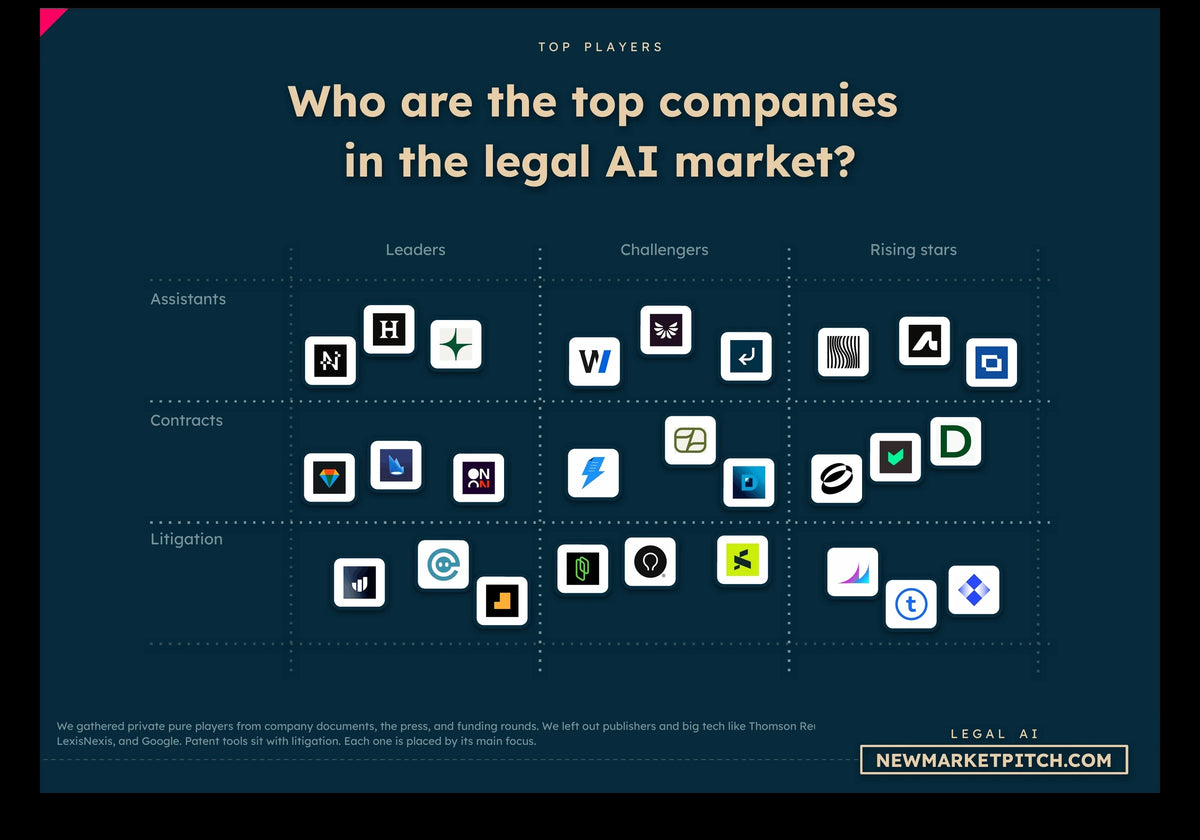
Who are the top legal AI startups besides Harvey?

Whether you're building or investing in the legal AI market, our report covers everything you need to know: the players, the money, and what's coming next.
Summary
Legora is the top legal AI startup besides Harvey, followed by EvenUp, Spellbook, Luminance, Norm Ai, Ivo, Supio, and Eudia. Legora is the strongest direct rival, while the others lead different parts of the legal AI market, from personal injury litigation to contracts and regulatory compliance.
Legora has the clearest evidence of large-scale revenue among these challengers. It reached a $5.6 billion valuation in April 2026 and subsequently reported approximately $150 million in annual recurring revenue, alongside around 1,500 law firm and corporate legal customers.
Customer counts reveal a different hierarchy. Spellbook reported 4,000 customer organizations and EvenUp more than 2,000 law firms, both above Legora's reported organization count. But thousands of smaller subscriptions can still generate less revenue than large enterprise contracts.
Personal injury law has produced one of the strongest specialist markets. EvenUp raised approximately $385 million and reported helping resolve more than 200,000 cases, while Supio disclosed 17-fold ARR growth. The competition is increasingly about automating entire case workflows, not just writing legal documents.
Corporate contracts have three particularly credible challengers. Spellbook leads on disclosed customer reach, Luminance has established a broad enterprise contract platform, and Ivo reported 500% ARR growth alongside major customers including Uber, Shopify, Atlassian, and Canva.
Norm Ai is making a different bet: combining AI agents with qualified lawyers to deliver legal services directly. Its $1.2 billion valuation reflects interest in a business that could capture legal-service spending rather than earning only software subscription fees, although its actual revenue remains undisclosed.
Eudia has built relationships with major technology platforms and legal service providers, but distribution is not the same as paid adoption. Its partnerships with Microsoft, Google Cloud, ServiceNow, NVIDIA, and Harbor provide potential reach without yet proving Legora-level commercial scale.
The incumbents are becoming harder to ignore. Clio completed a $1 billion acquisition of vLex, combining legal research with software already used by more than 200,000 legal professionals. Thomson Reuters and LexisNexis are also competing directly while investing in younger legal AI companies.
Legal AI is demonstrating real operational value in specific workflows. EvenUp customers have reported reducing demand letter preparation from approximately 20 hours to two to four hours, although these company-published case studies do not establish what an average customer saves after subscription costs.
Valuations already assume extraordinary growth. Legora's $5.6 billion valuation represents approximately 37 times its subsequently reported $150 million ARR, while Harvey's March 2026 financing valued it at roughly 58 times its end-2025 ARR. The lasting winners may be the companies that become indispensable to particular legal workflows, rather than those offering the widest collection of AI features.

Written by the New Market Pitch teamWe track new markets so founders and investors can move faster. About us
Is Legora now Harvey's biggest legal AI competitor?
Legora is Harvey's strongest direct competitor, and it is the only independent legal AI startup with a similarly broad product and enough disclosed revenue to make the comparison convincing.
The Swedish company, formerly called Leya, reached a $5.6 billion valuation in April 2026 after adding a $50 million extension to its $550 million Series D. That was more than triple its $1.8 billion valuation in October 2025. Over the same period, Legora crossed $100 million in annual recurring revenue, according to its financing announcement.
The Financial Times subsequently reported approximately $150 million in ARR during the second quarter and around 1,500 law firm and corporate legal customers. That compares with roughly 800 organizations reported in March. Although the two customer figures were collected at different points and may not use exactly the same definitions, the expansion is substantial.
Legora has secured relationships with White & Case, Cleary Gottlieb, Goodwin, Linklaters, and Deloitte. These customers are particularly valuable because large international firms can deploy legal AI across thousands of lawyers and many different practice areas.
Harvey remains ahead financially. In March 2026, it raised $200 million at an $11 billion valuation, roughly twice Legora's confirmed April valuation. A subsequent September financing increased Harvey's valuation to $15.5 billion. Harvey had also reported approximately $190 million in ARR at the end of 2025, compared with Legora's later $150 million figure.
Still, Legora's growth has made the competition much closer than it was a year earlier. It now has significant revenue, international law firm adoption, and the capital to keep expanding. Among independent companies trying to become the main AI platform for professional legal work, Legora is clearly number two.
If you want more recent data on this point, please see our latest legal AI market report.
Is EvenUp one of the biggest legal AI startups even though it doesn't compete directly with Harvey?
EvenUp is one of the largest legal AI startups, and its specialization in personal injury law has already produced a business valued at more than $2 billion.
In October 2025, EvenUp raised $150 million in a Series E led by Bessemer Venture Partners, bringing its total funding to approximately $385 million. Bloomberg Law reported that the company served more than 2,000 law firms, including 20% of the 100 largest personal injury firms in the United States.
That customer base makes EvenUp particularly interesting. Its reported firm count exceeds Legora's more recently disclosed organization count, although the two companies sell different products to different customers.
EvenUp focuses on the entire personal injury case process, including reviewing medical records, drafting demand letters, evaluating claims, and preparing settlement negotiations. Its AI has been developed using hundreds of thousands of injury cases and millions of medical records.
The company also reported helping resolve more than 200,000 cases and secure over $10 billion in damages for injury victims by October 2025. Those figures describe legal outcomes associated with its platform, rather than revenue earned by EvenUp.
Personal injury firms repeat similar processes across large numbers of cases. EvenUp can demonstrate its value through faster preparation, increased case capacity, and improved operational efficiency.
We rank EvenUp immediately behind Legora among the most credible independent legal AI businesses. Its revenue remains undisclosed, so we cannot confidently say it is the second-largest company by sales. But its customers, capital raised, and specialization make it one of the strongest.

In our report covering the legal AI market, we turn what is vague and complex into simple, useful visuals. Market maps like this one show you at a glance where every startup stands.
Does Spellbook actually have more legal AI customers than Legora?
Spellbook has reported more than twice as many customer organizations as Legora, making it one of the strongest legal AI startups by adoption, even though its revenue is less transparent.
In October 2025, Spellbook announced a $50 million Series B led by Khosla Ventures. At that point, it served approximately 4,000 law firms and in-house legal teams across 80 countries. Legora's later reported customer base was about 1,500 organizations.
Spellbook's growth also goes back further than one funding announcement. The company reported more than 600 legal teams in 2023, meaning its disclosed customer base grew by more than six times over roughly two years.
Its main advantage is simple: Spellbook works inside Microsoft Word, where lawyers already draft and review contracts. Lawyers can review clauses, generate suggested language, and analyze contractual risks without leaving their normal document workflow.
Spellbook reported that it was on track to triple revenue during 2025. That suggests growth is continuing beyond customer acquisition, although the company did not publish an absolute ARR figure.
The comparison with Legora exposes an important difference between customer count and financial scale. A platform serving 4,000 smaller firms can generate less revenue than one serving 1,500 large organizations under much bigger contracts.
Spellbook has a convincing claim to being one of the most widely adopted independent legal AI products. Legora has stronger disclosed evidence of large-scale recurring revenue.
Is Luminance still one of the top legal AI startups?
Luminance remains one of the most established independent legal AI companies, particularly in enterprise contract management, where it built a customer base before the generative AI boom.
Founded in 2015, Luminance predates Harvey, Legora, and many of their newer competitors. Its technology originally focused on using machine learning to analyze large collections of legal documents, including during mergers and acquisitions.
The company has since moved into contract creation, negotiation, review, and post-signature analysis. Its offering now covers agreements throughout their lifecycle.
In February 2025, Luminance raised $75 million in a Series C led by Point72 Private Investments. It reported more than 700 customer organizations across over 70 countries, including AMD, Hitachi, LG Chem, Rolls-Royce, and SiriusXM.
Its growth figures are particularly useful. Luminance reported that customer numbers for its core corporate product had increased fivefold and ARR sixfold over two years. In a separate company update, it reported more than fivefold total ARR growth across a similar period.
Revenue growing faster than customer count suggests Luminance has been able to increase the commercial value of its customer relationships as adoption expanded.
More recently, Luminance has continued expanding in the United States, which accounts for more than one-third of its reported revenue. That geographic shift is important for a British legal AI company because the US is both a major legal technology market and the home of several of its strongest competitors.
Luminance belongs near the top of any serious legal AI ranking. Its main weakness in a financial comparison is the absence of a publicly disclosed absolute ARR figure.

Our research about legal AI tools gets updated several times a month, so you always get the latest view of where things stand.
Is Ivo catching up with Spellbook and Luminance in contract AI?
Ivo is one of the fastest-growing corporate contract AI startups, and its recent revenue growth suggests it could become a major competitor to Spellbook and Luminance.
In January 2026, Ivo raised $55 million in a Series B led by Blackbird. Since its previous financing, the company reported a 500% increase in annual recurring revenue, 134% growth in total customers, and a 250% increase in Fortune 500 adoption.
The revenue and customer figures allow us to make a useful comparison. A 500% ARR increase means revenue reached six times its earlier level, while customer numbers increased by approximately 2.34 times. Assuming both figures cover the same customer population, average recurring revenue per customer rose about 2.6 times.
That's an unusually strong combination. Ivo has been gaining customers while also generating considerably more revenue per customer.
Its enterprise clients include Uber, Shopify, Atlassian, Reddit, and Canva. IBM has also been identified among companies using its technology.
Ivo's product began with AI-powered contract review inside Microsoft Word. It has expanded into contract repositories and intelligence, allowing businesses to examine obligations and risks across existing agreements.
This brings Ivo into competition with two established approaches. Spellbook has built broad distribution through Word-based drafting, while Luminance offers a more extensive contract management platform.
Ivo has the growth figures and customer names to challenge both. But without an absolute revenue disclosure, its 500% growth should not automatically place it above a larger, slower-growing competitor.
Which legal AI startups have the most impressive commercial numbers?
Legora has the strongest disclosed revenue benchmark among the independent legal AI startups examined, while Spellbook and EvenUp stand out for customer reach. Ivo and Supio have reported exceptional growth rates, but their absolute revenue remains undisclosed.
We compared the companies using three different types of evidence: recurring revenue, paying or reported customer organizations, and financing. These measures reveal different kinds of strength, so a company leading one column should not automatically win the overall ranking.
| Startup | Reported commercial scale | Growth evidence | Last major disclosed financing |
|---|---|---|---|
| Legora | ~$150M ARR; ~1,500 organizations | From ~$100M to ~$150M ARR during 2026 | $600M Series D including extension; $5.6B valuation |
| EvenUp | 2,000+ law firms | Valuation more than doubled in roughly one year | $150M Series E; over $2B valuation |
| Spellbook | 4,000 organizations | More than 6x reported customer growth since 2023 | $50M Series B |
| Luminance | 700+ organizations | ~6x corporate product ARR growth over two years | $75M Series C |
| Ivo | Enterprise customers including major global companies | 500% ARR growth; 134% customer growth | $55M Series B |
| Norm Ai | Institutional deployments; revenue undisclosed | Expanding into AI-native legal services | $120M Series C; $1.2B valuation |
| Supio | Revenue undisclosed | 17x ARR growth since emerging from stealth | $91M cumulative funding |
| Eudia | 500+ digital twins reported | Expanded enterprise partnerships in 2026 | Up to $105M Series A commitment |
The figures come from company financing announcements, disclosures reported by Bloomberg Law, Fortune, the Financial Times, and other industry publications. They cover different dates and are generally unaudited.
One useful observation is that customer counts and company valuations are telling very different stories. Spellbook reported thousands of legal customers without disclosing a billion-dollar valuation, while Norm Ai reached a $1.2 billion valuation without a comparable public customer count.
Among the companies with enough disclosed numbers to evaluate commercial traction, Legora remains the most convincing overall leader after Harvey.

In our market report about legal AI tools, we look at what the winners do differently, so you can learn from the best instead of guessing.
Could Norm Ai become bigger than traditional legal AI software companies?
Norm Ai could become a major competitor by selling AI-powered legal services directly, although its business model is much less commercially proven than Legora's.
In July 2026, Norm Ai raised $120 million at a $1.2 billion valuation. The round was led by Khosla Ventures, with participation from Blackstone, Bain Capital Ventures, Coatue, Vanguard, New York Life, and TIAA. Total capital raised exceeded $260 million.
Norm Ai originally focused on automating regulatory and compliance work for large financial institutions. It developed AI agents designed to interpret legal requirements and apply them to institutional documents and workflows.
Its biggest strategic move came with Norm Law, an affiliated law firm that uses Norm Ai's technology and qualified attorneys to deliver legal services. Human lawyers supervise the AI agents, while the firm aims to price work based on outcomes rather than traditional hourly billing.
That distinction could eventually be significant. Harvey and Legora primarily sell software to organizations that already employ lawyers. Norm Ai is also pursuing revenue that would otherwise go to legal service providers.
The company's institutional relationships give it a plausible starting point. In early 2026, Norm Ai described deployments involving institutions managing more than $30 trillion in assets. That figure reflects the assets of those institutions, however, and tells us little about Norm Ai's own revenue.
We would rank Norm Ai among the most ambitious legal AI companies rather than among the most commercially proven. Its model could capture more value per legal assignment, but it also brings the operational complexity of delivering professional services. Building a law firm and building a software company are two very different jobs.
If you want more recent data on this point, please see our latest legal AI market report.
Can Supio seriously challenge EvenUp in personal injury law?
Supio is one of EvenUp's strongest specialist competitors, with rapid growth and a product increasingly focused on handling complete plaintiff-side legal workflows.
In July 2026, Supio reported that annual recurring revenue had increased 17 times since the company emerged from stealth less than two years earlier. It also disclosed $91 million in cumulative funding from investors including Sapphire Ventures, Mayfield, and Thomson Reuters Ventures.
Supio initially concentrated on helping personal injury lawyers analyze medical records, organize evidence, and prepare legal documents. Its Supio Agent product has since expanded the offering toward more complete litigation workflows.
The company has also strengthened its relationship with Thomson Reuters, giving it a connection to one of the largest established legal technology providers.
EvenUp remains ahead on several available measures. It had raised approximately $385 million by October 2025, more than four times Supio's disclosed cumulative funding, and reported over 2,000 law firm customers. Its software also covers a broad range of pre-litigation tasks.
Supio's 17-fold revenue growth is impressive, but the undisclosed starting point makes comparisons difficult. A company moving from $1 million to $17 million has the same growth multiple as one moving from $10 million to $170 million.
EvenUp leads the personal injury AI category on disclosed scale. Supio deserves a place among the leading challengers because it has demonstrated rapid growth and is competing for much of the same work.

In our document detailing everything you need to know about legal AI, you will always find fresh funding data, taken straight from our own verified funding database.
Is Eudia building something bigger than a legal AI assistant?
Eudia is attempting to become a platform for enterprise legal, contracting, and compliance work, and its recent partnerships suggest it is pursuing much broader distribution.
In 2025, Eudia announced a Series A financing commitment of up to $105 million led by General Catalyst. The wording matters: a commitment of up to a certain amount should not be treated as proof that the entire sum was immediately funded.
Its technology focuses on capturing the knowledge of experienced legal and compliance professionals in AI agents and digital representations of expert judgment. Eudia reported more than 500 digital twins deployed, although it has not published the recurring revenue associated with them.
During 2026, the company announced partnerships with ServiceNow, Microsoft, Google Cloud, NVIDIA, and legal services provider Harbor.
The Harbor partnership is particularly interesting. Announced in September, it gives Eudia access to a services organization that works with nearly 600 corporate legal departments and more than 80% of Global 200 law firms. In August, Eudia also introduced legal AI capabilities developed with Google Cloud's Gemini Enterprise.
Those distribution relationships could help Eudia reach large customers without building every sales relationship itself. They also give it connections to enterprise systems already used by legal, procurement, and compliance teams.
However, a partner's customer base is not Eudia's customer base. We still lack the revenue and deployment figures needed to know how much commercial activity these partnerships generate.
Eudia belongs among the most interesting enterprise legal AI startups, but its financial position is considerably harder to judge than Legora's.
Are smaller legal AI startups like August and Paxton worth watching?
August and Paxton are credible emerging legal AI startups, particularly for firms looking for alternatives to expensive enterprise platforms, but neither has demonstrated the commercial scale of the leading companies.
August focuses on configurable AI workflows for law firms. After raising $7 million from investors including NEA and Pear VC, it disclosed relationships with firms such as Hughes Hubbard, Hicksons, and Harrison Drury.
Its approach could appeal to firms that want AI tailored to their actual practice rather than a single standardized assistant. A litigation practice, for example, has different document review and preparation needs from a real estate or corporate practice.
Paxton takes another approach, emphasizing legal research and drafting grounded in US federal and state legal sources. This addresses one of the biggest concerns about using general-purpose AI for legal work: incorrect citations and unsupported interpretations.
Both companies compete in a market where Harvey and Legora already have substantial funding advantages. Established providers such as Thomson Reuters and LexisNexis also offer legal research and drafting tools through products lawyers have used for years.
August and Paxton therefore need to prove they can win customers through pricing, specialization, usability, or superior results in particular legal tasks.
We would put both in the emerging challenger category. Their product positioning is credible, but publicly disclosed revenue, paid customer counts, and retention figures are insufficient to rank them alongside the largest legal AI startups.

Learning from others' mistakes is the cheapest lesson there is. In our report covering the legal AI market, we look at what broke startups before you, so you don't repeat it.
Could Clio become a bigger threat to Harvey than another AI startup?
Clio may be one of Harvey's most serious long-term competitors because it already controls software used to manage legal work, and its acquisition of vLex added a major legal research platform.
In November 2025, Clio completed its $1 billion acquisition of vLex and announced a $500 million Series G at a $5 billion valuation. It also secured a $350 million debt facility.
The acquisition brought together Clio's practice management products and vLex's Vincent AI legal research system. According to Clio, vLex's database contains more than one billion legal documents across 110 jurisdictions.
Clio was already serving a large existing legal market. Before the acquisition, the company said its technology was trusted by more than 200,000 legal professionals.
The combination gives Clio a way to connect legal research with client files, case management, document drafting, billing, and law firm operations.
That integration could become a meaningful advantage. Lawyers already spend much of their day inside their firm's practice management software. Adding capable AI to those systems potentially reduces the need for another standalone product.
We keep Clio outside our ranking of AI-native startups because it was founded as a broader legal software company. Nevertheless, Clio is a stronger competitive threat than many younger businesses with much higher public visibility in generative AI.
If you want more recent data on this point, please see our latest legal AI market report.
Can Thomson Reuters and LexisNexis stop legal AI startups from taking their customers?
Thomson Reuters and LexisNexis have enough legal content, customer relationships, and distribution power to remain major competitors, but their investments in AI startups show that they also want exposure to the newer companies.
Thomson Reuters sells CoCounsel and Westlaw, combining generative AI assistance with established legal research products. LexisNexis has expanded its Lexis+ AI offering around its legal information services.
These companies hold an advantage that is difficult for startups to recreate quickly: extensive legal databases, established licensing arrangements, and relationships with law firms that already pay for their products.
The competitive relationship is unusually complicated. Thomson Reuters Ventures has invested in Spellbook and Supio. REV, associated with LexisNexis parent RELX, participated in EvenUp's October 2025 financing.
Some legal AI startups therefore receive capital or distribution opportunities from companies that also compete with them.
Clio's $1 billion acquisition of vLex offers another indication of how this market could develop. Established providers can strengthen their AI products through acquisitions instead of developing every capability internally.
For startups, the pressure is likely to be greatest in general-purpose legal research, where incumbent databases remain central. Specialist workflows such as medical-record analysis, contract negotiation, and case preparation may offer more room to build independent customer relationships.

Your time is limited. In our research about legal AI tools, we put numbers on each part of the market, so you can see where it makes sense to focus.
Are legal AI startups actually saving law firms enough money to justify their prices?
Legal AI companies have produced credible examples of major time savings, particularly in personal injury and contract work, but we still lack consistent independent data showing how profitable those deployments are for customers.
EvenUp has published several detailed customer examples. In June 2026, Lerner & Rowe reported accelerating portions of its personal injury process by up to three months. In September, Jose Robles Jr. Law reported reducing demand letter preparation from approximately 20 hours to two to four hours.
That second example represents an 80% to 90% reduction in preparation time for the reported task. The firm also said it could produce five times as many letters without increasing staff.
Another September case study from Altman Nussbaum Shunnarah described a 67% increase in capacity per pre-litigation attorney.
These figures come from individual company customer studies, and we should not assume every law firm will achieve the same improvements. Still, they show why firms handling repetitive, document-heavy work are willing to buy specialized AI products.
Contracts offer a similar opportunity. Spellbook, Ivo, and Luminance concentrate on drafting, reviewing, and negotiating agreements that businesses need to process repeatedly.
The harder question is how much of the saved labor cost legal AI suppliers can capture. A firm may save thousands of hours but negotiate a fixed subscription, while competitors put downward pressure on software prices.
Productivity improvements are real in several well-defined workflows. Customer-level profitability and long-term vendor economics remain harder to establish from public evidence.
Are the top legal AI startups already overvalued?
Some of the highest-valued legal AI startups are priced for exceptional future growth, and Legora's disclosed revenue shows just how demanding those expectations have become.
In April 2026, Legora reached a $5.6 billion valuation after passing $100 million in annual recurring revenue. That implies an illustrative valuation of around 56 times ARR using those figures.
Using the approximately $150 million ARR subsequently reported by the Financial Times reduces the ratio to around 37 times. The revenue and valuation observations come from different dates, so neither should be treated as an exact transaction multiple.
Harvey offers another useful comparison. Its $11 billion valuation in March 2026 was nearly 58 times its reported $190 million ARR at the end of 2025. Its September valuation subsequently reached $15.5 billion, although applying that newer valuation to the old revenue figure would give an increasingly stale comparison.
These are substantial valuations, even for businesses growing quickly. A company valued at 40 times ARR must quadruple its revenue just to reduce the multiple to 10 times, assuming its valuation stays unchanged.
Recent developments also reveal how investor expectations are changing. In September 2026, the Financial Times reported that Legora had recorded more than seven consecutive quarters of annual recurring revenue growth exceeding 50% year over year, while also considering a financing that could value the company at around $10 billion.
The same reporting highlighted risks from large law firms developing their own AI capabilities and the arrival of more powerful general-purpose models. Legora's move toward usage-based pricing could also change how customers consume the product and how revenue grows.
Legora and Harvey have built real businesses, but their valuations leave little room for a prolonged slowdown. Investors are assuming that legal AI platforms will become deeply embedded in legal work and keep expanding their share of industry spending. That's a very big assumption to pay for upfront.
If you want more recent data on this point, please see our latest legal AI market report.

In our market report about legal AI tools, we always try to gather several sources and make estimates that make sense, so you can work with solid numbers.
Which legal AI startups are leading each part of the market?
Legora is the strongest direct Harvey rival, but the leading startups in personal injury, contracts, compliance, and legal services have built very different competitive positions.
After reviewing disclosed revenue, customer adoption, financing, and recent product expansion, we identify the following leaders by specialization. The ranking reflects available evidence rather than assuming that every company operates in the same market.
| Legal AI category | Leading startup | Strong challenger | Key evidence |
|---|---|---|---|
| Broad enterprise legal AI | Legora | August | ~$150M reported ARR and ~1,500 organizations |
| Personal injury AI | EvenUp | Supio | 2,000+ law firms and $385M raised |
| Contract drafting | Spellbook | Ivo | 4,000 organizations across 80 countries |
| Enterprise contract intelligence | Luminance | Ivo | 700+ customers; ~6x corporate ARR growth |
| Fast-growing corporate contract AI | Ivo | Spellbook | 500% ARR growth and major enterprise customers |
| Regulatory compliance AI | Norm Ai | Eudia | $1.2B valuation and institutional deployments |
| Enterprise legal operations | Eudia | Norm Ai | Partnerships with Google Cloud, Microsoft, and Harbor |
| AI for midsize law firms | August | Paxton | Configurable workflows and named law firm customers |
| Litigation opportunity discovery | Darrow | Specialist litigation analytics providers | Reported identification of litigation involving $22B in claims |
The legal AI market has several large specialists that can grow without winning the same customers as Harvey.
EvenUp can succeed by serving personal injury law firms. Ivo can build a substantial business around enterprise contracts. Norm Ai can pursue regulatory work and AI-enabled legal services.
These businesses will increasingly compete over some common features, but their commercial success still depends heavily on the legal workflows they understand best.
So who are the top legal AI startups besides Harvey?
Legora is the strongest legal AI startup after Harvey, followed by EvenUp, Spellbook, Luminance, Norm Ai, Ivo, Supio, and Eudia. This is our overall ranking based on the commercial evidence available, although the order after Legora is less certain.
Legora deserves first place because it combines roughly $150 million in reported ARR with around 1,500 customer organizations, adoption by major international law firms, and a $5.6 billion completed financing valuation. It has the best documented mix of revenue, customer growth, and direct competition with Harvey.
EvenUp comes next because it has established a large position in personal injury law, with more than 2,000 reported law firm customers and approximately $385 million in funding. Spellbook follows for its unusually broad adoption, reaching 4,000 customer organizations, while Luminance has built one of the most established AI businesses in corporate contracts.
Norm Ai is less commercially transparent but could become a major company if its AI-native law firm model works at scale. Ivo has some of the strongest disclosed growth figures, including a 500% ARR increase, and Supio is developing into a serious challenger in plaintiff litigation. Eudia has attracted important enterprise partners but needs more public evidence of paid adoption.
Clio also deserves special attention, even though it falls outside the AI-native startup ranking. Its $1 billion acquisition of vLex gives it an unusually strong combination of legal research, AI, and existing law firm software.
Legal AI already has several credible winners beyond Harvey, and they are succeeding in different ways. Legora is fighting for the same large law firms. EvenUp and Supio are automating plaintiff litigation. Spellbook, Luminance, and Ivo are competing for contract work. Norm Ai is experimenting with a different way to deliver legal services.
Legora is the clearest number-two legal AI platform. But the next large winner could just as easily come from one of these specialist markets, where owning a valuable legal workflow may prove more durable than offering the broadest AI assistant.
If you want more recent data on this point, please see our latest legal AI market report.

If you build or invest in the legal AI market, you need to know which business models pay off now and which ones are fading. That's why our report covering it has a whole section on it.
Our methodology
This analysis identifies the strongest independent legal AI startups besides Harvey using commercial evidence available through October 2026. We compare the leading companies across broad legal AI platforms, personal injury automation, contract drafting and intelligence, regulatory compliance, and AI-enabled legal services. We also examine established providers such as Clio, Thomson Reuters, and LexisNexis to understand the competitive landscape.
We approached the ranking as a structured aggregation of recent evidence rather than a simple ordering by valuation or total funding. For each company, we collected recent financing disclosures, reported recurring revenue, customer adoption, commercial growth, enterprise deployments, product expansion, and evidence of operational results. We aggregated those findings within each dimension, compared them across companies, and assessed which conclusions were supported by several measures rather than a single announcement.
Commercial traction received the greatest weight. Absolute ARR and identifiable customer adoption were treated as stronger evidence of scale than percentage growth without a disclosed starting point. We kept customer organizations, individual users, product deployments, and technology partners separate because they describe different levels of adoption. A company serving thousands of smaller law firms cannot automatically be considered larger than one with fewer multinational enterprise customers.
We also distinguished completed equity financings from announced funding commitments, and reported company valuations from prospective financing discussions. Capital raised and valuation were used to assess financial backing and investor expectations, not as substitutes for revenue. Where valuations and ARR figures came from different reporting dates, the resulting multiples were presented as illustrative comparisons rather than precise transaction multiples.
Competitive positioning was assessed within each legal workflow before drawing broader conclusions. We examined whether companies had established commercial relationships with relevant customers, expanded beyond narrow initial products, developed distinctive capabilities, or demonstrated practical results. For operational outcomes, we considered reported time savings, case throughput, and lawyer productivity, while distinguishing individual customer studies from independently verified industry-wide performance.
Our final ranking gives priority to demonstrated commercial scale, reinforced by customer breadth, revenue momentum, financial resources, and competitive positioning. This explains why Legora leads the overall ranking, while specialists such as EvenUp, Spellbook, and Luminance rank ahead of some highly valued but less commercially transparent businesses. Emerging companies are assessed on the evidence already available rather than the full size of the markets they hope to address.
Key financing and commercial sources include Legora's Series D announcement, TechCrunch's reporting on Legora's April financing extension, Harvey's September 2026 financing announcement, EvenUp's Series E disclosure, Spellbook's Series B announcement, Luminance's Series C announcement, Ivo's Series B disclosure, and Ivo's reported revenue and customer growth figures.
For newer business models and enterprise distribution, we examined Norm Ai's financing and legal services strategy, Eudia's funding and product positioning, Eudia's Harbor partnership, NEA's investment announcement for August, and Clio's completed vLex acquisition and financing. We also used LexisNexis's EvenUp investment announcement to assess strategic relationships between incumbents and independent startups.
Evidence of customer-level productivity was drawn from EvenUp's published studies involving Lerner & Rowe, Jose Robles Jr. Law, and Altman Nussbaum Shunnarah. These were considered alongside company announcements and reporting from the Financial Times, Bloomberg Law, Fortune, and specialist legal industry publications. Figures were evaluated according to their disclosure dates and the specific activities they measured, with greater weight given to attributable commercial and operational evidence than to unsupported claims about future market leadership.

In our report covering the legal AI market, we don't want to repeat what boring consulting reports say. Instead, we show you the real and latest market signals that matter.
Written by the New Market Pitch teamWe track new markets so founders and investors can move faster. About us