What are the most valuable medical imaging AI startups?
Whether you're building or investing in the medical imaging AI market, our report covers everything you need to know: the players, the money, and what's coming next.
Summary
Aidoc leads the medical imaging AI startup ranking, with a valuation we estimate at $1.0B–$1.9B. Viz.ai follows at $1.2B, and they are the only 2 startups whose valuations clear $1B across their full range.
The gap between the famous names and everyone else is large. We track 146 startups, and 143 sit below the billion-dollar bracket. The last one, Shukun Technology, has no current valuation, because its last published price, $1.45B in 2021, is more than five years old.
The leaders sell different things. Aidoc helps hospitals detect urgent findings and manage cases, Viz.ai connects scan alerts with treatment teams, and Cleerly, in third place, measures plaque in coronary CT scans.
Dentistry is close to having its own unicorn. DentalMonitoring, which helps orthodontists follow patients between visits, is estimated at $667M–$1.2B from its February 2026 round, while Overjet, Pearl and Videa compete to make dental X-rays more useful inside practices.
The United States has the deepest field, with 42 companies in our coverage against China's 6, and three of the top five places. Israel's Aidoc holds first place, and China's highest-ranked startup is Deepwise, in sixth.
Europe is building serious businesses too. France has 19 startups and the United Kingdom 17, covering everything from dental monitoring to cardiac ultrasound and cancer screening.
A few familiar names need a different comparison. HeartFlow trades on the stock market, while PathAI's value comes from a deal with Roche. Neither price is the equivalent of a new private funding round.
Even the best-known unicorn headlines can be old. Viz.ai's stated price dates back to an earlier financing, while newer rounds sometimes provide enough information for a range rather than one exact valuation.
We have values stated by a source or set by a deal for 8 companies. For the other 138, we use estimates, which is why we distinguish a reported price from a possible range.
Medical imaging AI can support big businesses in several different specialties. The next leader will have to keep selling useful clinical software, not simply collect approvals or a bigger headline valuation.

Written by the New Market Pitch teamWe track new markets so founders and investors can move faster. About us

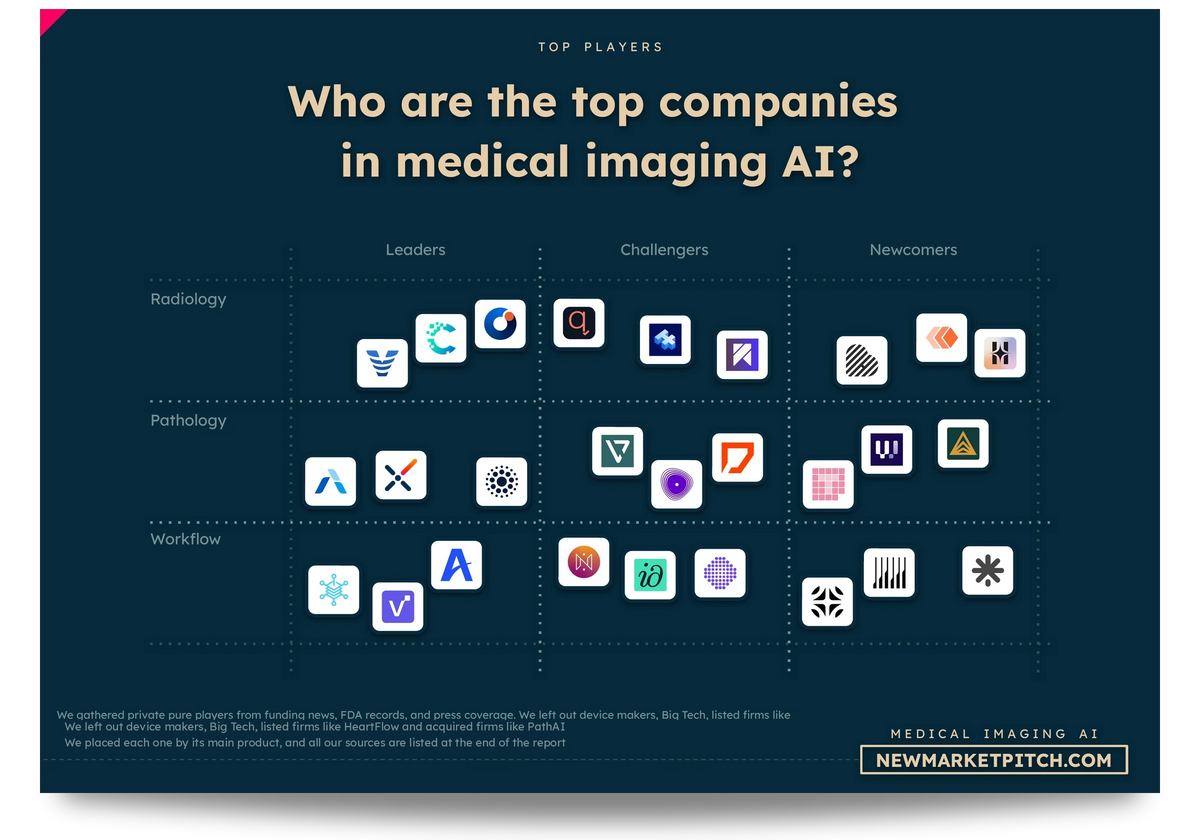
In our report covering the medical imaging AI market, we turn what is vague and complex into simple, useful visuals. Market maps like this one show you at a glance where every startup stands.
Top startups in the medical imaging AI market ranked by valuation
Here is the current ranking of the most valuable medical imaging AI startups. For each one you will also find our confidence level and the valuation basis we used.
If you want to go deeper into the medical imaging AI startup landscape, check our report covering the medical imaging AI market.
| # | Startup | Valuation | Confidence | Valuation basis | Last round | Total funding |
|---|---|---|---|---|---|---|
| Private startups | ||||||
| 1 | AidocAI clinical imaging and triage | $1.0B–$1.9Bas of Apr 2026 | Low | Estimated from last round | $150MSeries E · Apr 2026 | $436Mvalued at 3.1× this |
| 2 | Viz.aiAI disease detection and care coordination | $1.2Bas of Apr 2022 | Full | Announced private round valuation | $100MSeries D · Apr 2022 | $171M+valued at 7.0× this |
| 3 | CleerlyAI coronary plaque analysis | $700M–$1.3Bas of Nov 2026 | Partial | Comparables-based estimate | $106MSeries C · Dec 2024 | $372Mvalued at 2.6× this |
| 4 | DentalMonitoringAI remote orthodontic monitoring | $667M–$1.2Bas of Feb 2026 | Low | Estimated from last round | $100MGrowth equity · Feb 2026 | $300Mvalued at 3.0× this |
| 5 | PathAIAI-powered digital pathology diagnostics | $750M1as of May 2026 | Full | Acquisition value | $165MSeries C · May 2021 | $236M+valued at 3.2× this |
| 6 | DeepwiseAI-powered radiology diagnostics platforms | $463M–$869Mas of Jan 2025 | Low | Estimated from last round | $70MSeries D · Jan 2025 | $70M+valued at 9.1× this |
| 7 | ArteraAIAI cancer treatment decision tests | $360M–$900Mas of Mar 2023 | Low | Estimated from last round | $20MOther · Feb 2024 | $110Mvalued at 5.2× this |
| 8 | OverjetAI dental radiograph analysis | $550Mas of Mar 2024 | Strong | Reported private round valuation | $25MSeries C-1 · Dec 2025 | $156Mvalued at 3.5× this |
| 9 | Rad AI2Generative AI for radiology reporting | $525Mas of Jan 2025 | Full | Announced private round valuation | $8MSeries C extension · May 2025 | $147M+valued at 3.6× this |
| 10 | Harrison.aiAI radiology and pathology diagnostics | ~$521Mas of Feb 2025 | Strong | Reported private round valuation | $112MSeries C · Feb 2025 | $131M+valued at 4.0× this |
| 11 | ElucidAI cardiovascular plaque analysis | $367M–$688Mas of Sep 2026 | Low | Estimated from last round | $55MSeries D · Sep 2026 | $65Mvalued at 7.7× this |
| 12 | UltromicsAI cardiac ultrasound disease detection | $367M–$688Mas of Jul 2025 | Low | Estimated from last round | $55MSeries C · Jul 2025 | $101M+valued at 5.0× this |
| 13 | Qure.ai2AI diagnostics for medical scans | $350M–$700Mas of Nov 2026 | Partial | Comparables-based estimate | $65MSeries D · Sep 2024 | $121Mvalued at 4.1× this |
| 14 | Pearl2AI dental imaging diagnostics | $400Mas of Jul 2024 | Strong | Reported private round valuation | UndisclosedOther · Dec 2024 | $69Mvalued at 5.8× this |
| 15 | Sirona MedicalCloud radiology software and AI | $267M–$500Mas of Oct 2026 | Low | Estimated from last round | $40MSeries D · Oct 2026 | $122M+valued at 3.0× this |
| 16 | VideaAI dental X-ray diagnostics | $267M–$500Mas of Jan 2025 | Low | Estimated from last round | $40MSeries B · Jan 2025 | $65M+valued at 5.6× this |
| 17 | Scopio LabsAI blood smear microscopy and analysis | $270M–$420Mas of Nov 2026 | Partial | Comparables-based estimate | $10MSeries D+ · Jul 2025 | $125Mvalued at 2.7× this |
| 18 | QuibimAI imaging biomarkers for precision medicine | $250M–$417Mas of Jan 2025 | Low | Estimated from last round | $50MSeries A · Jan 2025 | $65Mvalued at 5.0× this |
| 19 | RapidAI2AI stroke imaging and workflows | $200M–$520Mas of Nov 2026 | Partial | Comparables-based estimate | $25MSeries B · Sep 2020 | $25Mvalued at 12.9× this |
| 20 | Subtle MedicalAI-enhanced MRI, PET and CT | $220M–$412Mas of Jun 2026 | Low | Estimated from last round | $33MSeries C · Jun 2026 | $43Mvalued at 7.0× this |
| 21 | InfervisionAI-assisted radiology image interpretation | $160M–$500Mas of Nov 2026 | Partial | Comparables-based estimate | Undisclosed | |
| 22 | Pictor LabsAI virtual tissue staining | $200M–$375Mas of Sep 2024 | Low | Estimated from last round | $30MSeries B · Sep 2024 | $49Mvalued at 5.6× this |
| 23 | Vista AIAI-powered automated MRI scanning | $197M–$369Mas of Jan 2026 | Low | Estimated from last round | $30MSeries B · Jan 2026 | $38M+valued at 7.0× this |
| 24 | Ibex Medical AnalyticsAI-assisted cancer pathology detection | $180M–$380Mas of Nov 2026 | Partial | Comparables-based estimate | $55MSeries C · Sep 2023 | $104Mvalued at 2.5× this |
| 25 | Digital DiagnosticsAutonomous AI diabetic retinopathy screening | $170M–$400Mas of Nov 2026 | Partial | Comparables-based estimate | $75MSeries B · Aug 2022 | $75Mvalued at 3.5× this |
| 26 | Omniscient NeurotechnologyBrain mapping software from MRI scans | $181M–$340Mas of May 2026 | Low | Estimated from last round | $27MSeries D+ · May 2026 | $27M+valued at 9.1× this |
| 27 | Laza MedicalAI-powered robotic cardiac imaging systems optimize catheterization-lab image acquisition and support image-guided intervention. | $180M–$300Mas of Dec 2023 | Low | Estimated from last round | UndisclosedSeries B · Nov 2026 | $36M+valued at 6.5× this |
| 28 | Smart ReportingAI-assisted structured medical reporting | $163M–$306Mas of Apr 2024 | Low | Estimated from last round | ~$24MSeries C · Apr 2024 | $45M+valued at 4.9× this |
| 29 | UltraSightAI-guided cardiac ultrasound imaging | $160M–$300Mas of Sep 2026 | Low | Estimated from last round | $24MSeries B2 · Sep 2026 | $37Mvalued at 5.9× this |
| 30 | Keya MedicalAI cardiovascular CT diagnostics | $130M–$360Mas of Nov 2026 | Partial | Comparables-based estimate | $46MSeries D · Jan 2021 | $96M+valued at 2.3× this |
| 31 | WaivAI precision oncology pathology testing | $165M–$275Mas of Mar 2026 | Low | Estimated from last round | $2MSeries A · Apr 2026 | $35Mvalued at 6.1× this |
| 32 | Imagene AIAI-powered cancer biomarker profiling | $153M–$288Mas of Jul 2025 | Low | Estimated from last round | $23MSeries B · Jul 2025 | $44Mvalued at 4.7× this |
| 33 | AI Medical ServiceAI gastrointestinal endoscopy diagnostics | $140M–$310Mas of Nov 2026 | Partial | Comparables-based estimate | $54MSeries C · Apr 2022 | $108Mvalued at 1.9× this |
| 34 | HOPPRmedical image foundation models and developer platform | $158M–$262Mas of Jun 2025 | Low | Estimated from last round | $32MSeries A · Jun 2025 | $32Mvalued at 6.5× this |
| 35 | AIRS MedicalAI MRI acceleration software | $148M–$278Mas of Sep 2026 | Low | Estimated from last round | $22MSeries D · Sep 2026 | $61Mvalued at 3.3× this |
| 36 | DeciphexAI-powered digital pathology diagnostics | $150M–$260Mas of Nov 2026 | Partial | Comparables-based estimate | $32MSeries C · Jan 2025 | $57Mvalued at 3.5× this |
| 37 | HutomAI surgical planning and navigation | $156M–$234Mas of Nov 2026 | Partial | Comparables-based estimate | $15MSeries C · Mar 2024 | $34Mvalued at 5.6× this |
| 38 | AIgnosticsAI computational pathology analysis | $145M–$250Mas of Nov 2026 | Partial | Comparables-based estimate | $34MSeries B · Oct 2024 | $76Mvalued at 2.5× this |
| 39 | PerspectumQuantitative MRI disease diagnostics | $130M–$270Mas of Nov 2026 | Partial | Comparables-based estimate | Undisclosed | |
| 40 | Skin AnalyticsAutonomous AI skin cancer detection | $128M–$240Mas of Apr 2025 | Low | Estimated from last round | $19MSeries B · Apr 2025 | $26M+valued at 6.6× this |
| 41 | ScreenPoint MedicalAI breast cancer screening software | $120M–$220Mas of Nov 2026 | Partial | Comparables-based estimate | $14MSeries C extension · Apr 2026 | $47Mvalued at 3.5× this |
| 42 | Tribun HealthAI-enabled digital pathology software | $110M–$206Mas of Sep 2023 | Low | Estimated from last round | $16MSeries B · Sep 2023 | $22Mvalued at 6.8× this |
| 43 | Hypervision SurgicalHyperspectral imaging for surgery | $115M–$191Mas of Apr 2026 | Low | Estimated from last round | ~$23MSeries A · Apr 2026 | $31M+valued at 4.7× this |
| 44 | Incepto MedicalAI radiology application distribution | $107M–$200Mas of Nov 2026 | Partial | Comparables-based estimate | $16MGrowth equity · Sep 2026 | $52Mvalued at 2.8× this |
| 45 | PromediusAI imaging analysis for age-related disease | $106M–$199Mas of Jun 2026 | Low | Estimated from last round | $16MSeries B · Jun 2026 | $26M+valued at 5.7× this |
| 46 | EdenAI medical imaging workflow infrastructure | $110M–$183Mas of Oct 2025 | Low | Estimated from last round | $22MSeries A · Oct 2025 | $47Mvalued at 3.0× this |
| 47 | Valar LabsAI cancer treatment response diagnostics | $110M–$183Mas of May 2024 | Low | Estimated from last round | $22MSeries A · May 2024 | $26Mvalued at 5.5× this |
| 48 | ClairityAI breast cancer risk prediction | $137Mas of Nov 2025 | Strong | Reported private round valuation | $43MSeries B · Nov 2025 | $43M+valued at 3.2× this |
| 49 | Ataraxis AIAI pathology tools for cancer prognosis | $102M–$170Mas of Mar 2025 | Low | Estimated from last round | $20MSeries A · Mar 2025 | $24M+valued at 5.4× this |
| 50 | Method AIAI-assisted medical imaging interpretation | $100M–$167Mas of Aug 2025 | Low | Estimated from last round | $20MSeries A · Aug 2025 | $20Mvalued at 6.5× this |
| 51 | Nucleaiai tissue image profiling for oncology precision medicine | $93M–$175Mas of Apr 2024 | Low | Estimated from last round | $14MSeries B · Apr 2024 | $58Mvalued at 2.2× this |
| 52 | New LanternAI-native radiology workflow platform | $95M–$158Mas of Nov 2024 | Low | Estimated from last round | $19MSeries A · Nov 2024 | $19Mvalued at 6.5× this |
| 53 | MediwhaleAI retinal cardiovascular risk assessment | $87M–$164Mas of Mar 2026 | Low | Estimated from last round | ~$13MSeries C · Mar 2026 | ~$35Mvalued at 3.4× this |
| 54 | Axial3DPatient-specific 3D medical models | $73M–$182Mas of Dec 2024 | Low | Estimated from last round | $18MDec 2024 | $18Mvalued at 6.3× this |
| 55 | AZmedAI X-ray fracture detection | $75M–$155Mas of Nov 2026 | Partial | Comparables-based estimate | ~$16MSeries A · Feb 2024 | $21Mvalued at 5.0× this |
| 56 | Caristo DiagnosticsAI coronary inflammation detection | $83M–$139Mas of Apr 2023 | Low | Estimated from last round | $17MSeries A · Apr 2023 | $17Mvalued at 6.5× this |
| 57 | EyenukAutonomous AI retinal disease screening | $70M–$155Mas of Nov 2026 | Partial | Comparables-based estimate | $5.6MSeries A extension · Jun 2026 | $33Mvalued at 3.1× this |
| 58 | Lucida MedicalAI prostate MRI cancer detection | $74M–$139Mas of Mar 2026 | Low | Estimated from last round | $11MGrowth equity · Mar 2026 | $11M+valued at 9.1× this |
| 59 | PreciseDxAI pathology diagnostics for cancer care | $73M–$138Mas of Jun 2025 | Low | Estimated from last round | $11MSeries B · Jun 2025 | $42Mvalued at 2.4× this |
| 60 | MindPeakAI cancer pathology analysis | $76M–$128Mas of Sep 2024 | Low | Estimated from last round | $15MSeries A · Sep 2024 | $18Mvalued at 5.4× this |
| 61 | Us2.aiAutomated AI echocardiography interpretation | $75M–$125Mas of Apr 2022 | Low | Estimated from last round | $15MSeries A · Apr 2022 | $20Mvalued at 5.0× this |
| 62 | Techcyteai digital microscopy and clinical pathology diagnostics | $60M–$150Mas of Apr 2026 | Low | Estimated from last round | $15MOther · Apr 2026 | $53Mvalued at 1.8× this |
| 63 | VIDA DiagnosticsAI pulmonary imaging and biomarkers | $55M–$150Mas of Nov 2026 | Partial | Comparables-based estimate | $11MEquity financing · Sep 2023 | $29Mvalued at 3.1× this |
| 64 | Koios MedicalAI breast and thyroid ultrasound | $90Mas of Sep 2026 | Full | Announced private round valuation | $9.3MPreferred-equity crowdfunding · Nov 2024 | $22M+valued at 4.0× this |
| 65 | Thorough FutureAI digital pathology diagnostics | $69M–$115Mas of Jun 2024 | Low | Estimated from last round | $14MSeries A · Jun 2024 | $14Mvalued at 6.5× this |
| 66 | Medical Image InsightsAI infrastructure for medical imaging | $56M–$140Mas of Oct 2025 | Low | Estimated from last round | $14MOct 2025 | $28M+valued at 3.2× this |
| 67 | deepcRadiology AI deployment and integration | $60M–$130Mas of Nov 2026 | Partial | Comparables-based estimate | $13MSeries A extension · Jul 2024 | $26M+valued at 3.4× this |
| 68 | OptellumAI lung cancer risk prediction | $60M–$130Mas of Nov 2026 | Partial | Comparables-based estimate | UndisclosedSeries B · Jan 2026 | $19M+valued at 4.6× this |
| 69 | RaidiumFoundation AI models for radiology | $68M–$113Mas of Nov 2024 | Low | Estimated from last round | $17MSeed · Nov 2024 | $17M+valued at 5.2× this |
| 70 | StratifAIAI cancer diagnostics from pathology images | $55M–$138Mas of Sep 2025 | Low | Estimated from last round | $14MOther · Sep 2025 | $15Mvalued at 5.6× this |
| 71 | mediaireAI brain MRI analysis | $66M–$110Mas of Nov 2024 | Low | Estimated from last round | $13MSeries A · Nov 2024 | $16Mvalued at 5.3× this |
| 72 | Cydar MedicalAI vascular surgery imaging guidance | $55M–$115Mas of Nov 2026 | Partial | Comparables-based estimate | $12MSeries A · Feb 2023 | $21Mvalued at 3.9× this |
| 73 | VaraAI-powered breast cancer screening | $50M–$125Mas of Nov 2026 | Partial | Comparables-based estimate | $8.9MSeries B · Oct 2024 | $16Mvalued at 4.9× this |
| 74 | BrightHeartAI prenatal ultrasound screening | $60M–$101Mas of Jan 2026 | Low | Estimated from last round | $12MSeries A · Jan 2026 | $14Mvalued at 5.5× this |
| 75 | CerebriuAI brain MRI workflow automation | $55M–$92Mas of Aug 2025 | Low | Estimated from last round | $11MSeries A · Aug 2025 | $36M+valued at 2.0× this |
| 76 | inHEARTAI cardiac imaging procedural planning | $55M–$92Mas of May 2024 | Low | Estimated from last round | $825KSeries A · Oct 2024 | $28M+valued at 2.5× this |
| 77 | AISAPAI ultrasound interpretation for clinical diagnosis | $52M–$87Mas of May 2024 | Low | Estimated from last round | $13MSeed · May 2024 | $13Mvalued at 5.2× this |
| 78 | BarreleyePortable ultrasound imaging systems | $52M–$86Mas of Nov 2025 | Low | Estimated from last round | $10MSeries A · Nov 2025 | $13Mvalued at 5.1× this |
| 79 | CARPL.aiRadiology AI deployment marketplace | $50M–$83Mas of Jul 2026 | Low | Estimated from last round | $10MSeries A · Jul 2026 | $16Mvalued at 4.0× this |
| 80 | DeepTekAI radiology and imaging diagnostics | $50M–$83Mas of Mar 2022 | Low | Estimated from last round | $10MSeries A · Mar 2022 | $10M+valued at 6.5× this |
| 81 | RetiSpecRetinal imaging tests for neurological disease | $50M–$83Mas of Jul 2024 | Low | Estimated from last round | $10MSeries A · Jul 2024 | $10Mvalued at 6.5× this |
| 82 | TherapixelAI breast imaging interpretation software | $45M–$90Mas of Nov 2026 | Partial | Comparables-based estimate | $16MSeries B · May 2022 | $23Mvalued at 2.8× this |
| 83 | BrainomixAI stroke and lung imaging | $43M–$81Mas of Feb 2026 | Low | Estimated from last round | ~$6.5MSeries C · Feb 2026 | $59M+valued at 1.0× this |
| 84 | AllisoneAI dental X-ray interpretation | $44M–$73Mas of Sep 2022 | Low | Estimated from last round | $11MSeed · Sep 2022 | $11M+valued at 5.2× this |
| 85 | Piur Imaging3D ultrasound imaging from standard probes | $41M–$77Mas of Jul 2025 | Low | Estimated from last round | $6.2MGrowth equity · Jul 2025 | $12Mvalued at 4.9× this |
| 86 | PrimaaAI breast and skin pathology | $40M–$68Mas of Oct 2025 | Low | Estimated from last round | $8.1MVenture equity · Oct 2025 | $19M+valued at 2.8× this |
| 87 | Riverain Technologiesai chest ct and x-ray analysis | $33M–$82Mas of Dec 2025 | Low | Estimated from last round | $8.2MOther · Dec 2025 | $23Mvalued at 2.2× this |
| 88 | Swift MedicalAI wound imaging and care management | $32M–$80Mas of Jan 2024 | Low | Estimated from last round | $8MJan 2024 | $8Mvalued at 6.3× this |
| 89 | ThironaAI lung and retinal imaging | $37M–$69Mas of Sep 2023 | Low | Estimated from last round | $5.5MSeries B · Sep 2023 | $5.5M+valued at 9.1× this |
| 90 | Avicenna.AIAI emergency CT diagnostics | $38M–$64Mas of Feb 2023 | Low | Estimated from last round | $7.7MSeries A · Feb 2023 | $11M+valued at 4.7× this |
| 91 | Cercare MedicalBrain perfusion imaging and decision software | $31M–$78Mas of Mar 2025 | Low | Estimated from last round | $7.8MMar 2025 | $7.8Mvalued at 6.3× this |
| 92 | Gestalt DiagnosticsDigital pathology workflow and AI platform | $38M–$62Mas of Apr 2025 | Low | Estimated from last round | $7.5MSeries A · Apr 2025 | $7.5Mvalued at 6.5× this |
| 93 | BrainreaderMRI brain volumetry for clinical decision support | $36M–$61Mas of May 2025 | Low | Estimated from last round | $7.3MSeries A · May 2025 | $8.9Mvalued at 5.3× this |
| 94 | VoioAI analysis for medical imaging | $34M–$57Mas of Nov 2025 | Low | Estimated from last round | $8.6MSeed · Nov 2025 | $8.6Mvalued at 5.2× this |
| 95 | ThinkSonoAI-guided ultrasound for blood clots | $34M–$56Mas of Jun 2025 | Low | Estimated from last round | $5.8MSeries A extension · Jun 2025 | $8.5M+valued at 5.2× this |
| 96 | XRlabsSurgical AI analyzes live clinical imaging and preoperative scans to guide procedures with real-time anatomical visualization. | $34M–$56Mas of Oct 2026 | Low | Estimated from last round | $8.4MSeed · Oct 2026 | $11Mvalued at 4.1× this |
| 97 | QritiveAI cancer detection in pathology | $30M–$50Mas of Jan 2023 | Low | Estimated from last round | $7.5MSeed / Series A · Jan 2023 | $9M+valued at 4.3× this |
| 98 | UncovrSurgical video documentation and coding automation | $28M–$47Mas of Jun 2026 | Low | Estimated from last round | $7MSeed · Jun 2026 | $7Mvalued at 5.2× this |
| 99 | SigTupleAI digital pathology and microscopy | $26M–$49Mas of Aug 2024 | Low | Estimated from last round | ~$3.9MSeries C extension · Aug 2024 | $50M+valued at 0.7× this |
| 100 | Spotlight MedicalCancer prognostic assays for treatment decisions | $27M–$45Mas of Jul 2024 | Low | Estimated from last round | $6.8MSeed · Jul 2024 | $6.8Mvalued at 5.2× this |
| 101 | Springbok AnalyticsMRI-based muscle analytics software | $25M–$42Mas of Jan 2025 | Low | Estimated from last round | $5MSeries A · Jan 2025 | $8Mvalued at 4.0× this |
| 102 | OptainAI retinal disease screening | $18M–$55Mas of Nov 2026 | Partial | Comparables-based estimate | $7.5MSeries A extension · Sep 2026 | $45Mvalued at 0.7× this |
| 103 | DiagnolyAI breast imaging decision support | $24M–$40Mas of Apr 2025 | Low | Estimated from last round | $6MSeed · Apr 2025 | $6Mvalued at 5.2× this |
| 104 | DESKiAI-guided cardiac ultrasound imaging platform | $24M–$40Mas of Jun 2025 | Low | Estimated from last round | ~$6MSeed · Jun 2025 | $6Mvalued at 5.2× this |
| 105 | NuclivisionAI analysis for nuclear medicine imaging | $23M–$38Mas of Apr 2025 | Low | Estimated from last round | $5.7MSeed · Apr 2025 | $5.7Mvalued at 5.2× this |
| 106 | Avatar MedicalVR medical imaging visualization software | $22M–$36Mas of Feb 2024 | Low | Estimated from last round | ~$5.4MSeed · Feb 2024 | $5.4Mvalued at 5.2× this |
| 107 | BrainSightAIBrain imaging analytics for clinical decisions | $20M–$33Mas of Jan 2025 | Low | Estimated from last round | $5MSeed · Jan 2025 | $5Mvalued at 5.2× this |
| 108 | ViewsML TechnologiesAI pathology image analysis software | $20M–$33Mas of Apr 2026 | Low | Estimated from last round | $4.9MSeed · Apr 2026 | $4.9Mvalued at 5.2× this |
| 109 | a2z Radiology AIAI software for radiology workflows | $18M–$30Mas of Dec 2025 | Low | Estimated from last round | $4.5MSeed · Dec 2025 | $4.5Mvalued at 5.2× this |
| 110 | AcurionAI cancer imaging and clinical decision support | $17M–$29Mas of Apr 2026 | Low | Estimated from last round | $4.3MSeed · Apr 2026 | $4.3Mvalued at 5.2× this |
| 111 | RevealDxAI lung nodule cancer assessment | $14M–$34Mas of Aug 2026 | Low | Estimated from last round | $3.4MOther · Aug 2026 | $7.7Mvalued at 2.8× this |
| 112 | Mecha HealthRadiology foundation models generating medical reports | $16M–$27Mas of Nov 2025 | Low | Estimated from last round | $4.1MSeed · Nov 2025 | $4.1Mvalued at 5.2× this |
| 113 | FloyAI assistance for medical imaging | $16M–$26Mas of Feb 2025 | Low | Estimated from last round | $4MSeed · Feb 2025 | $11Mvalued at 1.8× this |
| 114 | Alpha Intelligence ManifoldsAI software for medical image analysis | $16M–$26Mas of Aug 2025 | Low | Estimated from last round | $3.9MSeed · Aug 2025 | $3.9Mvalued at 5.2× this |
| 115 | Soombit.aiAI interpretation of chest X-rays | $14M–$24Mas of Nov 2024 | Low | Estimated from last round | $3.6MSeed · Nov 2024 | $3.6Mvalued at 5.2× this |
| 116 | Moonlight AIImaging-based genomic diagnostic software | $13M–$22Mas of May 2026 | Low | Estimated from last round | $3.3MSeed · May 2026 | $3.3Mvalued at 5.2× this |
| 117 | Sycai MedicalAI imaging analysis for pancreatic lesions | $13M–$22Mas of Jan 2025 | Low | Estimated from last round | $3.3MSeed · Jan 2025 | $3.3Mvalued at 5.2× this |
| 118 | PixacareMedical photography and wound monitoring software | $13M–$21Mas of Apr 2024 | Low | Estimated from last round | ~$3.2MSeed · Apr 2024 | $3.2Mvalued at 5.2× this |
| 119 | ImagenomixAI analysis of medical imaging scans | $13M–$21Mas of May 2026 | Low | Estimated from last round | $3.2MSeed · May 2026 | $3.2Mvalued at 5.2× this |
| 120 | See All AIAI-assisted three-dimensional medical imaging | $8M–$32Mas of Nov 2026 | Partial | Comparables-based estimate | $33MSeries A · May 2025 | $33Mvalued at 0.5× this |
| 121 | AiosynAI pathology software for cancer diagnostics | $11M–$19Mas of Sep 2025 | Low | Estimated from last round | ~$2.8MSeed · Sep 2025 | $2.8Mvalued at 5.2× this |
| 122 | CancilicoAI bone marrow cell analysis software | $11M–$18Mas of Jan 2026 | Low | Estimated from last round | $2.8MSeed · Jan 2026 | $2.8Mvalued at 5.2× this |
| 123 | RainPathPathology laboratory workflow software | $11M–$18Mas of Jul 2025 | Low | Estimated from last round | $2.8MPre-Seed · Jul 2025 | $2.8Mvalued at 5.2× this |
| 124 | TileBioPathology foundation models for tissue imaging | $8.4M–$14Mas of Mar 2026 | Low | Estimated from last round | ~$2.1MSeed · Mar 2026 | $2.1Mvalued at 5.2× this |
| 125 | Scopia SurgicalAI guidance for surgical imaging | $7.7M–$13Mas of Sep 2026 | Low | Estimated from last round | $1.9MPre-Seed · Sep 2026 | $1.9Mvalued at 5.2× this |
| 126 | Spotlight PathologyAI tools for digital pathology | $7.5M–$12Mas of Mar 2026 | Low | Estimated from last round | $160KSeed · May 2026 | $2.6Mvalued at 3.7× this |
| 127 | Computer VisionAI medical imaging analysis for radiology | $5.8M–$14Mas of Jun 2026 | Low | Estimated from last round | $1.4MJun 2026 | $2.3Mvalued at 4.1× this |
| 128 | PurpleAIAI analysis of medical imaging | $7M–$12Mas of Feb 2025 | Low | Estimated from last round | ~$1.7MSeed · Feb 2025 | $1.7Mvalued at 5.2× this |
| 129 | DeepLook MedicalImage enhancement software for radiology | $6.8M–$11Mas of Feb 2024 | Low | Estimated from last round | UndisclosedSeries A · Sep 2024 | $1.7M+valued at 5.2× this |
| 130 | RADiCAITAI radiology analysis for medical scans | $6.8M–$11Mas of Oct 2025 | Low | Estimated from last round | $1.7MSeed · Oct 2025 | $1.7Mvalued at 5.2× this |
| 131 | EnAcuityHyperspectral imaging software for surgery | $6.6M–$11Mas of Dec 2024 | Low | Estimated from last round | $1.6MPre-Seed · Dec 2024 | $1.6Mvalued at 5.2× this |
| 132 | vopemedAI ultrasound guidance for medical procedures | $6.4M–$11Mas of Apr 2025 | Low | Estimated from last round | $1.6MSeed · Apr 2025 | $1.6Mvalued at 5.2× this |
| 133 | EyedentityRetinal image screening for eye disease | $6M–$10Mas of Aug 2026 | Low | Estimated from last round | ~$1.5MSeed · Aug 2026 | $1.5Mvalued at 5.2× this |
| 134 | Octopath AIDevelops pathology AI software that analyses microscopic cancer tissue slides at single-cell resolution. | $5.4M–$8.9Mas of Nov 2026 | Low | Estimated from last round | ~$1.3MSeed · Nov 2026 | $1.3Mvalued at 5.2× this |
| 135 | AI Medical Technology AIMAI skin cancer image analysis software | $4M–$10Mas of Apr 2024 | Low | Estimated from last round | $1MApr 2024 | $1Mvalued at 6.3× this |
| 136 | Better MedicineAI cancer imaging analysis software | $4.6M–$7.7Mas of Aug 2025 | Low | Estimated from last round | ~$1.2MSeed · Aug 2025 | $1.2Mvalued at 5.2× this |
| 137 | MultivisionDxAI imaging analysis for radiology diagnostics | $4.4M–$7.3Mas of Dec 2025 | Low | Estimated from last round | $1.1MPre-Seed · Dec 2025 | $1.1Mvalued at 5.2× this |
| 138 | neuropacsBrain imaging analysis for neurological diagnosis | $4M–$6.7Mas of Jan 2026 | Low | Estimated from last round | $1M+Seed · Jan 2026 | $1M+valued at 5.2× this |
| 139 | AinovisAI radiology reporting software | $3M–$7.5Mas of May 2026 | Low | Estimated from last round | $748KOther · May 2026 | $748Kvalued at 6.3× this |
| 140 | Flonics4D flow MRI analysis software | $3M–$4.9Mas of Aug 2025 | Low | Estimated from last round | $740KSeed · Aug 2025 | $740Kvalued at 5.2× this |
| 141 | Endimension TechnologyAI chest imaging for clinical diagnosis | $2.9M–$4.8Mas of Apr 2024 | Low | Estimated from last round | ~$720KSeed · Apr 2024 | $720Kvalued at 5.2× this |
| 142 | Rayscapeai chest x-ray and lung ct analysis | $2M–$3.3Mas of Mar 2024 | Low | Estimated from last round | $500KSeed · Mar 2024 | $1.6Mvalued at 1.6× this |
| 143 | Dectrocel Healthcare and ResearchAI analysis for medical imaging diagnostics | $1.9M–$3.2Mas of Sep 2025 | Low | Estimated from last round | $480KSeed · Sep 2025 | $480Kvalued at 5.2× this |
| 144 | Viseur AIAI radiology analysis for medical imaging | $1.4M–$2.3Mas of May 2026 | Low | Estimated from last round | $350KSeed · May 2026 | $350K+valued at 5.2× this |
| 145 | Envisionit Deep AIAI medical imaging diagnostics | $1.4M–$2.3Mas of Sep 2025 | Low | Estimated from last round | $338KSeed · Sep 2025 | $338K+valued at 5.2× this |
| NR | Shukun TechnologyAI cardiovascular and diagnostic imaging | Undisclosed | Last published price over 5 years old (2021) | UndisclosedStrategic equity · Feb 2022 | $181M | |
| Listed in the last 5 years or acquired in the last 3 years · not ranked | ||||||
| HeartFlow3AI coronary artery disease diagnostics | $5.1B | Full | Public market cap | $364MIPO · Aug 2025 | $806Mvalued at 6.3× this | |
| Lunit3AI cancer imaging and diagnostics | $814M | Full | Public market cap | ~$28MIPO · Jul 2022 | $162Mvalued at 5.0× this | |
| CathWorksAI-guided coronary physiology assessment | $585M | Full | Acquisition value | $30MSeries C · Feb 2019 | $46M+valued at 12.8× this | |
| Artrya3AI coronary artery disease detection | ~$370Mas of Nov 2026 | Full | Public market cap | $26MIPO · Nov 2021 | $36Mvalued at 10.2× this | |
| GleamerAI radiology interpretation and detection | $264M | Full | Acquisition value | $30MSeries B · Jun 2023 | $40Mvalued at 6.6× this | |
| ProsciaAI-enabled digital pathology software | $240Mas of Oct 2026 | Full | Acquisition value | $50MGrowth equity · Mar 2025 | $129Mvalued at 1.9× this | |
| Airdoc3AI retinal disease screening | $112M | Full | Public market cap | $214MIPO · Nov 2021 | $252M+valued at 0.4× this | |
| Neurophet3AI brain imaging diagnostics | ~$47Mas of Nov 2026 | Full | Public market cap | $21MIPO · Jul 2025 | $21M+valued at 2.3× this | |
| Aiforia Technologies3AI digital pathology diagnostics | $36M | Full | Public market cap | $32MIPO · Dec 2021 | $76Mvalued at 0.5× this | |
| Coreline SoftAI chest CT analysis | ~$27Mas of Nov 2026 | Full | Public market cap | Undisclosed | ||
No startups match this search.
- PathAI: $750M is the announced upfront price from Roche; closing unconfirmed.
- Total funding is a minimum: some rounds have no public amount.
- Total funding includes the primary proceeds of its IPO.

Our research about AI for medical imaging gets updated several times a month, so you always get the latest view of where things stand.
Is Aidoc really the most valuable medical imaging AI startup?
Aidoc is the most valuable medical imaging AI startup in our ranking, although its lead over Viz.ai rests on an estimate rather than an announced price.
We place Aidoc first at $1.0B–$1.9B and count $436M in equity raised. Its last recorded financing is the $150M round of April 2026. The range is our estimate from the size of that round, not a price announced by Aidoc or its investors, which is why its confidence is low. We order companies by the middle of each range taken in proportion, and that puts Aidoc just above Viz.ai's announced $1.2B. Because that figure sits inside Aidoc's range, the gap between the two is much smaller than their rank numbers suggest.
Aidoc started with algorithms that flag urgent findings in medical scans. It now also connects clinical teams and helps hospitals run AI from other suppliers. In April 2026, Aidoc announced financing led by Goldman Sachs to develop its clinical foundation model and expand the platform. In August, it described a group of US health systems working together on diagnostic AI implementation.
The opportunity is a much bigger hospital software contract than one scan-reading tool could win alone. Aidoc still has to show that hospitals will keep paying for that wider role. It has earned its place at the top of our ranking, but only a new priced round would show how far ahead it really is.
What happened to Shukun Technology's medical imaging AI valuation?
Shukun Technology no longer has a current valuation in our medical imaging AI ranking, because its last published price is more than five years old.
The Chinese company was reported at $1.45B in 2021, and we count $181M in equity raised. Its last recorded funding, a strategic round in February 2022, disclosed neither an amount nor a price. That 2021 price is now more than five years old, and no priced round has followed, so we list Shukun at the end of our table without a rank and do not count it as a unicorn.
Shukun has kept working on its products since that financing. It sells AI for coronary CT scans and other diagnostic images. The company announced an FDA clearance for coronary CTA analysis in September 2025, alongside progress with regulators in Europe and Japan. Those clearances give it a route into more hospitals, where medical software has to pass clinical and regulatory checks before doctors can use it.
Still, a product approval does not tell us what new investors would pay today. Shukun may be worth more or less than its old price, and without a recent priced round we cannot place it in the ranking. A new financing with a disclosed valuation would bring it straight back into the comparison.

In our market report about AI for medical imaging, we look at what the winners do differently, so you can learn from the best instead of guessing.
Is Viz.ai still a billion-dollar medical imaging AI company?
Viz.ai is still a medical imaging AI unicorn on its last announced private valuation, although that price is several years old.
Viz.ai announced a $1.2B valuation with its April 2022 Series D+, which ranks it second. We record $171M+ in equity funding, with the plus sign marking a minimum. Its original stroke software identified urgent scan findings. The company then built tools to alert specialists and coordinate treatment, so the image result starts a care process instead of simply producing another report.
In January 2025, Viz.ai said its platform had reached 1,700 hospitals and healthcare systems and 60,000 American healthcare providers. It also announced partnerships with large pharmaceutical companies. Those are meaningful signs that clinicians use its platform beyond a small pilot program.
What they cannot prove is a fresh equity price. Hospital adoption makes Viz.ai more convincing than a company living on a fundraising announcement alone, but its market value has not been reset publicly by those deployment figures. We still count Viz.ai as a unicorn, with the age of that valuation made clear.
Are there actually many medical imaging AI unicorns?
Medical imaging AI has only 2 startups whose full valuation figure or range reaches the $1B unicorn threshold.
That is 1% of the 146 startups we track. The other 143, or 99%, are in the sub-billion-dollar bracket, and Shukun Technology has no current valuation. The two names that clear the line are Aidoc and Viz.ai. The estimates for Cleerly and DentalMonitoring reach above the threshold at their high ends, but their low ends stay below it.
The two unicorns both work inside hospital workflows. Aidoc runs clinical detection and workflow tools, while Viz.ai connects imaging alerts to care teams. The two companies closest to the line come from other specialties, with Cleerly in coronary plaque analysis and DentalMonitoring in orthodontic monitoring.
This count also keeps public stock prices and acquisition values separate. HeartFlow is a useful comparison, but public investors set its price every trading day. That is quite different from what a startup was worth when it last raised private money.
Is DentalMonitoring really worth unicorn money for analyzing teeth?
DentalMonitoring is close to unicorn value in medical imaging AI, and it has a real orthodontic business behind its estimate.
We estimate DentalMonitoring at $667M–$1.2B from the size of its February 2026 Growth Equity round, which ranks it fourth, and count $300M in equity raised. It was reported at $1.0B in 2021, but that price is now more than five years old, so the newer round sets our range. Because the low end is under $1B, we do not count it as a unicorn. Patients take images of their teeth during treatment, and the software helps orthodontists follow changes between appointments. That gives practices a reason to use it throughout a course of care rather than only when a patient comes in for a scan.
There is evidence beyond the fundraising headline. In February 2026, investor Lazard Elaia Capital said DentalMonitoring had reached operational profitability in 2025. The new investment was intended to support international growth and further AI development. Profitability is a stronger proof point than a promise that doctors might eventually adopt an app.
DentalMonitoring also shows why medical imaging AI cannot be limited to hospital radiology. The images are taken by patients, but a clinician uses the analysis to monitor treatment. For this business, repeat use inside orthodontic practices matters more than trying to do every kind of medical scan.

In our document detailing everything you need to know about medical imaging AI, you will always find fresh funding data, taken straight from our own verified funding database.
Who is winning medical imaging AI, China or the United States?
The United States is ahead of China in medical imaging AI, with more companies and higher-ranked ones, while Israel's Aidoc holds first place.
China's highest-ranked startup is Deepwise, in sixth place, estimated at $463M–$869M from the size of its January 2025 round. Shukun Technology, whose last published price dates from 2021, has no valuation under five years old. We count 42 US startups and 6 Chinese ones, and the United States holds three of the top five places with Viz.ai, Cleerly and PathAI. Adding estimates and old financing prices together would give a misleading country league table, so we compare ranks and counts instead.
The US group includes Viz.ai in stroke care, Cleerly in coronary plaque analysis, Overjet in dentistry and ArteraAI in cancer pathology. Other countries bring their own contenders. Israel has Aidoc, France has DentalMonitoring, the United Kingdom has Ultromics, and Australia's Harrison.ai sells radiology and pathology software. In February 2025, Harrison.ai said it was expanding in the United States. AIRS Medical has similarly been working to make its MRI software useful across scanner brands.
The answer depends on what we call winning. The United States has the deeper field and more of the top places, Israel has the leader, and companies from several countries are selling into overseas hospitals. None of that yet tells us which country will earn the most from medical imaging AI.
The table below shows the highest-ranked medical imaging AI startup from each selected country.
| Startup | Country | Valuation |
|---|---|---|
| Aidoc | Israel | $1.0B–$1.9B |
| Viz.ai | United States | $1.2B |
| DentalMonitoring | France | $667M–$1.2B |
| Deepwise | China | $463M–$869M |
| Harrison.ai | Australia | ~$521M |
| Ultromics | United Kingdom | $367M–$688M |
| Qure.ai | India | $350M–$700M |
| Quibim | Spain | $250M–$417M |
| AIRS Medical | South Korea | $148M–$278M |
Why isn't HeartFlow the most valuable medical imaging AI startup?
HeartFlow still counts as a medical imaging AI startup, since it listed only in 2025, but its stock-market value is shown apart from the private valuations.
We show HeartFlow separately at a $5.1B public market capitalization. Its software analyzes coronary CT scans to help doctors assess blood flow and plaque. That puts its clinical work close to Shukun Technology, Cleerly and Elucid. But a public share price moves with the stock market, while the private valuations in our main comparison come from rounds, reports or estimates.
HeartFlow also gives investors more information about the business itself. In its latest quarterly release, the company reported third-quarter revenue of $72.9 million. By the end of September, its platform had been used to assess coronary artery disease in more than 800,000 patients. Public financial reports let readers test that activity against spending and losses, which is harder to do for private startups.
HeartFlow is therefore a useful benchmark for how valuable coronary imaging software can become. Calling it the leading private startup, though, would mix two kinds of company and two different ways of setting a price.

Learning from others' mistakes is the cheapest lesson there is. In our report covering the medical imaging AI market, we look at what broke startups before you, so you don't repeat it.
Did Roche's PathAI deal create another medical imaging AI unicorn?
Roche's PathAI deal did not create another medical imaging AI unicorn because its recorded acquisition value sits below the threshold.
We record PathAI at a $750M acquisition value. Roche announced the agreement in May 2026, explaining how PathAI's software could fit with its diagnostics business. The figure describes a deal between companies, not a fresh equity round that priced PathAI as an independent startup.
PathAI analyzes digital tissue slides and works on pathology images and biomarkers. Roche already sells diagnostic equipment and tests to laboratories. Putting PathAI software into those relationships could make it easier to sell, particularly when a pathology result helps determine which drug a patient should receive. Roche's more recent digital pathology materials describe how the offerings fit together.
The purchase shows that large diagnostics companies want pathology AI they can distribute. It does not tell us what an independent investor would have paid for PathAI without Roche's sales channels. That is why we keep the acquisition label attached to this valuation.
Could Cleerly become the next medical imaging AI unicorn?
Cleerly could join the medical imaging AI unicorn group, but its valuation has not been confirmed above $1B.
We estimate Cleerly at $700M–$1.3B using comparable companies, and count $372M in equity raised. Its last recorded financing was a December 2024 Series C. The range is our estimate, not a valuation disclosed by Cleerly or its investors. The middle of that range, taken in proportion, places Cleerly third, ahead of DentalMonitoring's estimate and PathAI's $750M acquisition value. Since part of it falls below the unicorn line, we do not count Cleerly as one yet.
Cleerly uses coronary CT scans to measure plaque and help doctors understand heart disease. The company said its December 2024 financing extension would support commercial expansion and clinical research. Shukun Technology also works on cardiovascular imaging, while public company HeartFlow offers another way to assess coronary disease. They address related clinical problems, but they have different products and routes to hospitals.
Cleerly's biggest opportunity is to make plaque measurement a routine part of heart care. That depends on doctors using the result, patients benefiting and payers supporting the service. A valuation range that touches unicorn territory is promising, but a repeatable business and a new priced round would give us a firmer answer.

Your time is limited. In our research about AI for medical imaging, we put numbers on each part of the market, so you can see where it makes sense to focus.
Is Indian medical imaging AI startup Qure.ai undervalued?
Qure.ai could be undervalued, but the available medical imaging AI valuations cannot prove it is a bargain.
We estimate Qure.ai at $350M–$700M from comparable companies. Its last recorded financing was a September 2024 Series D+, and its products analyze X-rays and CT scans. Aidoc and Viz.ai have higher positions, but they also sell tools that connect the scan finding to teams and treatment. The companies are not charging hospitals for exactly the same service.
Qure.ai's regulatory materials describe FDA-cleared tools for lung nodules on chest X-rays and for emergency brain CT analysis. That gives clinicians concrete tasks to assess. Hospitals can compare accuracy, turnaround time, workflow fit and the number of cases that need the software. A hospital-wide platform may win a larger contract, yet a specialist model can be valuable when it solves a hard clinical problem reliably.
Without comparable sales, contract renewals and margins, calling Qure.ai cheap would be a guess. We see a serious international medical imaging AI competitor whose estimated price is below several better-known US platforms. The difference alone is not evidence of mispricing.
Can Overjet, Pearl and Videa catch DentalMonitoring in dental AI?
Overjet, Pearl and Videa could narrow the dental AI valuation gap, but DentalMonitoring still leads with a higher estimated range.
We record Overjet at $550M and Pearl at $400M, both reported with private rounds. Videa is at $267M–$500M, which is our estimate based on the size of its January 2025 Series B and dated to that round, not a price its investors announced. DentalMonitoring's range is an estimate from its February 2026 round, and Overjet's $550M sits just below its low end. DentalMonitoring follows orthodontic patients between visits. These three competitors focus more on reading dental X-rays and helping dentists make decisions during appointments.
Overjet is already working with large practice groups. In June 2026, it said Dental Care Alliance was introducing its products across more than 400 affiliated practices, covering imaging as well as voice and claims tasks. Pearl also offers chairside AI-assisted diagnosis, while Videa brings image interpretation into the normal dental workflow. Those products can become part of more than a single X-ray review.
The contest is now about how often practices use and pay for the software. DentalMonitoring can sell through an entire treatment program, while X-ray providers can grow through diagnosis, patient communication and operations. That gives the challengers room to build much bigger businesses, even if their last valuation evidence does not yet match the leader.
Can heart-scan AI startups beat general radiology AI platforms?
Heart-scan AI has produced some of the most valuable medical imaging startups, but broad radiology platforms remain serious rivals.
Shukun Technology sells cardiovascular scan analysis. Cleerly and Elucid focus on plaque seen in coronary CT, while Ultromics finds disease signals in cardiac ultrasound. We place Elucid and Ultromics at $367M–$688M each, a tie at the displayed figures. All of them try to help doctors make treatment decisions with information from images.
Ultromics has described EchoGo as a way to find cardiac problems that are easy to miss in routine ultrasound. In 2025, the company said its technology had processed more than 400,000 cases. HeartFlow's public company reports offer another example of a cardiovascular software company reaching real patients, although we keep its market capitalization out of the private ranking.
The broader platforms work differently. Aidoc can flag multiple conditions, Viz.ai follows patients into treatment workflows, and Sirona Medical aims to organize radiologists' everyday work. Heart-scan specialists may charge for a high-value diagnostic decision. General platforms have a chance to be used across more departments. Both routes are attracting meaningful valuations, and neither has settled the race.

In our market report about AI for medical imaging, we always try to gather several sources and make estimates that make sense, so you can work with solid numbers.
Can digital pathology AI startups rival radiology AI valuations?
Digital pathology AI startups are attracting major valuations and buyers, although radiology companies still hold the highest private positions.
PathAI's deal with Roche is one example. We estimate ArteraAI at $360M–$900M from the size of its February 2024 round, and Ibex Medical Analytics at $180M–$380M and Aignostics at $145M–$250M from comparable companies. None of these is a price announced by investors. ArteraAI's range is wide, and its middle, taken in proportion, places it seventh, just ahead of Overjet's reported $550M. The products work with tissue images to find cancer patterns, estimate outcomes or help researchers identify patients for clinical studies.
ArteraAI says its prostate cancer test appears in National Comprehensive Cancer Network guidance, which could help clinicians use image-based predictions when planning treatment. Roche has discussed pathology biomarkers and diagnostic testing alongside PathAI's software. In both cases, the result can influence a medical decision that goes well beyond marking a suspicious area on a slide.
Radiology platforms still hold the top private valuation positions, from Aidoc and Viz.ai to Deepwise. Pathology is building a meaningful business of its own, especially where image results guide cancer treatment. One acquisition and a collection of estimated prices do not yet put it ahead of radiology overall.
Can MRI AI startups succeed without diagnosing disease?
MRI AI startups can be valuable by making scans faster and clearer, even when they do not diagnose a disease.
Subtle Medical is estimated at $220M–$412M, Vista AI at $197M–$369M and AIRS Medical at $148M–$278M, each from the size of its last round rather than a published price. Their tools improve image acquisition, reconstruction or scan quality. A hospital may buy those products to use its existing scanner more efficiently, regardless of whether it adds another disease-detection algorithm.
In September 2026, AIRS Medical described a broader set of MRI software products designed to work across scanner brands. Subtle Medical announced FDA clearances for PET and CT image enhancement in May and June 2026, expanding beyond its MRI work. Both companies are trying to become useful in more parts of a hospital's imaging department instead of depending on one narrow product.
The payoff is practical: more usable images from the equipment a hospital already owns. The software still has to meet clinical quality standards and work reliably on different machines. That is a different path to a high valuation from replacing a radiologist's interpretation, but it can be a good business.

If you build or invest in the medical imaging AI market, you need to know which business models pay off now and which ones are fading. That's why our report covering it has a whole section on it.
Can hospital-wide medical imaging AI beat single-purpose tools?
Hospital-wide medical imaging AI platforms could become more valuable than single-purpose scan readers because hospitals use them across more workflows.
Aidoc combines detection, triage and AI deployment. Viz.ai moves from scan findings into treatment coordination. Sirona Medical, estimated at $267M–$500M from its October 2026 round, sells a radiology workspace. Rad AI, which builds radiology reporting software, announced a $525M valuation with its January 2025 Series C, which places it 9th. Incepto Medical, which helps hospitals deploy imaging AI applications, is estimated at $107M–$200M. Each tries to become part of the system clinicians work in every day.
Sirona's materials describe Cortex as a way to connect radiology worklists, scan context and specialized algorithms. Aidoc has also talked about running models from other vendors. Those tools can spare hospitals the work of buying and managing every AI product separately. But the broader software still has to save clinicians time, and another dashboard alone will not justify a larger contract.
A specialist can still win when its result is hard to reproduce and doctors use it often. Platform companies, meanwhile, can grow if hospitals choose them to connect multiple tools. The valuations point to real interest in both models, with an advantage for whichever software becomes routine in clinical work.
Can South Korean medical imaging AI startups catch the leaders?
South Korean medical imaging AI startups have credible products, but their private valuations are still below the global leaders.
We track 8 South Korean startups. AIRS Medical focuses on faster MRI scans, Hutom on surgical planning, Promedius on age-related disease imaging and Mediwhale on cardiovascular risks seen in retinal images. We estimate Hutom at $156M–$234M, Promedius at $106M–$199M and Mediwhale at $87M–$164M.
AIRS Medical's September 2026 product announcement showed a clear direction: sell software that works across more scanners and hospital workflows. That could expand its market beyond an imaging department using one MRI enhancement tool. Korean startups are also working on retinal screening and surgery, so their business prospects do not depend on a single radiology product.
To reach the top valuation group, these companies will need more international customers and repeatable sales. South Korea already has a solid range of specialists, though there is no evidence in these valuations that it has displaced the biggest Chinese, Israeli or American companies.

In our report covering the medical imaging AI market, we don't want to repeat what boring consulting reports say. Instead, we show you the real and latest market signals that matter.
Can European medical imaging AI startups catch the global leaders?
European medical imaging AI startups are competitive in several specialties, but the global valuation lead still sits elsewhere.
We count 19 French startups and 17 from the United Kingdom. DentalMonitoring is Europe's highest-ranked name, and the British group includes Ultromics, Brainomix and Perspectum. Spain has Quibim in imaging biomarkers, while Germany has Aignostics in pathology and deepc in radiology AI deployment. Europe's companies are spread across several important jobs rather than one dominant product type.
Some are already finding customers or partners outside their home markets. DentalMonitoring's investors emphasized international expansion in February 2026. Brainomix described an extension of its work with Boehringer Ingelheim in May 2026, using AI measurements from lung scans in pulmonary fibrosis research. Orthodontics and lung research have little in common commercially, but both show routes to an international market.
Europe's best chance is to turn these specialized products into businesses that can sell repeatedly across countries. It has plenty of candidates, and DentalMonitoring's estimate reaches unicorn level at its high end. For now, however, Israel and the United States occupy the top private valuation positions.
Does FDA clearance make a medical imaging AI startup valuable?
FDA clearance helps a medical imaging AI startup sell clinical software, but it does not guarantee a high valuation.
Shukun Technology, Aidoc, AIRS Medical and Subtle Medical have pursued regulatory authorization for their products. The FDA's list includes radiology, dental and other AI-enabled medical devices. Each authorization concerns a particular medical use. It cannot tell us whether the product will fit a hospital's workflow or attract enough paying customers.
Consider Subtle Medical, which enhances medical images, and Aidoc, which detects conditions and helps manage cases. Both deal with regulated clinical software, but hospitals buy them for different reasons. ScreenPoint Medical, estimated at $120M–$220M, has taken another route to proving usefulness: its Transpara breast imaging AI has been studied in randomized mammography screening trials, including Sweden's MASAI study.
Clearance opens doors. Clinical studies, integration and routine use decide how far the business can go after that. A company can have authorized software and still struggle to sell it, while a tool that saves time or improves care may earn a much larger place in the hospital budget.
Are today's medical imaging AI valuations still tied to old deals?
Some well-known medical imaging AI valuations still come from old rounds, even though the businesses have changed since then.
Viz.ai's $1.2B dates to its April 2022 round. Shukun Technology shows how far this can go. Its last published price, set in 2021, is more than five years old, and the round it raised after that disclosed no price, so we no longer show a valuation for it. DentalMonitoring was also reported at $1.0B in 2021, and we now estimate it from its February 2026 round instead. New products and more customers may have changed what investors would offer today, but they do not create an automatically updated valuation. A newer financing also does not always disclose a new price.
Aidoc shows the opposite problem. Its $1.0B–$1.9B figure is our estimate from the size of its April 2026 round, dated to that round. PathAI's $750M, by contrast, is the value of Roche's acquisition. We rank Aidoc ahead of PathAI using the middle of its range taken in proportion, but the two figures have different levels of certainty.
When we compare the leaders, we put more weight on whether an amount was actually reported, implied by a deal or estimated from other evidence. That distinction keeps a historical headline from looking like a live quote, and it helps explain why an estimated company can appear above one with a stated value.

In our research about AI for medical imaging, we like to show you the big picture. We know your time is precious, so we make every page quick to read and packed with as much learning as possible per minute.
Do the biggest medical imaging AI valuations reflect real businesses?
Several top medical imaging AI startups have real clinical customers and products, but a big valuation still tells us little about profits.
DentalMonitoring's investor has reported operational profitability. Viz.ai has described a large hospital network, and Aidoc works with health systems on diagnostic AI. Those are encouraging facts, though they measure different things. A business can have a widely used product and still spend heavily to grow it.
The market also has a substantial group of specialist companies well below unicorn territory. Clairity's breast cancer risk software has a $137M valuation reported with its last round, Mediwhale's retinal imaging software sits at $87M–$164M, and Brainomix's stroke and lung tools are estimated at $43M–$81M. Their work may matter to clinicians even without the highest valuation. ScreenPoint Medical's mammography trials similarly test whether a specific product helps screening teams.
HeartFlow's public filings give a much clearer financial view than most private startups provide. Among companies eligible for our valuation-to-equity-funding comparison, Pearl has the highest multiple at 5.8x, while the lowest is Overjet at 3.5x. Those are not revenue multiples, and neither proves that a company earns money. To judge whether a valuation is deserved, we would need comparable revenue, margins and cash flow alongside clinical use.
So, which medical imaging AI startups are worth the most today?
Aidoc is the most valuable medical imaging AI startup in our ranking, with Viz.ai close behind as the only other company in the billion-dollar group.
Aidoc's position rests on an estimate from its April 2026 round, and Viz.ai's announced price sits inside that range, so we would not treat the rank order as a huge gap in what investors might pay. Viz.ai remains a unicorn on its last announced private round. Shukun Technology drops out of the ranking because its last published price, from 2021, is more than five years old.
Below them, Cleerly and DentalMonitoring have estimates that reach past $1B at the high end, Deepwise is China's strongest name, and PathAI's deal with Roche shows why large diagnostics companies care about image AI. Cardiovascular analysis, radiology coordination, pathology, dentistry and scanner enhancement can all support valuable companies. They simply reach customers in different ways.
Our main judgment is that Aidoc leads, but no startup has put the rest of the field out of reach. Public market values, acquisition deals, reported private prices and estimates tell different stories. The next shift in the rankings will depend on actual customer use and newly priced transactions, rather than the loudest clinical AI announcement.
The table below shows what we found.
| Question | Answer |
|---|---|
| Is the valuation leader comfortably ahead today? | No, Aidoc leads, but the medical imaging AI race stays close. Viz.ai's announced $1.2B sits inside Aidoc's $1.0B–$1.9B range. Overlapping figures leave room for a change in leadership. |
| Have medical imaging AI unicorns become common? | No, the billion-dollar group remains a small minority of startups. Only 2 companies clear the line across their full valuations. That leaves many promising companies below the famous threshold. |
| Does the United States own the top spot? | No, Israel's Aidoc holds first place in our ranking. We count 42 US startups in this market. American breadth gives it second and third place with Viz.ai and Cleerly. |
| Has Europe produced a serious imaging AI contender? | Yes, Europe has built valuable companies across several specialties. France alone contributes 19 startups to the group we track. DentalMonitoring's estimate reaches unicorn level at its high end. |
| Can investors pin Aidoc to one valuation? | No, Aidoc's last round only supports a valuation range. Our figure for Aidoc is $1.0B–$1.9B. Viz.ai's announced price falls inside that range. |
| Does Viz.ai still have real clinical reach? | Yes, Viz.ai has a large hospital and provider network. The company reported reaching 1,700 hospitals and healthcare systems. Hospital adoption supports its business, though it cannot reset equity prices. |
| Can dental AI support a unicorn business? | Possibly, orthodontic monitoring is close to the billion-dollar line. We estimate DentalMonitoring at $667M–$1.2B from its February 2026 round. Dental X-ray competitors still have ground to make up. |
| Did pathology AI produce a big exit? | Yes, Roche's PathAI deal puts a substantial price on pathology software. PathAI carries a recorded acquisition value of $750M. An acquisition measures something different from an independent private round. |
| Can MRI software win without diagnosing patients? | Yes, speeding up scanners can support a valuable software company. Subtle Medical is estimated at $220M–$412M from its last round. Hospitals may pay to get more from equipment they own. |
| Is FDA clearance enough to justify valuations? | No, approval helps products reach doctors but cannot guarantee sales. ScreenPoint Medical has an estimated valuation of $120M–$220M. Its clinical trials matter alongside any regulatory authorization. |
| Do high valuations prove strong company finances? | No, a high private valuation cannot establish financial health alone. We cover 146 medical imaging AI startups with very different businesses. Revenue, repeat customers and cash flow would settle that argument. |

When you build or invest in the medical imaging AI market, you need clarity, not confusion. In our market report about AI for medical imaging, we always try to put numbers on and quantify whatever is usually vague and confusing.
Our methodology
Our data runs through November 13, 2026. We then reviewed this article and updated its answers on November 14, 2026, the date shown under the title. We define medical imaging AI as software that interprets, improves or operates on clinical images, including radiology, ultrasound, dental scans, retinal imaging and digital pathology; storage-only systems and general healthcare AI without substantive image analysis are excluded. We include companies at the boundary when clinical image analysis is core. Every company in the main ranking is an independent startup under our definition: founded in 2000 or later, built to grow around a new technology and funded privately, with recent listings or recent acquisitions handled according to our startup criteria; companies outside those criteria are shown separately. This valuation ranking covers each company's history, unlike our deal trackers that begin in January 2024.
Every startup in this ranking has raised equity funding, and each valuation comes with a confidence level that shows how it was obtained. A Full rating means the company announced the valuation itself, or several independent sources report the same figure. A Strong rating means a credible press report gives the valuation, or it follows directly from the terms of a funding round, such as the amount raised and the stake sold.
When no valuation has been disclosed, it is estimated. A Partial rating means the startup was compared with similar companies at the same stage, using indicators such as revenue, deal terms or recent transactions in the sector. A Low rating means the only reliable data point is the last equity round: the valuation is then derived from the amount raised and the share of the company that startups usually give up at that stage, which is why it is shown as a range and dated to that round.
Several safeguards keep these figures honest. Valuations that appear only in commercial databases, with no article or company statement behind them, are not used, and neither are share sales between existing shareholders, which often take place at a discount or a premium. Rounds older than five years are not used to estimate a valuation, debt and grants never count as equity, and companies whose claims are disputed are left out of the ranking. A price published more than five years ago is no longer shown as current, so a company with no newer priced round is listed at the end of the table without a rank. Startups that have since been acquired or have gone public are listed separately, valued at their acquisition price or market capitalization rather than at a past private round.
We order companies using the geometric mean of the low and high ends of each valuation range, so an optimistic upper endpoint does not pull a company disproportionately upward. Total funding counts equity only, excluding debt, grants and post-IPO offerings; a total marked "+" is a minimum. We include a round in that total when a company announcement, filing or press article confirms it, or when two recognized databases agree on its date and amount; the latter evidence is low confidence and never sufficient for a company with more than $100M raised. A round present in only one database stays out. Valuations come from company announcements, filings and reliable reporting, never a database figure alone.
An estimate can sit above a valuation reported by a source. We order companies by the geometric midpoint of a range, so an unusually high upper end does not decide the result. A Low estimate follows from the size and date of the last equity round and the stake startups typically sell at that stage. The confidence rating shows how that evidence compares with a reported deal price. A reported historical figure, a current public market capitalization and an acquisition consideration also describe different transactions; we label them accordingly rather than pretending they are interchangeable.
Key sources include Shukun Technology's clinical AI products and international regulatory footprint., Aidoc's April 2026 enterprise clinical AI financing and plans., Viz.ai's April 2022 disclosed private valuation and clinical focus., Viz.ai's hospital footprint and pharmaceutical partnerships., DentalMonitoring's profitability statement and growth investment., Roche's May 2026 PathAI acquisition agreement and rationale., Roche's PathAI integration discussion., HeartFlow's public-company operating and financial disclosures., Cleerly's cardiac imaging strategy and Series C extension., Qure.ai's stated FDA-cleared imaging applications., Harrison.ai's 2025 expansion into the US and product positioning., Overjet's June 2026 expansion across Dental Care Alliance practices., ArteraAI's prostate cancer testing and clinical guideline claims., FDA list of authorized AI-enabled medical devices by specialty., Subtle Medical's 2026 AI CT enhancement authorization and scanner deployments., AIRS Medical's MRI platform expansion and vendor-neutral approach., Ultromics' EchoGo clinical commercialization and use., ScreenPoint Medical's randomized mammography trials with Transpara., Sirona Medical's Cortex radiology AI orchestration platform., Brainomix's pulmonary fibrosis research partnership., and Brainomix's October 2026 quantitative CT clinical evidence..

A good product starts with a real problem. In our document detailing everything you need to know about medical imaging AI, we show you the ones customers still live with.
Written by the New Market Pitch teamWe track new markets so founders and investors can move faster. About us