What are the top medical imaging AI startups by revenue?
Whether you're building or investing in the medical imaging AI market, our report covers everything you need to know: the players, the money, and what's coming next.
Summary
HeartFlow is the number one medical imaging AI startup by revenue, with $176M of fiscal-year revenue in 2025. Lunit reported ~$61.5M of fiscal-year revenue for 2025, while Aidoc disclosed a >$60M revenue run-rate as of June 2025.
HeartFlow makes money when doctors order its cardiac CT analyses. Hospitals already have a reason to pay for these tests, so the company depends less on selling a new AI tool to every department.
Lunit and Aidoc reached serious commercial scale in different ways. Lunit sells cancer-imaging software and expanded through Volpara's breast-imaging business. Aidoc sells radiology triage tools and software that helps hospitals use several AI applications together.
There is a catch in comparing them. Lunit reported sales for a completed financial year; Aidoc's figure annualizes the pace of sales at one point in time. Both are useful, but they answer different questions.
Some of the stronger businesses tackle work that barely resembles ordinary X-ray detection. Perspectum measures disease with MRI, and Qure.ai provides AI for chest imaging in public-health programs.
Pathology has paying customers too. Proscia, acquired by Agilent Technologies in November 2026, sold software used in laboratories and drug development before becoming part of a larger group.
Radiology software buyers are also consolidating the field. Gleamer, acquired by RadNet's DeepHealth in March 2026, had already built a business around interpreting different kinds of medical scans.
Paige presents a different picture. Tempus AI bought the pathology AI company in August 2025, and its published sales contribution covers only the period after the acquisition. That cannot tell us what Paige made over a full standalone year.
Several familiar names remain harder to judge. Viz.ai, DentalMonitoring and Overjet have third-party revenue estimates, but no sufficiently corroborated figures for a rank. Sirona Medical and Pearl publish usage or customer-reach numbers instead of revenue.
The medical imaging AI companies making money today sell distinct clinical tools, often through very different payment models. The financial evidence is strongest for HeartFlow. For many other well-known names, hospital reach is easier to prove than sales.

Written by the New Market Pitch teamWe track new markets so founders and investors can move faster. About us

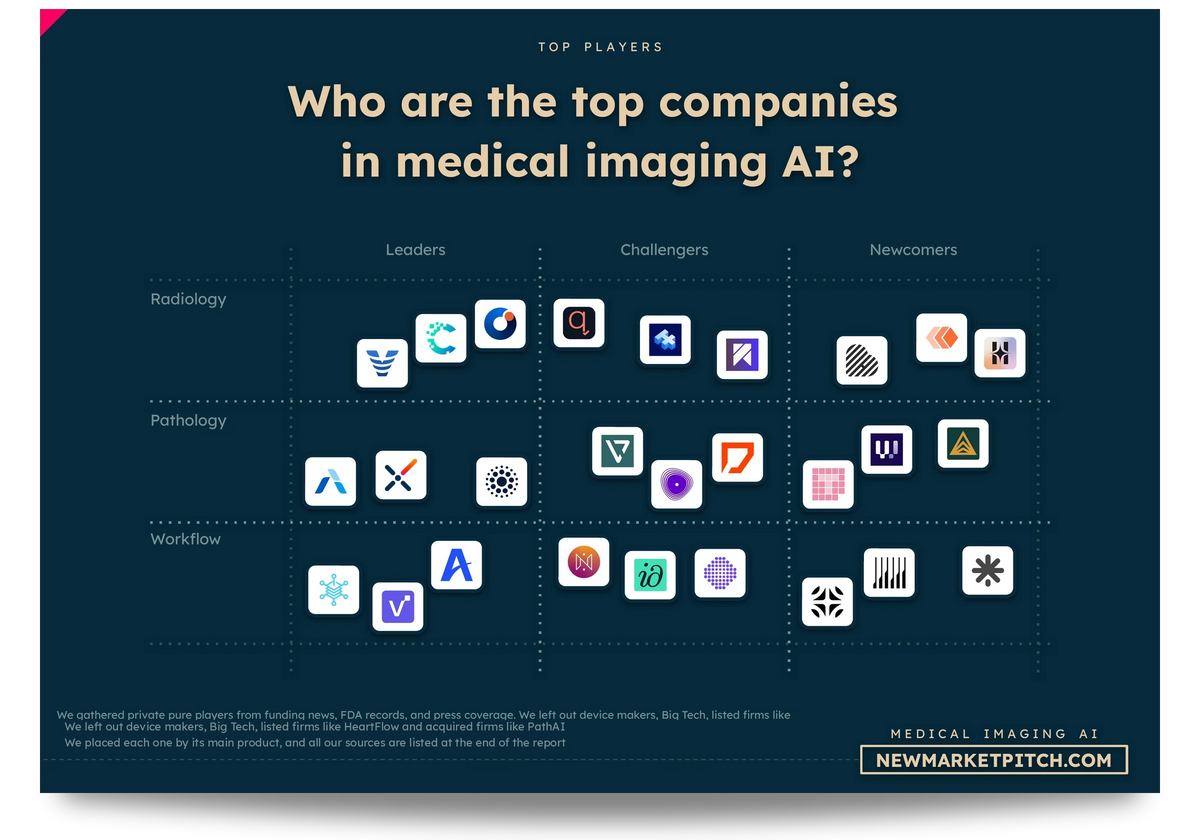
In our report covering the medical imaging AI market, we turn what is vague and complex into simple, useful visuals. Market maps like this one show you at a glance where every startup stands.
The ranking of top startups in the medical imaging AI market by revenue
Below is a table ranking the startups of this market by their current revenue scale. You can find our methodology at the end of this page.
If you want a deeper understanding of the market and its current dynamics, get our report on the medical imaging AI market.
| Ranking | Company | Latest Metric | Metric Type | Freshness | Disclosed When | Source Quality | Confidence | Segment | Why This Ranking | Local Metric | Country |
|---|---|---|---|---|---|---|---|---|---|---|---|
| 1 | HeartFlow | $176M | Fiscal-Year Revenue | Fresh · 11mo | Mar 18, 2026 | Filed / Audited | High | Quantification & Measurement | The SEC filing records $176M of fiscal-year 2025 revenue, a fresh, high-confidence result. The later $190M for the nine months through September 2026 is partial, so the full-year amount remains the comparable measure. | us | |
| 2 | Lunit | ~$61.5M | Fiscal-Year Revenue | Fresh · 11mo | Apr 20, 2026 | Filed / Audited | High | Detection & Diagnostic AI | A Korean filing records ~$61.5M of fiscal-year 2025 revenue. Aidoc's nearby >$60M figure is an annualized run-rate, not a completed fiscal-year result. | KRW 83.13B | kr |
| 3 | Aidoc | >$60M | Revenue Run-Rate | Fresh · 17mo | Sep 11, 2025 | Credible Reported | Medium | Triage & Prioritization | An investor-fund annual report documents a >$60M revenue run-rate as of June 2025. It annualizes the current pace rather than measuring booked full-year sales, unlike Lunit's ~$61.5M. | il | |
| 4 | Perspectum | ~$40.7M | Fiscal-Year Revenue | Fresh · 11mo | Jul 23, 2026 | Filed / Audited | High | Quantification & Measurement | UK financial accounts record ~$40.7M of fiscal-year 2025 revenue, a fresh, high-confidence measure of the company's quantitative imaging business. | GBP 31.8M | gb |
| 5 | Qure.ai | ~$21.1M | Fiscal-Year Revenue | Aging · 20mo | Nov 2025 | Filed / Audited | Medium | Detection & Diagnostic AI | The group financial filing reports ~$21.1M for the fiscal year ended March 2025. Airdoc's larger group figure includes cameras, so it sits with the unranked companies. | INR 1.75B | in |
| 6 | Proscia | >$18M | TTM Revenue | Very Fresh · 1mo | Oct 13, 2026 | Company Disclosed | Medium | Pathology Image AI | Agilent disclosed >$18M of trailing-twelve-month revenue through October 2026, a very fresh company-sourced figure. Agilent completed the acquisition in November 2026. | us | |
| 7 | Gleamer | $10.4M | Fiscal-Year Revenue | Fresh · 11mo | Jun 30, 2026 | Filed / Audited | High | Detection & Diagnostic AI | French filed accounts show $10.4M of fiscal-year 2025 revenue, a fresh full-year measure. RadNet acquired the radiology AI business in March 2026. | fr | |
| 8 | Brainomix | ~$7.77M | Fiscal-Year Revenue | Fresh · 11mo | Apr 2, 2026 | Filed / Audited | High | Triage & Prioritization | UK accounts report ~$7.77M of fiscal-year 2025 revenue. The adjacent ~$7.59M Incepto Medical figure represents only one business segment. | GBP 6.07M | gb |
| 9 | Incepto Medical | ~$7.59M | Segment Revenue | Fresh · 11mo | 2026 | Filed / Audited | Medium | Imaging Workflow & Reporting | The French registry supports ~$7.59M of segment revenue for fiscal-year 2025. It is a minimum, not total company sales, unlike Brainomix's ~$7.77M full-year figure. | EUR 6.9M | fr |
| 10 | Huiyi Huiying | ~$7.27M | Fiscal-Year Revenue | Fresh · 11mo | Apr 24, 2026 | Filed / Audited | High | Detection & Diagnostic AI | A Chinese annual filing reports ~$7.27M of fiscal-year 2025 revenue. The nearby ~$7.59M for Incepto Medical represents a narrower business segment. | CNY 51.9M | cn |
| 11 | Mirada Medical | ~$5.11M | Fiscal-Year Revenue | Fresh · 11mo | Oct 7, 2026 | Filed / Audited | High | Segmentation & Procedure Planning | UK filed accounts show ~$5.11M of fiscal-year 2025 revenue, a fresh and high-confidence full-year figure for radiotherapy imaging software. | GBP 3.99M | gb |
| 12 | Harrison.ai | ~$4.82M | Fiscal-Year Revenue | Fresh · 17mo | May 27, 2026 | Filed / Audited | High | Detection & Diagnostic AI | The company's fiscal-year accounts, discussed by the press, report ~$4.82M for the year ended June 2025. That is close to Mirada Medical's ~$5.11M for a different fiscal year. | AUD 7.3M | au |
| 13 | Paige | $4.6M | Segment Revenue | Fresh · 11mo | Feb 24, 2026 | Filed / Audited | Medium | Digital Pathology AI | Tempus filed $4.6M of revenue from Paige after the August 2025 acquisition through December 2025. This partial post-acquisition period is a minimum, not a full standalone year. | us | |
| 14 | Aiforia Technologies | ~$3.89M | Fiscal-Year Revenue | Fresh · 11mo | Mar 6, 2026 | Company Disclosed | High | Detection & Diagnostic AI | Its company-issued financial bulletin reports ~$3.89M of fiscal-year 2025 revenue, a fresh full-year figure for clinical and research pathology software. | EUR 3.54M | fi |
| 15 | Coreline Soft | ~$3.17M | Fiscal-Year Revenue | Fresh · 11mo | Mar 19, 2026 | Filed / Audited | High | Detection & Diagnostic AI | A Korean filing records ~$3.17M of fiscal-year 2025 revenue. The later ~$3.86M for nine months through September 2026 is a partial-period result, not another full year. | KRW 4.28B | kr |
| 16 | Neurophet | ~$1.94M | Fiscal-Year Revenue | Fresh · 11mo | Mar 20, 2026 | Filed / Audited | High | Quantification & Measurement | Audited Korean financial accounts record ~$1.94M of fiscal-year 2025 revenue, a fresh and high-confidence full-year figure for brain imaging analysis. | KRW 2.62B | kr |
| NR | DentalMonitoring | $91M | Annual Revenue | Aging · 23mo | Oct 30, 2026 | Third-Party Estimate | Low | Quantification & Measurement | GetLatka estimated $91M of annual revenue for 2024. This aging, automated estimate lacks independent confirmation, so DentalMonitoring has no rank. | fr | |
| NR | Overjet | $40.7M | Annual Revenue | Fresh · 11mo | Sep 10, 2026 | Third-Party Estimate | Low | Detection & Diagnostic AI | The $40.7M annual revenue figure for 2025 comes from an automated third-party profile, not a company filing. Without independent confirmation, it remains unranked. | us | |
| NR | Viz.ai | $40M | Annual Revenue | Historical · 35mo | 2023 | Third-Party Estimate | Low | Triage & Prioritization | Sacra estimated $40M of annual revenue in 2023. That historical analyst figure has no independent confirmation, so Viz.ai has no revenue rank. | us | |
| NR | ArteraAI | ~$34.3M | Annual Revenue | Fresh · 14mo | Oct 30, 2026 | Third-Party Estimate | Low | Detection & Diagnostic AI | The ~$34.3M annual revenue estimate as of September 2025 comes from an automated company profile. It is recent but uncorroborated and cannot support a rank. | us | |
| NR | AZmed | ~$33.9M | Annual Revenue | Fresh · 14mo | Sep 10, 2026 | Third-Party Estimate | Low | Detection & Diagnostic AI | An automated service estimated ~$33.9M of annual revenue as of September 2025. No second independent source confirms the figure, so AZmed remains unranked. | fr | |
| NR | Cleerly | $24.6M | Annual Revenue | Historical · 35mo | Oct 30, 2026 | Third-Party Estimate | Low | Cardiac CT AI | The $24.6M annual revenue figure for 2023 is an automated estimate. Its age and lack of independent confirmation rule out a rank. | us | |
| NR | Airdoc | ~$24.3M | Fiscal-Year Revenue | Fresh · 11mo | Apr 2026 | Filed / Audited | Medium | Detection & Diagnostic AI | Its annual filing reports ~$24.3M of fiscal-year 2025 revenue, but that total includes fundus cameras and vision-training products. The imaging AI share is not published, so Airdoc is shown without a rank. | CNY 173M | cn |
| NR | Scopio Labs | $21.9M | Annual Revenue | Aging · 29mo | Oct 5, 2026 | Third-Party Estimate | Low | Detection & Diagnostic AI | GetLatka puts annual revenue at $21.9M through June 2024. This is an aging automated estimate with no independent confirmation, so it is unranked. | il | |
| NR | Quibim | $18.8M | Annual Revenue | Fresh · 11mo | Sep 2, 2026 | Third-Party Estimate | Low | Quantification & Measurement | Quibim's $18.8M annual revenue figure for 2025 comes from an automated profile. A recent estimate without independent confirmation cannot receive a rank. | es | |
| NR | Ibex Medical Analytics | $15.8M | Annual Revenue | Aging · 29mo | Oct 5, 2026 | Third-Party Estimate | Low | Pathology Image AI | For June 2024, a company-data service estimated $15.8M of annual revenue. The aging figure is uncorroborated and has no rank. | il | |
| NR | Rad AI | $13.4M | Annual Revenue | Historical · 35mo | Oct 5, 2026 | Third-Party Estimate | Low | Imaging Workflow & Reporting | The $13.4M annual revenue figure for 2023 is an automated third-party estimate. It is historical and uncorroborated, so Rad AI remains unranked. | us | |
| NR | Ultromics | $7.3M | Annual Revenue | Fresh · 11mo | Aug 10, 2026 | Third-Party Estimate | Low | Detection & Diagnostic AI | The recent $7.3M annual revenue estimate for 2025 comes from GetLatka. Without a company disclosure or a second independent source, it cannot be ranked. | gb | |
| NR | Videa | $6.8M | Annual Revenue | Aging · 23mo | Sep 2026 | Third-Party Estimate | Low | Detection & Diagnostic AI | An automated profile puts Videa at $6.8M of annual revenue for 2024. This aging figure is neither company-disclosed nor independently confirmed, so it remains unranked. | us | |
| NR | DeepTek | ~$4.22M | Segment Revenue | Aging · 20mo | 2025 | Third-Party Estimate | Low | Imaging Workflow & Reporting | The ~$4.22M figure for the fiscal year ended March 2025 is an automated estimate of segment revenue. Its narrower scope and lack of independent confirmation keep DeepTek unranked. | INR 351M | in |
| NR | Shukun Technology | ~5,000 locations | Locations | Period not stated · collected this month | Period not stated | Company Disclosed | Medium | Cross-Modality Radiology AI | Shukun Technology reports ~5,000 locations but gives no reporting period. Locations are not revenue, so the company has no rank. | cn | |
| NR | Sirona Medical | >12M exams/year under contract | Other Scale Signal | Very Fresh · 2mo | Oct 15, 2026 | Company Disclosed | Medium | Radiology Workflow AI | Sirona Medical reports >12M exams/year under contract as of September 2026. The recent contracted volume does not reveal recognized revenue, so it has no rank. | us | |
| NR | Pearl | >29K dental practices | Locations | Undated | Company Disclosed | Medium | Dental X-ray AI | Pearl reports >29K dental practices using its products without a dated revenue figure. Practice reach cannot be ranked against revenue. | us |

Our research about AI for medical imaging gets updated several times a month, so you always get the latest view of where things stand.
Do any medical imaging AI startups make $100M a year?
Yes, HeartFlow is the clearest medical imaging AI startup above $100M in annual sales, with $176M of fiscal-year revenue in 2025.
The figure comes from the SEC annual report HeartFlow files as a public company since its August 2025 IPO. Doctors use its software to analyze coronary CT scans, check whether narrowed arteries affect blood flow and assess plaque. HeartFlow charges when a clinician orders an analysis, giving the business a direct link between medical use and payment.
That makes HeartFlow different from vendors that mainly discuss hospital trials, approved algorithms or the number of scans their software has processed. Those activities can lead to sales, but none tells us how much money reached the company. Lunit has a substantial completed-year result, while Aidoc reports a current annualized run-rate. Perspectum has also built a meaningful business around quantitative MRI. All three show that buyers pay for imaging AI, but none of them reports $100M of annual revenue.
HeartFlow sells a diagnostic service that physicians can order through a familiar clinical workflow. That direct path to payment also makes its revenue easier to document.
Is HeartFlow's cardiac imaging AI business still growing?
HeartFlow's cardiac imaging AI revenue is still growing, and its latest reported partial year points to more sales than its earlier full-year result.
HeartFlow reported $190M of revenue for the nine months through September 2026. That is a partial-period figure, so it does not replace its annual revenue figure in a like-for-like comparison. Its SEC filings describe fees earned from delivering FFRCT and plaque analyses to doctors rather than selling imaging equipment.
The company had 1,465 U.S. accounts at the end of 2025, including 489 using Plaque Analysis. It also reported that Aetna's coverage decision brought Plaque Analysis to roughly 75% of U.S. insured lives. Reimbursement helps remove a buying obstacle, but covered patients do not automatically become paying cases.
The main risk is how much HeartFlow still depends on one product. Its annual filing says FFRCT generated 98% of revenue in 2025. Plaque Analysis gives the company another reason for clinicians to use its platform, yet the evidence does not show a second product with the same sales weight. HeartFlow's growth is real; the next question is whether that newer product can become a substantial business of its own.

In our market report about AI for medical imaging, we look at what the winners do differently, so you can learn from the best instead of guessing.
Is Lunit really bigger than Aidoc in medical imaging AI?
Lunit and Aidoc both have substantial medical imaging AI sales, but their reported figures do not establish a clear winner on comparable annual revenue.
Lunit disclosed ~$61.5M of fiscal-year revenue in 2025 in a Korean regulatory filing. Aidoc's investor-fund report described a >$60M revenue run-rate as of June 2025. Lunit's number measures a completed year; Aidoc's annualizes the sales pace at a single date. The figures also come from different reporting periods.
The companies sell different products. Lunit analyzes mammograms and chest images and strengthened its breast-imaging business by buying Volpara. Aidoc focuses on urgent imaging findings, care coordination and the systems hospitals need to run clinical AI. Lunit's financial statements also include the consolidated operations of Lunit International, formerly Volpara. That broader scope matters when someone assumes every dollar comes from one image-detection algorithm.
We cannot say which company recognized more sales during the same year without matching financial statements. Both have reached real commercial scale, but they disclose it differently.
Has Aidoc turned radiology AI pilots into paying customers?
Aidoc has moved well beyond medical imaging AI pilots, with a >$60M revenue run-rate as of June 2025 and software running across large hospital networks.
In August 2026, Aidoc said it operated in nearly 2,000 hospitals and analyzed 60 million patient cases a year. It also joined 12 U.S. health systems, including Cedars-Sinai and Mount Sinai, in a consortium to test AI across more of the diagnostic process. That reach tells us hospitals use the tools. It does not reveal the amount of revenue collected from each site or case.
Aidoc's CARE foundation model supports imaging triage. Its aiOS platform helps health systems deploy and manage several AI applications together. This gives hospitals a reason to buy a broader service instead of one algorithm for one emergency. The company raised $150M in April 2026 to support that expansion, but investor funding is not customer revenue.
Aidoc already has a meaningful disclosed sales pace and a substantial hospital footprint. Whether its newer products keep accelerating sales will require later financial results, rather than another count of scans or installations.

In our document detailing everything you need to know about medical imaging AI, you will always find fresh funding data, taken straight from our own verified funding database.
What kinds of medical imaging AI are hospitals actually paying for?
Hospitals and laboratories now pay for medical imaging AI that measures disease, flags urgent cases, reads tissue slides and helps doctors plan treatment.
A cardiac CT algorithm has a different buyer and payment model from a stroke-alert tool or a pathology platform. Perspectum sells measurements from MRI scans taken on existing equipment. Proscia's Concentriq helps laboratories manage digital pathology images and analysis. Mirada Medical's products assist with radiotherapy imaging and treatment planning. Incepto Medical gives radiology teams access to several imaging AI tools through one platform.
These jobs can produce revenue without requiring hospitals to buy a new scanner. They also come with their own costs and sales cycles. A radiologist may pay for faster work, while a drug developer may use image measurements to study disease or treatment response. Product popularity alone cannot show which model earns the best margin.
The figures below include full-year revenue, trailing-twelve-month sales, and partial segment revenue. We keep those labels because a narrower business segment cannot be treated as a complete company year.
The table below shows clinical imaging AI products with published sales measures.
| Company | Product | Revenue figure | Basis |
|---|---|---|---|
| Proscia | Pathology platform | >$18M | Oct 2026 TTM |
| Brainomix | Stroke imaging | ~$7.77M | FY2025 revenue |
| Incepto Medical | AI deployment | ~$7.59M | FY2025 segment |
| Huiyi Huiying | Image diagnostics | ~$7.27M | FY2025 revenue |
| Mirada Medical | Radiotherapy planning | ~$5.11M | FY2025 revenue |
| Paige | Pathology analysis | $4.6M | 2025 partial segment |
| Coreline Soft | Lung imaging | ~$3.17M | FY2025 revenue |
| Neurophet | Brain measurements | ~$1.94M | FY2025 revenue |
Can Perspectum make serious money from MRI analysis?
Perspectum has turned quantitative MRI analysis into a substantial medical imaging AI business, reporting ~$40.7M of fiscal-year revenue in 2025.
Perspectum does not manufacture MRI scanners. Its LiverMultiScan and CoverScan software turn images taken on existing machines into measurements doctors can use to assess liver disease and other health conditions. Hospitals and clinics can add these analyses to scans they already perform, which is a much simpler buying decision than replacing imaging equipment.
The company is also moving beyond specialist liver clinics. In October 2026, Tucker Medical in Singapore integrated CoverScan, LiverMultiScan and Body Composition into preventive care and support for cancer survivors. Perspectum also serves drug developers who need consistent image measurements to track a disease or a treatment.
The reported revenue covers the wider company, so it does not tell us the sales of each MRI application. Nor can we assume every clinic pays in the same way. Still, the financial statements make one thing clear: turning existing MRI scans into clinical measurements has become a business that customers pay for, rather than only a research service.

Learning from others' mistakes is the cheapest lesson there is. In our report covering the medical imaging AI market, we look at what broke startups before you, so you don't repeat it.
Does Qure.ai make real money from tuberculosis screening AI?
Qure.ai does earn revenue from medical imaging AI, reporting ~$21.1M for the fiscal year ended March 2025, although that number covers more than tuberculosis screening.
Qure.ai's January 2026 impact report said its tools had reached more than 32 million lives across over 4,500 facilities in more than 100 countries during its 2024-25 reporting year. Its qXR software screened over 7 million people for tuberculosis in that period. These are substantial usage figures and explain why public-health programs keep the company on their procurement lists.
The business has a different economic model from cardiac imaging in an American hospital. Public programs need tools that can work across many clinics, often with tight budgets and large screening populations. That can mean very high scan volumes without the same payment per scan a specialized diagnostic service might receive. Qure.ai also works on lung cancer and other radiology problems.
The financial result proves there are paying customers. Its worldwide patient count cannot tell us how much more the company earned after that fiscal year, and we do not turn clinical activity into a new sales estimate.
Are Chinese medical imaging AI companies selling real products?
Chinese medical imaging AI companies already report sales, including Huiyi Huiying's ~$7.27M of fiscal-year revenue in 2025, while Airdoc's larger ~$24.3M group figure stays unranked.
Airdoc uses AI to support retinal screening and other image-based health checks. Huiyi Huiying sells image-analysis tools used in clinical diagnosis. Their regulatory reports tell us far more about commercial progress than announcements about hospital trials. Neither company breaks out sales for each algorithm, so the figures describe its reported business rather than a single AI product. Airdoc also sells fundus cameras and vision-training products and does not publish the share that comes from imaging AI software, so we show its total without a rank.
Other Chinese companies describe their reach without publishing comparable income figures. Shukun Technology reports ~5,000 locations for its imaging solutions, but does not give a period or corresponding revenue. A software installation may be actively used, occasionally used or only one part of a broader agreement. We cannot treat every site as a customer paying the same annual amount.
For now, China has both verified imaging AI sales and prominent vendors with far less financial detail. Neither fact alone proves that Chinese companies have overtaken HeartFlow in recognized medical imaging AI revenue.

Your time is limited. In our research about AI for medical imaging, we put numbers on each part of the market, so you can see where it makes sense to focus.
Are U.S. medical imaging AI startups the only ones making money?
No, medical imaging AI startups outside the U.S. are already earning serious revenue from MRI, cancer screening, radiology triage and pathology software.
South Korea's Lunit sells cancer-imaging tools. Britain's Perspectum analyzes MRI scans, while Brainomix works on stroke and lung imaging. France has Gleamer's radiology products and Incepto Medical's AI deployment platform. Qure.ai shows that screening software also has customers in India and in public-health programs abroad, under very different healthcare systems.
But a company's headquarters does not show where its customers are. Before RadNet bought Gleamer, the French company reported contracts across 44 countries. Qure.ai's public-health work reaches far beyond India. It would also be misleading to add the revenue figures into regional totals: some cover full years, others cover a run-rate or only one segment.
The U.S. has the clearest individual revenue standout in HeartFlow. The wider picture is international, and the companies gaining sales are solving different clinical problems rather than following one national model.
The table below shows selected non-U.S. medical imaging AI companies and their published revenue measures.
| Company | Country | Revenue figure | Basis |
|---|---|---|---|
| Lunit | KR | ~$61.5M | FY2025 revenue |
| Perspectum | GB | ~$40.7M | FY2025 revenue |
| Qure.ai | IN | ~$21.1M | Mar 2025 year |
| Gleamer | FR | $10.4M | FY2025 revenue |
| Brainomix | GB | ~$7.77M | FY2025 revenue |
| Incepto Medical | FR | ~$7.59M | FY2025 segment |
| Harrison.ai | AU | ~$4.82M | Jun 2025 year |
| Aiforia Technologies | FI | ~$3.89M | FY2025 revenue |
Did Gleamer have real radiology AI sales before RadNet bought it?
Yes, Gleamer sold medical imaging AI software before RadNet acquired it in March 2026, reporting $10.4M of fiscal-year revenue in 2025.
RadNet said Gleamer had more than 700 customer contracts across 44 countries. Its products cover fractures and other musculoskeletal injuries, as well as breast and lung imaging. Gleamer had already moved beyond one narrow X-ray task, giving clinics more reasons to buy its software.
RadNet has a direct way to put those tools to work. It owns diagnostic imaging centers and DeepHealth, a clinical imaging software business. In November 2026, RadNet reported that Gleamer technology was being used in its centers in California, Arizona, Maryland, New York and Florida. That puts the acquired products in front of RadNet's own radiology teams while creating more opportunities to sell to outside customers.
The acquisition does not tell us whether Gleamer was profitable, and RadNet's overall revenue cannot be attributed to Gleamer. Gleamer had already won paying customers before entering RadNet's much larger distribution network.

In our market report about AI for medical imaging, we always try to gather several sources and make estimates that make sense, so you can work with solid numbers.
Is digital pathology AI already making real money?
Digital pathology AI is already selling to laboratories and drug developers, and Proscia reported >$18M of trailing-twelve-month revenue through October 2026.
Agilent disclosed that figure before completing its purchase of Proscia in November 2026. The buyer said Proscia served more than 4,000 laboratories, hospitals and clinics and 16 of the top 20 pharmaceutical companies. Its Concentriq platform helps labs move from glass slides to digital workflows, connect systems and run image analysis. Customers can pay for the platform even when they are not buying a single cancer-detection tool.
The category also includes companies with different products and financial profiles. Aiforia Technologies reported ~$3.89M of fiscal-year revenue in 2025 and works with clinical pathology laboratories. Paige brought an FDA-authorized pathology AI product and a large slide collection into Tempus AI, but its reported post-acquisition sales cover only part of a year.
So pathology AI has paying customers and a clear route into routine lab work. What varies is what the vendor actually sells: diagnostic software, a complete laboratory platform or tools for drug research. That difference matters when judging how large each business has become.
Was Paige selling pathology AI before Tempus bought it?
Paige already had an FDA-authorized pathology AI product before Tempus bought it in August 2025, but its standalone medical imaging AI sales are unclear, because Tempus disclosed only $4.6M of segment revenue for the months after the purchase.
Tempus AI acquired Paige on August 22, 2025. The amount in Tempus's annual filing covers the months after that purchase, so it cannot be read as Paige's full-year sales. We also cannot multiply it into a hypothetical twelve-month figure without knowing the business's billing pattern or earlier results.
What Tempus bought goes well beyond one existing sales line. The company described almost 7 million digitized and clinically annotated pathology slides, along with an FDA-authorized image-analysis product. In January 2026, Tempus launched Paige Predict to estimate useful biomarker information from tissue images. Those assets may help Tempus develop new products and serve new customers, but their value cannot be inferred from the partial revenue contribution.
Acquisitions often make imaging AI sales less visible. A buyer may report the new subsidiary's contribution only from the closing date, while describing its technology and customers in far more detail. Paige is a good example of why those two kinds of information must be kept separate.
Can radiology AI software make money without owning scanners?
Radiology AI platforms can sell software to hospitals that already own scanners, and Incepto Medical reported ~$7.59M of segment revenue in 2025.
Incepto Medical said in September 2026 that its platform served more than 1,000 medical centers in ten countries and supported 6 million patients annually. It helps radiology departments use different AI applications, manage reporting and monitor results. Buying those services is easier to justify when they save work on equipment the hospital already operates.
There are limits to the comparison. Incepto's published figure covers one business segment and is treated as a minimum, not a full company total. Mirada Medical sells specialized radiotherapy imaging and planning software with a more conventional complete-year financial disclosure. Incepto also announced $16M in financing in September 2026, but money raised from investors does not belong in the sales figure.
Sirona Medical shows why contracts need careful reading. Its October 2026 statement referred to >12M exams/year under contract on its radiology platform. That tells us something about future workflow volume, but not the revenue recognized from imaging AI alone. Hospitals can buy useful software without buying new scanners; that still leaves the vendor to publish actual sales.

If you build or invest in the medical imaging AI market, you need to know which business models pay off now and which ones are fading. That's why our report covering it has a whole section on it.
Has Brainomix turned stroke imaging AI into a real business?
Brainomix has a real paid medical imaging AI business, reporting ~$7.77M of fiscal-year revenue in 2025 from its stroke and lung imaging products.
The NHS offers a useful view of why hospitals want the technology. In December 2025, NHS England said Brainomix 360 Stroke was in use at more than 70 hospitals. Its evaluation included roughly 15,000 patients who benefited directly from AI-assisted scan review, and hospitals saw faster treatment decisions and improved access to thrombectomy for eligible patients.
Those outcomes help explain why a public healthcare system might purchase the software. Faster recognition of a blocked artery can change the care a patient receives. But the NHS figures are clinical results, not an invoice. Nor does Brainomix separate its stroke and lung products in the annual revenue figure.
There is another complication with hospital sales: one regional agreement may cover many sites. Counting hospitals and assigning each an imagined yearly subscription fee would produce a number nobody actually disclosed. Brainomix has both a clinical reason to exist and verified revenue, which is more useful evidence than either hospital reach or medical outcomes alone.
Is Harrison.ai making as much as its hospital reach suggests?
Harrison.ai has a broad medical imaging AI footprint, but reported ~$4.82M of fiscal-year revenue for the year ended June 2025.
The Australian company folded its Annalise.ai brand into Harrison.ai in October 2025. It said its products had reached more than 1,000 sites across over 40 countries, where more than 3,400 clinicians had used them on nearly 7 million patient cases. The company has worked with NHS organizations, radiology practices in Australia and hospital services in Hong Kong.
That reach is impressive, but a hospital deployment is not necessarily a full enterprise contract. Some systems use the software for limited purposes, some buy through resellers, and others expand only after an initial rollout. We cannot infer the average price of a scan or site from the company announcement.
The fiscal-year number gives us a firmer answer about money than the case count does. Harrison.ai has made its software useful across many clinical settings; converting that reach into much larger recognized sales is a separate challenge. Until a later financial report shows the result, the adoption and revenue stories should be told side by side.

In our report covering the medical imaging AI market, we don't want to repeat what boring consulting reports say. Instead, we show you the real and latest market signals that matter.
Is dental X-ray AI already a big business?
Dental X-ray AI has reached large practice networks, but public revenue figures for several famous dental AI startups are still unverified estimates.
DentalMonitoring has a $91M automated estimate of annual revenue for 2024, Overjet a $40.7M automated estimate for 2025, and Videa a $6.8M automated estimate for 2024. These numbers come from company-data services rather than the companies' financial statements. None has the independent second source needed for a rank, so they cannot settle which dental imaging AI seller is earning the most.
The customer evidence is better. In June 2026, Overjet announced that Dental Care Alliance would use its products across more than 400 affiliated locations. Pearl says >29K dental practices have chosen its AI, which reads X-rays and helps with dental insurance work. A nationwide rollout or practice count, however, does not tell us how much the vendor bills or collects.
Dentistry may offer a steady need for image analysis because practices take X-rays every day. These products also handle documentation and insurance tasks, so not every dollar a company earns necessarily comes from image interpretation. Adoption is clear; the revenue comparison still needs better disclosures.
How much revenue does Viz.ai actually make today?
Viz.ai has a substantial medical imaging AI business, but its publicly cited $40M of annual revenue for 2023 is an analyst estimate, not a verified figure for today.
Sacra published that historical estimate. Without another independent estimate or a company financial statement, it cannot support a rank. Viz.ai has been much more specific about where its software is used. In July 2026, it described a presence in 2,000 hospitals, an estimated patient reach of 230 million and more than 50 clinical AI care pathways.
Viz.ai also said in January 2026 that its healthcare business had become profitable. That is a noteworthy claim about part of its operations, but it is neither an audited profit statement for the entire company nor a current annual-revenue disclosure. The company also sells to life-sciences customers, adding another reason not to guess an imaging-only sales number.
Viz.ai clearly reaches many hospitals. Its current sales still cannot be established by multiplying deployments by an imaginary contract price. The company has disclosed much more about clinical use than revenue.

In our research about AI for medical imaging, we like to show you the big picture. We know your time is precious, so we make every page quick to read and packed with as much learning as possible per minute.
Does FDA clearance guarantee paying customers for imaging AI?
No, FDA clearance allows medical imaging AI companies to market specific clinical products, but hospitals still have to decide to buy and use them.
Neurophet, a South Korean brain-imaging AI company, reported ~$1.94M of fiscal-year revenue in 2025. In February 2026 it announced FDA clearance for Neurophet AQUA AD Plus, which analyzes MRI and PET images used in Alzheimer's disease care. That lets the company pursue a broader commercial market. It does not change the revenue the company had already booked.
Harrison.ai has approvals for radiology applications and meaningful hospital reach. Aiforia Technologies has approvals for pathology AI products in Europe. In both cases, recognized sales come from paying users, not from a regulator's decision. A hospital must still budget for software, connect it to clinical systems and decide whether it improves care or saves enough time to justify the cost.
Regulatory announcements need careful reading. Aidoc's 2026 breakthrough designation for a report-drafting application is different from marketing clearance. The commercial test comes later, when clinicians start using a product in a paid workflow.
Are medical imaging AI startups profitable yet?
Some medical imaging AI businesses claim profits, but several startups with real revenue still report operating losses.
HeartFlow's SEC filing shows substantial operating costs alongside its paid cardiac imaging work. Lunit also reported an operating loss for 2025 despite its cancer-imaging sales and the addition of Volpara. Aiforia Technologies reported a loss while expanding its clinical pathology tools. Software revenue does not remove the cost of regulatory work, clinical validation, hospital integrations and sales teams.
Viz.ai offered a different update in January 2026 when it said its healthcare business had reached profitability. The statement applies to that business, not necessarily every part of the company. It also does not supply an audited group-wide profit amount.
Medical imaging AI startups sell through quite different models. HeartFlow charges for completed analyses; others sell subscriptions, pathology platforms or research software. Their costs and margins can vary, and a revenue total tells us little about how much cash remains after expenses. Today there is enough evidence to identify real sellers, but far less to compare net profits across the field.

When you build or invest in the medical imaging AI market, you need clarity, not confusion. In our market report about AI for medical imaging, we always try to put numbers on and quantify whatever is usually vague and confusing.
Why are big healthcare companies buying imaging AI startups?
Large healthcare companies are buying medical imaging AI startups for software, customers and clinical workflows they can sell through their existing businesses.
Tempus AI bought Paige in August 2025 to add pathology algorithms and tissue-slide information to its precision medicine services. RadNet acquired Gleamer in March 2026, bringing radiology image interpretation into DeepHealth and its imaging-center network. Agilent Technologies completed the purchase of Proscia in November 2026 to strengthen its digital pathology offering for laboratories and drug developers.
Each buyer has its own route to customers. Tempus can connect tissue imaging with molecular data. RadNet can deploy tools at its own imaging centers while selling software to outside practices. Agilent already works with labs that use instruments, reagents and digital pathology tools. Each can put the acquired products in places where an independent startup might have needed years to win contracts.
None of these acquisitions proves that the seller was profitable, and an acquisition price cannot be treated as sales. The deals also make future comparisons harder, because revenue may become part of a larger reporting segment. For a reader tracking who earns money, the last identifiable standalone figure can remain more informative than a buyer's later company-wide results.
So, which medical imaging AI startups make the most money today?
HeartFlow is the number one medical imaging AI startup by revenue, with the strongest qualifying annual financial disclosure.
HeartFlow built a business around paid coronary CT analysis that physicians actually request. Lunit and Aidoc have also reached serious commercial scale, though their reporting bases differ. Perspectum and Qure.ai show that MRI measurement and screening can sell, too. Digital pathology and clinical workflow software have real customers, but acquisitions and partial-period reporting make several companies harder to compare.
Hospital counts, regulatory approvals and funding rounds can tell us why an AI product might succeed. They do not replace financial results. HeartFlow remains the defensible answer today because its annual sales are recorded in a regulatory filing.
The table below shows what we found.
| Question | Answer |
|---|---|
| Why has cardiac imaging AI already passed $100M? | HeartFlow earns fees for analyses that doctors order regularly. Its 2025 fiscal-year revenue was $176M from those clinical services. That payment model gives the company unusually clear reported sales. |
| Can cancer imaging AI sell beyond hospital pilots? | Lunit has built a business around cancer-imaging applications and acquisitions. Its 2025 fiscal-year revenue reached ~$61.5M in the Korean filing. The total includes the broader business, not one standalone algorithm. |
| Are hospital AI platform contracts producing substantial sales? | Aidoc has turned hospital deployments into meaningful sales. It disclosed a >$60M revenue run-rate as of June 2025. That is a sales pace rather than completed-year recognized revenue. |
| Does public-health screening actually bring paying customers? | Qure.ai sells image analysis across clinical and screening programs. It reported ~$21.1M of fiscal-year revenue through March 2025. Patient counts show reach but cannot tell us billing rates. |
| Are Chinese imaging AI startups earning real money? | Huiyi Huiying has filed accounts showing sales of image diagnostics tools. Its fiscal-year revenue for 2025 was ~$7.27M. Airdoc's larger ~$24.3M also covers fundus cameras, so it has no rank. |
| Has digital pathology AI moved beyond lab trials? | Proscia sells pathology software to laboratories and drug developers. Its trailing-twelve-month revenue through October 2026 was >$18M. Agilent's acquisition now places those products inside a larger group. |
| Do dental AI companies publish trustworthy annual sales? | Dental imaging companies have customers but few verified sales figures. DentalMonitoring's $91M annual revenue estimate for 2024 remains uncorroborated. A third-party estimate cannot replace a verified financial statement. |
| Does Viz.ai reveal what its hospitals actually pay? | Viz.ai reports extensive clinical deployment and growing care pathways. Its $40M annual revenue figure for 2023 comes from one analyst. Current sales remain uncertain without corroborated financial disclosure. |
| Can brain imaging AI sell after regulatory approval? | Neurophet has regulatory clearance for additional brain imaging software. It reported ~$1.94M of fiscal-year revenue in 2025. Approval opens doors without guaranteeing hospitals will purchase the product. |
| Are contracted imaging exams the same as revenue? | Sirona Medical has commitments covering substantial radiology workflow volume. It reported >12M exams/year under contract as of September 2026. Those exams describe contracted usage rather than sales recognized in accounts. |

A good product starts with a real problem. In our document detailing everything you need to know about medical imaging AI, we show you the ones customers still live with.
Our methodology
Our data runs through November 13, 2026. We define medical imaging AI as software that analyzes or improves clinical image content or imaging-specific workflows, including radiology, dental images, ophthalmic imaging, microscopy and digital pathology. We include borderline image-centric businesses rather than silently removing them. Every ranked company meets our consistent startup definition: founded in 2000 or later, built around scalable new technology and financed by founders or outside backers, with recent listings and recent acquisitions allowed. Established groups themselves are not ranked.
We reviewed company announcements, annual reports, regulatory filings, investor material and reputable financial coverage across each company's available history over the past ten years. Hospitals and startups describe their scale differently: recognized revenue, ARR, current run-rate, billed product sales, signed contracts or imaging volumes. We retain the label and period of each financial figure rather than converting ARR into recognized revenue or inventing revenue from usage, bookings, GMV or customer prices.
We select one qualifying figure per company, favoring results no more than 18 months old, then strong sources such as filings and company disclosures ahead of press, analysts and automated company profiles. Among otherwise comparable candidates, a complete fiscal-year result takes precedence over annualized measures, partial periods or a single business segment. We order companies by the selected figure; a range uses its geometric midpoint rather than its optimistic high end, and a minimum is placed at its lower bound. Figures older than 36 months, forecasts and non-revenue scale signals receive no rank. These rankings examine each company's whole reported history rather than a fixed period of financing deals.
Our table labels freshness as Very Fresh, Fresh, Aging or Historical according to elapsed months since the financial period ended. High confidence means a recent, exact, complete fiscal-year figure from a company or official filing. Medium covers ARR, run-rates, partial figures, company minimums, press reporting and figures 18 to 30 months old. Low covers estimates, wide ranges and older evidence. We convert original currencies at fixed reference rates but retain the local amounts. A single analyst or automated estimate is shown without a rank; two independent agreeing estimates may rank with Low confidence, while conflicting estimates remain an unranked range. A company revenue figure with no stated period can rank with Low confidence, but an undated estimate cannot. A broader whole-company figure with no published imaging AI portion is not ranked, nor is a forecast.
The hardest comparison is not between two algorithms but between two reporting bases. A current annualized run-rate may sit next to a filed fiscal-year number because both say something useful about present commercial scale, but they are not interchangeable accounting results. A partial acquisition contribution is kept as a minimum, not silently converted into a whole year. We refuse to promote an uncorroborated estimate merely because it belongs to a famous company. These safeguards keep a single revenue ordering useful while making its limits clear.
Our purpose is to identify demonstrated commercial sales, not to replace another company's financial reporting or forecast its eventual size. We show what each source establishes, state the original reporting period and keep companies with insufficient comparable revenue evidence visible without assigning a false position. The result can be read as evidence of relative commercial scale, with confidence and accounting differences understood alongside each figure.
Key sources include HeartFlow fiscal-year financial statements, usage-based sales model and FFRCT concentration, HeartFlow's more recent nine-month sales and plaque reimbursement context, Lunit annual financial disclosure and Volpara consolidation, Investor-fund report underlying Aidoc's June 2025 revenue run-rate, Aidoc's August 2026 hospital footprint and 12-system consortium, Aidoc's April 2026 Series E funding and enterprise AI strategy, Perspectum's October 2026 MRI software clinical deployment in Singapore, Qure.ai's international clinical reach and tuberculosis screening activity, Airdoc's official 2025 annual report and product revenue scope, Proscia trailing-twelve-month sales and customer reach disclosed by Agilent, Completion of Agilent's Proscia acquisition in November 2026, Gleamer acquisition, contracts and geographic presence, NHS England evaluation of Brainomix stroke imaging AI deployment and outcomes, Incepto Medical's September 2026 installed base and financing, Tempus acquisition of Paige and pathology slide assets, Tempus 2025 annual filing underpinning Paige's partial-year contribution, Aiforia's 2025 financial results, clinical partnerships and operating loss, Harrison.ai's 2025 brand consolidation, installations and case reach, Neurophet's February 2026 U.S. neuroimaging AI clearance, Sirona Medical's October 2026 exams under contract and platform scope, Overjet's 2026 Dental Care Alliance deployment across dental practices, Pearl's published dental practice adoption figure, and Viz.ai's healthcare business profitability statement and hospital reach.

In our report covering the medical imaging AI market, we try to remove everything that could confuse you, especially if you're investing or building in this market.
Written by the New Market Pitch teamWe track new markets so founders and investors can move faster. About us