What’s the latest funding news in the military drones market? (October 2026)
Whether you're building or investing in the military drones market, our report covers everything you need to know: the players, the money, and what's coming next.
Military drone funding remained unusually concentrated in 2026, with investors backing both scaled aircraft manufacturers and smaller autonomy specialists shaped by lessons from active conflicts.
The 12 latest qualifying deals in this dataset range from a $2.1M pre-seed round for onboard drone autonomy to a $1.2B Series D for one of Europe's largest military UAV manufacturers.
Reconnaissance UAVs, interceptor drones and GPS-independent autonomy are especially visible, showing how investors are funding both aircraft production and the software needed to operate drones in contested environments.
And if you want to better understand this new industry, you can download our pitch covering the military drones market.
Insights
- The 12 military drone companies raised about $2.2B combined, but Quantum Systems, TEKEVER and Neros represented more than 90% of that capital, showing how sharply funding is concentrating around proven platforms.
- Military drone autonomy has become a standalone investment category: Occam Industries, DOD Solution and PDKINEMATICS all raised capital for navigation, targeting or guidance technology rather than complete aircraft fleets.
- Ukraine is influencing product development well beyond Ukrainian startups, with at least six companies in this list explicitly building around battlefield lessons, deployments or electronic-warfare conditions observed there.
- Counter-drone technology is increasingly becoming a drone market itself. Airbility and Mara both use autonomous interceptor UAVs rather than relying primarily on traditional missiles, lasers or electronic jamming.
- GPS-denied operation appears repeatedly across the latest military drone funding deals, reflecting investor demand for UAVs that can navigate, identify targets and complete missions despite electronic warfare.
- European military drone companies attracted the two largest rounds in the dataset, with Quantum Systems raising $1.2B and TEKEVER raising $580M as Europe accelerates domestic defense technology investment.
- The market is moving beyond manually piloted aircraft. AITAN, Neros, Occam Industries and DOD Solution are all developing systems that reduce operator workload through autonomous targeting, navigation or multi-drone coordination.
- Manufacturing capacity is now as important as technical performance. Several growth-stage companies specifically raised capital to increase production, localize supply chains or manufacture attritable drones closer to military users.

Written by the New Market Pitch teamWe track new markets so founders and investors can move faster. About us

In our report covering the military drone market, you will always find fresh funding data, taken straight from our own verified funding database.
Summary table of the latest funding deals in the military drones market as of October 2026
We define the military drones market as uncrewed aerial systems designed for military missions.
We include reconnaissance drones, strike drones, loitering munitions and their dedicated flight-control and mission systems.
We exclude civilian-only drones, crewed aircraft and uncrewed ground or maritime vehicles.
| Name | When | Amount in $ | Round Type | Category |
|---|---|---|---|---|
| Occam Industries | 30 September 2026 | ~$4.5M | Follow-on round | Military Drone Autonomy & Terminal Guidance |
| DOD Solution | 28 September 2026 | $2.1M | Pre-seed | UAV Mission Computers & Autonomous Guidance |
| TEKEVER | 23 September 2026 | $580M | Series D | Military Reconnaissance UAVs & Mission Intelligence |
| ADSYSTEM | 16 September 2026 | ~$9.9M | Series A | Military Reconnaissance & Armed UAVs |
| AITAN | 2 September 2026 | $41M | Institutional round | Combat Drone Autonomy & Command Systems |
| Airbility | 1 September 2026 | $4.7M | Series A | Military Interceptor UAVs & Counter-UAS |
| Easy Aerial | 31 August 2026 | $20M | Series B | Tethered Military ISR Drones & Drone-in-a-Box |
| Mara | 26 August 2026 | $7M | Pre-seed | Autonomous Interceptor UAVs & Counter-FPV Systems |
| Neros Technologies | 11 August 2026 | $250M | Series C | Military FPV Drones, Interceptors & Autonomy |
| Quantum Systems | 2 July 2026 | $1.2B | Series D | Tactical Reconnaissance UAVs & Mission Software |
| PDKINEMATICS | 17 June 2026 | ~$2.3M | Seed | Military UAV Precision Guidance & Anti-EW Systems |
| Firestorm Labs | 29 April 2026 | $82M | Series B | Modular Military UAVs & Forward Drone Manufacturing |
All the latest funding deals in the military drones market as of October 2026
Occam Industries raised about $4.5M in late September 2026 to expand military drone autonomy.
When was it?
Occam Industries announced the financing on September 30, 2026.
Who are they?
Occam Industries builds onboard autonomy software that helps military drones detect, track and guide themselves toward targets even when GPS or communications are disrupted.
Geographical focus?
Occam Industries operates from London and Kyiv, with deployments in Ukraine and expansion aimed at European and NATO drone manufacturers.
Why do we include them in the military drones market?
Occam Industries belongs in the military drone market because its software is dedicated to UAV autonomy, terminal guidance, reconnaissance and strike missions.
What is the company stage?
Occam Industries is at early PMF and field-deployment stage, with software already used by Ukrainian drone manufacturers and military units.
How much did they raise?
Occam Industries raised €3.8M, equivalent to roughly $4.5M.
What round is it?
Occam Industries did not disclose a formal Series label and described the financing as its second funding round of 2026.
Why did they raise?
Occam Industries raised the capital to expand its Ukrainian engineering team, develop more autonomy products and integrate its technology into additional military UAV platforms.

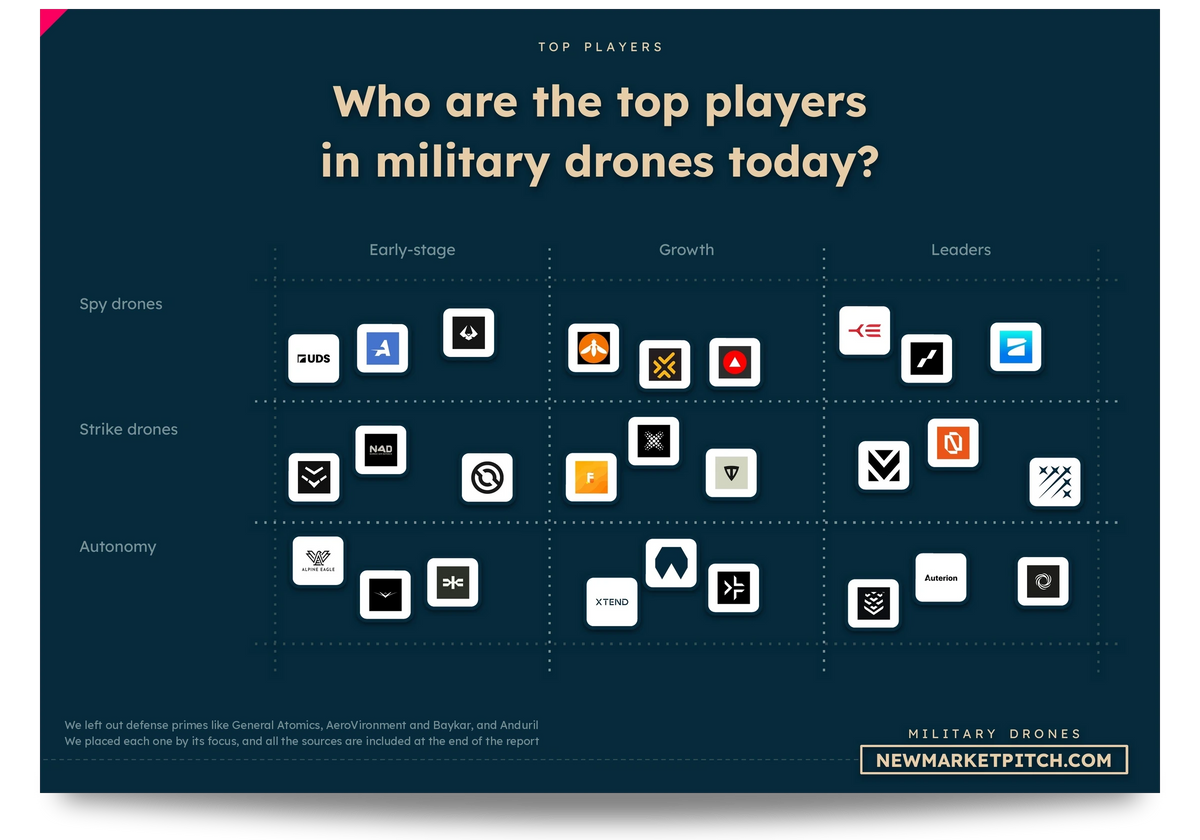
In our research about military drones, we turn what is vague and complex into simple, useful visuals. Market maps like this one show you at a glance where every startup stands.
DOD Solution raised $2.1M in late September 2026 to scale its combat-tested drone autonomy platform.
When was it?
DOD Solution announced the pre-seed financing on September 28, 2026.
Who are they?
DOD Solution builds an onboard computer and software stack that gives FPV, interceptor and fixed-wing drones autonomous navigation, recognition, tracking and terminal guidance.
Geographical focus?
DOD Solution is Estonian-Ukrainian, develops around battlefield requirements in Ukraine and is preparing expansion across Europe and North America.
Why do we include them in the military drones market?
DOD Solution belongs in the military drone market because AURA AI is a dedicated UAV autonomy and mission-control platform for contested environments.
What is the company stage?
DOD Solution is at pre-seed but already has combat-validated technology moving toward larger integrations and production.
How much did they raise?
DOD Solution raised $2.1M in this financing.
What round is it?
DOD Solution raised a pre-seed round.
Why did they raise?
DOD Solution raised the capital to manufacture its next AURA onboard computer, improve the autonomy software and integrate with more drone manufacturers.
TEKEVER raised $580M in September 2026 as its military reconnaissance drone business entered a new scale.
When was it?
TEKEVER announced the first close of its Series D on September 23, 2026.
Who are they?
TEKEVER builds long-endurance autonomous reconnaissance drones such as the AR3 and AR5 together with sensors, AI and mission-intelligence software.
Geographical focus?
TEKEVER is European-focused, with major operations in Portugal and the UK and extensive military experience in Ukraine and NATO markets.
Why do we include them in the military drones market?
TEKEVER belongs in the military drone market because military ISR and reconnaissance UAVs are a central part of its scaled product portfolio.
What is the company stage?
TEKEVER is at late-stage profitable growth, with operational fleets, large defense programs and several years of reported profitability.
How much did they raise?
TEKEVER raised $580M in the first close of the financing.
What round is it?
TEKEVER raised a Series D round.
Why did they raise?
TEKEVER raised the capital to increase production, expand internationally, advance autonomous systems and pursue strategic acquisitions.
ADSYSTEM raised about $9.9M in September 2026 to develop and industrialize its next military UAV.
When was it?
ADSYSTEM announced the Series A financing on September 16, 2026.
Who are they?
ADSYSTEM designs and manufactures low-observable VTOL military UAVs for reconnaissance and armed missions, including the AD-3000 and developing AD-4000.
Geographical focus?
ADSYSTEM is primarily focused on South Korea and the Republic of Korea military while positioning its UAVs for international defense customers.
Why do we include them in the military drones market?
ADSYSTEM belongs in the military drone market because its core products are dedicated reconnaissance and armed unmanned aircraft.
What is the company stage?
ADSYSTEM is at early growth and production stage, with existing drone programs and a next-generation combat platform under development.
How much did they raise?
ADSYSTEM raised KRW13B, equivalent to roughly $9.9M.
What round is it?
ADSYSTEM raised a Series A round.
Why did they raise?
ADSYSTEM raised the capital to complete the AD-4000 and build a larger, more automated military drone production operation.

In our market report about military drones, we always try to gather several sources and make estimates that make sense, so you can work with solid numbers.
AITAN raised $41M in September 2026 to take its battle-proven combat drone technology into international markets.
When was it?
AITAN announced the financing on September 2, 2026.
Who are they?
AITAN develops AI-based combat systems that coordinate surveillance and armed drones as networked autonomous forces.
Geographical focus?
AITAN developed its technology around Israeli military operations and is now targeting the United States, Europe, Asia and other allied markets.
Why do we include them in the military drones market?
AITAN belongs in the military drone market because its main proposition combines combat UAVs with dedicated autonomy and command-and-control software.
What is the company stage?
AITAN is at growth stage with proven PMF, extensive operational flight hours and international defense contracts.
How much did they raise?
AITAN raised $41M in the financing.
What round is it?
AITAN did not assign the round a conventional Series label and described it as its first significant institutional financing.
Why did they raise?
AITAN raised the capital to expand internationally, continue product development and grow its team around deployments with allied militaries.
Airbility raised $4.7M in September 2026 to commercialize autonomous drones designed to intercept hostile UAVs.
When was it?
Airbility announced the Series A financing on September 1, 2026.
Who are they?
Airbility builds high-speed interceptor drones, capture drones and airborne motherships designed around an autonomous counter-UAS kill chain.
Geographical focus?
Airbility is based in South Korea and is building an international defense presence around Korean aerospace and military expertise.
Why do we include them in the military drones market?
Airbility belongs in the military drone market because its primary counter-UAS weapons are themselves autonomous interceptor UAVs.
What is the company stage?
Airbility is moving from late prototype development into commercialization and scaled production.
How much did they raise?
Airbility raised KRW6.5B, equivalent to about $4.7M.
What round is it?
Airbility raised a Series A round.
Why did they raise?
Airbility raised the capital to improve its counter-UAS kill chain, launch additional interceptor platforms and build production capacity.
Easy Aerial raised $20M in August 2026 to expand production of autonomous persistent-surveillance drone systems.
When was it?
Easy Aerial announced the Series B financing on August 31, 2026.
Who are they?
Easy Aerial makes autonomous tethered UAVs and drone-in-a-box systems that provide persistent aerial intelligence and surveillance.
Geographical focus?
Easy Aerial is U.S.-based and serves American and international defense and security programs.
Why do we include them in the military drones market?
Easy Aerial belongs in the military drone market because its core physical products include military-grade ISR and force-protection UAV systems.
What is the company stage?
Easy Aerial is at growth stage with scaled products, defense qualifications and multiple domestic and international contracts.
How much did they raise?
Easy Aerial raised $20M in the financing.
What round is it?
Easy Aerial raised a Series B round.
Why did they raise?
Easy Aerial raised the capital to expand manufacturing, grow international operations and invest further in autonomous aerial technology.

Our document detailing everything you need to know about military drone gets updated several times a month, so you always get the latest view of where things stand.
Mara raised $7M in August 2026 to move its autonomous counter-FPV interceptor drone toward wider deployment.
When was it?
Mara announced the financing on August 26, 2026.
Who are they?
Mara develops the Spike system, which detects hostile FPV drones and launches low-cost autonomous Seeker drones to intercept them.
Geographical focus?
Mara is U.S.-based, with testing in the United States and Europe and a product shaped by threats seen on modern battlefields.
Why do we include them in the military drones market?
Mara belongs in the military drone market because the system's main kill mechanism is an autonomous military interceptor UAV.
What is the company stage?
Mara is at pre-seed and field-testing stage, moving from successful demonstrations toward broader operational deployment.
How much did they raise?
Mara raised $7M in the financing.
What round is it?
Mara raised a pre-seed round.
Why did they raise?
Mara raised the capital to finish development, expand manufacturing and deploy Spike with more military and security customers.
Neros Technologies raised $250M in August 2026 to scale autonomous strike and interceptor drone programs.
When was it?
Neros Technologies announced the Series C financing on August 11, 2026.
Who are they?
Neros Technologies mass-produces military FPV drones and develops autonomous strike guidance, counter-UAS interceptors and technology for coordinated multi-drone operations.
Geographical focus?
Neros Technologies primarily serves the U.S. Department of Defense and allied militaries, with product development heavily informed by lessons from Ukraine.
Why do we include them in the military drones market?
Neros Technologies belongs in the military drone market because military FPV aircraft, strike UAVs and interceptor drones form the company's core business.
What is the company stage?
Neros Technologies is at growth and industrial scale-up stage, with systems already used by defense customers and multiple new UAV programs in development.
How much did they raise?
Neros Technologies raised $250M in the financing.
What round is it?
Neros Technologies raised a Series C round.
Why did they raise?
Neros Technologies raised the capital to scale Archer AI, its Bandit interceptor and the manufacturing and compute infrastructure needed for larger drone fleets.
Quantum Systems raised $1.2B in July 2026 as it scaled military UAV production and autonomous systems.
When was it?
Quantum Systems announced the Series D financing on July 2, 2026.
Who are they?
Quantum Systems builds electric tactical reconnaissance UAVs such as Vector and Twister together with AI-enabled mission and intelligence software.
Geographical focus?
Quantum Systems is German and European-rooted but sells across NATO and allied markets, with extensive operational use in Ukraine.
Why do we include them in the military drones market?
Quantum Systems belongs in the military drone market because tactical reconnaissance UAVs remain its scaled commercial core, although the company is expanding into additional autonomous domains.
What is the company stage?
Quantum Systems is at profitable late-stage growth with large defense contracts, international manufacturing and rapidly expanding revenue.
How much did they raise?
Quantum Systems raised $1.2B in the financing.
What round is it?
Quantum Systems raised a Series D round.
Why did they raise?
Quantum Systems raised the capital to expand industrial capacity, strengthen supply chains, scale allied deliveries and continue investing in autonomous software and AI.

In our report covering the military drone market, we look at what the winners do differently, so you can learn from the best instead of guessing.
PDKINEMATICS raised about $2.3M in June 2026 to scale precision guidance for military UAVs.
When was it?
PDKINEMATICS announced the seed financing on June 17, 2026.
Who are they?
PDKINEMATICS makes compact GNSS-independent precision-guidance systems that help military drones deliver munitions accurately despite electronic warfare.
Geographical focus?
PDKINEMATICS is based in Lithuania, has battlefield validation in Ukraine and is expanding across European and NATO defense markets.
Why do we include them in the military drones market?
PDKINEMATICS belongs in the military drone market because its Gannet technology is a dedicated UAV guidance and mission system for military platforms.
What is the company stage?
PDKINEMATICS is at seed and early-PMF stage, with technology already integrated into UAV platforms and tested in operational conditions.
How much did they raise?
PDKINEMATICS raised €2M, equivalent to roughly $2.3M.
What round is it?
PDKINEMATICS raised a seed round.
Why did they raise?
PDKINEMATICS raised the capital to scale manufacturing, expand European and Ukrainian deployments and continue developing anti-EW guidance technology.
Firestorm Labs raised $82M in April 2026 to scale military UAV production closer to the battlefield.
When was it?
Firestorm Labs announced the Series B financing on April 29, 2026.
Who are they?
Firestorm Labs builds modular military UAVs and containerized xCell factories that allow forces to manufacture and replenish unmanned systems near deployment areas.
Geographical focus?
Firestorm Labs primarily serves the U.S. Department of Defense and allied forces, with a strong focus on expeditionary operations and the Indo-Pacific.
Why do we include them in the military drones market?
Firestorm Labs belongs in the military drone market because the company builds its own military UAS and the forward manufacturing systems used to produce them.
What is the company stage?
Firestorm Labs is at growth and operational-fielding stage, with its technology moving into U.S. defense deployments while production scales.
How much did they raise?
Firestorm Labs raised $82M in the financing.
What round is it?
Firestorm Labs raised a Series B round.
Why did they raise?
Firestorm Labs raised the capital to accelerate production and fielding of its portable drone-manufacturing systems and modular military UAVs.

In our research about military drones, we don't want to repeat what boring consulting reports say. Instead, we show you the real and latest market signals that matter.
Written by the New Market Pitch teamWe track new markets so founders and investors can move faster. About us