Loyal wingman drones: which company is ahead?
Whether you're building or investing in the military drone market, our report covers everything you need to know: the players, the money, and what's coming next.
Summary
Boeing is currently ahead in the loyal wingman drone race. Its MQ-28 Ghost Bat has the strongest publicly demonstrated combination of integrated combat capability, flight-test maturity and sustained military funding, although Anduril and General Atomics lead in U.S. Air Force procurement.
The clearest evidence is Boeing's December 2025 missile engagement. An MQ-28 destroyed an airborne target using an AIM-120 while operating alongside Australian crewed military aircraft, demonstrating a level of integrated air combat that its leading Western competitors have not yet publicly matched.
Australia is putting serious money behind that progress. Approximately AUD 1.4 billion in additional investment, including a AUD 754 million Boeing contract, is intended to move the Ghost Bat toward operational capability in 2028. Boeing has already produced multiple aircraft across successive development blocks.
The American procurement race tells a different story. In June 2026, the U.S. Air Force awarded production contracts to Anduril and General Atomics for its first Collaborative Combat Aircraft program, targeting at least 150 aircraft by the end of the decade. Boeing's technical lead has not translated into a place in that initial production selection.
Anduril has the most aggressive manufacturing ambition, with a stated capacity of approximately 150 Fury aircraft annually at Arsenal-1. But factory capacity and accepted military deliveries are very different things. General Atomics, meanwhile, has decades of unmanned-aircraft experience, although its FQ-42A suffered a crash in April 2026 before returning to flight testing.
Baykar may be the most underestimated challenger. Its Kızılelma has demonstrated radar-guided air-to-air engagement, autonomous formation flight and internal weapons-bay employment. Serial production and an Indonesian agreement covering 12 planned aircraft give it a route toward operational deployment that does not depend on American procurement decisions.
Europe is becoming a second major battleground. Airbus and Kratos completed the U740 Valkyrie's first European flight in October 2026, while Boeing and Rheinmetall are offering the MQ-28 to Germany. Existing aircraft have a timing advantage, but European control over mission software could influence the eventual selection.
The software competition could produce a winner separate from the aircraft manufacturers. Shield AI has flown its Hivemind autonomy system on Anduril's Fury, while the U.S. Air Force is developing an open architecture that could allow autonomy suppliers to serve multiple aircraft types.
The economics remain attractive but unproven. A roughly $20 million target per American CCA compares with approximately $82 million for an F-35A, suggesting around four unmanned aircraft for the acquisition price of one fighter. Weapons, maintenance, support and actual combat effectiveness could change that calculation considerably.
Our conclusion favors Boeing today, but the next two to three years could overturn that ranking. Operational MQ-28 capability in 2028, American CCA deliveries, Baykar's export commitments and Germany's procurement choice will reveal which companies can turn impressive demonstrations into reliable fleets. China remains an important unknown because comparable public evidence is limited.

Written by the New Market Pitch teamWe track new markets so founders and investors can move faster. About us
Is the loyal wingman drone race finally getting serious?
The loyal wingman drone race has now moved into production, with Boeing, Anduril, General Atomics and Baykar leading different parts of the competition.
The biggest change came in June 2026, when the U.S. Air Force awarded production contracts to Anduril and General Atomics for its first Collaborative Combat Aircraft (CCA) program. The service plans to acquire at least 150 aircraft by the end of the decade, with a longer-term ambition of around 1,000.
Australia has taken a different route with Boeing's MQ-28 Ghost Bat. After years of flight testing, the aircraft successfully destroyed an airborne target using an AIM-120 missile in December 2025. The Australian government then announced approximately AUD 1.4 billion in additional investment to help turn the aircraft into an operational combat system.
Türkiye's Baykar is also making progress. Its Kızılelma unmanned fighter has demonstrated air-to-air and air-to-ground weapons employment, while the company has begun serial production and secured an agreement covering deliveries to Indonesia from 2028.
These developments have brought the industry closer to actual military deployment. Boeing has the most convincing Western combat demonstration, Anduril and General Atomics have secured American production orders, and Baykar is pursuing its own unmanned fighter program.
Who's actually winning the loyal wingman drone race right now?
Boeing currently leads the loyal wingman drone race in demonstrated Western combat capability, while Anduril and General Atomics have the strongest position in U.S. Air Force procurement.
The difference comes down to what each company has proved. Boeing's MQ-28 has completed coordinated missions with crewed fighters and successfully engaged an airborne target with a live missile. Anduril's FQ-44A Fury and General Atomics' FQ-42A have reached production-contract status, with aircraft delivered for operational experimentation.
Baykar deserves a place alongside these three companies. Its Kızılelma has demonstrated autonomous formation flight, radar-supported air-to-air engagement and several types of precision weapons. Kratos is also a serious contender, particularly through its partnership with Airbus in Europe.
We give more weight to completed military tests, signed production contracts and delivered aircraft than to specifications or planned capabilities. A company that has flown an autonomous drone successfully has cleared one hurdle. Delivering a combat-ready fleet is considerably harder.
| Company | Main aircraft | Strongest achievement | Current weakness |
|---|---|---|---|
| Boeing | MQ-28 Ghost Bat | Integrated air-to-air missile engagement | Operational deployment still ahead |
| Anduril | FQ-44A Fury | U.S. Air Force production contract | Combat capability less publicly demonstrated |
| General Atomics | FQ-42A | U.S. production contract and military experimentation | Reliability still being tested |
| Baykar | Kızılelma | Multiple weapons tests and serial production | Operational fleet size unverified |
| Kratos | XQ-58A Valkyrie | Extensive flight history and European partnership | No comparable major Valkyrie production order |
| Airbus | U740 Valkyrie | First European flight in October 2026 | European autonomy integration still underway |
| Helsing | CA-1 Europa | European autonomous combat-aircraft development | Earlier stage of validation |
| Dassault Aviation | Future Rafale F5 combat drone | Established stealth-drone experience through nEUROn | Later operational timeline |
None of these companies has yet publicly demonstrated a large fleet of loyal wingman drones performing sustained operational combat missions. The race has advanced substantially, but commercial leadership and combat readiness still belong to different manufacturers.
If you want more recent data on this point, please see our latest military drones market report.

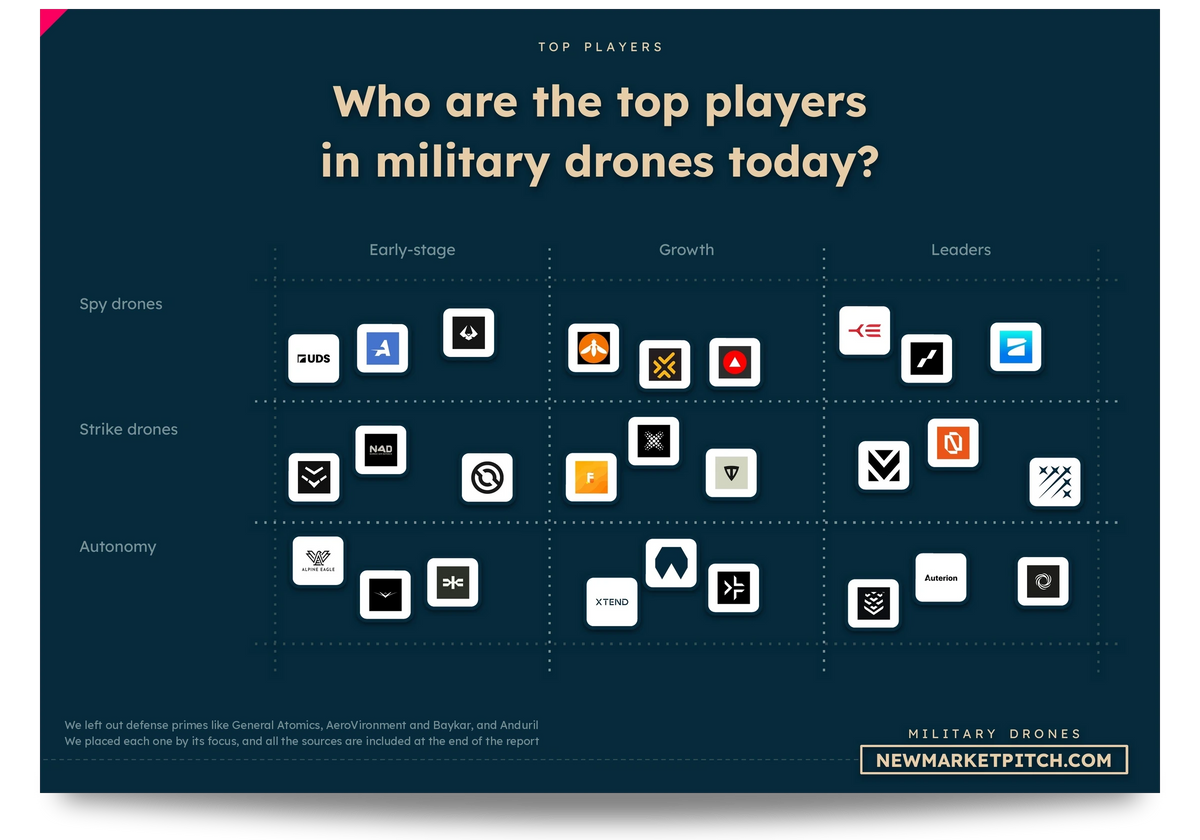
In our report covering the military drone market, we turn what is vague and complex into simple, useful visuals. Market maps like this one show you at a glance where every startup stands.
Is Boeing's MQ-28 Ghost Bat really the most advanced loyal wingman?
Boeing's MQ-28 Ghost Bat is currently the most convincing Western loyal wingman aircraft when we combine flight experience, military integration and demonstrated weapons employment.
The Australian aircraft first flew in February 2021. By March 2025, Boeing had reported more than 100 test flights and over 20,000 hours of digital testing. That gave the MQ-28 several years of practical development before the leading American CCA competitors reached their first-flight milestones.
The most important demonstration took place in December 2025 at Australia's Woomera Test Range. An MQ-28 worked alongside a Royal Australian Air Force E-7A Wedgetail and F/A-18F Super Hornet, launching an AIM-120 AMRAAM missile that destroyed a Phoenix Jet unmanned target.
According to the Australian Department of Defence, the test demonstrated coordinated engagement between crewed and uncrewed combat aircraft. It went beyond autonomous navigation: the MQ-28 participated in a mission involving military sensors, command systems and a live air-to-air weapon.
The funding trajectory is equally revealing. Australia has invested more than AUD 1 billion in the program, according to Boeing's December 2025 announcement. The government subsequently committed approximately AUD 1.4 billion more to advance collaborative air capabilities, including a AUD 754 million Boeing contract for additional aircraft, development and support.
Boeing reported that eight Ghost Bats had already been produced, with another three Block 2 aircraft in final production or testing. The new contract covers seven additional aircraft and work toward operational capability in 2028.
Among Western programs, that combination of physical aircraft, completed flight testing and continued government investment is difficult to match. The remaining challenge is to prove the MQ-28 can perform reliably in demanding operational conditions rather than controlled demonstrations.
Has Anduril already overtaken Boeing in loyal wingman drones?
Anduril has moved ahead of Boeing in the U.S. Air Force's first CCA procurement program, but Boeing still has a stronger publicly demonstrated record of integrated air combat.
Anduril entered the American competition in April 2024, when the Air Force selected it alongside General Atomics to develop prototype aircraft. Its Fury design then progressed through ground testing, flight testing and autonomous mission-system integration.
In February 2026, Shield AI announced that its Hivemind autonomy software had completed an initial mission-autonomy flight aboard the YFQ-44A. Four months later, the Air Force awarded Anduril an engineering, manufacturing development and production contract. The aircraft subsequently received the production designation FQ-44A.
By August, Anduril had delivered a Fury aircraft to the Air Force's Experimental Operations Unit. This moved the program into military experimentation, where airmen could begin testing how the aircraft would be operated and integrated into future missions.
Anduril's industrial ambitions are unusually aggressive. The company began FQ-44 production at its Arsenal-1 manufacturing operation in Ohio in 2026, describing capacity for approximately 150 aircraft annually.
Boeing still leads in proven combat-system maturity. Anduril, though, has secured a place in the world's most important near-term CCA procurement program. If it can actually deliver at the scale it is targeting, the balance could change pretty quickly.
If you want more recent data on this point, please see our latest military drones market report.

Our research about military drones gets updated several times a month, so you always get the latest view of where things stand.
Is General Atomics actually ahead of Anduril?
General Atomics currently matches Anduril in confirmed U.S. Air Force CCA procurement and has an earlier first-flight milestone, although neither company has demonstrated a decisive overall advantage.
General Atomics' FQ-42A completed its first announced flight in August 2025, ahead of Anduril's Fury. The company also brings decades of experience building and supporting unmanned military aircraft, including the MQ-1 Predator and MQ-9 Reaper.
Its development campaign suffered a setback on April 6, 2026, when an FQ-42A crashed shortly after takeoff. The aircraft was destroyed, but there were no injuries.
The subsequent investigation traced the accident to an autopilot calculation involving aircraft weight and center of gravity. General Atomics implemented software changes, and testing resumed on May 21, approximately six weeks later.
The Air Force's June procurement decision suggests the accident did not seriously undermine the program's position. General Atomics retained its place alongside Anduril, with officials indicating that both manufacturers could meet the service's cost, schedule and capability requirements.
Anduril's advantage is its aggressive manufacturing strategy and relatively fast progression from selection to production. General Atomics has extensive experience with military unmanned aircraft, existing production processes and long-term fleet support.
Neither company has published enough comparable information about aircraft reliability, mission-success rates, manufacturing cost or combat performance to establish a meaningful winner. The Air Force itself has kept both in the competition rather than choosing a single supplier.
Could Baykar's Kızılelma be ahead of the American loyal wingman drones?
Baykar's Kızılelma is one of the most advanced publicly demonstrated unmanned fighter programs, and its weapons-testing record makes it a serious competitor to Boeing, Anduril and General Atomics.
The Turkish aircraft first flew in December 2022. By late 2025, its development had progressed to radar-guided air-to-air weapons employment.
In November 2025, Baykar reported that Kızılelma used an ASELSAN MURAD AESA radar and a Gökdoğan beyond-visual-range missile to destroy a jet-powered aerial target. The following month, two Kızılelma aircraft demonstrated autonomous close-formation flight.
The company then expanded its weapons testing during 2026. In July, Kızılelma fired a JET-230 supersonic air-to-ground missile and completed internal weapons-bay tests involving TEBER-82 and TOLUN precision munitions.
Taken together, these demonstrations show a wider publicly reported range of individual weapons employment than many other loyal wingman programs. Kızılelma is designed more like an unmanned fighter than a relatively simple expendable aircraft, with onboard radar, internal weapons carriage and multiple strike options.
Boeing's December 2025 engagement remains particularly important because the MQ-28 operated alongside Australian crewed military aircraft. Baykar's tests provide strong evidence of Kızılelma's own combat functions, although they do not establish equivalent performance in the same crewed-uncrewed missions.
Baykar has also started serial production. At the SAHA 2026 exhibition in May, Janes reported an agreement involving 12 Kızılelma aircraft for Indonesia, with deliveries expected from 2028 and a possible expansion to 48 aircraft.
Baykar could become one of the earliest companies to deliver an operational unmanned fighter fleet. We would already rank Kızılelma among the strongest technological contenders, but announced production ambitions are not completed military deliveries.
If you want more recent data on this point, please see our latest military drones market report.

In our market report about military drones, we look at what the winners do differently, so you can learn from the best instead of guessing.
Has Kratos fallen behind in the loyal wingman market?
Kratos has fallen behind Anduril and General Atomics in the first U.S. Air Force production competition, but its XQ-58A Valkyrie has gained a credible second route into the market through Europe.
The XQ-58A first flew in March 2019, around two years before Boeing's MQ-28 and more than six years before the first announced flights of the American CCA production candidates.
That early start helped Kratos establish substantial flight experience, but it did not translate into a production award under the Air Force's first CCA increment.
In July 2025, Kratos announced a partnership with Airbus to offer a European Valkyrie variant equipped with Airbus's Multi-platform Autonomous Reconfigurable and Secure (MARS) mission system.
The partnership reached a major milestone in October 2026 when the U740 Valkyrie completed its first European flight. Airbus reported that the aircraft performed a rocket-assisted launch, reached speeds of up to Mach 0.8 and executed in-flight mission changes.
The difference from Boeing's recent progress is clear. Kratos and Airbus have demonstrated a flying platform for Europe, while Boeing has already demonstrated an integrated air-to-air missile engagement with the Ghost Bat.
Nevertheless, Kratos has an advantage over newly designed European competitors: the basic aircraft has been flying for years, and Airbus can concentrate on adapting its mission systems rather than developing an entirely new platform.
The next test is whether Germany or another European customer commits to buying aircraft. Without that order, Kratos remains a technically credible challenger with a promising export opportunity.
Is Germany about to decide who wins Europe's loyal wingman market?
Germany has become one of the most important battlegrounds for loyal wingman drones in Europe, with Boeing-Rheinmetall and Airbus-Kratos currently holding strong positions among the near-term contenders.
Germany wants affordable unmanned combat aircraft that can operate alongside its crewed fighters. Its intended capability timeline around 2029 has encouraged manufacturers to offer existing aircraft rather than start development from scratch.
Boeing signed an agreement with Rheinmetall in March 2026 to explore the MQ-28 Ghost Bat for German requirements. Diehl Defence and Rohde & Schwarz subsequently joined the industrial team, bringing experience in weapons, communications and electronic systems.
Airbus and Kratos are pursuing a competing approach based on the U740 Valkyrie. Airbus is developing the European mission software, allowing Germany to retain more control over how the aircraft operates and how its autonomy evolves.
The first European U740 flight strengthens that proposal. However, the full MARS integration and more demanding mission testing still lie ahead.
Europe also has homegrown alternatives. Helsing is developing the CA-1 Europa and working with HENSOLDT on sensor integration. Dassault Aviation is pursuing a future combat drone for France's Rafale F5, supported by experience from the earlier nEUROn stealth demonstrator.
The timing favors aircraft that have already flown. Boeing and Airbus-Kratos have a practical head start over newer European designs, although national control over software and weapons integration could influence procurement decisions.
Germany has not yet selected a definitive winner. Its eventual choice could give one manufacturer a much stronger European foothold, particularly if other air forces adopt the same aircraft.

In our document detailing everything you need to know about military drone, you will always find fresh funding data, taken straight from our own verified funding database.
Could Shield AI control the software inside future loyal wingman drones?
Shield AI is currently one of the strongest contenders in loyal wingman autonomy, although the U.S. Air Force is deliberately keeping its software market open to several companies.
Shield AI's Hivemind system has already moved beyond simulations. In February 2026, the company announced an autonomous mission flight aboard Anduril's YFQ-44A Fury, demonstrating that its software could operate on an aircraft developed by another manufacturer.
The company has also demonstrated coordinated defensive behavior using two U.S. Navy BQM-177A aircraft in a live-virtual-constructive environment. Those aircraft performed maneuvers to defend designated combat air patrol positions against simulated threats.
This approach gives Shield AI a different commercial opportunity from Boeing or General Atomics. Software can potentially be integrated into several aircraft families, allowing an autonomy specialist to expand without producing every airframe itself.
However, the Air Force has structured its CCA procurement to avoid dependence on one software supplier. In June 2026, it selected Anduril, Shield AI and Collins Aerospace for initial competitive mission-autonomy production options, drawn from a larger six-company pool that also includes General Atomics, Lockheed Martin and Northrop Grumman.
The competition is designed around a government-owned architecture that allows mission software to move between different aircraft. The Air Force expects to choose a primary autonomy provider for its first CCA increment by summer 2027, while retaining the option to license other systems.
Shield AI has a strong early position. Winning the primary autonomy role could make it influential across more aircraft than any single airframe manufacturer. But that depends on Hivemind outperforming competing systems in operationally relevant testing, not merely demonstrating that it can fly.
If you want more recent data on this point, please see our latest military drones market report.
Are loyal wingman drones really four times cheaper than fighter jets?
The U.S. Air Force is targeting roughly $20 million per loyal wingman aircraft, which would make a CCA about four times cheaper to acquire than an F-35A fighter. Whether the complete system delivers comparable savings remains uncertain.
Air & Space Forces Magazine reported the approximate $20 million target in September 2026. For comparison, U.S. budget figures put the F-35A's flyaway cost at roughly $82 million.
Using those estimates, four CCAs would cost about $80 million, close to the price of one F-35A. The difference could allow air forces to deploy more aircraft, extend their surveillance coverage and accept greater operational risk without putting additional pilots in danger.
However, aircraft acquisition costs exclude several important expenses, including some weapons, support infrastructure, training and long-term maintenance. The estimates also refer to aircraft with different capabilities and expected operating lives.
The cost question becomes especially important when comparing manufacturers. Anduril is building its production system around large-scale manufacturing. Boeing's MQ-28 is being developed through an extensive national program with multiple aircraft blocks and mission-system upgrades. Baykar has its own manufacturing base and experience producing military drones in considerable numbers.
We cannot yet calculate comparable lifetime operating costs for the leading loyal wingman aircraft because those figures are not publicly available.
The approximate four-to-one acquisition-cost ratio is promising. But a cheap aircraft that requires expensive support or cannot reliably complete its missions is no bargain. Actual fleet operating costs will be a more revealing measure than the advertised purchase price.

Learning from others' mistakes is the cheapest lesson there is. In our report covering the military drone market, we look at what broke startups before you, so you don't repeat it.
Can Anduril actually manufacture loyal wingman drones faster than Boeing?
Anduril has set one of the most aggressive manufacturing targets in the loyal wingman industry, but its claimed capacity of 150 Fury aircraft per year has not yet been demonstrated through completed annual deliveries.
The company began production of the FQ-44 at its Arsenal-1 facility in Ohio during 2026. The factory is part of a broader strategy to produce autonomous military systems using more standardized and scalable manufacturing methods.
The planned output is substantial when compared with the initial U.S. CCA program. The Air Force wants at least 150 aircraft from Anduril and General Atomics combined by the end of the decade. Anduril's stated annual capacity could theoretically produce a similar quantity in a single year.
General Atomics approaches the problem with an existing history of military drone manufacturing. Its MQ-9 Reaper production and support experience give it knowledge of aircraft assembly, military acceptance testing and long-term maintenance.
Boeing has a different production record. According to its December 2025 announcement, eight MQ-28 aircraft had already been produced, with three more Block 2 aircraft in final production or testing. The newly funded Australian program adds seven more aircraft.
The scale of these efforts is still modest compared with conventional fighter production. They also involve different manufacturing stages, so directly comparing Anduril's planned annual capacity with Boeing's delivered prototypes would be misleading.
Anduril has the more ambitious near-term factory target. Boeing has already built multiple generations of its aircraft, while General Atomics brings the longest established unmanned-aircraft production experience of the three.
Annual deliveries and government acceptance rates will provide a much clearer comparison once the first U.S. production contracts are fully underway.
Can loyal wingman drones really fight without human pilots?
Loyal wingman drones can already fly autonomously, coordinate with other aircraft and perform selected combat functions, but no leading manufacturer has publicly proved that its aircraft can independently handle every task performed by a fighter pilot.
Boeing's MQ-28 provides one of the clearest examples of advanced mission integration. During its December 2025 missile engagement, the aircraft operated alongside an Australian E-7A Wedgetail and F/A-18F Super Hornet.
Shield AI's Hivemind demonstrations show another part of the technology. Its software has controlled aircraft during mission-autonomy flights and coordinated defensive maneuvers across multiple unmanned platforms.
Baykar's Kızılelma has demonstrated autonomous close-formation flight and combat-system functions involving radar and guided weapons. These tests help establish that the underlying technology works across different aircraft designs.
What remains much harder to verify is how the systems perform under sustained electronic interference, unreliable communications, unexpected tactical situations or attacks by advanced enemy aircraft.
Military customers also maintain human authority over critical weapons decisions. Airbus, for example, describes its MARS architecture as keeping a human within the command hierarchy for decisions governed by rules of engagement.
The next meaningful demonstrations will involve increasingly complex missions with limited communications and realistic threats. Until those tests are completed and their results made public, claims that autonomous drones can fully replace fighter pilots remain premature.

In our research about military drones, we always try to gather several sources and make estimates that make sense, so you can work with solid numbers.
Is China secretly ahead in loyal wingman drones?
China could be more advanced in loyal wingman drones than public information suggests, but we have no reliable basis for placing it ahead of Boeing, Anduril or General Atomics today.
China has developed several sophisticated unmanned combat aircraft, including the GJ-11 Sharp Sword, and has displayed other jet-powered designs associated with future collaborative air combat.
The difficulty is that public information about these programs rarely provides the same level of detail as Western development announcements.
For Boeing, we can identify a specific missile engagement, the participating military aircraft and the target destroyed. For the American CCA program, the Air Force has confirmed production contract awards, flight-test milestones and the selected manufacturers.
Equivalent information about Chinese autonomous mission performance, weapons testing, fleet readiness and production volumes remains much harder to verify independently.
Aircraft displays and promotional videos offer some evidence of technological development, but they cannot establish how well an aircraft performs under combat conditions.
China may well have made more progress than outsiders can see. For now, a confident claim that Chinese loyal wingman technology leads the world would go beyond the available evidence.
Which company has the biggest loyal wingman contracts?
Anduril and General Atomics currently have the strongest direct position in the U.S. Air Force's initial CCA production program, while Boeing has secured one of the largest publicly documented national development commitments through Australia.
The American Air Force selected both manufacturers in June 2026 for engineering, manufacturing development and production contracts. The combined procurement objective is at least 150 aircraft by the end of the decade.
The Air Force did not disclose how much each manufacturer would receive or how many aircraft each would supply. That prevents us from ranking Anduril and General Atomics by confirmed contract value or aircraft volume.
Australia's funding is more transparent. In December 2025, the government announced approximately AUD 1.4 billion in additional investment associated with the MQ-28's transition toward operational capability. Boeing separately confirmed a AUD 754 million contract covering aircraft, development and support.
Baykar has announced serial production of Kızılelma and an Indonesian agreement for 12 aircraft, potentially increasing to 48. The disclosed information does not establish a comparable firm contract value.
Meanwhile, Kratos and Airbus are pursuing German requirements without a publicly confirmed fleet purchase.
| Company | Main customer | Procurement position | Publicly disclosed scale |
|---|---|---|---|
| Anduril | U.S. Air Force | Production contract awarded | Share of 150+ initial CCAs undisclosed |
| General Atomics | U.S. Air Force | Production contract awarded | Share of 150+ initial CCAs undisclosed |
| Boeing | Australia | Funded MQ-28 program | AUD 754M Boeing contract |
| Baykar | Türkiye | Serial production underway | Contract value and delivered volume undisclosed |
| Baykar | Indonesia | Export agreement | 12 aircraft planned, with possible expansion to 48 |
| Boeing / Rheinmetall | Germany | Industrial partnership | No confirmed aircraft order |
| Airbus / Kratos | Germany | Development and integration partnership | No confirmed fleet purchase |
| Shield AI | U.S. Air Force | Mission-autonomy production option | Licensing value undisclosed |
These commitments also show why the market cannot be divided neatly between traditional defense companies and startups. The U.S. Air Force selected one newer manufacturer and one established drone specialist, while Australia continued backing Boeing.
The longer-term commercial advantage will depend on follow-on orders and production volumes. The Air Force's decision to retain two manufacturers leaves room for the balance to change even after production begins.

If you build or invest in the military drone market, you need to know which business models pay off now and which ones are fading. That's why our report covering it has a whole section on it.
What could change the loyal wingman drone rankings by 2029?
The loyal wingman rankings could change substantially by 2029, especially if Anduril or General Atomics begins large-scale deliveries before Boeing's MQ-28 reaches full operational capability.
Boeing's next major target is Australia's planned operational capability around 2028. The MQ-28 has already demonstrated important combat functions, and the funded program now needs to deliver aircraft that military units can operate routinely.
Anduril and General Atomics face a different test. Their production contracts must turn into accepted aircraft, functioning autonomy systems and effective operational procedures. The Air Force's planned selection of a primary autonomy provider in 2027 will help shape that process.
Baykar's production schedule could also change the ranking. The company has announced plans to supply Türkiye's military and begin Indonesian deliveries from 2028. Delivering these aircraft on schedule would strengthen its position in a market where many competitors remain focused on testing.
Germany adds another deadline. Airbus-Kratos is targeting a combat-ready U740 capability by 2029, while Boeing-Rheinmetall is pursuing the same opportunity with the MQ-28. A German fleet order would be a major commercial breakthrough for either team.
By 2029, we should be able to compare actual operational fleets, annual production, repeat purchases and international deliveries more directly.
The company that achieves those milestones first could overtake today's technical leader, even without producing the most sophisticated aircraft.
So which company is ahead in loyal wingman drones?
Boeing is currently ahead in the loyal wingman drone race, based on the strongest publicly demonstrated combination of combat capability, aircraft maturity and sustained military funding.
The MQ-28 Ghost Bat has several advantages that the leading competitors have not yet matched together. Boeing began flight testing in 2021, built multiple generations of aircraft, completed a coordinated air-to-air missile engagement with Australian crewed aircraft and secured a substantial program commitment extending toward operational capability in 2028.
Anduril and General Atomics remain the most serious American challengers. Both have secured production contracts under the U.S. Air Force's first CCA increment, and both are moving toward military experimentation and fleet production. Anduril could eventually move ahead if it turns its ambitious manufacturing capacity into large deliveries.
Baykar is the strongest alternative outside the Western CCA procurement system. Kızılelma's weapons demonstrations, autonomous flight achievements and serial-production plans give it a credible route toward becoming one of the earliest operational unmanned fighter fleets.
Kratos and Airbus are also worth watching following the U740 Valkyrie's first European flight, while Shield AI could become especially important if its Hivemind software wins a central role in American mission autonomy.
Our overall judgment remains Boeing, with a meaningful qualification: the MQ-28 leads on demonstrated Western combat-system maturity, while the next stage of the competition will be decided by operational deployments and production volumes.
Boeing has the strongest case today. The company that delivers the first large, reliable and combat-ready loyal wingman fleet could still end up winning the much bigger race.
If you want more recent data on this point, please see our latest military drones market report.

In our document detailing everything you need to know about military drone, we don't want to repeat what boring consulting reports say. Instead, we show you the real and latest market signals that matter.
Sources and methodology
This analysis compares the leading loyal wingman drone manufacturers based on evidence available through October 2026. We assess demonstrated combat capability, autonomous mission performance, military integration, procurement momentum, manufacturing readiness, acquisition costs and operational deployment. Our objective is to determine which company has made the most substantial progress toward fielding useful combat aircraft, rather than simply which has announced the most ambitious program.
We prioritize completed flight tests, documented weapons engagements, government procurement decisions, military deliveries and funded production programs over manufacturer specifications or future targets. These achievements are evaluated separately before being combined into our overall assessment. A successful autonomous flight, a live missile engagement, a production contract and an accepted operational aircraft provide different levels of evidence, and we do not treat them as interchangeable.
We distinguish technical leadership from commercial leadership and software leadership. Boeing's MQ-28 is assessed primarily through its military integration, live weapons testing and Australian program funding. Anduril and General Atomics are compared using their U.S. Air Force CCA awards, flight-test progress and manufacturing readiness. Baykar's Kızılelma is evaluated through its weapons demonstrations, autonomy milestones and production commitments. Airbus, Kratos, Helsing and Dassault Aviation are assessed according to their European development and procurement progress, while Shield AI is considered separately as a potential mission-autonomy supplier.
Production capacity figures represent manufacturer targets unless completed deliveries are documented. Similarly, procurement objectives are not counted as aircraft already delivered, and development funding is distinguished from firm aircraft purchase commitments. The approximately $20 million American CCA target and $82 million F-35A comparison refer to aircraft acquisition costs, not equivalent lifetime costs or combat capability. Publicly announced tests are treated as evidence of demonstrated functions, without assuming those functions have been validated in sustained operational combat.
We prioritized official military statements, government announcements and first-hand manufacturer disclosures. Key sources for the American program include the U.S. Air Force's June 2026 CCA production announcement, its FQ-42 and FQ-44 program update, and its open mission-autonomy architecture announcement. We also used General Atomics' FQ-42A first-flight announcement, its April 2026 flight-incident statement, its return-to-flight update, and its production-contract announcement.
For Boeing and Australia's MQ-28 program, the principal sources are the Australian Department of Defence's December 2025 missile-engagement report, the Australian government's additional funding announcement, and Boeing's account of the integrated missile demonstration. For mission autonomy, we used Shield AI's Hivemind flight-test announcement.
For Baykar, we used its first-hand reports on Kızılelma's air-to-air missile engagement, autonomous formation flight, and internal weapons-bay firing tests. For the European competition, we relied on Airbus's partnership announcement with Kratos, its October 2026 U740 Valkyrie flight announcement, Helsing's CA-1 Europa collaboration with HENSOLDT, and Dassault Aviation's Rafale F5 unmanned combat-aircraft program announcement.
Our overall ranking gives the most weight to independently identifiable military milestones and funded progression toward operational service. Where comparable information about reliability, fleet readiness, long-term operating costs or production volume is unavailable, we avoid assigning artificial precision. This is particularly relevant to Chinese programs, whose actual maturity is difficult to assess from public disclosures. The conclusion reflects demonstrated progress through October 2026, while recognizing that future operational deployments and large-scale deliveries could change the competitive ranking.

In our report covering the military drone market, we like to show you the big picture. We know your time is precious, so we make every page quick to read and packed with as much learning as possible per minute.
Written by the New Market Pitch teamWe track new markets so founders and investors can move faster. About us