Which military drone startup is growing the fastest?
Whether you're building or investing in the military drone market, our report covers everything you need to know: the players, the money, and what's coming next.
Summary
Quantum Systems is the fastest-growing military drone startup among established manufacturers with a meaningful, comparable revenue history. Its estimated annual sales rose from $20 million in 2022 to $330 million in 2025, a sixteenfold increase in three years.
The German company's growth is unusually convincing because its revenue gains are getting larger in absolute terms. It added approximately $19 million in sales in 2023, $85 million in 2024, and $206 million in 2025. That's a remarkable acceleration for a business manufacturing physical aircraft.
Anduril is growing much faster in absolute dollars. Its revenue reportedly reached $2.2 billion in 2025, adding approximately $1.2 billion in one year. But Anduril sells a much broader range of defense products, making Quantum Systems the cleaner comparison for a drone-focused manufacturer.
Shield AI is a serious contender, with management reporting that fiscal 2026 revenue doubled. Its advantage may increasingly come from Hivemind autonomy software, which can operate across military vehicles that Shield AI doesn't manufacture itself.
The most explosive growth may eventually come from smaller companies. Neros secured a $100 million-plus order for 14,000 drones in September 2026, while STARK and Harmattan AI have gone from being founded in 2024 to major production operations and substantial military backing in roughly two years.
There's a big difference between winning contracts and generating sales. Anduril's $20 billion U.S. Army agreement and Tekever's £400 million British contract represent potential procurement over time. Neither amount should be mistaken for revenue already earned.
Military drone production is also difficult to compare. Thousands of inexpensive FPV aircraft can generate less revenue than a few hundred sophisticated reconnaissance drones. Factory capacity, completed deliveries, and revenue measure different kinds of growth.
Investor valuations are rising exceptionally quickly. Quantum Systems' approximately $8 billion valuation represents around 24 times its estimated 2025 revenue, while Anduril's $61 billion valuation implies roughly 28 times sales. Investors are paying heavily for expected future military demand.
Ukraine remains an important source of battlefield experience, but Quantum Systems' contracts with Germany, Romania, and the United States show that its expansion has moved beyond one war. Its acquisitions of drone, autonomy, propulsion, and ground-vehicle companies are also reshaping the business, although the organic share of its growth remains unclear.
Our conclusion is that Quantum Systems has the strongest demonstrated multiyear percentage growth at meaningful scale. Anduril wins on absolute revenue expansion, and Neros is a particularly interesting emerging challenger. The next test is whether these manufacturers can turn their growing order books into reliable deliveries and sustained sales without depending on constantly rising defense budgets.

Written by the New Market Pitch teamWe track new markets so founders and investors can move faster. About us
Why are military drone startups growing so fast right now?
Military drone startups are growing unusually fast because Ukraine has shown how quickly armies can consume unmanned aircraft, while European and American governments are putting much more money into autonomous weapons.
The war has changed what militaries buy. Small drones are now used for reconnaissance, targeting, strikes, and intercepting other drones. Armies need large quantities, frequent software updates, and replacements for equipment lost in combat. This favors manufacturers that can improve their products and deliver new batches much faster than traditional defense contractors.
The investment figures show how far the market has moved. Anduril raised $5 billion at a $61 billion valuation in May 2026. Quantum Systems secured $1.2 billion at an approximately $8 billion valuation in July. Helsing raised another $1.8 billion at $18 billion, while Tekever reached $6.4 billion following a $580 million financing announcement in September.
Together, those four companies announced roughly $8.58 billion in financing, although they operate across different parts of the defense industry.
What's especially interesting is how young some of their competitors are. STARK and Harmattan AI were both founded in 2024, yet they have already secured military programs and substantial venture funding. The sector is attracting established defense-technology companies alongside startups that barely existed two years ago.
What counts as the fastest-growing military drone startup?
The fastest-growing military drone startup should be the company increasing its actual sales fastest at a meaningful scale, rather than whichever manufacturer has just raised the most money.
There are several legitimate ways to measure growth, and they can produce very different winners.
A manufacturer going from $2 million to $20 million in annual revenue has grown 900%. Another going from $100 million to $300 million has grown 200%, but added more than eleven times as much revenue. The first leads in percentage terms; the second has built a much larger business.
Production and contracts introduce another complication. An order for 10,000 drones says something about customer demand, but it doesn't tell us how many aircraft have been delivered or how much money the supplier has received. Similarly, a multibillion-dollar procurement framework can cover years of possible purchases.
We therefore give the most weight to annual revenue growth, the absolute amount of new revenue, and whether that growth continues across several years. Contracts, factory expansion, and military deployments help us judge whether the business can keep growing.
The comparison covers private manufacturers of military drones and closely related autonomous systems. We also examine broader defense companies such as Anduril and Helsing, while accounting for the fact that their reported revenues include products beyond drones.

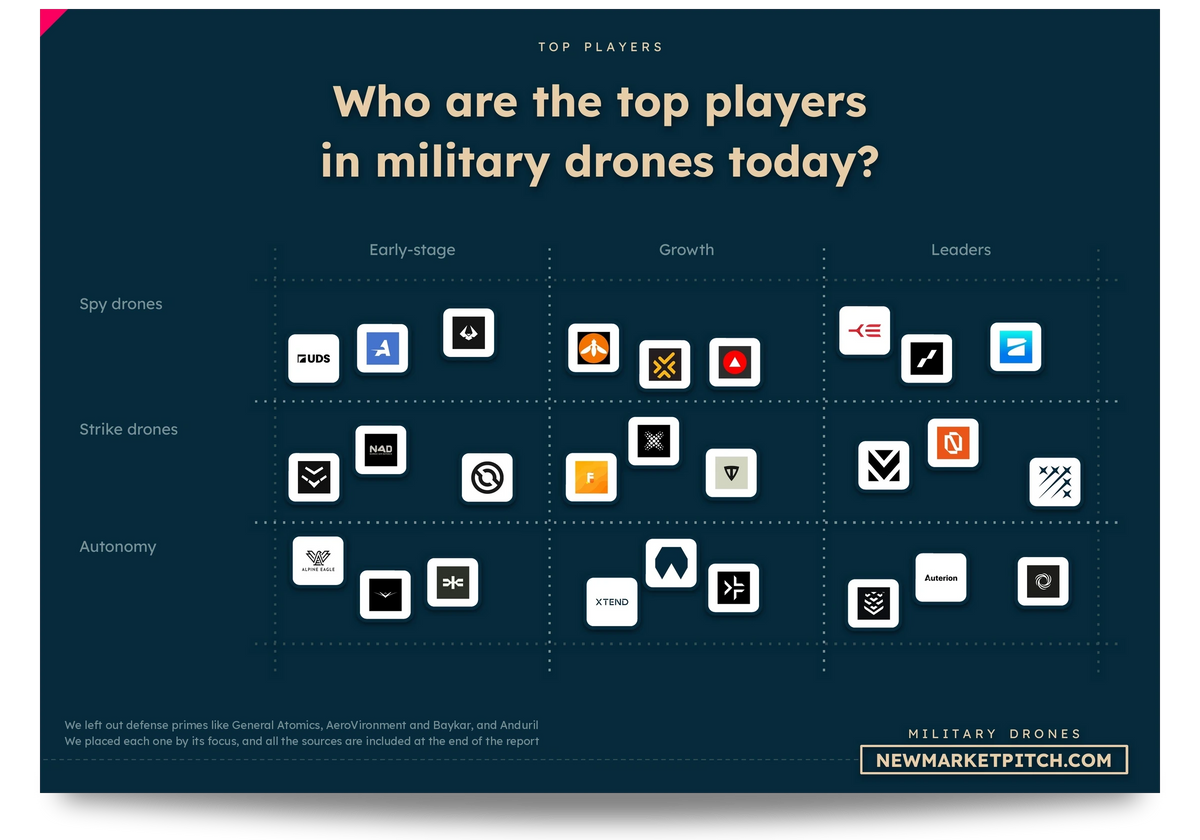
In our report covering the military drone market, we turn what is vague and complex into simple, useful visuals. Market maps like this one show you at a glance where every startup stands.
Is Quantum Systems the fastest-growing military drone startup today?
Quantum Systems currently has the strongest case for being the fastest-growing military drone startup, thanks to several years of exceptional revenue growth backed by actual military deployments.
The German company develops reconnaissance drones, including its Vector aircraft, which can take off vertically before flying like a conventional fixed-wing aircraft.
According to Sacra's July 2026 research, Quantum Systems generated approximately $20 million in revenue in 2022, $39 million in 2023, $124 million in 2024, and $330 million in 2025.
Revenue therefore increased about 16.5 times in three years. Using those rounded estimates, annual growth reached roughly 218% in 2024 and 166% in 2025. Sacra reports slightly different percentages from its underlying unrounded figures.
The more remarkable development is the amount of additional revenue. Quantum Systems added approximately $19 million in 2023, $85 million in 2024, and $206 million in 2025. Its annual increase in sales became more than ten times larger in just two years.
Quantum Systems' July 2026 financing announcement supported the broader picture, with management reporting triple-digit revenue growth and double-digit profitability.
The company also reported more than 19,000 missions flown by its drones in Ukraine during 2025. That gives us something valuable alongside the financial estimates: evidence that its products are being used extensively in combat conditions.
The revenue figures remain third-party estimates rather than audited financial results. Still, few privately held military drone manufacturers have a similarly detailed record of growth at this scale.
| Year | Estimated revenue | Annual growth | Additional revenue |
|---|---|---|---|
| 2022 | $20M | - | - |
| 2023 | $39M | 95% | $19M |
| 2024 | $124M | 218% | $85M |
| 2025 | $330M | 166% | $206M |
| 2026 | Not confirmed | Triple-digit growth reported by management | Not confirmed |
If you want more recent data on this point, please see our latest military drones market report.
Is Quantum Systems growing faster than Anduril?
Quantum Systems is growing faster than Anduril in percentage terms, but Anduril is adding far more revenue every year.
Anduril reported approximately $2.2 billion in 2025 revenue, more than double the previous year's roughly $1 billion. That represents growth of around 120%, compared with Quantum Systems' estimated 166%.
The difference becomes much larger when we compare additional sales.
Anduril added about $1.2 billion in revenue over one year, while Quantum Systems added approximately $206 million. In other words, Anduril generated nearly six times as much new annual business.
Anduril is also a much broader defense company. Its products include autonomous aircraft, counter-drone weapons, surveillance systems, underwater vehicles, and defense software.
Anduril's total revenue cannot be attributed exclusively to military drones. Quantum Systems has a much more concentrated drone business, even as it expands into ground systems and autonomy software.
Anduril also benefits from access to enormous American military programs. Its March 2026 U.S. Army enterprise agreement established a ceiling of up to $20 billion over ten years, although that amount represents potential spending rather than guaranteed revenue.
We give Quantum Systems the lead in percentage growth among the more directly drone-focused manufacturers. Anduril wins comfortably if we're measuring how much additional business a defense-technology startup is generating.

Our research about military drones gets updated several times a month, so you always get the latest view of where things stand.
Is Helsing growing faster than Quantum Systems?
Helsing has become much more valuable than Quantum Systems, but we cannot establish that its military drone business is growing faster.
The German defense AI company raised $1.8 billion in July 2026 at an $18 billion valuation. That made it more than twice as valuable as Quantum Systems, based on their latest financing rounds.
Helsing started with artificial intelligence software for military operations and subsequently expanded into physical weapons. Its HX-2 loitering munition is designed to attack targets using autonomous capabilities, while other company programs cover underwater systems, aircraft, and battlefield software.
The business is already competing for substantial government contracts. Germany has pursued an HX-2 procurement arrangement potentially worth €1.46 billion, according to Financial Times reporting in July 2026.
That's a very large commercial opportunity for a relatively young company. However, it covers potential future procurement rather than completed sales.
The Financial Times also reported projected Helsing revenue of approximately €441 million for 2026 and €753 million for 2027. Those forecasts suggest a rapidly growing business, but they are still projections, and the company has not released a comparable historical revenue series.
Helsing may become Europe's largest privately held autonomous-weapons supplier. Right now, Quantum Systems has the better-documented record of sustained growth.
Is Neros growing faster than the bigger military drone companies?
Neros is one of the most interesting military drone startups right now because a single recent American procurement award could dramatically increase its business.
The California manufacturer specializes in small first-person-view drones, including its Archer family. These aircraft are designed for missions where lower costs and the ability to replace lost equipment quickly are especially important.
Defense News reported in July 2025 that Neros was producing approximately 1,500 drones per month, with about two-thirds going to Ukraine. The company was targeting capacity of 10,000 drones per month by the end of that year.
Then came a much larger commercial breakthrough.
On September 30, 2026, Neros announced an order worth more than $100 million for 14,000 drones and explosive payloads through the Pentagon's Drone Dominance program.
The company ranked first in the close-quarters battle evaluation and third in deep strike. It also received an additional 800-drone order reassigned from competitors that had missed earlier delivery deadlines.
The combined orders cover 14,800 systems, although the reported $100 million value applies to the main 14,000-drone award.
At its previously reported rate of 1,500 drones per month, producing 14,800 aircraft would represent nearly ten months of output. Neros therefore has a strong reason to expand its manufacturing capacity.
However, we haven't seen a current annual revenue figure or verified total deliveries for these awards.
Neros could be growing faster in percentage terms than much larger competitors. Its latest orders make that plausible, but we cannot calculate the actual growth rate yet.
If you want more recent data on this point, please see our latest military drones market report.

In our market report about military drones, we look at what the winners do differently, so you can learn from the best instead of guessing.
Could STARK be Europe's fastest-growing military drone startup?
STARK is one of Europe's fastest-scaling young military drone companies, having moved from its founding in 2024 to major military contracts and a multibillion-euro valuation in roughly two years.
The Berlin-based startup develops autonomous weapons, including its Virtus loitering munition.
In June 2026, STARK secured approximately €500 million in funding at a reported €3.2 billion valuation. Investors included Founders Fund, Sequoia Capital, and the NATO Innovation Fund.
The company had also secured German military contracts worth roughly €300 million, according to Financial Times reporting.
An October 2026 statement from legal adviser LARK confirmed that STARK was operating in five countries and had more than 20,000 square meters of manufacturing space. It had expanded into the United Kingdom and Sweden and acquired software company Pleno.
For a startup founded only two years earlier, that's an unusually large industrial footprint.
The main question is whether its factories can turn signed contracts into steady deliveries. STARK has not published reliable annual revenue figures or a complete production history.
Its progress is already substantial, but there isn't enough financial information to rank STARK ahead of Quantum Systems. We can say much more confidently that STARK has become a serious European military drone manufacturer remarkably quickly.
Is Tekever growing faster than other European drone startups?
Tekever has recorded one of Europe's sharpest recent military drone valuation increases, and its latest British defense contract gives that increase more substance.
Founded in Portugal in 2001, Tekever spent years building software and unmanned aircraft before gaining significant military traction. Its AR3 and AR5 drones are used for surveillance, reconnaissance, and maritime monitoring.
In September 2026, Tekever announced a $580 million financing at a $6.4 billion valuation. Reuters and the Financial Times reported that its valuation had increased approximately fivefold.
The company had recently secured a British Army arrangement worth up to £400 million to supply its CORVUS surveillance capability, replacing the aging Watchkeeper system.
Tekever has also accumulated considerable battlefield experience. Reuters reported that its aircraft had completed more than 50,000 operational flight hours in Ukraine since 2022.
Unlike several younger companies, Tekever has a long operating history and an established customer base. It has also been expanding production in Britain and other European countries.
Its latest financial figures remain the missing piece. The company does not publish enough current revenue information for us to calculate its recent annual growth accurately.
Tekever's valuation has risen exceptionally quickly, and its contracts are becoming larger. Whether sales have accelerated at the same pace is still unclear.

In our document detailing everything you need to know about military drone, you will always find fresh funding data, taken straight from our own verified funding database.
Is Shield AI still growing as fast as the newest military drone startups?
Shield AI is still growing very quickly, and its latest company disclosures suggest the American defense-autonomy specialist has accelerated again.
Shield AI makes the V-BAT surveillance aircraft and Hivemind software, which enables autonomous operation across multiple military platforms.
In March 2026, the company announced $1.5 billion in Series G funding alongside $500 million in preferred-equity financing, at a $12.7 billion valuation.
Two months later, Shield AI stated that its fiscal 2026 orders and revenue had both doubled year over year.
That's particularly impressive because the company was already operating at considerable scale. Sacra had previously estimated its annual revenue at approximately $300 million for the period ending in March 2025.
We should be careful about combining these figures into one growth calculation, since the reporting periods and revenue definitions are not fully comparable.
Shield AI is also developing a wider business around its autonomy technology. In May 2026, management reported that Hivemind was operating across 30 classes of vehicles, expanding its reach beyond the company's own aircraft.
That software strategy could allow Shield AI to grow without manufacturing every vehicle that uses its technology.
Its reported revenue doubling puts Shield AI among the strongest established competitors. The company still needs to publish more consistent financial figures before we can determine whether its growth exceeds Quantum Systems over several years.
Which military drone startups are growing fastest by revenue and valuation?
Quantum Systems leads our comparison for sustained percentage revenue growth, Anduril for additional annual revenue, and Tekever for its especially sharp recent valuation increase.
The differences become clearer when we put the companies together.
Some publish estimates or statements about annual sales. Others report factory capacity, procurement awards, or fundraising. We can compare those figures, but we shouldn't treat them as though they were all revenue measurements.
For example, a startup winning its first $100 million military order can experience enormous growth without yet having delivered the equipment. Meanwhile, a manufacturer adding several hundred million dollars in annual sales has already achieved a much greater level of commercial activity.
The following comparison keeps those distinctions visible.
| Company | Recent growth evidence | Strongest claim | Main limitation |
|---|---|---|---|
| Quantum Systems | Estimated 2025 revenue +166% | Sustained percentage revenue growth | Estimates unaudited |
| Anduril | 2025 revenue roughly +120% | Largest absolute revenue increase | Broader defense business |
| Shield AI | FY2026 revenue doubled | Strong recent acceleration | Limited comparable history |
| Neros | $100M+ drone order | Procurement breakthrough | Revenue undisclosed |
| STARK | €500M financing, major contracts | Rapid industrial expansion | Revenue undisclosed |
| Tekever | Valuation increased roughly fivefold | Valuation growth | Current revenue undisclosed |
| Helsing | $18B valuation, large German programs | Scale of investor backing | Limited actual revenue data |
| Harmattan AI | $200M Series B | Rapid early-stage expansion | Revenue undisclosed |
If you want more recent data on this point, please see our latest military drones market report.

Learning from others' mistakes is the cheapest lesson there is. In our report covering the military drone market, we look at what broke startups before you, so you don't repeat it.
Is Quantum Systems' growth mostly coming from Ukraine?
Ukraine has been central to Quantum Systems' growth, but the German drone manufacturer is now winning substantial business from other NATO and European customers.
Quantum Systems originally focused on professional surveying and mapping aircraft. Military reconnaissance subsequently became the dominant part of its business.
Sacra estimated in September 2025 that defense accounted for approximately 95% of revenue, showing how thoroughly the company had changed direction.
The expansion beyond Ukraine is especially important.
In December 2025, Quantum Systems secured a reported $246 million agreement with the German Army. A $15 million American military order followed in April 2026, alongside a $36 million Romanian procurement agreement in June.
Those three agreements represent approximately $297 million in announced contract value across three countries.
We cannot count that entire amount as immediate revenue, but the geographical spread tells us something about demand. Quantum Systems is attracting customers who want their own surveillance fleets, independently of Ukrainian purchases.
The company is also expanding manufacturing across Europe, Australia, and the United States, suggesting that management expects orders from several markets.
Ukraine remains an important source of operational experience and demand. Still, the company's international contracts make it increasingly difficult to describe its growth as a temporary Ukrainian wartime business.
Are military drone startups turning big contracts into real sales?
The largest military drone startups are starting to turn government demand into substantial sales, although some widely quoted contract figures still refer to money that may never be fully spent.
Anduril offers the clearest illustration of the difference.
Its March 2026 U.S. Army agreement has a potential ceiling of $20 billion over ten years. That is an enormous figure, but it allows future purchases rather than guaranteeing $2 billion in annual revenue.
Tekever's British Army contract similarly has a ceiling of £400 million. The amount ultimately recognized will depend on purchases, delivery schedules, and contract terms.
Quantum Systems is easier to evaluate because its estimated annual sales can be compared with specific national procurement awards. The contracts provide evidence of future demand, while its historical revenue figures show that the business has already reached meaningful scale.
Neros' American order offers a different kind of visibility. It specifies a quantity of physical systems rather than just a broad procurement ceiling, giving us a clearer picture of the work the manufacturer must complete.
Even then, an announced order does not establish that every drone has been delivered, accepted, and paid for.
For our ranking, historical sales carry more weight than potential contract ceilings. The most useful contract announcements are those that give quantities, delivery requirements, and evidence of subsequent orders.

In our research about military drones, we always try to gather several sources and make estimates that make sense, so you can work with solid numbers.
Which military drone startup is increasing production fastest?
Neros and STARK are among the most aggressive manufacturers expanding drone production, but no reliable public comparison proves which startup currently has the fastest growth in actual delivered aircraft.
The difficulty begins with the products themselves.
An inexpensive FPV strike drone and a sophisticated long-range reconnaissance aircraft have very different costs, production times, and military uses.
A manufacturer producing 10,000 small drones could generate less revenue than one delivering a much smaller number of advanced aircraft.
Neros has publicly targeted a large increase in monthly output. STARK has invested in substantial manufacturing infrastructure. Quantum Systems has expanded production internationally to support its surveillance and autonomous-systems business.
Each approach involves a different kind of industrial growth.
Harmattan AI also deserves attention. In January 2026, Dassault Aviation stated that the French startup was already delivering thousands of autonomous systems each month, despite having been founded in 2024.
That's an unusually concrete production claim for such a young manufacturer, although the announcement did not provide a comparable history of monthly deliveries.
We cannot reliably rank these companies by production growth without consistent data on completed units across at least two periods. Their disclosed capacity plans are useful, but too incomplete for a definitive comparison.
Is Quantum Systems growing because it keeps buying other companies?
Quantum Systems is now using acquisitions to expand beyond its original reconnaissance drones, which means some of its recent growth may come from businesses it has purchased.
Its acquisition strategy has been particularly active.
In March 2025, Quantum Systems acquired AirRobot to expand into smaller drones. Spleenlab added autonomous flight software in October, FERNRIDE extended the company's capabilities into unmanned ground vehicles in December, and Hacker Motor strengthened its electric propulsion business in February 2026.
Four deals in approximately twelve months represent a deliberate push into several connected technologies.
Quantum Systems increasingly resembles a broader autonomous-defense supplier rather than a manufacturer of one successful drone platform.
It can now combine aircraft, autonomy software, motors, and ground vehicles while selling to military customers that often need several systems working together.
There is one important financial limitation, though. The company has not published enough information to separate revenue generated by its original operations from revenue added through acquisitions.
We therefore know that the consolidated business has expanded rapidly, but cannot calculate an exact organic growth rate.
That matters when comparing Quantum Systems with younger companies such as Neros, whose growth is more directly tied to selling and manufacturing its own drone products.

If you build or invest in the military drone market, you need to know which business models pay off now and which ones are fading. That's why our report covering it has a whole section on it.
Could military drone startup valuations be rising faster than their businesses?
Military drone startup valuations are running well ahead of today's sales in several prominent cases, although the revenue growth behind some of those valuations is genuinely exceptional.
Quantum Systems was valued at approximately $8 billion in its July 2026 funding round. Using Sacra's estimated 2025 revenue, that represents roughly 24 times annual sales.
Anduril's $61 billion valuation implies around 28 times its reported 2025 revenue.
Both multiples are high for businesses that manufacture physical products, even allowing for advanced software, autonomous systems, and potentially lucrative defense contracts.
Helsing illustrates the enthusiasm especially clearly.
Financial Times reporting in July 2026 placed its valuation at around 32 times projected 2026 revenue. Investors were therefore paying a substantial premium for revenue that the company still expected to generate.
Tekever's valuation jump also raises questions, particularly because the company has not disclosed recent sales. Investors appear to be placing considerable value on its military contracts, operational experience, and expected expansion.
The market is effectively betting that autonomous systems will capture a much larger share of military budgets over the coming years.
Some of those bets may prove justified. But valuation growth alone tells us very little about which manufacturer is currently growing its business fastest.
If you want more recent data on this point, please see our latest military drones market report.
Can Quantum Systems keep growing this fast?
Quantum Systems can probably maintain strong revenue growth for some time, but repeating its recent pace will become increasingly difficult as the company gets bigger.
The arithmetic is demanding.
To repeat approximately 166% annual growth from its estimated 2025 revenue base, Quantum Systems would need to approach $878 million in annual sales. That would require around $548 million in additional revenue over a single year.
For comparison, its previous annual revenue increase was approximately $206 million.
So the company would need to add more than twice as much new business as it did in the preceding year.
There are reasons to believe further expansion is possible. Its military customer base is growing, its manufacturing network is getting larger, and its product portfolio now covers more than reconnaissance drones.
The company has also claimed double-digit profitability alongside triple-digit revenue growth, which would be a notable achievement for a manufacturer investing so heavily in new production capacity.
However, the exact profitability measure was not disclosed in the July 2026 announcement, and the company has not published audited margins or cash-flow figures.
There are practical challenges, too. Military procurement can take years, components must meet demanding supply-chain requirements, and drones must be continually updated to deal with electronic warfare and changing battlefield tactics.
We expect Quantum Systems to remain a fast-growing manufacturer. Keeping annual growth above 150% is a much harder target, and the latest available financial information doesn't establish that it will achieve it.

In our document detailing everything you need to know about military drone, we don't want to repeat what boring consulting reports say. Instead, we show you the real and latest market signals that matter.
Which military drone startup could overtake Quantum Systems next?
Neros is currently one of the most credible challengers to Quantum Systems in percentage growth, while STARK and Harmattan AI could become equally important competitors as their manufacturing businesses mature.
Neros has the clearest recent American procurement breakthrough. Its ability to win awards across different drone missions also suggests that customers see value in its flexible platform rather than just one specialized aircraft.
STARK has moved especially quickly in Europe. Its contracts, manufacturing footprint, and venture funding give it substantial resources to scale production of loitering munitions.
Harmattan AI has a different advantage: it is backed by Dassault Aviation, one of Europe's major combat-aircraft manufacturers.
Its January 2026 financing valued the company at approximately $1.4 billion, according to TechCrunch. The partnership also gives Harmattan access to Dassault's experience with military aircraft, complex system integration, and international defense customers.
All three companies could achieve enormous growth percentages from relatively small starting revenue bases.
The next few years will depend heavily on whether they can deliver repeat orders without sacrificing product reliability or manufacturing efficiency.
For now, Neros has the most striking recent order-driven growth story among the emerging American manufacturers. STARK and Harmattan AI are serious European contenders, with the latter already reporting substantial monthly deliveries.
Which military drone startup is growing the fastest overall?
Quantum Systems is our choice for the fastest-growing military drone startup, based on its exceptional multiyear revenue growth and the scale of its existing military business.
Its sales have grown more than sixteenfold over three years, with annual revenue additions getting progressively larger. Military deployments, international contracts, and manufacturing expansion support the financial trajectory.
Anduril is the stronger choice if we measure absolute business expansion. It is already a multibillion-dollar defense company and adds considerably more annual revenue, although its business extends well beyond military drones.
Shield AI is also growing very quickly, with management reporting a doubling of fiscal 2026 revenue. The available figures do not yet give us a consistent enough multiyear comparison to place it ahead.
Among newer manufacturers, Neros stands out for its latest American procurement breakthrough. STARK and Harmattan AI are expanding rapidly in Europe, while Tekever has achieved one of the sector's largest recent increases in valuation.
We should also acknowledge that private military drone companies disclose their financial results unevenly. An undisclosed competitor could have a higher percentage growth rate, especially if it is starting from a small revenue base.
Still, among the companies with meaningful operating scale and enough historical evidence to make a defensible comparison, Quantum Systems has the strongest claim.
Anduril is growing more in absolute dollars. Neros could become the next major high-volume success story. But Quantum Systems currently offers the clearest evidence of sustained, exceptionally fast growth in the military drone industry.
If you want more recent data on this point, please see our latest military drones market report.

In our report covering the military drone market, we like to show you the big picture. We know your time is precious, so we make every page quick to read and packed with as much learning as possible per minute.
Our methodology
This analysis identifies the fastest-growing military drone startup based on the evidence available as of October 2026. We compare historical revenue growth, additional annual sales, military contracts, production expansion, operational deployments, and company valuations. We prioritize revenue growth at meaningful scale over fundraising announcements or projected contract values.
Our comparison covers private military drone manufacturers and closely related autonomous-defense companies, including Quantum Systems, Anduril, Shield AI, Helsing, Neros, STARK, Tekever, and Harmattan AI. We distinguish drone-focused manufacturers from broader defense businesses whose reported revenue includes software, surveillance equipment, underwater systems, and other military products.
Historical sales receive the greatest weight because they show business activity that has already occurred. We examine both annual percentage growth and absolute revenue increases, while treating orders, procurement frameworks, announced factory capacity, and valuation changes as separate indicators. We do not count a multiyear contract ceiling as guaranteed revenue or assume that announced production capacity equals completed deliveries.
Quantum Systems' revenue history is based on Sacra's estimates for 2022 through 2025, supplemented by the company's July 2026 financing and operating disclosures. We calculate year-over-year changes using the rounded revenue estimates and distinguish those calculations from the company's own growth statements. Quantum Systems' acquisitions are considered when assessing expansion, although its available disclosures do not allow us to isolate organic revenue growth.
For Anduril and Shield AI, we compare reported company-level revenue and management disclosures while accounting for differences in fiscal periods and product mix. For Neros, STARK, Tekever, Helsing, and Harmattan AI, we examine procurement decisions, announced production, government programs, and financing. Where comparable revenue histories are unavailable, we assess their commercial progress without assigning unsupported annual growth rates.
We prioritized original company announcements, government procurement documentation, independent financial estimates, and established defense and financial journalism. Company statements are used for announced transactions and operational milestones, while independent reporting helps contextualize valuations, financial performance, and contracts. The final ranking reflects the strength of the combined evidence rather than a single financing round or unusually large order.
Key sources for Quantum Systems include Sacra's analysis of estimated revenue growth, Quantum Systems' July 2026 Series D announcement, and its May 2025 financing announcement. Its acquisition strategy is documented in the company's announcements concerning AirRobot, Spleenlab, FERNRIDE, and Hacker Motor.
For established American defense companies, we used the U.S. Army's announcement of Anduril's enterprise agreement, Shield AI's March 2026 financing announcement, and Shield AI's May 2026 operational and financial update. For Neros, the principal references are Defense News on its manufacturing capacity and Neros' September 2026 procurement announcement.
Our European comparisons draw on Helsing's Series E announcement, Financial Times reporting on Helsing's forecasts and contracts, and Financial Times reporting on STARK's financing and military orders. For Tekever, we used its September 2026 financing announcement, British Army CORVUS contract announcement, and Reuters reporting on its operations and investment. Harmattan AI's reported production and strategic backing are supported by Dassault Aviation's January 2026 announcement.

When you build or invest in the military drone market, you need clarity, not confusion. In our research about military drones, we always try to put numbers on and quantify whatever is usually vague and confusing.
Written by the New Market Pitch teamWe track new markets so founders and investors can move faster. About us