Which military drone startups are winning real defense contracts?
Building a startup or looking for your next investment in military drones? Our report gives you the full picture.
Summary
Anduril, Quantum Systems, Neros, Skydio, Helsing, TEKEVER and Harmattan AI are currently the military-drone startups and scaleups with the strongest evidence of real defense procurement, but they are winning in very different parts of the market.
The biggest shift is not just that contract values are rising. Western militaries are now buying commercial-style drones in quantities measured in the thousands, which is pushing startups from demonstrations into actual industrial production.
Anduril still has the broadest institutional position. Its edge is not one giant drone order, but the number of U.S. programs it has entered across tactical drones, precision strike, counter-UAS and collaborative combat aircraft.
Neros is the clearest breakout in U.S. attritable attack drones. A funded order for roughly 14,000 drones and payloads worth more than $100 million is more meaningful than a much larger IDIQ ceiling because it represents committed production.
Skydio and Harmattan AI show how repeat procurement is becoming a stronger proof point than first-time selection. Both converted earlier fielding into materially larger follow-on orders, which is one of the cleanest signs that military users actually want more of the product.
Quantum Systems may have the best transatlantic procurement story. It has moved from wartime reconnaissance in Ukraine into German, U.S. and Romanian procurement while also expanding into interceptor drones at very high volumes.
Europe is producing its own distinct winners. Helsing has the strongest strike-drone production evidence, STARK has a credible Bundeswehr path, and TEKEVER has captured a high-value long-endurance ISR replacement program rather than competing only in cheap tactical drones.
Contract headlines remain easy to overstate. Multi-vendor vehicles, optional framework quantities and IDIQ ceilings can look enormous even when only a small initial amount has actually been obligated, so funded production orders deserve far more weight.
Ukraine experience is becoming a real commercial advantage, but only for companies that can turn battlefield feedback into NATO-procurable products with secure supply chains, training, integration and manufacturing behind them.
The next dividing line will be factories, not demos. Startups that can win a second order and then actually deliver thousands of systems on schedule are likely to pull away from companies that still have strong technology but mostly development contracts or contract ceilings.

Written by the New Market Pitch teamWe track new markets so founders and investors can move faster. About us

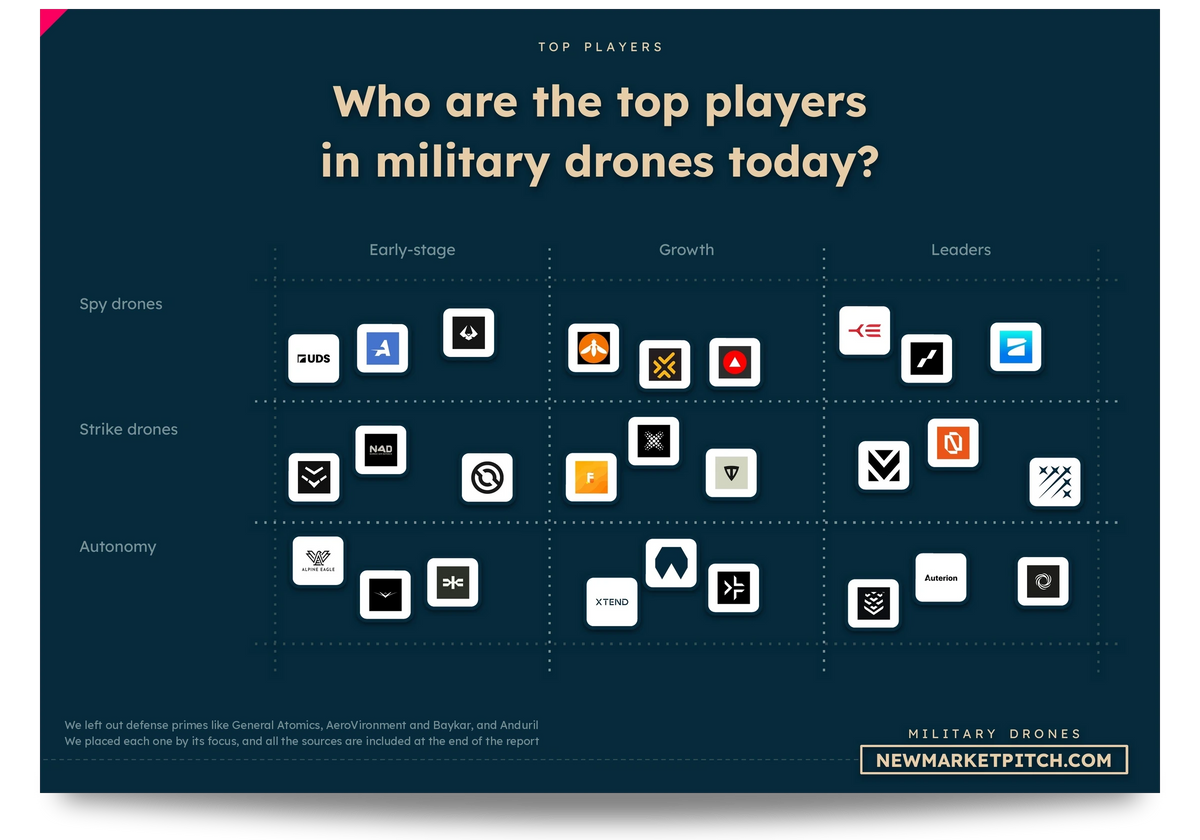
In our report covering the military drone market, we turn what is vague and complex into simple, useful visuals. Market maps like this one show you at a glance where every startup stands.
What counts as a real military drone contract?
A real military drone contract means money has moved beyond experimentation toward actual equipment, production or operational services.
We would not put a company at the top of this market simply because it joined an IDIQ vehicle, received an R&D grant or was selected for testing. There is a big difference between a contract ceiling and an order. An IDIQ worth “up to $500 million” gives a military customer permission to place future orders up to that level; it does not mean $500 million has been spent. The same applies to European framework contracts, where governments may negotiate a maximum quantity and then purchase only individual batches.
The strongest evidence combines funded procurement, meaningful quantities, follow-on orders and delivery into operational units. Skydio’s Army order for more than 2,500 X10D systems therefore carries more weight than simply being admitted to a large Pentagon contract vehicle. Harmattan AI delivering 1,000 drones and then receiving another 5,000-unit order is stronger than a successful demonstration. Neros receiving an order for 14,000 drones and payloads is different again: that is already mass procurement.
Why are military drone startups suddenly getting much larger contracts?
Military drone startups are getting much larger contracts because Western militaries have moved from testing whether small autonomous systems are useful to figuring out how to buy them in quantity.
The U.S. Army is one of the clearest examples. Programs including Short Range Reconnaissance, company-level small UAS, Medium Range Reconnaissance, Purpose-Built Attritable Systems and newer Drone Dominance efforts are creating multiple paths for commercial manufacturers to reach units. The Pentagon’s Replicator initiative also deliberately favored rapidly producible autonomous systems and non-traditional defense suppliers.
Europe is moving in the same direction. Germany has signed procurement contracts with Helsing and STARK for loitering munitions rather than simply funding demonstrations. France went from ordering 1,000 Harmattan AI drones to another 5,000. Britain selected TEKEVER’s AR5 to replace Watchkeeper under a program worth up to £400 million.
The change is now visible in procurement itself: militaries are creating acquisition routes for companies that update drones quickly and can manufacture them in large numbers.
Which military drone startups have the strongest contract evidence today?
Anduril, Neros, Skydio, Quantum Systems, Helsing, TEKEVER, Harmattan AI and STARK currently have some of the clearest evidence of real military drone procurement.
The shape of those wins differs enormously. Neros and Helsing are moving into quantities measured in thousands or tens of thousands. TEKEVER has won a much smaller number of far larger aircraft. Anduril is embedded across several U.S. procurement programs rather than relying on one drone. Quantum Systems is building something arguably just as valuable: repeated purchases across Ukraine, Germany, the United States and other European militaries.
Shield AI sits just behind this group. V-BAT has genuine operational use and international procurement, but some of its largest announced opportunities remain service contract vehicles on which it must still compete for individual task orders. Performance Drone Works is also becoming important through Army C100 procurement, while Firestorm remains earlier in the move from development funding toward large product orders.
| Company | Strongest visible evidence | Approximate scale | What it proves |
|---|---|---|---|
| Anduril | USMC Bolt-M fielding, Ghost-X Army selection, Air Force CCA production | 600+ Bolt-M plus multiple programs | Broad U.S. institutional penetration |
| Neros | Drone Dominance Gauntlet II order | 14,000 drones/payloads, >$100m | Mass attritable-drone procurement |
| Skydio | U.S. Army X10D order | 2,500+ drones, >$52m | Large tactical ISR procurement |
| Quantum Systems | Ukraine interceptors, U.S. Army Vector, Bundeswehr orders | 15,000 interceptors plus hundreds of ISR systems | Multi-country repeat procurement |
| Helsing | Ukraine HF-1/HX-2 orders and Bundeswehr procurement | 10,000 Ukraine strike drones announced | European strike-drone production scale |
| STARK | Bundeswehr Virtus framework | Several thousand systems contemplated | Direct entry into a major European army |
| TEKEVER | British Army CORVUS | Up to £400m; 24 AR5 initially confirmed | Major long-endurance ISR program |
| Harmattan AI | French DGA Delco/Sonora procurement | 1,000 delivered + 5,000 ordered | Rapid repeat sovereign procurement |
| Shield AI | V-BAT operational services and Polish Navy purchase | Value partly undisclosed | Operational Group 3 ISR adoption |
| PDW | U.S. Army C100 orders | $20.9m order plus additional procurement | Growing company-level ISR position |
If you want more recent data on this point, please see our latest military drones market report.

Our research about military drones gets updated several times a month, so you always get the latest view of where things stand.
Is Anduril actually winning military drone contracts, or mostly winning attention?
Anduril is genuinely winning military drone business, and its biggest advantage today is the breadth of the programs it has entered.
The Marine Corps provides concrete production evidence. After testing Bolt-M for Organic Precision Fires-Light, the service selected it for initial fielding under a $23.9 million award covering more than 600 systems plus control equipment and related hardware. Anduril said operational Marine units would begin receiving them in 2026.
Ghost-X gives Anduril another foothold. The Army selected Ghost-X alongside PDW's C100 for its company-level small-UAS requirement, and Army imagery now shows Ghost-X inside operational modernization exercises rather than exclusively at vendor demonstrations.
The higher-end breakthrough is Fury. The Air Force moved Anduril from Collaborative Combat Aircraft prototype development into the production phase of the CCA program alongside General Atomics. The Air Force intends roughly 1,000 combat-ready collaborative aircraft over time and has said it wants 500 by 2032.
The Army also said, when establishing a new enterprise agreement with Anduril, that more than 120 separate procurement actions for the company’s products had previously been managed across the Department of Defense. That breadth is why Anduril currently stands out from younger drone companies built around a single platform.
Is Neros becoming the breakout U.S. attack-drone startup?
Neros is currently the clearest breakout U.S. startup in attritable attack drones after receiving an order for roughly 14,000 drones and payloads.
The award, worth more than $100 million including explosive payloads, followed the Pentagon's Gauntlet II competition. Neros said its Archer AI 10-inch system placed first in the close-quarters battle category and third in deep strike, while orders also cover smaller Archer 5-inch aircraft.
This did not appear from nowhere. The Army had already selected Archer for its Purpose-Built Attritable Systems effort. During 2026, Army and Marine units were visibly training with Archer systems at Joint Base Lewis-McChord, Camp Pendleton, Okinawa, South Korea and other locations.
Another reported Army contract vehicle gives Neros an avenue for as much as $500 million of future Archer procurement through 2031. We would not count that ceiling as revenue. The funded 14,000-unit order is the much stronger evidence, and it puts Neros in a different category from most young American drone manufacturers.
Has Skydio finally turned drone autonomy into military scale?
Skydio has clearly turned its autonomy technology into meaningful military procurement, with repeat U.S. Army buying now providing the strongest evidence.
The Army first selected Skydio in the Short Range Reconnaissance program years ago, but the more important evidence is what happened afterward. X10D began initial Army fielding during 2025, and Skydio delivered hundreds of aircraft to a deploying Transformation in Contact unit.
The Army then selected X10D again for the next SRR tranche and placed an order exceeding $52 million for more than 2,500 X10D aircraft. Skydio described it as the largest single-vendor tactical small-UAS order in Army history.
A $52 million order across more than 2,500 aircraft implies an average contract value below roughly $21,000 per aircraft before accounting for controllers, accessories, support and other package elements. That places X10D firmly in equipment intended for broad tactical distribution rather than treatment as a scarce aviation asset.
Skydio is also generating repeat business outside the Army. Norway awarded an initial roughly $9.4 million tender for X10D systems, while the U.S. Air Force expanded contracts for X10D in EOD and other operational roles.

In our market report about military drones, we look at what the winners do differently, so you can learn from the best instead of guessing.
Is Quantum Systems becoming the strongest transatlantic military drone startup?
Quantum Systems may currently have the most geographically diversified procurement record among independent tactical-drone challengers.
Ukraine is the foundation. Vector reconnaissance drones have operated there since 2022, with an initial German-financed order followed by another 105 systems in early 2023 and subsequent procurement. Ukrainian frontline units have also acquired Vector directly through the BRAVE1 marketplace.
Quantum Systems has since expanded beyond reconnaissance. Ukraine's security and defense forces tasked it with delivering 15,000 interceptor drones through its partnership with WIY Drones. Germany has separately announced financing for tens of thousands of additional interceptor systems for Ukraine.
At home, Germany's procurement agency signed a contract for up to 747 Twister reconnaissance drones to replace the Bundeswehr's ALADIN system. In the United States, the Army selected Vector AI for a company-level UAS requirement under a $15.3 million contract. Romania has also selected additional Vector systems.
Few independent drone companies currently combine repeat Ukrainian use, Bundeswehr procurement and a direct U.S. Army win. That makes Quantum Systems one of the strongest transatlantic challengers in the market today.
If you want more recent data on this point, please see our latest military drones market report.
Are Helsing and STARK really becoming major Bundeswehr drone suppliers?
Helsing is already moving into large-scale European strike-drone procurement, while STARK has won a serious Bundeswehr position but still has more production execution to prove.
Helsing's first major strike-drone order covered 4,000 HF-1 systems for Ukraine. The company subsequently announced production of another 6,000 HX-2 systems, taking the two publicly identified batches to 10,000 strike drones.
HX-2 was designed around different economics from traditional precision missiles: electric propulsion, a claimed range of up to 100 kilometers, onboard navigation and target-assistance software, and a design intended for serial manufacture. Helsing opened its first Resilience Factory in Germany specifically around this model.
The company is also moving beyond Ukraine. The Bundeswehr signed a procurement contract with Helsing for loitering munitions alongside a separate agreement with STARK. Germany structured the contracts around performance milestones, allowing procurement to stop if systems fail to meet requirements and larger quantities to follow if they succeed.
STARK's Virtus agreement is important in its own right. The German government approved procurement after Bundeswehr testing, and STARK says the framework can cover several thousand Virtus systems following successful qualification. Initial deliveries were scheduled to begin during 2026. Virtus advertises more than 130 kilometers of range and up to 90 minutes of endurance.
Germany has deliberately kept several suppliers in the race, including Rheinmetall. Helsing has stronger evidence of production scale today, while STARK has secured a real path to becoming a major Bundeswehr supplier if qualification translates into larger call-offs.

In our document detailing everything you need to know about military drone, you will always find fresh funding data, taken straight from our own verified funding database.
Is TEKEVER the clearest European winner in long-endurance military ISR drones?
TEKEVER currently has one of the strongest long-endurance ISR contract wins among Europe's independent drone challengers.
The British Ministry of Defence selected TEKEVER's AR5 for the Army's new persistent-surveillance requirement, replacing Watchkeeper. The contract is worth up to £400 million over roughly a decade.
Britain has since provided useful quantity information: 24 AR5 aircraft are intended to enter service by 2029. That makes CORVUS easier to distinguish from an aspirational framework with no defined fielding plan.
TEKEVER also entered the competition with unusually deep wartime operating experience. According to the company and UK government announcements, AR-family systems accumulated more than 50,000 operational flight hours in Ukraine from 2022 onward.
TEKEVER was founded in 2001, so calling it a young startup would be misleading. But as a private defense scaleup taking a major program from a legacy system, it clearly belongs in the group of challengers reshaping military drone procurement.
Is Harmattan AI quietly becoming one of Europe's biggest small-drone winners?
Harmattan AI has one of the cleanest procurement trajectories in Europe: France ordered 1,000 systems, received them and then increased the next purchase to 5,000.
The French procurement agency DGA launched the original competition in 2025. Harmattan won and delivered the first 1,000 Delco short-range reconnaissance drones by early 2026.
Those aircraft were then used during France's ORION exercise. The DGA subsequently placed a second order for 5,000 aircraft, with delivery to the Army required by early 2027.
The follow-on purchase is five times the size of the initial procurement, bringing the cumulative disclosed quantity to 6,000 systems. For a young European defense company, that sequence from competition to delivery to a much larger repeat order is unusually strong.
Where does Shield AI really stand in the military drone race?
Shield AI is a real military-drone supplier with strong operational credibility, but its visible procurement scale is less straightforward than its reputation might suggest.
The U.S. Coast Guard has repeatedly contracted Shield AI for medium-range UAS deployment services aboard National Security Cutters. Federal contracting data shows additional orders continuing in 2026.
Poland's Armament Agency has also signed an acquisition contract for V-BAT aircraft for Polish Navy operations, giving Shield AI a direct foreign military procurement customer.
Operational use is another strong point. Shield AI says V-BAT has flown hundreds of targeting operations in Ukraine and has supported counternarcotics and Middle Eastern missions.
But we should not treat its selection for a U.S. Navy ISR vehicle worth up to $800 million as an $800 million Shield AI contract. Shield AI is one of multiple providers eligible to compete for task orders under that program.
Today, V-BAT looks operationally mature, but the public record still does not show a single recent procurement on the scale of Skydio's 2,500-aircraft Army order or the mass strike-drone purchases won by Neros and Helsing.
If you want more recent data on this point, please see our latest military drones market report.

Learning from others' mistakes is the cheapest lesson there is. In our report covering the military drone market, we look at what broke startups before you, so you don't repeat it.
Are PDW and Firestorm already winning real military drone contracts?
Performance Drone Works has clearly moved into real Army procurement, while Firestorm still sits closer to the boundary between funded development and scaled acquisition.
PDW's C100 was selected alongside Anduril Ghost-X for the Army's company-level UAS requirement. The company later announced a $20.9 million Army award for C100 systems and multi-mission payloads supporting Transformation in Contact.
Federal contracting records also show another roughly $15.3 million C100-related Army order during 2026. At that level, PDW is no longer living on innovation grants.
Firestorm has also made progress. The Air Force awarded it a $100 million SBIR Phase III IDIQ covering small UAS, support and R&D, and separate funded work is developing its expeditionary manufacturing system.
A $100 million ceiling, however, does not mean the Air Force has bought $100 million of Tempest aircraft. Much of Firestorm's visible funding still concerns development, integration and manufacturing capability, so PDW currently has the stronger procurement evidence.
Are counter-drone startups winning contracts just as fast as attack-drone startups?
Counter-drone startups are starting to become a mass-procurement category of their own, with Perennial Autonomy providing one of the clearest U.S. examples.
Perennial Autonomy received a three-year Pentagon IDIQ with a ceiling of $500 million covering systems including Merops interceptor drones, Bumblebee ISR aircraft and Hornet strike systems. The agreement was coordinated by the Pentagon organization responsible for synchronizing counter-UAS efforts.
The $500 million is a ceiling rather than guaranteed purchases. But Perennial has stronger underlying evidence than a newly admitted IDIQ vendor: Merops systems have already been used operationally and evaluated by NATO forces, and the Pentagon described the contract as a mechanism for accelerating procurement of systems already in use.
Quantum Systems illustrates the same trend from Europe. Its tasking to provide 15,000 interceptors to Ukraine, followed by German financing for tens of thousands more systems, suggests interceptor drones could become one of the highest-volume segments in Western drone procurement.
Which military drone contracts look much bigger than they really are?
The military drone contract numbers most likely to mislead readers are IDIQ ceilings, multi-vendor frameworks and agreements with large optional quantities.
Anduril's Marine Corps installation counter-UAS contract illustrates the difference. The contract has a maximum value above $640 million, but the initial obligated procurement was only a fraction of that ceiling. Subsequent orders have increased actual spending, yet Anduril did not receive $640 million on signing day.
The same rule applies to Neros' reported $500 million Army IDIQ and Perennial's $500 million counter-UAS vehicle. Both are strategically useful because they make future procurement easier. Neither should be counted as half a billion dollars of booked drone sales.
German loitering-munition procurement adds another complication. The frameworks contain performance milestones and optional follow-on quantities, so Helsing, STARK and Rheinmetall can scale only if their systems continue meeting requirements.
A funded production order therefore deserves much more weight than a headline ceiling.
| Contract signal | What it actually tells us | How much weight we give it |
|---|---|---|
| Funded production order | Customer has committed money for equipment | Very high |
| Follow-on production order | First batch produced enough satisfaction to buy again | Very high |
| Delivered systems to units | Procurement has translated into fielded hardware | Very high |
| Signed framework with initial call-off | Customer intends procurement but may not exercise full value | High |
| IDIQ ceiling | Vendor can receive future orders | Medium |
| Program selection | Vendor passed competition but quantities may remain limited | Medium |
| Prototype agreement | Government is paying to test or develop capability | Low–medium |
| MoU / partnership | Commercial intent without procurement | Low |
| Exercise participation | Operational interest, not necessarily purchasing | Low |

In our research about military drones, we always try to gather several sources and make estimates that make sense, so you can work with solid numbers.
Does battlefield use in Ukraine actually predict who wins Western contracts?
Battlefield use in Ukraine increasingly helps military drone startups win Western contracts, but only when the company can turn that experience into a product NATO forces can actually procure and support.
Quantum Systems is probably the cleanest case. Vector began operating in Ukraine in 2022 and accumulated years of battlefield feedback before winning newer U.S., German and Romanian procurement.
TEKEVER followed a similar path. The British government explicitly highlighted tens of thousands of operational hours accumulated in Ukraine when selecting AR5 for CORVUS.
Neros systems were also fielded in Ukraine before Archer moved deeper into U.S. Army and Marine procurement. Helsing's HF-1 and HX-2 development used Ukrainian operational experience before the Bundeswehr committed to its own loitering-munition purchases. Shield AI likewise points to V-BAT operations in Ukraine under GPS and communications disruption, and Poland has since chosen the aircraft for naval ISR.
Ukraine experience clearly helps, but militaries still need secure supply chains, integration, training, maintainability and reliable manufacturing. The companies converting battlefield feedback into procurement-ready products are the ones benefiting most.
Are military drone startups actually taking business from traditional defense contractors?
Military drone startups are now taking meaningful programs from established defense contractors, especially where technology cycles are fast and militaries are willing to accept new suppliers.
Britain selecting TEKEVER AR5 to replace Watchkeeper is a particularly visible example. Harmattan AI winning France's mass short-range drone requirement is another. Anduril reaching the Air Force's Collaborative Combat Aircraft production stage is strategically even larger.
Incumbents are still winning huge amounts of business. AeroVironment's U.S. Army Switchblade contract has a five-year ceiling of $990 million, with a $186 million delivery order for next-generation systems in 2026 followed by another $51 million order. The Army also awarded AeroVironment a $117.3 million P550 reconnaissance-drone production contract.
Germany deliberately placed loitering-munition business with Rheinmetall as well as Helsing and STARK. Rheinmetall's initial FV-014 call-off is around €300 million and sits inside a framework worth billions.
The shift is competitive rather than absolute: startups can now win production programs directly instead of waiting to be acquired or subcontracted by a prime.
If you want more recent data on this point, please see our latest military drones market report.

If you build or invest in the military drone market, you need to know which business models pay off now and which ones are fading. That's why our report covering it has a whole section on it.
Which type of military drone is producing the biggest startup winners?
The biggest startup procurement wins currently sit at two ends of the market: cheap attritable drones bought in huge quantities and larger ISR platforms that replace more expensive legacy aircraft.
FPV and one-way attack systems create the biggest unit counts. Neros' 14,000-system order, Quantum Systems' 15,000-interceptor requirement and Helsing's combined 10,000 announced Ukraine strike-drone batches are already at volumes that Western militaries rarely associated with drones a few years ago.
Short-range ISR is moving in the same direction. France's 5,000 Harmattan follow-on purchase and the U.S. Army's 2,500-plus Skydio order show reconnaissance drones becoming ordinary tactical equipment.
At the other end, TEKEVER shows how a few dozen larger aircraft can still create a program worth hundreds of millions of pounds because sensors, communications, support and endurance make each system much more valuable.
Collaborative combat aircraft could ultimately exceed both categories in dollar value. If the U.S. Air Force follows through on its ambition to procure roughly 1,000 CCAs, autonomous fighter-like aircraft will create a very large market despite much lower unit volumes.
Are repeat orders and manufacturing capacity becoming the real test for military drone startups?
Repeat orders and manufacturing capacity are now two of the clearest tests of whether a military drone startup has moved beyond a successful first contract.
Harmattan AI shows why repeat procurement matters. France went from 1,000 aircraft to another 5,000 after delivery and military exercise use.
Skydio followed the same pattern over a longer period. It won early Army SRR business, fielded X2D and X10D systems, was selected again for another tranche and then received an order for more than 2,500 X10Ds.
Quantum Systems has repeated the pattern across countries. Ukraine ordered Vector and then ordered more; Germany is buying separate reconnaissance systems; the U.S. Army selected Vector AI; Romania followed with another European procurement.
Manufacturing capacity becomes the second test once those orders arrive. Skydio says its California facility can manufacture more than 1,000 drones per month. Anduril expanded Bolt production toward more than 100 systems per month and planned to move beyond 175 systems monthly across variants. Helsing built a dedicated Resilience Factory around HX-2, while Quantum Systems is adding production through joint ventures in Ukraine and Germany.
Harmattan AI delivered its initial 1,000-drone French order within roughly six months before winning the five-times-larger follow-on. Neros now faces the same industrial challenge with 14,000 drones and payloads to supply.
The companies that keep winning will have to prove both sides at once: customers must come back, and factories must keep up.

In our document detailing everything you need to know about military drone, we don't want to repeat what boring consulting reports say. Instead, we show you the real and latest market signals that matter.
Who is not yet winning as much as the headlines suggest?
Several well-funded drone and autonomy startups have important military relationships without yet matching the production evidence of the current leaders.
Firestorm is the clearest example. Its distributed manufacturing model has attracted substantial Pentagon funding and a $100 million Air Force contract ceiling, but visible spending is still heavily weighted toward development and production infrastructure rather than thousands of purchased Tempest aircraft.
Shield AI sits much further along operationally, yet its public contract profile can also be overstated if the $800 million Navy ISR vehicle is treated as booked revenue. Shield AI still has to compete for individual orders.
Hermeus has obtained substantial Defense Innovation Unit funding for its Quarterhorse high-speed autonomous aircraft, including a contract ceiling above $200 million. Quarterhorse remains a development and flight-test program rather than a fielded drone fleet.
These companies may become major procurement winners, but today their headline contract numbers run ahead of their disclosed production orders.
Which military drone startups are winning real defense contracts?
Anduril, Quantum Systems, Neros, Skydio, Helsing, TEKEVER and Harmattan AI are currently the clearest military drone startup and scaleup winners, although each is winning in a different part of the market.
Anduril has the strongest overall institutional position because no other startup combines comparable access to U.S. procurement across tactical drones, precision weapons, counter-UAS and collaborative combat aircraft.
Quantum Systems may be the strongest independent transatlantic unmanned-systems challenger. Its path from Vector battlefield reconnaissance to U.S. Army contracts, German procurement and mass interceptor production is unusually broad.
Neros is the breakout American winner in attritable attack drones. A 14,000-system order worth more than $100 million puts the company abruptly into industrial-scale military production.
Skydio has built one of the clearest repeat-procurement stories in U.S. tactical ISR, with more than 2,500 X10Ds in one Army order after years of fielding and follow-on selections.
Helsing has become one of Europe's biggest strike-drone challengers through thousands of Ukraine-bound weapons and direct Bundeswehr procurement. STARK has secured a real German position but still has more production scaling to prove.
TEKEVER owns one of Europe's most valuable new ISR programs through Britain's up-to-£400 million CORVUS contract. Harmattan AI has perhaps the cleanest repeat-order story of the group, moving from 1,000 French drones to another 5,000 after delivering the first batch.
Shield AI remains a serious Group 3 VTOL ISR contender, while PDW is becoming a meaningful Army supplier. Firestorm remains one step earlier.
Venture-backed drone companies are now receiving production orders for hundreds, thousands and, in some categories, tens of thousands of military systems. The real winners are the companies that have already moved from prototype to procurement, then from procurement to repeat buying and industrial-scale production.
| Current position | Company | Where it is winning | Why we rank it there |
|---|---|---|---|
| Overall leader | Anduril | U.S. multi-program autonomy and strike | Broadest institutional penetration and CCA breakthrough |
| Top transatlantic challenger | Quantum Systems | Tactical ISR and interceptors | Repeated procurement across multiple militaries |
| Breakout mass-strike winner | Neros | FPV / attritable strike | 14,000-system >$100m order |
| Tactical ISR leader | Skydio | U.S. and allied short-range ISR | 2,500+ X10D order plus repeat Army fielding |
| European strike leader | Helsing | Loitering munitions | Thousands for Ukraine plus Bundeswehr procurement |
| Long-endurance ISR leader | TEKEVER | Group 3 persistent ISR | Up-to-£400m British Army replacement program |
| Fastest repeat-order story | Harmattan AI | Short-range ISR | 1,000 delivered followed by 5,000 more |
| High-upside German challenger | STARK | Loitering munitions | Bundeswehr framework for several thousand systems |
| Operational Group 3 contender | Shield AI | VTOL ISR | Combat use plus U.S. and Polish military demand |
| Emerging U.S. tactical supplier | PDW | Company-level multi-mission UAS | Multiple Army production orders |
| Counter-UAS contender | Perennial Autonomy | Drone interception | Operational technology plus $500m procurement vehicle |
| Earlier-stage production contender | Firestorm | Modular sUAS / distributed manufacturing | Serious Pentagon funding, less large-scale procurement so far |
If you want more recent data on this point, please see our latest military drones market report.
Our methodology
The answer to which military drone startups are actually winning is less obvious than the headlines make it look. Large contract announcements can represent very different things, companies operate across very different drone categories, and the biggest published number is not necessarily the strongest evidence of real procurement.
We broke the question into the dimensions that most clearly show whether military demand has moved from interest to durable procurement: the strength of the underlying contract evidence, quantities being purchased, follow-on orders, delivery and operational use, breadth across customers and programs, and evidence that manufacturing is scaling alongside demand.
For each dimension, we reviewed recent public signals available through October 7, 2026 and traced the most important claims back to military agencies, government procurement announcements, official contracting records and direct company disclosures. We prioritized first-hand evidence wherever it was available, particularly when distinguishing committed procurement from potential contract value.
We assessed the evidence company by company rather than ranking businesses from a single metric. A large first order can be important; repeated purchases can be more revealing. Thousands of inexpensive attritable drones cannot be compared mechanically with a few dozen long-endurance ISR aircraft, and access to several serious procurement programs tells us something different from winning one unusually large contract.
The final ranking is therefore an aggregation of those signals rather than a league table of announced contract values. We used the combination of evidence to identify which companies have progressed furthest from technical promise to procurement, repeat demand and industrial-scale military adoption.
Key sources used for this analysis include: the U.S. Department of Defense on the first Replicator tranche, the U.S. Department of Defense on Replicator 1.2, Neros on its 14,000-drone and payload order, Anduril on the Marine Corps Bolt-M award, Skydio on the U.S. Army X10D order, Quantum Systems on the 15,000-interceptor requirement, Helsing on HX-2 and HF-1 production for Ukraine, STARK on the Bundeswehr Virtus framework, the UK Ministry of Defence on TEKEVER's CORVUS contract, the French Ministry of the Armed Forces / DGA on Harmattan AI's 5,000-drone follow-on order, the U.S. Coast Guard on Shield AI V-BAT services, Performance Drone Works on its U.S. Army C100 award, Joint Interagency Task Force 401 on Perennial Autonomy's counter-UAS IDIQ, and the U.S. Air Force on the Collaborative Combat Aircraft program.

In our report covering the military drone market, we like to show you the big picture. We know your time is precious, so we make every page quick to read and packed with as much learning as possible per minute.
Written by the New Market Pitch teamWe track new markets so founders and investors can move faster. About us