What are the most valuable military drone startups?
Whether you're building or investing in the military drones market, our report covers everything you need to know: the players, the money, and what's coming next.
Summary
Anduril is the most valuable military drone startup, reportedly valued at $61.0B, ahead of Shield AI at $28.8B. Among the 76 independent startups we track, 14 are valued at $1B or more.
The size of Anduril's lead says a lot about what investors want. It builds aircraft, weapons and defense software, and it has won a place in major U.S. military programs.
Shield AI is a different kind of challenger. Its Hivemind software has controlled aircraft made by Anduril, so the companies can compete for contracts while working on different pieces of the same system.
Europe is getting closer. Helsing leads its military drone startups, Quantum Systems makes reconnaissance aircraft, and TEKEVER has a major British Army contract for surveillance drones.
New companies are moving fast too. UFORCE brings Ukrainian battlefield experience, while Neros Technologies and Harmattan AI are building aircraft and interception systems for customers who need them now.
Skydio shows why the price of a drone startup can mean more than military sales. It supplies U.S. soldiers, but its public-safety business also shapes what investors are willing to pay.
American startups still lead by number and valuation. European companies, however, have become serious contenders in strike aircraft, reconnaissance and interception.
Ukraine shows the other side of the story. Its domestic suppliers make drones for a huge wartime buying program, yet their private valuations remain much lower than those of the largest Western startups.
The prices need to be read carefully. Some were agreed in funding rounds, while others are estimates based on comparable companies or earlier financing. They tell us different things about confidence.
For now, Anduril has the clearest lead. The next winners will be the companies whose drones work in the field, whose factories deliver, and whose military customers come back for more.

Written by the New Market Pitch teamWe track new markets so founders and investors can move faster. About us

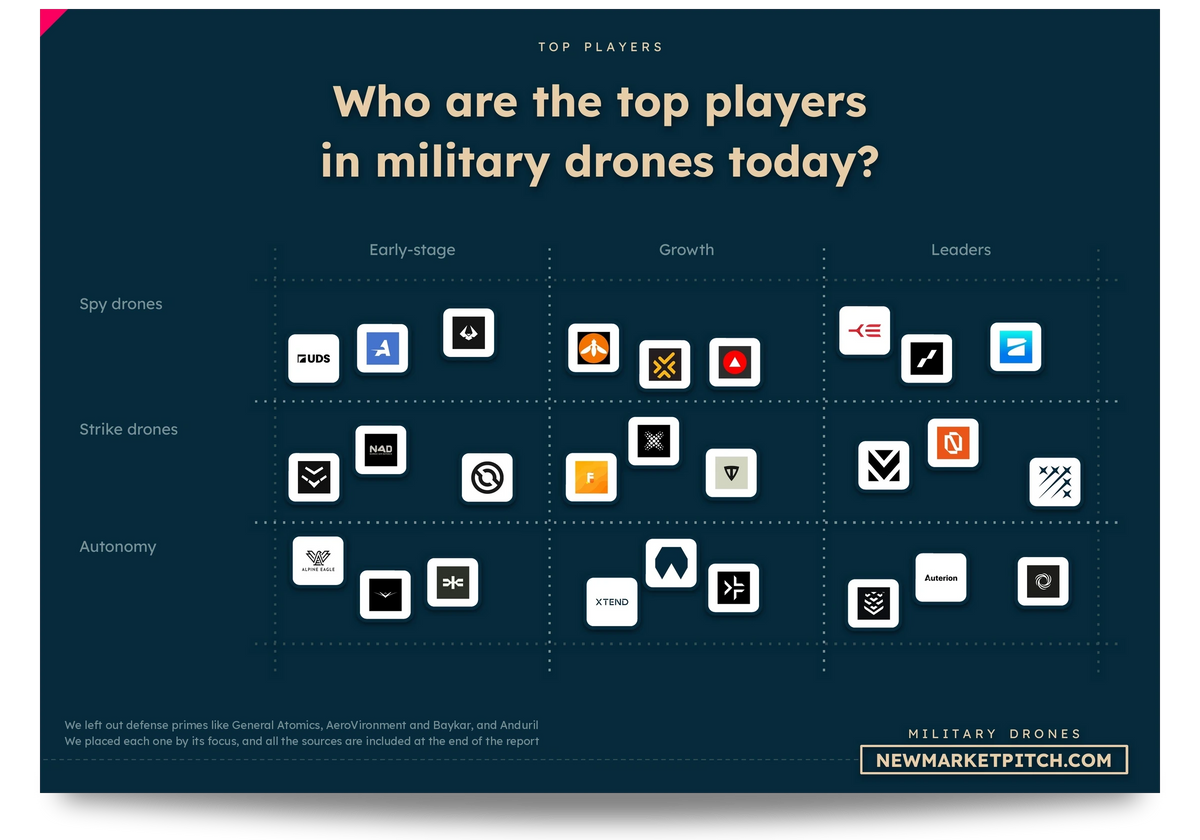
In our report covering the military drone market, we turn what is vague and complex into simple, useful visuals. Market maps like this one show you at a glance where every startup stands.
Top startups in the military drones market ranked by valuation
Here is the current ranking of the most valuable military drones startups. For each one you will also find our confidence level and the valuation basis we used.
If you want to go deeper into the military drones startup landscape, check our report covering the military drones market.
| # | Startup | Valuation | Confidence | Valuation basis | Last round | Total funding |
|---|---|---|---|---|---|---|
| Private startups | ||||||
| 1 | AndurilAutonomous defence systems and weapons | $61.0Bas of May 2026 | Strong | Reported private round valuation | $5.0BSeries D+ · May 2026 | $11.3Bvalued at 5.4× this |
| 2 | Shield AIMilitary aircraft and drone autonomy | $28.8Bas of Nov 2026 | Full | Announced private round valuation | $1.0BSeries H · Nov 2026 | $3.8Bvalued at 7.5× this |
| 3 | HelsingAI-powered autonomous defense systems | $18.0Bas of Jul 2026 | Full | Announced private round valuation | $1.8BSeries E · Jul 2026 | $3.3B+valued at 5.4× this |
| 4 | Quantum SystemsAutonomous military reconnaissance drone systems | $8.0Bas of Jul 2026 | Full | Announced private round valuation | $1.2BSeries D · Jul 2026 | $1.7Bvalued at 4.7× this |
| 5 | TEKEVERAI-powered military surveillance drone systems | $6.4Bas of Sep 2026 | Full | Announced private round valuation | ~$580MSeries D · Sep 2026 | $759Mvalued at 8.4× this |
| 6 | DestinusAutonomous aerospace and hypersonic systems | $5.5B–$6.6Bas of Nov 2026 | Partial | Comparables-based estimate | $29MSeed · Feb 2022 | $29M+valued at 208× this |
| 7 | UFORCECombat-tested autonomous military drone systems | $6.0Bas of Nov 2026 | Full | Announced private round valuation | $700MSeries A · Nov 2026 | $750Mvalued at 8.0× this |
| 8 | SkydioAutonomous drones for defense and inspection | $5.2B+as of Nov 2026 | Full | Announced private round valuation | $255MSeries G · Nov 2026 | $1.1B+valued at 4.7× this |
| 9 | Mach IndustriesMilitary attack drones and aerial interceptors | $3.7Bas of Sep 2026 | Full | Announced private round valuation | $600MSeries C extension · Sep 2026 | $1.1B+valued at 3.4× this |
| 10 | STARK DefenceAutonomous strike drones and loitering munitions | ~$3.52Bas of Jun 2026 | Strong | Reported private round valuation | $550MSeries C · Jun 2026 | $627M+valued at 5.6× this |
| 11 | Cambridge AerospaceLow-cost drone and missile interceptors | $3.4Bas of Aug 2026 | Full | Announced private round valuation | $300MSeries C · Aug 2026 | $600M+valued at 5.7× this |
| 12 | Neros TechnologiesManufactures autonomous military combat drones | $2.5Bas of Aug 2026 | Full | Announced private round valuation | $250MSeries C · Aug 2026 | $371Mvalued at 6.7× this |
| 13 | Harmattan AIAutonomous military drones and interceptors | $1.4Bas of Jan 2026 | Strong | Reported private round valuation | $200MSeries B · Jan 2026 | $230Mvalued at 6.1× this |
| 14 | Heven AeroTechHydrogen-powered long-endurance unmanned aerial systems | $1.0Bas of Dec 2025 | Full | Announced private round valuation | $100MSeries B · Dec 2025 | $100M+valued at 10.0× this |
| 15 | Raphe mPhibrDesigns and manufactures military UAVs | $900Mas of Jun 2025 | Strong | Reported private round valuation | $100MSeries B · Jun 2025 | $100Mvalued at 9.0× this |
| 16 | Firestorm LabsModular military drones and manufacturing | $547M–$1.0Bas of Apr 2026 | Low | Estimated from last round | $82MSeries B · Apr 2026 | $150M+valued at 5.0× this |
| 17 | AuterionAutonomous drone operating systems software | $600M+as of Sep 2025 | Full | Announced private round valuation | UndisclosedGrowth equity · Nov 2025 | $115M+valued at 5.2× this |
| 18 | PDWManufactures modular tactical military drones | $348M–$653Mas of Sep 2026 | Low | Estimated from last round | $52MLate VC · Sep 2026 | $222M+valued at 2.1× this |
| 19 | Fortem TechnologiesRadar-guided autonomous drone interception systems | $333M–$625Mas of Sep 2026 | Low | Estimated from last round | $50MSeries B · Sep 2026 | $118Mvalued at 3.9× this |
| 20 | VectorMilitary drones, integration and tactical training | $305M–$508Mas of Sep 2025 | Low | Estimated from last round | $61MSeries A · Sep 2025 | $74Mvalued at 5.3× this |
| 21 | Alta AresAI-powered battlefield air defense | $260M–$550Mas of Nov 2026 | Partial | Comparables-based estimate | $57MSeries A · Jun 2026 | $59Mvalued at 6.4× this |
| 22 | Swarm AeroLarge autonomous military drone fleets | $175M–$292Mas of Mar 2026 | Low | Estimated from last round | $35MSeries A · Mar 2026 | $59Mvalued at 3.8× this |
| 23 | NewSpace Research & TechnologiesDevelops military autonomous aerial systems | $132M–$330Mas of Mar 2024 | Low | Estimated from last round | $33MBridge equity · Mar 2024 | $57Mvalued at 3.6× this |
| 24 | Beyond VisionManufactures AI-enabled military drones and ISR unmanned platforms. | $160M–$267Mas of Oct 2026 | Low | Estimated from last round | $32M+Series A · Oct 2026 | $32M+valued at 6.5× this |
| 25 | SE3Develops onboard spatial AI and natural-language mission software that controls military drones even when GPS is denied. | $150M–$250Mas of Nov 2026 | Low | Estimated from last round | $30MSeries A · Nov 2026 | $30Mvalued at 6.5× this |
| 26 | Easy AerialTethered surveillance and security drones | $133M–$250Mas of Aug 2026 | Low | Estimated from last round | $20MSeries B · Aug 2026 | $26Mvalued at 7.0× this |
| 27 | Arcanus Aerial SystemsIntegrates and manufactures allied military UAV systems for reconnaissance and combat-support missions in Canada. | $135M–$225Mas of Nov 2026 | Low | Estimated from last round | $27M+Series A · Nov 2026 | $28M+valued at 6.3× this |
| 28 | DarkhiveAutonomous tactical reconnaissance drone platforms | $95M–$270Mas of Nov 2026 | Partial | Comparables-based estimate | $30MSeries B · May 2026 | $55Mvalued at 2.9× this |
| 29 | Grid AeroAutonomous cargo aircraft for military missions | $100M–$167Mas of Jan 2026 | Low | Estimated from last round | $20MSeries A · Jan 2026 | $26Mvalued at 5.0× this |
| 30 | Buntar AerospaceBattlefield reconnaissance drones and software | $80M–$180Mas of Nov 2026 | Partial | Comparables-based estimate | $16MUndisclosed stage · Oct 2026 | $28M+valued at 4.3× this |
| 31 | TYTAN TechnologiesAI-powered autonomous drone interceptors | ~$110Mas of Feb 2026 | Strong | Reported private round valuation | $33MSeries A · Feb 2026 | $50Mvalued at 2.2× this |
| 32 | Hoverfly TechnologiesTethered drones for persistent aerial surveillance | $70M–$170Mas of Nov 2026 | Partial | Comparables-based estimate | $20MSeries B · Oct 2025 | $31Mvalued at 3.6× this |
| 33 | AITANCoordinated autonomous military robotic systems | $60M–$180Mas of Nov 2026 | Partial | Comparables-based estimate | $41MSeries A · Sep 2026 | $41Mvalued at 2.5× this |
| 34 | SkywaysAutonomous military aerial cargo transportation | $75M–$125Mas of Dec 2021 | Low | Estimated from last round | $15MSeries A · Dec 2021 | $16M+valued at 6.0× this |
| 35 | OrqaManufactures FPV drones and components | $70M–$116Mas of Mar 2026 | Low | Estimated from last round | $14MSeries A · Mar 2026 | $22Mvalued at 4.1× this |
| 36 | Twentyfour IndustriesMass-produced tactical military quadcopter drones | $47M–$118Mas of Jan 2026 | Low | Estimated from last round | $12MUndisclosed stage · Jan 2026 | $12Mvalued at 6.3× this |
| 37 | Quantum AeroAI-guided autonomous defense drones | ~$74Mas of Jul 2025 | Strong | Reported private round valuation | $2.7MSeed · Mar 2025 | $2.7Mvalued at 27.0× this |
| 38 | Six RoboticsAutonomous military drone swarm software | $55M–$92Mas of Jun 2026 | Low | Estimated from last round | ~$14MSeed · Jun 2026 | $14Mvalued at 5.2× this |
| 39 | Alpine EagleAirborne autonomous counter-drone defense systems | $40M–$110Mas of Nov 2026 | Partial | Comparables-based estimate | ~$11MSeed · Mar 2025 | $11M+valued at 6.1× this |
| 40 | Tycho AIGPS-denied autonomous drone navigation systems | $50M–$83Mas of Oct 2025 | Low | Estimated from last round | $10MSeries A · Oct 2025 | $12Mvalued at 5.4× this |
| 41 | AD SystemsStealth military reconnaissance drone manufacturing | $47M–$78Mas of Sep 2026 | Low | Estimated from last round | ~$9.4MSeries A · Sep 2026 | $12Mvalued at 5.2× this |
| 42 | Askari DefenseHand-launched autonomous drone interceptors | $43M–$71Mas of May 2026 | Low | Estimated from last round | $11MSeed · May 2026 | $12Mvalued at 4.6× this |
| 43 | VermeerVision-based GPS-independent drone navigation | $30M–$90Mas of Nov 2026 | Partial | Comparables-based estimate | $10MSeries A · Oct 2025 | $15Mvalued at 3.5× this |
| 44 | Farsight VisionBattlefield mapping and geospatial intelligence | $34M–$57Mas of Feb 2026 | Low | Estimated from last round | ~$8.6MSeed · Feb 2026 | $9.2Mvalued at 4.8× this |
| 45 | Certo AerospaceBuilds the CAPSTONE heavy-lift autonomous VTOL aircraft for military logistics and support missions. | $26M–$66Mas of Oct 2026 | Low | Estimated from last round | ~$6.6MOct 2026 | $6.6Mvalued at 6.3× this |
| 46 | Occam IndustriesGPS-independent military drone autonomy software | $28M–$52Mas of Sep 2026 | Low | Estimated from last round | $4.2MGrowth equity · Sep 2026 | $7.5Mvalued at 5.1× this |
| 47 | MaraAutonomous kinetic drone interception | $20M–$65Mas of Nov 2026 | Partial | Comparables-based estimate | $7MPre-Seed · Aug 2026 | $7Mvalued at 5.2× this |
| 48 | LenduraiGPS-independent autonomous drone navigation | $26M–$43Mas of Jun 2025 | Low | Estimated from last round | $6.4MSeed · Jun 2025 | $6.4Mvalued at 5.2× this |
| 49 | AirbilityHigh-speed electric counter-drone aircraft | $24M–$39Mas of Sep 2026 | Low | Estimated from last round | $4.7MSeries A · Sep 2026 | $6.4M+valued at 4.7× this |
| 50 | Vantage RoboticsPortable military reconnaissance drone systems | $18M–$40Mas of Nov 2026 | Partial | Comparables-based estimate | $8.9MSeries A · Apr 2018 | $8.9Mvalued at 3.0× this |
| 51 | TrypillianTactical and deep-strike military drones | $20M–$33Mas of May 2025 | Low | Estimated from last round | $5MAngel / strategic · May 2025 | $5Mvalued at 5.2× this |
| 52 | FlyFocusNATO-compatible military UAV manufacturing | $20M–$33Mas of Feb 2026 | Low | Estimated from last round | $5MSeed · Feb 2026 | $5M+valued at 5.2× this |
| 53 | Nordic Air DefenceSoftware-defined low-cost drone interceptors | $15M–$40Mas of Nov 2026 | Partial | Comparables-based estimate | $3MSeed · Jul 2025 | $4.8Mvalued at 5.1× this |
| 54 | Orbotix IndustriesAI-powered autonomous defense drone systems | $12M–$45Mas of Nov 2026 | Partial | Comparables-based estimate | $7.2MPre-Seed · Oct 2025 | $7.2M+valued at 3.3× this |
| 55 | TheseusAutonomous defense drones and navigation systems | $17M–$29Mas of Apr 2025 | Low | Estimated from last round | $4.3MSeed · Apr 2025 | $4.3Mvalued at 5.2× this |
| 56 | Unmanned Defense SystemsAutonomous military drones and robotic systems | $14M–$23Mas of May 2024 | Low | Estimated from last round | ~$3.5MSeed · May 2024 | $3.5Mvalued at 5.2× this |
| 57 | AirlogixUnmanned aerial systems for defense | $13M–$22Mas of Feb 2026 | Low | Estimated from last round | $3.3MSeed · Feb 2026 | $3.3Mvalued at 5.2× this |
| 58 | MonopulseElectronic-warfare-resistant military reconnaissance drones | $9.2M–$23Mas of Oct 2026 | Low | Estimated from last round | $2.3M+Early VC · Oct 2026 | $2.3M+valued at 6.2× this |
| 59 | EOS TechnologieRodeur/Veloce ISR and loitering unmanned aerial weapons | $11M–$18Mas of Sep 2022 | Low | Estimated from last round | $2.8MSeed · Sep 2022 | $2.8Mvalued at 5.2× this |
| 60 | Origin RoboticsAutonomous precision drones for military missions | $11M–$18Mas of Oct 2024 | Low | Estimated from last round | $2.6MPre-Seed · Oct 2024 | $2.6M+valued at 5.2× this |
| 61 | Swarm Defense TechnologiesLow-cost coordinated military drone swarms | $8.2M–$20Mas of Sep 2026 | Low | Estimated from last round | $2MForm D / Undisclosed stage · Sep 2026 | $3.5M+valued at 3.7× this |
| 62 | FuvexLong-range drones for infrastructure inspections | $9.9M–$16Mas of Oct 2025 | Low | Estimated from last round | $2MSeries A · Oct 2025 | $2Mvalued at 6.5× this |
| 63 | PDKINEMATICSPrecision guidance systems for drones | $8.8M–$15Mas of Jun 2026 | Low | Estimated from last round | $2.2MSeed · Jun 2026 | $2.2Mvalued at 5.2× this |
| 64 | Silent ArrowManufactures autonomous cargo delivery gliders | $8M–$15Mas of Sep 2023 | Low | Estimated from last round | $1.2MGrowth equity · Sep 2023 | $1.3Mvalued at 8.2× this |
| 65 | DOD SolutionAutonomous navigation software for drones | $8.4M–$14Mas of Sep 2026 | Low | Estimated from last round | $2.1MPre-Seed · Sep 2026 | $2.1Mvalued at 5.2× this |
| 66 | UnmanndAutonomous military logistics and interceptor drones | $8M–$13Mas of Sep 2025 | Low | Estimated from last round | $2MPre-Seed / seed · Sep 2025 | $2Mvalued at 5.2× this |
| 67 | Thermopylae AerospaceAutonomous interceptor drones for counter-UAS | $6.4M–$11Mas of Nov 2025 | Low | Estimated from last round | $1.6MSeed · Nov 2025 | $4.1Mvalued at 2.0× this |
| 68 | M-FlyDrone imaging and laser guidance | $5.6M–$9.3Mas of Nov 2025 | Low | Estimated from last round | UndisclosedFollow-on equity · Sep 2026 | $2.7Mvalued at 2.7× this |
| 69 | Agilis AirAutonomous drones for defense missions | $5.6M–$9.3Mas of Sep 2026 | Low | Estimated from last round | $1.4MSeed · Sep 2026 | $1.4Mvalued at 5.2× this |
| 70 | Evolve DynamicsAll-weather tactical surveillance drone systems | $5.1M–$9.6Mas of Mar 2025 | Low | Estimated from last round | $768KGrowth equity · Mar 2025 | $4.1Mvalued at 1.7× this |
| 71 | Granta AutonomyAutonomous drones for defense reconnaissance | $4.4M–$7.3Mas of Jul 2024 | Low | Estimated from last round | $1.1MSeed · Jul 2024 | $1.1Mvalued at 5.2× this |
| 72 | NORDA DynamicsAutonomous drone navigation for defense | $4M–$6.7Mas of Sep 2025 | Low | Estimated from last round | $1MSeed · Sep 2025 | $1.2Mvalued at 4.5× this |
| 73 | HoverItLong-range drones for defense missions | $5Mas of Jan 2026 | Strong | Reported private round valuation | $500KSeed · Jan 2026 | $500Kvalued at 10.0× this |
| 74 | ZULU Defence SystemsAutonomous military drone systems | $3M–$5Mas of Apr 2024 | Low | Estimated from last round | $750KSeed · Apr 2024 | $750Kvalued at 5.2× this |
| 75 | Apollyon DynamicsMilitary drones for defense operations | ~$3Mas of May 2026 | Strong | Reported private round valuation | ~$480KSeed · May 2026 | $480Kvalued at 6.2× this |
| 76 | MaXon SystemsAutonomous interceptor drones for air defense | $1.2M–$2Mas of Aug 2025 | Low | Estimated from last round | UndisclosedSeed · Feb 2026 | $300K+valued at 5.2× this |
| Listed in the last 5 years or acquired in the last 3 years · not ranked | ||||||
| XTENDAI-assisted military reconnaissance and tactical drones | $350Mas of Nov 2026 | Full | Public market cap | $68MGrowth equity · Sep 2026 | $200Mvalued at 1.8× this | |
| ideaForge1Military and industrial surveillance drones | ~$336Mas of Nov 2026 | Full | Public market cap | $29MIPO · Jul 2023 | $56M+valued at 6.0× this | |
| Swarmer1Autonomous drone swarm control software | $250Mas of Nov 2026 | Full | Public market cap | $17MIPO · Mar 2026 | $35Mvalued at 7.2× this | |
No startups match this search.
- Total funding includes the primary proceeds of its IPO.

Our research about military drones gets updated several times a month, so you always get the latest view of where things stand.
Is Anduril still the most valuable military drone startup?
Anduril is still the most valuable military drone startup, reportedly valued at $61.0B, with a 2.1x lead over Shield AI.
Reuters reported in May 2026 that Anduril raised new money after its revenue more than doubled to $2.2 billion in 2025. That helps explain its lead. Anduril sells reconnaissance drones, autonomous combat aircraft, sensors and air-defense systems, plus the software that connects them. Investors are paying for a defense business that reaches well beyond one aircraft model.
The U.S. Air Force selected Anduril and General Atomics for the production phase of its Collaborative Combat Aircraft program in June 2026. General Atomics is an established manufacturer, and competing against it shows how far Anduril has come. Selection for a program still leaves deliveries and payments to come. But Anduril already combines substantial sales, a broad product range and access to major military orders. That is why it leads the startup valuation race today.
Is Shield AI catching up with Anduril?
Shield AI is becoming a bigger force in military drone autonomy, although its $28.8B valuation remains behind Anduril.
Shield AI announced a new financing in November 2026 alongside an agreement to acquire radar specialist Echodyne. The planned deal would add sensing technology to its V-BAT aircraft and Hivemind flight software. The acquisition has been announced; that does not mean the integration has already happened.
Here is what makes Shield AI interesting. In 2026, it said Hivemind had coordinated multiple Anduril-built collaborative combat aircraft in a U.S. Air Force demonstration. One company built the planes and another supplied the software controlling them. Military customers can buy those pieces separately, giving Shield AI room to grow even when another manufacturer wins the airframe contract. It has made a strong case for its autonomy technology. Catching Anduril in valuation is a different challenge.
Is Helsing now Europe's most valuable military drone startup?
Helsing leads Europe's military drone startups by valuation at $18.0B, with strike drones and military AI behind its price.
Helsing introduced its HX-2 loitering munition in December 2024, focusing on flights in jammed conditions and coordinated attacks. In February 2025, the company announced plans to produce 6,000 more HX-2 drones for Ukraine after an earlier HF-1 order. Those announcements show what Helsing intends to build and supply, although planned production is different from confirmed deliveries.
Helsing also develops autonomy software and other defense systems. Investors are paying for the possibility that its technology will spread across several military programs. That puts it well ahead of Germany's Quantum Systems and Portugal's TEKEVER on valuation, even though those companies sell different aircraft for different missions. Helsing is Europe's private-market leader for now. Its next test is how much of that announced production turns into accepted systems and repeat orders.

In our market report about military drones, we look at what the winners do differently, so you can learn from the best instead of guessing.
Why are reconnaissance drone startups worth billions?
Military reconnaissance drones can support billion-dollar startup valuations because armies need aircraft they can use repeatedly under real battlefield conditions.
Quantum Systems is valued at $8.0B and has raised $1.7B in equity. In July 2026, it announced financing to expand beyond individual drones into connected autonomous systems. Its Vector aircraft gives troops a way to spot threats and keep watching them as conditions change. Buyers also need reliable communications, training, spare parts and support. The drone itself is only part of the purchase.
TEKEVER sells larger aircraft such as the AR5 for long-duration surveillance, while Skydio's X10D works closer to troops in the field. Those products face different missions and budgets, but the business question is similar: will armed forces order replacements, upgrades and support for years? A useful drone can win an initial contract. A valuable drone company has to keep delivering after the first order.
Does TEKEVER have the contracts to justify its military drone valuation?
TEKEVER has a serious military customer behind its $6.4B valuation, although its British contract still has to turn into deliveries.
The company has raised $759M in equity. In September 2026, the British government announced a contract worth up to £400 million for TEKEVER's AR5 reconnaissance drone to enter British Army service. That ties the aircraft to an identified military program and the training and support that follow. The contract ceiling is not money already earned.
TEKEVER has also used its smaller AR3 for intelligence missions linked to Ukraine. The AR5 reaches a different surveillance market, farther from a frontline unit. Compare that with Mach Industries' attack drones or Cambridge Aerospace's interceptors and it becomes clear that these startups are selling quite different things. TEKEVER has more evidence of a real customer than many drone developers. Its valuation now rests on executing the army program and winning more work like it.
Is UFORCE's huge valuation backed by real combat demand?
UFORCE has battlefield experience behind its $6.0B military drone valuation, but selling those systems across allied countries is still the big test.
Founded in 2025 and headquartered in the United Kingdom, UFORCE completed a Series A in November 2026 and has raised $750M in equity. Its investor announcement described autonomous systems operating in the air, on land and at sea, with Ukrainian combat experience at the center of its pitch to allies. The company qualifies here through its aerial platforms.
UFORCE's investors pointed to extensive combat use of its systems in Ukraine when they announced the round in November 2026. That kind of battlefield feedback can help engineers improve a product quickly. But the next buyer may demand different certifications, secure components, maintenance arrangements and local production. UFORCE has a much stronger starting point than a startup with only a demonstration aircraft. The announced price also assumes it can win customers beyond the war where its systems were tested.

In our document detailing everything you need to know about military drone, you will always find fresh funding data, taken straight from our own verified funding database.
Is Skydio's valuation really about military drones anymore?
Skydio's valuation now reflects both military reconnaissance drones and a growing business supplying police and emergency responders.
Skydio is valued at $5.2B or more. The U.S. Army confirmed in December 2025 that it was buying X10D drones for short-range reconnaissance, following initial fielding. Soldiers are using a product designed for actual military work, which keeps Skydio firmly inside the military drone market.
But Axon announced another investment in Skydio and a partnership aimed at U.S. and Canadian public-safety customers in November 2026. Police drones can become routine equipment for responding to incidents, opening a second source of demand. That announcement included new investment and purchases of existing shares, so its full headline amount should not be counted as newly raised equity. Skydio therefore sits between two markets. Its valuation cannot be explained by army purchases alone, even though the defense business remains important.
How many military drone startups are worth at least $1B?
Only 14 of the 76 military drone startups we track are worth at least $1B, so unicorns are still a minority.
The higher end is especially small. There are 3 startups valued at $10B or more, 5 in the $5B to $10B range, and 6 in the lower unicorn bracket. The other 62 startups, or 82%, are valued below $1B. We include a company as a unicorn only when its entire valuation range clears the threshold. A high estimate that merely touches $1B does not qualify.
The group itself is varied. Anduril sells a much wider set of defense systems than drones alone. Shield AI works on aircraft and flight autonomy, and Helsing develops strike systems. Heven AeroTech is valued at $1.0B for long-endurance aircraft, while Neros Technologies is building tactical combat drones. Their order books and business models are different. Being called a unicorn tells us the size of an investor price, not how many drones a company has delivered or how much it earns.

Learning from others' mistakes is the cheapest lesson there is. In our report covering the military drone market, we look at what broke startups before you, so you don't repeat it.
Does America still dominate military drone startup valuations?
American startups lead the military drone valuation race, with Anduril at the top and 27 of the 76 startups we track.
Germany, India and Ukraine have 7 each. The American names also cover very different parts of the market: Anduril builds autonomous aircraft and other weapons, Shield AI works on flight software, Skydio sells reconnaissance systems, and Mach Industries and Neros Technologies develop combat drones. Their home market gives them access to a large defense buyer.
The U.S. Defense Innovation Unit's Blue UAS work has helped military buyers identify secure drones, while the Air Force's collaborative combat aircraft program gives autonomy companies a route into larger aircraft. Still, private startup valuations do not measure all drone production. China has substantial manufacturing capabilities, but civilian-first manufacturers and state-owned defense suppliers do not fit this startup definition. The U.S. wins this valuation comparison today. That is a narrower claim than saying America makes every important military drone.
Are European military drone startups catching up with the American leaders?
European military drone startups are getting closer to the top tier, but Anduril still leads them in valuation.
Helsing is valued at $18.0B, while Quantum Systems and TEKEVER have built recognizable reconnaissance businesses. Britain selected TEKEVER's AR5 for the army; Germany's STARK Defence has a Bundeswehr framework for its Virtus strike drone; and France's Harmattan AI works with Dassault Aviation. These are real steps toward military adoption across several countries.
Europe also has very different kinds of companies near the top. Destinus has a $5.5B–$6.6B comparables-based estimate, while UFORCE has a $6.0B announced valuation. Because the range overlaps the announced price, we do not treat either as definitively more valuable. Cambridge Aerospace makes interceptors, a different business again. Europe can produce strong competitors without copying every Anduril product. Its best companies already serve distinct military needs.
The table below shows leading European military drone startups and their valuations.
| Startup | Country | Valuation |
|---|---|---|
| Helsing | Germany | $18.0B |
| Quantum Systems | Germany | $8.0B |
| TEKEVER | Portugal | $6.4B |
| Destinus | Netherlands | $5.5B–$6.6B |
| UFORCE | United Kingdom | $6.0B |
| STARK Defence | Germany | ~$3.52B |
| Cambridge Aerospace | United Kingdom | $3.4B |
| Harmattan AI | France | $1.4B |
Destinus is a comparables-based estimate, whereas the nearby UFORCE and TEKEVER figures are announced valuations.
Why aren't Ukraine's military drone startups worth billions?
Ukraine has a huge military drone industry, but none of its independent startups has reached a billion-dollar valuation.
We track 7 Ukraine-based startups. Buntar Aerospace has a $80M–$180M estimate based on comparable businesses; Trypillian has a $20M–$33M estimate based on its financing. Neither range is a company-announced price. Ukraine's Ministry of Defence said its procurement agency signed UAH 333.6 billion in drone contracts during the first half of 2026. The ministry also reported that 95% of drones it bought were made domestically. Those national procurement figures tell us how important local production has become, not what investors would pay for one startup.
Local manufacturers have been built to respond quickly to military orders, often without going through large international equity rounds. Foreign investors also face wartime risks and export restrictions. UFORCE offers another perspective: it draws on Ukrainian battlefield experience but is headquartered in the United Kingdom. Ukrainian drones are central to the fighting. Private valuations measure something else too: how much capital can enter an individual company and what buyers expect it to earn later.

In our research about military drones, we always try to gather several sources and make estimates that make sense, so you can work with solid numbers.
Does India have a billion-dollar military drone startup yet?
India has no confirmed military drone unicorn today, and Raphe mPhibr leads its startups at $900M.
Raphe mPhibr makes military UAVs rather than just pitching a concept. TechCrunch reported in June 2025 that it had raised money to expand local design and manufacturing, supplied military customers and explored exports. We record $100M in equity raised and a reported private valuation. It is close to the unicorn threshold, but the published price remains below it.
India has 7 of the independent military drone startups we track. NewSpace Research & Technologies works on autonomous aerial systems, while Unmannd develops logistics and interceptor drones on a smaller scale. A company can win a useful defense order without being worth billions. For Raphe mPhibr, the next question is whether domestic production and sales can turn into a larger, repeatable business in India and abroad. Its current valuation makes it a serious contender, not an Indian unicorn yet.
Can Mach Industries live up to its multibillion-dollar valuation?
Mach Industries is worth $3.7B in the military drone market, but it now has to prove it can manufacture attack drones at scale.
Mach Industries has raised at least $1.1B in equity and completed a Series C in September 2026. Janes reported on its work on long-range strike aircraft, interceptors and the manufacturing systems needed to produce them. The Viper one-way attack drone targets a different mission from the reconnaissance aircraft sold by Quantum Systems and Skydio.
Low-cost strike drones have already changed the fighting in Ukraine. Building a reliable business from them takes more than a useful design: propulsion, components, testing and support all have to work in volume. STARK Defence has a nearby reported valuation, but the two companies have different weapons and customer relationships. Their price tags tell us investors see large possibilities, not that one has already won. The proof for Mach will come from military acceptance, repeated deliveries and orders beyond the first urgent purchases.
Has STARK Defence proved it can build more than prototype drones?
STARK Defence has moved beyond military drone demonstrations with a German procurement framework, though the full delivery work lies ahead.
STARK Defence is reportedly valued at ~$3.52B and completed a Series C in June 2026. In February 2026, the company said it had agreed a framework with the Bundeswehr for Virtus loitering munitions. The plan covers several thousand systems after they pass qualification. For a young strike-drone maker, getting that far with a national army is a meaningful step.
Virtus is designed to take off vertically and strike targets in difficult conditions. The Bundeswehr now has a way to buy it, but a framework does not confirm that all the planned drones have been delivered or paid for. STARK still has to pass the required tests, build the aircraft and support soldiers using them. Its valuation has a genuine customer behind it. The remaining risk is whether it can deliver at the scale implied by the agreement.

If you build or invest in the military drone market, you need to know which business models pay off now and which ones are fading. That's why our report covering it has a whole section on it.
Are drone interceptors becoming billion-dollar military startups?
Drone interceptors have become a billion-dollar military drone business because armies need cheaper ways to stop incoming aircraft.
Cambridge Aerospace is valued at $3.4B, Neros Technologies at $2.5B and Harmattan AI is reportedly valued at $1.4B. All three work on interceptors alongside other defense products. They address a problem that has become hard to ignore: shooting down a cheap drone with a much more expensive weapon can drain an air-defense budget quickly.
The U.S. Army announced in January 2026 that Fortem Technologies' DroneHunter was its first Replicator 2 counter-drone purchase. Cambridge Aerospace has also won British government work on low-cost interception. Buying an interceptor means testing whether it can spot, chase and destroy a real target, work with radar and operators, and still be affordable when fired often. These contracts show serious demand. Whether each new supplier becomes a lasting business depends on performance and manufacturing costs.
Does a military drone startup need to build the aircraft?
No, a military drone startup can build a valuable business by making the software that actually flies other companies' aircraft.
Shield AI demonstrated Hivemind coordinating U.S. Air Force aircraft built by Anduril, even though Shield AI also manufactures its own V-BAT. Helsing develops autonomy alongside strike drones. Auterion focuses more directly on the software and mission controls that connect military aircraft, with a valuation of at least $600M. That price is a floor from September 2025, so Firestorm Labs' estimated $547M–$1.0B range, placed on its middle, ranks just ahead of it. These systems actively command drones in flight, unlike ordinary mapping or intelligence-analysis software.
Auterion has also announced work with Ukrainian manufacturer Airlogix to bring common autonomy and swarm-control tools to different drones. That makes the software useful beyond one airframe. Customers will still demand strong cybersecurity, resilience against jamming and reliable operation when connections fail. Yet the basic business case is clear: the company that controls how a fleet flies can earn money across several drone manufacturers.

In our document detailing everything you need to know about military drone, we don't want to repeat what boring consulting reports say. Instead, we show you the real and latest market signals that matter.
How quickly can a military drone startup become a unicorn?
A military drone startup can reach a billion-dollar valuation in only a few years when it has a product armies urgently want.
Neros Technologies, founded in 2023, is valued at $2.5B and has raised $371M. Its August 2026 Series C announcement described plans to expand the Archer combat drone and Bandit interceptor programs. Harmattan AI, founded in 2024, is reportedly valued at $1.4B and has backing from Dassault Aviation. Neither company needed decades to attract a large price.
That speed is unusual compared with traditional weapons procurement, but it says more about how urgently militaries need new systems than about the maturity of every startup. A young company can have experienced engineers and technology developed before it was founded. It still has to pass tests, train operators and build reliable supply chains. Early unicorn status gets attention. Repeat military orders are what will make the price easier to defend.
Are billion-dollar military drone startups actually delivering aircraft?
Some highly valued military drone startups have real products and customers, but their valuations can run ahead of confirmed deliveries.
Helsing has announced large strike-drone production plans for Ukraine, while Neros Technologies has described growing output for its combat and interceptor platforms. Firestorm Labs is trying a different model: modular factories that can make replacement drones closer to the units that need them. We estimate Firestorm Labs at $547M–$1.0B from the size of its April 2026 Series B round. That is our estimate dated to the round, not a valuation announced by the company. Axios reported on its mobile-factory plans that month.
An assembly line is useful only if the military accepts what comes off it. Drones need dependable components, tested software, trained operators and replacement parts. A development award or future production target can help justify investment today, but it is not proof of completed sales. The startups that deliver reliably and earn follow-on orders should have the stronger case for keeping their prices high.
Why is AeroVironment missing from military drone startup lists?
AeroVironment is a major military drone manufacturer, but it is an established public company rather than a startup.
AeroVironment makes uncrewed aircraft and loitering munitions, while General Atomics builds large military drones. Both matter to what armed forces can buy. Neither belongs in a comparison of independent, newer technology-led startups. We focus on companies founded in 2000 or later; recently listed businesses appear separately instead of being mixed with private valuations.
Product focus matters as much as age. Skydio belongs here because it makes reconnaissance drones for military customers. Auterion belongs because its software directly flies and coordinates aircraft. Civilian-first drone makers, standalone parts suppliers and defense software companies without drone flight-control products fall outside this definition. A famous manufacturer being absent says something about the scope of the startup market, not the usefulness of its aircraft.

In our report covering the military drone market, we like to show you the big picture. We know your time is precious, so we make every page quick to read and packed with as much learning as possible per minute.
Do bigger military drone valuations always mean more funding?
No, military drone startups with high valuations have not necessarily raised the most equity money.
For companies with stated valuations and complete equity totals, Quantum Aero has the highest valuation-to-funding multiple at 27.0x, while TYTAN Technologies has the lowest at 2.2x. Those figures compare a startup's investor price with the equity it has raised over its lifetime. They do not tell us its revenue, profit or future return.
TEKEVER, UFORCE and Shield AI land on close multiples, between 7.5x and 8.4x, even though their products, ages and fundraising histories differ a lot. We leave companies with incomplete funding totals or estimated valuations out of this comparison. Otherwise, the ratio could make a startup look more or less expensive simply because part of its fundraising history is undisclosed. The figures raise useful questions about what investors are paying for, but a high multiple by itself is no proof of a better drone company.
The table below shows stated military drone valuations compared with recorded equity raised.
| Startup | Equity raised | Value / equity |
|---|---|---|
| Quantum Aero | $2.7M | 27.0x |
| Raphe mPhibr | $100M | 9.0x |
| TEKEVER | $759M | 8.4x |
| UFORCE | $750M | 8.0x |
| Shield AI | $3.8B | 7.5x |
| Neros Technologies | $371M | 6.7x |
| Harmattan AI | $230M | 6.1x |
| Anduril | $11.3B | 5.4x |
| Quantum Systems | $1.7B | 4.7x |
| TYTAN Technologies | $50M | 2.2x |
What could make military drone startup valuations fall?
Military drone startup valuations could fall if armies buy fewer systems than expected or manufacturers struggle to deliver working aircraft.
Buyers are active today. Ukraine has placed large wartime drone orders, U.S. forces are testing autonomous combat aircraft, and European militaries are buying reconnaissance and interception systems. But a development contract, an emergency purchase and a multiyear order do not mean the same thing for future sales. A startup priced for years of purchases has a problem if the military stops after the first batch.
Drone technology also changes quickly. Better jamming, cheaper ways to shoot down aircraft or new battlefield tactics can make an existing design less useful. Skydio has a second customer base in public safety, and Shield AI's software can run on other manufacturers' aircraft. Anduril spreads its business across multiple defense programs. Those differences can help, but none removes execution risk. We would put more weight on confirmed repeat orders than ambitious factory targets when deciding whether a price can last.
So, which military drone startups are worth the most today?
Anduril is the most valuable military drone startup today, reportedly valued at $61.0B, ahead of Shield AI and Helsing.
Anduril sells a wider group of military systems than most drone startups. Shield AI has become a serious autonomy-software supplier, and Helsing has a high-priced strike-drone business. Quantum Systems and TEKEVER specialize in reconnaissance, while UFORCE and Neros Technologies are chasing urgent battlefield demand. Those companies do not need to sell identical aircraft to attract huge valuations. Each has to prove buyers will keep ordering its particular product.
Anduril's lead is clear. Among the other high-valued startups, a contract announcement, an announced investor price and an estimate based on a previous round carry different levels of certainty. Real deployments and repeated deliveries provide the best reason to believe the valuations can hold. That is a stronger test than a compelling drone demonstration or an ambitious production target.
The table below shows what we found.
| Question | Answer |
|---|---|
| Is the market leader far ahead? | Anduril has the largest lead among military drone startups today. Its valuation is 2.1x Shield AI's stated price. That gap reflects a broader autonomous-defense product business. |
| Are billion-dollar military drone startups common? | No, they remain a minority of independent military drone businesses. Only 14 qualify as confirmed unicorns. That limits claims of a market-wide valuation boom. |
| Do most military drone startups remain smaller? | Yes, most military drone startups remain below the unicorn threshold. There are 62 companies in the lower valuation bracket. Important battlefield products do not automatically create billion-dollar valuations. |
| Does the United States own the field? | American startups lead the private military drone valuation race today. 27 of the 76 startups we track are American. European challengers nevertheless compete seriously in several military missions. |
| Is the European challenge only about software? | No, European firms also build reconnaissance aircraft and flying weapons. Germany alone has 7 of these startups. Their products span surveillance, strike and drone interception. |
| Has India crossed the military drone unicorn line? | India has a substantial domestic military drone manufacturing contender. Raphe mPhibr carries a reported $900M private valuation. That remains below the billion-dollar threshold for a unicorn. |
| Are defensive interceptors now a large business? | Yes, drone interception now attracts serious private-market valuations. Cambridge Aerospace is valued at $3.4B. Government contracts must still turn into sustained deliveries. |
| Can military drone software be valuable on its own? | Yes, flight autonomy can serve many different military aircraft. Auterion is worth at least $600M. Its software can work without manufacturing every airframe. |
| Are modular drone factories already proven winners? | They solve a real military replenishment and supply problem. Firestorm Labs has an estimated $547M–$1.0B valuation range. Industrial capacity still needs customers and accepted deliveries. |
| Does raising more money mean a higher valuation? | No, investor pricing differs widely across military drone startups. The observed multiples range from 27.0x to 2.2x. Neither extreme measures actual revenue or investment returns. |
| Is battlefield demand enough to justify prices? | No, wartime urgency establishes demand but not recurring profitability. Ukraine reports 95% domestic manufacture for procured drones. Individual startup valuations still depend on financing and execution. |

When you build or invest in the military drone market, you need clarity, not confusion. In our research about military drones, we always try to put numbers on and quantify whatever is usually vague and confusing.
Our methodology
Our data runs through November 14, 2026. We then reviewed this article and updated its answers on November 17, 2026, the date shown under the title. We define military drones as uncrewed aircraft built or materially configured for armed-forces surveillance, strike, logistics, electronic warfare and aerial interception, together with software that directly flies or coordinates those aircraft. We include companies near category boundaries when military aerial systems are a material and independently substantiated part of their business. Every company in the main ranking is an independent, technology-led startup founded in 2000 or later under our startup definition; businesses acquired recently or listed within the last five years are shown separately where applicable, rather than mixed into private valuations.
Every startup in this ranking has raised equity funding, and each valuation comes with a confidence level that shows how it was obtained. A Full rating means the company announced the valuation itself, or several independent sources report the same figure. A Strong rating means a credible press report gives the valuation, or it follows directly from the terms of a funding round, such as the amount raised and the stake sold.
When no valuation has been disclosed, it is estimated. A Partial rating means the startup was compared with similar companies at the same stage, using indicators such as revenue, deal terms or recent transactions in the sector. A Low rating means the only reliable data point is the last equity round: the valuation is then derived from the amount raised and the share of the company that startups usually give up at that stage, which is why it is shown as a range and dated to that round.
Several safeguards keep these figures honest. Valuations that appear only in commercial databases, with no article or company statement behind them, are not used, and neither are share sales between existing shareholders, which often take place at a discount or a premium. Rounds older than five years are not used to estimate a valuation, debt and grants never count as equity, and companies whose claims are disputed are left out of the ranking. Startups that have since been acquired or have gone public are listed separately, valued at their acquisition price or market capitalization rather than at a past private round.
We order valuation ranges by the geometric mean of their lower and upper ends, so an optimistic upper bound does not pull a company too high. Total funding covers verified equity rounds only, excluding debt, grants and post-IPO offerings; a total ending in “+” is a minimum when some amounts are undisclosed. We accept a round into the total when a company announcement, filing or press article confirms it, or when two recognized databases agree on its date and amount without an article; that database-only exception receives low confidence and never applies above $100M in reported equity raised. A round reported by only one database stays out, and valuations never rely on database figures alone. These rankings cover each company's funding and valuation history, unlike our deal and funding-trends coverage, which begin in January 2024, or our funding analysis, which compares consecutive recent periods.
One apparent surprise is that an estimated range can appear ahead of a smaller announced valuation. The order follows the geometric middle of the range, not its highest possible price; a Low estimate comes from the size of the last round, the typical ownership sold at that stage and the date of that financing. We show confidence alongside every figure so a reader can weigh that estimate against a price actually stated by a company or credible source. We also keep recently listed businesses separate, rather than pretending that a stock-market price and a private financing price are the same kind of observation.
Key sources include Reuters on Anduril's financing, revenue growth and broad defense business., Air Force selections for collaborative combat aircraft and autonomy suppliers., Shield AI's Echodyne transaction and announced equity pricing., Shield AI's coordinated flight demonstration on Air Force aircraft., Helsing's reported HX-2 manufacturing commitment for Ukraine., Bloomberg coverage of Helsing's European valuation position., Quantum Systems on financing, autonomy and industrial expansion., British government announcement of TEKEVER's AR5 contract., UFORCE's investor-published financing and Ukraine-linked operating claims., Axon's investment and public-safety partnership with Skydio., Ukrainian defense ministry on wartime drone contracting., Ukrainian defense ministry on domestic UAV manufacturing., Raphe mPhibr's product manufacturing and military customer development., Mach Industries' Viper and factory-scaling activities., STARK Defence's Bundeswehr framework and qualification conditions., Cambridge Aerospace's interceptor mission and UK contracts., Neros Technologies' Archer AI and Bandit programs., Dassault Aviation's partnership with Harmattan AI., Auterion's drone autonomy, production partnerships and swarm tests., U.S. Army confirmation of the DroneHunter Replicator 2 purchase., U.S. Defense Innovation Unit on secure drone procurement., Firestorm Labs' portable drone-manufacturing model., and U.S. Army selection of Skydio X10D reconnaissance systems..

A good product starts with a real problem. In our market report about military drones, we show you the ones customers still live with.
Written by the New Market Pitch teamWe track new markets so founders and investors can move faster. About us