Military drones: what are the biggest unsolved problems?
Whether you're building or investing in the military drone market, our report covers everything you need to know: the players, the money, and what's coming next.
Summary
The biggest unsolved military drone problems are electronic warfare, affordable defense against mass attacks, reliable autonomy, dependence on foreign components, and the difficulty of coordinating thousands of aircraft across a battlefield. Ukraine has proved that drones can be devastating weapons, but using them effectively at industrial scale remains surprisingly difficult.
Ukraine recorded more than 800,000 verified drone strikes by June 22, 2026, according to its Ministry of Defence. Yet neither side has managed to convert its enormous drone capacity into a decisive breakthrough. Destroying equipment and controlling territory are still very different things.
The technological race is moving almost too quickly for manufacturers. Radio jamming pushed armies toward fiber-optic drones, alternative navigation, and AI-assisted tracking, but each improvement brings new costs, operational limitations, and countermeasures. A competitive design can lose its advantage within months.
Fiber-optic drones expose a particularly interesting tradeoff. Their physical control links resist conventional radio jamming, but the cable adds weight, limits movement, and complicates deployment. The industry keeps solving one vulnerability by introducing another.
True autonomous swarms remain much less mature than mass drone attacks suggest. Most drones still depend heavily on human operators, and coordinating hundreds of independent aircraft requires reliable communications, onboard processing, and decisions that remain difficult even for advanced AI systems.
Counter-drone economics strongly favor attackers when defenders use expensive missiles against cheap aircraft. Ukraine intercepted an estimated 83% of Russian long-range drones in September 2026, yet more than 1,000 still got through. A high interception rate can coexist with a worsening security situation when attack volumes increase.
Production scale has become a military capability of its own. Ukraine expected to manufacture six million to seven million small attack drones in 2026, far beyond the volume associated with individual American procurement programs. The difficulty for Western countries is reproducing that scale while meeting security, testing, and supply-chain requirements.
China remains a major industrial bottleneck. Ukraine has reduced its direct dependence on Chinese drone components, but thermal sensors, batteries, electronics, and other parts remain difficult to replace at comparable prices. Domestic manufacturing capacity matters as much as clever drone designs.
The real economics of drones are also less impressive than their purchase prices suggest. Failed missions, trained operators, reconnaissance, batteries, maintenance, and supporting communications all increase the cost per successful attack. A $500 drone does not automatically mean a $500 military result.
More drones also mean more information for soldiers to manage. Battlefield systems such as Ukraine's DELTA are improving coordination, but the challenge is turning thousands of sensor observations into timely, reliable decisions without overwhelming operators or exposing communications to interference.
Our conclusion is that the next military drone advantage will come from reliable systems rather than individual aircraft. The strongest forces will be those capable of manufacturing drones cheaply, adapting them quickly, protecting their communications, integrating their information, and replacing losses without slowing down. Autonomy will help, but logistics, people, and coordination may prove just as decisive.

Written by the New Market Pitch teamWe track new markets so founders and investors can move faster. About us

A good product starts with a real problem. In our report covering the military drone market, we show you the ones customers still live with.
Why are military drones still so difficult to use despite their success in Ukraine?
Military drones have become essential to modern warfare, but Ukraine has shown that using them in enormous numbers still leaves armies facing serious problems with reliability, electronic warfare, production, and battlefield coordination.
According to Ukraine's Ministry of Defence, drone units recorded more than 800,000 verified strikes against Russian targets by June 22, 2026. Defence Minister Mykhailo Fedorov said drones accounted for more than 90% of enemy targets hit.
The growth was exceptionally fast. Ukraine reported approximately 105,800 verified drone strikes in January, 157,200 in March, and 200,218 in June. That means monthly strikes nearly doubled in five months. These are Ukrainian military figures covering recorded engagements, including damaged and destroyed targets, rather than independently verified equipment losses.
Ukraine has also become one of the world's largest drone manufacturers. Reuters reported in July 2026 that the country expected to produce between six million and seven million small first-person-view attack drones during the year.
Yet both Russia and Ukraine continue to face difficulties breaking through defended positions. Drones have made troop movements more dangerous and exposed equipment that previously could operate with greater freedom. They have also encouraged electronic jamming, camouflage, decoys, and increasingly sophisticated air defenses.
Drones are improving quickly and becoming cheaper to manufacture, while the battlefield is becoming harder for them to operate in. Some problems involve the aircraft themselves, but others concern the enormous effort needed to keep thousands of drones working together against an enemy that is constantly adapting.
Can military drones survive Russian electronic warfare and GPS jamming?
Electronic warfare is still one of the biggest weaknesses of military drones, especially when they depend on radio communications or satellite navigation to reach their targets.
Small first-person-view drones usually transmit video to an operator while receiving flight commands through a radio connection. When the enemy disrupts that connection, the operator may lose control or visibility. GPS interference creates another problem for drones that depend on satellite signals to determine their position.
Russia and Ukraine have responded by developing more resilient communications, alternative navigation systems, and drones that can continue toward a selected target after losing contact with their operator.
One of the clearest examples is the growing use of fiber-optic drones. These aircraft transmit video and commands through a thin physical cable, making their control links resistant to conventional radio-frequency jamming.
Ukrainian military officials cited by the Institute for the Study of War estimated in early 2026 that fiber-optic systems accounted for approximately 32% of Ukrainian strike drones and 24% of Russian strike drones. Those figures were battlefield estimates rather than verified shares of national production.
The drawback is that fiber-optic drones must carry cable spools, which add weight and can complicate operations around obstacles. They also face practical limits on how far they can fly while maintaining the physical connection.
GPS-independent navigation creates another set of tradeoffs. Inertial navigation systems gradually accumulate positioning errors, while visual navigation depends on cameras, recognizable terrain, and enough processing power to interpret what the drone sees.
Russia's Geran-5-K5 illustrates the direction of development. According to the Konrad Adenauer Foundation's Ukraine Air War Monitor, a version observed in September 2026 incorporated electro-optical navigation that compares ground features with reference imagery, reducing its dependence on satellite signals.
These technologies have made drones harder to disrupt, but none provides cheap, universal protection against every form of interference.

If you build or invest in the military drone market, you need to know which business models pay off now and which ones are fading. That's why our report covering it has a whole section on it.
Why haven't autonomous military drones replaced human pilots or started working in swarms?
Autonomous military drones still struggle to handle unpredictable combat situations, and large-scale AI-coordinated swarms remain far less advanced than mass drone attacks might suggest.
Modern drones can follow predetermined routes, avoid some obstacles, recognize visual patterns, and track selected objects. Some systems can continue an attack after communications have been disrupted.
Companies such as Shield AI and Anduril have invested heavily in autonomous flight and mission software. Ukrainian developers have also introduced computer-vision systems that help drones maintain contact with targets when radio links become unreliable.
However, these capabilities solve relatively narrow problems. A drone tracking a vehicle may perform well while the target remains visible. The situation becomes more difficult when the vehicle enters a building, changes appearance, or becomes impossible to distinguish from similar vehicles.
Carnegie Endowment research published in August 2026 found that most of the millions of drones produced by Russia and Ukraine remained far from fully autonomous. Human operators continued to perform essential tasks, even as AI improved navigation and target tracking.
The limitations become even more apparent with drone swarms. A genuine autonomous swarm should allow individual drones to share information, divide tasks, respond to losses, and adjust their behavior without requiring a human operator to control each aircraft.
Many systems described publicly as swarms are actually groups of drones following programmed routes or receiving separate instructions.
Ukrainian electronic warfare official Colonel Ivan Pavlenko told Janes that Russian forces had not demonstrated the kind of AI-enabled coordination that would allow large groups of drones to carry out complex attacks without continuous human involvement.
Coordinating hundreds of drones requires substantial communications capacity, reliable timing, and ways to prevent contradictory instructions. Electronic warfare makes those challenges worse. Drones that communicate frequently can become vulnerable to disruption, while drones that communicate less need greater onboard computing capabilities.
There is also an economic problem. Advanced autonomy requires sensors, processors, testing, and software development. Those costs are easier to justify on expensive military aircraft than on small drones designed to be expendable.
For now, the fastest progress is happening in assisted autonomy, particularly navigation, visual tracking, and automated task allocation. Large-scale autonomous combat swarms remain insufficiently proven under realistic battlefield conditions.
If you want more recent data on this point, please see our latest military drones market report.
Can AI-powered military drones reliably identify enemy targets?
AI-powered military drones can identify and track objects with increasing accuracy, but they still cannot reliably determine whether every potential target should be attacked. This is one of the clearest limits of autonomous weapons.
Computer-vision systems can be trained to recognize vehicles, aircraft, people, or other objects. Some can continue tracking a previously identified target when the operator loses radio contact.
That capability becomes less dependable when objects are partly hidden, damaged, disguised, or surrounded by other visually similar objects.
For example, recognizing a military-style truck does not establish whether it belongs to enemy forces, friendly troops, or a protected organization. A person carrying a weapon may be a combatant, but visual recognition alone cannot determine every legal and operational circumstance relevant to an attack.
Adversarial deception makes the problem harder. Military forces deliberately use camouflage, decoys, obscured equipment, and misleading visual patterns to reduce the accuracy of surveillance systems.
The International Committee of the Red Cross warned in March 2026 that autonomous weapons raise serious concerns about predicting and controlling attacks after activation.
Even a technically accurate recognition system can lack information about surrender, civilian presence, or changes in a target's protected status. Those issues require more context than a camera can necessarily provide.

Learning from others' mistakes is the cheapest lesson there is. In our market report about military drones, we look at what broke startups before you, so you don't repeat it.
Why is shooting down cheap military drones still so expensive?
Defending against cheap military drones remains expensive because attackers can launch large numbers of relatively inexpensive aircraft while forcing defenders to maintain sensors, interceptors, personnel, and ammunition across enormous areas.
Russia's long-range drone campaign against Ukraine provides unusually detailed evidence.
According to the Konrad Adenauer Foundation's Ukraine Air War Monitor, Russia launched 4,903 long-range drones in August 2026 and 6,322 in September, an increase of approximately 29%.
Ukraine intercepted an estimated 83% of incoming drones in September. Despite that high interception rate, 1,090 drones were not intercepted, compared with 832 the previous month.
The number of recorded targets hit also increased, from 555 to 581.
Even when defenders stop more than eight out of every ten drones, increasing the size of an attack can leave more aircraft reaching their targets.
The financial imbalance can be substantial when expensive surface-to-air missiles are used against inexpensive drones. Ukraine has responded by expanding the use of guns, electronic warfare, and specialized interceptor drones.
But defenders cannot simply replace every missile with a cheaper weapon. Some drones fly faster, higher, or farther than small interceptors can reliably reach. Others operate in conditions that make optical detection difficult.
Meanwhile, infrastructure defenders must protect large numbers of locations. Attackers can concentrate their resources against selected targets, while defenders need equipment distributed across cities, military facilities, and industrial sites.
Ukraine's experience shows that even high interception percentages are insufficient when the volume of attacks keeps increasing and the cost of defense remains high.
If you want more recent data on this point, please see our latest military drones market report.
Which counter-drone weapons are actually effective against cheap drones?
No counter-drone weapon currently works reliably against every type of military drone at an affordable cost. The best defensive systems combine several technologies because each has weaknesses that attackers can exploit.
Electronic warfare can be effective against drones that rely on vulnerable radio or satellite signals. Guns and specialized interceptors can destroy incoming aircraft physically. Missiles remain valuable against threats that smaller weapons cannot reach.
Directed-energy weapons are also attracting attention. Lasers offer the possibility of low marginal firing costs, while high-power microwave systems may disrupt electronic equipment across a wider area.
However, the economics are more complicated than the cost of one shot. A laser system needs power, cooling, maintenance, suitable weather, and a clear line of sight. Electronic warfare can be inexpensive to operate but ineffective against some autonomous or fiber-optic systems.
The performance gap between drone types is becoming more important.
The Konrad Adenauer Foundation estimated that Ukraine intercepted approximately 90% of conventional Geran-2 drones in September 2026, compared with roughly 60% of newer jet-powered variants. Those model-specific rates were estimates, but the difference illustrates how a new aircraft design can weaken an established defensive approach.
We should therefore evaluate counter-drone technologies by their total cost per successful interception, including unsuccessful attempts, equipment, personnel, and the threats they cannot engage.
| Counter-drone technology | Main advantage | Biggest limitation |
|---|---|---|
| Radio-frequency jamming | Can disrupt vulnerable drones without using ammunition | Does not reliably stop autonomous or fiber-optic drones |
| GPS jamming | Can interfere with satellite-dependent navigation | Less effective against drones with alternative navigation |
| Interceptor drones | Potentially inexpensive way to destroy individual drones | Limited speed, range, and endurance |
| Anti-aircraft guns | Can engage multiple targets using relatively inexpensive ammunition | Need accurate detection and targeting |
| Airburst ammunition | Can improve hit probability against small aircraft | Ammunition cost and limited engagement range |
| Short-range missiles | Can defeat more demanding aerial threats | Expensive ammunition and limited inventories |
| High-energy lasers | Potentially low marginal firing cost | Weather, power, cooling, and line-of-sight constraints |
| High-power microwaves | Potential to affect several electronic targets | Coverage limits and varying target susceptibility |

When you build or invest in the military drone market, you need clarity, not confusion. In our document detailing everything you need to know about military drone, we always try to put numbers on and quantify whatever is usually vague and confusing.
Why can't the US manufacture military drones as quickly as Ukraine without Chinese components?
The United States still produces cheap tactical military drones on a much smaller scale than Ukraine, and its effort to expand production faces another major obstacle: dependence on Chinese components.
Reuters highlighted the manufacturing gap in July 2026 through an interview with Travis Metz, a senior official at the Pentagon's Defense Innovation Unit.
Metz estimated that Ukraine would manufacture between six million and seven million small first-person-view attack drones during the year. That represents roughly 500,000-583,000 drones per month.
The Pentagon's $1.1 billion Drone Dominance Program, by comparison, was expected to have ordered just under 200,000 drones cumulatively by February 2027.
These figures compare Ukrainian national production with one American procurement program, so they should not be interpreted as total US drone manufacturing output. Nevertheless, they show how far the Pentagon still has to go in building its own mass-production ecosystem.
Part of the difference comes from procurement practices. American defense programs often involve lengthy testing, security checks, documentation, and formal approval procedures.
Ukraine has developed a different model. Manufacturers work closely with frontline units, adapt designs quickly, and compete for orders in a market where performance can be assessed through actual combat results.
That speed creates problems of its own. Frequent changes to motors, cameras, radio modules, and flight controllers complicate maintenance, training, and spare-parts management.
Associated Press reported in October 2026 that Ukrainian manufacturers could redesign some domestically produced drone components within days, while similar changes through foreign supply chains could take months.
However, Ukraine's industrial success has not eliminated its dependence on China.
The same Associated Press investigation found that China's share of Ukraine's imported drone components had fallen from nearly 90% in early 2024 to 28% during the first eight months of 2026. Some components shipped through European countries may still have originated in China.
Thermal imaging is a particularly revealing example. Ukrainian manufacturers estimated that they needed approximately four million thermal sensors annually, while European production was around 600,000 units. Even redirecting all European production toward Ukraine would satisfy only 15% of that estimated demand.
Oleksandr Yakovenko of TAF Industries estimated that switching entirely to Western components could increase costs and reduce production volumes by as much as 60%. That was a manufacturer's estimate rather than an independently verified industry-wide calculation.
There are encouraging exceptions. Radio Free Europe/Radio Liberty reported in October 2026 that Ukrainian manufacturer Fire Point was producing approximately 200-260 long-range drones per day while sourcing around 90% of components domestically.
Fire Point's progress shows that some designs can reduce their exposure to foreign suppliers. But manufacturing millions of inexpensive drones using secure Western supply chains remains a far larger challenge.
If you want more recent data on this point, please see our latest military drones market report.
Can military drones share battlefield data without overwhelming soldiers?
Military drones can now collect more battlefield information than many units can process efficiently. Connecting all those aircraft, sensors, and weapons into a reliable system remains a major challenge.
Ukraine provides an interesting example because its armed forces have developed considerable experience coordinating large numbers of drones.
The country's DELTA battlefield management system helps collect and share information about enemy positions, military equipment, and operational activity.
During NATO's REPMUS 2025 exercise, DELTA coordinated information from more than 100 unmanned platforms across air, land, surface, and underwater environments.
Further demonstrations at REPMUS 2026 showed progress integrating unmanned systems and radars through NATO-compatible communication standards.
The harder problem appears when information must move quickly between multiple military units under combat conditions.
A reconnaissance drone may identify a target, but that information needs to reach the appropriate unit before the target moves. Several drones might identify the same object, while different weapons compete for instructions from the same command network.
Electronic interference can interrupt communications, and automated systems can generate incorrect or duplicated information.
The integration challenge also extends beyond Ukraine. During NATO's Technical Interoperability Exercise in May 2026, approximately 300 participants from 40 companies and 11 Allied countries tested more than 60 counter-drone systems and 40 command-and-control software applications.
That variety shows how fragmented the military drone ecosystem has become. Adding more drones will have limited value if the information they produce cannot be reliably shared and acted upon.

In our report covering the military drone market, we look at what the winners do differently, so you can learn from the best instead of guessing.
Are military drone pilots becoming easier targets?
Military drone operators remain vulnerable to enemy attacks because remote control does not eliminate the need for people, antennas, communications equipment, and launch positions near the battlefield.
Operators of small first-person-view drones often need relatively stable positions to maintain video connections and control their aircraft.
Those positions can become vulnerable when electronic surveillance detects transmissions or enemy reconnaissance identifies repeated launch activity.
The Royal United Services Institute has documented how drone operators can become high-value targets because their effectiveness depends on communications equipment and specialized training.
The problem becomes particularly serious when experienced crews are lost.
A cheap drone can be manufactured quickly, but a skilled operator needs training and experience. Personnel must learn to work around electronic interference, identify targets, coordinate with other units, and understand the limitations of their equipment.
Ukraine has had to expand its training capacity alongside the rapid growth in drone use. Research on Ukrainian force generation has described how responsibility for training increasingly moved toward individual brigades and specialist organizations as demand exceeded centralized capacity.
That expansion creates differences in training quality and equipment familiarity.
Automation can reduce some workloads. A drone capable of following a selected target automatically may require less continuous manual control. Yet units still need personnel to prepare aircraft, maintain equipment, verify targets, and coordinate missions.
For forces expanding their drone fleets rapidly, experienced operators may become harder to replace than the aircraft themselves.
Are cheap military drones really cheaper than missiles and artillery?
Cheap military drones can be extraordinarily cost-effective against suitable targets, but their low purchase prices often hide much higher costs per successful attack.
The economics depend heavily on the mission.
A small first-person-view drone can be effective against an exposed vehicle, equipment position, or individual target. But a heavily protected structure may require a larger weapon, repeated attacks, or a different type of military firepower.
Several costs are frequently excluded from headline drone prices: batteries, ground-control equipment, communications infrastructure, operator training, maintenance, reconnaissance, and unsuccessful missions.
Consider the difference between a drone costing $500 and an attack costing $500. If several aircraft are lost or fail before one achieves the objective, the actual expenditure is already several times higher. Supporting personnel and equipment increase it further.
Traditional weapons also have advantages that cheap drones cannot always reproduce.
Artillery can deliver much larger explosive effects, while precision-guided missiles can engage distant or protected targets that small drones may struggle to damage.
In August 2025, Royal United Services Institute analyst Justin Bronk warned that NATO should avoid treating Ukraine's heavy reliance on inexpensive drones as proof that traditional firepower could simply be replaced.
We can make the comparison more useful by separating the purchase price of an aircraft from the total cost of achieving a military objective.
| Cost factor | What needs to be measured | Why it changes the comparison |
|---|---|---|
| Drone purchase price | Hardware cost per aircraft | Low prices can hide expensive supporting systems |
| Mission success rate | Successful attacks divided by attempts | Failed missions increase actual cost per result |
| Payload effectiveness | Damage achieved against the target | Small drones may require repeated attacks |
| Reconnaissance | Cost of finding and tracking targets | Target discovery requires additional resources |
| Operator training | Time and money required to train crews | Skilled operators are not immediately replaceable |
| Maintenance | Repairs, batteries, chargers, and spare parts | Operating costs accumulate beyond purchase |
| Electronic warfare resistance | Cost of maintaining reliability under interference | Better protection often increases aircraft cost |
| Replacement capacity | Ability to replenish combat losses | Low prices matter less when supply is unreliable |
| System integration | Software, communications, and command equipment | Aircraft need infrastructure to operate effectively |
If you want more recent data on this point, please see our latest military drones market report.

In our research about military drones, we always try to gather several sources and make estimates that make sense, so you can work with solid numbers.
Why can't military drones replace infantry and win wars on their own?
Military drones can destroy enormous quantities of equipment and personnel, but they still cannot replace infantry when armies need to capture territory, secure positions, and maintain control of an area.
Ukraine is perhaps the clearest example.
The International Institute for Strategic Studies estimated in April 2026 that Ukraine's Unmanned Systems Forces had grown to approximately 20,000 personnel. Dedicated drone units had also become increasingly common across conventional military formations.
Despite that expansion, Ukraine continued to face shortages of combat-ready infantry.
Associated Press reported in October 2026 that some frontline units were operating at approximately half strength, making it difficult to exploit opportunities created by successful drone strikes.
That is a serious limitation for a country with one of the world's most advanced military drone ecosystems.
Drones can make movement extremely dangerous for the enemy and destroy vehicles before they reach their intended positions. But someone still needs to occupy buildings, defend roads, protect supply routes, and maintain control after an opposing force withdraws.
A Council on Foreign Relations analysis published in June 2026 reported that Ukraine recovered approximately 78 square miles of territory over five days in February, with expanded drone operations contributing to improved battlefield conditions.
Can military drone manufacturers keep a technological advantage for long?
Military drone manufacturers are finding it increasingly difficult to maintain a technological lead because new designs can quickly trigger countermeasures, imitation, and changes in enemy tactics.
The war in Ukraine has produced repeated examples.
Radio-controlled first-person-view drones became increasingly effective before widespread jamming pushed manufacturers toward more resilient communications.
Fiber-optic systems then reduced the effectiveness of conventional radio interference, encouraging further investment in alternative interception methods.
AI-assisted target tracking has followed a similar pattern, helping drones continue toward targets after losing communications while introducing new requirements for sensors, computing power, and software reliability.
Long-range Russian drones show how quickly these changes can affect the battlefield.
According to the Konrad Adenauer Foundation, estimated Russian deployments of jet-powered Geran drones increased from approximately 350 in June 2026 to 1,500 in July, 2,800 in August, and 3,900 in September.
Companies that want to remain competitive will need to update software, redesign components, and incorporate battlefield feedback quickly. A manufacturer capable of repeatedly improving its products is in a stronger position than one relying on a single successful design.

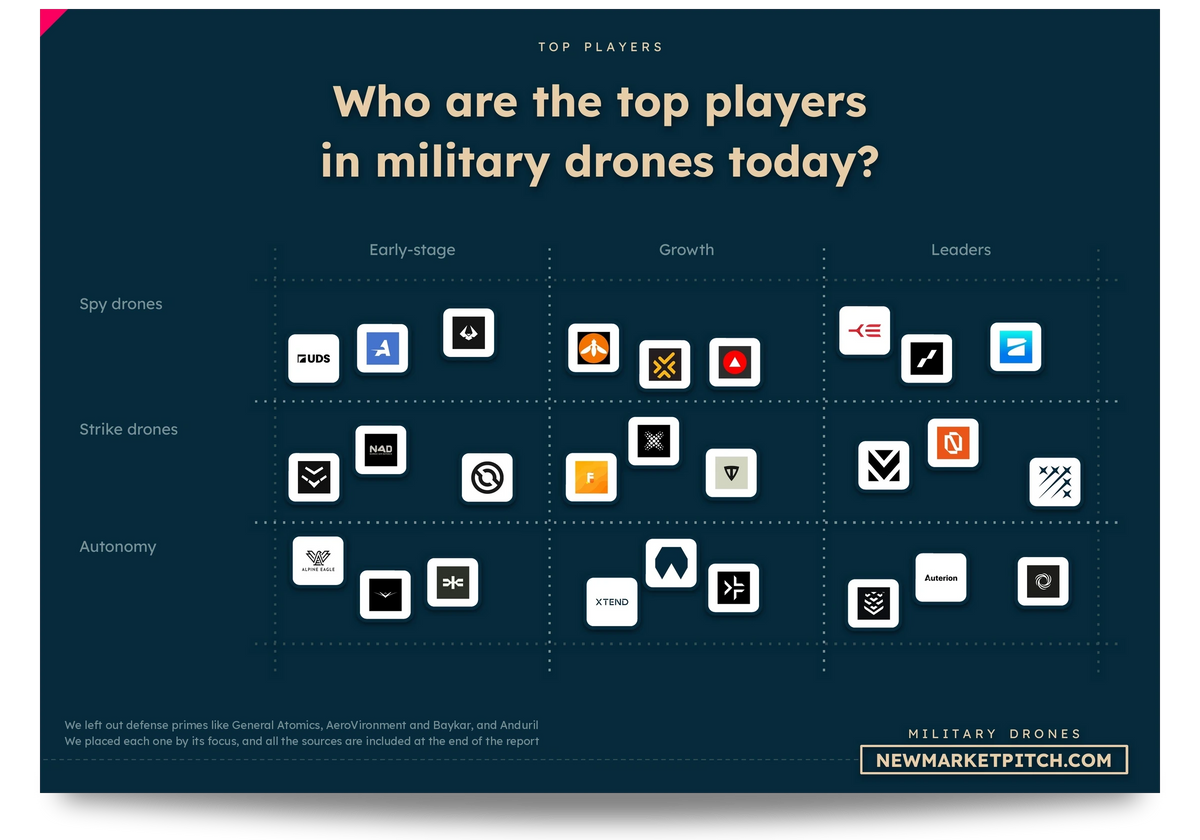
In our market report about military drones, we turn what is vague and complex into simple, useful visuals. Market maps like this one show you at a glance where every startup stands.
Can autonomous military drones ever make their own kill decisions safely?
Autonomous military drones are creating legal and ethical problems that better AI alone cannot settle. The hardest question is how much control humans must retain when a weapon can independently select and attack targets.
International humanitarian law requires military attacks to distinguish lawful targets from protected persons and objects. Attacks must also comply with proportionality requirements and take feasible precautions to reduce civilian harm.
These obligations become harder to enforce when a machine makes decisions after activation without direct human approval of every engagement.
The International Committee of the Red Cross has called for international restrictions on autonomous weapons, including prohibitions on systems whose effects cannot be sufficiently predicted or controlled.
In August 2026, the United Nations Secretary-General and the ICRC president renewed their appeal for legally binding international rules governing autonomous weapons.
The debate is complicated by differences between existing technologies.
A remotely controlled drone, an aircraft that automatically tracks a previously selected target, and a system that independently chooses targets are not equivalent.
The legal and ethical risks generally become more difficult as systems receive greater freedom to determine when, where, and against whom force is used.
The evidence also needs to be treated carefully. During an August 2026 United Nations briefing, an ICRC official said the organization did not have confirmed evidence of autonomous weapons being used to directly target human beings on the battlefield.
That does not mean the risks are hypothetical. Claims about fully autonomous lethal targeting should be separated from the growing, well-documented use of automated navigation and target tracking.
For now, armed forces face difficult choices about which decisions can safely be delegated to machines, what level of human supervision is sufficient, and who should be accountable when an autonomous system makes a mistake.
If you want more recent data on this point, please see our latest military drones market report.
What are the biggest unsolved military drone problems today?
The biggest unsolved military drone problems today are electronic warfare, affordable defense against mass attacks, reliable autonomy, supply-chain dependence, and the difficulty of integrating thousands of drones into coordinated military operations.
Electronic warfare remains especially serious for small tactical drones. Radio interference and GPS jamming can undermine relatively inexpensive systems, while more resilient communications and navigation increase their cost or complexity.
Counter-drone defense is another major weakness. Ukraine's experience shows that stopping more than 80% of incoming long-range drones can still leave hundreds reaching targets when attack volumes rise. New aircraft designs can also reduce the effectiveness of defensive technologies that previously worked well.
Industrial capacity presents a different problem. Ukraine's projected production of six million to seven million small first-person-view drones in 2026 shows that enormous output is possible. However, many Western military procurement systems are still far from operating at comparable scale.
Dependence on Chinese components makes production harder to secure. Even Ukraine, despite rapid progress in domestic manufacturing, continues to rely on imported sensors, batteries, motors, and other critical parts.
Autonomy is improving, particularly for navigation and visual target tracking, but fully independent missions and large-scale autonomous swarms remain much less mature than demonstrations sometimes suggest.
Our conclusion is that military drones have largely proved their value as weapons. The biggest unsolved challenge now is making them reliable, affordable, and effective across entire military operations, even when an enemy is constantly trying to disrupt them.

Our document detailing everything you need to know about military drone gets updated several times a month, so you always get the latest view of where things stand.
Our methodology
This analysis examines the biggest unsolved problems in military drone warfare using operational evidence, defense research, military reporting, and first-hand industry investigations. We focus on the problems that prevent drones from delivering consistent results at scale, particularly electronic warfare, autonomy, counter-drone defense, manufacturing, supply chains, economics, and battlefield coordination.
We prioritized developments from 2025 and 2026, with particular attention to the war in Ukraine. We examined these challenges separately before comparing the evidence to identify which limitations persisted despite improvements in drone technology. The analysis draws on official Ukrainian military reporting, NATO exercises, institutional defense research, and investigations by Reuters, Associated Press, and other established publications.
We distinguish demonstrated battlefield performance from technical demonstrations, production forecasts, and military estimates. For example, Ukraine's verified drone-strike figures represent recorded engagements rather than independently confirmed equipment losses. The figure exceeding 800,000 strikes refers to the Ministry of Defence's announcement on June 22, 2026, rather than a finalized first-half total. Similarly, national production projections and model-specific interception estimates are treated as reported figures, not independently audited results.
For technology, we compare the capabilities of radio-controlled, fiber-optic, GPS-independent, and AI-assisted drones with the countermeasures they face. For autonomy, we distinguish automated navigation and target tracking from systems capable of independently coordinating missions or selecting targets. For counter-drone defense, we consider interception performance alongside attack volumes, operating requirements, and the cost of successful engagements.
Our industrial and economic assessment compares production capacity, component sourcing, procurement practices, operator requirements, and the costs associated with unsuccessful missions. We distinguish Ukrainian national production forecasts from individual American procurement programs rather than treating them as directly equivalent measures of national manufacturing output.
Finally, we examine how drone operations fit into wider military systems, including command-and-control software, battlefield intelligence sharing, infantry operations, and the legal requirements governing autonomous weapons. We place greater weight on sustained operational evidence than on isolated demonstrations or manufacturer claims. The objective is to identify the problems that repeatedly limit battlefield performance, even as individual drone technologies improve.
Key sources used for this analysis include: Ukraine's Ministry of Defence on verified drone strikes in 2026, Konrad Adenauer Foundation's Ukraine Air War Monitor, Carnegie Endowment on military AI adoption and autonomy, Reuters on American and Ukrainian drone manufacturing capacity, Associated Press on Ukraine's drone component supply chains, Radio Free Europe/Radio Liberty on domestic drone production, Ukraine's Ministry of Defence on DELTA at REPMUS 2025, NATO Communications and Information Agency on counter-drone interoperability testing, Royal United Services Institute on drones and traditional firepower, International Institute for Strategic Studies on Ukrainian force adaptation, Council on Foreign Relations on Ukraine's battlefield drone innovation, International Committee of the Red Cross on autonomous weapon systems, and the ICRC and United Nations appeal for international rules on autonomous weapons.

In our report covering the military drone market, we don't want to repeat what boring consulting reports say. Instead, we show you the real and latest market signals that matter.
Written by the New Market Pitch teamWe track new markets so founders and investors can move faster. About us