Which business models work best in military drones?
Whether you're building or investing in the military drones market, our report covers everything you need to know: the players, the money, and what's coming next.
Summary
The best military drone business models combine recurring demand with proprietary technology that keeps earning money after the first airframe is sold, used or replaced. Cross-platform autonomy, advanced loitering munitions, ISR fleets with software and support, contractor-operated surveillance, specialist payloads and export licensing currently have the strongest structures.
Pure airframe manufacturing is becoming less attractive at the low end. Ukraine's procurement market shows how quickly technically similar drones can be compared, substituted and pushed down on price once several suppliers can meet the same operating requirements.
Loitering munitions have unusually clean hardware economics because successful use creates replacement demand automatically. Consumption itself becomes part of the revenue model, although margins still depend on autonomy, EW resistance, seeker quality and manufacturing scale.
Reusable ISR drones work for almost the opposite reason. The aircraft survives, but the operator keeps paying for training, spares, batteries, maintenance, software, payload changes and support, turning one fleet sale into a much longer commercial relationship.
Drone-as-a-service can be even more attractive because the government buys surveillance output rather than just hardware. Contracts can repeat for years, but the model is operationally heavy and can carry surprisingly modest margins once aircraft, crews and deployed support are included.
Autonomy software has the best long-term structure on paper because one software stack can potentially spread across several aircraft families. The important proof point is that the U.S. Air Force is already separating mission autonomy from the aircraft in CCA procurement, while Shield AI's Hivemind has flown on Anduril's Fury.
Cheap drones do not automatically mean bad businesses. Cheap, replaceable drones can produce enormous volumes, but the attractive economics sit in whatever remains hard to copy: navigation without GPS, EW resilience, autonomous targeting, manufacturing quality, proprietary sensors and software.
Exports are becoming part of the core scale strategy rather than a bonus. Baykar generating 88% of its 2025 revenue outside Türkiye shows what a globally diversified drone supplier can look like, while younger companies are trying to use domestic wins as references for allied procurement.
Local production and technology transfer are growing because governments want sovereign supply. The best version for the original supplier is not simply handing over the design; it is keeping control of software, key components, mission systems or upgrades that continue generating revenue after assembly moves abroad.
One flagship military program can change a company's trajectory, but dependence on one buyer is still dangerous. Procurement can move slowly, requirements can change, and companies may have to finance factories and engineering teams long before full-rate production arrives.
The weakest model is a replaceable airframe sold once into a concentrated customer base with little proprietary software or recurring support. The strongest companies get paid repeatedly through fleet expansion, replenishment, upgrades, services, payloads, autonomy and licensing.

Written by the New Market Pitch teamWe track new markets so founders and investors can move faster. About us

A good product starts with a real problem. In our report covering the military drone market, we show you the ones customers still live with.
What makes a military drone business actually good today?
The best military drone businesses today make money more than once from the same technology, either because drones keep getting consumed or because customers keep paying for software, services, upgrades and support.
That distinction is more useful than simply asking which company sells the most expensive aircraft. Military drones now range from FPV systems consumed almost like ammunition to reusable surveillance aircraft that can stay operational for years. Their economics are completely different.
A cheap one-way drone can produce repeat orders because every successful mission removes one unit from inventory. A reusable ISR drone has the opposite logic: the customer wants it to survive, so the manufacturer needs other ways to keep making money after delivery. Training, replacement parts, sensors, software, maintenance and contractor-operated missions become much more important.
There is also a third model emerging around autonomy. The U.S. Air Force is now buying mission-autonomy software separately from the aircraft in its Collaborative Combat Aircraft program. That creates the possibility that one software company could make money across several different drone fleets without manufacturing all of them.
When we compare these models, five things matter most: how often the customer comes back, whether margins disappear when hardware gets cheaper, how much capital is needed to grow, whether the technology works across several programs and whether one procurement loss can cripple the company.
| Business model | Repeat revenue | Price pressure | Capital needed | Long-term appeal |
|---|---|---|---|---|
| Generic FPV drones | Very high in war | Very high | Medium | Fragile |
| Advanced loitering munitions | Very high | Medium | Medium-high | Excellent |
| Reusable tactical ISR drones | High | High | Medium-high | Strong |
| Large ISR drones + support | Very high over fleet life | Lower | Very high | Strong |
| Drone-as-a-service | Very high | Lower | High | Very strong |
| Autonomy software | Potentially very high | Lower | Low-medium | Excellent if portable |
| Sensors and payloads | High | Medium | Medium | Very strong |
| Licensed local production | High | Medium | Medium | Increasingly important |
If you want more recent data on this point, please see our latest military drones market report.
Why is the military drone business changing so fast?
Military drone demand has moved from buying relatively small fleets toward continuously buying, replacing and upgrading huge numbers of systems.
Ukraine gives us the clearest picture of the change. Its Ministry of Defence said more than 3 million FPV drones were delivered to the armed forces during 2025, almost 2.5 times the previous year's level.
The procurement system then kept evolving. By late 2026, Ukrainian units had ordered more than 590,000 UAVs through Brave1 Market during the first nine months of the year alone. The average monthly value of orders had more than doubled since the beginning of the year.
The mix was changing too. Interceptor drones had become the most ordered category on Brave1 Market. Copter FPV attack drones ranked second, while orders for fixed-wing kamikaze UAVs reached a peak roughly six times higher than at the beginning of the year.
The U.S. has been moving in the same direction through programs such as Replicator and Project Artemis. Artemis evaluated 165 proposals in roughly four months before selecting four teams to work on affordable long-range one-way systems designed for contested electronic environments.
Drone manufacturers therefore face a market where demand is growing quickly while yesterday's winning aircraft can lose relevance unusually fast.

If you build or invest in the military drone market, you need to know which business models pay off now and which ones are fading. That's why our report covering it has a whole section on it.
Are cheap kamikaze drones replacing expensive reusable military drones?
Cheap expendable military drones are taking over more strike missions, but reusable drones still have a large role wherever endurance, sensors and repeated surveillance matter.
The economics explain the split. A €1,000 or €5,000 drone can be sent into situations where losing a multimillion-dollar aircraft would make no sense. Once the aircraft itself becomes part of the munition, survivability matters less than whether enough units can reach the target.
Ukraine's procurement numbers show how far that model can scale. Millions of FPVs are now supplied annually, and fixed-wing kamikaze demand has recently been among the fastest-growing categories on Brave1 Market.
Reusable surveillance aircraft serve another job. Poland has selected Shield AI's V-BAT for maritime surveillance. Germany is buying MQ-9B SeaGuardians. Large and medium ISR aircraft still make sense when a military needs a valuable sensor flying for hours rather than a weapon disappearing after one mission.
Both markets can grow at the same time, and currently they are.
Is selling the military drone itself still enough?
Selling military drone airframes alone is becoming a tough business unless the manufacturer has something competitors cannot quickly reproduce.
Ukraine's procurement market already looks uncomfortable for basic hardware suppliers. More than 1,100 products became available through Brave1 Market within its first year, while more than 400 military units gained the ability to choose equipment directly.
Competition is affecting prices as well. In an FPV procurement round based on technical requirements rather than a preferred manufacturer, eight suppliers competed and Ukraine's Defence Procurement Agency said it saved nearly UAH 511 million versus the expected procurement cost.
That was about a 15% saving.
The customer increasingly specifies what the drone has to do and lets suppliers compete to do it cheaply. Once several companies can meet the same range, payload and communications requirements, the brand on the fuselage becomes much less valuable.
We can also see the pressure in the United States. Red Cat's Black Widow has won the U.S. Army Short Range Reconnaissance program, but the same company is still competing for additional customers one tender at a time. It has recently secured orders from a NATO ally, Japan's Ministry of Defense, Asia-Pacific customers and the U.S. Air Force.
A strong hardware company therefore needs another advantage around the airframe, such as better autonomy, unusual EW resistance, proprietary sensors, manufacturing scale, a trusted supply chain or much faster updates.

Learning from others' mistakes is the cheapest lesson there is. In our market report about military drones, we look at what broke startups before you, so you don't repeat it.
Why are loitering munitions such a good drone business?
Loitering munitions have one of the strongest hardware models in military drones because actual use creates replacement demand automatically.
Reusable aircraft eventually saturate a fleet. If an army needs 200 reconnaissance drones and already owns 200 reliable ones, the manufacturer must wait for expansion, attrition or replacement cycles.
A loitering munition disappears when used as intended.
AeroVironment's Switchblade is the obvious established example. The Switchblade 600 has moved from a relatively specialized precision weapon into larger U.S. procurement efforts, including Replicator.
Project Artemis pushes the same economics toward longer-range systems. The Pentagon asked industry for affordable one-way aircraft able to operate from roughly 50 kilometers to beyond 300 kilometers while surviving disrupted communications and satellite navigation.
The strongest loitering-munition suppliers will still need differentiation in range, autonomous navigation, seekers and EW resistance because expendability alone will not protect margins.
If you want more recent data on this point, please see our latest military drones market report.
Can reusable ISR drones still make more money than kamikaze drones?
Reusable ISR drones can be excellent businesses when the aircraft becomes the start of a longer customer relationship rather than the entire sale.
Red Cat's recent Black Widow deals show what this looks like at the small end. A U.S. Air Force order worth $2.49 million covered Black Widow systems together with train-the-trainer support, batteries, spares and shipping. The Air Force is evaluating the aircraft as a possible replacement for its existing Teal 2 fleet.
The same product has also been selected through competitive processes by Japan and several allied customers. Those international orders matter because every additional operator creates future demand for replacement aircraft, batteries, controllers, support and upgrades.
Larger ISR aircraft stretch the relationship much further. An MQ-9B customer needs ground-control infrastructure, training, spare parts, maintenance, engineering support and eventually new payloads. The aircraft may remain in service for decades.
The useful comparison is therefore the lifetime revenue generated by one reusable fleet versus the cumulative revenue generated by thousands of expendable systems.
Is drone-as-a-service better than selling drones?
Drone-as-a-service is currently one of the most attractive military drone models because governments can keep paying for surveillance without having to own and operate the whole system themselves.
Textron has already shown that the model can repeat. Its Aerosonde aircraft have operated from several U.S. Navy ships under contractor-owned, contractor-operated arrangements. One task order added support for three more Littoral Combat Ships at a value of up to $47 million, while another award worth up to $17 million supported an additional ship.
By that point, Aerosonde was supporting 11 U.S. Navy vessels.
Shield AI has pursued a similar route with V-BAT. The U.S. Coast Guard created a contractor-owned and contractor-operated UAS services vehicle worth up to roughly $198 million. Shield AI was also selected as one of the companies able to compete for work under a separate Navy ISR services contract vehicle whose total ceiling reaches $800 million.
The customer gets flight hours and intelligence without immediately building a complete pilot, maintenance and logistics organization. The supplier gets a recurring relationship rather than one aircraft delivery.
The economics still need discipline. Military drone services require aircraft, operators, repairs and deployed support teams.
AeroVironment's latest fiscal results illustrate that warning. Following the BlueHalo acquisition, the company reported roughly $561 million in contract-service revenue but only about $45 million in gross profit from those services. Purchase-accounting effects and the acquired business mix influenced the result, so we should not treat that margin as a steady-state benchmark.
| Example | Model | Contract evidence | Where repeat revenue comes from |
|---|---|---|---|
| Textron Aerosonde | Contractor-operated ISR | Up to $47M for three additional Navy ships | Aircraft operation and deployed crews |
| Textron Aerosonde | Contractor-operated ISR | Up to $17M for another ship | Continued maritime ISR |
| Shield AI V-BAT / Coast Guard | COCO surveillance | Vehicle up to about $198M | Persistent surveillance services |
| Shield AI / U.S. Navy | Competitive ISR services | Vehicle ceiling up to $800M | Individual mission task orders |
| MQ-9-type fleets | Customer-owned | Multi-year support programs | Sustainment and fleet availability |
| Tactical ISR fleets | Customer-owned | Repeated follow-on purchases | Spares, batteries, training and replacements |
| Specialist payload providers | Installed hardware | Fleet-by-fleet upgrades | Sensors and mission equipment |

When you build or invest in the military drone market, you need clarity, not confusion. In our document detailing everything you need to know about military drone, we always try to put numbers on and quantify whatever is usually vague and confusing.
Is autonomy software becoming the best military drone business?
Military drone autonomy software currently has the strongest long-term economics on paper, especially when the same software can work on aircraft built by several different companies.
Shield AI gives us the clearest evidence.
The Air Force selected Hivemind as a mission-autonomy provider for its Collaborative Combat Aircraft program. Hivemind was then integrated onto Anduril's YFQ-44A Fury and completed its first CCA flight test. A few months later, Shield AI received a production contract to implement the software for the program.
The architecture is more important than any individual award. The Air Force's Autonomy Government Reference Architecture allows mission software to evolve independently from the airframe.
That opens a very different market. An autonomy supplier can potentially win work on aircraft built by other companies instead of needing its own drone to win every competition.
Shield AI is already testing that idea internationally. Taiwan's National Chung-Shan Institute of Science and Technology is using Hivemind to develop locally produced AI pilots. ST Engineering in Singapore is also exploring integrations and use of the Hivemind software development kit for sovereign autonomy.
Auterion approaches the market from another direction. Its role in Project Artemis centers on an open autonomy stack for low-cost one-way drones, including platforms built by partners.
Owning hardware can still strengthen that software model. Shield AI can develop Hivemind on V-BAT and then deploy it elsewhere, while Anduril can use Lattice across its own systems and third-party equipment. Proprietary aircraft give these companies a controlled environment for testing new autonomous behavior and collecting operational experience.
The stronger model is therefore portable autonomy supported by in-house hardware rather than software permanently locked to one proprietary drone. Shield AI's Hivemind already flying on Anduril's Fury shows that this can work in practice.
Military customers also have a reason to prefer that approach. Open architectures let them replace an aircraft, sensor or autonomy package without rebuilding the complete system.
These arrangements are still more complicated than conventional SaaS. Every new military aircraft requires integration, validation, testing and security work. Even so, one autonomy stack can potentially sit inside far more aircraft than its developer could ever manufacture itself.
If you want more recent data on this point, please see our latest military drones market report.
How much money is there after the military buys the drone?
Training, spare parts, payloads, software and sustainment can eventually be worth as much as the initial military drone sale, especially on larger reusable fleets.
General Atomics shows the mature version of this model with MQ-9 aircraft. Customers also need ground-control stations, synthetic training systems, engineering, spares and long-term support. The company's global support approach allows operators to share parts of the sustainment infrastructure across MQ-9B fleets.
The same logic now appears much further down the price ladder.
Red Cat's latest U.S. Air Force Black Widow order included training, batteries and spares. Tactical drones burn through batteries, propellers and other components even when the aircraft survives. Operators also need new payloads as missions change.
Sensors can be particularly valuable. A military may keep the same airframe while replacing the electro-optical camera, adding electronic-warfare equipment or installing a different communications package.
Software adds another upgrade cycle. Navigation, object detection, coordination between drones and resistance to jamming can improve without requiring a completely new fuselage.

In our report covering the military drone market, we look at what the winners do differently, so you can learn from the best instead of guessing.
Can a technically better military drone still lose?
A technically better military drone can absolutely lose if it takes too long to update, costs too much to produce or arrives after battlefield requirements have changed.
Ukraine is making that painfully clear.
Brave1 Market has shortened the distance between frontline users and suppliers. More than 400 combat units now use the system, and manufacturers receive data on how their products are being used and how they compare with other equipment.
By late 2026, troops had ordered more than 590,000 UAVs through the marketplace during the year. The mix had already changed substantially, with interceptor drones leading orders and fixed-wing kamikaze systems showing the fastest growth.
Manufacturers therefore receive an unusually quick answer to whether troops still want their product.
Ukraine has also introduced custom drone ordering. Units can describe the characteristics they need rather than choosing only from a manufacturer's existing catalogue.
U.S. procurement is still more structured, although the philosophy is moving closer. Programs such as Short Range Reconnaissance, Replicator and Artemis deliberately expose several suppliers to repeated evaluation instead of assuming one design should remain dominant for decades.
These days, update speed belongs inside the business model.
Are cheap military drones turning into commodities?
Cheap military drone hardware is already becoming commoditized in parts of the market, and the pricing power is moving toward whatever remains difficult to copy.
Ukraine offers perhaps the clearest live experiment.
Military units can compare hundreds of products, order by required characteristics and switch suppliers. Competitive procurement has already produced measurable savings. More than 1,100 products were available on Brave1 Market after its first year.
The market is large enough for several manufacturers to survive, but that does not mean every manufacturer will earn attractive margins.
Motors, frames, batteries and many electronic components can often be sourced from overlapping supply chains. Competitors can inspect a successful design, understand what users like about it and build something similar surprisingly quickly.
EW resistance is much harder. Reliable navigation when GPS disappears is harder. An autonomous seeker that can still identify the right target is harder. Producing hundreds of thousands of systems while maintaining quality is harder too.
Those are the places where pricing power can survive.
If you want more recent data on this point, please see our latest military drones market report.

In our research about military drones, we always try to gather several sources and make estimates that make sense, so you can work with solid numbers.
Do military drone companies need exports to get big?
Military drone companies increasingly need international customers because relying on one country's procurement cycle leaves factories dangerously exposed between major orders.
Baykar shows what an export-heavy drone company can become. The Turkish manufacturer reported about $2.5 billion of revenue for 2025, including roughly $2.2 billion from exports. International sales represented 88% of total revenue.
That is a dramatically broader customer base than depending on one national defense ministry.
We can see smaller companies heading the same way. Red Cat's Black Widow now has orders from the U.S. military, Japan, a NATO ally and other Asia-Pacific customers. Shield AI has pushed V-BAT and Hivemind into several foreign partnerships. General Atomics has built MQ-9B demand across Europe and the Indo-Pacific.
There is another change underneath those exports: more governments want some of the production and technology at home.
Ukraine has been developing international “Drone Deal” structures involving exports, licensed manufacturing, joint production and technology transfer. Shield AI's agreements with countries such as Taiwan and Singapore similarly emphasize the ability to develop sovereign autonomy rather than simply importing a finished black box.
That can be commercially attractive if the original supplier keeps control of something valuable. Software licenses, critical components, mission systems and continuous upgrades can generate revenue even when final assembly happens locally.
The dangerous version is a straightforward technology transfer that eventually teaches the customer how to replace the supplier.
Can one big military contract make a drone company?
One large military drone contract can transform a company's revenue, but depending on that single program is one of the riskiest business models in defense technology.
Red Cat shows both sides of the equation.
Black Widow's U.S. Army Short Range Reconnaissance selection gave the company a serious production opportunity and much stronger credibility with foreign customers. Since then, Black Widow has moved into additional competitive orders with NATO and Asia-Pacific customers and a fresh U.S. Air Force evaluation.
That expansion is exactly what a drone company should try to do after winning a flagship program: use the first customer to make the product easier to sell elsewhere.
Kratos shows why the economics can still be awkward while a company waits for drone programs to scale. Its unmanned-systems segment generated $292 million of revenue in 2025, up from $270.5 million the previous year, but reported only $2.6 million of segment operating income.
That works out to an operating margin below 1%.
The company was simultaneously investing for expected growth and building capacity around programs such as Valkyrie. The potential future production volume may justify that spending, but factories and engineering teams cost money before the customer reaches full-rate orders.
A diversified drone company can spread engineers, factories and software across several programs. A single-program company has to keep financing the organization while waiting for one customer to move.

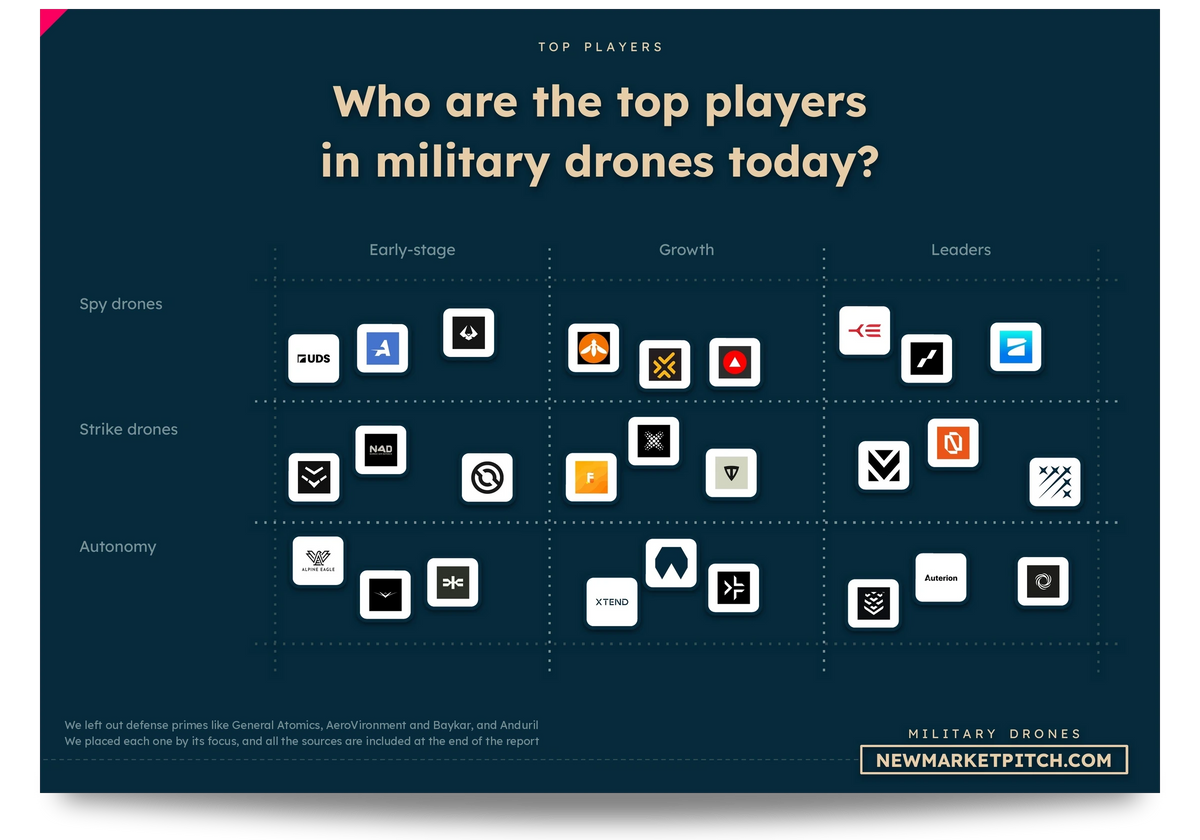
In our market report about military drones, we turn what is vague and complex into simple, useful visuals. Market maps like this one show you at a glance where every startup stands.
Do military drone winners stay locked in for decades?
Winning a military drone program is extremely valuable, but the old aerospace assumption that one victory secures decades of comfortable incumbency looks much weaker today.
Traditional defense programs reward longevity. Once an aircraft becomes deeply integrated into training, logistics and maintenance systems, replacing it becomes expensive.
Drones are evolving too quickly for that protection to be absolute.
The U.S. Army's small-UAS programs have already moved through successive technology tranches. Replicator was created around rapid adoption and scaling. Artemis went from a problem statement to evaluating 165 proposals, flight demonstrations and contract negotiations in roughly four months.
As seen above, Brave1 Market also lets Ukrainian units shift spending toward different drone categories according to what is working on the battlefield.
A winning supplier still gains a major advantage. Production scale improves, operators become familiar with the product and foreign buyers take domestic military adoption seriously. But program-of-record status increasingly looks like a head start rather than permanent protection.
Which military drone business models actually have the best economics?
The best military drone economics currently sit where repeat purchasing meets technology that remains valuable even when individual airframes get cheaper or obsolete.
Public financial results show why we should be cautious about assuming that booming demand automatically means huge profits.
AeroVironment generated roughly $1.42 billion in product revenue in its latest fiscal year and around $456 million of product gross profit, putting product gross margin near 32%. The company has grown enormously, especially after BlueHalo, yet it still carries the manufacturing, integration and R&D costs of a large defense technology business.
Kratos tells an even sharper story. Its unmanned-systems revenue increased from about $212 million in 2023 to $270.5 million in 2024 and $292 million in 2025. Segment operating income went from $4.2 million to $2.9 million and then $2.6 million over those same years.
Revenue rose roughly 38% in two years while reported segment operating profit fell.
That does not mean the unmanned business is failing. Kratos is investing ahead of expected production and operates in a market dominated by long development cycles and government programs. But the numbers are a useful reminder that building sophisticated military aircraft at scale is expensive.
Autonomy software should eventually have better incremental economics, although we still lack enough standalone financial disclosure from companies such as Shield AI or Anduril to claim that military autonomy already produces SaaS-like margins.
Loitering munitions have a simpler advantage: consumption keeps creating new unit demand.
Drone services create long contracts, although they remain operationally heavy.
Reusable ISR can become very attractive once a large installed fleet generates training, maintenance, sensor and software revenue.
| Business model | Why the economics can work | Main weakness | Our current view |
|---|---|---|---|
| Cross-platform autonomy software | One technology can spread across many aircraft | Integration is still expensive | Best long-term structure |
| Advanced loitering munitions | Use constantly replenishes demand | Hardware prices can fall | Best pure hardware model |
| ISR drone + software + support | Monetizes the same fleet repeatedly | Requires good installed-base scale | Excellent |
| Contractor-operated ISR | Long recurring contracts | People and aircraft remain costly | Very strong |
| Sensors / payloads / EW | Upgrades many existing drones | Depends on platform access | Very strong |
| Export + local licensing | Expands production beyond home market | Technology-transfer risk | Very strong |
| Program-of-record drone hardware | Large initial volumes | Can become dependent on one buyer | Strong |
| Generic FPV manufacturing | Massive potential volume | Almost no durable pricing power | High volume, weak moat |
If you want more recent data on this point, please see our latest military drones market report.

Our document detailing everything you need to know about military drone gets updated several times a month, so you always get the latest view of where things stand.
Which business models work best in military drones?
The strongest military drone companies now combine recurring demand with technology that can keep making money after one specific aircraft has been sold, used or replaced.
Autonomy software probably has the best long-term structure. The latest U.S. Air Force CCA decisions are important here because mission autonomy is being evaluated and procured as a layer that can move independently from the aircraft. Shield AI has already demonstrated Hivemind on Anduril's Fury and moved from integration into a production contract. If that procurement model spreads, a leading autonomy supplier could participate in several competing aircraft programs at the same time.
Loitering munitions currently offer the cleanest hardware economics. The customer consumes inventory during actual operations and has to replenish it. Project Artemis, Replicator, Switchblade procurement and Ukraine's enormous one-way-drone volumes all point in the same direction. The winners will need enough autonomy, EW resilience and manufacturing scale to avoid competing purely on price.
Reusable ISR works best when the airframe opens a longer stream of revenue. Black Widow's training and spares, Aerosonde's contractor-operated deployments and large-UAS sustainment programs show how many commercial layers can sit around a fleet after the aircraft itself has been delivered.
Exports have become hard to separate from any serious scale strategy. Baykar generating 88% of its 2025 revenue outside Türkiye is an extreme example, but the pattern is spreading. Even relatively young U.S. platforms such as Black Widow are quickly pursuing several allied customers instead of waiting for domestic procurement alone.
The weakest position is easy to identify: a company sells a replaceable airframe once, has little proprietary software, depends heavily on one customer and competes mainly through hardware specifications that other manufacturers can match.
The strongest companies can get paid several different ways. A military buys the first aircraft, expands the fleet, replaces lost systems, renews services, changes sensors, upgrades autonomy and sometimes licenses the same technology into its domestic industry.
That is where the military drone business is becoming most attractive. The airframe still matters, but increasingly it is the entry point into the economics rather than the whole business.
Our methodology
The answer to “Which business models work best in military drones?” is not obvious from contract values or aircraft specifications alone. Companies that all sell military drones can have completely different economics depending on whether revenue comes from expendable hardware, reusable fleets, services, software, payloads, sustainment, exports or licensing. We therefore broke the question into the dimensions that most clearly separate durable models from fragile ones.
Those dimensions were recurring demand, pricing power, capital intensity, customer concentration, technological defensibility, software portability, installed-base monetization, exportability and exposure to fast-moving battlefield requirements. For each one, we looked at recent evidence of what customers are actually buying, repeating, replacing, upgrading or switching away from.
Ukraine's procurement system was particularly useful because it gives an unusually high-frequency view of military drone demand. We used Ministry of Defence and procurement data on FPV volumes, Brave1 Market orders, product availability, competitive tenders and category shifts to understand where hardware is becoming commoditized and where repeat purchasing is strongest.
U.S. and allied programs were more useful for understanding the economics around formal procurement, contractor-operated services, large reusable fleets and autonomy. Project Artemis, Collaborative Combat Aircraft procurement, Navy and Coast Guard ISR contracts, Black Widow orders and MQ-9B purchases helped show how revenue can continue after the initial aircraft sale.
We treated autonomy software more cautiously than the theoretical economics might suggest. Cross-platform software has an attractive structure, but military integration is not conventional SaaS. We therefore gave more weight to demonstrated flight integration, production contracts and procurement architectures that explicitly separate mission autonomy from the airframe.
We also used public-company financial reporting as a reality check. AeroVironment's product and contract-service results and Kratos' Unmanned Systems segment show that rapid demand growth does not automatically produce high margins. Manufacturing capacity, engineering, integration and deployed services can absorb a lot of money even when revenue is rising quickly.
Export revenue and localization were evaluated as part of the business model rather than as a separate geographic question. A broader customer base can reduce dependence on one country's procurement cycle, while licensed manufacturing can extend scale further. The economics are strongest when the original supplier retains valuable software, critical components, mission systems or continuous upgrade revenue after local production begins.
The final ranking therefore reflects our synthesis of recent procurement behavior, contract structures, fleet economics and reported financial performance. It is not a ranking of the biggest military drone companies or the most sophisticated aircraft. The question is simpler: which structures give a supplier the best chance of getting paid repeatedly without losing all of its pricing power as individual airframes become cheaper or obsolete?
Key sources used for this analysis include Ukraine's Ministry of Defence on more than 3 million FPV drones delivered in 2025, Ukraine's Ministry of Defence on more than 590,000 UAVs ordered through Brave1 Market in 2026, Ukraine's Ministry of Defence on Brave1 Market's first-year scale, Ukraine's Defence Procurement Agency on specification-based FPV competition and procurement savings, Ukraine's Ministry of Defence on direct-order drone procurement through DOT-Chain Defence, the U.S. Defense Innovation Unit on Project Artemis, Textron Systems on contractor-operated Aerosonde deployments for three additional U.S. Navy ships, Textron Systems on another Aerosonde Navy deployment, Shield AI on the U.S. Coast Guard's contractor-operated V-BAT services vehicle, the U.S. Air Force on the open autonomy architecture for Collaborative Combat Aircraft, the U.S. Air Force on CCA autonomy contracts and software portability, Shield AI on Hivemind's first CCA flight aboard Anduril's YFQ-44A Fury, Shield AI on its subsequent U.S. Air Force production contract, Shield AI on Poland's V-BAT acquisition, General Atomics on Germany's MQ-9B SeaGuardian purchase, Baykar on its 2025 revenue and export mix, AeroVironment's fiscal 2026 Form 10-K, and Kratos' 2025 Form 10-K.

In our report covering the military drone market, we don't want to repeat what boring consulting reports say. Instead, we show you the real and latest market signals that matter.
Written by the New Market Pitch teamWe track new markets so founders and investors can move faster. About us