
Nuclear fusion funding tracker (85 deals)
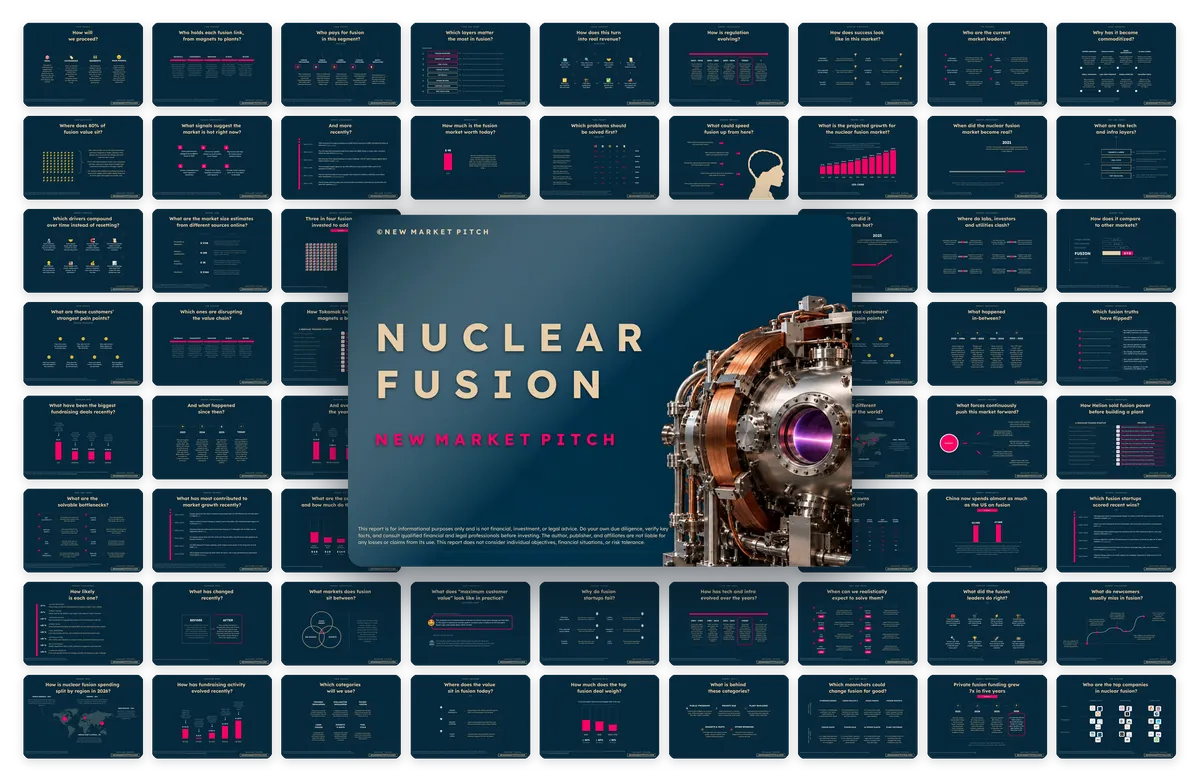
Everything we know about the nuclear fusion market, in one place. Get our report whether you build or invest.
Summary
Nuclear fusion is now a multibillion-dollar private fundraising market, but the capital is concentrated in a surprisingly small group of reactor developers. Across 84 qualifying financings involving 53 companies, we recorded at least $8.85 billion, with the five largest recipients collecting almost 64% of the total.
The typical fusion financing is considerably smaller than the headline rounds suggest. The median disclosed round is $33.8 million, against a $132.1 million average. Removing financings above $100 million leaves just $1.38 billion of recorded capital.
Funding concentration is extreme even by deep-tech standards. Commonwealth Fusion Systems raised $1.863 billion during the period, while NeoFusion, Helion, Pacific Fusion and Proxima Fusion account for much of the remaining capital at the top. The ten largest recipients together represent approximately 83% of quantified funding.
Fusion investors are increasingly financing integrated machines rather than early scientific concepts alone. Twenty-one rounds reached at least $100 million, accounting for almost 88% of recorded capital. These financings support reactor construction, magnet manufacturing, industrial facilities and future power-plant development.
The technological competition is uneven. Tokamak developers attracted approximately $4.04 billion, or 46% of quantified capital, followed by pulsed and magneto-inertial systems at $2.08 billion. Alternative-confinement approaches generate substantial deal activity but attract much smaller financial commitments.
There is an unusually large generation of young fusion companies entering the market. The median company age at financing is just two years, while companies founded in 2025 already account for 15 financing observations. Still, companies raising more than $50 million are typically older, with a median age of five years.
The financing ladder narrows sharply after early institutional backing. We counted 30 Seed rounds and 24 Series A deals, against only five explicitly classified Series B rounds. The stage labels are imperfect, but they expose the difficult transition from an investable scientific program to an expensive engineering platform.
Geography reveals two different funding markets. The US leads in disclosed capital, with approximately $4.83 billion across 20 financings. China leads in volume, with 31 deals and about $2.63 billion recorded, although undisclosed Chinese rounds and unusual capital structures make its dollar total less directly comparable.
Repeat funding provides another useful measure of investor conviction. Only 19 of the 53 companies raised more than once during the observation window, yet those repeat raisers captured approximately $5.09 billion. The ability to finance successive generations of hardware is becoming a major dividing line.
Industrial investors are increasingly embedded in fusion financing. Strategic investors participated in 35 of 84 deals, bringing potential customers, manufacturing capabilities and supply-chain relationships alongside capital. The emerging financial model extends beyond conventional venture capital.
Funding momentum remains strong: the Fusion Industry Association reported a record $4.48 billion raised in the 12 months to July 2026, up 69% from the previous survey. The central constraint is now the relatively small number of companies capable of turning early technical progress into a credible, financeable power-plant development program.

Written by the New Market Pitch teamWe track new markets so founders and investors can move faster. About us

In our report covering the nuclear fusion market, you will always find fresh funding data, taken straight from our own verified funding database.
Our funding tracker covering the nuclear fusion market
Below is the table listing all the deals. You may find our methodology at the end of this page.
And, if you want to gain a deeper understanding of the market and its current dynamics, get our report covering the nuclear fusion market.
| Company | Category | Date | Stage | Deal size | What they do | Region | Lead investors | Country |
|---|---|---|---|---|---|---|---|---|
| Daedal Systems Inc. | Fusion Control & Diagnostics | September 2026 | Seed | $4M | Develops standardized plasma-diagnostic hardware and software specifically for fusion machines. | North America | OMERS Ventures | Canada |
| Honghu Future Energy (Shanghai) Ltd. (鸿鹄未来能源) | Stellarator Reactors | September 2026 | Seed | ≈$28M | Develops high-temperature-superconducting stellarator systems for commercial fusion-energy generation. | Asia-Pacific | Not disclosed | China |
| Helion Energy | Pulsed & Magneto-Inertial Reactors | September 2026 | Series D+ | $35M | Develops pulsed magneto-inertial fusion generators using field-reversed configurations for direct electricity production. | North America | Not disclosed | United States |
| Fusionality | Fusion Control & Diagnostics | September 2026 | Seed | $3.7M | Builds integrated plasma measurement, control and operational data systems specifically for fusion devices. | Europe | Founderful; Playfair | Switzerland |
| NovaFusion Energy Technology (Shanghai) Co., Ltd. (诺瓦聚变能源科技(上海)有限公司) | Alternative Confinement Reactors | August 2026 | Unknown | $178.6M | Develops compact field-reversed-configuration fusion reactors intended for modular commercial power generation. | Asia-Pacific | Not disclosed | China |
| Kyoto Fusioneering | Fusion Fuel & Reactor Components | August 2026 | Series D+ | ≈$105M | Builds fusion plant systems such as gyrotron heating systems and fuel-cycle test facilities. | Asia-Pacific | Not disclosed | Japan |
| Startorus Fusion | Tokamak Reactors | August 2026 | Series A | ≈$130M | Develops commercial spherical-tokamak fusion reactors using repetitive magnetic-reconnection heating. | Asia-Pacific | Shenzhen Investment Holdings Capital; Shenzhen Credit Guarantee Venture Capital; ABC Capital; Bank of Communications Investment | China |
| Beta Fusion (贝塔聚变) | Pulsed & Magneto-Inertial Reactors | July 2026 | Seed | Not Disclosed | Develops pulsed field-reversed-configuration fusion systems designed around compact, distributed fusion-energy units. | Asia-Pacific | CATL | China |
| Commonwealth Fusion Systems | Tokamak Reactors | July 2026 | Unknown | $1B | Develops high-field tokamak fusion systems, including SPARC and the planned ARC commercial power plant. | North America | Not disclosed | United States |
| Starlight Engine Ltd. | Tokamak Reactors | July 2026 | Unknown | $37.4M | Develops the FAST advanced superconducting tokamak and integrated systems for commercial fusion power plants. | Asia-Pacific | Global Brain Corporation | Japan |
| Proxima Fusion | Stellarator Reactors | July 2026 | Unknown | $468M | Develops quasi-isodynamic stellarator fusion power plants for commercial electricity generation. | Europe | XTX Ventures; East X Ventures | Germany |
| Xinghe Fusion Energy (合肥星核聚变能源科技有限公司) | Stellarator Reactors | June 2026 | Seed | ≈$122.2M | Develops high-temperature-superconducting quasi-isodynamic stellarator systems for commercial fusion energy. | Asia-Pacific | SAIC Motor Financial Holdings; Hengxu Capital; Shenzhen Capital Group; CAS Star | China |
| Guomai Fusion Energy (北京国脉聚能科技有限责任公司) | Pulsed & Magneto-Inertial Reactors | June 2026 | Seed | Not Disclosed | Develops compact modular advanced-FRC fusion systems for commercial power generation. | Asia-Pacific | Beijing Green Energy Fund | China |
| SuperMag Energy (超磁新能(上海)科技有限公司) | Fusion Magnet & Power Systems | June 2026 | Seed | Not Disclosed | Develops high-field high-temperature-superconducting toroidal-field magnet systems specifically for controlled-fusion reactors. | Asia-Pacific | Gaorong Ventures | China |
| UniFusion (合肥聚合聚变技术有限公司) | Pulsed & Magneto-Inertial Reactors | June 2026 | Seed | Not Disclosed | Develops an FRC pulsed magnetic-confinement fusion device and its pulse-power, vacuum and plasma-diagnostics subsystems. | Asia-Pacific | Hillhouse Venture Capital | China |
| Xeonova | Alternative Confinement Reactors | June 2026 | Series A | ≈$73.9M | Develops compact FRC and tandem-mirror fusion reactors using pulsed compression and advanced magnetic-mirror technology. | Asia-Pacific | Ant Group; GP Capital | China |
| Beta Fusion (贝塔聚变(北京)能源科技有限公司) | Pulsed & Magneto-Inertial Reactors | June 2026 | Seed | Not Disclosed | Develops pulsed FRC magneto-inertial-confinement fusion systems for commercial energy generation. | Asia-Pacific | CATL | China |
| SunUp Fusion (东昇聚变(上海)技术有限公司) | Tokamak Reactors | June 2026 | Series A | $100M | Develops compact high-field magnetic-confinement fusion systems targeting D-He3 commercial power generation. | Asia-Pacific | Qiming Venture Partners; Zhuhai Technology Industry Group (Huajin Capital); ICBC Capital; CMC Capital | China |
| Helion Energy | Pulsed & Magneto-Inertial Reactors | June 2026 | Series D+ | $465M | Develops pulsed FRC fusion generators using direct conversion of fusion energy into electricity. | North America | Thrive Capital | United States |
| VeloAlpha (北京瞬原科技有限公司) | Fusion Control & Diagnostics | June 2026 | Seed | Not Disclosed | Develops fusion simulation software, plasma-physics algorithms and digital design tools for commercial fusion systems. | Asia-Pacific | Loongson VC | China |
| Dongxi Fusion Energy (东曦聚变能源科技(北京)有限公司) | Inertial Fusion Reactors | May 2026 | Seed | Not Disclosed | Develops laser inertial-confinement fusion systems spanning high-energy drivers, targets, diagnostics and integrated fusion-energy systems. | Asia-Pacific | CAS Star | China |
| Focused Energy | Inertial Fusion Reactors | May 2026 | Series A | $240M | Develops laser-driven inertial-confinement fusion systems for commercial power plants. | Europe | RWE | Germany |
| SunUp Fusion (东昇聚变(上海)技术有限公司) | Tokamak Reactors | May 2026 | Unknown | Not Disclosed | Develops compact high-field magnetic-confinement fusion systems targeting D-He3 commercial power generation. | Asia-Pacific | CMC Capital (Huawen Clean Energy Fund) | China |
| Thea Energy | Stellarator Reactors | May 2026 | Series B | $100M | Develops planar-coil stellarator fusion power plants designed for simplified manufacturing and maintenance. | North America | US Innovative Technology Fund (USIT) | United States |
| Startorus Fusion | Tokamak Reactors | May 2026 | Series A | ≈$73.5M | Develops negative-triangularity spherical-tokamak fusion reactors together with associated superconducting magnets and control systems. | Asia-Pacific | Not disclosed | China |
| Helical Fusion | Stellarator Reactors | April 2026 | Series B | ≈$16.9M | Develops commercial helical stellarator fusion reactors, including the Helix HARUKA demonstration system. | Asia-Pacific | Not disclosed | Japan |
| First Light Fusion Ltd | Inertial Fusion Reactors | April 2026 | Unknown | ≈$33.8M | Develops inertial-fusion fuel-target amplification and enabling pulsed-power technology for commercial fusion power. | Europe | East X Ventures (Starmaker One) | United Kingdom |
| NovaFusionX | Alternative Confinement Reactors | April 2026 | Seed | ≈$102.5M | Develops compact FRC fusion reactors intended for modular commercial power generation. | Asia-Pacific | Not disclosed | China |
| Pranos Fusion Private Limited | Tokamak Reactors | March 2026 | Unknown | $6.8M | Develops compact low-aspect-ratio tokamaks, HTS magnets and plasma-design/control software for fusion power. | Asia-Pacific | pi Ventures; Ankur Capital | India |
| LPPFusion, Inc. | Alternative Confinement Reactors | March 2026 | Unknown | >$1M | Develops proton-boron Dense Plasma Focus fusion generators with direct electrical-energy conversion. | North America | Not disclosed | United States |
| Dongsheng Fusion (东昇聚变(上海)技术有限公司) | Tokamak Reactors | February 2026 | Seed | Not Disclosed | Develops compact high-field deuterium–helium-3 tokamak fusion power plants. | Asia-Pacific | Not disclosed | China |
| Inertia Enterprises | Inertial Fusion Reactors | February 2026 | Series A | $450M | Develops laser-driven inertial-confinement fusion power plants, high-power lasers and mass-produced fusion fuel targets. | North America | Bessemer Venture Partners | United States |
| Energy Singularity (能量奇点能源科技(上海)有限公司) | Tokamak Reactors | February 2026 | Series A | Not Disclosed | Develops fully HTS compact tokamak fusion devices, magnets and reactor-control software for commercial fusion power. | Asia-Pacific | Not disclosed | China |
| BlueStar Fusion (合肥蔚蓝恒星科技有限公司) | Stellarator Reactors | February 2026 | Seed | Not Disclosed | Develops HTS stellarator fusion reactors, including advanced magnet and plasma-engineering systems. | Asia-Pacific | Not disclosed | China |
| SuperMag New Energy (超磁新能(上海)科技有限公司) | Fusion Magnet & Power Systems | January 2026 | Seed | Not Disclosed | Develops large high-temperature-superconducting high-field magnet systems for compact magnetic-confinement fusion. | Asia-Pacific | Dingfeng Kechuang | China |
| Startorus Fusion | Tokamak Reactors | January 2026 | Series A | $143M | Develops compact high-field spherical-tokamak fusion reactors using HTS magnets and magnetic-reconnection heating. | Asia-Pacific | Shanghai STVC Group; Shanghai Future Industry Fund; Shanghai CCI Investment Co., Ltd.; Jiading Venture Capital | China |
| Dongsheng Fusion (东昇聚变(上海)技术有限公司) | Tokamak Reactors | January 2026 | Seed | Not Disclosed | Develops compact high-field deuterium–helium-3 tokamak fusion power plants. | Asia-Pacific | Not disclosed | China |
| Magnull Fusion (北京零点聚能科技有限公司) | Alternative Confinement Reactors | December 2025 | Seed | >$7.1M | Develops a magnetic-null-point plasma-confinement approach aimed at low-cost commercial fusion energy. | Asia-Pacific | Not disclosed | China |
| Helical Fusion | Stellarator Reactors | December 2025 | Series A | $5.5M | Develops helical stellarator fusion reactors and related technologies for commercial power generation. | Asia-Pacific | Not disclosed | Japan |
| Maritime Fusion | Tokamak Reactors | November 2025 | Seed | $4.5M | Develops low-power-density high-temperature-superconducting tokamak fusion reactors for ships and off-grid applications. | North America | Trucks VC | United States |
| Xeonova | Alternative Confinement Reactors | November 2025 | Unknown | Not Disclosed | Develops a linear field-reversed-configuration and tandem-mirror fusion system for commercial fusion power. | Asia-Pacific | Ant Group | China |
| EX-Fusion | Inertial Fusion Reactors | October 2025 | Series A | ≈$2.6M | Develops full-stack laser inertial-fusion systems including high-power laser control, target delivery and reactor technologies. | Asia-Pacific | Not disclosed | Japan |
| Focused Energy | Inertial Fusion Reactors | October 2025 | Unknown | ≈$11.7M | Develops direct-drive laser inertial-fusion technology and integrated systems for commercial fusion power generation. | Europe | Not disclosed | Germany |
| Kyoto Fusioneering Ltd. | Fusion Fuel & Reactor Components | September 2025 | Series C | ≈$9.8M | Develops fusion power-plant systems including gyrotrons, tritium fuel-cycle equipment, breeding blankets and heat-extraction systems. | Asia-Pacific | 31VENTURES – Global Brain – Growth I GK | Japan |
| Proxima Fusion | Stellarator Reactors | September 2025 | Series A | ≈$17.6M | Designs quasi-isodynamic stellarator fusion power plants using high-temperature superconducting magnets. | Europe | Not disclosed | Germany |
| Commonwealth Fusion Systems LLC | Tokamak Reactors | August 2025 | Series B | $863M | Develops high-field HTS tokamak fusion systems, including SPARC and the planned ARC commercial power plant. | North America | Not disclosed | United States |
| General Fusion Inc. | Pulsed & Magneto-Inertial Reactors | August 2025 | Unknown | $18.4M | Develops magnetized-target fusion systems that mechanically compress plasma in liquid metal for commercial power generation. | North America | PenderFund; Segra Capital | Canada |
| MiRESSO Co., Ltd. | Fusion Fuel & Reactor Components | August 2025 | Series A | $12M | Develops low-temperature beryllium refining and production to supply neutron-multiplier material for fusion blankets. | Asia-Pacific | Spiral Capital | Japan |
| HYLENR Technologies Private Limited | Alternative Confinement Reactors | August 2025 | Seed | $3M | Develops lattice-confinement/low-energy nuclear-reaction microreactors for industrial heat and power. | Asia-Pacific | Valour Capital; Chhattisgarh Investments Limited | India |
| NovaFusionX | Alternative Confinement Reactors | August 2025 | Seed | >$69M | Develops compact modular field-reversed-configuration fusion reactors for distributed power, including AI data centers. | Asia-Pacific | Social Security Fund Zhongguancun Independent Innovation Special Fund; Legend Capital; Lightspeed China Partners (光速光合); Gaorong Capital; Huakong Fund; Mingshi Capital; Lingang Science & Technology Investment Fund; Alibaba | China |
| Helical Fusion | Stellarator Reactors | July 2025 | Series A | $15M | Develops commercial helical/stellarator fusion reactors designed for steady-state net-electricity generation. | Asia-Pacific | SBI Investment Co., Ltd.; Keio Innovation Initiative, Inc.; X&KSK I Investment Limited Partnership | Japan |
| Proxima Fusion | Stellarator Reactors | June 2025 | Series A | $150M | Develops quasi-isodynamic high-temperature-superconducting stellarators for commercial fusion power plants. | Europe | Cherry Ventures; Balderton Capital | Germany |
| EX-Fusion | Inertial Fusion Reactors | June 2025 | Series A | ≈$16M | Develops fast-ignition laser fusion reactors and the high-repetition laser, target-delivery and optical-control technologies required for them. | Asia-Pacific | Not disclosed | Japan |
| LINEA Innovations, Inc. | Alternative Confinement Reactors | June 2025 | Series A | ≈$12.3M | Develops an aneutronic p-11B fusion reactor using a field-reversed-configuration and mirror hybrid confinement system. | Asia-Pacific | ANRI | Japan |
| TAE Technologies, Inc. | Alternative Confinement Reactors | June 2025 | Unknown | >$150M | Develops beam-driven field-reversed-configuration reactors targeting hydrogen-boron fusion for commercial power generation. | North America | Not disclosed | United States |
| Pranos Fusion Private Limited | Tokamak Reactors | May 2025 | Seed | $410K | Develops compact low-aspect-ratio tokamak reactors, fusion-grade superconducting magnets and integrated plasma-control technology. | Asia-Pacific | Not disclosed | India |
| Realta Fusion Inc. | Alternative Confinement Reactors | May 2025 | Series A | $36M | Develops compact modular magnetic-mirror fusion systems for industrial heat and electricity generation. | North America | Future Ventures | United States |
| Marvel Fusion GmbH | Inertial Fusion Reactors | March 2025 | Series B | $54M | Develops high-energy laser systems and reactor technology for laser-driven inertial fusion power plants. | Europe | Not disclosed | Germany |
| Novatron Fusion Group AB | Alternative Confinement Reactors | March 2025 | Series A | $10.8M | Develops the NOVATRON magnetic-mirror fusion concept using a concave magnetic-field configuration for plasma confinement. | Europe | St1 | Sweden |
| Magnull Fusion (北京零点聚能科技有限公司) | Alternative Confinement Reactors | March 2025 | Seed | Not Disclosed | Develops a magnetic-null-point plasma-confinement approach aimed at low-cost commercial fusion energy. | Asia-Pacific | Not disclosed | China |
| Renaissance Fusion | Stellarator Reactors | March 2025 | Series A | $33.2M | Develops simplified stellarator fusion reactors integrating proprietary HTS magnets and liquid-metal walls. | Europe | Crédit Mutuel Impact (Révolution Environnementale et Solidaire fund); Lowercarbon Capital | France |
| China Fusion Energy Co., Ltd. (中国聚变能源有限公司) | Tokamak Reactors | February 2025 | Unknown | $240.3M | Develops and commercializes magnetic-confinement fusion systems, following a tokamak pathway toward experimental, demonstration and commercial fusion reactors. | Asia-Pacific | Not disclosed | China |
| Helion Energy | Pulsed & Magneto-Inertial Reactors | January 2025 | Series D+ | $425M | Develops pulsed field-reversed-configuration fusion generators designed to convert fusion energy directly into electricity. | North America | Not disclosed | United States |
| Acceleron Fusion | Alternative Confinement Reactors | December 2024 | Series A | $24M | Develops muon-catalyzed fusion using an efficient muon source and high-density fusion cell to produce fusion at comparatively low temperatures. | North America | Lowercarbon Capital; Collaborative Fund | United States |
| Xeonova | Alternative Confinement Reactors | November 2024 | Seed | >$13.8M | Develops a linear field-reversed-configuration and magnetic-mirror fusion reactor architecture aimed at commercial power generation. | Asia-Pacific | China Merchants Venture Capital; CASSTAR | China |
| Tokamak Energy | Tokamak Reactors | November 2024 | Series C | $75M | Develops compact spherical tokamak fusion reactors and high-temperature superconducting magnets for fusion-energy systems. | Europe | East X Ventures; Lingotto Investment Management | United Kingdom |
| EX-Fusion | Inertial Fusion Reactors | November 2024 | Unknown | ≈$7.2M | Develops high-repetition laser-driven fusion power systems integrating high-power lasers, continuous target supply and optical control. | Asia-Pacific | Not disclosed | Japan |
| Pacific Fusion | Pulsed & Magneto-Inertial Reactors | October 2024 | Series A | >$900M | Develops pulser-driven inertial fusion systems using high-current pulses to magnetically compress deuterium-tritium fuel. | North America | General Catalyst | United States |
| Zap Energy | Pulsed & Magneto-Inertial Reactors | October 2024 | Series D+ | $130M | Develops compact sheared-flow-stabilized Z-pinch fusion systems using repetitive electrical pulses to confine and compress plasma. | North America | Soros Fund Management | United States |
| Marvel Fusion GmbH | Inertial Fusion Reactors | September 2024 | Series B | $70M | Develops laser-driven inertial fusion using high-power short-pulse lasers and nanostructured fuel targets for commercial fusion plants. | Europe | HV Capital | Germany |
| Fuse Energy Technologies Corp. | Pulsed & Magneto-Inertial Reactors | September 2024 | Series A | $32M | Develops high-power pulsed-power systems and Magnetized Liner Inertial Fusion technology for eventual fusion power generation. | North America | Not disclosed | United States |
| HHMAX Energy | Alternative Confinement Reactors | August 2024 | Seed | Not Disclosed | Develops linear field-reversed-configuration fusion devices together with plasma-source and diagnostic systems for commercial fusion reactors. | Asia-Pacific | Meridian Capital (Huaying Capital) | China |
| General Fusion Inc. | Pulsed & Magneto-Inertial Reactors | August 2024 | Series D+ | Not Disclosed | Develops Magnetized Target Fusion systems that mechanically compress plasma inside a liquid-metal cavity to produce fusion energy. | North America | Canadian Nuclear Laboratories; BDC Capital | Canada |
| Type One Energy Group, Inc. | Stellarator Reactors | July 2024 | Seed | $53.5M | Develops optimized stellarator fusion power systems using high-field superconducting magnets and computational plasma engineering. | North America | Breakthrough Energy Ventures; GD1; Centaurus Capital | United States |
| Kyoto Fusioneering Ltd. | Fusion Fuel & Reactor Components | July 2024 | Series C | ≈$6.9M | Develops critical fusion-plant engineering systems including tritium fuel cycles, breeding blankets, gyrotrons and power-generation technology. | Asia-Pacific | In-Q-Tel (IQT); Marubeni Corporation; NICHICON CORPORATION | Japan |
| Marathon Fusion, Inc. | Fusion Fuel & Reactor Components | July 2024 | Seed | $5.9M | Develops high-throughput tritium and fusion-fuel processing systems for commercial fusion power plants. | North America | 1517 Fund; Anglo American | United States |
| Fusion Energy Technology Co., Ltd. (Neo Fusion / 聚变新能(安徽)有限公司) | Tokamak Reactors | July 2024 | Series A | ≈$1.3B | Commercializes magnetic-confinement fusion technology through the BEST superconducting tokamak and subsequent fusion-power demonstration systems. | Asia-Pacific | Not disclosed | China |
| Xcimer Energy Inc. | Inertial Fusion Reactors | June 2024 | Series A | $100M | Develops high-energy excimer-laser systems and integrated power-plant architecture for laser-driven inertial fusion energy. | North America | Hedosophia | United States |
| NeoFusion (聚变新能(安徽)有限公司) | Tokamak Reactors | June 2024 | Unknown | ≈$1.3B | Builds and commercializes the BEST superconducting tokamak, with a roadmap toward CFEDR and commercial fusion power plants. | Asia-Pacific | Not disclosed | China |
| Kyoto Fusioneering Ltd. | Fusion Fuel & Reactor Components | April 2024 | Series C | $9.9M | Engineers dedicated fusion power-plant systems and components including gyrotrons, tritium fuel cycles, breeding blankets and heat-recovery systems. | Asia-Pacific | 31VENTURES – Global Brain – Growth I GK | Japan |
| Proxima Fusion | Stellarator Reactors | April 2024 | Seed | $21.7M | Designs quasi-isodynamic stellarator fusion power plants using high-temperature superconducting magnets. | Europe | redalpine | Germany |
| Startorus Fusion | Tokamak Reactors | March 2024 | Seed | $41M | Develops compact spherical-tokamak fusion reactors using magnetic-reconnection heating and high-temperature superconducting magnets. | Asia-Pacific | Shanghai Intellectual Property Fund | China |
| Blue Laser Fusion Inc. | Inertial Fusion Reactors | March 2024 | Seed | $37.5M | Develops high-power pulsed-laser and inertial-confinement fusion reactor technology for commercial power generation. | North America | Not disclosed | United States |
| Thea Energy | Stellarator Reactors | February 2024 | Series A | $20M | Develops planar-coil stellarator fusion systems using superconducting magnets and software-defined controls for commercial fusion power. | North America | Prelude Ventures | United States |
| Tokamak Energy | Tokamak Reactors | January 2024 | Series C | $12.7M | Develops spherical tokamak fusion reactors and high-temperature superconducting magnet systems for commercial fusion power. | Europe | Not disclosed | United Kingdom |
| LINEA Innovations, Inc. | Alternative Confinement Reactors | January 2024 | Seed | $483K | Develops a hybrid field-reversed-configuration and tandem-mirror fusion reactor using advanced aneutronic fuels. | Asia-Pacific | ANRI | Japan |

In our research about nuclear fusion, we turn what is vague and complex into simple, useful visuals. Market maps like this one show you at a glance where every startup stands.
Is nuclear fusion actually a well-funded market today?
Nuclear fusion is attracting serious money today, but the $8.85 billion headline makes the market look broader than it really is.
Across the period we studied, 84 qualifying financings went to 53 companies. Only 67 deals disclosed a usable amount, yet those disclosed and approximated rounds already add up to at least $8.85 billion.
The more useful benchmark for a normal company is the median disclosed round: $33.8 million. The average is $132.1 million, almost four times higher, because several companies are raising sums that look closer to industrial-project financing than ordinary venture rounds.
Strip out every financing above $100 million and the total falls to about $1.38 billion. Remove rounds above $50 million and only around $616 million remains. These days, fusion really does have a multibillion-dollar funding market, but most of those billions sit with a fairly small group of companies building expensive integrated systems.
The broader sector is also having a strong year. The Fusion Industry Association reported that 56 companies raised $4.48 billion in the 12 months to July 2026, its highest annual figure since the survey began. Our market definition and inclusion rules differ, but the direction is the same: large private financing has accelerated sharply.
How many nuclear fusion companies are actually raising money?
The nuclear fusion funding market currently consists of 53 companies in our research, far fewer than the 84 financing announcements might suggest.
Thirty-four companies appear once during the period. Ten raise twice. Only nine raise three times or more.
A long stream of announcements can make fusion look like a huge collection of equally financeable startups. In practice, only 19 companies return for more than one financing during the window.
Those repeat raisers collect roughly $5.09 billion, compared with about $3.76 billion for the 34 companies that appear only once. Funding gets progressively pulled toward companies that can keep showing technical progress and come back for the next, usually larger, check.
| Financings per company | Companies | Share of companies |
|---|---|---|
| 1 | 34 | 64.2% |
| 2 | 10 | 18.9% |
| 3+ | 9 | 17.0% |
| More than one | 19 | 35.8% |
| Total | 53 | 100% |
Is nuclear fusion funding concentrated in just a few companies?
Yes. Nuclear fusion funding is currently concentrated very heavily at the top, with five companies accounting for almost 64% of the capital we can quantify.
Commonwealth Fusion Systems alone raised $1.863 billion during the period. NeoFusion contributes about $1.31 billion, although that figure comes from a subscribed registered-capital increase and should be read carefully. Helion raised $925 million, Pacific Fusion announced more than $900 million, and Proxima Fusion accumulated $657.3 million.
The top ten companies together absorb about 83% of quantified capital.
Several of these companies also keep coming back. CFS raised $863 million in 2025 and another $1 billion in 2026. Helion had three financings in our window. Proxima had four. Startorus had four.
That repeat access to large checks is one of the clearest dividing lines in fusion today. Plenty of teams can raise enough to start developing a reactor concept. Far fewer can convince investors to finance the next machine, then the one after that.
| Company | Financings | Capital recorded in the period |
|---|---|---|
| Commonwealth Fusion Systems | 2 | $1.863B |
| NeoFusion | 1 | $1.310B |
| Helion Energy | 3 | $925M |
| Pacific Fusion | 1 | >$900M |
| Proxima Fusion | 4 | $657.3M |
| Inertia Enterprises | 1 | $450M |
| Startorus Fusion | 4 | $387.5M |
| NovaFusionX | 3 | $350.1M+ |
| Focused Energy | 2 | $251.7M |
| China Fusion Energy | 1 | $240.3M |

Your time is limited. In our market report about nuclear fusion, we put numbers on each part of the market, so you can see where it makes sense to focus.
What can a normal nuclear fusion startup expect to raise?
For most nuclear fusion startups, a financing in the tens of millions is much more normal than a nine-figure round.
The median disclosed financing is $33.8 million. Eight rounds are below $5 million, 19 fall between $5 million and $20 million, and another 12 sit between $20 million and $50 million.
Then the market changes character. Twenty-one quantified deals reach at least $100 million and together account for almost 88% of recorded capital.
Xcimer's $100 million Series A funded a new facility and prototype laser system. Thea Energy's $100 million Series B is going into magnet manufacturing and construction of an integrated fusion system. Focused Energy's $240 million Series A is designed to finance a much larger step toward a fusion power plant.
So a fusion company can start on venture-sized money. Once it begins building integrated hardware at meaningful scale, the check size can jump very quickly.
| Round size | Deals | Share of all deals | Recorded capital |
|---|---|---|---|
| Under $5M | 8 | 9.5% | $19.8M |
| $5M–<$20M | 19 | 22.6% | $216.3M |
| $20M–<$50M | 12 | 14.3% | $379.6M |
| $50M–<$100M | 7 | 8.3% | $468.9M |
| $100M+ | 21 | 25.0% | $7.768B |
| Undisclosed | 17 | 20.2% | - |
Which nuclear fusion technology is getting the most money right now?
Tokamak companies currently attract the most fusion capital by a wide margin, with about $4.04 billion across 19 financings.
That is roughly 46% of all quantified funding from only 23% of the deals. Pulsed and magneto-inertial systems come next at about $2.08 billion.
Together, those two groups absorb close to 69% of known capital.
Stellarators and inertial fusion each clear $1 billion, although individual companies still shape those totals heavily. Proxima alone represents roughly 45% of stellarator funding in our window. In inertial fusion, one large financing contributes about 44% of category capital.
Alternative-confinement concepts are much more numerous relative to the money behind them: 16 deals produce only $608.6 million. That part of the market currently has plenty of experimentation and much smaller average financial commitments.
| Fusion approach | Deals | Companies | Recorded capital | Capital share |
|---|---|---|---|---|
| Tokamak Reactors | 19 | 10 | $4.038B | 45.6% |
| Pulsed & Magneto-Inertial | 13 | 9 | $2.079B | 23.5% |
| Stellarator Reactors | 14 | 8 | $1.052B | 11.9% |
| Inertial Fusion Reactors | 12 | 8 | $1.023B | 11.6% |
| Alternative Confinement | 16 | 11 | $608.6M | 6.9% |
| Fuel & Reactor Components | 5 | 3 | $44.5M | 0.5% |
| Control & Diagnostics | 3 | 3 | $7.7M | 0.09% |
| Magnet & Power Systems | 2 | 2 | Undisclosed | - |
Why are some fusion companies suddenly raising hundreds of millions?
The biggest fusion rounds today are paying for machines, factories, magnets and power-plant development rather than another round of basic scientific exploration.
CFS said its $863 million 2025 financing would help complete SPARC and advance work on ARC. Its next $1 billion equity round in 2026 brought in a wider mix of pension, sovereign, infrastructure and industrial capital.
Helion's 2026 Series G reached $500 million after an initial $465 million close. The company said the money was for manufacturing expansion and commercial deployment.
Proxima raised $468 million to push its Alpha stellarator demonstrator forward while expanding its engineering organization. Thea Energy's $100 million round is funding magnet manufacturing and an integrated stellarator system. Focused Energy's $240 million financing brought in investors willing, according to the company, to support the construction path toward a power plant.
The spending around these companies is getting more industrial as well. The Fusion Industry Association's 2026 supply-chain study found that reported supplier spending rose 24% in 2025, while 75% of surveyed suppliers had invested in extra fusion capacity during the previous year.
That's where the giant financing gap comes from. Building a company around promising plasma physics is expensive; building the hardware needed to turn it into electricity is dramatically more expensive.

In our document detailing everything you need to know about nuclear fusion, we always try to gather several sources and make estimates that make sense, so you can work with solid numbers.
Are most funded nuclear fusion companies old or new?
Most of the funded nuclear fusion population is surprisingly young, with a median company age of only two years at the time of financing.
The recent formation wave is visible throughout our dataset. Companies founded in 2021 account for 13 financing observations, while 2023 and 2024 contribute 11 each. Companies founded in 2025 already generate 15.
That sits alongside much older names such as TAE, General Fusion, Tokamak Energy and Helion. Those veterans become especially important in larger rounds, but they no longer define the whole private fusion market.
Newer companies including Proxima, Thea, LINEA, Startorus, NovaFusionX and a growing group of Chinese ventures have created another generation of investable fusion companies.
Today's funding market combines two quite different populations: long-running programs with years of engineering behind them and very young teams trying newer architectures, materials or design approaches.
How old are fusion startups before investors write really big checks?
Fusion companies raising more than $50 million are around five years old at the median, compared with one year for companies raising less than $5 million.
The progression by stage also looks sensible. Seed deals happen at a median company age of one year. Series A rises to four years, Series B to five and Series D or later to 13.
Fusion investors can back a young team quite early, especially when the founders come out of established research programs. The heavier financial commitment usually comes after several years of work.
By that point, investors have more to judge: magnet performance, plasma results, subsystem testing, simulation accuracy, manufacturing progress, facility construction and the team's ability to keep hitting milestones.
The age data therefore gives us a clearer view of maturity than the stage labels do.
Where does nuclear fusion funding get much harder?
Nuclear fusion funding gets much harder after Series A, where the visible pipeline drops from 24 Series A deals to only five Series B financings.
We also count 30 Seed rounds, so there is no shortage of companies getting started. The conventional ladder becomes much thinner after the first substantial institutional round.
We should avoid reading the five Series B deals as a literal graduation rate. Fusion companies frequently stop using neat venture labels as their financing becomes more complex, and 15 deals in our research have no reliable conventional stage.
Those unknown-stage rounds contain $3.46 billion, including some of the largest financings in the market.
Still, the broad pattern is hard to miss. Investors are funding plenty of early experiments. The much smaller group that receives serious scale capital has usually produced enough technical evidence to justify a much more expensive machine.
| Stage | Deals | Companies | Recorded capital | Median disclosed round |
|---|---|---|---|---|
| Seed | 30 | 26 | $518.3M | $13.8M |
| Series A | 24 | 19 | $2.597B | $33.2M |
| Series B | 5 | 4 | $1.104B | $70.0M |
| Series C | 5 | 2 | $114.3M | $9.9M |
| Series D+ | 5 | 3 | $1.055B | $277.5M |
| Unknown | 15 | 15 | $3.463B | $37.4M |

Our report covering the nuclear fusion market gets updated several times a month, so you always get the latest view of where things stand.
Why does nuclear fusion barely have a normal growth-equity stage?
Fusion companies increasingly leave the normal venture ladder behind once their capital needs reach industrial scale.
We record no deal explicitly classified as Growth Equity, even though companies are clearly raising growth-sized amounts. CFS raised $1 billion. Helion's latest round reached $500 million. Proxima raised $468 million.
The labels become messy because the investor base becomes messy too. CFS's latest financing includes institutional, sovereign, infrastructure and industrial money. Public programs also sit beside private capital. Strategic investors can become customers or engineering partners. Some commitments unlock against technical milestones.
The U.S. Department of Energy's current fusion roadmap reflects the same shift. Its Milestone Program now centers on private companies progressing from technical roadmaps toward major integrated experiments and early power-plant concepts, with companies covering most of the underlying project cost themselves.
Later-stage fusion financing already exists. These days, it simply looks less like a conventional growth round and more like a hybrid industrial capital stack.
Is nuclear fusion funding going mainly to new startups or companies that already raised before?
Existing fusion companies currently take most of the money: follow-on financings account for 60 of the 84 deals and about $6.97 billion of recorded capital.
Only 24 deals are first financings in our window. Their median size is $13.8 million, compared with $35.5 million for follow-ons.
The pattern fits how fusion development works. A company can raise an initial round to build the team and prove a subsystem. The next machine usually costs more. If that machine works, the following one can cost much more again.
Proxima's progression is a good example. It raised €20 million in 2024 and then reached a €411 million financing in 2026. Thea moved from a $20 million Series A to a $100 million Series B. Helion, CFS and Startorus have also returned repeatedly for larger amounts.
New-company formation is still healthy. The money, however, increasingly follows companies that have already survived one or more rounds of technical scrutiny.
Who leads nuclear fusion funding right now: the US, China or Europe?
The US currently leads nuclear fusion funding by dollars, while China leads by number of financings.
North America records 23 deals and about $4.86 billion, giving the region roughly 55% of quantified capital. Asia-Pacific generates 47 deals, more than half of all activity, but around $2.80 billion of disclosed capital. Europe has 14 deals and roughly $1.20 billion.
At country level, US companies account for about $4.83 billion across 20 financings. China has 31 deals and around $2.63 billion. Japan has 13 deals but only about $152 million.
The contrast is quite sharp. The US has built the deepest private market for companies raising several hundred million dollars at once. China currently has the widest flow of newly financed companies and approaches. Europe has fewer deals, but Proxima, Focused Energy and Marvel Fusion give it several companies capable of raising substantial rounds.
The regional race looks different depending on what we count. China wins on breadth; the US wins comfortably on disclosed capital.

In our research about nuclear fusion, we look at what the winners do differently, so you can learn from the best instead of guessing.
Are we probably undercounting Chinese fusion funding?
Yes, Chinese nuclear fusion funding is almost certainly understated in dollar terms because many rounds are announced without a precise amount.
Several Chinese transactions are described publicly only as "tens of millions of RMB" or "hundreds of millions of RMB." We keep those deals in the count when they clearly pass our minimum threshold, while leaving their dollar amount undisclosed.
At the same time, China's biggest recorded transaction requires the opposite caution. NeoFusion's approximately $1.31 billion figure comes from an increase in subscribed registered capital from RMB5 billion to RMB14.5 billion. Registered capital can include contributions that differ from cash proceeds received at closing.
The result is a slightly awkward but more defensible picture. Smaller Chinese rounds are probably underrepresented in the aggregate dollar total, while NeoFusion's headline number is less directly comparable with an ordinary preferred-equity financing.
We are therefore more confident in the conclusion that China has exceptional funding breadth than in any claim that its private fusion sector raised exactly $2.63 billion in cash.
Which investors keep coming back to nuclear fusion?
Nuclear fusion still has a surprisingly fragmented lead-investor market, with no firm repeatedly controlling a large share of the rounds we studied.
A lead is publicly identifiable in 54 of 84 financings. Those deals contain 85 distinct lead or co-lead names.
Only seven names appear more than once: East X Ventures, CAS Star, Ant Group, Lowercarbon Capital, 31VENTURES–Global Brain–Growth I, ANRI and CATL. None appears in more than two transactions.
That is unusual for a market where individual rounds can run into hundreds of millions.
Part of the explanation is geography. Chinese fusion companies draw from a different network than US or European companies. Technology also matters: a laser-fusion round, a stellarator round and a Chinese compact-tokamak financing naturally pull different specialists.
The other reason is scale. Once a fusion company needs several hundred million dollars, a standard VC syndicate may no longer be enough. Infrastructure investors, sovereign funds, industrial companies and large institutional pools start appearing beside venture firms.
Why are so many energy and industrial companies investing in fusion?
Strategic investors show up in about 42% of the fusion deals we studied because the companies increasingly need industrial capabilities as much as financial capital.
We identified strategic investors in 35 of 84 financings. The median strategic-backed round is $35.6 million, barely above the $33.2 million median for deals without one. Their importance shows up more clearly in what they bring than in check size.
RWE combines investment with power-plant expertise around companies including Proxima and Focused Energy. Fujikura and Furukawa Electric have direct relevance to superconducting technology. St1 described its investment in Novatron as a long-term industrial partnership that brings commercial, regulatory and energy-market knowledge.
CFS now gives us an even clearer example. Eni, an investor since 2018, signed a power-purchase agreement worth more than $1 billion for electricity from CFS's first ARC plant. Google has committed to 200 MW from the same future plant while also investing in CFS. Hyundai joined CFS's 2026 financing while exploring collaboration around future ARC plants.
Today, the best strategic investor can help a fusion company solve a future customer problem, a supply-chain problem or a plant-engineering problem at the same time.

In our market report about nuclear fusion, we don't want to repeat what boring consulting reports say. Instead, we show you the real and latest market signals that matter.
Why are fusion components and diagnostics raising so little money?
Standalone fusion components and diagnostics currently receive very little startup funding compared with complete reactor developers.
Fuel and reactor-component companies account for only about $44.5 million in our quantified total. Control and diagnostics receive less than $8 million. The magnet and power-systems category contains two financings with undisclosed amounts.
Those numbers look tiny beside the $4.04 billion going into tokamak developers.
The explanation is partly structural. A lot of component development happens inside reactor companies themselves, inside established industrial suppliers, at national laboratories or through public-private research programs. The startup table therefore captures only part of the actual spending.
Recent industry evidence supports that reading. The Fusion Industry Association surveyed 25 fusion companies and 67 suppliers for its 2026 supply-chain report. Reported supply-chain spending reached $538 million in 2025 and was projected to rise to $681 million in 2026. Suppliers highlighted extreme-condition materials, heat management and fuel systems among the longer-term constraints.
As seen above, reactor companies absorb most private funding directly, while a much broader industrial ecosystem is forming around them.
Is nuclear fusion funding really accelerating right now?
Yes, nuclear fusion funding is running at a historically high level right now, although the biggest months are still driven by a few huge transactions.
Across the 33 completed months in our window, the median month contains two deals and about $78.5 million of recorded capital.
The busiest month reaches nine deals. The biggest month by dollars reaches about $1.51 billion from only four financings, led overwhelmingly by CFS's $1 billion round and Proxima's $468 million raise.
The wider sector data confirms that the recent acceleration goes beyond one unusually large month. The Fusion Industry Association reported $4.48 billion raised in the 12 months to July 2026, 69% more than the previous year's survey total.
The mix has also changed. CFS, Helion, Proxima, Focused Energy and Thea all announced major financings recently, while the US Department of Energy's 2026 roadmap now talks explicitly about the infrastructure needed for private fusion companies to scale toward pilot plants and commercial systems.
Fusion funding is clearly hotter these days. The breadth of companies capable of raising the largest checks remains much narrower than the headline growth rate suggests.
Can we really compare every dollar in nuclear fusion funding?
No single nuclear fusion funding total can perfectly compare every transaction, so we preserve the important differences rather than forcing them into false precision.
Pacific Fusion says it has secured more than $900 million, but that capital is tied to predefined milestones. NeoFusion's approximately $1.31 billion comes from subscribed registered capital. Several Chinese deals have no precise disclosed amount at all.
Extensions and extra closes create another problem. Tokamak Energy, Marvel Fusion, Helion and others announced incremental additions to existing rounds during the period. We count an additional close when public evidence shows genuinely new capital, while avoiding a second count of the full round.
Pacific Fusion is particularly useful for understanding how strange these numbers can become. The company genuinely secured more than $900 million of financing support, and that is economically important. Treating the full amount as cash sitting in a bank account on announcement day would tell a different story.
So we use the $8.85 billion total to understand scale, concentration and who can attract capital. For precise cash-comparability across companies, the underlying financing structure still needs to be read deal by deal.

Learning from others' mistakes is the cheapest lesson there is. In our document detailing everything you need to know about nuclear fusion, we look at what broke startups before you, so you don't repeat it.
Where does the nuclear fusion funding market hit its real bottleneck?
The real nuclear fusion funding bottleneck today appears when a promising scientific platform has to become an integrated, financeable machine.
Seed funding is active. Series A is active. Young companies continue to enter the market. What gets much harder is assembling enough technical proof, engineering depth and investor confidence to finance the next major hardware step.
Only 19 of 53 companies return for more than one financing in our window. The conventional stage count falls from 24 Series A deals to five Series B deals. Meanwhile, the companies that do break through can jump very quickly into $100 million, $250 million or $500 million financings.
The US Department of Energy's current Milestone Program is built around much the same transition. Its participating private companies are expected to move from technical roadmaps toward major integrated experiments and critical technologies for future fusion power plants, with private capital covering most of the cost.
Investors are willing to fund plenty of fusion ideas. The hard part is becoming one of the relatively few companies that can credibly spend hundreds of millions of dollars on the path toward an actual power plant.
What should we actually take away from the nuclear fusion funding data?
Nuclear fusion has become a serious private-capital market, but its financial depth sits overwhelmingly with a small group of companies. The $8.85 billion total comes from 53 companies, while the top five collect almost 64% of quantified capital.
The typical financing remains much smaller than the headline rounds suggest. A $33.8 million median is a better reference point for most companies than the $132.1 million average.
Capital currently favors reactor developers, especially tokamak and pulsed or magneto-inertial approaches. Companies building integrated machines can move from venture-sized rounds into several hundred million dollars of funding surprisingly quickly once investors believe the technical program is ready.
The market is also young. New fusion companies keep appearing, but repeat financing becomes a powerful filter. Only 19 companies in our window raise more than once.
Industrial and strategic money is now becoming part of the basic financing architecture. Utilities, energy companies, technology buyers and specialist manufacturers are showing up because future fusion plants need customers, materials, engineering and supply chains alongside capital.
The biggest weakness remains the middle of the journey. There are plenty of early financings and a small number of enormous scale rounds. Far fewer companies manage to cross the gap between them.
Our methodology
This analysis provides a quantitative assessment of private fundraising in the nuclear fusion market between January 1, 2024 and October 8, 2026. We examined financing activity, deal sizes, capital concentration, reactor technologies, company maturity, funding stages, geographic distribution and investor participation to identify where capital is actually flowing and where financing becomes more difficult.
Our research began with 85 nuclear fusion market records. After reviewing company identities, transaction structures, financing dates and potential duplicates, we retained 84 qualifying financing events involving 53 distinct companies. Of these, 67 had usable disclosed or approximated financing amounts, producing a recorded funding total of at least $8.85 billion.
We restricted the analysis to private companies whose overwhelming core business is nuclear fusion or a directly related specialist technology. Qualifying transactions had to meet the dataset's minimum financing threshold. We excluded debt, grants, loans, public offerings, unconverted convertibles and financing packages whose equity component could not be reliably isolated. Where funding combined equity with other instruments, we counted the identifiable equity component only.
Each financing was reviewed as a distinct transaction. We consolidated duplicate announcements, normalized company names and checked extensions, additional closes and tranches for genuinely incremental capital. Deal dates, venture stages, lead investors, company ages and prior financing histories were retained when supported by identifiable evidence. We did not infer a funding stage from the amount raised or assign lead-investor status based solely on participation in a syndicate.
We analyzed funding both by transaction and by company. Deal-size distributions, medians and averages describe disclosed or usable financing amounts, while deal counts include eligible financings with undisclosed values. Capital concentration was calculated from quantified transactions. We also grouped companies by fusion technology, geography, company age and financing stage, then compared first financings with follow-on activity and venture participation with strategic investment.
Some unusually large transactions require specific treatment. Pacific Fusion's financing includes more than $900 million secured against predefined milestones, while NeoFusion's approximately $1.31 billion figure reflects an increase in subscribed registered capital. Both are retained with their structural distinctions, rather than interpreted as directly equivalent to cash proceeds from conventional equity closings. Chinese financings disclosed only as broad RMB ranges remain in the deal count without an invented precise dollar amount.
We checked funding announcements against their stated use of proceeds to distinguish early technical development from spending on integrated hardware, manufacturing, demonstrators and commercial power-plant programs. External industry benchmarks were used separately from our transaction dataset: the Fusion Industry Association's 2026 funding report provides the wider industry's $4.48 billion annual fundraising benchmark, while its 2026 supply-chain study documents supplier spending and industrial capacity investment.
Our source review prioritized direct company announcements, investor disclosures, government records, specialist industry research, established funding databases and reputable financial reporting. Key company sources include Commonwealth Fusion Systems' $1 billion financing announcement, its 2025 Series B2 disclosure, Helion Energy's Series G announcement, Proxima Fusion's €411 million financing, Focused Energy's $240 million Series A, Thea Energy's Series B and Xcimer Energy's Series A.
We also used TAE Technologies' funding disclosure, Marvel Fusion's Series B extension, Novatron's St1 partnership announcement, CFS's Eni power-purchase agreement, its Google strategic partnership, and the U.S. Department of Energy's Fusion Science and Technology Roadmap to assess the relationship between fundraising, industrial partnerships, technical milestones and the financing requirements of future fusion plants.
Finally, we ran a separate quality-control review covering missed transactions, duplicate rounds, date boundaries, non-equity capital, company eligibility, financing-stage consistency and conflicting company identities. The resulting figures are intended to describe recorded private financing activity, including clearly identified financing commitments, rather than claim that every reported dollar represents immediately available cash. This distinction is particularly important when comparing capital concentration, regional fundraising totals and the industry's largest transactions.

If you build or invest in the nuclear fusion market, you need to know which business models pay off now and which ones are fading. That's why our report covering it has a whole section on it.
Written by the New Market Pitch teamWe track new markets so founders and investors can move faster. About us