
Which nuclear fusion startups are closest to commercial power?
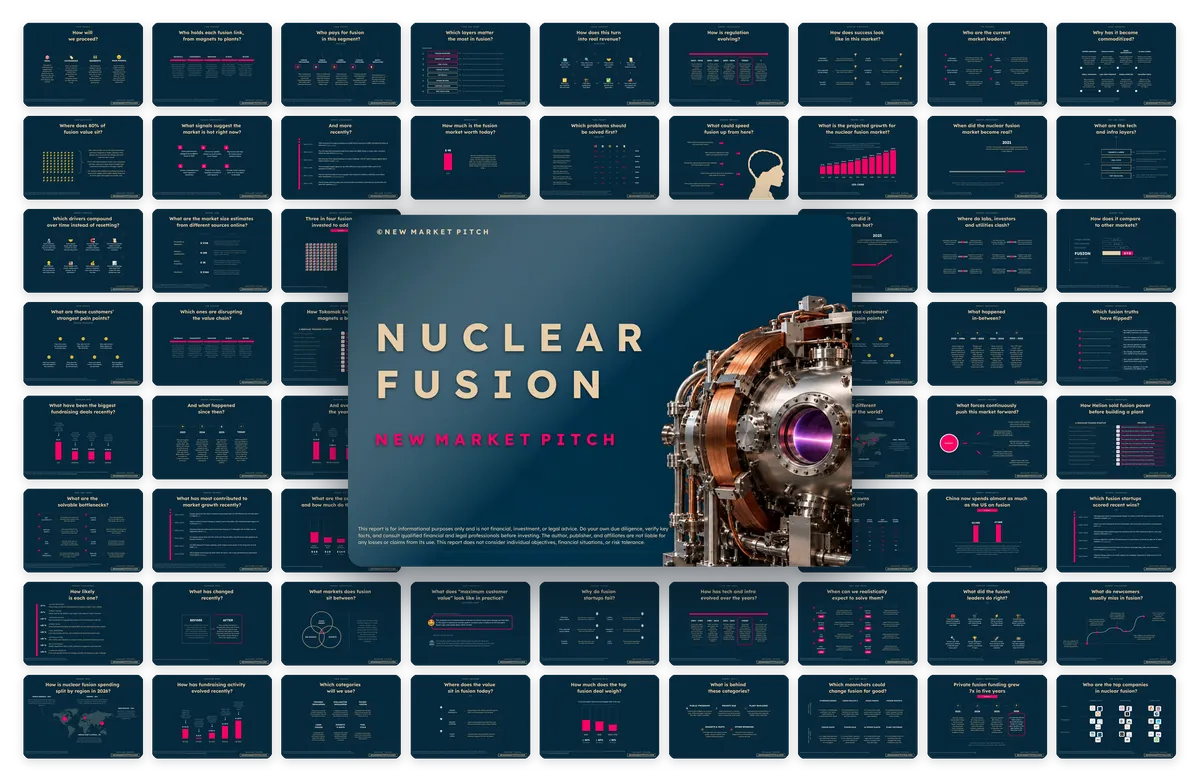
Building a startup or looking for your next investment in nuclear fusion? Our report gives you the full picture.
Summary
Helion Energy is the nuclear fusion startup closest to attempting commercial power today, while Commonwealth Fusion Systems currently has the strongest overall path to a fusion architecture that could become repeatable at utility scale.
The two companies lead for different reasons. Helion is furthest along on deployment, with a customer, site, construction activity and a 2028 electricity target, while CFS is putting a major Q>1 physics demonstration in front of its commercial ARC plant.
The biggest mistake is to rank fusion companies by announced power dates alone. A credible commercial path has to combine plasma performance, integrated engineering, licensing, construction, fuel handling, component lifetime, grid delivery and eventually plant availability.
Helion's lead is therefore unusually concentrated. Orion is more commercially advanced than rival projects, but Helion has not yet publicly demonstrated the integrated net-electricity performance its first power plant will need.
CFS has almost the opposite risk profile. SPARC will not sell electricity, but a convincing Q>1 result would remove a major physics uncertainty before CFS asks its much larger ARC machine to operate as a commercial generator.
TAE Technologies is the most aggressive challenger among the long-established fusion companies. Its decision to skip the previously planned Copernicus machine could save years, but it also pushes a much larger technical jump into the 50 MWe Da Vinci plant.
Type One Energy is becoming much harder to dismiss. Its TVA relationship, Tennessee site, licensing progress, fresh capital and 400 MWe Infinity Two design give it one of the clearest utility-backed development paths, even if its commercial timeline is later.
Pacific Fusion is the biggest potential ranking disruptor. It is younger and has less integrated fusion validation than the leaders, but it is already developing a roughly $1 billion-scale facility intended to demonstrate net facility gain by 2030.
General Fusion and Zap Energy remain technically serious but need stronger experimental results to close the gap. General Fusion is producing real compression data with LM26, while Zap's simpler Z-pinch architecture could become economically attractive if it can finally demonstrate sufficiently high fusion gain.
Proxima Fusion is playing a longer European game. Its stellarator program has strong scientific roots, major industrial partners and a proposed German commercial site, but Alpha still has to demonstrate Q>1 before Stellaris can become a realistic power project.
The most important fusion milestones over the rest of this decade may not be another temperature record. SPARC's gain, Helion's electricity production, LM26's compression performance, Infinity One's engineering results and Pacific Fusion's facility-gain test should show whether today's aggressive 2030s schedules survive contact with full-scale hardware.
If we had to choose one company to put fusion electricity on the grid first, we would choose Helion. If we had to choose one company most likely to prove a commercially repeatable fusion architecture, we would choose Commonwealth Fusion Systems.

Written by the New Market Pitch teamWe track new markets so founders and investors can move faster. About us

In our report covering the nuclear fusion market, we turn what is vague and complex into simple, useful visuals. Market maps like this one show you at a glance where every startup stands.
What does “closest to commercial fusion power” actually mean?
The fusion startup closest to commercial power is the one with the shortest credible path to sustained electricity sales, which requires far more than producing fusion reactions in an experiment.
A fusion machine can generate reactions while consuming far more energy than those reactions release. It can then reach Q>1, where fusion power exceeds the energy delivered to heat the plasma, without producing net electricity from the overall facility.
That distinction separates the companies much better than their announced dates do. Helion has gone unusually far toward an actual power project before publicly proving all the energy performance Orion will need. Commonwealth Fusion Systems is taking the opposite route: SPARC is supposed to prove high-gain fusion before CFS builds ARC. TAE Technologies has shortened its own development sequence and now wants Da Vinci to move directly toward power production.
For our ranking, we therefore give the most weight to demonstrated fusion performance, hardware already built, remaining technical steps, power-plant engineering, financing, licensing and evidence that somebody actually wants the electricity.
| Milestone | What it proves | How close it gets us to commercial power |
|---|---|---|
| Fusion reactions | Atomic nuclei are fusing | Very early |
| Reactor-relevant temperature | Plasma can reach useful conditions | Early |
| Q>1 plasma gain | Fusion output beats plasma-heating input | Major physics milestone |
| Net facility gain | Fusion output beats the machine's total stored/input energy | Much closer |
| Net electricity | The full plant exports more electricity than it consumes | Critical |
| Grid connection | The electricity can enter a real power system | Near-commercial |
| Repeated or continuous operation | The plant can keep producing electricity | Essential |
| Competitive cost and availability | Customers can rely on the plant economically | Commercial fusion |
Why does commercial fusion look more realistic now than it did a few years ago?
Commercial fusion looks more serious today because companies are spending billions on machines, factories and power-plant sites rather than mainly raising money around distant reactor concepts.
The Fusion Industry Association's latest annual survey counted 56 fusion companies and $4.48 billion raised over the previous twelve months, the highest annual figure since the survey began. Cumulative funding reported since 2021 reached $14.24 billion.
The industrial spending underneath those fundraising numbers is more interesting. In a separate FIA supply-chain study, participating fusion companies reported $538 million of supplier spending during 2025, 24% more than the previous year. They expected another 27% increase in 2026. Three-quarters of surveyed suppliers said they had invested in expanding fusion capacity.
We can also see actual electricity customers entering the picture. Microsoft has contracted for power from Helion's planned Orion plant. Google has agreed to buy 200 MW from the first CFS ARC plant. TVA is working directly with Type One Energy in Tennessee.
The sector still has a huge technical gap to close, but companies are now spending real industrial money on that gap. That's a meaningful change from a fusion industry dominated by laboratory milestones and reactor renderings.

Our research about nuclear fusion gets updated several times a month, so you always get the latest view of where things stand.
Is Helion Energy closest to putting fusion electricity on the grid?
Helion Energy is currently closest to attempting commercial fusion power because Orion already has a customer, a site, construction activity and important regulatory approvals, although Helion still has to prove that the full system can produce useful net electricity.
Microsoft agreed to buy electricity from Helion's first plant, with Constellation involved in the power-purchase agreement. Orion is designed to provide at least 50 MW after ramp-up and Helion is still targeting initial operations in 2028.
The physical project has progressed further than most competing commercial plants. Helion selected Malaga in Washington state, completed its environmental review, received a conditional-use permit and began site construction. The company has also received the relevant radioactive-material and air-emissions licenses from Washington state.
Polaris, Helion's seventh fusion prototype, has strengthened the physics case without closing it. Helion reported that Polaris became the first privately developed fusion machine to demonstrate measurable deuterium-tritium fusion and reached plasma temperatures above 150 million degrees Celsius. Its previous machine, Trenta, completed around 10,000 high-power pulses.
The missing proof is still enormous. Helion itself says the remaining work includes demonstrating electricity from fusion, extending performance repeatably, scaling the integrated machine, proving component lifetime and handling fuel processing and grid delivery.
That makes the 2028 Microsoft target unusually useful when judging Helion. There is a real deadline attached to a real customer, but the technical program has not yet publicly demonstrated the complete performance required to meet it.
Helion has also given itself enough money to keep trying. Its latest $465 million financing valued the company at $15.5 billion after the round and added more capital for manufacturing and deployment.
So Helion leads the commercial race today, but its lead is much stronger in project execution than in publicly demonstrated net-energy performance.
If you want more recent data on this point, please see our latest nuclear fusion market report.
Is Commonwealth Fusion Systems a safer bet than Helion?
Commonwealth Fusion Systems is probably the strongest risk-adjusted bet on commercial fusion because SPARC combines a relatively well-understood tokamak approach with new high-field magnets, serious funding and a commercial ARC project already tied to Google.
CFS is building SPARC in Massachusetts around high-temperature superconducting magnets. The company currently describes the machine as almost 80% complete, with magnets being installed, the vacuum vessel progressing and support systems beginning operation.
SPARC has one very specific job: demonstrate Q>1. It will not sell electricity. If it performs roughly as predicted, however, CFS will have experimentally tested the fusion core behind its much larger ARC power plant before asking ARC to become a commercial generator.
This is where CFS differs sharply from Helion. Helion is moving rapidly toward an electricity-producing plant while several system-level performance questions remain open. CFS is putting one large physics experiment in front of its power plant.
The underlying tokamak database also gives CFS an advantage. Thousands of tokamak experiments have already explored the confinement regime, while CFS's major technological bet is that very strong REBCO superconducting magnets allow a smaller machine to reach commercially relevant performance.
CFS has already validated major pieces of that magnet program. The US Department of Energy independently reviewed full-scale toroidal-field magnet testing, while CFS has completed additional DOE milestones covering its ARC roadmap and preconceptual design.
ARC is intended to export around 400 MW of electricity. Google has agreed to purchase 200 MW from the first plant planned in Virginia, giving CFS a concrete customer rather than a theoretical future electricity market.
The next SPARC result could therefore change the ranking more than almost any other private-fusion experiment. A convincing Q>1 result would remove one of CFS's biggest uncertainties while ARC development is already underway. A serious miss would push the whole commercial program backwards.

In our market report about nuclear fusion, we look at what the winners do differently, so you can learn from the best instead of guessing.
Can TAE Technologies really produce fusion power in 2031?
TAE Technologies could reach commercial fusion early in the next decade, but its 2031 Da Vinci schedule currently looks more aggressive than the public experimental evidence supporting it.
TAE has spent nearly three decades developing field-reversed configurations and has built five generations of fusion machines. Its current technology has sustained plasma above 70 million degrees Celsius, and TAE developed a simpler method for creating its FRC plasma using neutral beam injection.
The result changed the company's roadmap. TAE had previously planned another major experimental machine called Copernicus before moving to a commercial plant. It now believes the newer architecture allows it to skip that step and move directly toward Da Vinci.
Da Vinci is designed as a 50 MWe plant. TAE says its key designs have been completed and that it has been evaluating sites in Alabama, Ohio and Texas. The current roadmap targets first plasma around 2029, net-energy capability in 2030 and initial power operations in 2031.
Skipping Copernicus saves years if TAE is right. It also concentrates much more technical risk inside Da Vinci.
Fuel adds another uncertainty. TAE ultimately wants to use advanced fuels that produce fewer neutrons than conventional deuterium-tritium fusion, and it has recently been developing a future helium-3 supply pathway. Those fuels could make a power plant cleaner and simpler in some respects, but they require tougher plasma conditions.
TAE belongs in the leading group because the company has decades of hardware behind it, a defined commercial machine and a short path on paper. We still rank it below Helion and CFS because Da Vinci carries more unproven physics into the power-plant stage.
If you want more recent data on this point, please see our latest nuclear fusion market report.
Is Type One Energy becoming a real threat to the fusion leaders?
Type One Energy has quietly become one of the more credible commercial fusion companies, even if its mid-2030s timeline probably keeps it out of the race for the very first fusion electricity.
Type One is building Infinity One at TVA's Bull Run site in Tennessee. Infinity One is an engineering and verification machine rather than the final power plant, with commissioning currently planned for 2029.
The commercial machine is Infinity Two, a stellarator designed to produce roughly 800 MW of fusion power and deliver around 400 MWe to the grid. TVA has already signed commercial contracts supporting the program and has expressed interest in deploying the power plant once it is ready.
The company also benefits from a deeper scientific base than its age suggests. Its team draws heavily on work from Wendelstein 7-X and earlier optimized stellarators, and Type One has published a seven-paper peer-reviewed physics basis covering its power-plant design.
A fresh development has made the program harder to dismiss. Type One has now closed a $200 million Series B backed by investors including Breakthrough Energy Ventures, Lowercarbon Capital and Siemens Energy Ventures. That came after the initial fusion operating license for Project Infinity was granted.
Stellarators could ultimately be attractive power machines because they are naturally suited to steady-state plasma operation. The difficult part shifts toward manufacturing: their three-dimensional magnets and surrounding reactor geometry are much more complicated than a simple torus.
Type One's approach is slower and more methodical than Helion's. For a utility such as TVA, that may actually be an advantage.

In our document detailing everything you need to know about nuclear fusion, you will always find fresh funding data, taken straight from our own verified funding database.
Is General Fusion still in the commercial fusion race?
General Fusion remains a serious contender because LM26 is operating and producing useful compression data, but the company now sits a clear step behind the leading commercial timelines.
Its magnetized-target-fusion approach compresses magnetized plasma with a lithium liner. LM26 has recently demonstrated compressional heating to electron temperatures of about 0.72 keV, or roughly 8.4 million degrees Celsius.
Results from its first 11 compression experiments showed more than a threefold increase in electron temperature, alongside roughly tenfold increases in density and poloidal magnetic field in its best-performing shots.
Those numbers show that the basic compression process is doing real work. They are still well below the conditions General Fusion ultimately needs. The company wants LM26 to move through higher-temperature milestones and toward conditions relevant to the Lawson criterion before shifting its focus toward a commercial machine.
Its commercialization position has nevertheless strengthened in other ways. General Fusion has become the first publicly listed pure-play fusion company and has signed a framework agreement with Renexia covering possible future fusion deployment in Italy.
The physics schedule remains the limiting factor. General Fusion's own roadmap points toward a first-of-a-kind electricity-producing plant around the middle of the next decade, giving Helion, CFS and TAE several years of theoretical head start.
Could Zap Energy's simpler fusion reactor beat the big tokamaks?
Zap Energy could eventually build a simpler fusion power plant than the magnet-heavy designs around it, but we still need to see much stronger fusion performance from its Z-pinch before putting Zap among the leaders.
Zap passes a large electrical current through plasma, allowing the plasma itself to generate much of the magnetic field needed for confinement. That removes the giant superconducting magnet systems used by tokamaks and stellarators.
The historical problem with Z-pinches is instability. Zap is betting on sheared-flow stabilization to keep the plasma controlled long enough to reach useful fusion conditions.
Its engineering program has made real progress. The Century platform has demonstrated repeated plasma shots roughly every few seconds while testing liquid-metal systems and power handling. Zap has also completed a US Department of Energy milestone covering a preconceptual plant designed around approximately 50 MW of net electrical output per module.
Those achievements test pieces of a future power plant, but Century is mainly an engineering platform. The central question is still whether Zap can reach sufficiently high fusion gain with the Z-pinch itself.
If that happens, the commercial payoff could be unusually large because Zap may avoid some of the most expensive hardware used by competing concepts. Until then, the simpler reactor remains more promise than advantage.

Learning from others' mistakes is the cheapest lesson there is. In our report covering the nuclear fusion market, we look at what broke startups before you, so you don't repeat it.
Could Pacific Fusion suddenly jump into the top tier?
Pacific Fusion could move into the top group surprisingly quickly because it has already broken ground on a $1 billion-scale facility designed to demonstrate net facility gain by 2030.
The company uses pulsed magnetic inertial fusion. A huge electrical pulse compresses a small fusion target very rapidly rather than keeping plasma confined continuously.
Pacific Fusion has moved much faster into large-scale infrastructure than its young age would suggest. Its Research and Manufacturing Campus in Albuquerque is now under development, while a separate build center in Los Lunas is producing components for the Demonstration System.
The target is particularly interesting because Pacific Fusion is aiming beyond simple target gain. Its Demonstration System is designed to release more fusion energy than the total energy initially stored in the machine.
That would still leave another difficult step before electricity. A commercial plant would need to repeat the pulses reliably, manufacture and inject targets cheaply, manage heat and component damage, recover the fusion energy and turn the whole process into an economical generator.
Pacific Fusion has already completed multiple technical milestones on its modular pulsed-power hardware. If the 2030 facility achieves its stated gain target, we would expect the company to move sharply upward in any ranking of commercial fusion contenders.
For now, its position is unusual: Pacific Fusion is earlier than Helion or CFS in integrated fusion validation but already ahead of many older startups in capital commitment and physical infrastructure.
If you want more recent data on this point, please see our latest nuclear fusion market report.
Is Proxima Fusion too far behind the US fusion startups?
Proxima Fusion is probably too late to win the first-power race, but it has become one of Europe's strongest candidates for a commercially useful fusion plant later in the 2030s.
Proxima spun out of the Max Planck Institute for Plasma Physics and builds directly on decades of stellarator research, including Wendelstein 7-X.
Its plan starts with major magnet validation before moving to Alpha, a stellarator intended to demonstrate Q>1 in the early 2030s. Stellaris would follow as the commercial power plant.
The company has raised enough money to make that roadmap much more credible. Its latest financing added roughly half a billion dollars, putting Proxima among the better-capitalized private fusion companies.
It has also started connecting the technology to an actual energy site. Proxima, RWE, Bavaria and the Max Planck Institute are working around the former Gundremmingen nuclear site as the intended location for Stellaris.
Proxima is therefore playing a longer game. It has a plausible route to continuous stellarator power, serious European industrial partners and unusually strong scientific roots. Several big machines still have to work before Stellaris can become a power station, which keeps Proxima below the near-term leaders today.

Your time is limited. In our research about nuclear fusion, we put numbers on each part of the market, so you can see where it makes sense to focus.
Which fusion startups have moved beyond reactor renderings?
Helion, CFS, Type One Energy, General Fusion and Pacific Fusion currently stand out because their commercial claims are backed by large hardware, construction work or specific power sites.
Helion has Polaris operating and construction underway at Orion's Washington site. CFS is assembling SPARC in Massachusetts and has chosen Virginia for ARC. Type One is deploying Infinity One at TVA's Bull Run site. General Fusion is running LM26 in Vancouver. Pacific Fusion has broken ground on the Albuquerque campus for its Demonstration System.
TAE has an extensive experimental history through five generations of machines and has completed key Da Vinci designs, although the final commercial site remains less settled.
Proxima sits in a different position. Alpha still needs to be built, but Stellaris already has a proposed German location and a major utility partner.
This gives us a cleaner way to judge ambitious dates. A company that has a proposed reactor and a 2030s target belongs in a different category from one ordering full-scale hardware, pouring foundations or installing magnets.
| Company | Major hardware today | Commercial site/customer evidence | Where that leaves it |
|---|---|---|---|
| Helion | Polaris operating; Orion construction underway | Microsoft; Washington site | Leading commercial deployment |
| CFS | SPARC almost 80% complete | Google; Virginia ARC site | Leading physics-to-power program |
| Type One Energy | Infinity One being deployed | TVA; Tennessee | Strong utility-backed program |
| TAE Technologies | Norm operating | Da Vinci siting process | Strong but aggressive roadmap |
| General Fusion | LM26 operating | Italy deployment framework | Real hardware, later timeline |
| Pacific Fusion | Demonstration System under construction | New Mexico campus | Fast-rising challenger |
| Proxima Fusion | Alpha still ahead | RWE; Gundremmingen planned | Strong long-term contender |
| Zap Energy | Century operating | Pilot design completed | Needs stronger plasma proof |
| Tokamak Energy | Multiple machines and HTS magnet program | Pilot plant under development | Serious but behind CFS |
| Marvel Fusion | ATLAS development program | Later pilot-plant roadmap | Longer path to electricity |
Could fusion startups run out of money before they reach a power plant?
Money can still kill a fusion company, but the leading startups now face technical problems that another billion-dollar funding round cannot solve by itself.
The industry's finances are much stronger than they were several years ago. According to the latest Fusion Industry Association survey, private fusion companies raised $4.48 billion in twelve months and reported $14.24 billion of cumulative funding since the survey began in 2021.
Several leaders now have unusually deep capital bases. CFS has raised several billion dollars. Helion added $465 million in its latest financing. Type One has just raised $200 million. Proxima's latest round exceeded $500 million. Pacific Fusion is moving ahead with a $1 billion-scale New Mexico project.
Yet fusion burns capital quickly because every major step involves custom scientific equipment, specialized materials, large buildings, regulatory work and teams of physicists and engineers. FIA respondents estimate, on average, that another roughly $2.7 billion per company would be needed to reach commercially viable fusion, although individual estimates vary enormously.
The industry's own assessment of its future problems also tells us something. Financing remains important, but companies increasingly point toward power efficiency, neutron-resistant materials and fuel systems as major obstacles.
Several fusion startups can now afford to build the experiments that decide whether their concepts work. Money cannot guarantee the answer those experiments give.
If you want more recent data on this point, please see our latest nuclear fusion market report.

In our market report about nuclear fusion, we always try to gather several sources and make estimates that make sense, so you can work with solid numbers.
Could tritium stop the leading fusion startups even after they achieve net energy?
Tritium could become a serious bottleneck for deuterium-tritium fusion plants because today's external supply is far too small to fuel a large commercial fleet indefinitely.
D-T fusion is attractive because it is much easier to ignite than most alternative fusion reactions. That advantage is one reason tokamak and stellarator programs commonly use it.
Commercial plants would eventually need to make much of their own tritium. The standard idea is to surround the fusion chamber with lithium-containing blankets so neutrons from the fusion reaction create replacement tritium.
The blanket then has to do several jobs at once. It needs to breed enough fuel, absorb neutron energy, extract useful heat, protect magnets and other components and survive long enough to make maintenance economically reasonable.
That problem hits companies such as CFS and Type One directly. It is one reason achieving Q>1 in a plasma cannot be treated as the end of the fusion challenge.
Alternative fuels trade this problem for harder physics. TAE's long-term advanced-fuel strategy and Helion's intended deuterium-helium-3 pathway could reduce some neutron-related problems, but both require more demanding fusion conditions and their own fuel-supply solutions.
Fuel choice therefore changes where the difficulty appears rather than making the difficulty disappear.
What could actually delay commercial fusion after the plasma works?
Component lifetime, fuel handling, power efficiency and repeated operation could delay commercial fusion more than another small improvement in plasma temperature.
The change is already visible in the companies nearest to a plant. Helion needs Polaris and then Orion to show that high-power pulses, energy recovery, component lifetime and fuel handling can work together repeatedly. CFS eventually needs ARC to combine a burning plasma with breeding blankets, heat extraction, remote maintenance and a power cycle. Type One has to manufacture and service a complicated three-dimensional stellarator around a commercial fusion core.
Pulsed systems face a different version of the same problem. Pacific Fusion would need to turn extreme fusion bursts into a repeatable industrial process. Laser concepts have to manufacture, position and ignite huge numbers of targets while keeping the driver efficient enough for the facility to produce net electricity.
This is where several ambitious schedules could break. A machine may produce an excellent physics result and still be years away from behaving like a generator.
The next really revealing fusion numbers could therefore be pulses per day, operating hours, internal electricity consumption, maintenance intervals and plant availability. Those metrics are much less glamorous than a temperature record, but utilities will care about them far more.

If you build or invest in the nuclear fusion market, you need to know which business models pay off now and which ones are fading. That's why our report covering it has a whole section on it.
Could the first commercial fusion plant still slip into the 2040s?
Yes. Commercial fusion can still slip well beyond today's startup schedules even if several upcoming machines produce good physics results.
The latest Fusion Industry Association survey found that 71% of fusion companies expect the first commercial electricity in the 2030s. That is strikingly confident for an industry in which no private company has yet generated net electricity from fusion.
A lot has to go right at the same time. SPARC needs to perform close to its models. Helion has to turn Polaris progress into electricity. TAE's shortened development path has to work. First-of-a-kind manufacturing must stay on schedule. Materials need to survive. Licensing needs to keep moving. Companies must keep financing multi-billion-dollar programs.
Energy infrastructure also has a poor habit of becoming slower once construction, regulation and supply chains replace laboratory work.
The difference today is that we will not have to wait another twenty years to find out whether the optimism is justified. SPARC, Orion, LM26, Infinity One and Pacific Fusion's Demonstration System should provide much harder evidence before the end of this decade.
A few clear successes would make early-to-mid-2030s power much easier to believe. Repeated delays or disappointing gain results would quickly push the realistic window toward the late 2030s or beyond.
So which nuclear fusion startups are actually closest to commercial power?
Helion Energy is closest to attempting commercial fusion electricity, while Commonwealth Fusion Systems is currently our strongest overall bet on a power plant that can become a repeatable commercial model.
Helion comes first on deployment. Orion has Microsoft as a customer, a Washington site, construction activity and important regulatory approvals. Polaris has now produced measurable D-T fusion above 150 million degrees Celsius. No other private fusion company has combined those pieces with a stated 2028 electricity target.
The remaining Helion risk is unusually concentrated. Polaris has not yet publicly demonstrated the integrated net-electricity performance Orion needs. If Helion closes that gap, it can win the race several years ahead of most competitors.
CFS comes first on technical confidence. SPARC is almost 80% complete, its high-field magnet technology has passed major full-scale tests, the tokamak physics base is deep, ARC already has a Virginia site and Google has contracted for 200 MW. A successful SPARC Q>1 result would give CFS the strongest combination of demonstrated physics and commercial preparation in the industry.
TAE Technologies ranks third. Its long experimental history and 50 MWe Da Vinci plan make it a credible challenger, but the jump from today's FRC results to net energy and 2031 power remains larger than TAE's compressed roadmap makes it appear.
Type One Energy has moved firmly into the next group. Its fresh $200 million financing, initial Project Infinity operating license, TVA relationship and 400 MWe Infinity Two design give it one of the most serious utility-backed programs in private fusion. Its timeline is simply later.
Pacific Fusion is the startup most capable of disrupting this ranking. A $1 billion-scale facility is now under development around a Demonstration System targeting net facility gain by 2030. If that works, Pacific Fusion could jump several older companies at once.
General Fusion, Zap Energy and Proxima Fusion remain credible for different reasons. General Fusion has an operating integrated machine but a later commercial schedule. Zap could gain a huge cost advantage from its simpler architecture if its Z-pinch reaches high fusion gain. Proxima has one of the strongest long-term stellarator programs but several major steps between today's work and Stellaris.
Our ranking today is therefore:
| Rank | Fusion startup | Why it ranks here | Biggest remaining question |
|---|---|---|---|
| 1 | Helion Energy | Furthest along on a real commercial power project | Can Orion actually produce repeatable net electricity? |
| 2 | Commonwealth Fusion Systems | Strongest mix of proven physics base, hardware and commercial preparation | Will SPARC demonstrate the expected Q>1 performance? |
| 3 | TAE Technologies | Deep experimental program and aggressive 50 MWe Da Vinci plan | Is the leap from Norm to Da Vinci too large? |
| 4 | Type One Energy | Strong stellarator science plus TVA, licensing and fresh capital | Can Infinity One validate the engineering quickly enough? |
| 5 | Pacific Fusion | Huge facility commitment and 2030 net-facility-gain target | Will the pulsed system deliver its modeled gain? |
| 6 | General Fusion | LM26 is producing real compression data | Can it reach fusion conditions fast enough to keep its commercial schedule? |
| 7 | Zap Energy | Potentially much simpler and cheaper reactor architecture | Can the Z-pinch reach commercially useful fusion gain? |
| 8 | Proxima Fusion | Strong scientific roots and industrial stellarator plan | Can Alpha validate the concept early enough for Stellaris? |
| 9 | Tokamak Energy | Serious spherical-tokamak and HTS program | Can it translate its technology into an integrated pilot plant? |
| 10 | Marvel Fusion | Benefits from progress in inertial-fusion physics | Can lasers and targets become efficient enough for continuous electricity production? |
If we had to choose one company to produce fusion electricity first, we would choose Helion.
If we had to choose one company most likely to prove a commercially repeatable fusion architecture, we would choose CFS.
Those are still two different bets today.
If you want more recent data on this point, please see our latest nuclear fusion market report.
Our methodology
There is no single metric that tells us which fusion company is closest to commercial power. Different companies are solving different parts of the problem, reporting different milestones and pursuing architectures that cannot be compared cleanly through one headline number.
We therefore broke the question into analytical dimensions covering scientific progress, engineering maturity, physical deployment, commercial preparation, financing and the remaining distance between the machine operating today and a plant capable of supplying electricity.
For each dimension, we looked for the freshest concrete evidence available and gave more weight to experimental results, hardware under construction, independently reviewed technical milestones, site development, regulatory progress, utility involvement and signed power agreements than to projected dates or reactor concepts that have not reached the same stage of execution.
We also assessed each company relative to its own development path rather than forcing fundamentally different fusion technologies into a single physics benchmark. What mattered was how much of that path had already been demonstrated, how difficult the unresolved steps remain and whether progress in one area actually reduces the risk of reaching commercial electricity.
We then compared those signals across the field. The ranking is therefore not simply a ranking of plasma temperatures, funding raised, announced power dates or theoretical reactor performance. It reflects the full body of recent evidence pointing toward an operating commercial power plant.
The distinction between being first to produce commercial fusion electricity and having the strongest path to a repeatable commercial architecture is deliberate. Those are closely related questions, but the evidence currently points to Helion on the first and Commonwealth Fusion Systems on the second.
Key industry-level sources include the Fusion Industry Association's 2026 Global Fusion Industry Report, the FIA's 2026 Fusion Industry Supply Chain Report, and the U.S. Department of Energy's Fusion Science & Technology Roadmap.
For Helion, we used the company's material on its Microsoft power-purchase agreement, Orion site development, permitting progress, Polaris fusion results, technical roadmap and remaining requirements, and latest financing.
For Commonwealth Fusion Systems, the main references were its SPARC construction updates, the DOE-reviewed full-scale magnet testing, the Google agreement for 200 MW from ARC, and the company's peer-reviewed ARC physics basis.
Other key company sources include TAE Technologies' experimental history and shortened Da Vinci roadmap; Type One Energy's Infinity program, the TVA fusion program and its $200 million Series B financing; General Fusion's LM26 business and technical update; Zap Energy's DOE-approved pilot-plant milestone; Pacific Fusion's New Mexico Demonstration System project; and Proxima Fusion's development roadmap and Stellaris partnership with RWE, Bavaria and the Max Planck Institute for Plasma Physics.

In our report covering the nuclear fusion market, we don't want to repeat what boring consulting reports say. Instead, we show you the real and latest market signals that matter.
Written by the New Market Pitch teamWe track new markets so founders and investors can move faster. About us