Pet Tech Funding Tracker (45 deals)
Whether you're building or investing in the Pet Tech market, our report covers everything you need to know: the players, the money, and what's coming next.
Summary
Across 45 tracked deals, Pet Tech is a real but still small venture market today: funding is active, but the typical round is only $2M and the market has almost no visible late-stage layer.
We tracked 45 qualifying financings across 39 companies, with $222.24M of disclosed capital from 38 rounds. Seven rounds remain undisclosed, so the dollar total is a floor rather than a full estimate of capital deployed.
The headline capital is concentrated without being distorted by a single mega-round. Six financings between $20M and $50M account for 58.3% of disclosed dollars, while no disclosed round exceeds $50M.
The normal founder experience sits much lower. Sixty percent of all financings were below $5M, and the median disclosed round was $2M, making low-single-digit millions a much better benchmark than the $5.85M average.
The strongest scale-up pocket is software. Pet Care Apps produced 28 of the 45 deals and $141.9M of disclosed capital, while veterinary operating systems, pharmacy platforms and workflow tools are the clearest part of the market attracting $10M–$25M checks. Software taking most deals and the larger checks is why we compare which models make money in our report on pet tech.
Tele-vet is smaller by deal count but unusually large by check size. Four financings generated $55.76M, with a $16M median disclosed round, largely because the funded companies tend to be older and already operating at expansion stage.
The financing ladder narrows fast. We found 25 Seed rounds, five Series As, four Series Bs, one Series C and nothing beyond that, so Pet Tech currently has a wide early-stage base and only a thin institutional scale-up tier.
Follow-on capital dominates the dollars even though most companies appear only once. First financings represent 35.6% of deals but only $41.01M, while follow-ons account for 81.5% of disclosed funding.
North America leads on visible capital, but China is more important than its disclosed dollar total suggests. China produced 12 financings, yet seven of them lack exact amounts, making deal count a more useful measure of its activity than reported capital.
The investor base is still fragmented. No exact lead investor appears twice among the 31 deals with a disclosed lead, and strategic participation is rare, which makes Pet Tech look more like a collection of individual venture bets than a tightly formed specialist funding ecosystem.

Written by the New Market Pitch teamWe track new markets so founders and investors can move faster. About us

In our report covering the pet tech market, you will always find fresh funding data, taken straight from our own verified funding database.
Our funding tracker covering the Pet Tech market
Below is the table listing all the deals. You may find our methodology at the end of this page.
And, if you want to gain a deeper understanding of the market and its current dynamics, get our report covering the Pet Tech Market.
| Company | Category | Date | Stage | Deal size | What they do | Region | Lead investors | Country | Rank |
|---|---|---|---|---|---|---|---|---|---|
| Janus Labs | Smart Pet Devices | November 2026 | Seed | $1.8M | Develops contactless neural sensors and AI software to monitor pets for early signs of illness, pain and stress. | North America | New York Angels | United States | |
| BetaCat | Veterinary Practice Software & AI | October 2026 | Unknown | $1.4M+ | Develops practice-management SaaS software for veterinary clinics. | Asia-Pacific | Not disclosed | China | |
| Moonback | Smart Pet Devices | September 2026 | Unknown | $1.4M+ | Develops connected pet products including smart litter boxes and pet-monitoring devices. | Asia-Pacific | Not disclosed | China | |
| Elita | Pet Training & Care Apps | September 2026 | Seed | $1.4M | Preventive canine health platform | Asia-Pacific | Boost VC, Gandel Invest | Australia | |
| Vet-AI (Joii Pet Care) | Veterinary Telehealth | September 2026 | Unknown | ~$26M | AI-assisted online veterinary healthcare | Europe | Not disclosed | United Kingdom | |
| Shenzhen Vetoo Medical Technology | Veterinary Practice Software & AI | September 2026 | Unknown | Undisclosed | Veterinary diagnostic and monitoring devices | Asia-Pacific | BIOCHING VENTURES | China | |
| ImpriMed | Veterinary Practice Software & AI | September 2026 | Series A | $10M | AI precision oncology for pets | North America | LB Investment | United States | |
| Hoomanely | Pet Health Wearables | August 2026 | Seed | $1.8M | AI-powered pet health monitoring | North America | Not disclosed | United States | |
| CompanAIn | Smart Pet Devices | August 2026 | Seed | $730K | AI pet-health timeline platform | North America | Not disclosed | United States | |
| Wonderdog | Pet Training & Care Apps | July 2026 | Seed | $5M | Preventive canine diagnostics and monitoring | North America | WndrCo, Maveron | United States | |
| Qisuanfa | Pet Training & Care Apps | May 2026 | Unknown | Undisclosed | Smart devices and software for pets | Asia-Pacific | Not disclosed | China | |
| Travv | Veterinary Practice Software & AI | May 2026 | Seed | $1.6M | AI veterinary radiology workflow software | North America | Digitalis Ventures | United States | |
| Petwealth | Veterinary Practice Software & AI | April 2026 | Seed | $1.7M | AI-powered PCR diagnostics for pets | North America | Predictive Venture Partners | United States | |
| Petwealth | Veterinary Practice Software & AI | April 2026 | Seed | $2M | AI-powered PCR diagnostics for pets | North America | Not disclosed | United States | |
| PettiChat | Pet Training & Care Apps | March 2026 | Seed | $1M | AI health assistant for pets | Asia-Pacific | Not disclosed | China | |
| Moggie | Pet Health Wearables | March 2026 | Seed | ~$461K | AI-powered feline health wearable | Europe | Not disclosed | United Kingdom | |
| Moggie | Pet Health Wearables | March 2026 | Unknown | $1.5M | AI-powered feline health wearable | Europe | Not disclosed | United Kingdom | |
| MOVA AI Pets | Smart Pet Devices | February 2026 | Series A | Undisclosed | AI smart cat litter boxes | Asia-Pacific | Skyworks Venture Capital | China | |
| PitPat | Pet Health Wearables | February 2026 | Series A | ~$4.2M | GPS trackers and dog activity monitors | Europe | Not disclosed | United Kingdom | |
| SATELLAI | Pet Tracking & Safety | January 2026 | Series A | $2.9M | AI pet tracking and health wearables | North America | SenseTime Guoxiang Capital | United States | |
| Traini | Pet Training & Care Apps | December 2025 | Unknown | $7.5M | AI-powered pet communication and training | North America | Banyan Tree, Silver Capital, ZhaoTai Group, NYX Ventures | United States | |
| VETSTOR | Pet Training & Care Apps | December 2025 | Seed | ~$1.2M | Cloud software for veterinary inventory management | Europe | JSK Investments | Czech Republic | |
| Digitail | Veterinary Practice Software & AI | November 2025 | Series B | $23M | Veterinary practice management software | North America | Five Elms Capital | United States | |
| Hezong Liantou Data | Pet Training & Care Apps | November 2025 | Seed | ~$1.7M | Pet identity chips and lifecycle platform | Asia-Pacific | Not disclosed | China | |
| Shenzhen Xiaowen Intelligent Healthcare Technology | Pet Training & Care Apps | October 2025 | Seed | Undisclosed | AI veterinary diagnostics and monitoring | Asia-Pacific | Shenzhen Qianhai Lvsong Investment | China | |
| Lupa | Veterinary Practice Software & AI | October 2025 | Series A | $20M | AI veterinary practice management platform | Europe | Singular | United Kingdom | |
| Nest Veterinary | Pet Training & Care Apps | September 2025 | Unknown | $3.4M | Technology-enabled veterinary clinics and care | North America | Not disclosed | United States | |
| Petscribers | Pet Training & Care Apps | August 2025 | Seed | ~$399K | Pet prescription comparison and e-prescribing | Europe | Not disclosed | United Kingdom | |
| SATELLAI | Pet Tracking & Safety | July 2025 | Seed | Undisclosed | AI pet tracking and health wearables | North America | 01VC | United States | |
| Happy Pet Tech | Pet Training & Care Apps | July 2025 | Seed | $600K | Management software for pet businesses | Asia-Pacific | Not disclosed | India | |
| Elita | Pet Training & Care Apps | July 2025 | Seed | ~$720K | Preventive canine health platform | Asia-Pacific | Not disclosed | Australia | |
| Vetr | Veterinary Telehealth | May 2025 | Unknown | $21M | Digital veterinary services and medications | North America | Pale Horse Capital | United States | |
| Koala Health | Pet Training & Care Apps | May 2025 | Series B | $20M | Online pharmacy for pet medications | North America | Valspring Capital | United States | |
| Maven Pet | Pet Health Wearables | May 2025 | Unknown | Undisclosed | AI-powered continuous pet health monitoring | North America | Not disclosed | United States | |
| MetaDx | Pet Training & Care Apps | April 2025 | Seed | ~$341K | Veterinary cancer screening and risk software | Asia-Pacific | KAIST Youth Startup Investment Holdings | South Korea | |
| Airvet | Veterinary Telehealth | April 2025 | Series B | $11M | Virtual veterinary telehealth platform | North America | HighlandX | United States | |
| Vetflux | Pet Training & Care Apps | March 2025 | Seed | ~$887K | Veterinary workflow and clinic management software | Asia-Pacific | DB Digital Technology Holdings | South Korea | |
| Scooch | Pet Training & Care Apps | March 2025 | Seed | $1.3M | Pet health subscription and preventive care | Europe | Not disclosed | United Kingdom | |
| Goose | Pet Training & Care Apps | February 2025 | Seed | $13M | Pet-care business operating system | North America | B Capital | United States | |
| Otis | Veterinary Telehealth | February 2025 | Seed | $2.3M | Online veterinary consultations and prescriptions | North America | Female Founders Fund | United States | |
| VetVerifi | Pet Training & Care Apps | February 2025 | Seed | $2.8M | Digital pet vaccination verification platform | North America | Las Olas Venture Capital | United States | |
| RABO (Catlog) | Smart Pet Devices | February 2025 | Unknown | $5.4M | AI-powered cat health monitoring devices | Asia-Pacific | Not disclosed | Japan | |
| Lupa | Veterinary Practice Software & AI | January 2025 | Seed | $4M | AI veterinary practice management platform | Europe | Not disclosed | United Kingdom | |
| Petwealth | Veterinary Practice Software & AI | 2025 | Seed | Undisclosed | AI-powered PCR diagnostics for pets | North America | Not disclosed | United States | |
| Pilton | Smart Pet Devices | December 2024 | Series A | ~$4.1M | Smart pet devices and connected pet services | Asia-Pacific | Anji Industrial Fund | China | |
| SATELLAI | Pet Tracking & Safety | December 2024 | Seed | ~$1.4M | AI pet tracking and health wearables | North America | Future Light Cone Frontier Technology Fund, Zero Yi Capital | United States | |
| Vetnio | Pet Training & Care Apps | December 2024 | Seed | ~$1.1M | AI clinical copilot for veterinarians | Europe | Peak, YZR Capital | Sweden | |
| HappyDoc | Veterinary Practice Software & AI | November 2024 | Seed | $2.2M | AI veterinary documentation assistant | North America | Range Ventures | United States | |
| Scribenote | Veterinary Practice Software & AI | September 2024 | Seed | $8.2M | AI clinical documentation for veterinarians | North America | Andreessen Horowitz | Canada | |
| Maven Pet | Pet Health Wearables | September 2024 | Unknown | $4.4M | AI-powered continuous pet health monitoring | North America | Touro Capital Partners | United States | |
| Beijing Yuanyibai Technology | Smart Pet Devices | August 2024 | Unknown | Undisclosed | Smart pet devices and connected services | Asia-Pacific | Not disclosed | China | |
| Koala Health | Pet Training & Care Apps | August 2024 | Series A | Undisclosed | Online pharmacy for pet medications | North America | Not disclosed | United States | |
| Yangzhou Xiaoyi Intelligent Technology | Smart Pet Devices | August 2024 | Series B | ~$3.9M | Smart pet feeders and connected devices | Asia-Pacific | Jinding Capital's Chuangling Weilai Industrial Fund | China | |
| Traini | Pet Training & Care Apps | July 2024 | Seed | $1.5M | AI-powered pet communication and training | North America | Not disclosed | United States | |
| MoeGo | Pet Training & Care Apps | July 2024 | Unknown | $500K | Pet grooming business management software | North America | Not disclosed | United States | |
| FirstVet | Veterinary Telehealth | June 2024 | Series C | $21M | Online veterinary telehealth service | Europe | TELUS Global Ventures | Sweden | |
| DogGO | Pet Training & Care Apps | May 2024 | Seed | $312K | Dog walking grooming and boarding marketplace | Europe | Not disclosed | Turkey | |
| VetVerifi | Pet Training & Care Apps | March 2024 | Seed | $1.5M | Digital pet vaccination verification platform | North America | Bitwerx | United States | |
| MoeGo | Pet Training & Care Apps | March 2024 | Series A | $24M | Pet grooming business management software | North America | Base10 Partners | United States | |
| Halo Collar | Pet Health Wearables | February 2024 | Series A | $20M | GPS wireless dog fence collar | North America | Volition Capital | United States |

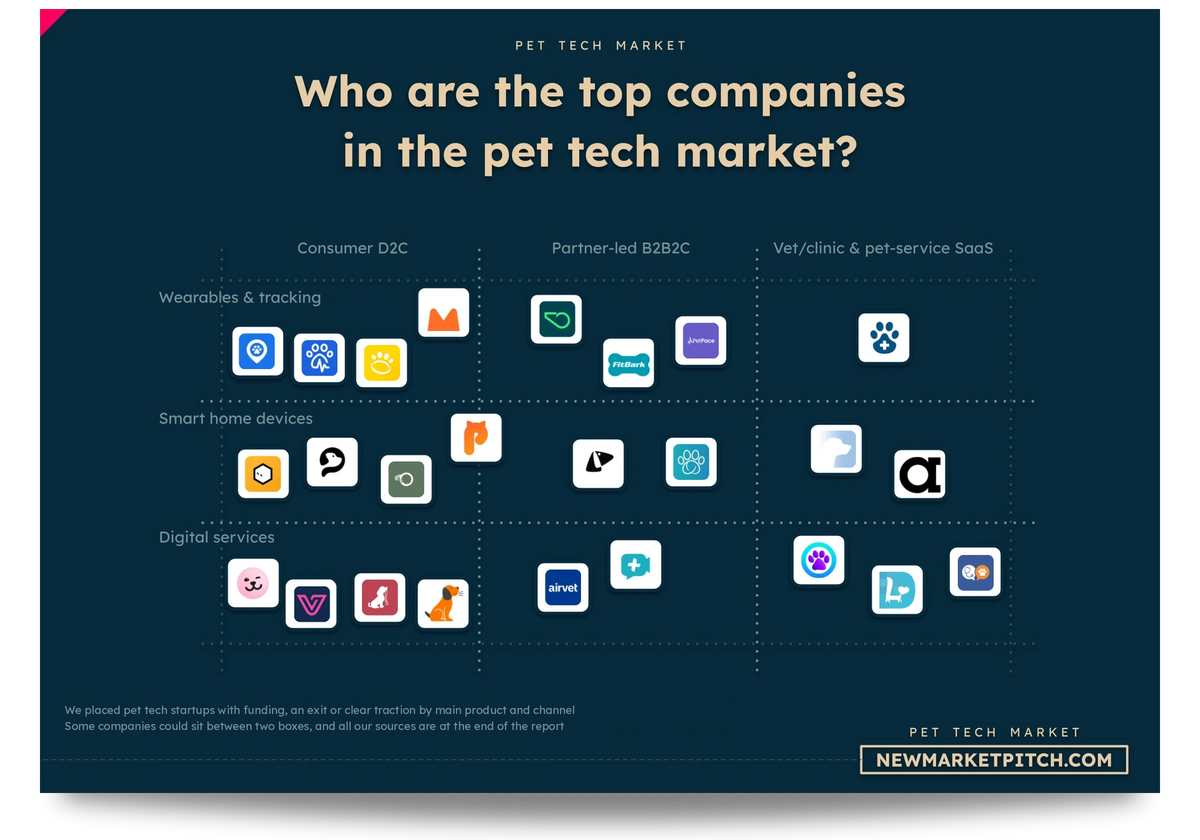
In our research about pet technology, we turn what is vague and complex into simple, useful visuals. Market maps like this one show you at a glance where every startup stands.
Is Pet Tech actually getting serious funding today?
Pet Tech funding is active today, but most startups are still raising small rounds and only a narrow group has reached $20M-scale financing.
We tracked 45 qualifying financings across 39 companies from March 7, 2024 through September 21, 2026. Thirty-eight rounds disclose a usable amount, adding up to $222.24M. Seven others do not disclose an exact figure, so the real total is higher.
The typical round is much smaller than $222M divided across a few dozen deals might suggest. The median disclosed financing is $2M, while the average reaches $5.85M because several $20M–$24M rounds pull it upward.
There is no giant deal doing all the work. We found no disclosed financing above $50M. Pet Tech's upper tier currently consists of companies such as MoeGo, Digitail, FirstVet, Lupa and Koala Health raising around $20M at a time.
For now, that is the market's real funding shape: lots of relatively small bets and a short list of companies that have graduated into much bigger checks.
| Metric | Pet Tech market |
|---|---|
| Qualifying financings | 45 |
| Unique companies | 39 |
| Disclosed financings | 38 |
| Undisclosed financings | 7 |
| Disclosed capital | $222.24M |
| Median disclosed round | $2.00M |
| Average disclosed round | $5.85M |
| Largest disclosed round | $24.00M |
| Rounds above $50M | 0 |
How many Pet Tech startups are actually getting funded?
The funded Pet Tech market currently comes down to 39 companies, and 34 of them appear only once in our dataset.
Four companies raised twice during the period. SATELLAI is the only one that appears three times. Overall, just five of the 39 companies raised more than once, a repeat-fundraising rate of 12.8%.
Those repeat companies still attracted $63.18M, or 28.4% of disclosed capital. But most of the money actually went to companies that appear only once: $159.06M, or 71.6%.
That says something useful about the market's current depth. Pet Tech has enough new companies and one-off financings to produce a steady stream of announcements, but very few businesses are coming back again and again for increasingly large rounds.
Is Pet Tech funding concentrated in just a few companies?
Yes. A relatively small group of Pet Tech companies holds most of the money raised during the period.
The five largest individual financings account for 49.3% of disclosed capital. The ten largest account for 76.3%. Looking at companies rather than individual deals gives a similar result: the ten best-funded companies hold 79% of disclosed capital.
MoeGo leads with $24.5M across two financings, followed by Lupa at $24M, Digitail at $23M, FirstVet at $21.46M, Vetr at $21M and Koala Health at $20M. A handful of companies holding most of the money is a concentration risk we rate by likelihood in our market report about pet tech.
The striking part is how little money is needed to enter Pet Tech's top tier. A company does not need a $100M round. Six financings between $20M and $50M already account for 58.3% of all disclosed dollars.
Meanwhile, roughly three-quarters of the companies have no more than $5M of disclosed cumulative capital during our window. There is a very large gap between an ordinary funded Pet Tech startup and the handful of businesses at the top.
| Company | Rounds in period | Disclosed capital |
|---|---|---|
| MoeGo | 2 | $24.50M |
| Lupa | 2 | $24.00M |
| Digitail | 1 | $23.00M |
| FirstVet | 1 | $21.46M |
| Vetr | 1 | $21.00M |
| Koala Health | 1 | $20.00M |
| Goose | 1 | $13.40M |
| Airvet | 1 | $11.00M |
| Traini | 2 | $9.00M |
| Scribenote | 1 | $8.20M |

Your time is limited. In our market report about pet technology, we put numbers on each part of the market, so you can see where it makes sense to focus.
What can a normal Pet Tech startup expect to raise?
For most Pet Tech startups today, a realistic funding round is closer to $1M–$3M than to $5M or $10M.
The median disclosed round is $2M. Twenty-seven of the 45 financings we tracked, or 60%, came in below $5M. Together, those 27 rounds account for only $47.68M.
Another five deals landed between $5M and $20M.
Then there is a sharp jump. Just six financings between $20M and $50M contributed $129.46M, more than half of every disclosed dollar in the market.
That is a much better guide for founders than the $5.85M average round. Early Pet Tech funding usually comes in low single-digit millions. Reaching $20M is a different stage of company development altogether, and very few businesses get there.
| Round size | Deals | Share of deals | Disclosed capital |
|---|---|---|---|
| <$5M | 27 | 60.0% | $47.68M |
| $5M–<$20M | 5 | 11.1% | $45.10M |
| $20M–<$50M | 6 | 13.3% | $129.46M |
| $50M–<$100M | 0 | 0% | - |
| $100M+ | 0 | 0% | - |
| Undisclosed | 7 | 15.6% | - |
Which part of Pet Tech is getting the most money?
Pet Care Apps get the most Pet Tech funding by far, while tele-vet companies stand out for attracting much bigger checks per deal.
Pet Care Apps generated 28 of the 45 financings and $141.9M of disclosed capital. That is roughly 62% of deals and 64% of the money.
This category is broad. It includes veterinary operating software, AI documentation tools, pharmacy platforms, pet-health apps and software for grooming, boarding and other pet-care businesses. MoeGo, Digitail, Lupa, Koala Health, Goose and Scribenote all sit somewhere inside that wider software layer.
Tele Vet Platforms generated only four deals but absorbed $55.76M. Their median disclosed round is $16M, compared with $1.64M for Pet Care Apps.
Hardware is much smaller in visible dollars. Pet Health Wearables produced seven financings and at least $32M of disclosed capital. Smart Pet Devices produced eight but only at least $17M in precisely disclosed funding.
So when investors are writing serious Pet Tech checks these days, the money is overwhelmingly flowing toward software and digital veterinary services.
Why are veterinary software startups raising the biggest Pet Tech rounds?
Veterinary software startups are getting bigger checks because some of them have moved from selling a useful app to running core parts of a veterinary or pet-care business.
MoeGo is a good example. Its software handles scheduling, payments, payroll, reporting, customer communication and day-to-day operations for grooming, boarding, daycare and training businesses. Its $24M Series A therefore backed a product sitting directly inside recurring business workflows.
Digitail has gone even deeper into veterinary clinics. Its own Series B announcement says the platform combines scheduling, medical records, invoicing, inventory, client communications and AI tools inside one system. When Digitail raised $23M, the company said it was already supporting around 10,000 veterinarians and three million pet parents.
Lupa raised $20M at Series A to expand its AI-powered veterinary operating system and push into more markets. Koala Health raised $20M at Series B around digital pet pharmacy and chronic medication delivery. Scribenote raised $8.2M for software that automates veterinary documentation.
These companies have different products, but the money is chasing a similar opportunity: recurring workflows where better software can save clinics time, reduce administrative work or improve revenue.
There is a fresh commercial signal behind that thesis too. Digitail said its customer base had more than doubled in the twelve months before its Series B. Lupa said it had grown revenue 50-fold between rounds. Airvet reported more than fourfold year-over-year growth in enterprise annual recurring revenue before raising its B-2.
That helps explain why veterinary software has become the part of Pet Tech where $10M–$25M checks now look believable.

In our document detailing everything you need to know about pet tech, we always try to gather several sources and make estimates that make sense, so you can work with solid numbers.
Why are tele-vet companies raising such large rounds?
Tele-vet companies are raising unusually large Pet Tech rounds because the companies receiving them tend to be much older and already operating at expansion stage.
The four tele-vet financings in our dataset produced $55.76M of disclosed capital. Their median disclosed round is $16M, far above the market-wide $2M median. Tele-vet leaders pulling ahead of the median is easier to follow with the market maps and grids in our pet tech market report.
FirstVet raised €20M in Series C funding led by TELUS Global Ventures. The company said the money would support expansion outside Europe, further product development and new partnerships. That is very different from funding an early prototype.
Airvet raised $11M in a Series B-2 after reporting more than fourfold annual growth in enterprise recurring revenue. Otis sits at the younger end with a roughly $2.3M seed round.
Vetr's $21M financing lifts the category further, although that transaction deserves a caveat: the capital came from Pale Horse Capital, which is controlled by Vetr founder Andrew Hamilton. We would not treat that exactly like an independent institutional round.
Company age helps put the numbers in context. Tele-vet companies have a median age of roughly 7.5 years at financing, versus around two years for Pet Care Apps. Investors are generally putting large sums into tele-vet only after years of operating history.
Are Pet Tech wearables and smart devices really taking off?
Pet Tech wearables and smart devices are getting funded, but neither category has yet produced the kind of institutional scale we see in veterinary software.
Pet Health Wearables generated six financings and $13.76M of precisely disclosed funding. Five of those six were follow-ons, so some investors are coming back for a second or third bet.
Traini's $7.5M round alone contributes more than half of disclosed wearable funding. Maven Pet raised about $4.42M. SATELLAI appears three times in our dataset, although two of its later Chinese rounds were announced without an exact amount.
Smart Pet Devices tell a similar story. Eight deals produced at least $17M in disclosed capital, including roughly $4.12M for Pilton, $3.9M for Yangzhou Xiaoyi and $1M for PettiChat.
We should be careful with that hardware total because three Smart Pet Device rounds do not disclose an exact size. Chinese financings in particular are often reported only as "tens of millions of RMB."
Even allowing for those missing amounts, there is still no disclosed $20M-scale device or wearable financing in our dataset. Nor do we see a classified Series B+ wearable round.
Wearables and connected hardware are clearly attracting experiments and follow-on bets. The jump into large institutional financing has yet to show up.

Our report covering the pet tech market gets updated several times a month, so you always get the latest view of where things stand.
How old are Pet Tech startups when investors fund them?
Pet Tech companies are usually only a few years old when they first show up in the funding market, but the companies receiving bigger later-stage checks are much older.
Across the financings where founding dates are known, the median company age is about 2.5 years.
Seed companies have a median age of roughly two years. Series A companies also sit around two years, although stage labels are messy enough in Pet Tech that we would not read too much into that similarity.
Series B is where the profile changes. Companies raising B rounds have a median age of about 6.5 years. FirstVet, the only Series C company in our period, had been operating for roughly eight years.
The same split appears by business model. Pet Care Apps have a median company age of around two years. Wearables sit around 2.5 years, Smart Pet Devices around four, and Tele Vet Platforms around 7.5.
A startup can get into Pet Tech funding quickly. Getting one of the market's larger checks generally takes much longer.
Where does the Pet Tech funding ladder get difficult?
The hardest jump in Pet Tech funding currently comes after Seed: we found 25 Seed financings but only five Series A rounds.
That is a five-to-one difference.
Once a company reaches Series A, the next step appears less brutal. We found five Series A deals and four Series Bs. Companies that stall between rounds are one reason we study what failed or stalled startups had in common in our report on pet tech.
After B, the ladder almost disappears. Four Series B financings lead to a single Series C. There are no Series D+ rounds and no Growth Equity financings in our period.
These figures are not conversion rates because we are looking at a market snapshot rather than following one cohort over many years. Still, the shape is hard to miss.
Pet Tech has a wide pool of early companies, a much smaller group raising serious institutional capital, and almost no visible funding layer beyond Series B.
| Stage | Deals | Disclosed capital | Median disclosed round |
|---|---|---|---|
| Seed | 25 | $56.19M | $1.44M |
| Series A | 5 | $48.12M | $20.00M |
| Series B | 4 | $57.90M | $15.50M |
| Series C | 1 | $21.46M | $21.46M |
| Series D+ | 0 | - | - |
| Growth Equity | 0 | - | - |
| Unknown | 10 | $38.57M | $3.93M |
Why are there almost no late-stage Pet Tech rounds?
Late-stage Pet Tech funding barely exists in the market we tracked, with just one Series C and nothing above it.
The missing upper end is visible in several ways at once. There are no Series D+ rounds, no Growth Equity deals and no disclosed financings above $50M.
FirstVet is the sole Series C company. Digitail, Koala Health and Airvet sit one rung below at Series B or B-2, with rounds of $23M, $20M and $11M.
As seen above, the market's largest financings cluster around $20M–$24M. Today, that range looks much more like Pet Tech's current scale-up tier than a stepping stone toward regular $50M or $100M growth rounds.
The next few years will show whether companies such as Digitail, Lupa, MoeGo and other fast-growing software platforms can create that missing upper layer. For now, the funding market effectively runs out before conventional late-stage venture begins.

In our research about pet technology, we look at what the winners do differently, so you can learn from the best instead of guessing.
Are investors funding new Pet Tech startups or backing companies they already know?
Most Pet Tech capital currently goes to companies that have raised before, even though new startups continue to enter the market.
We classified 16 of the 45 transactions as first financings. They represent 35.6% of deals but only $41.01M of disclosed capital.
Follow-ons account for the other 29 transactions and $181.22M. That is 81.5% of disclosed funding.
Check sizes explain a lot of the gap. The median first financing is $1.6M. The median follow-on is $3.9M.
This is still a market where new companies can get funded. First financings account for 16 of the 39 businesses we tracked. The larger checks, though, tend to arrive after investors have already seen some evidence that the company can build, sell and survive.
Is North America dominating Pet Tech funding right now?
North America is currently where Pet Tech raises the most visible capital, while Asia-Pacific is much closer in deal count than the dollar totals suggest.
North America produced 19 of the 45 financings and $152.45M of disclosed capital. That gives the region 42.2% of deals but 68.6% of the money. North America holding 68.6% of the money on 42.2% of deals is a signal we track every quarter in our pet tech market report.
Europe contributed nine financings and $54.2M.
Asia-Pacific generated 16 deals, only three fewer than North America, but just $15.27M of precisely disclosed capital.
That last figure needs context. Seven of China's 12 financings do not disclose an exact amount. Several were announced simply as "tens of millions of RMB." We therefore know APAC's visible capital total is understated; we just do not know by exactly how much.
The United States alone contributes $121.25M, or 54.6% of disclosed funding. Canada adds $31.2M. In Europe, the United Kingdom contributes roughly $26.1M and Sweden about $22.5M.
So North America clearly leads in large, observable checks today. Asia is already an important activity center, but its financing data is far less transparent.
Is China becoming a real Pet Tech funding hub?
China already has a meaningful Pet Tech funding pipeline, especially in connected devices, AI and veterinary technology, although its true dollar size is difficult to pin down.
We identified 12 Chinese financings, one of the strongest country-level deal counts in the market. Only five disclose an exact amount.
The range of companies is broad. SATELLAI develops AI-connected pet collars and health monitoring. Yangzhou Xiaoyi makes connected litter boxes, feeders and water fountains. MOVA AI Pets is developing AI-linked pet devices. Vetoo combines veterinary imaging equipment with AI diagnostic software. Xiaowen Intelligent Healthcare is building veterinary decision-support and digital-health tools.
The funding disclosures are much less precise than they are in the US. "Tens of millions of RMB" appears repeatedly, particularly around Pre-A and other locally labelled rounds.
That makes China's disclosed $12.08M total a poor measure of the country's actual Pet Tech investment. Deal count is much more informative here.
As of now, China looks like an active early-stage Pet Tech market with a strong hardware and AI component. What we still cannot see clearly is how much capital is really being deployed.

Theory only gets you so far. In our market report about pet technology, we dig up the real signals from the field and show you the ones worth watching.
Which investors keep coming back to Pet Tech?
There is no dominant Pet Tech lead investor today: 31 deals disclose a lead, yet no exact lead investor appears twice.
That degree of fragmentation is unusual.
Base10 backed MoeGo. Five Elms Capital led Digitail. Singular led Lupa. B Capital backed Goose. HighlandX led Airvet's B-2. Valspring Capital led Koala Health. Andreessen Horowitz led Scribenote.
The names are credible and in several cases very large venture firms, but they are choosing individual Pet Tech companies rather than repeatedly underwriting the category.
Digitalis is the closest recurring ecosystem we found. Digitalis Ventures participated around MoeGo through its animal-health investment activities, the Digitalis Mars Companion Fund appeared in VetVerifi's financing, and Digitalis Ventures later led Travv.
Even then, there is no obvious fund that keeps turning up as lead across the whole market.
This fragmented investor base helps explain why Pet Tech can produce well-funded individual winners without yet looking like a fully formed specialist venture category.
Are big pet companies and strategic investors putting money into Pet Tech?
Strategic investors play a surprisingly small role in Pet Tech funding today, at least in publicly disclosed transactions.
Only two of the 45 financings in our dataset explicitly include a strategic investor, equal to 4.4% of deals. With so few strategic investors, who backs pet tech and what they now avoid is covered in our market report about pet tech.
MoeGo's financing included Digitalis Ventures, whose animal-health Companion Funds invest in partnership with Mars Petcare. VetVerifi's pre-seed financing included Bitwerx and the Digitalis Mars Companion Fund, both closely connected to veterinary data or the broader pet-care industry.
There are gray areas. FirstVet's €20M Series C was led by TELUS Global Ventures, which TELUS describes as its strategic investment arm. Depending on how narrowly we define "strategic investor," that could reasonably be viewed as corporate strategic capital too.
Either way, the broader pattern stays the same. We do not see Mars, Nestlé Purina, Zoetis, IDEXX, major veterinary groups or other industry incumbents repeatedly financing companies across the dataset.
Financial venture capital is doing most of the work.
Does Pet Tech funding happen steadily through the year?
Pet Tech funding is pretty lumpy: a normal month brings roughly one deal, while one or two larger rounds can suddenly make the market look much busier.
Across the 32 completed months we analyzed before the current partial month, the average was 1.34 financings per month and the median was one.
No completed month produced more than three financings. December 2024 and February 2025 both reached that level.
Dollar volume swings much more sharply. Average disclosed monthly capital was about $6.9M, while the median was only $2.07M.
May 2025 is the clearest example. Only two deals occurred, but they happened to be Vetr's $21M financing and Koala Health's $20M Series B. That was enough to make it the biggest capital month at $41M.
For anyone following Pet Tech from funding headlines, this is worth remembering. A couple of large announcements can make one month look dramatically hotter even when the underlying deal pace has barely changed.

In our document detailing everything you need to know about pet tech, we don't want to repeat what boring consulting reports say. Instead, we show you the real and latest market signals that matter.
What should we actually take away from Pet Tech funding?
Pet Tech is currently a real venture market, but a small one. The 45 financings we tracked represent only 39 companies, and the normal round is around $2M rather than anything close to the $20M deals that attract headlines.
The serious money is concentrated in a short list of businesses. Six $20M–$50M rounds account for 58.3% of disclosed capital, while most funded companies remain below $5M.
Veterinary and pet-business software has become the clearest place where investors are willing to write larger checks. MoeGo, Digitail, Lupa, Koala Health, Scribenote and other software companies are increasingly selling into recurring workflows rather than relying on one-off consumer gadget sales. Tele-vet also commands large checks, but mainly among older companies.
Hardware and wearables are active without yet showing the same scale. They generate plenty of deals, particularly in China, but there is still no visible $20M+ hardware financing or mature wearable funding ladder in our period.
The biggest weakness sits higher up the financing ladder. Twenty-five Seed deals shrink to five Series As, four Series Bs, one Series C and nothing beyond it. As of now, Pet Tech has a genuine early-stage ecosystem and a small scale-up layer, but hardly any late-stage venture market.
Geography adds another wrinkle. North America clearly dominates observable dollars, while China has a much stronger deal pipeline than its disclosed funding total suggests. The large number of Chinese rounds with vague amounts makes any clean US-versus-China capital comparison misleading.
Finally, the investor base is still fragmented. We found no lead investor repeatedly leading deals across the period, while explicit strategic investment remains rare. The market is producing individual winners before it has produced a tightly connected funding ecosystem around them.
Our methodology
This analysis builds a quantitative snapshot of private-company Pet Tech fundraising from January 1, 2024 through September 21, 2026. We tracked 45 qualifying financings across 39 companies, with the first qualifying deal in the final dataset occurring on March 7, 2024.
We used a strict Pet Tech definition. The relevant technology or digitally enabled pet-care activity had to represent the company's overwhelming core business at the time of financing. Companies where Pet Tech was only a peripheral product line were excluded.
Only qualifying private-company equity financings above our minimum size threshold were included. Debt, loans, grants, public offerings and transactions where an equity component could not be isolated were excluded. When a source disclosed only vague language such as "tens of millions of RMB," we kept the amount undisclosed rather than inventing a precise figure.
Each financing was counted separately. Duplicate coverage of the same transaction was consolidated, while extensions, additional closes and unusual tranches were reviewed individually. Stage, investors, financing history, company age and lead attribution were recorded only when public evidence was strong enough to support them.
Where public sources disagreed, we kept the uncertainty visible and used the more defensible figure. Currency conversions were checked for locally denominated rounds, and apparently large local-currency transactions were reviewed against better primary or audited evidence when available.
After compiling the dataset, we ran a separate quality-control pass for missed transactions, duplicates, date-boundary issues, non-equity financings, borderline market eligibility and inconsistent classifications. Seven of the 45 qualifying rounds still do not disclose a precise amount, so the $222.24M total should be read as disclosed capital rather than the exact amount invested across the entire market.
Key sources used in the analysis include Digitail's Series B announcement, Lupa's Series A announcement, FirstVet and TELUS Global Ventures on FirstVet's €20M Series C, Airvet's Series B-2 announcement, Scribenote's $8.2M Seed announcement, MoeGo's $24M Series A announcement, Koala Health's Series B announcement, VetVerifi's pre-seed announcement, VetVerifi's later $2.8M Seed financing, Travv's Seed announcement, 36Kr on SATELLAI, ChinaVenture on Yangzhou Xiaoyi, GeekPark on MOVA AI Pets, 36Kr on Shenzhen Vetoo Medical Technology, the Vetr financing announcement, Wonderdog's financing announcement, and Petwealth's financing announcement.

Learning from others' mistakes is the cheapest lesson there is. In our report covering the pet tech market, we look at what broke startups before you, so you don't repeat it.
Written by the New Market Pitch teamWe track new markets so founders and investors can move faster. About us