Pet Tech: what are the biggest unsolved problems?
Whether you're building or investing in the pet tech market, our report covers everything you need to know: the players, the money, and what's coming next.
Summary
The biggest unsolved problems in Pet Tech are expensive veterinary care, low insurance coverage, disconnected medical records, unproven disease-detection technology, and preventive healthcare that too often fails to improve outcomes. Veterinary affordability is the most urgent problem, while better integration between clinics, insurers, and health technologies may offer the clearest software opportunity.
Americans spent $158 billion on pets in 2025, yet 52% of surveyed dog and cat owners had skipped or declined needed veterinary care. The industry's enormous consumer spending has not translated into affordable treatment for millions of animals.
The affordability problem is also partly about communication. While 81% of veterinarians say they frequently offer alternative treatment plans when finances are a problem, 73% of financially constrained owners say they were not offered a cheaper option. Making treatment choices and prices clearer could help even before medical costs fall.
Insurance hasn't closed the gap. Only 4.27% of American pets were insured in 2025, and North American premium revenue grew 19.4% while the insured population increased just 8.5%. The business is growing financially much faster than its reach among pet owners.
Digital access has physical limits. Telemedicine can improve triage and follow-up, but it cannot perform surgery, replace diagnostic equipment, or create emergency hospital capacity where none exists. Better coordination may be more valuable than trying to move every veterinary interaction online.
Medical records are a surprisingly basic weakness. Clinics have adopted digital practice software, yet a pet's history can remain scattered across several incompatible systems. Connecting records, diagnostic results, treatment plans, and payments could remove more friction than adding another standalone application.
Health trackers and veterinary AI have substantial potential, but clinical validation is lagging behind product development. Detecting an unusual heart rate or identifying an abnormal X-ray is useful; demonstrating that these systems consistently improve diagnosis or treatment outcomes is a much higher bar.
Preventive care has its own execution problem. In a 2025 owner survey, only 28% of dogs and 19% of cats whose owners attempted weight loss reportedly reached their target. Better feeding measurements and veterinary-guided follow-up may deliver more value than increasingly sophisticated devices alone.
Cats are particularly underserved. Their U.S. insurance penetration was only 2.29%, compared with 5.99% for dogs, and just 6% of stray cats entering shelters were returned to owners, versus 34% of dogs. Cat-specific health monitoring, identification, and preventive services address genuine gaps.
Animal welfare and product durability reveal two other weaknesses. U.S. shelters accumulated a net 213,000 additional animals in the first half of 2026, while the Whistle-to-Tractive transition showed how connected hardware can lose its usefulness when proprietary software is discontinued.
The strongest startup opportunities are likely to come from solving recurring healthcare problems: reducing the cost of care, connecting veterinary information, improving clinic workflows, and turning monitoring data into effective treatment. Pet owners already buy plenty of technology. What they need is technology that makes caring for an animal easier, more affordable, and measurably better.

Written by the New Market Pitch teamWe track new markets so founders and investors can move faster. About us
Why are so many pet health problems still unsolved despite a $158 billion industry?
Pet Tech is growing, but the industry still struggles with its most important job: helping owners keep their animals healthy without spending more than they can afford.
According to the American Pet Products Association (APPA), Americans spent $158 billion on pets in 2025, up 3.7% from the previous year. Spending is projected to reach $165 billion in 2026, and approximately 95 million U.S. households own at least one pet.
Yet a PetSmart Charities-Gallup study published in April 2025 found that 52% of American dog and cat owners had skipped or declined needed veterinary care during the preceding year. Across all respondents, 37% had visited a veterinarian but turned down recommended services, while 15% had avoided a visit because of financial or other barriers.
The contrast is striking. Pet owners are spending record amounts on food, healthcare, insurance, grooming, and connected devices, while millions still struggle to pay for essential treatment.
The industry's main unresolved problems fall into three areas: veterinary care that remains too expensive or difficult to access, medical technology that has yet to prove its full clinical value, and disconnected services that make even routine care unnecessarily complicated.
These problems have very different solutions. Some require better software. Others depend on insurance economics, veterinary staffing, or clinical research. That helps explain why Pet Tech has attracted so many companies without closing some of its largest gaps.
Is expensive veterinary care the biggest problem in Pet Tech?
Veterinary affordability is currently the biggest unsolved problem in Pet Tech, and the evidence is unusually clear: millions of owners are unable to follow medical recommendations because of cost.
The PetSmart Charities-Gallup State of Pet Care study surveyed 2,498 American dog and cat owners. Among respondents who had gone without needed care, 71% cited financial considerations.
The findings were reinforced by a second Gallup study, published in January 2026, involving 933 practicing U.S. veterinarians. An overwhelming 94% said clients' finances sometimes or often prevented them from providing recommended treatment.
What's particularly interesting is the gap between veterinarians' intentions and owners' experiences. Gallup found that 81% of veterinarians often or always recommended alternative treatment plans when finances were an issue, but 73% of owners who faced financial barriers said they had not been offered a cheaper option.
Even when alternative treatments exist, owners may leave a consultation without understanding their options. That is a problem software could actually help fix.
Companies offering veterinary financing, such as CareCredit and Scratchpay, help some owners spread costs over time. However, financing cannot always help customers who lack sufficient income or creditworthiness, and borrowing still increases the eventual amount owed when interest or fees apply.
There's a potentially valuable role for software that automatically presents clinically appropriate treatment options, estimates their costs, and identifies insurance or assistance programs before an owner declines care.
Still, technology can only solve part of the affordability crisis. Diagnostic equipment, skilled staff, medicines, and operating facilities remain expensive. The bigger opportunity is to make those resources more accessible while removing avoidable costs from the process.
If you want more recent data on this point, please see our latest Pet Tech market report.

A good product starts with a real problem. In our report covering the pet tech market, we show you the ones customers still live with.
Why hasn't pet insurance made veterinary care affordable?
Pet insurance has grown into a multibillion-dollar industry, but its biggest weakness remains unchanged: very few American animals are actually covered.
The North American Pet Health Insurance Association (NAPHIA) reported that 7.6 million pets were insured across the United States and Canada at the end of 2025, compared with 7.03 million a year earlier.
That represents 8.5% growth in insured animals. Meanwhile, gross written premiums rose 19.4% to approximately $6.2 billion.
Premium revenue therefore grew about 2.3 times as fast as the insured pet population.
These figures do not establish how much the price of an individual policy increased, because coverage mixes and other factors also affect premiums. But the insurance industry is clearly collecting revenue much faster than it is adding insured animals.
According to NAPHIA's latest figures, only 4.27% of American pets had insurance in 2025. Dogs had a coverage rate of 5.99%, compared with 2.29% for cats.
The limited reach of insurance is partly explained by its design. Many policies reimburse eligible expenses after the owner pays the veterinarian. Deductibles, exclusions, waiting periods, and annual limits also affect how much the insurer ultimately covers.
Even insured owners can therefore face difficult decisions when treatment costs thousands of dollars upfront.
Companies such as Trupanion, Fetch, and Lemonade have expanded the available options, but broader coverage depends on keeping policies understandable and affordable as veterinary costs rise.
| U.S. pet insurance indicator | 2024 | 2025 |
|---|---|---|
| Overall insurance penetration | 3.92% | 4.27% |
| Dog insurance penetration | 5.46% | 5.99% |
| Cat insurance penetration | 2.04% | 2.29% |
| Pets without insurance | 96.08% | 95.73% |
| North American insured pets | 7.03M | 7.60M |
| North American premiums written | ~$5.19B | $6.20B |
| Annual insured-pet growth | - | 8.5% |
| Annual premium growth | - | 19.4% |
Can online veterinarians actually replace clinic visits?
Online veterinary consultations can handle some follow-ups and initial assessments, but remote veterinary care still cannot replace the physical examinations and diagnostic procedures needed for many conditions.
Companies such as Vetster, Dutch, and Airvet have made it easier for owners to speak with veterinary professionals without traveling to a clinic.
This can be particularly useful when a pet has a minor concern, an owner needs guidance about an existing treatment, or a veterinarian must decide how urgently an animal needs physical care.
However, veterinary telemedicine in the United States faces legal restrictions involving the veterinarian-client-patient relationship, commonly called the VCPR.
Under the FDA's federal definition, which applies to certain prescribing activities, a VCPR must be established through an in-person examination or a medically appropriate visit to the premises where the animal is kept. State regulations can impose additional requirements or allow different types of remote care.
There are also obvious medical limitations. Video consultations cannot perform blood tests, obtain X-rays, palpate an abdomen, or reliably determine the cause of many internal problems.
The strongest opportunity is in coordinating care. Better remote triage could prevent unnecessary visits, direct emergency cases to appropriate facilities, and make follow-up appointments easier for both veterinarians and owners.
But claims that telemedicine can dramatically reduce veterinary costs still need stronger evidence. The savings depend on how many physical visits are genuinely avoided without delaying necessary treatment.

If you build or invest in the pet tech market, you need to know which business models pay off now and which ones are fading. That's why our report covering it has a whole section on it.
Why can't veterinarians easily access a pet's medical history?
Veterinary medical records remain fragmented across clinics, emergency hospitals, laboratories, and specialists, even though most of the industry has already moved toward digital software.
Companies such as IDEXX, ezyVet, Provet, and Digitail provide systems for managing veterinary appointments, medical records, laboratory results, and practice administration.
These platforms have helped individual clinics organize their work. Sharing information between different providers is much less straightforward.
Consider a dog that visits a regular veterinarian, receives emergency treatment at another hospital, and later sees a specialist. Its vaccination history, medications, blood tests, and diagnostic images may be stored in three separate systems.
The receiving veterinarian can request records, but the information may arrive as PDFs, emails, or documents requiring manual review.
The problem becomes more serious when owners move, travel internationally, or need urgent treatment outside their usual clinic.
Human healthcare has spent years developing standards and systems for exchanging medical information. Companion-animal medicine still lacks a similarly widespread, standardized infrastructure connecting veterinary providers.
Medical-record interoperability is one of Pet Tech's clearest software opportunities. A properly designed system could reduce repeated administrative work, make referrals easier, and help veterinarians understand an animal's history before treatment.
The hard part will be convincing competing software vendors and veterinary practices to cooperate while protecting sensitive client information. A universal pet medical record needs broad adoption to become genuinely useful. Without that, it's just another database.
If you want more recent data on this point, please see our latest Pet Tech market report.
Can pet health trackers detect diseases before owners notice symptoms?
Pet health trackers can identify changes in an animal's activity and behavior, but there is still insufficient independent clinical evidence to treat most consumer wearables as reliable early-disease detection systems.
Tractive, Fi, and PetPace have developed devices that monitor different combinations of location, activity, sleep, and physiological measurements.
Their potential advantage is continuous observation. A veterinarian might examine an animal once or twice a year, while a wearable can collect measurements every day.
Tractive, for example, offers GPS tracking alongside activity and health-related features such as resting heart rate and respiratory rate monitoring.
That information could be useful when an animal gradually becomes less active, sleeps differently, or develops unusual physiological patterns.
But a dog walking less frequently could be suffering from joint pain, recovering from exercise, experiencing a change in routine, or simply responding to hot weather. A sensor may detect the change without knowing what caused it.
Medical usefulness depends on sensitivity, specificity, and the consequences of incorrect alerts. A device that frequently produces false alarms can generate unnecessary consultations, while one that misses important changes provides false reassurance.
The industry needs prospective studies demonstrating how accurately devices identify specific health problems across breeds, ages, and living environments.
Until then, consumer health trackers are best understood as monitoring and awareness tools. Their potential is real, but claims about preventing disease or extending pets' lives require much stronger evidence.

Learning from others' mistakes is the cheapest lesson there is. In our market report about pet technology, we look at what broke startups before you, so you don't repeat it.
Is veterinary AI good enough to diagnose animals today?
Veterinary AI is already useful for assisting clinical work, particularly medical-image analysis, but autonomous diagnosis remains too risky without reliable validation and veterinary oversight.
Companies such as SignalPET and Vetology have developed AI-assisted veterinary imaging services. Zoetis has also expanded diagnostic technologies and digital workflows for veterinary practices.
Radiology is a natural starting point because machine-learning systems can identify patterns in X-rays and other medical images.
However, veterinary images are unusually diverse. Algorithms must handle animals of different species, breeds, sizes, ages, and body shapes, alongside variations in imaging equipment and disease prevalence.
In a 2025 joint position statement, the American College of Veterinary Radiology and the European College of Veterinary Diagnostic Imaging emphasized the need for transparent development, clinical oversight, independent evaluation, and ongoing performance monitoring.
These requirements address a real risk: an AI model can perform well on a carefully selected dataset while making more mistakes when deployed across ordinary veterinary hospitals.
There is also a major difference between recognizing a visible abnormality and determining the correct diagnosis. Veterinarians must combine imaging with symptoms, examination findings, laboratory results, and medical history.
For now, the strongest applications involve helping clinicians review images, prioritize suspicious cases, prepare reports, and reduce repetitive work.
The breakthrough worth watching will be evidence from real clinical settings showing that veterinary AI improves diagnostic accuracy or patient outcomes, rather than simply completing an image interpretation faster.
Why are so many pets still overweight despite smart feeders and health apps?
Pet obesity remains a major unsolved problem because owners often recognize excess weight but struggle to manage portions, maintain routines, and achieve lasting results.
The Association for Pet Obesity Prevention's 2025 opinion survey found that 37% of dog owners and 43% of cat owners described their animals as above ideal weight.
The comparison with 2024 is revealing. The proportion rose from 35% to 37% for dogs and from 33% to 43% for cats.
These figures come from self-reported surveys rather than veterinary examinations, so they should not be interpreted as precise changes in clinical obesity prevalence. Nevertheless, they suggest growing concern, particularly among cat owners.
An even more useful finding comes from attempts to manage weight. In the same survey, 56% of dog owners and 53% of cat owners reported trying to help their pets lose weight. Among those attempting weight loss, only 28% of dogs and 19% of cats were reported to have reached a healthy target.
Feeding habits reveal a practical weakness. Just 16% of surveyed dog owners and 3% of cat owners weighed their pets' food. Many relied on measuring cups, estimates, or free-feeding.
Connected feeders from companies such as PETKIT and Sure Petcare can help control feeding schedules and portions, but the devices cannot independently determine the correct diet for every animal.
Treats, household routines, exercise, medical conditions, and food quality all influence results.
There is also a price problem. The same survey found that 40% of owners had changed aspects of pet care because of costs, including switching food brands or reducing veterinary visits.
A smart feeder costing hundreds of dollars will be difficult to justify if a relatively inexpensive feeding plan could deliver similar results.
Pet Tech has an opportunity to make weight management easier through affordable monitoring, accurate food measurements, and veterinary-guided plans. But companies need to show that their products produce better results than conventional care. For now, that case is far from settled.
If you want more recent data on this point, please see our latest Pet Tech market report.

When you build or invest in the pet tech market, you need clarity, not confusion. In our document detailing everything you need to know about pet tech, we always try to put numbers on and quantify whatever is usually vague and confusing.
Why is Pet Tech still so focused on dogs when cats are everywhere?
Cats remain underserved by several parts of Pet Tech, particularly insurance and health monitoring, despite representing one of the largest companion-animal markets.
According to APPA, approximately 53 million American households owned cats in 2025.
Yet NAPHIA's insurance figures show that only 2.29% of American cats were covered, compared with 5.99% of dogs.
That means dogs were about 2.6 times as likely to be insured.
Health monitoring also presents different challenges. Dogs typically have more structured outdoor activities, making walking distance, activity changes, and GPS tracking relatively straightforward to measure.
Cats spend more time indoors, often hide signs of illness, and may show subtle changes in feeding, grooming, movement, or litter-box behavior.
Products such as Litter-Robot, Petivity Smart Litterbox Monitor, and SureFeed address some of these needs through automated litter management, weight monitoring, and controlled feeding.
But cat-specific technology still faces difficult diagnostic questions. More frequent litter-box visits might indicate a medical problem, while changes in food consumption or activity may have several explanations.
The latest animal shelter data also highlight the difference between species. Shelter Animals Count reported that 674,000 kittens entered U.S. shelters and rescues during the first half of 2026, while overall cat intake increased by 3.5% compared with the same period in 2025.
Cat-related problems extend well beyond consumer devices, and the opportunity is broad: better preventive care, affordable monitoring, improved insurance products, and technologies that help owners notice potentially serious changes earlier.
Why isn't veterinary software saving clinics more time?
Veterinary practice software can automate appointments, billing, and documentation, but many clinics still depend on time-consuming manual work because medical care involves far more than entering information.
Platforms such as IDEXX Neo, ezyVet, Provet, and Digitail cover major parts of practice management. AI-powered tools are also increasingly available for recording consultations, generating notes, and handling client communication.
These applications can remove repetitive tasks. However, their actual value depends on how well they fit into an existing clinic.
A veterinarian using an AI note-taking service still needs to review its accuracy. A system that automates client reminders may reduce reception work but does little to speed up surgery or laboratory testing.
Another issue is software fragmentation. Clinics can use different providers for appointments, payments, inventory, diagnostics, insurance claims, and client messaging.
Integrating these tools can involve extra costs, data migration, staff training, and ongoing maintenance.
The market needs better evidence of practical productivity improvements. Saving a few minutes on documentation is useful, but reducing administrative errors, improving appointment availability, and increasing the number of patients a clinic can safely treat would be more convincing.
The strongest opportunity is in software that automates entire connected workflows rather than isolated tasks. A single system coordinating patient records, diagnostic results, treatment plans, and payments could remove much more manual work than another standalone AI assistant.

In our report covering the pet tech market, we look at what the winners do differently, so you can learn from the best instead of guessing.
Why is it still difficult to find emergency veterinary care?
Emergency veterinary care remains difficult to access in some locations because online booking and telehealth cannot compensate for missing clinical staff, hospital facilities, or specialist equipment.
An ordinary veterinary practice may provide vaccinations, preventive examinations, and routine procedures without offering overnight hospitalization, intensive care, or emergency surgery.
That distinction becomes critical when an animal needs immediate treatment.
Veterinary telehealth providers can help owners identify urgent symptoms and find appropriate facilities, but a remote consultation cannot stabilize a critically ill animal.
Availability also varies widely by geography and specialty. The evidence does not support treating every part of the veterinary industry as if it faced the same nationwide staffing shortage.
For Pet Tech startups, the more realistic opportunity is better coordination between veterinary practices, emergency hospitals, and specialists.
A platform showing verified emergency capacity, available services, and appropriate referral options could reduce unnecessary calls and delays.
Remote specialist support and better scheduling may also help clinics use existing resources more efficiently.
However, we still need stronger evidence showing how much digital coordination can improve treatment times, reduce unnecessary emergency visits, or expand access in underserved areas.
Why do connected pet devices still lose customers when companies change platforms?
Smart pet devices depend heavily on subscriptions and proprietary software, making customers vulnerable when manufacturers discontinue products or combine platforms.
A clear example appeared in July 2025, when Tractive acquired Whistle from Mars Petcare.
Tractive reported more than 1.4 million active users worldwide at the time, making the acquisition a meaningful consolidation of two established pet-tracking businesses.
Whistle customers were offered replacement Tractive devices as the company moved customers away from the original Whistle platform. Existing Whistle hardware depended on an ecosystem whose continued operation was no longer assured.
The company explained that maintaining two separate hardware and software ecosystems would increase complexity.
Here's the uncomfortable part for consumers: a physically functional device can become useless because its manufacturer no longer wants to maintain the service behind it.
There is also a distinction between hardware sales and recurring value. A GPS tracker offers an obvious ongoing service because the owner can locate a missing animal. A smart feeder or health monitor may struggle to justify a subscription unless its information remains useful.
Companies such as Tractive, Fi, PETKIT, and Litter-Robot also operate across very different product categories and replacement cycles. Their economics should not be lumped together.
The industry needs more durable products, transparent subscriptions, dependable software support, and easier ways to transfer information when customers change devices. Owners shouldn't have to replace working hardware just because two companies merge.
If you want more recent data on this point, please see our latest Pet Tech market report.

Your time is limited. In our research about pet technology, we put numbers on each part of the market, so you can see where it makes sense to focus.
Why are so many lost cats never reunited with their owners?
Lost cats are far less likely than dogs to be reunited with their owners through shelters, and current identification technologies have not closed that gap.
Shelter Animals Count's 2025 annual report found that 638,000 dogs and cats were returned to their owners, a 3% decline from 2024.
The difference between species was substantial. Among stray animals entering shelters, 34% of dogs were returned to owners, compared with just 6% of cats.
That makes stray dogs approximately 5.7 times as likely to be reunited with their owners through this process.
The statistics describe shelter outcomes rather than the recovery rate of every missing pet, since many animals return home without entering shelters. Even so, the gap is too large to ignore.
GPS collars and microchips solve different parts of the problem. GPS devices can help locate an animal while they have power and connectivity. Microchips provide permanent identification when an animal is scanned, assuming registration information is correct.
Neither guarantees recovery. Cats may lose collars, move through areas with poor signal coverage, or enter shelters without an up-to-date identification record.
Better coordination between shelters, veterinarians, microchip databases, and local communities could improve reunification rates.
The more important measure for lost-pet technology is successful recovery, particularly for cats, rather than GPS accuracy or the number of trackers sold.
Can Pet Tech actually solve overcrowding in animal shelters?
Pet Tech can improve animal identification, adoption matching, and shelter coordination, but the latest figures show that overcrowding remains a serious problem even when adoption activity improves.
Shelter Animals Count estimated that 5.8 million dogs and cats entered American shelters and rescues in 2025, while 4.2 million were adopted.
Approximately 597,000 animals were euthanized during the year. That was lower than the previous year, but still a significant animal-welfare problem.
The latest mid-year figures reveal a more complicated trend.
In the first half of 2026, shelters and rescues recorded 3.68 million total intakes, including transfers, up 2% from the same period in 2025. Cat intake accounted for most of the increase.
During those six months, 2.07 million animals were adopted, up 1.3% year over year. However, 213,000 more animals entered care than left, creating a larger-than-usual buildup in shelter populations.
Adoption numbers can improve while shelters continue to become more crowded.
Longer-term figures also show uneven progress. Cat adoptions in the first half of 2026 were 13.2% higher than in the same period in 2016, while dog adoptions were still 6.3% lower.
Platforms such as Petfinder and Adopt a Pet help connect animals with prospective owners. Shelter software can improve medical records, transfers, and placement management.
But adoption marketplaces cannot create suitable households or remove housing restrictions that prevent people from keeping animals.
Technology may help most by improving foster coordination, reducing avoidable delays, identifying animals at risk of long stays, and supporting transfers between organizations.
These systems should be judged by completed adoptions, successful reunifications, shorter stays, and fewer animals entering shelters unnecessarily.

In our market report about pet technology, we always try to gather several sources and make estimates that make sense, so you can work with solid numbers.
Which Pet Tech problems offer the biggest opportunities for startups?
Veterinary affordability, medical-record sharing, preventive healthcare, and clinic automation currently offer some of the strongest opportunities for Pet Tech startups, although they differ substantially in market potential and technical difficulty.
The evidence points to an important trade-off. Veterinary affordability affects an enormous number of households, but reducing the actual cost of medical treatment requires changes beyond software.
Medical-record interoperability appears more technically achievable, although adoption depends on cooperation between competing providers.
Preventive monitoring offers opportunities for consumer products, but companies must demonstrate that their technology produces measurable health improvements rather than simply collecting more information.
Veterinary AI can become an important clinical tool, particularly in diagnostics, but validation requirements and professional oversight will remain central.
To compare these opportunities, we ranked them using the scale of the unmet problem, the potential benefit to customers, and how much of the problem a technology company can realistically address. These are qualitative assessments based on the available evidence, rather than calculated investment returns.
| Pet Tech problem | Evidence of unmet need | Startup opportunity | Main difficulty |
|---|---|---|---|
| Veterinary affordability | 52% skipped or declined needed care | Treatment pricing, payment options, financing | Actual medical costs |
| Pet insurance | Only 4.27% of U.S. pets insured | Affordable coverage and direct payments | Premium pricing and risk |
| Medical records | Different clinics use disconnected systems | Portable veterinary medical records | Integrations and adoption |
| Preventive healthcare | Low reported weight-loss success | Monitoring linked to treatment plans | Behavior change |
| Veterinary AI | Specialists require stronger clinical validation | Diagnostic decision support | Accuracy and safety |
| Clinic administration | Many separate clinical workflows | Integrated automation | Legacy software and training |
| Cat healthcare | Cats have only 2.29% insurance penetration | Cat-specific monitoring and care | Clinical validation |
| Emergency access | Uneven physical and specialist capacity | Digital triage and referrals | Staff and hospital availability |
| Animal shelters | 213,000 net additional animals in care in H1 2026 | Adoption, foster and transfer coordination | Adoption demand and shelter capacity |
Pet Tech: what are the biggest unsolved problems today?
The biggest unsolved problems in Pet Tech are veterinary affordability, limited insurance coverage, fragmented medical records, unreliable early-disease detection, and the difficulty of making preventive care genuinely effective.
Veterinary affordability comes first. It affects the largest group of owners in our research, directly influences medical decisions, and remains a problem even for some higher-income households.
Insurance is closely connected, but coverage growth has been much slower than premium growth, and the vast majority of American pets remain uninsured.
The biggest technological gap is the lack of a connected veterinary healthcare system. Pet trackers collect data, veterinary clinics maintain medical records, diagnostic providers analyze samples, and insurers handle payments, often through separate platforms.
Even advanced monitoring technology has limited value when owners cannot afford the resulting treatment or veterinarians cannot easily access the animal's medical history.
Preventive healthcare is another major opportunity. The obesity data show that many owners are actively trying to improve their pets' health without achieving the results they want. Better measurement, nutrition guidance, and follow-up could make a difference, although the industry still needs stronger clinical evidence.
Other problems, such as shelter overcrowding and emergency veterinary access, will require a combination of technology and changes to physical services, financing, and capacity.
Our overall judgment is that the next major Pet Tech winners are more likely to emerge from solving expensive, recurring healthcare problems than from adding another convenience feature to connected pet devices.
The pet industry already has enormous consumer demand. What's missing is an affordable and dependable way to turn that spending, technology, and medical information into consistently better care for animals.
If you want more recent data on this point, please see our latest Pet Tech market report.

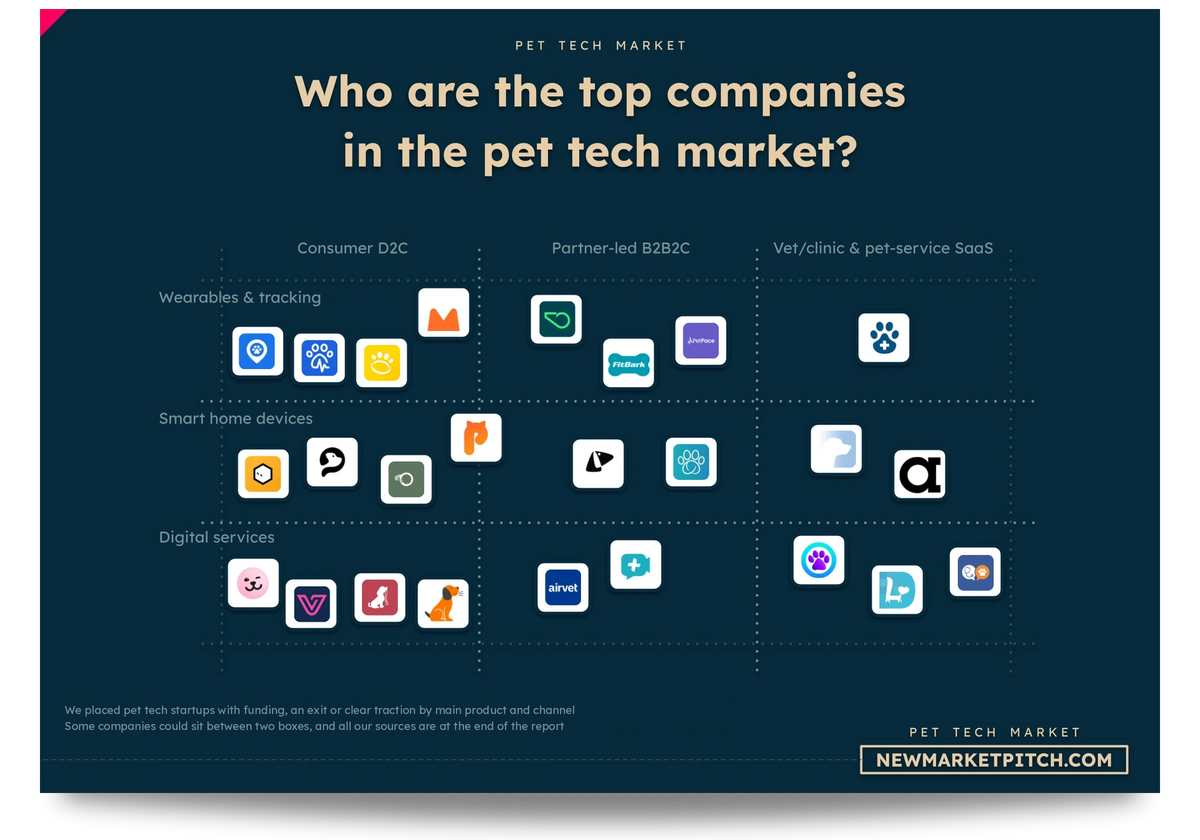
In our document detailing everything you need to know about pet tech, we turn what is vague and complex into simple, useful visuals. Market maps like this one show you at a glance where every startup stands.
Sources and methodology
This analysis identifies Pet Tech's biggest unsolved problems by examining where existing products, veterinary services, and industry infrastructure still fall short of what pet owners and animals need. We assessed veterinary affordability, insurance coverage, access to care, clinical technology, preventive healthcare, medical-record sharing, practice efficiency, connected devices, and animal welfare.
We prioritized original research, industry association data, professional guidance, regulatory information, and first-hand company documentation. The main evidence includes national surveys of pet owners and veterinarians, pet insurance market statistics, clinical technology guidance, shelter outcome data, and documented changes to connected-device platforms. We used these sources to distinguish widespread problems from smaller product limitations and commercial growth from measurable improvements in animal care.
For veterinary affordability, we relied on the PetSmart Charities-Gallup study involving 2,498 U.S. dog and cat owners and Gallup's January 2026 research involving 933 practicing veterinarians. For insurance, we used NAPHIA's 2026 industry data, distinguishing U.S. insurance penetration from North American insured-pet and premium totals. Comparisons between premium growth and insured-pet growth describe industry-level trends and should not be interpreted as individual policy-price increases.
For preventive health, we used the Association for Pet Obesity Prevention's 2025 survey, treating owner-reported weight and feeding outcomes separately from clinically measured obesity prevalence. For veterinary AI, we considered the professional guidance of the American College of Veterinary Radiology and the European College of Veterinary Diagnostic Imaging. We treated manufacturer descriptions of monitoring capabilities and software integrations as evidence of available functionality, rather than independent proof of improved clinical outcomes.
For animal welfare, we used Shelter Animals Count's 2025 annual report and 2026 mid-year statistics. Return-to-owner rates describe stray animals entering shelters, not all missing pets. Shelter intake, adoptions, transfers, and net population changes were also considered separately to avoid treating adoption growth as proof that overcrowding has declined.
We compared the problems using three qualitative criteria: the scale and persistence of unmet need, the consequences for owners and animals, and the extent to which a technology company can realistically address the problem. The resulting assessment is a judgment about unresolved needs and startup opportunities, not a forecast of investment returns or a numerical ranking derived from a single dataset.
Key industry and affordability sources include the American Pet Products Association's 2026 industry figures, Gallup's study of pet owners declining veterinary care, Gallup's research on veterinarians and treatment affordability, and NAPHIA's pet insurance industry data.
Key clinical and software sources include the FDA's veterinary telemedicine and VCPR guidance, the American College of Veterinary Radiology's AI position statement, IDEXX's ezyVet integration documentation, and IDEXX's documentation on integrated payments and administrative workflows.
For preventive health and connected devices, we used the Association for Pet Obesity Prevention's 2025 survey, Tractive's resting heart-rate monitoring documentation, Tractive's respiratory-rate monitoring documentation, Tractive's announcement of its Whistle acquisition, and its customer transition information.
Animal welfare and identification sources include Shelter Animals Count's 2025 Annual Data Report, its 2026 Mid-Year Data Summary, its analysis of lost-pet reunification trends, and the American Veterinary Medical Association's microchipping guidance.

Our report covering the pet tech market gets updated several times a month, so you always get the latest view of where things stand.
Written by the New Market Pitch teamWe track new markets so founders and investors can move faster. About us