Who are the top investors in pet tech?
Whether you're building or investing in the pet tech market, our report covers everything you need to know: the players, the money, and what's coming next.
Summary
Digitalis Ventures is the top specialist investor in pet tech, while Leap Venture Studio leads in early-stage investment breadth. Kima Ventures and several generalist venture funds also rank highly, but no single investor dominates the industry across investment activity, capital deployed and financial returns.
Digitalis has the strongest combination of sector focus and investment history. It leads Tracxn's historical early-stage ranking with nine pet tech investments, operates dedicated animal-health funds and benefits from a strategic partnership with Mars Petcare.
Leap has built a much broader startup investment network, with 72 recorded investment transactions as of August 2026. Its standardized $200,000 checks make it particularly influential among companies seeking their first institutional funding, rather than those raising large growth rounds.
The wider market is more fragmented than those historical rankings suggest. New Market Pitch identified 45 financings between March 2024 and September 2026, with $222.24 million disclosed across 38 transactions. No exact lead investor appeared twice among the 31 deals with identifiable leads.
Funding is heavily concentrated. The five largest disclosed rounds accounted for 49.3% of total capital, while the median round was just $2 million. Pet tech remains primarily a small-round market, punctuated by occasional large software and healthcare investments.
Veterinary software is becoming one of the clearest routes to larger institutional checks. Five Elms led Digitail's $23 million Series B, Singular led Lupa's $20 million Series A, and Valspring led Koala Health's $20 million Series B. Established software investors are increasingly willing to back pet-related businesses.
AI is broadening the investor base, but the money is far from evenly distributed. Established veterinary platforms can raise tens of millions, while younger AI diagnostics and preventive-health startups are still raising much smaller rounds.
The latest funding mix favors new entrants. First financings accounted for seven of 11 deals in the most recent comparable year-to-date sample, up from 28.6% in the previous year. Yet follow-on financings still represent 81.5% of disclosed capital across the longer dataset.
The US remains the industry's historical center of gravity, representing approximately 60.1% of pet tech equity funding in Tracxn's tracked market. China is becoming more active in connected devices and veterinary hardware, although limited funding disclosures make capital comparisons difficult.
Strategic access is an important advantage in pet tech. Digitalis and Leap can connect startups with the Mars ecosystem, including veterinary expertise and distribution relationships. That can be particularly useful for companies selling complex products into veterinary practices.
The biggest missing piece is investor returns. Public records show who backed companies and who led financing rounds, but rarely reveal individual checks, ownership stakes or realized profits. On the evidence available, Digitalis is the strongest overall specialist, Leap is the early-stage breadth leader, and the largest growth rounds remain open to a changing group of institutional investors.

Written by the New Market Pitch teamWe track new markets so founders and investors can move faster. About us
Why is it so hard to rank the top pet tech investors?
Digitalis Ventures, Leap Venture Studio and Kima Ventures are among the most active pet tech investors, but the ranking changes considerably depending on whether we count investments, companies backed or capital committed.
The problem starts with what qualifies as pet tech. Tracxn's January 2026 Pet Tech report includes digital pet services, marketplaces and connected products, while some veterinary software companies fall under other technology categories. A ranking that includes veterinary clinics, pet food manufacturers and pharmaceutical companies would produce another set of investors.
Investment databases also count activity differently. One may record several investments in the same startup, while another counts distinct portfolio companies. And when five investors participate in a $20 million round, the public announcement rarely reveals how much each contributed.
We therefore give more weight to repeated investments in identifiable pet tech companies, the ability to lead financing rounds, and a demonstrated commitment to the industry. Large individual rounds still count, but they cannot establish who has invested the most without knowing each investor's actual contribution.
Is pet tech still attracting serious venture capital?
Pet tech is still attracting venture capital, although the latest funding data points to a smaller and more selective market than the biggest investment announcements might suggest.
New Market Pitch's funding tracker identified 45 financings involving 39 companies between March 2024 and September 2026. Of those, 38 disclosed usable amounts totaling $222.24 million. The median disclosed round was approximately $2 million, against an average of $5.85 million.
That gap shows how much a few large transactions influence the market. The five largest rounds accounted for 49.3% of disclosed funding, while the ten largest represented 76.3%. The remaining 28 disclosed financings shared less than one-quarter of the capital.
The comparison with earlier periods is also revealing. In the latest comparable year-to-date analysis, 11 deals were recorded against 14 in the previous year. Disclosed funding fell from $77.88 million to $12.46 million, although five recent rounds lacked precise amounts and could make the apparent decline look worse than the actual one.
The bigger change was the absence of disclosed $20 million-plus rounds in that latest period. Companies are still getting funded, but the largest checks have become harder to find.
For pet tech investors, that creates two different markets. Seed funds can continue backing young startups with relatively small amounts, while growth investors have fewer companies raising substantial rounds.

In our report covering the pet tech market, you will always find fresh funding data, taken straight from our own verified funding database.
Which venture capital firms have backed the most pet tech startups?
Digitalis Ventures leads Tracxn's historical early-stage pet tech ranking with nine investments, while Kima Ventures tops its seed-stage ranking with eight.
Tracxn's January 2026 report also identifies Gaingels with six investments, followed by Global Founders Capital, Alumni Ventures, BoxGroup and Lerer Hippeau with five each.
The portfolios show how different these investors are. Digitalis has backed companies including Smalls, MoeGo and MollyBox through its wider animal-health investment activities. Kima has invested in Dalma, Petnet and NomNomNow. BoxGroup's pet-related investments include Modern Animal, BarkBox and Koala.
Kima's activity is particularly interesting because it comes from a very broad seed-investing model. Digitalis, by comparison, has built a dedicated animal-health platform. Both appear frequently in pet tech funding records, but only one has made the category an explicit investment specialty.
These counts cover historical investments within Tracxn's defined market. They should not be read as the number of investments completed this year or as a measure of each firm's financial returns.
| Investor | Pet tech investments | Main investment profile | Notable companies backed |
|---|---|---|---|
| Digitalis Ventures | 9 | Animal health, early stage | Smalls, MollyBox, MoeGo |
| Kima Ventures | 8 | Generalist seed | Dalma, Petnet, NomNomNow |
| Gaingels | 6 | Generalist venture | Wag!, Fuzzy, Wild Earth |
| Global Founders Capital | 5 | Generalist seed | Mixlab, Dalma, DogHero |
| Alumni Ventures | 5 | Generalist venture | Ollie, PetPlate, Whistle |
| BoxGroup | 5 | Generalist seed | Modern Animal, BarkBox, Koala |
| Lerer Hippeau | 5 | Generalist early stage | BarkBox, Ollie, Fi |
| First Round Capital | 4 | Generalist seed | Rover, DogVacay, Koala |
| FJ Labs | 4 | Marketplace-focused seed | Fuzzy, Laika, MollyBox |
| Slow Ventures | 4 | Generalist early stage | BarkBox, Fable, Good Dog |
| Companion Fund | 4 | Specialist pet care | MollyBox, Whistle, Companion |
Is Digitalis Ventures the biggest specialist investor in pet tech?
Digitalis Ventures has the strongest claim to being the leading specialist pet tech investor today, thanks to its repeated investments and its animal-health partnership with Mars Petcare.
Digitalis invests through its Companion Funds in businesses that use science and technology to improve animal health. Its investments cover several parts of the industry, including veterinary software, pet nutrition, diagnostics and healthcare financing.
The portfolio includes companies such as MoeGo, Smalls, Vedi and Scratchpay. That range is important because Digitalis has continued investing across different pet-related business models rather than concentrating its exposure on one consumer trend.
Its relationship with Mars Petcare gives the platform another advantage. According to Digitalis, its investment network can draw on expertise from more than 100,000 associates in veterinary services and diagnostics, working with over 25 million pets annually across more than 2,500 clinics and laboratories.
For a startup selling veterinary software or diagnostic technology, access to that kind of industry network could be valuable. Digitalis has also remained visible in recent financing activity, including Travv's $1.6 million veterinary AI round in May 2026.
We cannot establish that Digitalis has invested more dollars than every other pet tech fund, since investors rarely disclose their individual contributions. Its leadership comes from the combination of sector specialization, historical investment activity and access to a major industry partner.
If you want more recent data on this point, please see our latest Pet Tech market report.

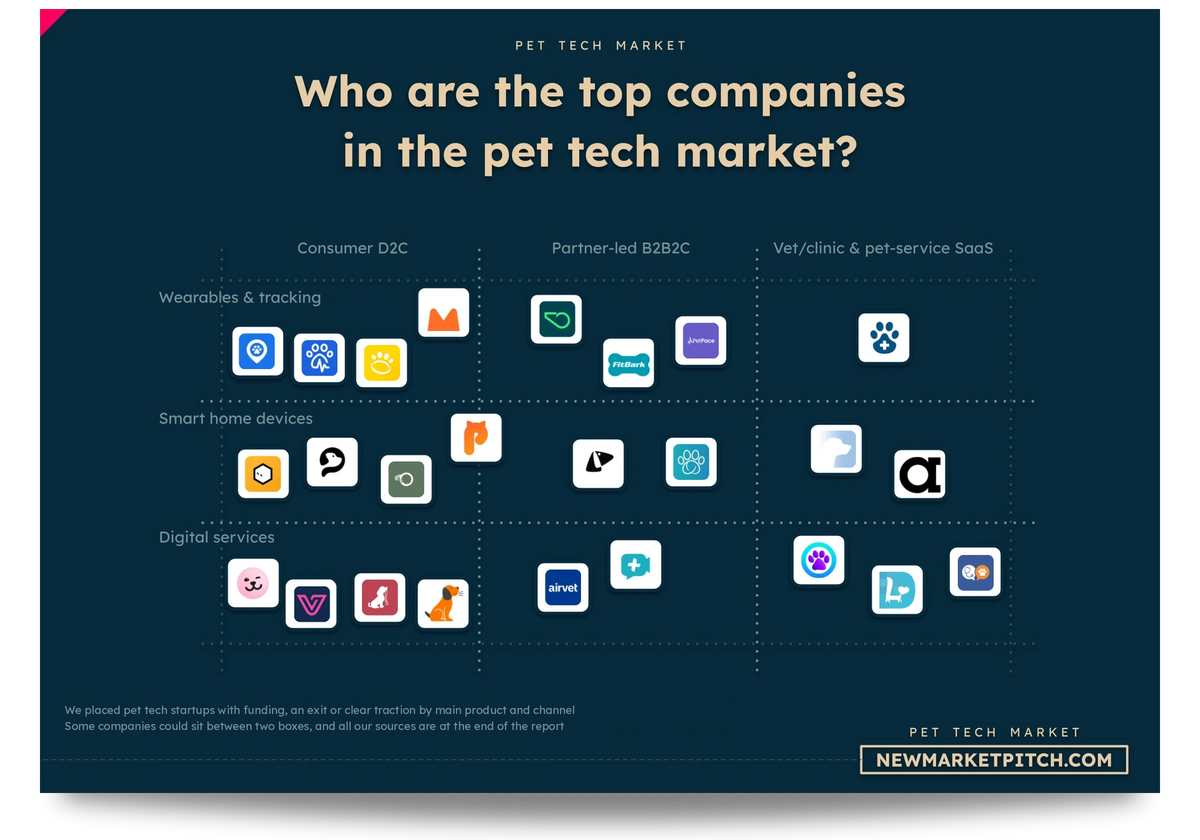
In our research about pet technology, we turn what is vague and complex into simple, useful visuals. Market maps like this one show you at a glance where every startup stands.
How much influence does Mars Petcare have over pet tech investing?
Mars Petcare is one of the most influential strategic backers of pet tech innovation, with a reach that extends well beyond its direct participation in startup funding.
The company's startup investment ecosystem includes the Mars-backed Companion Funds managed by Digitalis Ventures and Leap Venture Studio, developed with Michelson Found Animals. These initiatives serve different stages of startup development.
Mars has established operations across veterinary care, animal nutrition, diagnostics and digital pet services. Its broader commercial network gives it relationships with veterinarians, pet owners and industry suppliers that most traditional venture funds would need years to develop.
That reach can be especially useful for companies selling into veterinary practices. A startup building diagnostic software, for example, has to convince clinical teams to adopt its product. Industry expertise and access to potential customers can help it understand the market more quickly.
Still, we should distinguish the investor from its associated programs. Mars, Digitalis, Companion Fund and Leap have overlapping relationships, so counting their investments as four unrelated portfolios would inflate the apparent size of the investment ecosystem.
Mars is particularly strong when we measure strategic influence. Ranking its actual venture capital deployment against independent funds would require investment amounts that are not consistently public.
Has Leap Venture Studio become the most active early-stage pet tech investor?
Leap Venture Studio is one of the most active pet tech startup investment programs, with 72 investment transactions recorded by CB Insights as of August 2026.
Leap was established through Mars Petcare and Michelson Found Animals, with TAW Ventures joining the investment partnership. The accelerator currently offers selected startups $200,000 in investment alongside mentorship and access to industry specialists.
Its activity has built steadily. In 2025, Michelson Found Animals reported that Leap had invested in 51 companies across 16 countries since launching in 2018. Those companies had collectively raised more than $200 million in follow-on funding, and two portfolio companies, PetHospice and Lacuna Diagnostics, had achieved exits.
By August 2026, CB Insights showed 72 investment transactions, including new investments in Luna, NanosVet and Grub Club Pets. The transaction count is higher than the 2025 company count partly because it covers a later period and uses a different measure.
The program has also become increasingly competitive. Its tenth cohort selected six startups from more than 300 applications spanning 40 countries, giving it an acceptance rate below 2% based on the reported applicant pool.
Leap has probably reached more very early-stage pet startups than many conventional specialist funds. Its $200,000 investments, however, serve a different purpose from the multimillion-dollar rounds led by institutional venture investors.
If you want more recent data on this point, please see our latest Pet Tech market report.

Your time is limited. In our market report about pet technology, we put numbers on each part of the market, so you can see where it makes sense to focus.
Which investors are writing the largest checks in pet tech?
Five Elms Capital, Singular and Valspring Capital are among the investors associated with the largest recent pet tech financing rounds, particularly in veterinary software and digital pet healthcare.
Five Elms led Digitail's $23 million Series B in November 2025. The financing brought Digitail's cumulative funding above $37 million and included existing investors Atomico, Partech, Byfounders and Gradient.
A month earlier, Singular led a $20 million Series A for Lupa, which had raised seed funding just months before. Koala Health also secured a $20 million Series B in May 2025, led by Valspring Capital.
These three rounds totaled $63 million in announced capital. That's a lot of money for a market where the median disclosed financing is around $2 million.
The amounts need one qualification: $23 million raised by Digitail does not mean Five Elms personally invested $23 million. The same applies to Singular and Valspring. Financing announcements usually give the round total rather than each participant's check.
What we can establish is that these firms were willing to lead large financings in pet-related technology companies. That makes them important growth investors, even without evidence that pet tech represents a major share of their overall portfolios.
Why are software investors suddenly interested in pet tech?
Software investors are increasingly interested in pet tech because veterinary practice-management companies have started showing the kind of growth that attracts established enterprise software funds.
Digitail provides one of the clearest examples. When Five Elms Capital announced its $23 million investment in November 2025, Digitail reported that its customer base had more than doubled over the previous 12 months. The platform was supporting 10,000 veterinarians and 3 million pet owners.
Its product includes AI-assisted patient intake, clinical notes and medical-record summaries. Those tools operate inside a veterinary clinic's daily workflow, where software can become difficult to replace once employees depend on it.
Lupa attracted Singular with another AI-enabled veterinary platform, while Goose secured $13.4 million in seed funding in February 2025 with participation from B Capital for pet-care business software.
The three rounds add up to $56.4 million. Their common feature is the business model: companies selling software to pet-care operators, often with recurring revenue and opportunities to expand into related services.
Five Elms already specializes in business software. Its investment in Digitail fits that broader strategy. Pet tech is now attracting investors who might previously have focused on healthcare software or other industry-specific platforms.
Consumer products, connected devices and pet insurance still attract investors. But veterinary software has become one of the clearest routes to larger institutional checks.

In our document detailing everything you need to know about pet tech, we always try to gather several sources and make estimates that make sense, so you can work with solid numbers.
Is AI bringing new investors into pet tech?
AI is attracting new investment into pet tech, especially in veterinary software and diagnostics, although the funding is still concentrated in a relatively small number of companies.
Digitail and Lupa illustrate the more established end of the market. Both raised at least $20 million in 2025 while developing AI-enabled systems for veterinary clinics.
Younger startups are getting smaller rounds for more specialized products. In May 2026, Travv raised $1.6 million with Digitalis Ventures involved in the financing. Its technology focuses on AI-native veterinary diagnostic workflows.
Wonderdog raised $5 million in July 2026 from investors including WndrCo and Maveron for a preventive canine-health platform combining at-home testing with digital health insights.
Meanwhile, companies such as SATELLAI, Traini and Hoomanely are exploring AI-powered pet wearables, behavioral technology and connected devices.
The difference in funding stages is worth keeping in mind. Digitail's $23 million round was more than 14 times Travv's $1.6 million financing, but Digitail was raising a Series B, while Travv was still at an earlier stage.
Investors are backing AI products that address quite different problems: reducing veterinary paperwork, interpreting health information, monitoring animals and helping owners manage care.
The unanswered question is how many of these products can build lasting businesses. Strong customer adoption is documented for some established veterinary platforms, but the newer AI startups still have much less public operating history.
Are generalist venture funds becoming more important than pet tech specialists?
Generalist venture funds are important players in pet tech, especially when startups need larger rounds, but specialist investors remain more consistently focused on the industry.
First Round Capital has historically backed Rover, DogVacay and Koala. BoxGroup has invested in Modern Animal, BarkBox and Koala. Lerer Hippeau's pet-related portfolio includes BarkBox, Ollie and Fi.
These investments cover marketplaces, connected devices, pet nutrition and veterinary services. Several became substantial businesses, and their investors gained exposure to the pet industry without creating dedicated pet tech funds.
What makes the generalist model interesting is its flexibility. First Round can invest in a pet-services marketplace and also pursue opportunities across enterprise software, fintech and consumer technology. Digitalis has a much narrower animal-health focus.
That difference also affects how investors select companies. A generalist fund may be particularly interested in a pet tech startup that looks like a scalable software company or a large consumer platform. A specialist can pursue opportunities requiring deeper knowledge of veterinary medicine or animal-health distribution.
Neither model has a proven advantage in financial returns based on the public data. The stronger distinction is consistency: specialist funds keep investing in pet tech across cycles, while generalist firms often become especially important when individual startups grow large enough to attract broader venture capital.
If you want more recent data on this point, please see our latest Pet Tech market report.

Our report covering the pet tech market gets updated several times a month, so you always get the latest view of where things stand.
Are US investors still dominating pet tech funding?
US investors remain the most established group in pet tech venture capital, supported by a larger historical funding market and a deep network of generalist and specialist funds.
Tracxn's January 2026 report attributed approximately 60.1% of historical pet tech equity funding in its tracked universe to US companies. The United Kingdom followed with around 15.2%.
The US investor network includes Digitalis Ventures, First Round Capital, BoxGroup, Lerer Hippeau and Gaingels, alongside newer participants such as Valspring Capital and WndrCo.
Their investments also cover several different areas. Koala Health operates in digital pet pharmacy services, Wonderdog focuses on preventive canine health, and Modern Animal has developed technology-enabled veterinary care.
Europe has some notable competitors. France-based Kima Ventures appears at the top of Tracxn's historical seed-stage investment ranking, while Singular led Lupa's $20 million financing in London. Existing Lupa investors included firstminute capital, 2100 Ventures and Vento by Exor Ventures.
Asia is also becoming more visible. In New Market Pitch's 45-deal international sample, 12 financings involved Chinese companies, representing 26.7% of the recorded transactions. Seven of those rounds lacked precise disclosed amounts, making dollar-based comparisons unreliable.
Chinese startups such as SATELLAI, MOVA AI Pets and Shenzhen Vetoo Medical Technology show particular activity in connected devices, AI-enabled hardware and veterinary diagnostics. Investors appearing in this market include 01VC, SenseTime Guoxiang Capital and Skyworks Venture Capital.
The US still has the strongest documented combination of funding history and established investors. China's transaction activity suggests a more geographically diverse future, especially in hardware, although we cannot yet make a reliable like-for-like comparison of invested capital.
Do pet tech startups benefit more from strategic investors?
Strategic investors can offer pet tech startups a real advantage in veterinary care and diagnostics, where industry relationships are often essential to getting a product adopted.
Digitalis's partnership with Mars Petcare is the strongest example. Through the relationship, its portfolio companies can potentially access commercial knowledge and connections across veterinary practices, laboratories and animal-health businesses.
Leap Venture Studio takes a similar approach with much younger startups. Selected companies receive $200,000 in funding, participate in a 12-week program and work with specialists from the wider partner network.
That can be particularly helpful for founders who understand software but have limited experience selling to veterinary clinics. Clinical workflows, customer purchasing decisions and healthcare regulations can make these markets harder to enter than ordinary consumer software.
Access to an established industry network doesn't guarantee commercial contracts, though. A startup still needs to demonstrate that its product works and that customers are willing to pay for it.
There are also reasons to value independent venture capital. A startup working with several competing veterinary groups may prefer investors without close ties to one major corporate ecosystem.
The stronger the company's dependence on clinical adoption or specialist distribution, the more valuable a strategic investor may become. For consumer apps and general software products, traditional venture capital can be equally useful.
If you want more recent data on this point, please see our latest Pet Tech market report.

In our research about pet technology, we look at what the winners do differently, so you can learn from the best instead of guessing.
Are pet tech investors funding more new startups than established ones?
Pet tech investors are currently funding a higher proportion of first-time deals, even though established startups have historically attracted most of the disclosed capital.
New Market Pitch's latest comparable year-to-date sample classified seven of 11 financings as first financings. That's 63.6% of the total, compared with 28.6% in the previous year and 11.1% two years earlier.
The number of follow-on financings moved in the opposite direction. Across those three comparable periods, the counts were eight, ten and four.
The longer funding sample tells the other side of the story. Follow-on rounds accounted for 81.5% of disclosed capital across 45 transactions, reflecting the influence of larger financings for companies such as Digitail, Lupa and Koala Health.
Early-stage activity is still producing new investment opportunities, while fewer established startups have been announcing large financings lately.
This could create opportunities for seed investors such as Kima, Gaingels and the Leap ecosystem. Growth investors, meanwhile, have fewer publicly visible candidates raising the kinds of rounds they usually lead.
The sample is relatively small, so it would be premature to declare a lasting shift in investor strategy. But the rise in first financings is large enough to deserve attention.
Are the same pet tech investors leading deals again and again?
Recent pet tech financing is unusually fragmented: New Market Pitch identified 31 deals with disclosed lead investors, and no exact lead investor appeared more than once in that sample.
That helps explain why there is no obvious winner when we look only at recent investment announcements.
Five Elms led Digitail's financing, Singular led Lupa's, Valspring backed Koala Health, and other investors appeared behind smaller rounds. WndrCo and Maveron participated in Wonderdog, while Digitalis Ventures backed Travv.
There is no repeated lead investor dominating these recent transactions.
That doesn't mean the same investors never back multiple pet companies. The historical portfolios of Digitalis, Kima, BoxGroup and First Round show otherwise. Nor does it rule out undisclosed investments or follow-on participation.
Growth-stage leadership remains spread across investors with different specialties. The market has not developed a small group of funds that repeatedly wins most of its largest financing rounds.
The latest disclosed financings also show how widely the opportunity has spread, from veterinary AI to digital health records and preventive pet care.
| Investor | Startup | Round size | Announcement | Business |
|---|---|---|---|---|
| Boost VC / Gandel Invest | Elita | ~$1.36M | Sep 2026 | Preventive pet health |
| WndrCo / Maveron | Wonderdog | $5M | Jul 2026 | Canine health technology |
| Digitalis Ventures | Travv | $1.6M | May 2026 | Veterinary AI |
| Predictive Venture Partners | Petwealth | $1.7M | Apr 2026 | At-home diagnostics |
| Five Elms Capital | Digitail | $23M | Nov 2025 | Veterinary software |
| Singular | Lupa | $20M | Oct 2025 | AI veterinary software |
| Valspring Capital | Koala Health | $20M | May 2025 | Digital pet pharmacy |
| HighlandX | Airvet | $11M | Apr 2025 | Veterinary telehealth |
| B Capital | Goose | $13.4M | Feb 2025 | Pet business software |
| Las Olas Venture Capital | VetVerifi | $2.8M | Feb 2025 | Pet health records |

Theory only gets you so far. In our market report about pet technology, we dig up the real signals from the field and show you the ones worth watching.
Have the top pet tech investors actually made money?
Pet tech has produced successful company exits, but public information is too limited to determine which venture capital funds have made the most money from their investments.
Rover and BarkBox both reached public markets, giving early investors potential paths to liquidity. The industry has also seen acquisitions involving veterinary software and digital pet services.
Leap Venture Studio provides a more specific portfolio example. Michelson Found Animals reported in 2025 that two Leap-backed companies, PetHospice and Lacuna Diagnostics, had achieved exits.
The missing information is what those outcomes meant financially for each investor. To calculate an investment return, we would need to know the initial investment, ownership, dilution, subsequent contributions and eventual proceeds.
A startup raising $100 million does not tell us whether its early investors made money. Even a successful acquisition can produce very different results for shareholders who invested at different valuations.
This is where rankings based on transaction counts have their limits. Digitalis's nine historical early-stage investments and Kima's eight seed investments demonstrate experience in the market, but neither number reveals portfolio performance.
At present, we have enough evidence to identify active and influential pet tech investors. We do not have enough comparable data to rank them by realized returns.
Could one investor eventually dominate pet tech?
Pet tech could eventually produce a dominant venture investor, but its current financing structure makes that difficult.
The median disclosed round in New Market Pitch's recent sample was approximately $2 million, and 60% of tracked financings were below $5 million. Those are manageable investment sizes for a wide range of seed funds, angel syndicates and specialist investors.
At the other end of the market, the relatively small number of $20 million-plus rounds attracts software investors, healthcare funds and large generalist venture firms.
That mix encourages competition. A company developing AI veterinary software may appeal to a software growth investor, while a connected collar manufacturer could attract hardware specialists. Pet insurance businesses may appeal to investors with experience in financial services.
Digitalis already has a recognizable specialist position, and the Mars-backed ecosystem gives it access to a substantial network of early-stage companies. Leap's growing investment record strengthens that reach.
A more concentrated market would likely require a larger group of pet tech startups raising repeated Series B and Series C rounds. Investors capable of financing those companies over multiple stages would then have a stronger opportunity to build dominant positions.
For now, the large number of small deals and the diversity of business models leave plenty of room for competing investors.

In our document detailing everything you need to know about pet tech, we don't want to repeat what boring consulting reports say. Instead, we show you the real and latest market signals that matter.
Who are the top investors in pet tech today?
Digitalis Ventures is currently our top specialist pet tech investor, Leap Venture Studio leads in very early-stage investment breadth, and Five Elms Capital, Singular and other institutional investors stand out for their involvement in larger recent financings.
Digitalis has the most convincing combination of sector focus and repeated investment activity. It leads Tracxn's historical early-stage pet tech ranking with nine investments, operates through dedicated Companion Funds, and has a strategic relationship with Mars Petcare. Its participation in Travv's 2026 financing also shows that its activity continues.
Leap has built an even wider early-stage investment program, reaching 72 recorded investment transactions by August 2026. Its standardized $200,000 checks and industry mentorship make it especially relevant to startups seeking their first institutional backing.
For larger companies, the leading names change. Five Elms led Digitail's $23 million Series B, Singular led Lupa's $20 million Series A, and Valspring led Koala Health's $20 million Series B. These firms have shown that established software and healthcare investors are willing to commit to pet tech when they see a compelling business.
Kima Ventures, Gaingels, BoxGroup, Lerer Hippeau and First Round Capital also deserve recognition for their historical investments, even though pet tech represents only part of their wider investment activity.
We would be much less confident naming the biggest investor by dollars deployed or the best investor by financial returns. Individual capital contributions and realized portfolio returns are rarely disclosed, and recent lead-investor activity remains fragmented.
So the current ranking depends on what a founder or industry observer actually wants to know. Digitalis is the clearest specialist leader. Leap has one of the broadest early-stage investment records. Large software-oriented funds provide some of the biggest individual checks.
No firm has established overall dominance across all three measures. For now, Digitalis Ventures has the strongest claim to the title of top pet tech investor, while the wider market remains open to both specialist and generalist venture capital.
If you want more recent data on this point, please see our latest Pet Tech market report.
Sources and methodology
This analysis identifies the top investors in pet tech by comparing five dimensions: historical investment activity, recent financing participation, sector specialization, investment leadership and strategic influence. We examined both dedicated animal-health investors and generalist venture firms, including their documented portfolios, financing announcements and relationships with industry partners.
We used Tracxn's January 2026 Pet Tech report to establish historical investment rankings and distinguish early-stage from seed-stage investors. These figures represent investment activity within Tracxn's defined pet technology market, rather than total dollars deployed or unique companies funded. We separately examined CB Insights' investment history for Leap Venture Studio and disclosures from Digitalis Ventures, Mars Petcare and Michelson Found Animals to assess specialist investment activity and strategic reach.
For recent market activity, we analyzed New Market Pitch's transaction-level pet tech funding tracker covering March 2024 through September 2026. The dataset contains 45 financings involving 39 companies, including 38 transactions with usable disclosed amounts totaling $222.24 million. We aggregated deal sizes, funding concentration, first financings versus follow-on rounds, geographic activity and disclosed lead investors. The year-to-date comparisons use consistent periods rather than full-year totals.
We distinguished financing-round totals from individual investor commitments. When an investor leads a $20 million round, that figure represents the entire announced financing unless the investor's own contribution is explicitly disclosed. We also separated investment transactions from distinct portfolio companies and avoided treating related Mars-backed investment programs as entirely independent portfolios.
Our assessment gives more weight to repeated identifiable investments, documented round leadership, continued participation in the sector and relevant industry partnerships. We used announced exits as evidence of potential liquidity, without inferring investment returns where ownership stakes, dilution and proceeds are unavailable. The resulting rankings reflect investment activity and influence, rather than a calculated ranking of capital deployed or fund performance.
Key sources include Digitalis Ventures' animal-health investment strategy, Leap Venture Studio's accelerator and investment program, Leap's investment terms and eligibility details, Michelson Found Animals' Leap portfolio and cohort announcement, Michelson Found Animals' Leap Venture Studio overview, and CB Insights' Leap Venture Studio investment history.
For individual transactions, we used Digitail's $23 million Series B announcement, Lupa's $20 million Series A announcement, Goodwin's confirmation of Lupa's financing, Koala Health's Series B announcement, Goose's $13.4 million seed financing, Travv's seed financing announcement, and Airvet's Series B-2 announcement. For exit context, we referenced Rover's announcement of its acquisition by Blackstone.
The historical rankings are based on Tracxn's January 2026 Pet Tech report, while the recent funding aggregates and lead-investor comparisons are based on New Market Pitch's original transaction-level research. These sources are used for different purposes: Tracxn provides historical investor activity, while the New Market Pitch dataset captures the recent funding environment and its changing investment patterns.

Learning from others' mistakes is the cheapest lesson there is. In our report covering the pet tech market, we look at what broke startups before you, so you don't repeat it.
Written by the New Market Pitch teamWe track new markets so founders and investors can move faster. About us