Pet health trackers: which startup is ahead?
Whether you're building or investing in the Pet Tech market, our report covers everything you need to know: the players, the money, and what's coming next.
Summary
Tractive is clearly ahead in pet health trackers today. Fi is the strongest independent consumer challenger, while PetPace leads the medical side of the market.
Tractive's lead now has a price tag. Bending Spoons closed its purchase in May 2026 at a $759 million enterprise value, and its filings show Tractive brought in $27 million of revenue in its first six weeks inside the group. No independent rival discloses anything close.
Fi is not close to matching that scale, but it is the rival that moved fastest this year. In June 2026 it spread to 38 countries across North America and Europe, and in July it launched the satellite-enabled Ultra, the most capable remote-tracking collar on the market.
The market is splitting into two races. Tractive and Fi compete for everyday safety and wellness, while PetPace, Invoxia and Maven are trying to make the collar useful for medical monitoring. Everyday safety collars and medical monitoring collars are two different races, and we set out what counts in each in our pet tech market report.
PetPace has the deepest health product. Its vital-sign measurements, veterinarian dashboard and clinical research make it more useful for sick, elderly or recovering animals than a normal consumer GPS tracker.
Invoxia may have the strongest technical position among the smaller companies. Its cardiac sensing and long-term study of 703 dogs give it a dataset that is difficult to reproduce with standard GPS and activity hardware.
Maven is smaller, but it has found a sensible middle ground. Peer-reviewed respiratory monitoring, personalized baselines and one subscription covering several pets make it a credible health-first challenger without the cost of a full clinical platform.
Life360 is the biggest outside threat because it already has distribution. Its pet tracker is medically basic, but since August 2026 it comes inside a $99-a-year plan in an app used by more than 102 million people a month.
The ranking depends on what pet wearables become. If owners mainly want escape alerts and location, Tractive and Fi should stay in front; if veterinary care and insurance begin using continuous pet data routinely, PetPace, Invoxia and Maven become much more valuable.
For now, the order is clear: Tractive first, Fi second, PetPace third, Invoxia fourth, Maven fifth, Petcube sixth and FitBark seventh.

Written by the New Market Pitch teamWe track new markets so founders and investors can move faster. About us

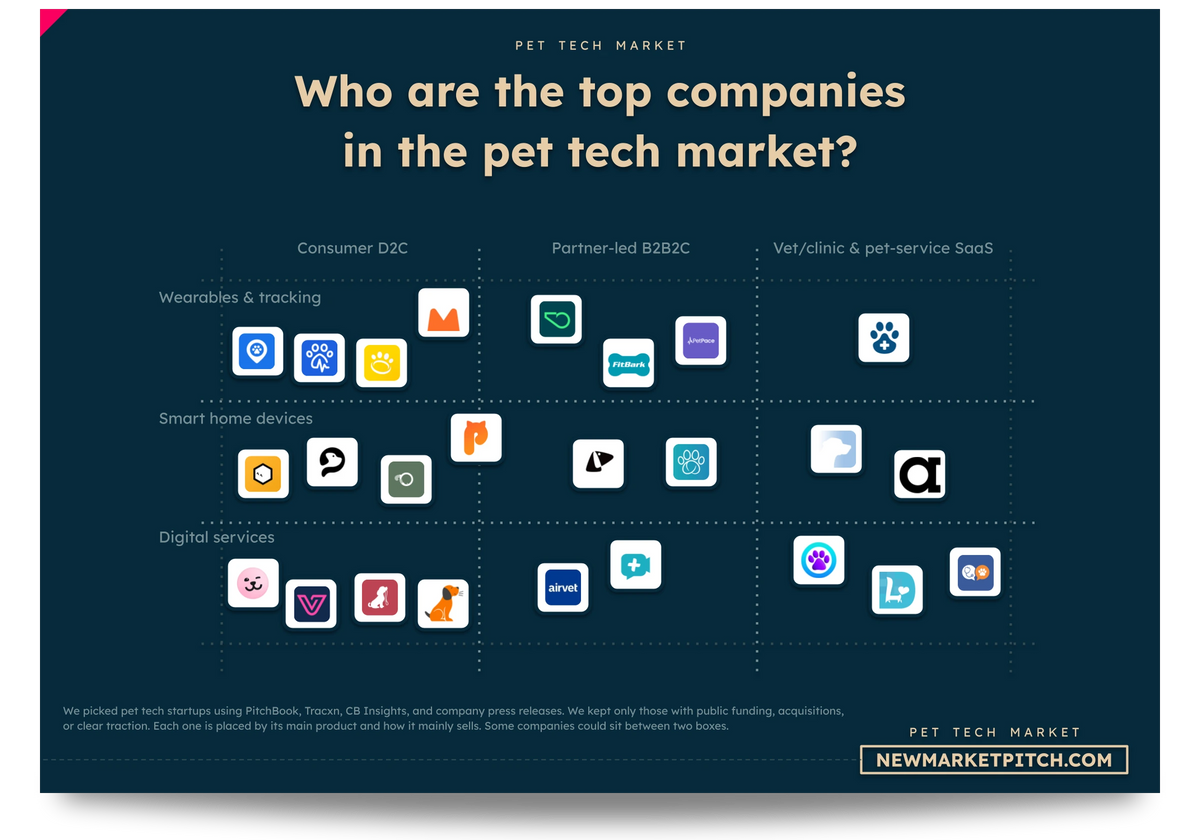
In our report covering the pet tech market, we turn what is vague and complex into simple, useful visuals. Market maps like this one show you at a glance where every startup stands.
Which pet health tracker startups actually belong in the race?
The real pet health tracker race currently has seven credible companies: Tractive, Fi, Invoxia, PetPace, Maven Pet, Petcube and FitBark.
We include companies that sell an active wearable and track at least one health or behavioral metric. That covers broad GPS products that monitor activity and sleep, as well as health-first collars measuring heart rate, breathing or temperature.
The companies are still solving different problems. Tractive and Fi began with location and safety, then added health features. PetPace and Maven started with health monitoring. Invoxia sits between the two, combining GPS with unusually advanced cardiac measurements.
Tractive remains essential to the comparison even though Bending Spoons now owns it. The deal closed on 18 May 2026, and Tractive is no longer independent, but it still sets the benchmark every startup has to beat. Whistle is excluded because Tractive acquired the business and closed the separate Whistle platform.
We also exclude Halo and SpotOn because containment and training remain their main functions. Apple AirTags and similar Bluetooth tags can help locate an animal nearby, but they do not monitor health. Life360 appears later as an outside threat because it is an established consumer platform entering pet tracking, rather than a pet health startup.
Funding figures need some caution. Fi has raised slightly more disclosed venture funding than Tractive raised before its acquisition, and none of the independent companies has publicly announced a new round in 2026. Invoxia and PetPace have less complete public records, so their totals should be read as approximate rather than exact.
| Startup | What it currently does | Disclosed cumulative funding |
|---|---|---|
| Tractive | GPS, activity, sleep, behavior and vital-sign tracking for dogs and cats | About $38 million before its sale; acquired by Bending Spoons in May 2026 at a $759 million enterprise value |
| Fi | GPS, activity, sleep and AI behavior tracking, including satellite connectivity | About $40 million; no new round disclosed |
| Invoxia | GPS, activity, sleep, heart rate, respiratory rate and heart-rate variability | Precise total not publicly disclosed |
| PetPace | Clinical monitoring of vital signs, behavior, pain-related patterns and location | Previously described as below $10 million; exact total uncertain |
| Petcube | GPS, activity monitoring and veterinary chat within a broader pet-device platform | About $13.8 million |
| Maven Pet | Health-first tracking of heart rate, respiratory rate, activity, sleep and behavior | At least $4.4 million (three rounds, last one in 2024); exact total not disclosed |
| FitBark | GPS, activity, sleep and behavior tracking, with strong research use | About $125,000 publicly recorded |
Is there already a clear leader in pet health trackers?
Yes. Tractive is clearly ahead in pet health trackers today, with Fi as the strongest consumer challenger and PetPace and Invoxia leading narrower medical niches.
The gap is larger than the number of competing brands suggests. Tractive reported 1.4 million active users in July 2025, after agreeing to absorb Whistle, and sells its subscription in more than 175 countries. It passed €100 million in annual recurring revenue in 2024. In April 2026 it described its base only as "millions of active users," without a new exact count.
The sale to Bending Spoons added an outside check on those claims. A buyer paying a $759 million enterprise value, and reporting $27 million of Tractive revenue for just 18 May to 30 June 2026, confirms that the business is large and real.
No independent competitor has published a similar combination of paying users, recurring revenue and international reach. Fi has a strong brand and a growing product range, but it does not disclose subscriber or revenue figures. Invoxia reports more than 400,000 users across its entire tracking business, although that figure also includes vehicles, bicycles and valuables.
The smaller health specialists lead where Tractive remains less advanced. PetPace monitors a wider set of clinically useful measurements and gives veterinarians their own dashboard. Invoxia has built one of the category's best real-world cardiac datasets. Maven has added peer-reviewed evidence to a relatively accessible consumer subscription.

Our research about pet technology gets updated several times a month, so you always get the latest view of where things stand.
How big is Tractive's business now that Bending Spoons owns it?
Tractive is by far the biggest pet health tracker business, and it is now worth roughly three quarters of a billion dollars to its new owner.
Bending Spoons said in its August 2026 results that it bought Tractive at a $759 million enterprise value, including $115 million paid one year after closing. The financial statements in the same filing show a higher figure, and the filing does not reconcile the two. Either way, no other pet wearable company has been valued anywhere near that level.
The same filing gives the first hard revenue number in years. Tractive contributed $27 million of revenue between 18 May and 30 June 2026. If that pace held over a full year, it would mean roughly $225 million a year including hardware. That is our rough estimate, not a company figure, and pet tracker sales are seasonal. Rough yearly figures like this are no substitute for a proper size estimate, which we build from the ground up in our report on pet tech.
Tractive also posted a $13 million loss before tax over those six weeks. That number should not be read as a broken model. Bending Spoons reorganized the company in June 2026, offered separation packages to departing staff and booked deal-related costs in the same period. The number of jobs cut has not been disclosed.
The older figures still fit together. Dividing €100 million in recurring revenue by 1.4 million active users gives roughly €71 per user per year, which sits inside Tractive's subscription pricing of about €5 to €13 a month. The dates and definitions do not align perfectly, so this is only a rough check.
Bending Spoons also said Tractive and WeTransfer made the largest contributions to its 3% organic revenue growth in the second quarter of 2026.
Fi says its products are trusted by millions of pet parents, and its June 2026 expansion release listed 110 employees. Those figures show a real company, but they do not reveal how many subscriptions remain active or how much revenue Fi earns. Petcube does not separate tracker revenue. Maven, PetPace and FitBark disclose very little about active paid users.
Tractive can finance software, support, connectivity and new devices from its own customers and now from a larger parent. Its smaller rivals still have to protect cash, charge premium prices or stay focused on a narrower group of owners.
Can Fi catch Tractive now that it sells in Europe?
Not soon. Fi still trails Tractive by a wide margin on proven scale, even though it now competes on Tractive's home ground and leads on battery design and remote tracking.
In June 2026 Fi said its collars now work in 38 countries across North America and Europe, with full device sales in 29 markets. Nine of those sales markets were new, including Sweden, Austria, the Netherlands and Belgium.
That move matters because Europe is where Tractive was built. Fi now competes for the same owners in Austria and the Nordics, not only in the United States. But the release gave no customer figures, so it is too early to say whether the expansion is winning share.
Fi's regular Series 3+ collar can last up to three months under favorable conditions. The hardware is built directly into the collar, which feels cleaner and more durable than attaching a separate tracker to a normal collar. Fi also monitors barking, licking, scratching, eating, drinking, sleep and activity.
Fi's most distinctive product is the Ultra, launched in July 2026. It combines normal GPS and cellular tracking with T-Mobile's Starlink-powered direct-to-cell service. During testing by The Verge, the tracker successfully sent locations from an area with no normal LTE reception. Satellite coverage works only in the United States.
The limitation is battery life. Fi's regular products can run for weeks or months, while the Ultra generally lasts one or two days because it uses several radios and checks location much more often. Launch reports put the Ultra at $199 for new customers plus a $189 annual membership.
Tractive still has the larger dog and cat range, the broader international operation and a far more visible subscription business. Fi can narrow the gap through better hardware and new markets, but it still has to prove that those products create comparable customer scale.

In our market report about pet technology, we look at what the winners do differently, so you can learn from the best instead of guessing.
Which pet health tracker monitors the most meaningful health data?
PetPace is currently the strongest pure health tracker, while Tractive covers the widest mix of pets and everyday tracking needs.
PetPace continuously follows temperature, pulse, respiratory rate, heart-rate variability, activity, sleep, body position and behavioral patterns linked with pain or stress. Veterinarians can review the same information through a clinical dashboard and use it for recovery, chronic disease or senior-pet monitoring.
That clinical connection gives PetPace more depth than a normal consumer tracker. The system is built for situations where a change in breathing, posture or resting heart rate could affect a medical decision.
Invoxia provides the strongest consumer alternative for cardiac monitoring. Its fifth-generation Biotracker, shown at IFA in Berlin in September 2026, tracks six biomarkers, including heart rate, respiratory rate and heart-rate variability, and adds one-second live GPS. Invoxia uses those measurements to flag stress, fatigue or possible pain before visible symptoms appear.
Maven occupies a simpler middle ground. It tracks heart rate, resting respiratory rate, activity, sleep, itching and drinking behavior, then compares each animal with its own normal baseline. It lacks GPS, which makes it less useful for escape prevention but keeps it focused on health.
Tractive is closing the gap faster than the specialists would like. It already measured resting heart and respiratory rates on dog trackers. In April 2026 it launched the CAT 6 Mini, which brings the same vital-sign monitoring to cats, added scratch monitoring for dogs and began sending weekly AI health summaries. Its advantage is breadth: dogs and cats, health changes, live location and escape alerts in one app.
Fi tracks more visible behaviors than most competitors, including licking, barking, scratching, eating and drinking. Those features can help owners notice a problem, although Fi currently provides less physiological detail than PetPace or Invoxia.
For owners with a sick, elderly or recovering pet, PetPace offers the deepest monitoring. Tractive is the stronger everyday product for households wanting location, wellness and health changes in one place. Invoxia and Maven are more focused choices for owners who care about biometrics but do not need a full clinical system.
Which pet health tracker has the strongest clinical evidence?
PetPace has the broadest clinical evidence in pet health trackers, while Invoxia has completed the strongest large real-world biometric study.
PetPace has appeared in peer-reviewed research covering activity measurement, osteoarthritis pain, body position and physiological monitoring. It keeps adding to it. In May 2026 a Michigan State University study used PetPace collars to show that simple lighting changes can reduce stress in shelter cats. In March 2026 PetPace signed an alliance with Crucial Data Solutions to bring at-home monitoring into clinical research.
The studies do not prove that every PetPace alert is medically accurate. They do show that independent veterinary researchers have used the system repeatedly across different clinical questions.
Invoxia's AI-COLLAR study, published in Frontiers in Veterinary Science in 2025, followed 703 dogs in 29 countries, with a median wear time of 189 days. The researchers used the data to build reference ranges for resting heart rate and respiratory rate across different ages, body sizes, health conditions and times of day.
That sample is far larger and longer than most pet-wearable studies, which often follow a few dozen animals for a short period. Three of the four authors work for Invoxia, so the research was commercially connected, but it still went through peer review and produced a valuable dataset.
Maven has also moved beyond company claims. A prospective study compared its resting-respiratory-rate measurements with manual counts and was published through the American Veterinary Medical Association. The results supported Maven's use for home respiratory monitoring, although the initial research focused mainly on apparently healthy dogs.
FitBark remains widely used for activity research. More than 150 research institutions and veterinary schools have reportedly used the device in studies involving mobility, osteoarthritis, rehabilitation, nutrition, sleep, skin problems and anxiety. Its measurements are narrower than those offered by PetPace or Invoxia, but researchers know the platform well.
Tractive may have the largest volume of real-world pet data, and it says it holds more than 200 patents. Yet it has published less independent validation for its heart and respiratory features, including the new cat measurements. Fi also has a large consumer product and detailed behavioral monitoring, but its public clinical evidence remains limited.
| Startup | Strongest research evidence | What we can reasonably conclude |
|---|---|---|
| PetPace | Multiple published studies across activity, pain, posture and vital signs, plus a 2026 shelter-cat study | Broadest clinical research base |
| Invoxia | International long-term study of 703 dogs | Strongest large biometric dataset |
| Maven Pet | Peer-reviewed comparison of collar and manual respiratory measurements | Most credible emerging health-first challenger |
| FitBark | Use by more than 150 research institutions and veterinary schools | Strong research utility for activity and behavior |
| Tractive | Very large consumer dataset but limited independent validation of vital-sign features for dogs and cats | Strong data scale, weaker public clinical proof |
| Fi | Detailed behavioral monitoring with little published clinical validation | Strong consumer product, limited medical evidence |

In our document detailing everything you need to know about pet tech, you will always find fresh funding data, taken straight from our own verified funding database.
Which pet health tracker is best at finding a lost pet?
Tractive is the best all-round lost-pet tracker today, while Fi Ultra is better for remote US areas without normal cellular coverage.
Tractive combines live GPS, virtual fences, escape notifications, location history and Wi-Fi power-saving zones. Its trackers work across more than 175 countries, and the company has years of experience dealing with different mobile networks, battery conditions and pet-owner alerts. Its April 2026 DOG 6 XL, priced at $89, has the longest battery life in its range.
The company's large installed base also reduces the risk of buying an experimental product that could lose support. Lost-pet tracking depends heavily on app reliability, billing, replacement hardware and customer service, not only the accuracy of the GPS chip. Established lost-pet tracking and newer health monitoring sit at different stages of maturity, which we sort out in our pet tech market report.
Fi has a clear advantage when a dog leaves cellular coverage. The Ultra can connect through T-Mobile's direct-to-cell satellite service using Starlink, allowing it to send a location from places where a standard LTE tracker becomes unreachable.
The trade-off is charging. Fi Ultra generally lasts one or two days, compared with much longer battery life from the normal Fi Series 3+ and several competing trackers. Owners need to remember to charge it before a remote trip.
Invoxia's 2026 Biotracker also improves the lost-pet experience with one-second updates in live mode and LTE-M connectivity. Petcube offers a dedicated lost-dog mode and relatively inexpensive service. FitBark supports multiple LTE networks and stores several years of location history.
For normal daily use, Tractive remains the safer choice because it combines proven international coverage, mature software and reasonable battery life. Fi Ultra is better for hiking, hunting or living in areas where cellular coverage regularly disappears.
Which pet health tracker gives owners the best value?
Tractive gives most owners the best value today, while Invoxia is the strongest flexible health option and Maven works well for multi-pet homes monitoring chronic conditions.
Tractive's hardware usually costs less than $100, with the CAT 6 Mini at $79 and the DOG 6 XL at $89, and its annual cost falls when owners commit to a longer plan. That gives customers live location, virtual fences, activity, sleep, behavioral changes and some vital-sign monitoring within one established app.
Invoxia uses a more flexible pricing model. Its 2026 Biotracker costs €248.90 in Europe, and owners can choose between several plans. Basic Bluetooth health tracking has worked without an ongoing subscription, with a paid health-analysis plan or a GPS plan added when owners need deeper monitoring or cellular location.
Maven costs roughly $168 per year on its annual plan and can cover as many as three pets. The price looks high beside a basic activity tracker, but it becomes much more reasonable for a household with several older animals.
Fi's standard annual membership costs about $189. Owners are paying for long battery life, polished integrated collars and detailed behavior monitoring. Fi offers real advantages, although many ordinary households can get the essential safety features for less through Tractive.
PetPace sits at the premium end because it combines advanced sensors, cellular service, telemedicine and veterinarian access. The cost makes sense for a dog with heart disease, chronic pain or a complicated recovery. A healthy young pet is unlikely to need that level of monitoring.
FitBark and Petcube remain cheaper alternatives for owners mainly interested in GPS and activity. Their health features are lighter, so the lower price comes with a narrower view of the animal.

Learning from others' mistakes is the cheapest lesson there is. In our report covering the pet tech market, we look at what broke startups before you, so you don't repeat it.
Which pet health tracker has the strongest business model and support operation?
Tractive has the strongest pet health tracker business model and the only support operation already proven at large international scale.
Connected pet hardware creates ongoing costs long after the tracker leaves the factory. The company still has to pay for mobile data, maintain the app, replace broken devices, answer support requests and improve location accuracy. Costs that keep running after the sale decide which business models keep their margins, something we compare in our report on pet tech.
Tractive funds that work through recurring subscriptions spread across a large customer base. It can keep the device price relatively accessible, then offer annual or multiyear plans that collect predictable revenue. Bending Spoons describes it as a business that "monetizes primarily via subscriptions."
As seen above, the network already spans more than 175 countries. Tractive has also shown that it can handle a large customer migration after buying Whistle. Former Whistle users received replacement devices and had remaining subscription time transferred to the new platform.
The new owner brings a risk as well as capital. Bending Spoons cut jobs at Tractive in June 2026, as it has done after other deals. It says it will keep investing in health, safety and next-generation devices, but owners will judge that by support quality over the next year.
Fi follows a similar subscription model with higher annual pricing. That can produce more revenue per customer, but it also raises expectations. Fi needs its better battery life, industrial design and AI features to feel clearly superior every year, now in Europe as well as the United States.
Maven and PetPace can survive with fewer customers because their products address more expensive health problems. An owner may readily pay a premium when monitoring heart disease or post-operative recovery. Their challenge is reaching those owners at the right moment. PetPace is now trying retail too, with Macy's online in April 2026 and Chewy in October 2026.
Invoxia benefits from using some of the same tracking technology across pets, vehicles, bicycles and valuables. That spreads engineering costs across several categories. Petcube has a comparable advantage through its cameras, veterinary chat and existing pet-owner accounts.
Tractive remains ahead because the model has already worked in practice. Its subscription base supports the service operation, while Bending Spoons gives it more capital and consumer-software expertise.
What pet health tracker advantage is hardest for competitors to copy?
Tractive's installed data network is the hardest overall advantage to copy, while PetPace and Invoxia have stronger defenses inside medical monitoring.
Most competitors can buy similar GPS modules, accelerometers, batteries and LTE chips. They can also add virtual fences, activity goals and sleep charts without inventing new hardware.
Tractive has years of location, movement, sleep and health-pattern data from a very large population of dogs and cats. It says it holds billions of anonymized data points on cat movement and behavior alone. That history can improve battery management, personalized baselines, escape detection and comparisons between similar animals.
The company can compare one pet with animals of a similar breed, age, weight and lifestyle. Those comparison groups become more useful as the dataset grows, giving Tractive an advantage that a new tracker cannot reproduce during its first few years.
PetPace has built a different kind of protection through veterinary workflows. Clinics can review patient trends, alerts and recovery information inside a dedicated portal. Once a veterinarian has used the same system across many cases, switching to another collar becomes more disruptive.
Invoxia's advantage comes from signal processing and cardiac data. Turning small collar movements into useful estimates of heart rate, breathing and heart-rate variability requires more than a standard activity algorithm. Its long-term study of 703 dogs gives the company reference data that smaller entrants do not have.
Maven is beginning to build its own personalized baselines and veterinary summaries, although its dataset is still smaller. Fi has an important design advantage and early access to satellite pet tracking. The satellite network belongs to T-Mobile and Starlink, however, so other tracker companies may eventually use similar connectivity.

Your time is limited. In our research about pet technology, we put numbers on each part of the market, so you can see where it makes sense to focus.
Which pet health tracker startup has the most momentum right now?
Fi has the strongest momentum among independent pet health tracker startups, while Tractive has the strongest strategic momentum.
Fi moved on several fronts in 2026. In June it expanded to 38 countries and started selling in nine new European markets. In July it launched the Ultra. In September it added Fi Levels, an app feature that turns a dog's walking history into running progress.
Its range now covers each earlier weakness. The Mini makes the brand relevant to small dogs and cats. The Ultra gives Fi a feature competitors cannot yet match in the United States. The normal Series 3+ keeps the long-battery-life advantage and carries the European push.
The Ultra's short battery life stops it from becoming the default product for every owner. Even so, it gives Fi a strong position in remote tracking and makes the brand easier to distinguish from cheaper GPS collars.
Tractive's moves carry more business weight. It launched its first cat tracker with vital signs in April 2026, closed its sale to Bending Spoons in May and was reorganized in June. Its parent named Tractive one of its two biggest growth drivers.
PetPace has the strongest distribution momentum among the health specialists. Its collar reached Macy's online in April 2026 and Chewy in October 2026, putting a clinical-grade product in front of mainstream shoppers.
Invoxia is showing the strongest technical momentum. Its fifth-generation Biotracker tracks six biomarkers and adds one-second live GPS. Maven has improved its credibility through peer-reviewed respiratory research but has announced no new funding since 2024. None of the three has reported the kind of adoption jump that would change the overall ranking yet.
Could Life360's $99 pet bundle overtake pet tracker startups?
Not on health, but it is the most credible threat to pet tracking itself. Life360 can place a GPS tracker inside an app already used by about 102.4 million people a month.
In August 2026 Life360 moved its Pet GPS into the Silver plan at $99 a year, instead of reserving it for the higher Gold and Platinum tiers. It also launched $7.99 scannable pet tags, care logs and "Zoomies" activity alerts. It sells the products in the United States, Canada, Australia, New Zealand and the United Kingdom.
The early numbers show reach, not yet sales. Life360 says families have added more than 8 million pets to their accounts. Its chief financial officer said in August 2026 that Pet GPS devices would initially lose money at the device level, because the company is chasing subscribers first. Total hardware revenue fell 20% to $9.8 million in the second quarter of 2026, partly because of Pet GPS supply limits. A big platform selling pet GPS below cost is the kind of less obvious risk we rate by likelihood in our market report about pet tech.
That distribution gives Life360 a shortcut. Converting only 1% of its monthly users into pet-tracker customers would approach one million devices. This is not a forecast, because many users belong to the same household. It does show how quickly an established platform could become large.
Life360 still focuses on location and recovery. Its product does not offer the same depth in heart rate, respiratory rate, pain, recovery or veterinary monitoring as PetPace, Invoxia or Maven. A medication log is the closest it gets to health.
The company therefore threatens Tractive, Fi, Petcube and FitBark first. Those brands all rely heavily on the value of knowing where a pet is and receiving an alert when it leaves a safe area.
For now, Life360 has the strongest distribution threat, but Tractive still has a more complete pet-specific product and far deeper experience with pet behavior, hardware and subscriptions.

In our market report about pet technology, we always try to gather several sources and make estimates that make sense, so you can work with solid numbers.
Which pet health tracker startups are actually ahead?
Tractive is the clear overall leader in pet health trackers today, with Fi in second place and PetPace leading the medical side of the category.
Tractive's lead rests on paying users and revenue, not on its price tag. Its 1.4 million active users in 2025, over €100 million in recurring revenue in 2024 and $27 million of revenue in six weeks of 2026 put it far ahead of every independent rival. It also covers dogs and cats, operates internationally and now offers vital signs for both.
Fi ranks second because it is the strongest independent consumer company. It has raised around $40 million, built some of the category's best hardware, leads in satellite-enabled tracking and now sells in Europe. Its main weakness is the lack of disclosed subscriber or revenue figures.
PetPace ranks third overall and first for clinical monitoring. It measures the widest set of physiological signals, connects directly with veterinarians and has the broadest medical research base. Its Chewy launch could widen its reach, but a smaller disclosed customer footprint keeps it below Fi for now.
Invoxia ranks fourth because its cardiac sensing, heart-rate variability and large long-term dog study give it a real technical edge. It could move higher if those advantages start producing a much larger pet-specific customer base.
Maven ranks fifth as the most credible emerging health-first challenger. Its peer-reviewed respiratory monitoring and multi-pet subscription give it a clear position, although the business is still young.
Petcube ranks sixth because its cameras, veterinary chat and existing customer base make it a credible low-cost platform. Its tracker still lacks the health depth of the companies above it, and Life360's bundle now competes directly with its low-cost pitch.
FitBark ranks seventh. It remains respected in veterinary research and offers affordable GPS and activity tracking, but its commercial scale and product development have fallen behind the leading group.
The ranking could change if pet wearables become a standard part of veterinary care or insurance. That would increase the value of PetPace, Invoxia and Maven. If the market remains centered on escape prevention, location and general wellness, Tractive and Fi should stay in front.
| Rank | Startup | Why it currently holds this position |
|---|---|---|
| 1 | Tractive | Clear leader in active users, recurring revenue, international reach and product breadth; owned by Bending Spoons since May 2026 |
| 2 | Fi | Strongest independent consumer challenger, with leading battery design, satellite connectivity and a new European footprint |
| 3 | PetPace | Best medical-monitoring platform, supported by advanced vital signs, veterinary workflows, clinical research and new retail reach |
| 4 | Invoxia | Strongest biometric innovator, especially in cardiac and respiratory monitoring |
| 5 | Maven Pet | Most credible emerging health-first challenger, with peer-reviewed evidence and practical multi-pet pricing |
| 6 | Petcube | Affordable GPS platform supported by cameras, veterinary chat and an existing pet-owner ecosystem |
| 7 | FitBark | Established research and activity tracker that now trails the leaders in commercial and technical momentum |
Our methodology
This analysis compares the pet health tracker companies that currently sell an active wearable and monitor at least one health or behavioral metric. We include GPS-first trackers that have added wellness features and health-first collars built around vital signs, recovery or veterinary monitoring.
We compare the companies across commercial scale, product breadth, health-monitoring depth, clinical evidence, lost-pet performance, customer value, business-model durability, defensibility and recent momentum. The overall ranking comes from the full comparison rather than one product feature or a mechanical score.
Disclosed recurring revenue, active users, international coverage, independently published research and demonstrated product performance carry more weight than broad marketing claims, review totals or company-wide user figures that cannot be tied directly to pet tracking.
We keep commercial leadership separate from medical leadership. Tractive and Fi are judged mainly as consumer subscription businesses, while PetPace, Invoxia and Maven receive more weight for physiological measurements, veterinary workflows and published validation.
Tractive remains in the ranking after its acquisition by Bending Spoons because it still defines the competitive benchmark. Whistle is excluded as a separate company because Tractive acquired the business and closed the standalone platform. Life360 is treated as an outside threat rather than a startup competitor.
Funding figures are presented cautiously because public records are incomplete and databases may count equity, debt, grants and extensions differently. We use rounded disclosed totals where possible and avoid treating uncertain amounts as exact. Annualized revenue figures are our own estimates and are labeled as such.
Key sources used for this analysis include Bending Spoons' Q2 2026 results on the Tractive deal and revenue, Tractive on the completed Bending Spoons acquisition, Tractive's April 2026 cat and dog tracker launch, Fi's expansion to 38 countries, The Verge's independent Fi Ultra test, Invoxia's Biotracker documentation, the AI-COLLAR study of 703 dogs, PetPace's 2026 press releases, the Maven respiratory-rate study, Life360's Q2 2026 results, and TechCrunch on Life360's expanded pet tracking.

If you build or invest in the pet tech market, you need to know which business models pay off now and which ones are fading. That's why our report covering it has a whole section on it.
Written by the New Market Pitch teamWe track new markets so founders and investors can move faster. About us