Modern vet clinics: which startup is ahead?
Everything we know about the pet tech market, in one place. Get our report whether you build or invest.
Summary
Modern Animal is ahead in the modern veterinary clinic market based on proven commercial performance and its approximately $400 million acquisition by Chewy. GoodVets leads in clinic count, while Petfolk stands out among the remaining independent challengers.
The latest wave of veterinary acquisitions has reshuffled the rankings. GoodVets reached 116 hospitals after buying WellHaven, Bond Vet and Small Door combined into a network of more than 55 clinics, and Chewy acquired Modern Animal's 29 locations.
Modern Animal's biggest advantage is clinic productivity. Its mature locations generate approximately $5 million to $6 million or more annually, roughly two to four times the industry revenue range used in Chewy's comparison. Around one-third of its clinics have already reached four-wall EBITDA margins above 20%.
Chewy paid approximately $399.8 million for Modern Animal, equivalent to less than 3.2 times its reported annualized revenue of more than $125 million. The deal provides a concrete acquisition valuation, although it does not establish how much investors earned on the roughly $229 million previously raised.
The acquisition also reveals what Chewy valued most. Goodwill and customer relationships represented more than $260 million in its preliminary purchase-price allocation, while developed technology accounted for just $6 million. The clinical network and customer relationships were central to the deal.
GoodVets has taken a different route to leadership. Its acquisition of 41 WellHaven hospitals expanded its network by almost 55% in one transaction, but the enlarged footprint has not been accompanied by comparable public revenue or profitability disclosures.
Bond Vet and Small Door have created another substantial competitor, with more than 170 veterinarians and over 500,000 pets served across their combined network. Their geographic overlap could make integration useful, although financial benefits remain unproven.
Petfolk is particularly interesting because it remains independent. Its reported cumulative funding of approximately $155 million to $159 million and latest indicated valuation near $358.8 million show continued investor support, but its clinic economics remain largely undisclosed.
Memberships are helping modern operators build lasting customer relationships. Modern Animal reported more than 100,000 member families, yet the financial contribution of membership fees, customer retention and virtual care cannot be isolated from the performance of its physical clinics. Membership income is hard to separate from clinic income, so we compare which models keep their margins in our market report about pet tech.
Chewy's ownership gives Modern Animal a distribution advantage that independent competitors cannot easily reproduce: access to more than 21 million active customers, prescription services and recurring pet-product purchases. The next competitive test is whether these networks can expand without sacrificing clinic productivity, veterinarian availability or margins.

Written by the New Market Pitch teamWe track new markets so founders and investors can move faster. About us

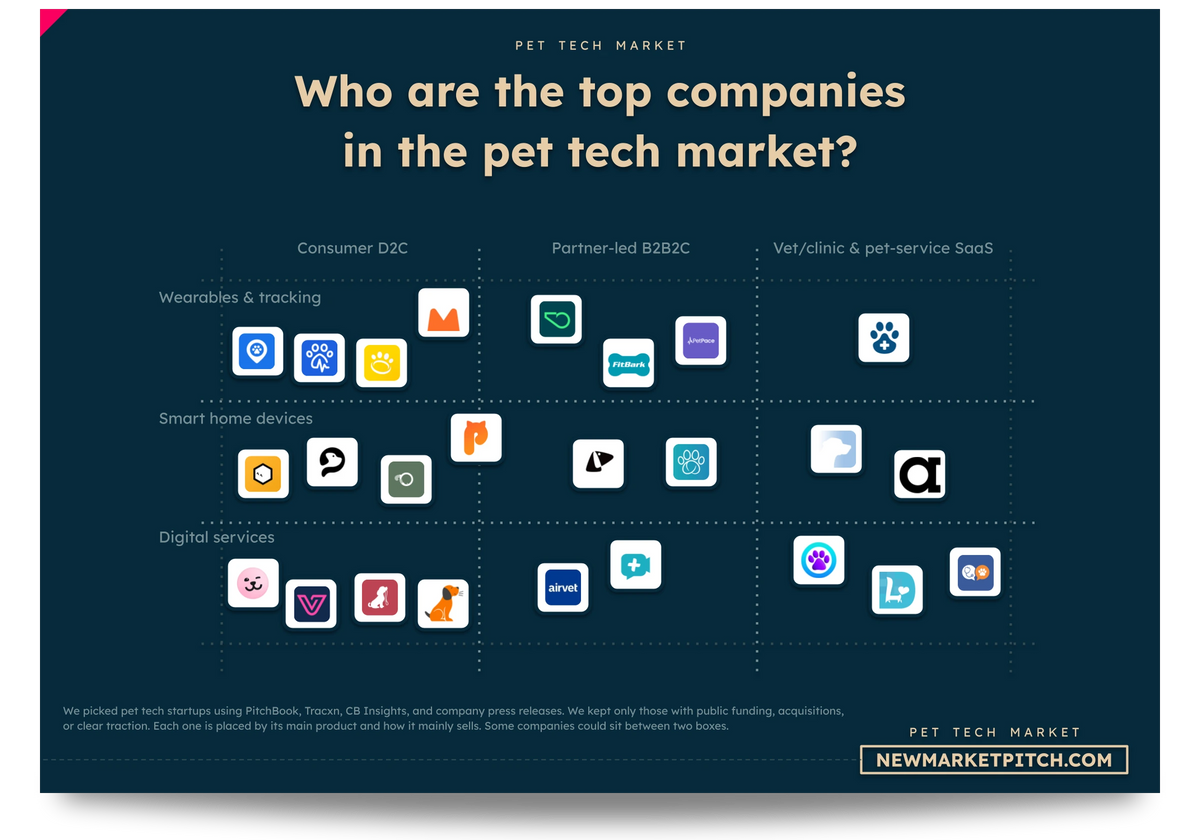
In our report covering the pet tech market, we turn what is vague and complex into simple, useful visuals. Market maps like this one show you at a glance where every startup stands.
Which modern veterinary clinic startup is winning right now?
Modern Animal is currently the strongest success story among modern veterinary clinic startups, although GoodVets leads in clinic count and Petfolk remains one of the most interesting independent competitors.
The ranking has changed following three major deals. Chewy acquired Modern Animal for approximately $400 million, GoodVets expanded to 116 hospitals by buying WellHaven Pet Health, and Bond Vet merged with Small Door Veterinary to create a network of more than 55 clinics.
We reviewed those transactions alongside funding histories, clinic productivity, financial disclosures and geographic expansion. Modern Animal stands out because Chewy disclosed more than $125 million in annualized revenue, positive clinic-level EBITDA and mature practices generating more than twice the industry's average revenue per clinic. GoodVets has greater physical scale, but comparable financial figures are unavailable.
So the answer depends on what we're measuring: the largest network, the strongest demonstrated clinic economics or the best remaining independent startup. On commercial evidence, Modern Animal wins.
Why are investors putting so much money into modern veterinary clinics?
Modern veterinary clinics are attracting investors because the U.S. pet healthcare market is already worth around $40 billion, and newer operators believe they can deliver better care experiences while generating more revenue per practice.
According to Chewy's April 2026 acquisition announcement, veterinary services are growing at approximately 5% annually. The American Veterinary Medical Association's 2026 ownership research also identified 58.9 million dog-owning households and 46 million cat-owning households in the United States.
Modern Animal, Bond Vet and Petfolk have built businesses around frustrations that traditional clinics sometimes struggle to address: appointment availability, communication, pricing clarity and access to urgent care. Modern Animal uses memberships and 24/7 virtual care, Bond Vet combines primary and urgent care, and Petfolk connects physical clinics with digital services. Booking delays and unclear pricing frustrate owners; we study the customers and what they would pay to fix in our pet tech market report.
Their financial models still depend heavily on in-person treatment. The opportunity lies in attracting more patients, bringing them back regularly and making better use of veterinarians' time.
Which modern vet startups have the most clinics today?
GoodVets is now the largest of the emerging veterinary networks we examined, with 116 hospitals after acquiring WellHaven Pet Health in September 2026.
The acquisition added 41 hospitals to GoodVets' previous network of 75. By comparison, Bond Vet and Small Door reported more than 55 combined clinics when they merged in July, while Petfolk's published directory lists approximately 49 care centers across multiple metropolitan markets. Modern Animal had 29 clinics when Chewy acquired it.
The differences are substantial. GoodVets has more than twice the footprint of the Bond Vet–Small Door combination and roughly four times Modern Animal's acquired network. However, these counts mix newly built locations with acquired practices, and some directories can include upcoming openings.
We also exclude established chains such as Banfield, VCA and National Veterinary Associates from the startup ranking. Those operators are much larger, but they belong to a different generation of veterinary businesses.
| Veterinary company | Reported clinics | Recent development |
|---|---|---|
| GoodVets | 116 | Acquired WellHaven |
| Bond Vet + Small Door | More than 55 | Completed merger |
| Petfolk | Approximately 49 | Multistate expansion |
| Modern Animal | 29 | Acquired by Chewy |
| Chewy Vet Care | 18 before acquisition | Integrated Modern Animal |
| WellHaven | 41 | Acquired by GoodVets |
| Small Door | 13 | Merged with Bond Vet |
| Chewy Vet Care + Modern Animal | 47 immediately after acquisition | Combined network |
The standalone clinic counts in the table are included in their respective combined networks and should not be added together.

Our research about pet technology gets updated several times a month, so you always get the latest view of where things stand.
Does Modern Animal make more money per clinic than its competitors?
Modern Animal has the strongest publicly documented clinic productivity among the modern veterinary startups we examined, with mature locations generating approximately $5 million to $6 million or more in annual revenue.
Chewy's April 2026 investor presentation compared that figure with an industry range of approximately $1.5 million to $2.5 million per practice. Modern Animal's representative mature clinics therefore generate roughly two to four times as much revenue as clinics in that comparison group.
Chewy Vet Care, meanwhile, targets more than $3.5 million in steady-state revenue per clinic. Its target is below Modern Animal's demonstrated mature-clinic range, despite both businesses pursuing technology-enabled veterinary care.
That's a substantial productivity advantage. The catch is that Modern Animal's figures refer to mature practices rather than the average across its entire network. GoodVets, Petfolk and Bond Vet have not published directly comparable revenue-per-clinic figures.
Is Modern Animal actually profitable?
Modern Animal has demonstrated profitable clinics, but its entire veterinary business has not yet been shown to generate sustained consolidated profits.
Chewy disclosed positive four-wall EBITDA at Modern Animal's clinic level, with mature practices capable of exceeding 20% margins. Its investor presentation indicated that approximately one-third of locations had already reached that margin threshold.
At $5 million in annual revenue, a 20% four-wall EBITDA margin translates into approximately $1 million before corporate overhead, financing expenses and other excluded costs. These are attractive economics for a physical healthcare business.
There is an important limitation: Modern Animal clinics typically take two to four years to mature. Chewy expected the acquisition to be approximately neutral to EBITDA dollars in fiscal 2026, with a positive contribution beginning in fiscal 2027.
Profitable mature clinics are encouraging. But they aren't the same thing as a profitable company, particularly when new locations are still absorbing substantial opening and operating costs. A profitable mature clinic is not yet a profitable company, so we compare which models keep their margins in our report on pet tech.
Was Chewy's $400 million acquisition of Modern Animal a good exit?
Modern Animal achieved one of the clearest realized exits in the modern veterinary startup market when Chewy completed its acquisition for approximately $399.8 million in May 2026.
Chewy's subsequent SEC filing broke the transaction into a $399.8 million purchase price and $378 million of cash paid after deducting $21.8 million of cash acquired. Its preliminary purchase-price allocation included $221.6 million of goodwill, $39 million in customer relationships, $19 million in trademarks and $6 million in developed technology.
Those figures tell us something interesting about what Chewy bought. Goodwill and customer relationships accounted for more than $260 million of the purchase-price allocation, considerably more than the value assigned to Modern Animal's developed technology.
Using Chewy's disclosure of more than $125 million in annualized revenue, the acquisition price was below approximately 3.2 times run-rate sales. That comparison is indicative rather than a formal enterprise-value multiple.
Modern Animal had also raised approximately $229 million historically, according to Sacra. The acquisition price was higher than that total, but the difference cannot be interpreted as an investor profit without knowing dilution, preferences and ownership.

In our market report about pet technology, we look at what the winners do differently, so you can learn from the best instead of guessing.
Could GoodVets be the real leader in modern veterinary clinics?
GoodVets has the strongest claim to leadership in physical scale, particularly after increasing its hospital network by almost 55% through one acquisition.
Its September 2026 purchase of WellHaven added 41 hospitals across seven states. According to transaction adviser Holland & Knight, the deal expanded GoodVets' reach into the Pacific Northwest and Midwest.
The move also marks a change in how GoodVets grows. Founded in 2016, the company developed its reputation by opening hospitals with entrepreneurial veterinarians, combining local clinical leadership with centralized business support. Buying WellHaven gave it a ready-made regional network instead.
That's a much faster way to expand, though there's no public evidence yet that the newly acquired hospitals produce the same revenue or margins as GoodVets' original practices.
GoodVets has earned the scale crown among the newer networks. Whether it deserves the financial-performance crown is another question, and we don't have the figures to award it.
Did the Bond Vet–Small Door merger create a serious rival?
Bond Vet and Small Door have become a much more significant competitor since merging into a network serving more than 500,000 pets across the Northeast, Mid-Atlantic and Midwest.
The July 2026 announcement reported more than 170 veterinarians and over 1,000 employees across the combined organization. Florent Peyre, Small Door's co-founder and CEO, took leadership of the merged business.
The two brands also bring different strengths. Bond Vet developed a convenient mix of urgent and primary veterinary care, while Small Door built a membership-based service around personalized appointments, digital communication and continuity of care. As urgent-care and membership brands merge, the market maps and grids in our report covering the pet tech market show where each brand now sits.
Interestingly, the businesses often served the same neighborhoods before merging. Their combination therefore creates opportunities to share clinical resources and coordinate patient care within existing markets.
Financial terms were not disclosed, and both brands continue operating separately in the near term. The merger creates a larger competitor, but improved margins and retention still need to be demonstrated.
Is Petfolk the most promising independent vet clinic startup?
Petfolk is one of the strongest independent candidates today, with a growing multistate clinic network and roughly $155 million to $159 million in reported cumulative financing.
The company's financing history is particularly revealing. Forge records a $40.22 million Series B in October 2023 at a $245 million post-money valuation, followed by a $36 million Series C in October 2024 at approximately $308.3 million.
Its latest $40 million Series D is associated with a roughly $358.8 million post-money valuation in Forge's data. That represents approximately 16.4% appreciation from the previous reported valuation, compared with roughly 25.8% between the Series B and Series C.
These figures do not provide a clean like-for-like measure of investor returns, but they suggest that Petfolk has continued raising money at higher valuations without the explosive repricing seen in some software startups.
Petfolk also has a different geographic strategy from Modern Animal's concentrated California, Colorado and Texas footprint. Its directory covers cities including Atlanta, Charlotte, Dallas, Houston, Orlando and Raleigh, with expansion into additional markets.
The next test is financial. Petfolk has the footprint and investor backing to be taken seriously, but without reliable revenue and profit figures, we cannot tell whether its newer locations can match Modern Animal's mature practices.

In our document detailing everything you need to know about pet tech, you will always find fresh funding data, taken straight from our own verified funding database.
Which modern veterinary startup has raised the most funding?
Bond Vet appears to have raised the most capital among the major emerging brands in our comparison, with CB Insights reporting approximately $245.45 million, ahead of Modern Animal's roughly $229 million.
Petfolk follows with approximately $155 million to $159 million, depending on the database. Its reported funding includes substantial rounds led or supported by investors such as Movendo Capital, White Star Capital and Deerfield Management.
Funding totals need some care because databases can handle debt, equity and historical transactions differently. They also say little about how much cash each business has left.
The more interesting comparison is what happened after the fundraising. Modern Animal reached an acquisition, Bond Vet expanded through a merger, and Petfolk remains privately financed for further growth.
| Company or event | Reported amount | Type |
|---|---|---|
| Bond Vet | ~$245.45M | Cumulative funding |
| Modern Animal | ~$229M | Cumulative funding |
| Petfolk | ~$155M–$159M | Cumulative funding |
| Petfolk Series B | $40.22M | Equity financing |
| Petfolk Series C | $36M | Equity financing |
| Petfolk Series D | $40M | Equity financing |
| Petfolk latest indicated valuation | ~$358.8M | Post-money valuation |
| Modern Animal acquisition | ~$399.8M | Purchase price |
Individual Petfolk rounds are already included in its cumulative funding total.
Do pet owners really want veterinary memberships?
Modern Animal has demonstrated meaningful demand for veterinary memberships, with Chewy reporting more than 100,000 member families when it announced the acquisition.
Modern Animal's service combines membership access with virtual care, in-app communication and physical appointments. Small Door has pursued a similar membership relationship, while Petfolk offers connected digital and in-person services.
What makes Modern Animal's approach particularly interesting is the combination of recurring relationships and high clinic productivity. Its model encourages customers to use the same veterinary network over time, while digital communication makes ongoing care easier.
Still, the company has not published enough information to calculate reliable membership churn, customer lifetime value or the exact share of revenue generated by subscription fees.
There is clearly demand for the membership experience. Whether memberships themselves explain Modern Animal's financial advantage is much harder to establish. Location, pricing and clinical operations could be doing much of the work. Whether memberships, location or pricing earn the credit matters when we study what leaders do differently in our market report about pet tech.
Will Chewy make Modern Animal grow much faster?
Chewy has given Modern Animal access to a much larger customer base and the resources to expand more quickly, although the full commercial benefit is still ahead.
The acquisition brought Modern Animal into an ecosystem with more than 21 million active Chewy customers, an established prescription platform and the Autoship subscription business. Chewy also targeted approximately 60 combined veterinary locations by the end of fiscal 2026.
A particularly interesting part of Chewy's investor presentation concerns cross-selling. The company estimated that veterinary clinic customers could generate a 15% to 20% increase in net sales per active customer through greater engagement across its ecosystem.
That gives Chewy a financial advantage beyond the veterinary appointment itself. A clinic can introduce customers to prescription purchases, recurring food deliveries and other pet-health products.
It's a compelling advantage on paper. But the uplift remains a company expectation, and Chewy has not yet provided enough post-acquisition data to prove that Modern Animal's members are generating those incremental sales at the projected rate.

Learning from others' mistakes is the cheapest lesson there is. In our report covering the pet tech market, we look at what broke startups before you, so you don't repeat it.
Are veterinary startups growing mainly by buying other clinics?
Acquisitions have recently become one of the fastest ways for modern veterinary networks to expand, with three major transactions reshaping the competitive landscape in a short period.
GoodVets added 41 WellHaven hospitals, Bond Vet combined with Small Door's existing network, and Chewy bought Modern Animal's clinics. Taken together, the transactions involved at least 125 locations entering new ownership or combined corporate structures.
None of those locations necessarily represents newly created veterinary capacity. The same hospitals and medical teams can remain in place while the corporate network becomes much larger.
That distinction is worth remembering when comparing growth rates. Petfolk's development of new care centers and GoodVets' traditional ground-up hospital model involve different capital requirements, opening schedules and recruitment challenges from acquisitions.
Building new clinics and consolidating existing practices will likely continue side by side. For now, acquisitions can change the size rankings almost overnight.
Can modern veterinary clinics find enough veterinarians to keep expanding?
Hiring enough veterinarians could become a real constraint for modern clinic startups, especially those opening multiple locations across different cities.
Chewy's investor presentation provides a useful productivity benchmark: Modern Animal's mature clinics generate approximately $1.1 million in net revenue per veterinarian. At that productivity level, a practice producing $5.5 million annually would need roughly five revenue-generating veterinarian equivalents.
The Bond Vet–Small Door merger reported over 170 veterinarians for a network of more than 55 clinics, giving a rough ratio of three veterinarians per clinic based on its disclosed minimum footprint. The figures are not directly comparable because staffing schedules and service mixes differ. Finding enough veterinarians is among the less obvious risks we rate by likelihood in our report on pet tech.
Still, the staffing question becomes harder as these networks expand. Recruiting five veterinarians for one established metropolitan practice is different from recruiting dozens across newly entered cities.
Modern Animal's productivity suggests its operating model can support well-staffed, high-revenue practices. Competitors have not released similarly detailed productivity benchmarks.
Are modern veterinary clinics actually cheaper than traditional vets?
Modern veterinary clinics have not established a clear pricing advantage over traditional practices, despite offering more digital services and easier appointment booking.
Modern Animal emphasizes membership access and connected care, Bond Vet promotes convenient urgent and primary services, and Small Door focuses on personalized appointments and transparent communication. These are mainly service improvements.
According to the AVMA's 2025 pet-owner survey, the average reported cost of the most recent veterinary visit was approximately $200, compared with $147 in the previous survey and $190 in 2023. The changing figures reflect reported visits with different treatments and respondents, so they cannot be treated as a standardized price index.
There is also no reliable nationwide comparison showing that the same examination, vaccination or procedure consistently costs less at Modern Animal, Petfolk or GoodVets.
For now, convenience and experience are much more convincing selling points than lower prices.

Your time is limited. In our research about pet technology, we put numbers on each part of the market, so you can see where it makes sense to focus.
Can Modern Animal, GoodVets or Petfolk seriously challenge Banfield and VCA?
Modern Animal, GoodVets and Petfolk can challenge established veterinary chains in individual cities, but their networks remain far smaller than Banfield, VCA and National Veterinary Associates.
Those established groups operate hundreds or thousands of veterinary practices, while even the largest emerging network in our comparison has only recently passed 100 hospitals.
The competitive opportunity is most visible in metropolitan markets. A modern operator can establish several convenient locations, create a recognizable brand and offer digital services that improve communication with pet owners.
For example, Modern Animal developed a concentrated network in the Los Angeles area, Bond Vet built a strong presence in New York, and Petfolk has expanded across several southeastern and southwestern cities.
National market share will take much longer to change. Yet smaller networks can still build valuable businesses if their individual clinics consistently outperform conventional practices.
Modern vet clinics: which startup is ahead overall?
Modern Animal is currently the strongest proven modern veterinary clinic startup, GoodVets leads in physical scale, and Petfolk is one of the most promising independent challengers.
Modern Animal's advantage comes from evidence we can actually measure: high revenue per mature clinic, positive four-wall EBITDA, meaningful membership adoption and a completed strategic acquisition. Its financial disclosures are considerably more detailed than those of the other emerging networks.
GoodVets deserves a different kind of recognition. Its WellHaven acquisition moved it well ahead in hospital count, although we still lack comparable figures showing what those hospitals earn. Bond Vet and Small Door now represent a meaningful combined competitor, while Petfolk has continued attracting capital and expanding across the country.
The biggest change is that Modern Animal now belongs to Chewy. Its future growth will benefit from a much larger pet-commerce business, but its independence is gone.
Modern Animal has delivered the clearest commercial validation of the modern veterinary clinic model. GoodVets has built the largest emerging network, and Petfolk remains particularly worth watching. The next winner will be the company that can reproduce strong clinic economics across dozens of additional locations without letting expansion costs overwhelm the business. Repeating strong clinic economics across many new locations is a signal we follow every quarter in our report covering the pet tech market.
Our methodology
This analysis compares modern veterinary clinic startups using the latest available evidence on market position, physical expansion, clinic-level economics, profitability, capital raised, acquisition outcomes, customer adoption and operational scalability. We examined Modern Animal, GoodVets, Petfolk, Bond Vet and Small Door Veterinary, while using established veterinary chains as broader industry context.
We compared clinic counts with reported financial performance rather than treating network size as proof of leadership. We distinguished ground-up clinic openings from acquisitions, mature-clinic productivity from network-wide averages, and positive four-wall EBITDA from consolidated profitability. We also separated completed acquisition prices from private fundraising valuations and estimated future synergies.
For Modern Animal, we used Chewy's acquisition announcement, investor presentation and SEC disclosures to assess annualized revenue, mature-clinic economics, membership adoption, acquisition consideration and preliminary purchase-price allocation. For GoodVets and the Bond Vet–Small Door combination, we examined transaction announcements and reported operating footprints. Petfolk's financing history and valuation were assessed using specialized private-company databases, while its geographic presence was compared with its published location directory.
Our final ranking gives greater weight to demonstrated operating performance and completed transactions than to capital raised or planned expansion. Where financial disclosures were incomplete, we limited our conclusions to the metrics that could be compared reliably. Industry benchmarks and veterinary workforce data were used to assess whether current performance could reasonably be reproduced across larger networks.
Key sources used for this analysis include: Chewy's Modern Animal acquisition announcement, Chewy's April 2026 investor presentation, Chewy's SEC quarterly filing, Holland & Knight on the GoodVets–WellHaven acquisition, the Bond Vet–Small Door merger announcement, Petfolk's location directory, Forge's Petfolk financing and valuation data, CB Insights on Bond Vet's funding, CB Insights on Petfolk's funding, Sacra's Modern Animal financial profile, and the American Veterinary Medical Association's pet ownership research.

In our market report about pet technology, we always try to gather several sources and make estimates that make sense, so you can work with solid numbers.
Written by the New Market Pitch teamWe track new markets so founders and investors can move faster. About us