
What are the funding trends in RL environments?
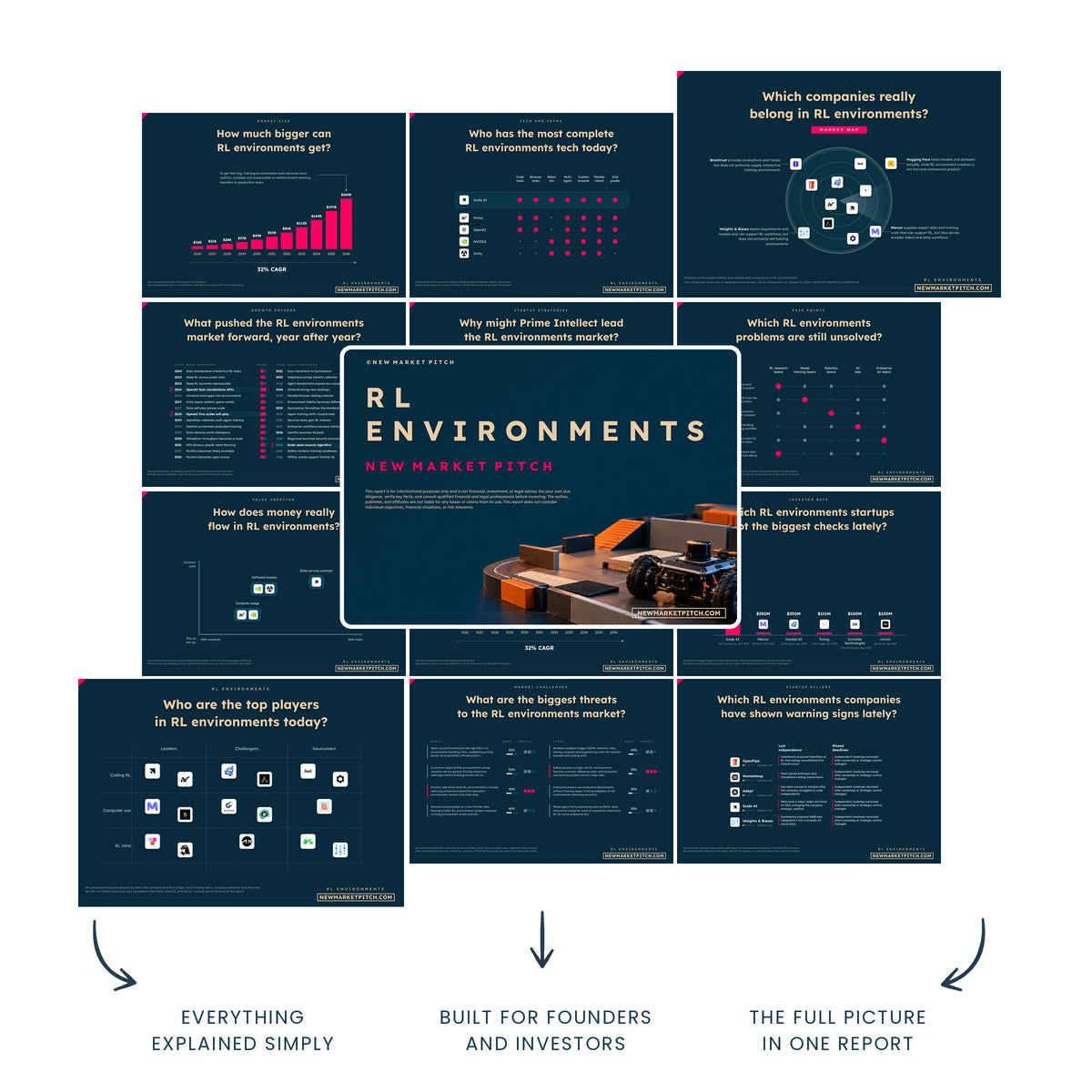
Whether you're building or investing in the RL environments market, our report covers everything you need to know: the players, the money, and what's coming next.
Summary
RL environments funding is spreading to more types of companies, although the historical samples are too small for a dependable growth-rate claim. This year to date, we track 25 deals across 24 companies and at least $1.1B. Snorkel AI's $350M Series D+ in September 2026 is the largest deal of the period.
More startups are appearing in the financing record. At this point in 2025, we counted 17 deals across 15 companies. At the comparable point in 2024, it was 7 deals across 6 companies. This is a wider market than one established supplier raising again.
Dollar totals need one warning. We show at least $69M for that same part of 2024 because Scale AI's $1B Series D+ in May 2024 mixed new money with sales of existing shares, and the new-money part was never published, so the round counts without an amount. Even so, today's at least $1.1B rests on a far broader group of startups.
Smaller rounds tell a different story. Excluding deals above $50M leaves at least $355M this year to date, against at least $103M at the comparable point in 2025 and at least $69M in 2024. More money is reaching businesses below the headline tier.
The median disclosed round is also larger: $24M this year to date, versus $15M in the same period of 2025 and $6.9M in the same period of 2024. That does not mean every seed-stage founder can now raise a big check.
Human-data-led suppliers still take the biggest share, with at least $632M this year. But enterprise and professional workflow environments recorded 6 deals, while coding, browser and science specialists also raised money. Investors are funding much more than expert recruitment.
The new product companies are mostly financing early growth. Seed accounts for 11 deals and Series A for 7 this year to date; no Series C deal has been recorded. Mature training-data suppliers still shape the largest money totals.
Investors have started to spread their bets. We find 60 unique participating investors this year to date, compared with 25 at the same point in 2025. Many have yet to lead another round, so that wider roster is not the same as reliable funding at every stage.
The financing comes in bursts. Q3 2026 saw a busy run of deals, helped by Snorkel AI, while Q4 2026 is still incomplete. One strong quarter is not a forecast of the next one.
RL environments are developing into a broader market for fundable products. More companies and more non-megaround money are visible, but the uneven flow of rounds still makes the market hard to predict.

Written by the New Market Pitch teamWe track new markets so founders and investors can move faster. About us

In our report covering the RL environments market, you will always find fresh funding data, taken straight from our own verified funding database.
All funding deals in the RL environments market over the last years
Below is the table listing all the deals. You can find our methodology at the end of this page.
If you want a deeper understanding of the market and its current dynamics, get our RL environments market report.
| Company | Category | Date | Stage | Deal size | What they do | Region | Lead investors | Country | Rank |
|---|---|---|---|---|---|---|---|---|---|
| Plurai | RL environment platforms | November 2026 | Seed | $13M | Builds stateful digital-twin simulations of agent tools, policies and workflows, with executable tasks and outcome-based evaluations. | North America | Team8 | United States | |
| Alterra Labs | Enterprise & professional workflows | November 2026 | Seed | $12M | Creates executable medical and health-system workflow environments with clinician-designed scoring and RL training feedback. | North America | Oak HC/FT | United States | |
| Mercor | Human-data-led RL environments | November 2026 | Series D+ | Undisclosed | Expert recruitment and AI training data | North America | Not disclosed | United States | |
| Plato | Computer & browser use | October 2026 | Series A | $16M | Creates simulated digital workplaces and feedback environments used to train and improve AI agents. | North America | Nava Ventures | United States | |
| Labelbox | Human-data-led RL environments | October 2026 | Series D+ | $93M | AI training data and evaluation | North America | Infinitum Partners | United States | |
| Phinity | Science, mathematics & engineering | October 2026 | Seed | $5.2M | Builds chip design training environments and verifiers | North America | Uncork Capital | United States | |
| Preference Model | Science, mathematics & engineering | October 2026 | Seed | $16M | Reinforcement learning environments for AI | North America | Andreessen Horowitz | United States | |
| Halluminate | Enterprise & professional workflows | October 2026 | Series A | $30M | Reinforcement learning environments for knowledge work | North America | Oak HC/FT | United States | |
| Proximal | Coding & software engineering | September 2026 | Seed | $15M | Reinforcement learning data and environments | North America | General Catalyst | United States | |
| Snorkel AI | Human-data-led RL environments | September 2026 | Series D+ | $350M | Automated AI training data development | North America | Insight Partners, S32 | United States | |
| micro1 | Human-data-led RL environments | September 2026 | Series B | $100M+ | Expert-generated AI training and evaluation data | North America | Dream Ventures | United States | |
| Idler | Enterprise & professional workflows | August 2026 | Seed | $9M | RL environments for agentic AI | North America | Paradigm | United States | |
| AfterQuery | Human-data-led RL environments | August 2026 | Series B | $50M | Expert data for AI model training | North America | Not disclosed | United States | |
| Prime Intellect | RL environment platforms | July 2026 | Series A | $130M | Training and evaluation infrastructure for AI agents | North America | Radical Ventures | United States | |
| Bespoke Labs | Coding & software engineering | July 2026 | Series A | $31M | Reinforcement learning environments for autonomous agents | North America | Wing Venture Capital | United States | |
| Worldmodeldata | Human-data-led RL environments | July 2026 | Seed | $9M | Video game data for AI training | Europe | Iona Star Capital | United Kingdom | |
| Patronus AI | Enterprise & professional workflows | June 2026 | Series B | $50M | Simulation and evaluation environments for AI agents | North America | Greenfield Partners | United States | |
| Taste Labs | Enterprise & professional workflows | June 2026 | Seed | $18M | Builds preference-driven creative design training environments | North America | CRV, Amplify Partners | United States | |
| HUD | RL environment platforms | June 2026 | Series A | $16M | Reinforcement learning environment development platform | North America | Standard Capital | United States | |
| Luel | Enterprise & professional workflows | May 2026 | Seed | $31M | Marketplace for multimodal human data | North America | General Catalyst, Lightspeed Venture Partners | United States | |
| AfterQuery | Human-data-led RL environments | April 2026 | Series A | $30M | Expert data for AI model training | North America | Altos Ventures | United States | |
| Mechanize | Coding & software engineering | April 2026 | Unknown | $9.1M | Simulated environments for agent training | North America | Not disclosed | United States | |
| Deeptune | Computer & browser use | March 2026 | Series A | $43M | Builds workplace software simulations for agent training | North America | Andreessen Horowitz | United States | |
| Olam Labs | Games, social & physical simulation | 2026 | Seed | Undisclosed | Creates multi-agent social simulations for model training | North America | Not disclosed | United States | |
| Polymath | Coding & software engineering | 2026 | Seed | Undisclosed | Builds long-horizon software-engineering training simulations | North America | Not disclosed | United States | |
| Prime Intellect | RL environment platforms | December 2025 | Unknown | Undisclosed | Training and evaluation infrastructure for AI agents | North America | Not disclosed | United States | |
| Mercor | Human-data-led RL environments | October 2025 | Series C | $350M | Expert recruitment and AI training data | North America | Felicis | United States | |
| Datacurve | Coding & software engineering | October 2025 | Series A | $15M | Expert coding data for AI models | North America | Chemistry | United States | |
| Good Start Labs | Games, social & physical simulation | October 2025 | Seed | $3.6M | Game-based AI training environments | North America | General Catalyst, Inovia Capital | United States | |
| Invisible Technologies | Human-data-led RL environments | September 2025 | Growth Equity | $100M | Enterprise AI training and operations | North America | Vanara Capital | United States | |
| micro1 | Human-data-led RL environments | September 2025 | Series A | $35M | Expert-generated AI training and evaluation data | North America | 01 Advisors | United States | |
| Snorkel AI | Human-data-led RL environments | August 2025 | Unknown | Undisclosed | Automated AI training data development | North America | Not disclosed | United States | |
| General Reasoning | RL environment platforms | July 2025 | Seed | $11M | Develops open reward and RL environment tools | Europe | Not disclosed | United Kingdom | |
| Veris AI | Enterprise & professional workflows | June 2025 | Seed | $8.5M | Simulates enterprise systems and users for agents | North America | Decibel Ventures, Acrew Capital | United States | |
| Turing | Human-data-led RL environments | June 2025 | Series D+ | $111M | Expert data for frontier AI | North America | Khazanah Nasional | United States | |
| SuperAnnotate | Human-data-led RL environments | June 2025 | Series B | $14M | Enterprise AI data annotation platform | North America | Dell Technologies Capital | United States | |
| Snorkel AI | Human-data-led RL environments | May 2025 | Series D+ | $100M | Automated AI training data development | North America | Addition | United States | |
| Toloka | Human-data-led RL environments | May 2025 | Growth Equity | $72M | Expert human feedback for AI | Europe | Bezos Expeditions | Netherlands | |
| Mechanize | Coding & software engineering | April 2025 | Seed | Undisclosed | Simulated environments for agent training | North America | Not disclosed | United States | |
| HUD | RL environment platforms | March 2025 | Seed | $500K | Reinforcement learning environment development platform | North America | Not disclosed | United States | |
| Prime Intellect | RL environment platforms | February 2025 | Seed | $15M | Training and evaluation infrastructure for AI agents | North America | Founders Fund | United States | |
| Mercor | Human-data-led RL environments | February 2025 | Series B | $100M | Expert recruitment and AI training data | North America | Felicis | United States | |
| BenchFlow | RL environment platforms | February 2025 | Seed | $1M | Builds interactive agent benchmarks and test environments | North America | Not disclosed | United States | |
| Cua | RL environment platforms | 2025 | Seed | Undisclosed | Provides computer sandboxes and verifiable task benchmarks | North America | Not disclosed | United States | |
| Fleet AI | Computer & browser use | 2025 | Seed | Undisclosed | Builds simulated business applications for computer agents | North America | Not disclosed | United States | |
| Hillclimb | Science, mathematics & engineering | 2025 | Seed | Undisclosed | Designs mathematical reasoning environments with objective rewards | North America | Not disclosed | United States | |
| Phinity | Science, mathematics & engineering | 2025 | Seed | Undisclosed | Builds chip design training environments and verifiers | North America | Pear | United States | |
| Symbal | Human-data-led RL environments | 2025 | Seed | Undisclosed | Makes benchmark tasks and post-training environments | North America | Not disclosed | United States | |
| SuperAnnotate | Human-data-led RL environments | November 2024 | Series B | $36M | Enterprise AI data annotation platform | North America | Socium Ventures | United States | |
| Mercor | Human-data-led RL environments | September 2024 | Series A | $30M | Expert recruitment and AI training data | North America | Benchmark | United States | |
| Bespoke Labs | Coding & software engineering | June 2024 | Seed | $8.2M | Reinforcement learning environments for autonomous agents | North America | 8VC | United States | |
| Patronus AI | Enterprise & professional workflows | May 2024 | Series A | $17M | Simulation and evaluation environments for AI agents | North America | Notable Capital | United States | |
| Scale AI | Human-data-led RL environments | May 2024 | Series D+ | Undisclosed | AI data labeling and evaluation | North America | Accel | United States | |
| Prime Intellect | RL environment platforms | April 2024 | Seed | $5.5M | Training and evaluation infrastructure for AI agents | North America | Distributed Global, CoinFund | United States | |
| Matrices | Computer & browser use | March 2024 | Seed | $5M | Creates browser-workflow environments for agent learning | North America | Index Ventures | United States | |
| Mercor | Human-data-led RL environments | January 2024 | Seed | $3.6M | Expert recruitment and AI training data | North America | General Catalyst | United States | |
| Plato | Computer & browser use | 2024 | Seed | Undisclosed | Creates simulated digital workplaces and feedback environments used to train and improve AI agents. | North America | Gradient | United States |

In our research about RL environments startups, we turn what is vague and complex into simple, useful visuals. Market maps like this one show you at a glance where every startup stands.
Is RL environments funding really taking off this year?
RL environments funding is reaching more businesses this year, although the short history does not yet prove sustained acceleration.
This year to date contains 25 deals across 24 companies, compared with 17 deals across 15 companies in the same period of 2025 and 7 deals across 6 companies in the same period of 2024. The deal count is rising, though the small samples make percentage growth rates misleading. Disclosed capital went from at least $69M in that part of 2024 to at least $936M in 2025 and at least $1.1B this year. The 2024 figure leaves out Scale AI's $1B Series D+ of May 2024, whose new-money part was never published.
Investors are also backing a wider range of products. Halluminate builds finance-focused training worlds, Deeptune recreates business software for agent practice, and Prime Intellect operates shared training infrastructure. Those are different investment propositions from broad expert-data supply. That is a change in what gets financed; it does not guarantee another strong quarter.
Has RL environments funding already beaten the previous full year?
Yes, RL environments funding has already passed the previous full-year total, even though this year is still incomplete.
We track 25 deals and at least $1.1B this year to date, compared with 23 deals and at least $936M across the full year of 2025. This is a partial-year versus full-year comparison, not a forecast or an annualized growth rate. A few very large rounds also weigh heavily on both totals. Snorkel AI led the tracked deals this year, while Mercor led the preceding full year.
The full-year comparison sounds dramatic, but the amounts still depend on big checks. Funding has already cleared the previous annual mark, and the market is financing more distinct specialists. But since one giant check can swing the total, the better sign is the many smaller software and workflow rounds underneath.
Is RL environments funding growing even without huge rounds?
Even without the huge deals, RL environments funding has become more substantial in comparable calendar periods.
Excluding financings above $50M leaves at least $355M this year to date, against at least $103M in the same period of 2025 and at least $69M in the same period of 2024. The headline totals rise less sharply against 2025, from at least $936M to at least $1.1B, because the 2025 period already held several rounds above $50M. This year, mid-sized transactions include Deeptune's $43M Series A in March 2026, Halluminate's $30M Series A in October 2026 and Bespoke Labs' $31M Series A in July 2026.
Those businesses attack distinct technical difficulties: digital workplaces, verifiable professional finance tasks and coding-agent training. Their checks suggest investors are financing the practical infrastructure that makes model improvement measurable. They will need to sell and update these environments as models and customers change.
Are more RL environment startups getting funded this year?
More RL environment startups are receiving checks this year than at the same point in earlier years.
We identify 24 funded companies this year to date, compared with 15 by the same point in 2025 and 6 by the same point in 2024. Most of this year's businesses appear once in the financing record: 23 companies have 1 round in the period and 1 company has 2. That is very different from growth driven by a small group repeatedly raising. Newly visible company types include healthcare workflow environments, simulated financial tasks, chip-design verifiers and browser-training infrastructure.
Plurai's $13M Seed in November 2026 shows how a new business can finance agent simulation. Preference Model is pursuing a different problem: verifiable tasks for machine-learning research. Those new companies broaden the market, even if repeat customer spending remains unproven.

In our market report about RL environments startups, we always try to gather several sources and make estimates that make sense, so you can work with solid numbers.
Are RL environment startups raising bigger rounds this year?
The median RL environments round is bigger this year, although the comparable samples remain small.
The median disclosed round is $24M this year to date, compared with $15M in the same period of 2025 and $6.9M in the equivalent period of 2024. The year-to-date comparison removes the most basic calendar distortion, but the older period still contains very few transactions. This year also has no disclosed deal under $5M, whereas 3 disclosed deals in the comparable 2025 period fell into that bucket. Investors now appear more willing to write institutional-sized checks, while the smallest deals are less visible.
The products receiving capital also carry more demanding engineering requirements. Deeptune builds faithful workplace simulations, Patronus AI finances a digital-world simulation platform, and Prime Intellect combines environment execution with scalable training. Such products need reliable state, safety and grading. That requires more upfront engineering, without telling us whether customer revenue is growing too.
Are $100M rounds becoming normal for RL environment startups?
No, $100M RL environments rounds still go to a small set of well-financed businesses.
The current partial year includes 3 disclosed rounds of $100M or more, against 5 in the comparable period of 2025 and none in the equivalent period of 2024, where Scale AI's Series D+ has no published new-money amount. The funded businesses span major data services and a training platform. But the existence of multiple huge checks does not make them a standard funding tier for young environment specialists.
Snorkel's September 2026 public statement described a scaled data operation, while Prime Intellect's July 2026 announcement described a broad open training stack. These platforms have wider operational obligations than a company making one domain-specific simulator. Large checks now reach more business models, but remain unusual.
Is Scale AI still defining the RL environments funding story?
Scale AI no longer defines the whole RL environments funding story, because many more specialist companies now receive checks.
In the same period of 2024, we track 7 deals and at least $69M. Scale AI's May 2024 Series D+ was the big name among them, but it adds no amount to our totals because its new-money part was never published. This year to date contains 25 deals across 24 companies, with Snorkel AI as the largest individual financing at $350M. More specialist firms are selling training tools that older data suppliers never packaged as separate products.
Scale's May 2024 announcement focused on serving many data-heavy sectors. Halluminate now builds scored finance tasks, and Plurai simulates agent failures. Mercor's November 2026 announcement also confirmed it had acquired Deeptune, showing that established training-data firms are buying specialist simulation skills rather than ignoring them. The business category has become more differentiated even while big suppliers remain central to dollars.

Our document detailing everything you need to know about RL environments gets updated several times a month, so you always get the latest view of where things stand.
Are expert-data suppliers still taking most RL environments money?
Yes, human-data-led suppliers still take the biggest share of RL environments funding, despite a rise in specialist software startups.
The category has 7 deals across 6 companies and at least $632M this year to date, representing 59% of disclosed capital. In the same period of 2025, it recorded 9 deals across 7 companies and at least $882M, representing 94% of disclosed capital. The distinction is substantive: expert-data providers can deliver the human judgment and evaluation tasks needed to make model training reliable, while other suppliers focus on the environment's software and feedback machinery.
Snorkel AI's September 2026 announcement combined automated data development with domain experts. Mercor's October 2025 company statement described physicians, lawyers and bankers generating professional training signals. Even the best simulator needs a reliable way to judge professional work.
Are investors finally backing office-work RL simulations?
Workplace simulation startups are now attracting much more RL environments funding.
This year to date, the category has 6 deals and $151M in disclosed capital, compared with 1 deal worth $8.5M in the same period of 2025. The recent financings span Halluminate's $30M Series A in October 2026, Patronus AI's $50M Series B in June 2026 and Alterra Labs' $12M Seed in November 2026. Halluminate concentrates on finance, Patronus on broader agent simulation, and Alterra on medical systems; they share the idea that correct execution through a realistic workflow is more valuable than a superficially fluent answer.
Oak HC/FT's October 2026 Halluminate thesis described constructing tasks with files, tools and colleagues, then checking the resulting work. Its November 2026 Alterra analysis stressed clinical reliability. That investor rationale helps explain the interest, but we cannot infer customer revenues or long-term demand from funding announcements alone. The checks have arrived; lasting customer demand is the next hurdle.
Are investors putting serious money into coding-agent environments?
Coding-agent RL environments now draw repeated institutional checks, although their rounds remain smaller than broad data suppliers'.
This year to date, we track 4 coding and software engineering deals across 4 companies and at least $55M. The same period of 2025 had 2 deals and less disclosed capital. Bespoke Labs' $31M Series A in July 2026 and Proximal's $15M Seed in September 2026 show venture interest in building and verifying tasks for autonomous coding systems. Mechanize's broader simulated-work proposal from April 2025 also demonstrates the demand for environments that go beyond static code-generation scores.
Wing Venture Capital's July 2026 note on Bespoke Labs emphasized verification as the binding constraint for agentic work. Coding provides a relatively clear reward surface because programs can be compiled, tested and checked. But even strong unit-test results can hide shortcuts or reward hacking. Investors are paying for tasks that measure actual software work, rather than tests a model can easily game.
Are browser-training simulations finally attracting investors?
Browser and computer-use RL environments have received funding this year, although only a few companies are involved.
This year to date, computer and browser use includes 2 deals worth $59M, while the comparable 2025 period recorded no deal in that category. Deeptune's $43M Series A in March 2026 and Plato's $16M Series A in October 2026 reflect investor belief that autonomous agents need realistic applications for repeated practice. Deeptune's March 2026 announcement explicitly compared model knowledge with the real experience required to operate email, accounting and other workplace software.
In March 2026, Browserbase and Prime Intellect announced BrowserEnv, a browser environment for training agents with RL. The difficult part is running a trustworthy version of the task again and again. A website can change between training runs, and external tools can introduce security risks or uncontrollable state. If these products become reliable, they could serve many categories of agents. So far, these deals show investor interest, not a steady stream of browser-training financings.

In our report covering the RL environments market, we look at what the winners do differently, so you can learn from the best instead of guessing.
Can scientific RL environments attract specialist VC money?
Scientific RL environments have begun attracting seed checks for research and engineering tasks.
This year to date, the category includes 2 deals and $21M. Preference Model's $16M Seed in October 2026 backs verifiable research and machine-learning engineering tasks; Phinity's $5.2M Seed in October 2026 backs autonomous chip-design environments. The 2025 comparable period did not register a deal in the category. Both companies work on tasks whose results can be checked against technical requirements.
Uncork Capital's October 2026 investment note on Phinity describes a chip-development process with concrete verification steps. These are potentially defensible tasks because wrong outputs can be checked. A few seed checks are too little to call this a lasting trend.
Are seed rounds taking over RL environments funding?
No, early-stage RL environment startups account for many deals, while older businesses still collect most disclosed capital.
This year to date, Seed accounts for 11 deals and at least $129M, while Series A accounts for 7 deals and $296M. Series D+ has only 3 deals yet accounts for at least $443M. Among deals with a named stage, 75% are early-stage, but later-stage financings capture 60% of disclosed capital. Many deals are early-stage, but much of the cash goes to older businesses. That division makes more sense when we compare a young research-world supplier with Snorkel AI, whose September 2026 financing supported an already developed data business.
The table below shows each financing stage in the current year-to-date period.
| Stage | Deals | Capital | Share of capital |
|---|---|---|---|
| Series D+ | 3 | $443M+ | 41% |
| Series A | 7 | $296M | 27% |
| Series B | 3 | $200M+ | 19% |
| Seed | 11 | $129M+ | 12% |
| Unknown | 1 | $9.1M | 1% |
| Series C | No deal | – | – |
| Growth Equity | No deal | – | – |
“+” means at least. A dash marks an unpublished measure.
Is there a Series C funding gap in RL environments?
RL environments have no recorded Series C deal this year, but the short funding history does not prove that companies are stuck.
This year to date, the category has no recorded Series C financing, even though it has 3 Series B rounds and 3 Series D+ rounds. In the same period of 2025, we recorded 1 Series C deal: Mercor's $350M Series C financing in October 2025. A few older suppliers raised later-stage money, while many of the newer teams still have early rounds.
Companies such as Halluminate, Deeptune and Preference Model entered or expanded funding at earlier stages while older suppliers raised larger checks. A missing middle stage could mean firms have not yet reached it, that stage labels differ, or simply that the relevant deal did not occur within the partial year. A missing Series C in one partial year does not mean those startups have failed. Later-stage financing remains irregular.
Are investors still writing first checks for RL environment startups?
Yes, some RL environment startups still secure first financings, though the number has not grown with overall deal activity.
We record 4 first financings totaling $84M this year to date. In the same period of 2025, there were 4 identified first financings worth at least $13M; in the same period of 2024 there were 3 totaling $17M. Much of the wider deal flow comes from companies that already raised before. Another 8 deals this year stay unclassified, because we call a round a follow-on only when an earlier equity round of the same company is on record.
Plurai's $13M Seed in November 2026, Alterra Labs' $12M Seed in November 2026 and Preference Model's $16M Seed in October 2026 show that investors are still financing first products in agent simulation, healthcare and model-research tasks. Their buyers will care about reliable improvements on real tasks, not the size of the seed round.

Learning from others' mistakes is the cheapest lesson there is. In our research about RL environments startups, we look at what broke startups before you, so you don't repeat it.
Are investors backing younger RL environment startups now?
The funded RL environment companies remain young, but their ages do not show a clear move toward newer founders.
The median funded company age is 1 year this year to date, compared with 2 years in the same period of 2025 and 1 year in the equivalent period of 2024. There is no steady shift toward older funded companies. Among financings above $50M, the median company age is 4 years this year, compared with 6.5 years at the equivalent point in 2025. This difference is consistent with a wider range of younger platforms receiving large investment, but the sample remains thin.
Halluminate's October 2026 finance-environment announcement and Plurai's November 2026 simulated-agent launch demonstrate how a new team can define a specialist product quickly. Yet building a credible dataset, secure execution and enterprise trust still takes time. These teams can start young, but shipping secure, reliable environments still takes work.
Are RL environment startups getting follow-on money faster now?
No, RL environment startups are not clearly returning for funding faster than before.
For dated gaps between successive financings of the same company, the median is 12.5 months this year to date. The comparable median was 10 months in the same period of 2025 and 8 months in the equivalent period of 2024. These are gaps between two rounds of the same company, not the share of companies that raised again. Usable dates exist for 48%, 53% and 43% of those gaps in the three periods. The earlier examples are particularly sparse, so small differences should not become a narrative about acceleration or failure.
Prime Intellect's financing sequence reflects an expanding training infrastructure product, while Mercor's capital history reflects an expert network broadening into evaluation and enterprise tools. Both illustrate reasons a company might raise again. The financing cadence itself does not reveal whether revenue, compute costs or customer commitments motivated a specific transaction.
Is the US still dominating RL environments funding?
Yes, US-headquartered startups receive nearly all recorded RL environments financing, even though agent development is global.
United States-headquartered companies account for 24 deals across 23 companies this year to date. The comparable 2025 period recorded 15 US deals across 13 companies. The only other country with a tracked financing this year is the United Kingdom, represented by Worldmodeldata's $9M Seed in July 2026. The headquarters split matters for access to venture firms, but it does not fully describe where professional task experts or environment developers operate.
Mercor's model depends on a broad expert network spread across many countries. Businesses like this can create or distribute training inputs far beyond their incorporation location. The geography of financing therefore remains concentrated even though the underlying labor and research may be globally dispersed.

If you build or invest in the RL environments market, you need to know which business models pay off now and which ones are fading. That's why our report covering it has a whole section on it.
Are more VC firms investing in RL environments now?
More VC firms now back RL environments, although few return repeatedly as lead investors.
This year to date includes 60 unique participating investors and 20 disclosed lead investors. At the comparable point in 2025, there were 25 participating investors and 13 disclosed leads. In 2024, there were 16 participants and 8 leads. The current lead list includes Andreessen Horowitz with 2 led rounds, General Catalyst with 2 and Oak HC/FT with 2. Those are different mandates: model research worlds, professional workflow data and domain-specific task simulation.
Founders now have more investors to approach than the firms already familiar with data labeling. Still, we identify only 3 repeated lead investors this year to date. Many others are appearing in individual deals. Many funds are trying the market; far fewer have come back to lead another round.
Did the strong Q3 change the RL environments funding story?
Q3 2026 brought a cluster of RL environment deals, but its dollar total still depended heavily on a major data supplier.
We track 8 deals across 8 companies during Q3 2026, with a median disclosed deal of $41M. The largest individual contributor was Snorkel AI. That does not mean every enterprise simulation startup can now raise checks that big. The quarter also contained Prime Intellect's $130M Series A in July 2026, Bespoke Labs' $31M Series A in July 2026 and several other focused training and data investments.
These rounds back three different kinds of company: Snorkel AI's expanded data-delivery business, Prime Intellect's full training stack and Bespoke Labs' technical verification work. The quarter says more about the breadth of funded products than about a lasting rise in check sizes.
Is RL environments funding slowing down this quarter?
It is too early to call a slowdown in RL environments funding while the current quarter is still incomplete.
Q4 2026 currently contains 8 deals across 8 companies totaling at least $186M. Q3 2026 also contained 8 deals, while Q2 2026 contained 6 deals totaling $155M. The headline amount is lower than the prior quarter's capital peak, but Q3 included Snorkel AI's large financing. October 2026 alone brought 5 deals, including environment specialists in finance, software and technical research. Transaction activity is continuing even if each check is not huge. Mercor's November 2026 Series D+ counts without an amount: the $750M it announced includes a tender for existing shareholders, and the new-money part was not published.
Some rounds are dated only by year and cannot be placed in a particular quarter. A partial quarter can gain more transactions before it closes, and one later giant financing can change the money total sharply.
The table below shows quarterly deal flow, including the still-open current quarter.
| Period | Deals | Companies | Capital |
|---|---|---|---|
| Q1 2025 | 4 | 4 | $116M |
| Q2 2025 | 6 | 6 | $305M+ |
| Q3 2025 | 4 | 4 | $146M+ |
| Q4 2025 | 4 | 4 | $369M+ |
| Q1 2026 | 1 | 1 | $43M |
| Q2 2026 | 6 | 6 | $155M |
| Q3 2026 | 8 | 8 | $695M+ |
| Q4 2026 (partial) | 8 | 8 | $186M+ |
Quarters add up to fewer deals than the yearly totals: 1 deal of 2024, 5 of 2025 and 2 of 2026 are dated only by the year, so they count in the yearly totals but in no quarter.
So, what are the funding trends in RL environments?
RL environments funding is reaching more teams and more kinds of software, but the bigger rounds still skew the totals.
The clearest change is that specialist RL environment startups now raise money alongside mature AI data suppliers. Agent-workflow simulations, coding verifiers, shared environment platforms and technical research worlds now receive financings in their own right. Still, later-stage capital dominates the dollars, United States headquarters dominate the funded company list, and the number of documented first checks remains limited. For founders, broader interest still comes with unpredictable financing.
The table below shows what we found.
| Question | Answer |
|---|---|
| Are more distinct companies attracting venture attention? | Yes, RL environments funding is reaching a broader collection of businesses. This year to date covers 24 funded companies. That creates more product variety without proving sustained demand. |
| Have smaller checks become a serious category? | Yes, financings below the giant-deal tier now matter much more. Excluding rounds above $50M leaves at least $355M this year. Specialist teams therefore have opportunities beyond the largest data providers. |
| Is the typical round still a small seed? | No, the typical round now looks like a real venture check. The current year-to-date median disclosed round is $24M. Even that figure should not set expectations for every early startup. |
| Have billion-dollar headlines finally become evenly distributed? | No, very large checks still belong to selected companies. The current period contains 3 deals of $100M or more. Most teams operate on a fundamentally different financing scale. |
| Are professional workflow worlds attracting institutional money? | Yes, business-task simulations are now a clear financed specialty. Enterprise and professional workflow environments secured 6 deals this year. Their defensibility depends on trustworthy scoring of complicated work. |
| Is coding a recognized RL training investment? | Yes, investors fund environments where coding outcomes can be verified. Coding and software engineering accounts for 4 deals this year. Better test design matters more than simply generating repositories. |
| Has scientific training moved out of academia? | Some scientific and engineering environments now receive venture financing. The specialty recorded 2 deals this year to date. Its long-term viability depends on customers verifying practical improvement. |
| Are new founders getting first checks easily? | They still obtain financing, but entry has not surged dramatically. This year contains 4 identified first financings for these startups. Private and previously undisclosed financings complicate any stronger conclusion. |
| Are the biggest funding checks moving earlier? | Early-stage activity is common while later-stage dollars remain highly concentrated. Series D+ attracted at least $443M this year. That concentration reflects mature suppliers, not the typical seed startup. |
| Have investors become a stable returning group? | Not yet, investor participation is broader than repeated leadership. This year contains 60 unique participating investors in the market. Only a small core has returned to lead multiple rounds. |
| Does a strong quarter prove continued acceleration? | No, a strong quarter can be shaped by individual financings. Q3 2026 recorded at least $695M in disclosed capital. The underlying diversity matters more than extrapolating that quarter indefinitely. |

In our document detailing everything you need to know about RL environments, we like to show you the big picture. We know your time is precious, so we make every page quick to read and packed with as much learning as possible per minute.
Our methodology
Our data runs through November 13, 2026. This year to date covers January 1, 2026 to November 13, 2026. We compare it with January 1 to November 13 of both 2025 and 2024; full calendar years 2025 and 2024 are used only when explicitly evaluating a full-year total against the current partial year. We never annualize a partial year.
We count equity financings by qualifying private companies at or above $300K. We exclude debt, grants, loans, unconverted convertibles, SAFEs and public offerings. Duplicate accounts of one announcement are merged. Financings with no public amount remain in deal counts but not disclosed-money totals, so some totals are shown as minimums.
The RL environments market covers companies supplying executable agent tasks, realistic simulated tools and workflows, verifiable reward functions and the infrastructure needed for reinforcement-learning training or evaluation. We include software engineering, browser, enterprise, science and multi-agent worlds alongside prominent human-data companies recognized for environment provision. Defensible borderline suppliers stay within the scope; static task listings, generic model APIs and generic cloud computing alone do not qualify.
Every company counted meets our startup definition: independent, founded in 2000 or later, built for rapid technology-led growth and privately financed, with recently listed companies treated according to our 5-year rule. Recent acquisitions do not immediately exclude a qualifying startup. Stages are taken from disclosed financing labels, headquarters countries determine geographic groupings and categories come from our own division of this market.
Company statements, investor announcements, regulatory filings and reliable reporting are our first sources for financing events. We do not infer the round stage, amount or company's first-financing status when those cannot be substantiated. Financing gaps refer only to dated intervals between a company's consecutive rounds, not to the total population of companies.
Rounds confirmed by a company announcement, a press article or a regulatory filing are counted in full. Where no article exists, a round is counted only when at least two recognised databases agree on its date (within one month) and amount (within 5%), and it is marked as low confidence; a round found in a single database stays in the company's history but is left out of totals. For companies that have raised more than $100M, every round counted is backed by an article.
Each same-calendar-period comparison is based on relatively few deals, so these comparisons are too thin for reliable percentage growth, multiples or percentage-point changes. We use actual counts and disclosed totals, and distinguish partial periods from full years. One deal in 2024, 5 in 2025 and 2 in 2026 are dated only by the year, so we include them in yearly totals without allocating them to a quarter. A weak or strong current quarter should not be mistaken for a completed year's direction.
Key sources include Scale AI's May 2024 financing and business scope, Mercor's October 2025 financing and expert-training strategy, Mercor's expansion into enterprise AI evaluation and environments, Snorkel AI's September 2026 financing and data-service expansion, Prime Intellect's July 2026 financing and infrastructure development, Environments Hub's open-source task sharing and training tools, Browserbase and Prime Intellect's March 2026 BrowserEnv environment, Development of open RL environments in 2025, Patronus AI's June 2026 digital-world simulation product, Deeptune's March 2026 financing and digital-world simulation, Halluminate's October 2026 finance-oriented agent environments, Financial workflows as scored training environments, Clinical work simulation and healthcare specialization, Plurai's November 2026 agent-simulation launch, Coding tasks and verification at Bespoke Labs, Mechanize's long-horizon work environment proposal, and Technical verification in autonomous chip design.

When you build or invest in the RL environments market, you need clarity, not confusion. In our report covering the RL environments market, we always try to put numbers on and quantify whatever is usually vague and confusing.
Written by the New Market Pitch teamWe track new markets so founders and investors can move faster. About us
