
Which RL environment startups raised the most?
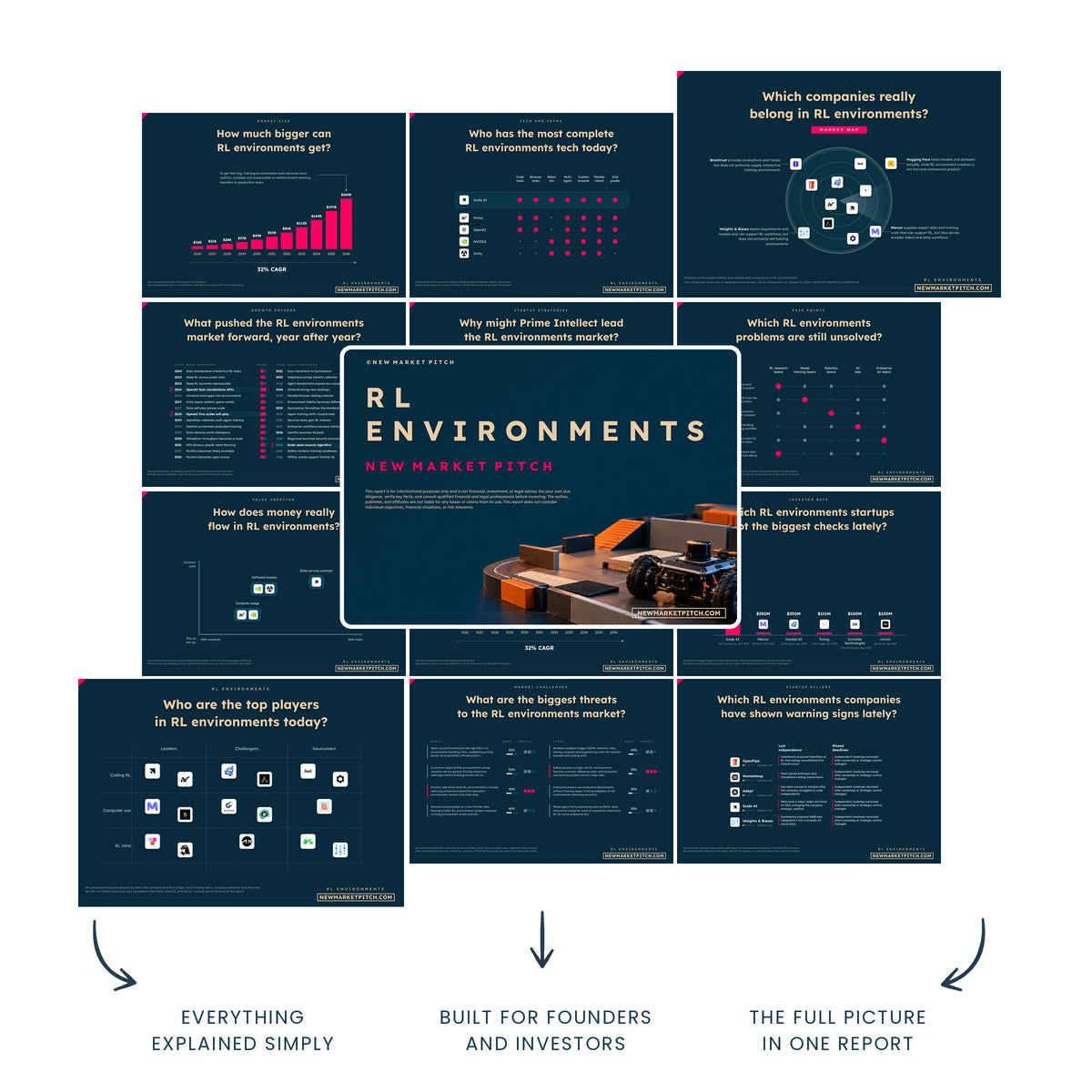
Whether you're building or investing in the RL environments market, our report covers everything you need to know: the players, the money, and what's coming next.
Summary
Scale AI has raised the most equity among RL environment startups, with at least $602M documented since founding. Like the totals behind it, that figure is a minimum, so the order at the top could still change. Scale built its lead over years of providing data and evaluations to AI developers.
Snorkel AI follows closely with at least $583M raised, then Mercor with at least $484M. One automates data development; the other built a network of experts. Both now have bigger ambitions in agent training.
Handshake brings an established recruiting network to the market, while Labelbox sells training and agent software. Turing uses specialist engineering talent to help model developers test and improve their systems.
Scale AI's May 2024 Series D+ was announced at $1B, but it mixed new money with sales of existing shares, so we count it without an amount. More recent financings for Snorkel AI and Prime Intellect have brought software training environments into sharper focus.
But big fundraising totals remain unusual. Only 9 of the 43 companies we track have raised nine-figure equity totals; 34 sit below that level.
Newer companies are finding backers without running decades-old data operations. Prime Intellect builds an RL training stack, while Patronus AI is working on simulated digital worlds.
Other specialists go narrower. Deeptune, Bespoke Labs, Halluminate and Plato recreate work agents can practice. Preference Model focuses on whether the system can judge those attempts correctly.
Time matters in these comparisons. Handshake completed 7 documented equity rounds and Scale AI 6, while 24 companies have recorded just 1. Young specialists are still at a very different point in their funding histories.
The United States accounts for 40 of the 43 funded startups we track. British and Dutch companies are present, but most of the venture-backed companies are headquartered in America.
Big lifetime funding totals still belong to broad AI data businesses. Dedicated simulators are getting checks of their own, and we will learn more from the environments customers keep using than from any single funding announcement.

Written by the New Market Pitch teamWe track new markets so founders and investors can move faster. About us

In our report covering the RL environments market, you will always find fresh funding data, taken straight from our own verified funding database.
Top startups in the RL environments market ranked by total funding raised
Here is the current ranking of the RL environments startups that raised the most, with the total each one has raised and our confidence level.
If you want to go deeper into the RL environments startup landscape, check our report covering the RL environments market.
| # | Startup | Total raised | Last round | Status | Confidence |
|---|---|---|---|---|---|
| $500M to $1B | |||||
| 1 | Scale AIAI data labeling and evaluation | $602M+ | May 2024Undisclosed · Series F | Active | Full |
| 2 | Snorkel AIAutomated AI training data development | $583M+ | Sep 2026$350M · Series D+ | Active | Full |
| $100M to $500M | |||||
| 3 | MercorExpert recruitment and AI training data | $484M+ | Nov 2026Undisclosed · Series D | Active | Full |
| 4 | HandshakeExpert human data for AI | $434M | Jan 2022$200M · Series F | Active | Full |
| 5 | LabelboxAI training data and evaluation | $283M | Oct 2026$93M · Series E | Active | Full |
| 6 | TuringExpert data for frontier AI | $244M | Jun 2025$111M · Series E | Active | Full |
| 7 | Prime IntellectTraining and evaluation infrastructure for AI agents | $150M+ | Jul 2026$130M · Series A | Active | Full |
| 8 | micro1Expert-generated AI training and evaluation data | $135M+ | Sep 2026$100M+ · Series B | Active | Full |
| 9 | Invisible TechnologiesEnterprise AI training and operations | $100M | Sep 2025$100M · Growth equity | Active | Full |
| Below $100M | |||||
| 10 | AfterQueryExpert data for AI model training | $80M | Aug 2026$50M · Series B | Active | Full |
| 11 | TolokaExpert human feedback for AI | $72M | May 2025$72M · Growth equity | Active | Full |
| 12 | Patronus AISimulation and evaluation environments for AI agents | $70M | Jun 2026$50M · Series B | Active | Full |
| 13 | SuperAnnotateEnterprise AI data annotation platform | $67M+ | Jun 2025$14M · Series B | Active | Full |
| 14 | ReveloLatin American remote developer recruitment | $48M | Oct 2021$28M · Series B | Active | Full |
| 15 | DeeptuneBuilds workplace software simulations for agent training | $43M | Mar 2026$43M · Series A | Acquired | Full |
| 16 | Bespoke LabsReinforcement learning environments for autonomous agents | $40M | Jul 2026$31M · Series A | Active | Full |
| 17 | LatchBioBuilds biological AI benchmark environments and tasks | $33M | Jun 2022$28M · Series A | Active | Full |
| 18 | LuelMarketplace for multimodal human data | $31M | May 2026$31M · Seed | Active | Full |
| 19 | HalluminateReinforcement learning environments for knowledge work | $30M | Oct 2026$30M · Series A | Active | Full |
| 20 | Taste LabsBuilds preference-driven creative design training environments | $18M | Jun 2026$18M · Seed | Active | Full |
| 21 | HUDReinforcement learning environment development platform | $16M+ | Jun 2026$16M · Series A | Active | Full |
| 22 | PlatoCreates simulated digital workplaces and feedback environments used to train and improve AI agents. | $16M+ | Oct 2026$16M · Series A | Active | Full |
| 23 | Preference ModelReinforcement learning environments for AI | $16M | Oct 2026$16M · Seed | Active | Full |
| 24 | DatacurveExpert coding data for AI models | $15M | Oct 2025$15M · Series A | Active | Full |
| 25 | ProximalReinforcement learning data and environments | $15M | Sep 2026$15M · Seed | Active | Full |
| 26 | PluraiBuilds stateful digital-twin simulations of agent tools, policies and workflows, with executable tasks and outcome-based evaluations. | $13M | Nov 2026$13M · Seed | Active | Full |
| 27 | Alterra LabsCreates executable medical and health-system workflow environments with clinician-designed scoring and RL training feedback. | $12M | Nov 2026$12M · Seed | Active | Full |
| 28 | General ReasoningDevelops open reward and RL environment tools | $11M | Jul 2025$11M · Seed | Active | Low |
| 29 | MechanizeSimulated environments for agent training | $9.1M+ | Apr 2026$9.1M · Venture / stage undisclosed | Active | Full |
| 30 | IdlerRL environments for agentic AI | $9M | Aug 2026$9M · Seed | Active | Full |
| 31 | WorldmodeldataVideo game data for AI training | $9M+ | Jul 2026$9M · Seed | Active | Full |
| 32 | Veris AISimulates enterprise systems and users for agents | $8.5M | Jun 2025$8.5M · Seed | Active | Full |
| 33 | PhinityBuilds chip design training environments and verifiers | $5.2M+ | Oct 2026$5.2M · Seed | Active | Full |
| 34 | ParetoExpert human data and evaluations | $5.1M | Nov 2021$4.5M · Seed | Active | Full |
| 35 | MatricesCreates browser-workflow environments for agent learning | $5M | Mar 2024$5M · Seed | Active | Full |
| 36 | Good Start LabsGame-based AI training environments | $3.6M | Oct 2025$3.6M · Seed | Active | Full |
| 37 | BenchFlowBuilds interactive agent benchmarks and test environments | $1M | Feb 2025$1M · Pre-Seed | Active | Full |
| Undisclosed | |||||
| 38 | CuaProvides computer sandboxes and verifiable task benchmarks | Undisclosed | 2025Undisclosed · Seed | Active | Low |
| 39 | Fleet AIBuilds simulated business applications for computer agents | Undisclosed | 2025Undisclosed · Seed | Active | Low |
| 40 | HillclimbDesigns mathematical reasoning environments with objective rewards | Undisclosed | 2025Undisclosed · Seed | Active | Low |
| 41 | Olam LabsCreates multi-agent social simulations for model training | Undisclosed | 2026Undisclosed · Seed | Active | Low |
| 42 | PolymathBuilds long-horizon software-engineering training simulations | Undisclosed | 2026Undisclosed · Seed | Active | Low |
| 43 | SymbalMakes benchmark tasks and post-training environments | Undisclosed | 2025Undisclosed · Seed | Active | Low |
No startups match this search.

In our research about RL environments startups, we turn what is vague and complex into simple, useful visuals. Market maps like this one show you at a glance where every startup stands.
Why are investors putting money into RL environments now?
Investors are putting money into RL environments because AI agents need safe places to practice tasks that can be checked.
The challenge is practical. An agent must interact with tools, handle changing states and complete a task whose outcome can be checked. A static answer dataset cannot always supply that experience. Mercor described the problem clearly in July 2026 when it announced its plan to acquire Deeptune: experts can formulate tasks, but agents also need recreated software systems in which to attempt them. Patronus AI made the related case for simulated digital worlds in its June 2026 funding announcement.
Different businesses can solve parts of that problem. Scale AI and Snorkel AI can sell training data and evaluations to existing customers. Prime Intellect builds the infrastructure needed to run reinforcement learning. HUD helps users author environments, while Preference Model develops harder-to-exploit scoring systems. Investors want to own a piece of the systems that teach agents through practice. Not every simulator has recurring customers, and an ordinary cloud sandbox does not count as an RL environment on its own. We measure actual equity financing to distinguish committed capital from grand claims about future markets.
Has Scale AI raised more than any other RL environment startup?
Scale AI remains the most heavily funded RL environment startup, with at least $602M of documented equity since founding, against at least $583M for Snorkel AI. Both figures are minimums.
Scale built its lead well before AI agents became the focus. Its data operations supported computer vision, large-language-model training, evaluation and red-teaming. In May 2024, the company announced a major Series D+ transaction led by Accel, with participation from investors spanning venture capital, software and semiconductor businesses. Investors from across AI computing and software wanted exposure to the training-data business.
A subsequent Meta investment in June 2025 changed the company's strategic context. Scale announced a valuation and a stronger commercial relationship with Meta, while founder Alexandr Wang moved to Meta's AI effort. That deal paid existing shareholders for their stock rather than funding a round, so it is not in Scale's total. Even without it, Scale leads on equity raised. Scale still has to compete for RL environments customers, and rival model labs may worry about the Meta relationship.
Did one giant check give Scale AI its funding lead?
No, Scale AI built its RL environment funding lead across years of fundraising, and its giant 2024 Series D+ adds no amount to our count.
Scale AI's May 2024 Series D+ was announced at $1B, but it mixed new money with sales of existing shares and the new-money part was never published. Scale's documented total therefore comes from its earlier rounds, and the Series D+ counts as its sixth round, without an amount. Scale had already built a sizable data business, and it listed support from investors tied to both AI labs and the broader computing industry.
The biggest single rounds we can count are Mercor's $350M Series C in October 2025 and Snorkel AI's $350M Series D+ in September 2026. The latter funded a move into delivering completed training datasets and simulated environments. These large financings have backed several kinds of training-data businesses. A record round is only part of a company's lifetime funding story. Handshake has the greatest number of documented rounds, which illustrates why repeated access to investment can matter as much as a record-breaking announcement.

In our market report about RL environments startups, we always try to gather several sources and make estimates that make sense, so you can work with solid numbers.
Is Snorkel AI the closest funded rival to Scale AI?
Snorkel AI is Scale AI's closest rival on documented RL environment funding, with at least $583M raised.
Snorkel AI's $350M Series D+ in September 2026 was led by Insight Partners and S32. Snorkel described the investment as funding a more automated way to generate expert training material, tasks and simulated environments. The company had begun as software for data development at Stanford and later moved toward supplying finished data itself. Hard RL environments need both software that behaves realistically and experts who can check the outcomes.
Snorkel AI operates differently from Mercor and Handshake. Instead of maximizing access to a large pool of contractors, it claims to combine people, software and synthetic generation into an increasingly repeatable delivery process. It also competes with Prime Intellect and HUD, which put more of the tooling in customers' hands. Investors have funded both its delivery operation and its software research. We still need to see whether automation makes its work cheaper or better. For now, Snorkel has the largest documented equity total after Scale.
Has Mercor raised enough to compete with older AI data firms?
Mercor has raised at least $484M for AI training and evaluation, placing it among the best-funded companies in RL environments.
Its original recruitment technology evolved into a service connecting frontier model builders with experts who can create data, score outputs and evaluate complex tasks. Its November 2026 company update described a further shift toward enterprise evaluations, post-training and environments based on actual workplace requirements. Mercor is now using capital to build much more than an expert-recruitment marketplace.
The Deeptune acquisition in July 2026 shows what changed. Deeptune had recreated enterprise software so agents could attempt tasks in simulated environments, while Mercor had expertise in constructing the tasks and checking their results. Bringing the two together may reduce friction for customers that previously had to assemble those pieces themselves. Buying a simulator is quicker than proving all the pieces work well together for paying customers. Mercor announced a $750M Series D+ in November 2026, but that figure includes a tender for existing shareholders and the new-money part was not published, so the round counts without an amount in our total.

Our document detailing everything you need to know about RL environments gets updated several times a month, so you always get the latest view of where things stand.
Can Handshake use its old funding to compete in AI training?
Handshake has $434M in historical equity to support its newer AI training and RL environment work.
Its history is unusual: the company built an education-to-employment platform before entering frontier AI data work. The original recruiting network helped it source people with the academic and professional backgrounds model labs need for expert feedback. Handshake's January 2022 Series D+ was $200M, reflecting capital raised well before its current environment business became central.
In January 2026, Handshake acquired Cleanlab, bringing researchers and software into its AI unit to improve evaluation, data quality and reinforcement-learning environments. Handshake could put a network built for recruiting to work on expert AI data. But there is an important limit. A large historic equity total does not tell readers how much unspent cash remains today or whether AI services will produce software-like margins. Handshake can draw on its past investment and expert network, but the AI business still has to prove itself.
Was Labelbox's latest financing all equity?
No, Labelbox's recent RL environment financing included credit alongside equity, so the headline was not all new ownership capital.
Our equity total for Labelbox is $283M, including a $93M Series D+ in October 2026. Its public announcement characterized the wider financing package as including a credit facility. Borrowing is debt, not an equity investment. Counting it as venture funding would overstate how much ownership capital Labelbox has raised.
Labelbox has good reasons to use both types of financing. Labelbox is financing Horizon, which creates training environments and evaluations for frontier labs, and Recursion, which operates managed agents for businesses. Both can generate complex operating obligations, from maintaining simulated applications to providing compute and support. Credit may finance predictable needs, while equity can support riskier product development. We count only the equity part in its historical fundraising total. The company has moved from labeling software toward a combination of AI data, task environments and enterprise agent operations; the mix of debt and equity helps explain how it is paying for that shift.
Is Turing still one of the best-funded AI training startups?
Turing remains a well-financed AI training supplier, with $244M of equity recorded since founding.
Turing's June 2025 Series D+ brought $111M and was framed by the company as financing for frontier AI research and technical work. Its foundation in recruiting and coordinating specialized engineers makes it relevant to coding-model training, where experts must create tasks, inspect outputs and decide whether software actually works. The work is more specialized than generic text annotation, particularly when tasks require multi-file changes or tool use.
That capability places Turing between several different competitors. micro1 and Handshake recruit experts; Snorkel AI focuses on systems for producing finished data; Prime Intellect offers a training stack to users who want to operate the loop themselves. Turing's capital history gives it experience and delivery capacity, but fundraising alone cannot tell us which approach will gain the most recurring sales. Turing has funded a substantial technical-data business. To win in simulation software, it will still have to prove the product.

In our report covering the RL environments market, we look at what the winners do differently, so you can learn from the best instead of guessing.
Can Prime Intellect compete for RL environment customers?
Prime Intellect can compete for RL training customers with its integrated stack, even though it has raised less than the biggest data suppliers.
The company has raised at least $150M in our records, including its $130M Series A in July 2026. Prime Intellect described a training stack that combines large-scale reinforcement learning, sandboxes, environments, evaluation, deployment and inference. Prime Intellect is betting that more companies will want to train models on their own tasks.
Prime Intellect is putting investor money into a training stack instead of building a huge contractor network. Infrastructure providers need research, compute integration, developer tools and reliability. Prime Intellect's announcement also described a broad customer base using several parts of its stack, which gives the financing a commercial rationale beyond the novelty of the technology. The risk is platform competition: labs and cloud vendors may build overlapping capabilities themselves. The Series A shows real investor backing for standalone RL tools. Winning against larger data suppliers still depends on paying customers.
Has micro1 caught up with older AI data companies on fundraising?
micro1 is now among the major funded AI training suppliers after only 2 documented equity rounds.
We record at least $135M raised, with a September 2026 Series B of at least $100M. Forbes reported that the company grew from AI-assisted recruiting into specialized training data for frontier labs, and that customers included Microsoft, Amazon and robotics company 1X. Its business illustrates how a small initial product can become a supplier of expert labor and tasks when buyers suddenly require deep subject knowledge.
The relevant comparison is with Handshake and Scale AI, which developed much longer financing histories before the current agent-training boom. micro1 is attempting to reach operating scale while retaining a comparatively short record of institutional financing. A shorter funding history can be efficient. It also leaves less room for mistakes if customers need harder simulations and better scoring. micro1 shows that newer expert-data firms can still break through. Its business works differently from the software-first products at Prime Intellect and Patronus AI.

Learning from others' mistakes is the cheapest lesson there is. In our research about RL environments startups, we look at what broke startups before you, so you don't repeat it.
Why did Invisible Technologies wait to raise outside capital?
Invisible Technologies waited to take outside Growth Equity while it built a profitable enterprise AI operation.
In its financing announcement, chief executive Matt Fitzpatrick said Invisible had spent years helping AI systems work in business processes and had operated profitably before deciding to accelerate growth. The company described serving both leading AI labs and enterprises, combining technical systems with human operations. That experience could help Invisible sell RL environments: businesses need simulations of processes that involve documents, policies, handoffs and judgment, not just isolated prompts.
The funding was classified as Growth Equity, unlike the Seed and Series A financings of many newer environment startups. Growth Equity can expand a business that already has customers. Seed financing often pays for the product before it has proven itself. Compared with Patronus AI's simulated worlds or Plato's reusable workplace software, Invisible brings direct experience delivering enterprise work. Invisible raised money to expand an existing enterprise AI operation, with years of customer work behind it.
Has AfterQuery raised as much as Mercor and Snorkel AI?
AfterQuery has raised less money than rival AI data companies, with $80M in documented equity.
Our records include its $50M Series B in August 2026. TechCrunch reported the following month that the company had attracted a striking new valuation after expanding its expert-generated AI training business. It works with professionals whose judgment can be turned into examples, tasks and evaluations for more capable models. This is valuable to customers, but the funding requirement is not necessarily the same as building a general simulation platform from scratch.
The companies spend money differently. Mercor is integrating a software-environments specialist. Snorkel AI is investing in automated and synthetic generation systems. AfterQuery emphasizes professionals and their work patterns. Each has different bills to pay. The amount raised tells us little about which product is technically best. It does tell us how much equity capital investors have committed. AfterQuery's position shows that being commercially visible and receiving a high reported valuation do not require the largest financing history, while leaving open whether its future product ambitions will need more capital.
Do RL environment startups really need to raise $1B?
No, RL environment startups do not normally raise $1B. None of the 43 companies we track has crossed that line in documented equity.
Scale AI and Snorkel AI are the exceptions in how much equity they have raised, with totals between $500M and $1B, and 7 more have raised between $100M and $500M. The remaining companies include dedicated software simulators, expert-data services and early-stage infrastructure tools operating with substantially smaller amounts.
The products also have different costs. An established AI data supplier may need years of labor coordination, technology and sales infrastructure. A narrower company such as Halluminate can focus on financial workflows, or Preference Model can concentrate on task verification and reward design. They need not copy Scale's capital history to create useful products. Yet a small amount of equity does not automatically prove capital efficiency, because revenue, margins and customer retention are separate measurements. A new RL environment company does not need to copy Scale's funding history to be taken seriously.

If you build or invest in the RL environments market, you need to know which business models pay off now and which ones are fading. That's why our report covering it has a whole section on it.
Have most RL environment startups raised over $100M?
Raising nine figures remains unusual among RL environment startups, despite the big AI funding headlines.
Among the 43 startups we track, 9 have reached the nine-figure funding threshold, while 34 have raised less, and these companies are of very different ages. One huge announcement can make the whole market look flush with cash, even while most specialist developers are still raising Seed or Series A.
That split changes how we interpret the leaders. Scale AI and Snorkel AI have deep funding histories; Prime Intellect and micro1 have achieved significant totals more recently; Patronus AI and Bespoke Labs remain smaller but focused on agent training and verification. Buyers now have more options than the large, established data providers. Investors are funding tools for reusable tasks and feedback alongside the big data businesses. We still do not know which smaller companies can turn an initial round into a lasting business.
Are specialist RL simulation startups getting big checks yet?
Specialist RL simulation startups are getting meaningful investor checks, even if established data suppliers still lead on total equity raised.
Patronus AI has raised $70M and uses digital world models to simulate agent tasks. Deeptune raised $43M before joining Mercor, reflecting the value of software that recreates workplace applications. Bespoke Labs has raised $40M and concentrates on training and verification for agents, while Halluminate designs finance-oriented environments. Those checks are smaller than the data giants' totals, but they can pay for serious engineering teams.
Their products share a technical problem. Each needs an executable task, believable system behavior and a credible verdict about whether an agent succeeded. Wing Venture Capital's July 2026 discussion of Bespoke Labs emphasized verification as the difficult part of making long-horizon tasks useful. Mercor's Deeptune announcement highlighted the effort required to recreate enterprise software accurately. Investors are now paying to build the environments themselves, including the software behavior and grading that makes practice useful.
The table below shows selected dedicated RL environment and task-simulation developers with their qualifying equity totals.
| Company | Total raised | Last stage | Last round |
|---|---|---|---|
| Patronus AI | $70M | Series B | June 2026 |
| Deeptune | $43M | Series A | March 2026 |
| Bespoke Labs | $40M | Series A | July 2026 |
| Halluminate | $30M | Series A | October 2026 |
| Taste Labs | $18M | Seed | June 2026 |
| HUD | $16M+ | Series A | June 2026 |
| Plato | $16M+ | Series A | October 2026 |
| Preference Model | $16M | Seed | October 2026 |
| Plurai | $13M | Seed | November 2026 |
| Alterra Labs | $12M | Seed | November 2026 |
A plus sign denotes a minimum when at least one amount is undisclosed. Deeptune is included with its acquired status; this table is a selected product-focused comparison, not the complete fundraising ranking.

In our document detailing everything you need to know about RL environments, we like to show you the big picture. We know your time is precious, so we make every page quick to read and packed with as much learning as possible per minute.
Are investors backing simulated worlds for AI agents?
Patronus AI is one example of investors funding simulated digital worlds that let AI agents practice long, changing workflows.
Patronus AI announced a $50M Series B in June 2026, led by Greenfield Partners. Its Digital World Model approach aims to simulate coding, dialogue, research and tool-use workflows in a way that permits repeated testing and training. An agent can do well on a familiar test and still fail at a job that changes over many steps.
Patronus has competitors working on other parts of agent training. Prime Intellect supplies infrastructure for organizations to run their own RL loops. HUD offers a platform for creating and distributing environments. Halluminate develops professional tasks where expert verification is central. Patronus's research direction is more about modeling the behavior of digital environments themselves. Financing can pay for that technical work, but the commercial question is whether customers repeatedly use the resulting simulations to improve models and catch failures. Investors have paid to develop this approach. Whether customers make Patronus's world models a standard part of training remains open.
Can workplace simulators raise money without giant expert networks?
Yes, RL workplace simulator startups can raise capital by building reusable software tasks without owning large expert workforces.
Halluminate announced a $30M Series A in October 2026, which it says brought its total funding to $38.5M, and highlighted simulated work in financial services, where an agent must prepare models or analyze complex business materials correctly. Plato announced a $16M Series A in the same month to build repeatable software workplaces, with applications, policies and tasks that change as an agent acts. Bespoke Labs focuses on verification for longer agent workflows rather than recruiting broad pools of annotators.
The software still needs people who know the job. They must decide what realistic success looks like and whether an agent got there for legitimate reasons. They want to turn that expertise into tasks and scoring systems customers can reuse. Unlike Mercor and Handshake, these specialists aim to sell more software than human staffing. If customers repeatedly pay for better simulations, specialist platforms can build recurring revenue from intellectual property and infrastructure. The fundraising shows that investors believe in the model. Repeat customer spending is still the test.
Did Mercor's Deeptune deal change the RL environments race?
Mercor's purchase of Deeptune gave the AI training company workplace simulation technology and changed the race for RL environment customers.
Deeptune raised $43M in a March 2026 Series A and was acquired in July 2026. Mercor's announcement explained the rationale: Deeptune had recreated enterprise applications that allow models to practice tasks inside software, while Mercor's experts were already writing the evaluations and scoring criteria. The buyer thus gained a missing technical layer instead of building every simulation system itself.
Deeptune ended up following an acquisition path. A specialist's equity can finance product development, but its most important strategic result may be acquisition by a company with customers and distribution. Deeptune's earlier equity rounds do not become Mercor's fundraising just because Mercor bought the company. We preserve Deeptune as an acquired company in the lifetime funding comparison and count Mercor's own qualifying equity separately. That keeps money invested in each company separate from the purchase itself. For other specialist founders, the deal demonstrates both an exit path and the risk that large data companies may absorb independent environment technology.

When you build or invest in the RL environments market, you need clarity, not confusion. In our report covering the RL environments market, we always try to put numbers on and quantify whatever is usually vague and confusing.
Can small RL environment startups matter without huge funding?
Even modestly funded RL environment startups can be useful when they solve one hard training problem well.
Luel has raised $31M to build a network for multimodal human data, according to our records; its May 2026 investor announcement focused on rights-cleared contributions at scale. Preference Model raised $16M for creating RL environments that withstand reward hacking, while Plurai raised $13M in November 2026 for simulations designed to find agent failures before customers do. Alterra Labs is pursuing executable health-system tasks, where medical and operational judgment are essential.
These startups are not close substitutes. Luel's marketplace must recruit and verify contributors; Preference Model's challenge is robust grader design; Plurai's product must mimic enterprise systems convincingly; Alterra Labs needs domain-specific medical validation. Their early financing tells us investors are backing different kinds of scarce knowledge, from multimodal data rights to safe simulation. A small round alone cannot protect any of these businesses from new competitors. A young specialist can still solve an important problem without matching the giants' budgets. The decisive evidence will be repeat customers and demonstrably better model performance, not seed-round publicity.
Do the biggest AI training companies keep raising more rounds?
Older AI training suppliers have usually raised money through more rounds than young simulator startups, but frequent fundraising says little about technical quality.
Handshake has the most documented equity rounds, at 7, with Scale AI next at 6. Across the entire group, 24 companies have only 1 recorded round. Younger companies may never need the same long sequence of rounds. A business can rely on customers, change ownership or be acquired before needing many rounds.
The contrast is visible in product strategies. Handshake and Scale accumulated operating systems and networks over time; Prime Intellect raised heavily while building an integrated RL stack; Plurai and Preference Model made focused early bets on simulation and reliable rewards. Some newer companies may remain specialized suppliers with fewer capital needs, while others may need additional financing to support enterprise installations, frontier-lab integration and ongoing research. A longer funding history gives a company more capital, but says little about product quality. Only product performance and customer sales can show whether that money was put to good use.
The table below shows a selected comparison of heavily financed RL environment suppliers and the breadth of their equity histories.
| Company | Total raised | Rounds | Last stage |
|---|---|---|---|
| Scale AI | $602M+ | 6 | Series D+ |
| Snorkel AI | $583M+ | 6 | Series D+ |
| Mercor | $484M+ | 5 | Series D+ |
| Handshake | $434M | 7 | Series D+ |
| Labelbox | $283M | 6 | Series D+ |
| Turing | $244M | 4 | Series D+ |
| Prime Intellect | $150M+ | 4 | Series A |
| micro1 | $135M+ | 2 | Series B |
Totals with plus signs are documented minimums, and the table is a selected view of established fundraisers rather than a full ranking.

A good product starts with a real problem. In our research about RL environments startups, we show you the ones customers still live with.
Are most funded RL environment startups American?
Yes, 40 of the 43 funded RL environment startups we track are headquartered in the United States.
The remaining companies include 2 in the United Kingdom and 1 in the Netherlands. Their presence reflects distinct approaches: Worldmodeldata is collecting gaming-derived training material in Britain; General Reasoning develops reward and environment tools; Toloka supplies expert human feedback from a European base. Serving customers worldwide does not change where the startups are based.
The American concentration is especially clear across different stages and products. Scale AI and Mercor are large data businesses, but HUD, Patronus AI, Mechanize and Alterra Labs are also US-based specialists. Proximity to the frontier labs, AI engineering talent and venture investors offers a plausible commercial advantage, though the count alone cannot prove causation. It also cannot be read as the share of dollars raised in each country. We use it to describe where qualifying companies are incorporated or headquartered, not where every contractor works or every customer operates. Buyers looking for venture-funded RL environment suppliers will find most of them in the United States.
Why isn't Surge AI among the biggest RL environment fundraisers?
Surge AI has built a serious AI training-data business without the outside equity rounds that dominate RL environment fundraising comparisons.
Founder Edwin Chen's public explanation of Surge stresses independence and the decision not to take outside capital. A company can generate revenue, serve frontier labs and produce valuable AI training data without having a venture-round history comparable with Scale AI or Mercor. Surge competes with venture-backed suppliers, but we have no qualifying equity total to assign it.
Funding totals tell only part of the story for AI data companies. Scale's history demonstrates repeated institutional financing. Snorkel AI and Labelbox have used large rounds to develop software and operations. Surge represents a different funding choice, one that may preserve ownership but does not create a sequence of venture equity transactions for this comparison. Surge can be an important supplier without venture funding. A bigger equity total also tells us nothing by itself about revenue or margins. Our subject is the documented equity invested in RL environment startups since founding, not the full universe of commercially important training-data companies.
So, which RL environment startups have raised the most?
Scale AI has raised the most equity in RL environments, followed by Snorkel AI and Mercor.
The leader has at least $602M in documented equity, and Snorkel AI at least $583M. Both are minimums, so the gap between them is not settled. Behind it, Snorkel's software-and-data factory, Mercor's network of experts, Handshake's recruiting base, Labelbox's agent software and Turing's technical workforce represent different paths to raising capital. Prime Intellect and micro1 show that newer businesses can also join the well-funded group, while Patronus AI and other simulators remain earlier in their equity histories.
Raised capital gives a company more resources, but says little about whether its environments work best. The totals show which teams have attracted investor capital for software, experts and research. Smaller competitors may do well if they can build training tasks customers keep using and cannot easily copy.
The table below shows what we found.
| Question | Answer |
|---|---|
| Did Scale really win by raising repeatedly? | Scale AI still leads on cumulative qualifying equity raised. We record 6 financing rounds over the company's history. That long record matters beyond any single giant announcement. |
| Could Snorkel AI close Scale's funding gap? | Snorkel AI remains second on documented RL environment equity. Its September 2026 financing brought $350M into the business. That supports automated data production as well as simulated environments. |
| Did Deeptune make Mercor more competitive? | Mercor has moved beyond selling expert data to model developers. Its Deeptune acquisition in July 2026 added workplace simulations. That could make its training offer easier for customers to adopt. |
| Does Handshake still benefit from older rounds? | Handshake uses its older funding base to support AI training. Its documented equity total reaches $434M across its history. Cleanlab adds research and evaluation software to the business. |
| Was Labelbox's entire financing new equity? | Labelbox combined equity funding with credit for agent products. We count $283M of qualifying equity across its history. Loans should stay separate when comparing startups' fundraising totals. |
| Is Turing a serious capital-backed AI training rival? | Turing remains a well-funded supplier for difficult engineering tasks. Its qualifying equity total is $244M since founding. That supports expert work, though simulation products need more investment. |
| Can Prime Intellect build an RL stack? | Prime Intellect is a funded challenger to large data vendors. Its July 2026 Series A brought $130M in backing. The money pays for training tools instead of giant contractor networks. |
| Does AfterQuery need as much cash as Mercor? | AfterQuery has attracted attention with a smaller funding history. We count $80M in qualifying equity for the company. That says little about whether its expert products will keep selling. |
| Must serious RL simulators raise over a billion? | Very few RL environment companies reach giant lifetime totals. None of the 43 tracked startups has passed that threshold. Smaller builders can focus on narrower software problems instead. |
| Do new RL developers need repeated rounds? | Many specialist firms are working from a single financing. We count 24 companies with only 1 recorded round. Some may build lasting businesses without matching older rivals' histories. |
| Is the RL environments funding race global? | American companies account for most funded RL environment businesses. We find 40 US-based startups among the 43 tracked. That reflects headquarters, not where experts or customers work. |

In our market report about RL environments startups, we try to remove everything that could confuse you, especially if you're investing or building in this market.
Our methodology
Our data runs through November 13, 2026. We define the RL environments market around companies producing interactive tasks in which AI agents act inside executable software worlds and receive verifiable feedback, including coding, workplace, tool-use, scientific and security simulations and recognized suppliers of those systems. We include companies near the boundary rather than silently excluding them. Every ranked company is a startup under our definition, founded in 2000 or later; companies later listed, acquired or shut down retain their historical place and status, with financing stopping at IPO or acquisition, and primary IPO proceeds included.
We count equity raised since founding, including older private rounds and the primary proceeds of an IPO. We exclude debt, venture debt, grants, unconverted SAFEs and other convertible instruments, post-IPO offerings and secondary share sales; a SAFE converted into a priced round is part of that round. Duplicate accounts of the same financing are merged. An amount marked with a plus sign is a minimum, normally because a recorded round does not disclose its full amount.
Rounds confirmed by a company announcement, a press article or a regulatory filing are counted in full. Where no article exists, a round is counted only when at least two recognised databases agree on its date (within one month) and amount (within 5%), and it is marked as low confidence; a round found in a single database stays in the company's history but is left out of totals. For companies that have raised more than $100M, every round counted is backed by an article.
We do not substitute totals or valuations shown by commercial databases for our own numbers: they can combine equity with loans, grants, commitments, secondary transactions or estimates. A two-database-only round remains low confidence rather than being treated like a company announcement. If a company or the press states a different lifetime total, we retain the sum of the qualifying equity rounds and record major gaps separately. Our Full, Strong, Partial and Low confidence indicators describe how much of each total rests on independently confirmed evidence.
A company may therefore appear with less equity than a public financing headline suggests, especially when that announcement includes debt, employee liquidity or secondary sales. We do not turn an acquisition purchase price into newly raised equity for either company, and we do not invent funding for an independent business that has never reported qualifying rounds. These decisions make the lifetime totals comparable rather than rewarding the most expansive press release.
The fundraising ranking covers each company's history since founding, not just deals signed recently. This differs deliberately from market deal lists beginning in January 2024, funding-trend views covering that period, funding analyses comparing recent rolling windows and investor-activity views counting rounds since January 2024. A late-stage company with an older funding history can therefore rank highly here even if its recent deal flow is quiet.
Key sources include Scale AI's May 2024 Series F transaction and investor base, Scale AI's June 2025 Meta investment, Snorkel AI's 2026 financing and data-production strategy, Mercor's financing announcement and enterprise AI evaluations, Mercor's acquisition of the simulator developer Deeptune, Handshake's AI research expansion via Cleanlab, Labelbox financing structure, Horizon and Recursion products, Turing's 2025 financing and model-training focus, Prime Intellect's July 2026 Series A and full RL stack, Forbes on micro1's specialist AI data business, Invisible Technologies' September 2025 growth financing, AfterQuery's rapid expert-data expansion, Patronus AI's June 2026 simulation strategy and Series B, Wing on Bespoke Labs' agent verification approach, Halluminate's workplace RL environments and financing, Plato's simulated workplace Series A announcement, HUD's Series A and RL environment creator platform, Preference Model's reward verification work and funding, Luel's multimodal human-data financing, Plurai's November 2026 seed and simulated agent testing, Alterra Labs' clinical workflow simulations, Worldmodeldata's gaming-based training-data strategy, and Surge AI founder on independent funding and business strategy.
In our document detailing everything you need to know about RL environments, you will always find fresh funding data, taken straight from our own verified funding database.
Written by the New Market Pitch teamWe track new markets so founders and investors can move faster. About us
