
RL environments funding tracker
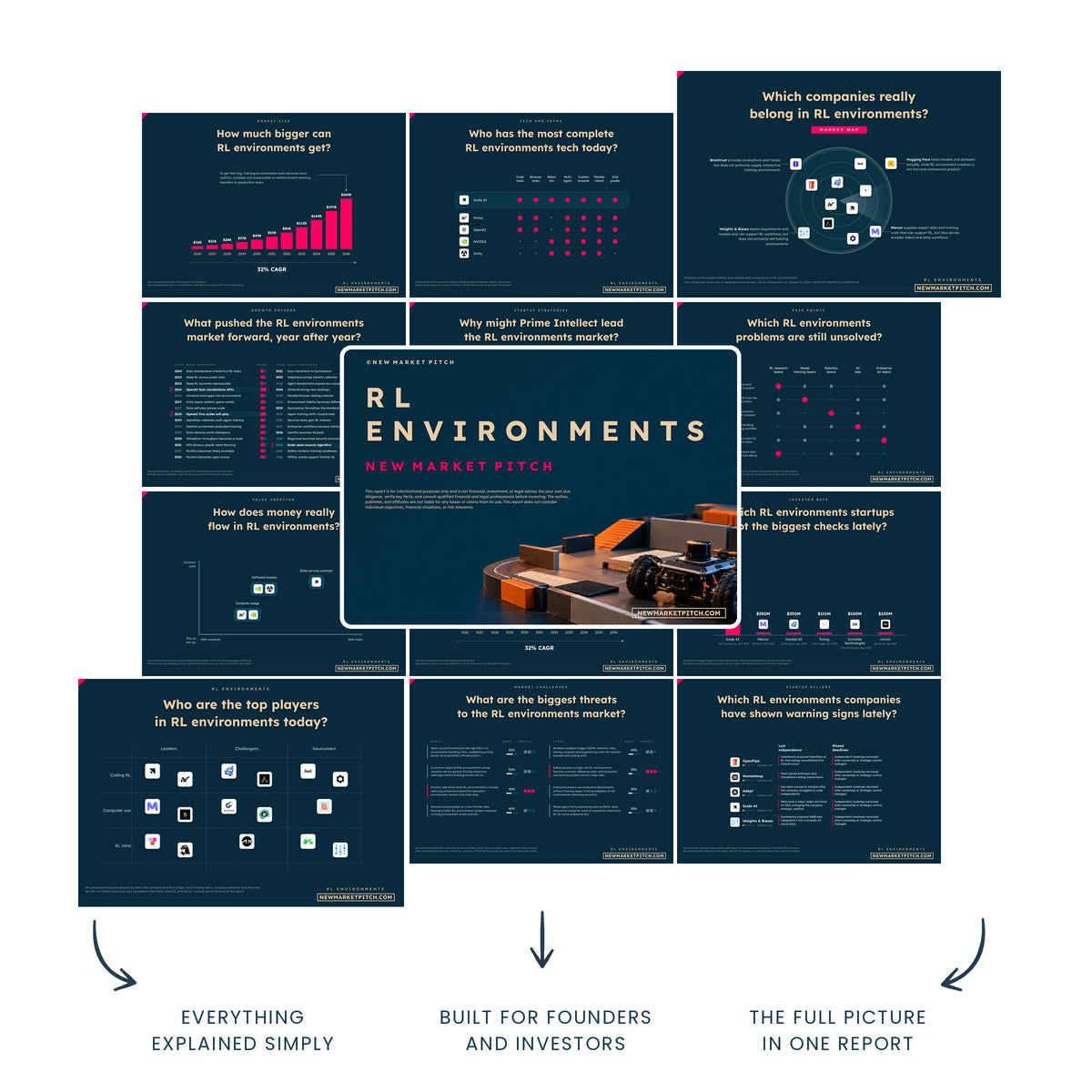
Whether you're building or investing in the RL environments market, our report covers everything you need to know: the players, the money, and what's coming next.
Summary
RL environments have attracted 57 funding deals across 39 companies and at least $2.1B since the start of our complete coverage. Mercor leads the companies we track with at least $484M raised across 5 rounds in the window. That's real money, but very little of it reflects what a new simulator startup usually raises.
A few giant deals do most of the work. The 11 rounds above $50M account for 19% of financings and at least $1.6B of disclosed capital. The median announced round is $16M. Those are very different funding experiences.
Most companies have not returned for another check within the window. Of the 39 funded companies, 27 have 1 recorded round. A regular stream of follow-on financings has yet to develop across the whole market.
The money also follows a particular kind of business. Human-data-led RL environments account for 21 deals and 75% of disclosed capital. These suppliers organize expert judgment and training data, while newer firms build the software worlds in which agents practice tasks.
That leaves room for more focused products. Investors have financed both reusable RL environment platforms and simulations of real office workflows. The first group sells training tools; the second recreates work and checks whether an agent actually completes it.
Lots of startups get early checks, but far fewer reach the later rounds. Seed accounts for 28 deals, while just 6 Series D+ deals represent 31% of disclosed capital, more than any other stage. The largest data suppliers raise on another scale entirely from a startup building its first environment.
Age makes the split clearer. The median company was 1 year old when it raised, compared with a median age of 6 years among companies raising above $50M. Big checks tend to follow years of operating experience.
Most of these deals happen in the United States. US-headquartered companies account for 54 deals, or 95% of the window's activity, and 96% of disclosed capital. That says where the fundraising is concentrated, not where all the people building environments work.
The flow is hardly steady. Across 34 completed months, the median month saw 1 deal, and 9 months had no deal at all. A busy announcement week can make a small market look continuously active.
RL environments have become a real venture category, although they still contain quite different businesses. Large human-data suppliers take most of the money; smaller teams are funding the simulations, tests and reward systems that could make agent training more useful.

Written by the New Market Pitch teamWe track new markets so founders and investors can move faster. About us

In our report covering the RL environments market, you will always find fresh funding data, taken straight from our own verified funding database.
Our funding tracker covering the RL environments market
Below is the table listing all the deals. You can find our methodology at the end of this page.
If you want a deeper understanding of the market and its current dynamics, get our RL environments market report.
| Company | Category | Date | Stage | Deal size | What they do | Region | Lead investors | Country | Rank |
|---|---|---|---|---|---|---|---|---|---|
| Plurai | RL environment platforms | November 2026 | Seed | $13M | Builds stateful digital-twin simulations of agent tools, policies and workflows, with executable tasks and outcome-based evaluations. | North America | Team8 | United States | |
| Alterra Labs | Enterprise & professional workflows | November 2026 | Seed | $12M | Creates executable medical and health-system workflow environments with clinician-designed scoring and RL training feedback. | North America | Oak HC/FT | United States | |
| Mercor | Human-data-led RL environments | November 2026 | Series D+ | Undisclosed | Expert recruitment and AI training data | North America | Not disclosed | United States | |
| Plato | Computer & browser use | October 2026 | Series A | $16M | Creates simulated digital workplaces and feedback environments used to train and improve AI agents. | North America | Nava Ventures | United States | |
| Labelbox | Human-data-led RL environments | October 2026 | Series D+ | $93M | AI training data and evaluation | North America | Infinitum Partners | United States | |
| Phinity | Science, mathematics & engineering | October 2026 | Seed | $5.2M | Builds chip design training environments and verifiers | North America | Uncork Capital | United States | |
| Preference Model | Science, mathematics & engineering | October 2026 | Seed | $16M | Reinforcement learning environments for AI | North America | Andreessen Horowitz | United States | |
| Halluminate | Enterprise & professional workflows | October 2026 | Series A | $30M | Reinforcement learning environments for knowledge work | North America | Oak HC/FT | United States | |
| Proximal | Coding & software engineering | September 2026 | Seed | $15M | Reinforcement learning data and environments | North America | General Catalyst | United States | |
| Snorkel AI | Human-data-led RL environments | September 2026 | Series D+ | $350M | Automated AI training data development | North America | Insight Partners, S32 | United States | |
| micro1 | Human-data-led RL environments | September 2026 | Series B | $100M+ | Expert-generated AI training and evaluation data | North America | Dream Ventures | United States | |
| Idler | Enterprise & professional workflows | August 2026 | Seed | $9M | RL environments for agentic AI | North America | Paradigm | United States | |
| AfterQuery | Human-data-led RL environments | August 2026 | Series B | $50M | Expert data for AI model training | North America | Not disclosed | United States | |
| Prime Intellect | RL environment platforms | July 2026 | Series A | $130M | Training and evaluation infrastructure for AI agents | North America | Radical Ventures | United States | |
| Bespoke Labs | Coding & software engineering | July 2026 | Series A | $31M | Reinforcement learning environments for autonomous agents | North America | Wing Venture Capital | United States | |
| Worldmodeldata | Human-data-led RL environments | July 2026 | Seed | $9M | Video game data for AI training | Europe | Iona Star Capital | United Kingdom | |
| Patronus AI | Enterprise & professional workflows | June 2026 | Series B | $50M | Simulation and evaluation environments for AI agents | North America | Greenfield Partners | United States | |
| Taste Labs | Enterprise & professional workflows | June 2026 | Seed | $18M | Builds preference-driven creative design training environments | North America | CRV, Amplify Partners | United States | |
| HUD | RL environment platforms | June 2026 | Series A | $16M | Reinforcement learning environment development platform | North America | Standard Capital | United States | |
| Luel | Enterprise & professional workflows | May 2026 | Seed | $31M | Marketplace for multimodal human data | North America | General Catalyst, Lightspeed Venture Partners | United States | |
| AfterQuery | Human-data-led RL environments | April 2026 | Series A | $30M | Expert data for AI model training | North America | Altos Ventures | United States | |
| Mechanize | Coding & software engineering | April 2026 | Unknown | $9.1M | Simulated environments for agent training | North America | Not disclosed | United States | |
| Deeptune | Computer & browser use | March 2026 | Series A | $43M | Builds workplace software simulations for agent training | North America | Andreessen Horowitz | United States | |
| Olam Labs | Games, social & physical simulation | 2026 | Seed | Undisclosed | Creates multi-agent social simulations for model training | North America | Not disclosed | United States | |
| Polymath | Coding & software engineering | 2026 | Seed | Undisclosed | Builds long-horizon software-engineering training simulations | North America | Not disclosed | United States | |
| Prime Intellect | RL environment platforms | December 2025 | Unknown | Undisclosed | Training and evaluation infrastructure for AI agents | North America | Not disclosed | United States | |
| Mercor | Human-data-led RL environments | October 2025 | Series C | $350M | Expert recruitment and AI training data | North America | Felicis | United States | |
| Datacurve | Coding & software engineering | October 2025 | Series A | $15M | Expert coding data for AI models | North America | Chemistry | United States | |
| Good Start Labs | Games, social & physical simulation | October 2025 | Seed | $3.6M | Game-based AI training environments | North America | General Catalyst, Inovia Capital | United States | |
| Invisible Technologies | Human-data-led RL environments | September 2025 | Growth Equity | $100M | Enterprise AI training and operations | North America | Vanara Capital | United States | |
| micro1 | Human-data-led RL environments | September 2025 | Series A | $35M | Expert-generated AI training and evaluation data | North America | 01 Advisors | United States | |
| Snorkel AI | Human-data-led RL environments | August 2025 | Unknown | Undisclosed | Automated AI training data development | North America | Not disclosed | United States | |
| General Reasoning | RL environment platforms | July 2025 | Seed | $11M | Develops open reward and RL environment tools | Europe | Not disclosed | United Kingdom | |
| Veris AI | Enterprise & professional workflows | June 2025 | Seed | $8.5M | Simulates enterprise systems and users for agents | North America | Decibel Ventures, Acrew Capital | United States | |
| Turing | Human-data-led RL environments | June 2025 | Series D+ | $111M | Expert data for frontier AI | North America | Khazanah Nasional | United States | |
| SuperAnnotate | Human-data-led RL environments | June 2025 | Series B | $14M | Enterprise AI data annotation platform | North America | Dell Technologies Capital | United States | |
| Snorkel AI | Human-data-led RL environments | May 2025 | Series D+ | $100M | Automated AI training data development | North America | Addition | United States | |
| Toloka | Human-data-led RL environments | May 2025 | Growth Equity | $72M | Expert human feedback for AI | Europe | Bezos Expeditions | Netherlands | |
| Mechanize | Coding & software engineering | April 2025 | Seed | Undisclosed | Simulated environments for agent training | North America | Not disclosed | United States | |
| HUD | RL environment platforms | March 2025 | Seed | $500K | Reinforcement learning environment development platform | North America | Not disclosed | United States | |
| Prime Intellect | RL environment platforms | February 2025 | Seed | $15M | Training and evaluation infrastructure for AI agents | North America | Founders Fund | United States | |
| Mercor | Human-data-led RL environments | February 2025 | Series B | $100M | Expert recruitment and AI training data | North America | Felicis | United States | |
| BenchFlow | RL environment platforms | February 2025 | Seed | $1M | Builds interactive agent benchmarks and test environments | North America | Not disclosed | United States | |
| Cua | RL environment platforms | 2025 | Seed | Undisclosed | Provides computer sandboxes and verifiable task benchmarks | North America | Not disclosed | United States | |
| Fleet AI | Computer & browser use | 2025 | Seed | Undisclosed | Builds simulated business applications for computer agents | North America | Not disclosed | United States | |
| Hillclimb | Science, mathematics & engineering | 2025 | Seed | Undisclosed | Designs mathematical reasoning environments with objective rewards | North America | Not disclosed | United States | |
| Phinity | Science, mathematics & engineering | 2025 | Seed | Undisclosed | Builds chip design training environments and verifiers | North America | Pear | United States | |
| Symbal | Human-data-led RL environments | 2025 | Seed | Undisclosed | Makes benchmark tasks and post-training environments | North America | Not disclosed | United States | |
| SuperAnnotate | Human-data-led RL environments | November 2024 | Series B | $36M | Enterprise AI data annotation platform | North America | Socium Ventures | United States | |
| Mercor | Human-data-led RL environments | September 2024 | Series A | $30M | Expert recruitment and AI training data | North America | Benchmark | United States | |
| Bespoke Labs | Coding & software engineering | June 2024 | Seed | $8.2M | Reinforcement learning environments for autonomous agents | North America | 8VC | United States | |
| Patronus AI | Enterprise & professional workflows | May 2024 | Series A | $17M | Simulation and evaluation environments for AI agents | North America | Notable Capital | United States | |
| Scale AI | Human-data-led RL environments | May 2024 | Series D+ | Undisclosed | AI data labeling and evaluation | North America | Accel | United States | |
| Prime Intellect | RL environment platforms | April 2024 | Seed | $5.5M | Training and evaluation infrastructure for AI agents | North America | Distributed Global, CoinFund | United States | |
| Matrices | Computer & browser use | March 2024 | Seed | $5M | Creates browser-workflow environments for agent learning | North America | Index Ventures | United States | |
| Mercor | Human-data-led RL environments | January 2024 | Seed | $3.6M | Expert recruitment and AI training data | North America | General Catalyst | United States | |
| Plato | Computer & browser use | 2024 | Seed | Undisclosed | Creates simulated digital workplaces and feedback environments used to train and improve AI agents. | North America | Gradient | United States |

In our research about RL environments startups, we turn what is vague and complex into simple, useful visuals. Market maps like this one show you at a glance where every startup stands.
Have RL environment startups really raised billions?
RL environments have raised at least $2.1B, but giant deals account for most of that money.
We track 57 deals across 39 companies over the complete window. The difference is stark: excluding rounds above $50M leaves at least $563M. Most funded specialists work on a much smaller scale than a company managing huge expert-data operations. Snorkel AI's $350M Series D+ in September 2026 and Mercor's $350M Series C in October 2025 show how a mature data business can move the entire market total. Prime Intellect and Patronus AI illustrate the alternative: capital financing reusable reinforcement-learning infrastructure and task simulations, not simply more human labeling capacity.
A specialist can build useful scored tasks without a giant balance sheet. Selling those tasks repeatedly is the harder test.
Does Scale AI still dominate RL environments funding?
No, Scale AI no longer has the largest RL environments deal we can count, and investors now fund a much wider mix of training systems.
Scale AI's $1B Series D+ in May 2024 mixed new money with sales of existing shares, and the new-money part was never published, so we count it without an amount. Meta's June 2025 investment paid existing Scale AI shareholders for their stock, so it is a stake purchase, not a funding round, and it is left out. The largest round we can count is Snorkel AI's $350M Series D+ in September 2026, the same size as Mercor's $350M Series C in October 2025. Across the window, Mercor leads with at least $484M in tracked financings, ahead of Snorkel AI with at least $450M and Prime Intellect with at least $150M. Their products differ in a commercially meaningful way. Mercor recruits experts to generate complex professional training and evaluation tasks; Snorkel combines programmatic data development and domain-specific evaluation; Prime Intellect offers infrastructure where developers can build, run and share environments.
Scale AI's May 2024 announcement described customers in automotive, defense and generative AI. Prime Intellect's August 2025 Hub gave developers executable tasks with scored outcomes. Mercor has since bought Deeptune, according to its November 2026 announcement, bringing a specialist workplace simulator inside a much larger expert-training business.
How much do RL environment startups usually raise?
The median disclosed RL environments funding round is $16M, far below the checks written to the biggest AI data companies.
The $5M to under $20M bucket contains 20 deals, representing 45% of financings with public amounts, while the $20M to under $50M bucket contains 8 deals. That middle band is where product-focused teams can finance engineering, environment creation and evaluation operations without needing enterprise-scale fundraising. Deeptune's $43M Series A in March 2026 financed simulations of everyday software work, while Halluminate's $30M Series A in October 2026 supported finance-focused training environments.
The engineering is also different. Agents need realistic tools, clear scoring and test conditions they can run repeatedly. According to Deeptune's March 2026 announcement, the company builds digital workplaces so models can acquire practical experience instead of merely reading examples. Building a world that behaves correctly costs more than writing examples for a model to read.
Are $100M rounds normal for RL environment startups?
No, $100M RL environments rounds remain unusual, even though several companies have reached that scale.
We track 8 rounds of $100M or more, which account for 18% of deals with a disclosed amount and at least $1.3B of capital. Only 4 of them are strictly above $100M. Mercor's $350M Series C in October 2025, Snorkel AI's $350M Series D+ in September 2026 and Prime Intellect's $130M Series A in July 2026 show that exceptional checks can now finance expert networks, automated data development and open training stacks.
Those checks are poor guides for a brand-new startup. Prime Intellect's July 2026 announcement emphasized a broader stack spanning environments, training, compute and evaluation. Snorkel's September 2026 announcement described a rapidly expanded data-as-a-service business. Both are different from a team launching its first narrow task simulator.

In our market report about RL environments startups, we always try to gather several sources and make estimates that make sense, so you can work with solid numbers.
Do RL environment startups usually get another funding round?
Most funded RL environment startups have appeared only once in our window, while a smaller group has raised again.
Of the 39 companies tracked, 27 companies have 1 deal in the window, while 9 companies have 2 and 3 companies have at least 3. A single recorded round says nothing about whether the business will survive. Prime Intellect's $5.5M Seed in April 2024, $15M Seed in February 2025 and $130M Series A in July 2026 illustrate how a platform can accumulate investment while expanding its product scope. Mercor's financings similarly followed a move from matching talent into professional AI training and evaluation.
The hard part is getting customers to pay for the same environment, updated or improved, over time. Prime Intellect's Environments Hub and Mechanize's April 2025 announcement suggest that reusable workflows, tasks and evaluations are becoming products in their own right, rather than isolated research exercises.
Are investors backing young RL environment startups or older data firms?
Investors are backing both young RL environment startups and established data companies, but their checks are very different sizes.
The median company age at a tracked financing is 1 year. Among companies that raised above $50M, however, the median age was 6 years. Among companies that raised under $5M, it was 0.5 years. The much larger rounds largely belong to companies that have been operating longer. Scale AI already operated an established data foundry before the newer simulation startups appeared. By contrast, Mechanize introduced itself publicly in April 2025 with an explicit plan to build simulated professional work environments, and Plurai launched its agent simulation platform alongside a $13M Seed in November 2026.
A young developer can build a useful verifier or task world quickly. Companies that win the largest checks have typically spent years on expert recruitment, reliable data delivery and customer relationships.
Where is the most money in RL environments going?
Companies that organize human expertise for AI training still take the biggest share of RL environments funding.
Across the window, human-data-led RL environments drew 21 deals and at least $1.6B. RL environment platforms followed with 10 deals and at least $192M, and enterprise and professional workflows had 8 deals and $177M. That is why the biggest funding stories can make RL environments look like expert outsourcing, even as startups sell simulated tasks and verification tools. Mercor's October 2025 statement emphasized expert judgment; Prime Intellect's August 2025 Hub emphasized shared training worlds; Halluminate's October 2026 announcement described finance-specific simulations scored against professional outcomes.
The table below shows capital and deal counts for the 7 categories across the full window.
| Category | Deals | Capital | Share of capital |
|---|---|---|---|
| Human-data-led RL environments | 21 | $1.6B+ | 75% |
| RL environment platforms | 10 | $192M+ | 9% |
| Enterprise & professional workflows | 8 | $177M | 8% |
| Coding & software engineering | 7 | $79M+ | 4% |
| Computer & browser use | 5 | $64M+ | 3% |
| Science, mathematics & engineering | 4 | $21M+ | 1% |
| Games, social & physical simulation | 2 | $3.6M+ | <1% |
“+” means at least; some round amounts were not disclosed.

Our document detailing everything you need to know about RL environments gets updated several times a month, so you always get the latest view of where things stand.
Are investors really backing standalone RL environment platforms?
Yes, companies building reusable RL environment platforms are raising checks that go well beyond small research projects.
The category recorded 10 deals across 6 companies in the full window. Prime Intellect's $130M Series A in July 2026 was particularly significant because its public product roadmap connects environment authoring with training, verification and hosted evaluation. Its August 2025 Environments Hub launch let developers publish and test interactive tasks. According to Prime Intellect's July 2026 announcement, its wider AI stack had more than 6,000 customers and a revenue run-rate of more than $100M. The company did not disclose how much came from environments alone. HUD's $16M Series A in June 2026 represents a smaller but related bet on environment development infrastructure.
A useful environment needs more than a written task. Teams also need to execute actions, reset state, run many attempts and audit the scoring signal. A provider that makes those steps easy can sell tools across coding, office work and science without hiring every expert itself.
Are investors funding simulations of real office work?
Startups building realistic office-work simulations are now attracting serious RL environment funding.
Enterprise and professional workflow companies attracted 8 deals across the full window. Halluminate's $30M Series A in October 2026 focuses on professional finance work, while Patronus AI's $50M Series B in June 2026 backs simulation and evaluation for agents across professional domains. Alterra Labs' $12M Seed in November 2026 points to a more specialized healthcare opportunity. Halluminate's October 2026 announcement described training environments built around financial deliverables, while Patronus explained that agents need realistic digital worlds where mistakes can be identified and scored.
The environments have to reproduce documents, policies and interfaces, then check whether the work was done correctly. The funding pattern suggests investors are willing to finance that complexity when a company can connect the simulated work to a real buyer's costly failures.
Can coding-agent training environments attract serious venture funding?
Coding-agent RL environments are attracting institutional money, although their rounds remain smaller than those of the major human-data suppliers.
Coding and software engineering environments generated 7 deals across 5 companies and at least $79M during the full window. Bespoke Labs' $31M Series A in July 2026 and Proximal's $15M Seed in September 2026 show investors backing systems that give coding agents tasks with verifiable outcomes. Mechanize's April 2025 launch took a broader approach to simulated work, explicitly including computer use and long-horizon tasks. Wing Venture Capital's July 2026 account of Bespoke Labs focused on verification: a model must complete a real task, not simply produce code that looks plausible.
Coding tasks have a practical advantage: tests, builds and file changes can show whether an agent succeeded. The challenge is generalization. A system trained against narrow test cases may learn the checker instead of the work. Funding will matter most where a supplier can create new tasks and resist that failure mode.

In our report covering the RL environments market, we look at what the winners do differently, so you can learn from the best instead of guessing.
Are browser-training startups still raising less than AI data firms?
Yes, browser and computer-use RL environments receive smaller disclosed checks than the biggest expert-data businesses.
We track 5 deals across 4 companies and at least $64M for computer and browser use over the complete window. Deeptune's $43M Series A in March 2026 helps explain why the category exists: agents have to navigate software interfaces, complete tasks and recover from failures in realistic digital workplaces. Plato's $16M Series A in October 2026 addresses similar computer-use workflows. The problem is keeping browser tasks stable when websites change, accounts differ and access rights get in the way.
Training needs browser environments that behave the same way every time. A credible supplier must control initial state, capture actions and score the final outcome while avoiding unsafe access to production systems. That infrastructure is expensive, but the product market remains younger than expert-data procurement.
Are healthcare simulations starting to attract venture capital?
Healthcare RL environments are beginning to attract venture money, but we cannot yet call them a separate, established funding market.
Alterra Labs' $12M Seed in November 2026 is a concrete example inside the enterprise-workflow category, not evidence of a separate sector-wide funding total. Oak HC/FT's November 2026 investment explanation described simulated electronic health records, payer portals and clinical systems where model behavior can be assessed before deployment. Patronus AI's $50M Series B in June 2026 also encompasses professional simulations, while Halluminate has concentrated on finance. These cases show investors favoring realistic workflows that general-purpose benchmarks cannot easily represent.
Clinical tasks are unusually difficult to score safely. Completing a claim, reading an image and following clinical instructions have different standards of correctness, and the wrong action can carry real consequences. Investors appear willing to fund teams combining domain practitioners with software engineers, but a handful of financings is not yet proof of a mature healthcare-only submarket.
Can scientific RL environments attract venture capital?
Yes, scientific and mathematical RL environments have secured venture checks, though the category is still small.
Science, mathematics and engineering environments recorded 4 deals across 3 companies and at least $21M in the whole window. Preference Model's $16M Seed in October 2026 backs RL tasks intended for machine-learning research and engineering; Phinity's $5.2M Seed in October 2026 focuses on autonomous chip-design verification. The two investments tackle different problems but share a need for feedback that a model cannot easily bluff. Uncork Capital's October 2026 account of Phinity describes engineering workflows that must generate designs which can actually be verified.
A chip design or a mathematics result can be checked more directly than a vague chatbot answer. Building good practice tasks is still difficult. Progress depends on whether successful simulation transfers to real research or engineering work, and whether customers can verify that transfer independently.
Why do RL environments still need human experts?
RL environments still rely on human experts for the hardest professional tasks and for judging whether an AI agent succeeded.
Human-data-led suppliers account for 12 companies and 21 deals over the full window. Mercor's October 2025 financing announcement highlighted doctors, bankers and lawyers training agents against professional judgment. Snorkel AI's September 2026 statement emphasized combining expert work with automated data generation rather than replacing the entire human contribution. Halluminate's October 2026 finance-focused launch likewise depended on translating expert work into scored environments.
Producing text is easy to simulate; checking whether the model made the right decision is harder. A synthetic interface can produce endless transactions, but the environment is only useful for reinforcement learning if its outcomes correspond to the right real-world decisions. That explains why expert networks and software simulators can attract funding for different parts of agent training.

Learning from others' mistakes is the cheapest lesson there is. In our research about RL environments startups, we look at what broke startups before you, so you don't repeat it.
Does RL environments funding come in bursts?
Funding for RL environments comes in bursts, with long quiet stretches between busy months.
Across 34 completed months, the median was 1 deal and $9.6M in disclosed capital; 9 months had no recorded deal. October 2026 had the most deals, at 5, while September 2026 had the highest monthly disclosed capital, at least $465M, with Snorkel AI as the main contributor. May 2024 shows only at least $17M because Scale AI's Series D+ that month counts without an amount. That is why announcements from three different years can feel like a single continuous funding boom, even though investor activity is lumpy.
One quiet month does not mean investors have stopped funding the market. One giant round says little about the seed checks available to other founders.
The table below shows selected months spanning quiet periods and major funding bursts.
| Month | Deals | Capital |
|---|---|---|
| February 2024 | No deal | No deal |
| May 2024 | 2 | $17M+ |
| January 2025 | No deal | No deal |
| May 2025 | 2 | $172M |
| June 2025 | 3 | $133M |
| October 2025 | 3 | $369M |
| March 2026 | 1 | $43M |
| September 2026 | 3 | $465M+ |
| October 2026 | 5 | $160M |
Do RL environment startups make it past Series A?
Many RL environment startups secure seed or Series A funding, but far fewer have reached Series B and beyond.
Across the full window, Seed represented 28 deals, Series A 11, Series B 6, Series C 1, Series D+ 6 and Growth Equity 2. Among deals with a named stage, 72% were early-stage but captured only 28% of disclosed capital, whereas later-stage financings captured 72%. Plenty of seed-backed specialists will never need a giant growth round. The biggest checks serve older businesses with much larger operations.
The table below shows each recorded financing stage over the complete window.
| Stage | Deals | Capital | Share of capital |
|---|---|---|---|
| Series D+ | 6 | $654M+ | 31% |
| Series A | 11 | $393M | 19% |
| Series B | 6 | $350M+ | 17% |
| Series C | 1 | $350M | 17% |
| Seed | 28 | $191M+ | 9% |
| Growth Equity | 2 | $172M | 8% |
| Unknown | 3 | $9.1M+ | <1% |
“+” means at least; some round amounts were not disclosed.
Does most RL environment money go to first checks or follow-on rounds?
Follow-on rounds take most of the disclosed RL environments money, far ahead of identified first financings.
Within the full window, 11 first financings attracted at least $114M and accounted for 5% of disclosed capital. By contrast, 27 follow-on financings accounted for at least $1.7B and 82% of disclosed capital. Another 19 deals stay unclassified: we call a round a follow-on only when an earlier equity round of the same company is on record, and a first financing only when a source says so. Even allowing for those unclassified deals, the gap is huge. Prime Intellect's early seed financings and later Series A are an intuitive example. Patronus AI's $17M Series A in May 2024 and $50M Series B in June 2026 provide another.
First-time founders can still raise. The biggest checks, though, go to companies that already have customers, expert networks or a reusable training platform.
Are RL environment startups getting funded outside America?
Yes, some European RL environment startups have raised money, but US-based companies take nearly all the recorded capital.
The United States generated 54 deals across 36 companies and at least $2.0B in the complete window. Europe recorded 3 deals across 3 companies totaling $92M. The European activity includes Toloka's $72M Growth Equity deal in May 2025 in the Netherlands and Worldmodeldata's $9M Seed in July 2026 in the United Kingdom. Those are quite different business models: expert feedback and training data on one side, game-derived data on the other. Europe's funded products also differ from the US-heavy list; they are not just smaller versions of Silicon Valley platforms.
Nebius's May 2025 filing described a strategic investment led by Bezos Expeditions in Toloka. Yet the geographic financing gap cannot tell us where all environment engineering actually occurs; it records headquarters of funded companies, not employees, customers or the location of contributors.

If you build or invest in the RL environments market, you need to know which business models pay off now and which ones are fading. That's why our report covering it has a whole section on it.
Which big VC firms keep backing RL environment startups?
A small group of familiar VC firms has repeatedly led RL environment rounds, while most named leads appear only once.
We identify 97 unique participating investors across the window and 42 unique disclosed lead investors. Only 4 lead investors appear more than once, accounting for 24% of rounds with an identified lead. General Catalyst heads the lead-investor list with 4 rounds led and $53M in combined financing amounts. Andreessen Horowitz and Oak HC/FT also recur, while a single enormous round can put another investor near the top by the size of financings associated with it. Those totals describe the rounds they led, not the size of each VC firm's check.
The table below shows the most active disclosed lead investors by tracked rounds.
| Lead investor | Rounds led | Round sizes |
|---|---|---|
| Felicis | 2 | $450M |
| Insight Partners | 1 | $350M |
| Andreessen Horowitz | 2 | $59M |
| General Catalyst | 4 | $53M |
| Oak HC/FT | 2 | $42M |
Can open-source RL environments compete with venture-backed suppliers?
Open-source RL environments already challenge paid suppliers on basic task sharing, but companies still charge for reliable execution and hard-to-copy expertise.
Prime Intellect's August 2025 Environments Hub made it possible to publish and reuse task environments, while its October 2025 program sought to expand open contributions. That can reduce the cost of basic environment construction and put pressure on vendors selling commodity tasks. Yet it can also increase demand for reliable hosting, evaluation, orchestration and specialist grading, which are harder to provide through a repository alone. Its growing venture-backed training business shows that open distribution and private infrastructure investment are not opposites.
Meanwhile, Halluminate's professional finance environments and Alterra Labs' healthcare systems rely on proprietary expertise and realistic workflows. What customers may pay for is the hard part: reliable tasks, accurate feedback and secure systems that work every time.
So, where does RL environments funding actually go?
RL environments funding is substantial, but the biggest checks go to mature human-data companies while specialists build smaller, focused businesses.
Mercor and Snorkel AI lead the overall funding picture, but most specialist companies operate on far smaller checks. Lots of startups get early checks, but very few make it to the biggest rounds. The real test for a founder is whether labs and enterprises keep paying to use the environment.
The table below shows what we found.
| Question | Answer |
|---|---|
| Are a few giant rounds dominating funding? | Yes, unusually large financings still dominate this RL environments market. The 11 deals above $50M represent 19% of recorded deals. That concentration makes headline totals unsuitable for judging most new startups. |
| Does a normal founder raise huge checks? | No, most disclosed RL environments rounds sit far below the headlines. The $5M to under $20M band contains 20 disclosed deals. That is a better starting point for planning a typical fundraising. |
| Have specialist platforms attracted real financing yet? | Yes, dedicated platforms have moved beyond experiments into funded infrastructure businesses. RL environment platforms raised at least $192M over the window. Their challenge is turning reusable technical tooling into recurring customer demand. |
| Are human experts being displaced by simulation? | Not yet, expert-led suppliers still collect the largest capital commitments. Human-data-led RL environments hold 75% of disclosed capital. Scoring real professional work remains expensive even when tasks are synthetic. |
| Is enterprise simulation a funded product category? | Yes, enterprise workflows have secured substantial support from venture investors. The category generated $177M over the full window. Specialized verification is the commercial distinction from generic agent testing. |
| Can coding simulations attract institutional venture money? | They can, although coding has a smaller funding pool. Coding and software engineering environments attracted 7 tracked deals. Reliable rewards matter more than merely generating many test tasks. |
| Is browser training already attracting giant capital? | Not on the scale of major human-data infrastructure suppliers. Computer and browser environments secured at least $64M. Interface reliability remains essential before broader enterprise adoption can follow. |
| Do first-time financings absorb the market's capital? | No, follow-on capital is much larger than initial startup checks. Follow-on deals represented 82% of disclosed capital in our window. Established operating capacity still receives the bulk of investment. |
| Are the biggest checks going to newcomers? | Usually not, large funded businesses tend to be older. The median age above $50M was 6 years. That favors suppliers with tested customer relationships and delivery infrastructure. |
| Is venture participation already broad and repetitive? | Broad syndicates exist, but repeated lead investors remain uncommon. We identified 42 distinct lead investors across the window. A small returning core does not yet create a mature financing ecosystem. |
| Does the United States still dominate funding? | Yes, the US is overwhelmingly the center of financed companies. Those businesses account for 95% of full-window deals. Headquarters concentration should not be mistaken for the global distribution of developers. |

In our document detailing everything you need to know about RL environments, we like to show you the big picture. We know your time is precious, so we make every page quick to read and packed with as much learning as possible per minute.
Our methodology
Our data runs through November 13, 2026. We cover financing announced from January 1, 2024 to November 13, 2026, using one continuous window to describe the RL environments market rather than adding company lifetime funding from earlier periods.
We count equity financings of private companies at or above $300K. We exclude debt, grants, loans, unconverted convertibles, SAFEs and public offerings. Each announcement is counted once; when publications describe the same financing differently, we merge duplicate reports rather than recording extra rounds.
We define RL environments as interactive worlds where AI agents can take actions and receive verifiable feedback during reinforcement-learning training or evaluation. The scope covers coding, browser, enterprise, security, science, mathematical and multi-agent simulations, as well as environment authoring, verifier design and major human-data suppliers with a recognized RL-environment role. Borderline commercial suppliers remain included rather than being silently discarded; standalone static datasets and generic computing services do not qualify.
Every company counted meets our startup definition: an independent business founded in 2000 or later, built for rapid growth around new technology, financed privately, and not listed except for a listing within the last 5 years. A recent acquisition does not immediately eliminate a qualifying company. Stages follow announced labels; categories reflect our classification of each company's main offering, and regions follow headquarters country rather than workforce location.
Undisclosed financings count toward deal volume but not the disclosed-money total, so amounts marked with a plus sign are minimums. We prioritize company releases, investor statements, regulatory filings and reliable reporting, using databases as corroboration under the rule below. We distinguish company-level financing from one individual round, and distinguish a lead investor's associated deal size from the amount of the lead's own check.
Rounds confirmed by a company announcement, a press article or a regulatory filing are counted in full. Where no article exists, a round is counted only when at least two recognised databases agree on its date (within one month) and amount (within 5%), and it is marked as low confidence; a round found in a single database stays in the company's history but is left out of totals. For companies that have raised more than $100M, every round counted is backed by an article.
A reader may see a larger total elsewhere because that source includes different company types, debt, earlier rounds or broader AI-training firms. We deliberately measure a consistent market and funding window rather than combining incompatible figures. Recent months are not extrapolated, and the fact that a public announcement lacks an amount is not treated as proof that no financing occurred.
Key sources include Scale AI's May 2024 funding and scope of its data business, Meta's June 2025 investment in Scale AI and payments to existing shareholders, Mercor's October 2025 expert-led AI training and evaluation strategy, Mercor's November 2026 expansion into enterprise evaluations and environments, Snorkel AI's September 2026 financing and data-as-a-service shift, Prime Intellect's July 2026 financing and training platform, Prime Intellect's environment-sharing and verification infrastructure, Expansion of the open RL environments ecosystem in October 2025, Patronus AI's simulation strategy and June 2026 round, Deeptune's March 2026 simulated digital workplaces, Mechanize's April 2025 focus on virtual professional work, Halluminate's October 2026 financial-work environments, Plurai's November 2026 simulation product and seed announcement, Healthcare workflow environments at Alterra Labs, Phinity's technical chip-design environment and financing, Bespoke Labs and verification for coding agents, Turing's model-training and evaluation business, and Toloka's investor-led expansion in May 2025.

When you build or invest in the RL environments market, you need clarity, not confusion. In our report covering the RL environments market, we always try to put numbers on and quantify whatever is usually vague and confusing.
Written by the New Market Pitch teamWe track new markets so founders and investors can move faster. About us
